Free email delivery
Please sign up for email delivery in the subscription area to the right.
No salesman will call, at least not from us. Maybe from someone else.
Meet “the one who wrote the book”…on seabirds, that is.
Larry Wan of the Wan Conservancy invites you to a friend-maker & fundraiser event at the G2 Gallery in Venice to hear and meet Peter Harrison, author of the authoritative SEABIRDS, AN IDENTIFICATION GUIDE. The speaker will focus on the Wan Conservancy effort to fund research on nesting of a number of Storm-petrel species in South America.
The event will be held on Monday April 27th from 6 to 9PM, and it is free; however you must RSVP to wanlarry719@gmail.com. For further information go to http://www.wanconservancy.org/pdf/WANConservancy_E-vite.pdf
Tricolored Blackbirds IMMEDIATE Action Needed
This was just passed to us from Garry George, Chapter Network Director at Audubon California:
Or Link to Credit Card Payment: https://secure3.convio.net/nasaud/site/Donation2?df_id=1320&1320.donation=form1
Or Link to Credit Card Payment: https://secure3.convio.net/nasaud/site/Donation2?df_id=1320&1320.donation=form1
We can save this colony, but we have to raise $40,000 in the next 24 hours to purchase food for the cows in order to do so. Why is this important? Because the Tricolored Blackbird is currently at risk for extinction. We have seen the total population decline in recent years, with a critical 85 percent drop in colony size since 2006, as colony after colony has been mowed down while nesting.Please consider making an investment today in the future of these birds. They urgently need your help. You can call Kym Pietsch, our Director of Development, at (626) 390-2631 to make a gift or pledge over the phone, or if you have any questions.
Or Link to Credit Card Payment: https://secure3.convio.net/nasaud/site/Donation2?df_id=1320&1320.donation=form1
Brigid McCormack
P.S. I want you to know that saving this bird is an all-out effort for our team. In addition to raising funds, we are working with our partners (farmers, agencies and other NGO’s) throughout the Central Valley to convince the farm to delay its harvest until the young Tricolored Blackbirds have fledged. I’ll be sure to keep you up to date with our progress.
Call Kym Pietsch, CA’s Director of Development: (626) 390-2631
Or Link to Credit Card Payment: https://secure3.convio.net/nasaud/site/Donation2?df_id=1320&1320.donation=form1
Birders’ Bonus
Many of you attend the regular California Native Plant Society weekend sales in Fall and Spring. The April sale this year has an added bonus, a 90-minute symposium on Botany for Birders by Mickey Long, noon to 1:30 on April 19th. Note that this event is a one-day only.
As usual, it’s held at the Sepulveda Garden Center and plants will be provided by the Theodore Payne Foundation. For full details go to http://www.lacnps.org
LucienP
To move or not to move?
We have received a member complaint about not finding parking at the Chris Reed Park evening meeting place. This leads us to believe there may be others with opinions about where we should meet in the future. Your Board will be discussing the possibilities at the annual summer planning meeting. (The Chris Reed Park room is already rented for May.) So please inform us as to your favored venue.
We had parking problems, narrow spaces, noise from other rooms,… at the Ken Edwards Center. At Reed Park we have only street parking and it gets harder to find after 7:15. All non-City subsidized sites we have investigated would cost between $10 and $20 per attendee and no member has offered to subsidize a better meeting place.
We look forward to your feedback. If you want to keep it private, please email me directly at plauzoles@me.com.
LucienP
Malibu Lagoon Trip Report: 23 March, 2014
BE SURE TO VISIT THE SLIDESHOW ON THE BLOG.
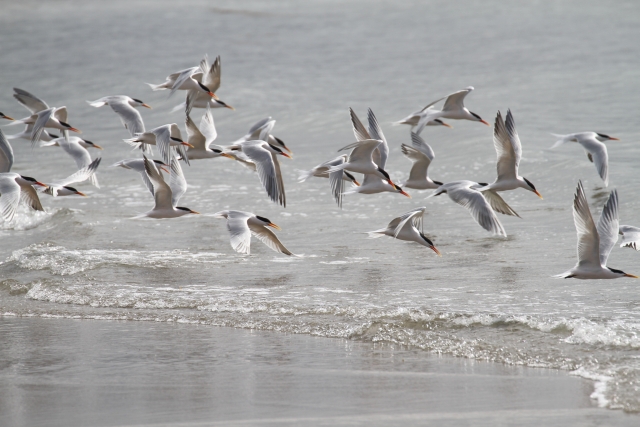
Elegant Terns flying (R. Ehler 3/23/14)
Perhaps it was the shift to daylight savings time, forcing us to arrive an hour closer to dawn, but the gulls, terns, pelicans and cormorants were on the beach and in the lagoon, unlike the last four months when most were out to sea and beyond viewing distance. This pushed our total bird count up to 51% above the running 6-year average for March (82% above the 10-year average). As is usual for this time of year, the weather was cooperative – 62-70° with little wind – and the large group of birders had a good time. Oddly enough, we saw not a single raptor, whereas we’ve had 2-6 species per visit since last October.
We’ve got another nice collection of photos from Randy Ehler in the slideshow on the blog. Randy has become a regular attendee on our lagoon walks and he always has his camera, for which I am very grateful, as I am too busy spotting birds, pointing out birds, counting birds, answering questions and moving people along to even try to take a decent photo.

Brown Pelican dodging waves (R. Ehler 3/23/14)
Birds new for the season were: Long-billed Dowitcher, Caspian Tern, Elegant Tern (135!), Anna’s Hummingbird, Western Scrub-Jay, Rough-winged & Barn Swallows, Savannah Sparrow, and Red-winged Blackbird. The hummer and the jay are both year-round residents, yet we somehow managed to miss them for the past few months. Red-wings usually hang out across the street at Legacy Park, where they’re close to the food court where they can snag fries and burger bits from unwary eaters. The Savannah Sparrows were on the beach, gleaning bugs and whatnot (a scientific term) from the high-tide wrack. The Townsend’s Warbler was gone, but the three Meadowlarks were still there, now 6-months long. May they now qualify for residency and get a green card?

Marbled Godwit admiring its own reflection (R. Ehler 3/23/14)
Our next three scheduled field trips: Wilson Canyon or Walker Ranch, 5 Apr, 8:30am; Paramount Ranch to Malibu Creek S.P. 1-way hike, 12 Mar, 8:00am; Malibu Lagoon, 27 Apr, 8:30 & 10am.
Our next program: Tuesday, 1 April, 7:30 pm. Urban Crows & predation on Least Terns: presented by Dr. Peter Auger.
NOTE: Our 10 a.m. Parent’s & Kids Birdwalk meets at the shaded viewing area.
Links: Unusual birds at Malibu Lagoon
Aerial photo of Malibu Lagoon from 9/23/02.
Prior checklists: July-Dec’11, Jan-June’11, July-Dec ’10, Jan-June ’10, Jul-Dec ‘09, and Jan-June ‘09.
NOTE: WordPress (our blogsite host) recently did one of their periodic updates, following which many things won’t work properly for a while (or ever again in some cases). If this blog looks odd, blame them (or Canada, if you prefer).
Comments on Bird Lists Below
Total Birds: March total birds of 1564 is 51% above the 6-year Mar. average of 1034; for a change many gulls and pelicans were present as were many ducks, coots, and cormorants.
Summary of total birds from the 6-year average so far: Jun’12 +36%, Jul’12 -9%, Aug’12 -9%, Sep’12 +12%, Oct’12 +3%, Nov’12 -5%, Dec’12 +30%, Jan’13 -20%, Feb’13 -29%, Mar’13 -30%, Apr’13 -34%, May’13 -37%, Jun’13 -24%, Jul’13 +83%, Aug’13 +37%, Sep’13 +23%, Oct’13 +41%, Nov’13 -58%, Dec’13 -49%, Jan’14 -62%, Feb’14 -28%, Mar’14 +51%.
Species Diversity: March 2014 with 59 species was 6% above the 6-year Mar. average of 56.
Summary of species diversity from the 6-year average so far: Jun’12 -10%, Jul’12 +10%, Aug’12. -6%, Sep’12 -20%, Oct’12 +5%, Nov’12 +2%, Dec’12 -4%, Jan’13 +2%, Feb’13 -8%, Mar’13 +9%, Apr’13 -2%, May’13 +3%, Jun’13 +13%, Jul’13 0%, Aug’13 +11%, Sep’13 -14%, Oct’13 +19%, Nov’13 -3%, Dec’13 -6%, Jan’14 -2% Feb’14 +9%, Mar’14 +6%.
10-year comparison summaries are available on our Lagoon Project Bird Census Page. [Chuck Almdale]
Note: Beginning July, we return to our pre-project bird list format, reporting the most recent 6-month period.
| Malibu Census | 2009 | 2010 | 2011 | 2012 | 2013 | 2014 | |
| March 2009-14 | 3/22 | 3/28 | 3/27 | 3/25 | 3/24 | 3/23 | |
| Temperature | 50-60 | 70-80 | 54-61 | 51-54 | 60-75 | 62-70 | |
| Tide Lo/Hi Height | H+4.8 | H+5.48 | L+0.05 | H+3.64 | H+4.90 | L+.39 | |
| Tide Time | 0728 | 0840 | 1216 | 1146 | 0806 | 1010 | Birds |
| Gadwall | 18 | 16 | 32 | 18 | 13 | 25 | 20.3 |
| American Wigeon | 4 | 14 | 3 | 31 | 8.7 | ||
| Mallard | 16 | 12 | 30 | 24 | 28 | 19 | 21.5 |
| Cinnamon Teal | 4 | 0.7 | |||||
| Northern Shoveler | 2 | 8 | 18 | 2 | 5.0 | ||
| Northern Pintail | 1 | 5 | 1.0 | ||||
| Green-winged Teal | 4 | 1 | 10 | 11 | 4 | 5.0 | |
| Lesser Scaup | 1 | 0.2 | |||||
| Surf Scoter | 10 | 18 | 8 | 5 | 6.8 | ||
| Bufflehead | 1 | 0.2 | |||||
| Red-brstd Merganser | 3 | 1 | 4 | 2 | 12 | 7 | 4.8 |
| Ruddy Duck | 11 | 15 | 20 | 55 | 23 | 20.7 | |
| Red-throated Loon | 2 | 2 | 0.7 | ||||
| Pacific Loon | 5 | 15 | 3 | 1 | 4.0 | ||
| Common Loon | 1 | 1 | 1 | 0.5 | |||
| Pied-billed Grebe | 1 | 1 | 4 | 2 | 1.3 | ||
| Horned Grebe | 1 | 0.2 | |||||
| Eared Grebe | 1 | 0.2 | |||||
| Western Grebe | 12 | 27 | 20 | 1 | 22 | 13.7 | |
| Blk-vented Shearwater | many | 0.2 | |||||
| Brandt’s Cormorant | 2 | 1 | 1 | 1 | 0.8 | ||
| Dble-crstd Cormorant | 36 | 42 | 90 | 30 | 15 | 45 | 43.0 |
| Pelagic Cormorant | 1 | 1 | 1 | 0.5 | |||
| Brown Pelican | 170 | 184 | 89 | 40 | 35 | 390 | 151 |
| Great Blue Heron | 1 | 2 | 1 | 1 | 2 | 1.2 | |
| Great Egret | 2 | 1 | 1 | 1 | 2 | 1.2 | |
| Snowy Egret | 10 | 7 | 5 | 12 | 5 | 8 | 7.8 |
| Green Heron | 1 | 0.2 | |||||
| Blk-crwnd N-Heron | 1 | 0.2 | |||||
| Turkey Vulture | 3 | 2 | 0.8 | ||||
| Osprey | 1 | 0.2 | |||||
| Cooper’s Hawk | 1 | 0.2 | |||||
| Red-shouldered Hawk | 1 | 1 | 0.3 | ||||
| Red-tailed Hawk | 2 | 2 | 2 | 1 | 1.2 | ||
| Merlin | 1 | 0.2 | |||||
| Virginia Rail | 1 | 0.2 | |||||
| Sora | 1 | 1 | 4 | 1.0 | |||
| American Coot | 85 | 92 | 153 | 20 | 170 | 104 | 104 |
| Blk-bellied Plover | 24 | 25 | 7 | 3 | 9.8 | ||
| Snowy Plover | 36 | 25 | 42 | 14 | 33 | 5 | 25.8 |
| Killdeer | 3 | 1 | 2 | 2 | 6 | 2.3 | |
| Black Oystercatcher | 2 | 2 | 0.7 | ||||
| American Avocet | 7 | 1.2 | |||||
| Spotted Sandpiper | 1 | 1 | 1 | 1 | 1 | 1 | 1.0 |
| Greater Yellowlegs | 1 | 0.2 | |||||
| Willet | 4 | 4 | 3 | 3 | 16 | 4 | 5.7 |
| Whimbrel | 3 | 1 | 18 | 28 | 5 | 9.2 | |
| Marbled Godwit | 12 | 2 | 12 | 4 | 5.0 | ||
| Ruddy Turnstone | 12 | 2 | 2.3 | ||||
| Sanderling | 6 | 1.0 | |||||
| Western Sandpiper | 15 | 2 | 2.8 | ||||
| Least Sandpiper | 2 | 14 | 20 | 20 | 9.3 | ||
| Long-billed Dowitcher | 5 | 0.8 | |||||
| Boneparte’s Gull | 2 | 4 | 1.0 | ||||
| Heermann’s Gull | 4 | 4 | 155 | 27.2 | |||
| Ring-billed Gull | 25 | 2 | 50 | 8 | 25 | 18 | 21.3 |
| Western Gull | 70 | 48 | 100 | 30 | 35 | 190 | 78.8 |
| California Gull | 180 | 27 | 1100 | 12 | 30 | 135 | 247 |
| Herring Gull | 1 | 0.2 | |||||
| Glaucous-wingd Gull | 11 | 1 | 1 | 1 | 2.3 | ||
| Caspian Tern | 1 | 2 | 5 | 3 | 1 | 2.0 | |
| Forster’s Tern | 1 | 0.2 | |||||
| Royal Tern | 3 | 8 | 1.8 | ||||
| Elegant Tern | 22 | 47 | 4 | 2 | 135 | 35.0 | |
| Black Skimmer | 3 | 0.5 | |||||
| Rock Pigeon | 4 | 4 | 2 | 25 | 4 | 6.5 | |
| Mourning Dove | 2 | 2 | 0.7 | ||||
| Blk-hooded Parakeet | 4 | 0.7 | |||||
| Anna’s Hummingbird | 2 | 3 | 2 | 1 | 1 | 1.5 | |
| Rufous Hummingbird | 1 | 0.2 | |||||
| Allen’s Hummingbird | 2 | 3 | 4 | 5 | 4 | 3.0 | |
| Belted Kingfisher | 1 | 1 | 1 | 0.5 | |||
| Black Phoebe | 6 | 6 | 12 | 5 | 8 | 6.2 | |
| Say’s Phoebe | 1 | 1 | 0.3 | ||||
| Cassin’s Kingbird | 1 | 0.2 | |||||
| Western Kingbird | 2 | 2 | 16 | 3.3 | |||
| Western Scrub-Jay | 1 | 1 | 1 | 0.5 | |||
| American Crow | 6 | 4 | 6 | 3 | 8 | 6 | 5.5 |
| Rough-wingd Swallow | 30 | 3 | 2 | 6 | 12 | 20 | 12.2 |
| Tree Swallow | 8 | 1.3 | |||||
| Barn Swallow | 1 | 1 | 12 | 2.3 | |||
| Oak Titmouse | 1 | 0.2 | |||||
| Bushtit | 4 | 4 | 4 | 5 | 6 | 3.8 | |
| Bewick’s Wren | 1 | 1 | 1 | 0.5 | |||
| Northern Mockingbird | 2 | 2 | 1 | 2 | 7 | 2.3 | |
| European Starling | 20 | 8 | 16 | 15 | 9.8 | ||
| Ornge-crwnd Warbler | 7 | 1.2 | |||||
| Yellow-rumpd Warbler | 2 | 5 | 8 | 1 | 18 | 5.7 | |
| Common Yellowthroat | 2 | 1 | 3 | 1 | 4 | 1.8 | |
| Spotted Towhee | 1 | 0.2 | |||||
| California Towhee | 2 | 1 | 2 | 3 | 1.3 | ||
| Savannah Sparrow | 5 | 7 | 2.0 | ||||
| Song Sparrow | 6 | 8 | 12 | 13 | 8 | 14 | 10.2 |
| White-crwnd Sparrow | 3 | 5 | 2 | 1.7 | |||
| Red-winged Blackbird | 2 | 6 | 2 | 12 | 3.7 | ||
| Western Meadowlark | 3 | 0.5 | |||||
| Brewer’s Blackbird | 1 | 0.2 | |||||
| Great-tailed Grackle | 7 | 4 | 1.8 | ||||
| Brwn-headed Cowbird | 2 | 3 | 0.8 | ||||
| House Finch | 4 | 6 | 20 | 19 | 2 | 11 | 10.3 |
| Lesser Goldfinch | 3 | 4 | 4 | 28 | 6.5 | ||
| Totals by Type | 3/22 | 3/28 | 3/27 | 3/25 | 3/24 | 3/23 | |
| Waterfowl | 74 | 70 | 99 | 101 | 115 | 110 | 95 |
| Water Birds-Other | 307 | 354 | 376 | 91 | 234 | 566 | 321 |
| Herons, Egrets | 11 | 12 | 7 | 14 | 7 | 12 | 11 |
| Raptors | 3 | 2 | 6 | 0 | 6 | 0 | 3 |
| Shorebirds | 113 | 87 | 71 | 65 | 92 | 35 | 77 |
| Gulls & Terns | 313 | 133 | 1270 | 53 | 94 | 643 | 418 |
| Doves | 4 | 6 | 4 | 0 | 25 | 4 | 7 |
| Other Non-Pass. | 5 | 6 | 8 | 0 | 11 | 5 | 6 |
| Passerines | 91 | 53 | 94 | 62 | 89 | 189 | 96 |
| Totals Birds | 921 | 723 | 1935 | 386 | 673 | 1564 | 1034 |
| 2009 | 2010 | 2011 | 2012 | 2013 | 2014 | ||
| Total Species | 3/22 | 3/28 | 3/27 | 3/25 | 3/24 | 3/23 | |
| Waterfowl | 11 | 7 | 6 | 8 | 6 | 7 | 7.5 |
| Water Birds-Other | 7 | 8 | 11 | 4 | 11 | 9 | 8.3 |
| Herons, Egrets | 2 | 4 | 3 | 3 | 3 | 3 | 3.0 |
| Raptors | 2 | 1 | 3 | 0 | 5 | 0 | 1.8 |
| Shorebirds | 12 | 9 | 7 | 7 | 6 | 9 | 8.3 |
| Gulls & Terns | 7 | 8 | 9 | 4 | 6 | 8 | 7.0 |
| Doves | 1 | 2 | 2 | 0 | 1 | 1 | 1.2 |
| Other Non-Pass. | 3 | 2 | 4 | 0 | 4 | 2 | 2.5 |
| Passerines | 15 | 14 | 18 | 9 | 19 | 20 | 15.8 |
| Totals Species – 101 |
60 | 55 | 63 | 35 | 61 | 59 | 56 |



 SANTA MONICA BAY AUDUBON SOCIETY BLOG