Free email delivery
Please sign up for email delivery in the subscription area to the right.
No salesman will call, at least not from us. Maybe from someone else.
Malibu Lagoon Trip Report: 23 February, 2014
At the start of these bird walks, I always tell everyone to ask whatever questions they like. So, of course, I was immediately hit with what – in my book – is unanswerable: “What unusual birds might we see today?” “Well,” I think to myself, “if it’s unusual, how can I know in advance what it’ll be? Kiwi, Andean Cock-of-the Rock, Wandering Albatross – those would certainly be unusual, although not likely.” I may have replied, “Wait and see,” or perhaps the ever-truthful, “I don’t know.” Life is mysterious: wonders and surprises abound.

Peregrine Falcon on PCH light pole (L. Johnson 2/23/14)
Unusual, certainly, were the six species of raptors which appeared, especially the great show put on by the Peregrine Falcon who flew around and perched in several locations so close to us it seemed to be demanding that attention must be paid. The gulls, ducks and shorebirds, while less admiring than were we, certainly paid attention.
The Peregrine was first spotted perched far off in a tree in Malibu Colony. It then flew by us, under the PCH bridge, and up onto a light pole.

Peregrine Falcon (R. Ehler 2/23/14)
Then back and around to perch in a tree over the path to the beach.

Peregrine Falcon (R. Ehler 2/23/14)
DNA analysis recently revealed that the Falcons are far more closely related to Passerines (crows, sparrows, etc.)

Peregrine Falcon with harassing crow (R. Ehler 2/23/14)
than to the Hawks & Eagles, and the order of Falcons (along with the Parrots who were found to be the Falcons’ closest kin), were relocated between the Woodpeckers and the Passerines. For now. Who knows what the next round of DNA analysis might reveal – perhaps hummingbirds and swifts really are insects as some fool claimed last April Fool’s Day. But I still consider falcons to be ‘raptors’: today we had 2 Osprey and one each of Red-shouldered & Red-tailed Hawk, American Kestrel, Merlin and Peregrine Falcon.

One of the two Ospreys (R. Ehler 2/23/14)
When we first arrived, and as in previous months, we saw many gulls on the east end of the beach, but by the time we’d gotten there, most had flown off to feed far out on the ocean. Although fog was thin, it was heavy enough to obscure the horizon, rendering the far-off flock difficult to see. It might have contained pelicans and terns; we couldn’t be sure.
It’s surprising (and unusual) how some birds have hung on at the lagoon this winter: an Orange-crowned Warbler has (intermittently) been seen since last August, an even-more-uncommon Townsend’s Warbler since October, and 3 (or more) Western Meadowlarks, also since October. The warblers prefer the foliage and the swale along the back of the Malibu Colony houses. The meadowlarks prefer sandy areas with sparse vegetation; when they get onto the sand islands, they’re nearly impossible to see. This month’s Hermit Thrush was in the brush fringing the parking lot, rather than by the colony wall as were last month’s duo.
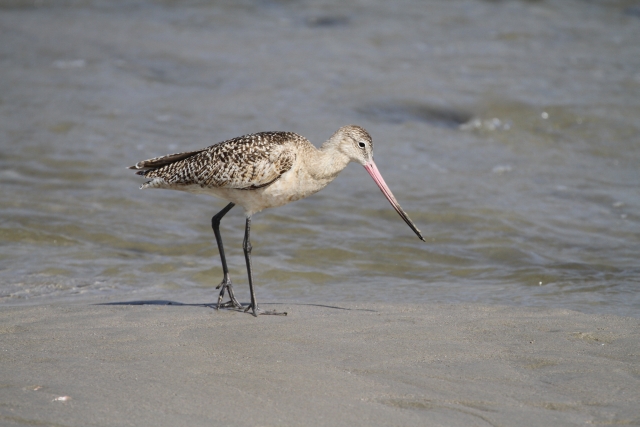
Marbled Godwit at lagoon outlet (R. Ehler 2/23/14)
Birds new for the season were: Surf Scoter, American Kestrel (usually found at Legacy Park), Black Oystercatcher (unusual and irregular lagoon visitors), Eurasian Collared Dove, and Tree Swallow.

Black Oystercatchers with Malibu Pier in background (R. Ehler 2/23/14)
Our next three scheduled field trips: Hiker Lu’s Santa Monica Mountains adventure, 8 Mar, 8:30am; Malibu Lagoon, 23 Mar, 8:30 & 10am; Wilson Canyon or Walker Ranch, 5 Apr, 8:30am.
Our next program: Tuesday, 4 Mar., 7:30 pm. Antarctica:, presented by Chuck & Alice Bragg.
NOTE: Our 10 a.m. Parent’s & Kids Birdwalk meets at the shaded viewing area.
Links: Unusual birds at Malibu Lagoon
Aerial photo of Malibu Lagoon from 9/23/02.
Prior checklists: July-Dec’11, Jan-June’11, July-Dec ’10, Jan-June ’10, Jul-Dec ‘09, and Jan-June ‘09.
Comments on Bird Lists Below
Total Birds: February total birds of 1139 is 28% below the 6-year Feb. average of 1585, due primarily to the departure of gulls before they were counted.
Summary of total birds from the 6-year average so far: Jun’12 +36%, Jul’12 -9%, Aug’12 -9%, Sep’12 +12%, Oct’12 +3%, Nov’12 -5%, Dec’12 +30%, Jan’13 -20%, Feb’13 -29%, Mar’13 -30%, Apr’13 -34%, May’13 -37%, Jun’13 -24%, Jul’13 +83%, Aug’13 +37%, Sep’13 +23%, Oct’13 +41%, Nov’13 -58%, Dec’13 -49%, Jan’14 -62%, Feb’14 -28%.
Species Diversity: February 2014 with 66 species was 10% above the 6-year Feb. average of 60.
Summary of species diversity from the 6-year average so far: Jun’12 -10%, Jul’12 +10%, Aug’12. -6%, Sep’12 -20%, Oct’12 +5%, Nov’12 +2%, Dec’12 -4%, Jan’13 +2%, Feb’13 -8%, Mar’13 +9%, Apr’13 -2%, May’13 +3%, Jun’13 +13%, Jul’13 0%, Aug’13 +11%, Sep’13 -14%, Oct’13 +19%, Nov’13 -3%, Dec’13 -6%, Jan’14 -2%, Feb’14 +10%.
10-year comparison summaries are available on our Lagoon Project Bird Census Page. [Chuck Almdale]
| Malibu Census | 2009 | 2010 | 2011 | 2012 | 2013 | 2014 | |
| February 2009-14 | 2/22 | 2/28 | 2/27 | 2/26 | 2/24 | 2/23 | |
| Temperature | 60-70 | 55-61 | 45-60 | 48-64 | 55-65 | 60-65 | |
| Tide Lo/Hi Height | H+5.5 | H+6.19 | L-0.41 | H+3.37 | H+5.50 | L+0.31 | Ave. |
| Tide Time | 0728 | 0835 | 1243 | 1136 | 0802 | 1104 | Birds |
| Snow Goose | 1 | 0.2 | |||||
| Brant | 15 | 2.5 | |||||
| Canada Goose | 6 | 1.0 | |||||
| Gadwall | 18 | 35 | 22 | 35 | 13 | 30 | 25.5 |
| American Wigeon | 16 | 4 | 8 | 20 | 8.0 | ||
| Mallard | 20 | 13 | 24 | 30 | 14 | 18 | 19.8 |
| Cinnamon Teal | 5 | 0.8 | |||||
| Northern Shoveler | 28 | 2 | 35 | 22 | 25 | 18.7 | |
| Northern Pintail | 8 | 2 | 1.7 | ||||
| Green-winged Teal | 23 | 2 | 17 | 38 | 1 | 12 | 15.5 |
| Surf Scoter | 6 | 4 | 8 | 40 | 3 | 10.2 | |
| Bufflehead | 8 | 2 | 4 | 14 | 8 | 6.0 | |
| Common Merganser | 6 | 1.0 | |||||
| Red-brstd Merganser | 5 | 5 | 8 | 8 | 3 | 6 | 5.8 |
| Ruddy Duck | 12 | 14 | 33 | 24 | 41 | 70 | 32.3 |
| Red-throated Loon | 1 | 2 | 0.5 | ||||
| Pacific Loon | 2 | 1 | 1 | 3 | 2 | 1 | 1.7 |
| Common Loon | 1 | 1 | 0.3 | ||||
| Pied-billed Grebe | 1 | 2 | 2 | 2 | 4 | 1.8 | |
| Horned Grebe | 1 | 3 | 0.7 | ||||
| Eared Grebe | 2 | 3 | 0.8 | ||||
| Western Grebe | 9 | 6 | 12 | 40 | 2 | 11.5 | |
| Brandt’s Cormorant | 3 | 2 | 15 | 4 | 4.0 | ||
| Dble-crstd Cormorant | 25 | 21 | 37 | 28 | 40 | 33 | 30.7 |
| Pelagic Cormorant | 2 | 1 | 3 | 2 | 1.3 | ||
| Brown Pelican | 107 | 81 | 23 | 12 | 10 | 5 | 39.7 |
| Great Blue Heron | 1 | 1 | 2 | 0.7 | |||
| Great Egret | 4 | 3 | 1 | 2 | 1 | 4 | 2.5 |
| Snowy Egret | 10 | 4 | 9 | 8 | 1 | 8 | 6.7 |
| Blk-crwnd N-Heron | 1 | 0.2 | |||||
| Turkey Vulture | 1 | 1 | 0.3 | ||||
| Osprey | 2 | 0.3 | |||||
| Red-shouldered Hawk | 2 | 1 | 0.5 | ||||
| Red-tailed Hawk | 1 | 3 | 2 | 1 | 1.2 | ||
| American Kestrel | 1 | 0.2 | |||||
| Merlin | 1 | 0.2 | |||||
| Peregrine Falcon | 1 | 0.2 | |||||
| Virginia Rail | 1 | 0.2 | |||||
| Sora | 2 | 1 | 3 | 3 | 1.5 | ||
| American Coot | 152 | 175 | 175 | 285 | 82 | 210 | 180 |
| Blk-bellied Plover | 42 | 59 | 65 | 93 | 50 | 93 | 67.0 |
| Snowy Plover | 49 | 49 | 59 | 54 | 36 | 24 | 45.2 |
| Semipalmated Plover | 1 | 0.2 | |||||
| Killdeer | 1 | 4 | 10 | 1 | 6 | 3.7 | |
| Black Oystercatcher | 1 | 2 | 2 | 0.8 | |||
| American Avocet | 2 | 2 | 1 | 0.8 | |||
| Spotted Sandpiper | 3 | 2 | 2 | 1 | 2 | 1.7 | |
| Willet | 8 | 15 | 7 | 2 | 1 | 5 | 6.3 |
| Whimbrel | 2 | 5 | 2 | 3 | 2.0 | ||
| Marbled Godwit | 24 | 17 | 2 | 3 | 7.7 | ||
| Ruddy Turnstone | 9 | 11 | 5 | 13 | 6.3 | ||
| Sanderling | 130 | 172 | 135 | 100 | 170 | 140 | 141 |
| Least Sandpiper | 4 | 18 | 3.7 | ||||
| Boneparte’s Gull | 13 | 1 | 2.3 | ||||
| Heermann’s Gull | 19 | 7 | 3 | 4.8 | |||
| Mew Gull | 1 | 0.2 | |||||
| Ring-billed Gull | 20 | 42 | 250 | 35 | 120 | 35 | 83.7 |
| Western Gull | 125 | 74 | 120 | 55 | 40 | 70 | 80.7 |
| California Gull | 1360 | 45 | 1050 | 360 | 280 | 110 | 534 |
| Herring Gull | 1 | 0.2 | |||||
| Glaucous-wingd Gull | 12 | 3 | 3 | 2 | 2 | 3.7 | |
| Forster’s Tern | 1 | 0.2 | |||||
| Royal Tern | 8 | 32 | 1 | 3 | 6 | 8.3 | |
| Elegant Tern | 1 | 0.2 | |||||
| Black Skimmer | 5 | 3 | 1.3 | ||||
| Rock Pigeon | 6 | 4 | 4 | 4 | 1 | 4 | 3.8 |
| Eur. Collared-Dove | 1 | 0.2 | |||||
| Mourning Dove | 2 | 2 | 0.7 | ||||
| Anna’s Hummingbird | 2 | 3 | 2 | 2 | 1 | 1.7 | |
| Allen’s Hummingbird | 3 | 3 | 3 | 1 | 3 | 4 | 2.8 |
| Belted Kingfisher | 1 | 1 | 1 | 0.5 | |||
| Downy Woodpecker | 1 | 0.2 | |||||
| Black Phoebe | 4 | 5 | 5 | 4 | 6 | 4.0 | |
| Say’s Phoebe | 1 | 1 | 3 | 0.8 | |||
| Cassin’s Kingbird | 2 | 1 | 0.5 | ||||
| American Crow | 6 | 4 | 4 | 8 | 7 | 4 | 5.5 |
| Common Raven | 1 | 0.2 | |||||
| Rough-wingd Swallow | 20 | 1 | 2 | 3.8 | |||
| Tree Swallow | 180 | 10 | 1 | 31.8 | |||
| Barn Swallow | 3 | 0.5 | |||||
| Cliff Swallow | 1 | 12 | 2.2 | ||||
| Bushtit | 16 | 5 | 6 | 4 | 10 | 2 | 7.2 |
| Bewick’s Wren | 1 | 2 | 0.5 | ||||
| Marsh Wren | 1 | 1 | 0.3 | ||||
| Ruby-crowned Kinglet | 2 | 2 | 0.7 | ||||
| Hermit Thrush | 1 | 1 | 0.3 | ||||
| Northern Mockingbird | 1 | 3 | 2 | 2 | 2 | 2 | 2.0 |
| European Starling | 12 | 41 | 35 | 15 | 52 | 35 | 31.7 |
| Ornge-crwnd Warbler | 1 | 1 | 0.3 | ||||
| Yellow-rumpd Warbler | 10 | 4 | 2 | 2 | 28 | 7.7 | |
| Townsend’s Warbler | 1 | 0.2 | |||||
| Common Yellowthroat | 2 | 1 | 2 | 2 | 5 | 2.0 | |
| Spotted Towhee | 1 | 1 | 0.3 | ||||
| California Towhee | 1 | 1 | 2 | 1 | 0.8 | ||
| Savannah Sparrow | 2 | 0.3 | |||||
| Song Sparrow | 5 | 6 | 8 | 8 | 2 | 18 | 7.8 |
| White-crwnd Sparrow | 3 | 4 | 4 | 4 | 15 | 5.0 | |
| Red-winged Blackbird | 4 | 15 | 3.2 | ||||
| Western Meadowlark | 1 | 3 | 0.7 | ||||
| Brewer’s Blackbird | 1 | 0.2 | |||||
| Great-tailed Grackle | 2 | 8 | 5 | 3 | 3.0 | ||
| Brwn-headed Cowbird | 2 | 0.3 | |||||
| House Finch | 6 | 3 | 3 | 10 | 3 | 8 | 5.5 |
| Lesser Goldfinch | 4 | 2 | 12 | 3.0 | |||
| Totals by Type | 2/22 | 2/28 | 2/27 | 2/26 | 2/24 | 2/23 | Ave. |
| Waterfowl | 141 | 73 | 126 | 231 | 131 | 192 | 149 |
| Water Birds-Other | 305 | 289 | 257 | 395 | 142 | 259 | 275 |
| Herons, Egrets | 14 | 7 | 12 | 10 | 3 | 14 | 10 |
| Raptors | 2 | 3 | 0 | 2 | 3 | 7 | 3 |
| Shorebirds | 274 | 328 | 301 | 278 | 260 | 278 | 287 |
| Gulls & Terns | 1545 | 209 | 1440 | 455 | 445 | 224 | 720 |
| Doves | 8 | 4 | 4 | 6 | 1 | 5 | 5 |
| Other Non-Pass. | 6 | 6 | 6 | 4 | 5 | 4 | 5 |
| Passerines | 269 | 81 | 81 | 93 | 114 | 156 | 132 |
| Totals Birds | 2564 | 1000 | 2227 | 1474 | 1104 | 1139 | 1585 |
| 2009 | 2010 | 2011 | 2012 | 2013 | 2014 | ||
| Total Species | 2/22 | 2/28 | 2/27 | 2/26 | 2/24 | 2/23 | Ave. |
| Waterfowl | 10 | 6 | 10 | 11 | 10 | 9 | 9.3 |
| Water Birds-Other | 11 | 9 | 9 | 12 | 7 | 7 | 9.2 |
| Herons, Egrets | 2 | 2 | 4 | 2 | 3 | 3 | 2.7 |
| Raptors | 2 | 1 | 0 | 1 | 2 | 6 | 2.0 |
| Shorebirds | 11 | 9 | 10 | 10 | 6 | 9 | 9.2 |
| Gulls & Terns | 7 | 8 | 7 | 7 | 5 | 5 | 6.7 |
| Doves | 2 | 1 | 1 | 2 | 1 | 2 | 1.5 |
| Other Non-Pass. | 3 | 2 | 3 | 3 | 3 | 1 | 2.5 |
| Passerines | 15 | 15 | 15 | 19 | 15 | 23 | 17.0 |
| Totals Species – 104 | 63 | 53 | 59 | 67 | 52 | 65 | 60 |
San Jacinto Wildlife Area Trip Report: 15 February, 2014
It’s been at least five years since we last visited San Jacinto Wildlife Area. It hasn’t changed much, except that previously the dirt roads were often very muddy and difficult to drive. You remember – that was waaay back in the old, old days when winters were wet.
We saw loads of birds: flocks of ducks or gulls rising into the sky, squadrons of White Pelicans, Long-billed Curlews or White-faced Ibis cruising by; power lines festooned with swallows, hawks and falcons sitting on seemingly every tree snag or stony outcropping. An avian abundance.
We started well by quickly locating the female Black-throated Blue Warbler reported to be in the trees across the road from the gate. It looked much like a dingy Orange-crowned Warbler, but with a white vent, noticeable white facial markings and prominent square white mark in the folded wing. After that we went looking for an unlocked bathroom which we were not able to find.
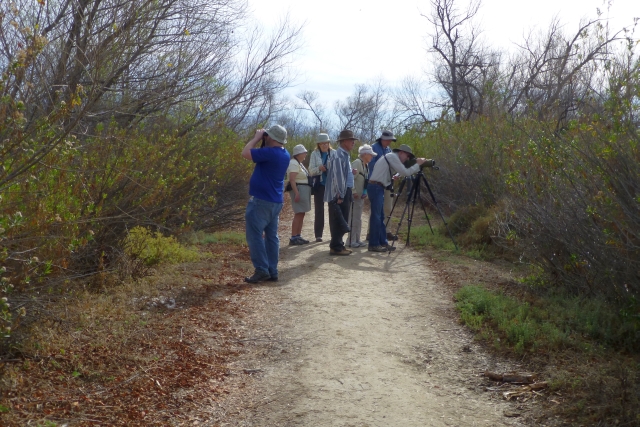
On the trail (L. Johnson 2/15/14)
We did a lot of “sorting out” of ducks, and raptors, and swallows, while keeping our eyes peeled for the occasional oddity, such as the Prairie Falcon perched high on a rocky hillside, or the Redhead, Cinnamon Teal or Lesser Scaup lurking among the hordes of Northern Shovelers, Northern Pintails, Ruddy Ducks and American Coots. At one point an Osprey flew by carrying a fish in its talons – one foot ahead of the other – fish head first, in the traditional Osprey style.
A Burrowing Owl hiding in a hole in the side of a crevice and behind a bush gave us a bit of trouble as for a long time only one person could see it and the rest of us were beginning to wonder…
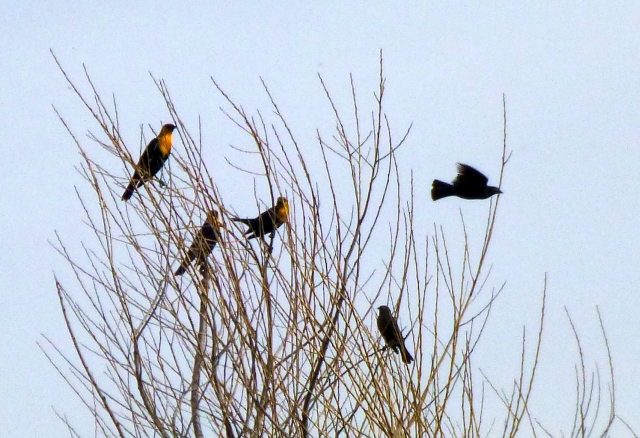
Yellow-headed Blackbirds (L. Johnson 2/15/14)
At the end, just before leaving, a single Vesper Sparrow – never a particularly common bird – flew from where it was lurking in a leafy tree down to the ground, close to where we were clambering into our cars – it was difficult to see both eyering and chestnut shoulder patch, but they were there.
Wonderful weather, fine companions, great birds, timely lunch – it was, all in all, a very enjoyable day. [Chuck Almdale]
Key to Trip List
A = 1-10 B = 11-50 C = 51-100 D = 101-500
E = 500+ 1 = actual no. h = heard only
| San Jacinto Wildlife Area | Trip List 2/15/14 | ||
| Canada Goose | C | California Gull | E |
| Gadwall | D | Herring Gull | A |
| American Wigeon | B | Burrowing Owl | 1 |
| Mallard | C | Anna’s Hummingbird | A |
| Cinnamon Teal | B | Nuttall’s Woodpecker | 1 |
| Northern Shoveler | E | Northern Flicker | Ah |
| Northern Pintail | E | American Kestrel | B |
| Green-winged Teal | C | Prairie Falcon | 1 |
| Redhead | A | Black Phoebe | B |
| Ring-necked Duck | A | Say’s Phoebe | B |
| Lesser Scaup | A | Cassin’s Kingbird | 1 |
| Bufflehead | B | Loggerhead Shrike | A |
| Ruddy Duck | D | Common Raven | B |
| Eared Grebe | A | Tree Swallow | D |
| Double-crested Cormorant | B | No. Rough-winged Swallow | C |
| American White Pelican | B | Barn Swallow | D |
| Great Blue Heron | A | Marsh Wren | Bh |
| Great Egret | B | Ruby-crowned Kinglet | A |
| Snowy Egret | B | Mountain Bluebird | B |
| White-faced Ibis | C | Northern Mockingbird | A |
| Osprey | A | American Pipit | B |
| Northern Harrier | B | Common Yellowthroat | A |
| Red-shouldered Hawk | B | Black-throated Blue Warbler | 1 |
| Red-tailed Hawk | C | Yellow-rumped Warbler | B |
| Rough-legged Hawk | 1 | California Towhee | A |
| Sora | 1 | Brewer’s Sparrow | A |
| American Coot | E | Vesper Sparrow | 1 |
| Killdeer | B | Savannah Sparrow | B |
| Black-necked Stilt | B | Song Sparrow | B |
| American Avocet | B | White-crowned Sparrow | B |
| Spotted Sandpiper | 1 | Red-winged Blackbird | B |
| Greater Yellowlegs | B | Western Meadowlark | A |
| Lesser Yellowlegs | 1 | Yellow-headed Blackbird | B |
| Long-billed Curlew | A | Brewer’s Blackbird | B |
| Long-billed Dowitcher | B | Great-tailed Grackle | A |
| Bonaparte’s Gull | D | House Finch | B |
| Ring-billed Gull | E | Lesser Goldfinch | A |
| Total Species | 74 |
Full Snow Moon Update for 14 February, 2014, 3:53 PM PST
Here’s another update from SMBAS Blog on that large, disc-shaped, shining object which has frequently and mysteriously appeared in our nighttime sky this year (known to many as the moon).

Moonrise over Refuge (T. Hinnebusch 2/14/14)
Feb. 14, 3:53 p.m. PST — Full Snow Moon. Usually the heaviest snowfalls occur during this month. Hunting becomes very difficult, and so to some tribes, this was the Full Hunger Moon. Storm Moon, Hunger Moon, Little Famine Moon, and Full Bony Moon are other traditional names for February’s full moon. [Infographic: Moon Phases & Lunar Cycles]
Note: Pacific Daylight Time starts on March 9, 2014 at 2 AM (becoming 3 AM) and ends November 2, 2014 at 2 AM (becoming 1 AM).
The next significant full moon will occur on 16 March 10:09 a.m. Keep an eye on this spot for additional late-breaking news on this unprecedented event.
This information comes to you courtesy of: http://www.space.com/24262-weird-full-moon-names-2014-explained.html
written by Joe Rao. Joe Rao serves as an instructor and guest lecturer at New York’s Hayden Planetarium. He writes about astronomy for Natural History magazine, the Farmer’s Almanac and other publications, and he is also an on-camera meteorologist for News 12 Westchester, N.Y.
But that’s waaay too long to type in, and besides, you don’t need to go there because SMBAS has done the work for you! [Chuck Almdale]
Snowbirds of Santa Monica
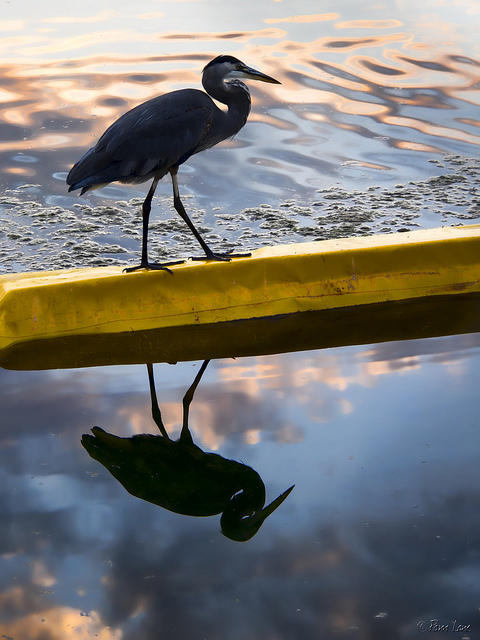
Great Blue Heron on turbidity curtain
(Pam Lane – Flickr)
Deep in the heart of winter, January is a time when many casual birders around the country shelve their binoculars and head indoors for the season. In Santa Monica, however, there is no need. Mild weather means flocks of birds. And flocks of birds mean flocks of snowbirds—of both the resident Californian and migratory breeds—will take to the mountains and coastlines to get a jump start on their annual species lists.
It’s no secret that the Santa Monica Mountains and surrounding region are a haven for our feathered friends. The Mediterranean climate supports more than 380 species year-round. This represents nearly 50 percent of the North American total. And during the colder months, birders can expect to see plenty of stopovers that have settled in Santa Monica where the food supply is ample.

Snowy Plovers (Chuq Van Rospach – Flickr)
Among the gulls and terns that frequent the shore, expect to see Snowy Plovers darting across the sand. The Pacific Coast’s population of these miniature plovers are designated a Threatened Species under the Endangered Species Act. Other notables to watch for are Peregrine Falcons and the increasingly rare Black-vented Shearwater. Elegant Snowy Egrets have been spotted at Malibu Lagoon as recently as late December. While the showy Surf Scoter was absent during the last lagoon survey, it is worth keeping an eye out for them bobbing on the water’s surface. Newcomers to the coast include the Northern Pintail, Western Sandpiper, and Savannah Sparrow.
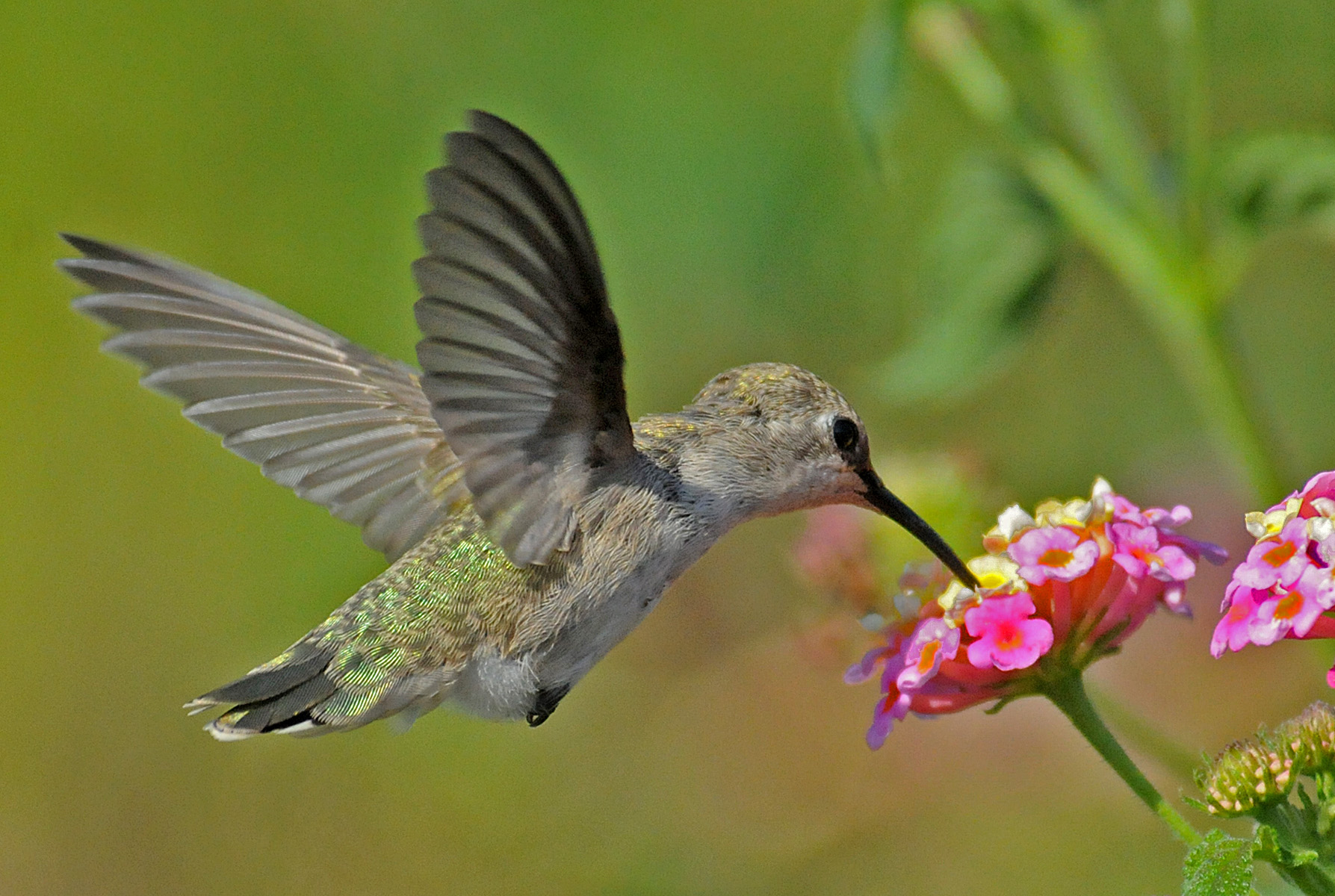
Anna’s Hummingbird female (Jim Kenney 8/14/12)
Birders who stick to drier ground, visiting the inland grasslands and mountain ranges, stand a good chance of spotting Ferruginous Hawks, Anna’s Hummingbirds, and Western Bluebirds like fallen pieces of sky. This time of year, the Salton Sea merits a day trip. It boasts every manner of waterfowl and crowds of Sandhill Cranes heralding the day as though with trumpets.
This year, beat the wintertime blues and start your year off right. Get out and explore Santa Monica’s diverse ecosystems and the truly inspiring array of avian species that make their homes there. [Ernie Allison]
The author is a bird watcher with a love of life and nature, passionate about both writing and wildlife conservation. He writes both for pleasure and profit, currently for Bird Feeders.
Bobcats and Lynxes
Bobcat & Lynx facts:
The Middle English name “Lynx” – meaning “light” or “brightness,” in reference to its eyeshine – came from Latin, previously from Greek and originally from Indo-European. There are four species in the Lynx genus:
Eurasian Lynx: Lynx lynx, the most numerous and widespread, found throughout Western Europe and Northern Asia. Weight 40-66 lbs, 32-51″ long & 28″ high.
Iberian Lynx: Lynx pardinus, the rarest, found only in Spain and Portugal. They weigh 21-28 lbs, are 33-43″ long & 24-28″ high.
Canadian Lynx: Lynx canadensis, found in Canada and a few northern U.S. states including Maine, Minnesota, Montana, Wyoming and Washington. They weigh 17.6-24.3 lbs, are 31-41″ long & 19-22″ high.
Bobcat: Lynx rufus, which dominates the North American continent. It tolerates a varied habitat — from marshes and swampy areas in the southern part of the continent, to desert and scrub in the western regions to mountainous, forested areas in the north. The Canadian Lynx prefers forested areas since that’s where its main source of food, the Snowshoe Hare, lives. The only area where the Canadian lynx and bobcat coexist is along the U.S.-Canada border. Bobcats weigh 16-31 lbs, are 28-39″ long & 20-24″ high.
Telling them apart in North America: They are roughly the same size with short (“bobbed”) tails, but the Bobcat seems to have more of an attitude. Canadian Lynx has extra-long tufts on its ear-tips, a shaggy mane of cheek fur, and bigger feet and longer legs adapted to deep snowy habitats. Bobcats look much like an overgrown feral housecat. Both sound much like a crying baby.
When you “whip your weight in wildcats,” it’s Bobcats you’re talking about. Good luck with that, and be sure to notify your next of kin beforehand.
Now that you know there’s a difference, and what it is, here’s a film of two Lynx conversing at night. It takes a while before you can see the dark eartufts on both of them. The above information was cribbed from Wikipedia and HowStuffWorks.
Links to articles about bobcat trapping near Joshua Tree National Park:
Here Kitty Kitty…Bobcat Trapping Endangers Desert Wildlife – SunRunner Dec’12
Bad Science, Dead Bobcats – SunRunner Feb’13
Bobcat Protection Act Passes California State Assembly – SunRunner May’14
[This article was originally part of a program announcement about urban bobcats, but is now re-purposed into a stand-alone piece.]
[Chuck Almdale]



 SANTA MONICA BAY AUDUBON SOCIETY BLOG