Free email delivery
Please sign up for email delivery in the subscription area to the right.
No salesman will call, at least not from us. Maybe from someone else.
Nothing like “home”
The Santa Monica Beach Maintenance crew erected the Snowy Plover fencing early this year, before the end of July, and it seems that the plovers are just as grateful as we plover-watchers at SMBAS. Previously the fencing has been postponed to well after Labor Day. 
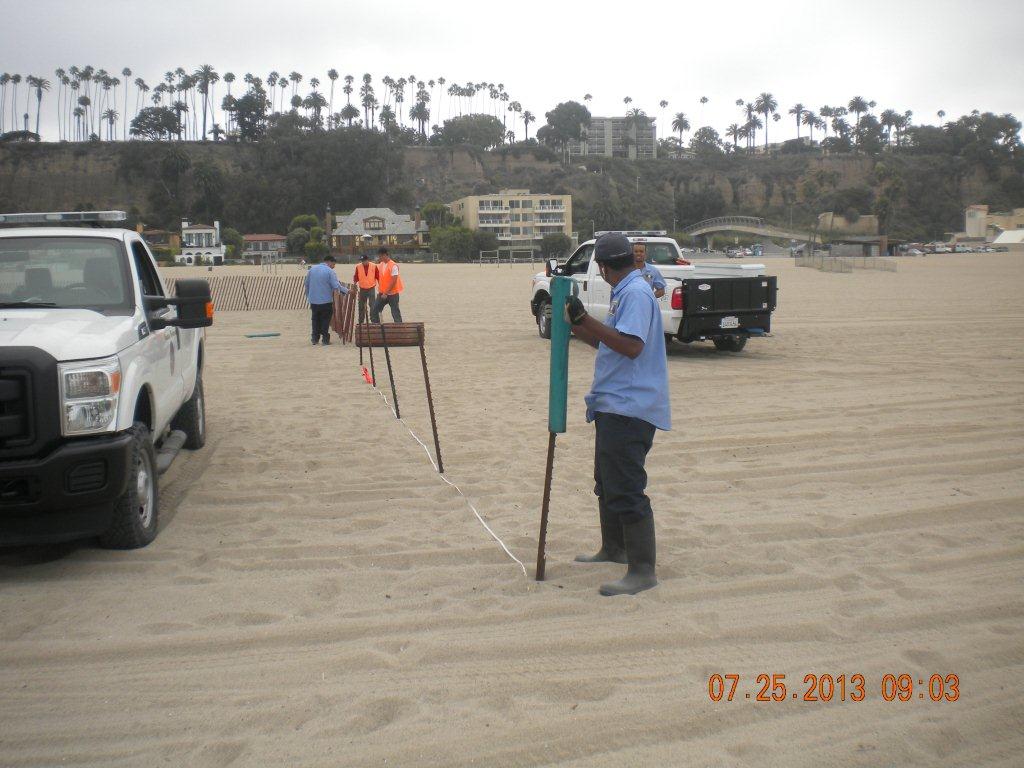
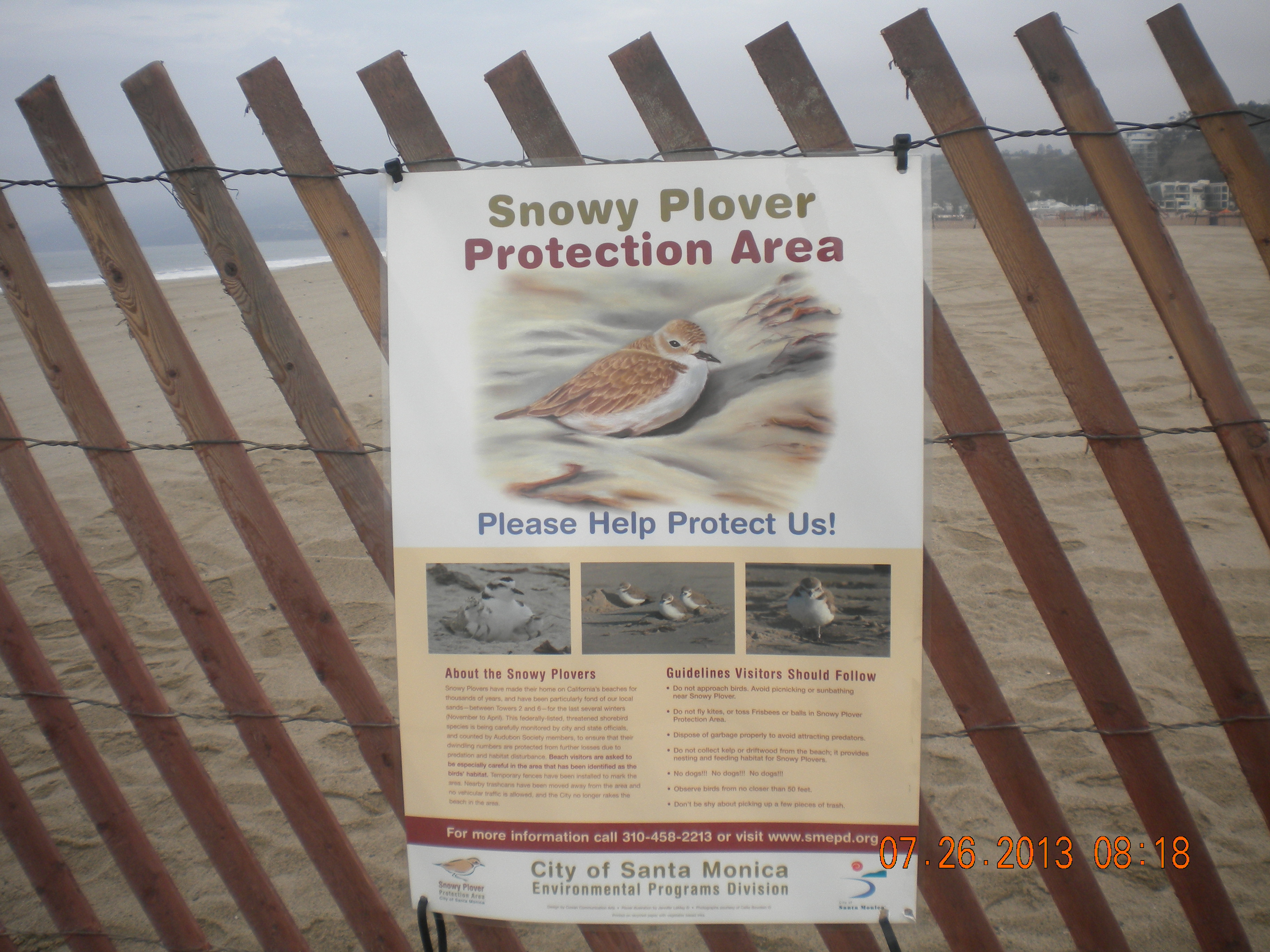 On two Sundays we have observed the small flock of 16 to 18 plovers using the fenced area as refuge from the large crowds of beachgoers. Thanks to Paul Davis of the City of Santa Monica for making time in the busy summer months to help the birds. SMBAS is contributing to the cost of of the fencing on an annual basis.
LucienP Conservation Chair
It’s Lucky When It Lands on You
It’s time for a new kind of blog entry – strange things having to do with birds. The new tag is “News of The Weird.” This first entry will simply be a link with no comment.
http://www.mercurynews.com/bay-area-living/ci_23782606/bird-poop-facials-cost-clients-180-at-nyc
Malibu Lagoon Trip Report: 28 July, 2013

Adamson House panorama (A. Albaisa 7/28/13)
Another nippy, foggy summer day: 63° when we arrived, still only 68° by noon. Only a few beach-strollers and die-hard surfers were around.
Speaking of surfers, someone started a trench at the west end to breach the beach and empty the lagoon, a location which – accidentally, no doubt – happens to be right where the surfers prefer it. They didn’t get far (see photo in slideshow) perhaps figuring that it would be a lot of sand to move.
The young Mallards begin to resemble real birds rather than fuzzballs, and were floating around the lagoon and channel. Brown Pelican numbers rebounded: 195 birds, mostly young ones, well above the 30-bird monthly average for the past year. Elegant Tern numbers were astronomical: from the west side of the channel we watched a flock of several thousand rise skittishly and repeatedly from the sand, but by the time we reached the beach, only 600 birds remained on the low-tide exposed rocks. Our all-time high count of Elegants was 700 birds on 4/26/09; if the bulk of today’s flock had remained, we’d have seen far more than that.

Beach Primrose – Camissonia cheiranthifolia
(L. Johnson 7/28/13)
The channel’s mat of algae which we’d wondered about in last month’s blog was reduced. Photos and film taken during June and July and posted on website The Real Malibu 411 here and again here show that, as predicted and hoped, the afternoon winds blow the algae around. Now you see it, now you don’t!
Snowy Plovers are back: 30 birds on the beach, including one banded bird GG:AR (left leg green over green: right leg aqua over red). This bird was one of three fledglings banded with this combination in 2011 at Oceano Dunes, just south of the cities of Pismo Beach & Oceano on the central California coast, and has been a member of the Malibu Lagoon wintering flock since then.
Well offshore was a huge flock of seabirds: pelicans, terns (probably all the missing Elegants), gulls, cormorants and at least two species of shearwater. Dolphins cut back and forth through the cloud of birds, and no doubt all were making significant inroads into the bay’s population of baitfish. We didn’t include any of these birds in our census. The Shearwaters were in the thousands, with more of a smaller species, Black-vented probably, and fewer of a larger, likely Pink-footed.
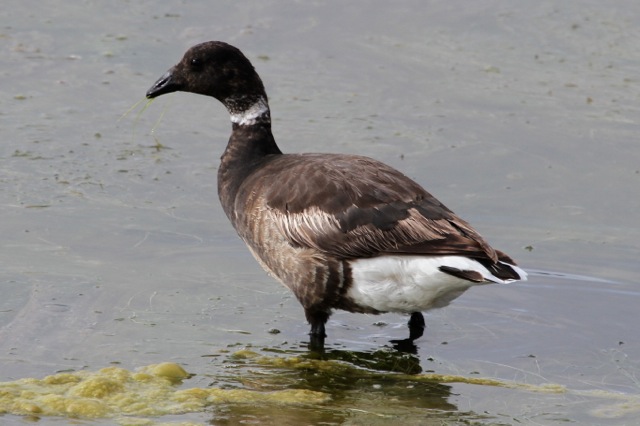
Brant (Joyce Waterman)
Other notable finds were 2 Brant and 4 Semipalmated Plovers on one of the channel sand islands, the latter mistaken by some for Killdeer which also seem to like these islands; 7 Black-bellied Plovers returning from Arctic breeding grounds; 34 Whimbrel also returning for the winter; at least 10 Allen’s Hummingbirds, mostly at Adamson House; at least a dozen Barn Swallows flycatching over the beach; an American Robin for the 2nd month in a row; 2 Hooded Orioles – an adult near the picnic area and a juvenile at Adamson House; on a snag near Adamson House, a juvenile Red-shouldered Hawk who’d probably recently fledged upstream; in the seeding grass and flowers at the beach end of the path was a mixed flock of Savannah Sparrows, House Finches, Lesser and American Goldfinches.

Challenge! – Find the 3rd Ruddy Turnstone (A. Albaisa 7/22/13)
Our next three scheduled field trips: Lower L.A. River, 24 Aug, 7:30am; Malibu Lagoon, 25 Aug, 8:30am. Malibu Lagoon, 22 Sept, 8:30am.
Our next program: Tuesday, 1 Oct., 7:30 pm. To be announced, as usual, from the blog.
NOTE: Our 10 a.m. Parent’s & Kids Birdwalks have resumed, meeting at the shaded viewing area near the parking lot .
Links: Unusual birds at Malibu Lagoon
Aerial photo of Malibu Lagoon from 9/23/02.
Prior checklists: July-Dec’11, Jan-June’11, July-Dec ’10, Jan-June ’10, Jul-Dec ‘09, and Jan-June ‘09.
Comments on Bird Lists Below
Total Birds: July total birds of 1427 are 83% above the 6-year average, an improvement from the previous 6 months; pelican numbers rebounded and Elegant Terns were abundant.
Summary of total birds from the 6-year average so far: June +36%, July -9%, Aug. -9%, Sep. +12%, Oct. +3%, Nov -5%, Dec +30%, Jan -20%, Feb -29%, March -30%, April -34%, May -37%, June -24%, July +83%.
Species Diversity: July 2013 with 48 species was fractionally below the 6-year average of 48.3.
Summary of species diversity from the 6-year average so far: June -10%, July +10%, Aug. -6%, Sep. -20%, Oct. +5%, Nov +2%, Dec -4%, Jan +2%, Feb -8%, March +9%, April -2%, May +3%, June +13%, July 0%.
10-year comparison summaries are available on our Lagoon Project Bird Census Page. [Chuck Almdale]
| Malibu Census | 2007 | 2009 | 2010 | 2011 | 2012 | 2013 | |
| July 2007-13 | 7/22 | 7/26 | 7/25 | 7/24 | 7/22 | 7/28 | |
| Temperature | 68-75 | 60-67 | 65-72 | 64-70 | 63-68 | ||
| Tide Lo/Hi Height | L+2.2 | L+0.4 | H+4.05 | L+2.61 | H+2.34 | L+1.27 | Ave. |
| Tide Time | 0848 | 0704 | 1036 | 0947 | 1121 | 0628 | Birds |
| Brant | 6 | 2 | 1.3 | ||||
| Gadwall | 12 | 4 | 2.7 | ||||
| Mallard | 50 | 25 | 49 | 54 | 42 | 45 | 44.2 |
| White-winged Scoter | 1 | 0.2 | |||||
| Red-brstd Merganser | 2 | 0.3 | |||||
| Ruddy Duck | 1 | 3 | 2 | 1.0 | |||
| Pied-billed Grebe | 12 | 6 | 5 | 4 | 4 | 3 | 5.7 |
| Eared Grebe | 1 | 0.2 | |||||
| Dble-crstd Cormorant | 9 | 15 | 20 | 31 | 24 | 28 | 21.2 |
| Pelagic Cormorant | 1 | 0.2 | |||||
| Brown Pelican | 78 | 40 | 187 | 407 | 17 | 195 | 154.0 |
| Great Blue Heron | 9 | 3 | 6 | 6 | 1 | 4 | 4.8 |
| Great Egret | 5 | 5 | 4 | 4 | 1 | 2 | 3.5 |
| Snowy Egret | 10 | 40 | 14 | 11 | 11 | 17 | 17.2 |
| Green Heron | 1 | 0.2 | |||||
| Blk-crwnd N-Heron | 3 | 2 | 4 | 11 | 2 | 3.7 | |
| Osprey | 1 | 0.2 | |||||
| Cooper’s Hawk | 1 | 0.2 | |||||
| Red-shouldered Hawk | 1 | 0.2 | |||||
| Red-tailed Hawk | 1 | 1 | 1 | 0.5 | |||
| Sora | 1 | 0.2 | |||||
| American Coot | 28 | 20 | 15 | 20 | 12 | 47 | 23.7 |
| Blk-bellied Plover | 4 | 45 | 7 | 9.3 | |||
| Snowy Plover | 4 | 1 | 26 | 13 | 22 | 30 | 16.0 |
| Semipalmated Plover | 6 | 2 | 4 | 2.0 | |||
| Killdeer | 2 | 3 | 2 | 3 | 3 | 2.2 | |
| Black Oystercatcher | 1 | 0.2 | |||||
| Spotted Sandpiper | 1 | 2 | 0.5 | ||||
| Greater Yellowlegs | 1 | 0.2 | |||||
| Willet | 3 | 1 | 7 | 1.8 | |||
| Whimbrel | 3 | 1 | 48 | 42 | 34 | 21.3 | |
| Ruddy Turnstone | 3 | 7 | 5 | 7 | 3.7 | ||
| Black Turnstone | 8 | 1 | 2 | 1.8 | |||
| Red Knot | 2 | 0.3 | |||||
| Sanderling | 4 | 0.7 | |||||
| Western Sandpiper | 8 | 1 | 20 | 2 | 2 | 5.5 | |
| Least Sandpiper | 2 | 1 | 3 | 1 | 1.2 | ||
| Short-billd Dowitcher | 2 | 0.3 | |||||
| Boneparte’s Gull | 2 | 0.3 | |||||
| Heermann’s Gull | 12 | 12 | 125 | 41 | 12 | 26 | 38.0 |
| Ring-billed Gull | 4 | 4 | 1 | 1.5 | |||
| Western Gull | 109 | 30 | 80 | 107 | 95 | 190 | 101.8 |
| California Gull | 2 | 1 | 2 | 1 | 1.0 | ||
| Least Tern | 8 | 36 | 13 | 3 | 10.0 | ||
| Caspian Tern | 5 | 13 | 3 | 2 | 3.8 | ||
| Common Tern | 1 | 0.2 | |||||
| Royal Tern | 2 | 3 | 3 | 1.3 | |||
| Elegant Tern | 10 | 8 | 45 | 600 | 110.5 | ||
| Black Skimmer | 35 | 1 | 1 | 1 | 6.3 | ||
| Rock Pigeon | 6 | 1 | 6 | 6 | 2 | 8 | 4.8 |
| Eur. Collared-Dove | 1 | 0.2 | |||||
| Mourning Dove | 2 | 1 | 4 | 3 | 2 | 3 | 2.5 |
| Anna’s Hummingbird | 3 | 1 | 1 | 3 | 1 | 2 | 1.8 |
| Allen’s Hummingbird | 4 | 3 | 6 | 3 | 9 | 10 | 5.8 |
| Belted Kingfisher | 1 | 0.2 | |||||
| Black Phoebe | 4 | 6 | 2 | 8 | 5 | 6 | 5.2 |
| Western Kingbird | 5 | 1 | 1.0 | ||||
| Western Scrub-Jay | 1 | 1 | 0.3 | ||||
| American Crow | 6 | 1 | 6 | 4 | 6 | 6 | 4.8 |
| Rough-wingd Swallow | 6 | 2 | 5 | 20 | 5 | 6.3 | |
| Barn Swallow | 30 | 12 | 20 | 18 | 20 | 12 | 18.7 |
| Cliff Swallow | 25 | 24 | 10 | 25 | 15 | 16.5 | |
| Oak Titmouse | 1 | 2 | 0.5 | ||||
| Bushtit | 8 | 6 | 6 | 8 | 8 | 2 | 6.3 |
| Bewick’s Wren | 1 | 0.2 | |||||
| American Robin | 1 | 0.2 | |||||
| Wrentit | 1 | 1 | 0.3 | ||||
| Northern Mockingbird | 2 | 3 | 2 | 2 | 5 | 4 | 3.0 |
| European Starling | 8 | 6 | 80 | 38 | 17 | 42 | 31.8 |
| Common Yellowthroat | 3 | 2 | 4 | 1 | 1 | 1 | 2.0 |
| California Towhee | 1 | 2 | 2 | 3 | 1 | 1 | 1.7 |
| Savannah Sparrow | 5 | 0.8 | |||||
| Song Sparrow | 4 | 1 | 3 | 1 | 4 | 12 | 4.2 |
| Lincoln’s Sparrow | 1 | 0.2 | |||||
| Western Tanager | 1 | 0.2 | |||||
| Red-winged Blackbird | 6 | 2 | 1 | 17 | 4.3 | ||
| Great-tailed Grackle | 1 | 3 | 5 | 1.5 | |||
| Brwn-headed Cowbird | 1 | 1 | 3 | 6 | 1.8 | ||
| Hooded Oriole | 2 | 4 | 6 | 2 | 2 | 2.7 | |
| Bullock’s Oriole | 1 | 0.2 | |||||
| House Finch | 6 | 24 | 2 | 4 | 35 | 8 | 13.2 |
| Lesser Goldfinch | 2 | 35 | 6.2 | ||||
| American Goldfinch | 6 | 1.0 | |||||
| House Sparrow | 4 | 0.7 | |||||
| Totals by Type | 7/22 | 7/26 | 7/25 | 7/24 | 7/22 | 7/28 | Ave. |
| Waterfowl | 62 | 26 | 58 | 56 | 49 | 47 | 50 |
| Water Birds-Other | 128 | 81 | 227 | 463 | 57 | 274 | 205 |
| Herons, Egrets | 28 | 50 | 28 | 32 | 13 | 25 | 29 |
| Raptors | 2 | 1 | 1 | 0 | 1 | 1 | 1 |
| Shorebirds | 23 | 4 | 127 | 32 | 128 | 88 | 67 |
| Gulls & Terns | 140 | 44 | 306 | 175 | 161 | 823 | 275 |
| Doves | 8 | 3 | 10 | 9 | 4 | 11 | 8 |
| Other Non-Pass. | 7 | 5 | 7 | 6 | 10 | 12 | 8 |
| Passerines | 121 | 95 | 152 | 167 | 133 | 146 | 136 |
| Totals Birds | 519 | 309 | 916 | 940 | 556 | 1427 | 778 |
| Total Species | 7/22 | 7/26 | 7/25 | 7/24 | 7/22 | 7/28 | Ave. |
| Waterfowl | 2 | 2 | 3 | 2 | 4 | 2 | 2.5 |
| Water Birds-Other | 5 | 4 | 4 | 5 | 4 | 5 | 4.5 |
| Herons, Egrets | 5 | 4 | 4 | 4 | 3 | 4 | 4.0 |
| Raptors | 2 | 1 | 1 | 0 | 1 | 1 | 1.0 |
| Shorebirds | 7 | 4 | 10 | 8 | 11 | 8 | 8.0 |
| Gulls & Terns | 6 | 3 | 9 | 8 | 7 | 7 | 6.7 |
| Doves | 2 | 3 | 2 | 2 | 2 | 2 | 2.2 |
| Other Non-Pass. | 2 | 3 | 2 | 2 | 2 | 2 | 2.2 |
| Passerines | 18 | 16 | 16 | 19 | 18 | 17 | 17.3 |
| Totals Species | 49 | 40 | 51 | 50 | 52 | 48 | 48.3 |
The Unfeathered Bird – Katrina van Grouw
BOOK REVIEW
The Unfeathered Bird
Katrina van Grouw
Princeton University Press, NJ & Oxford, 2013, 287 pgs, $49.95.
This blog hasn’t posted book reviews in the past – we prefer to stick to issues concerning our chapter and local birds and not deluge our readers with email – but this book demands special attention. It is stunning, beautiful, mind-boggling, fascinating, and other space-hogging superlatives. It is not just a book, but a work of art, lovely, wonderful just to leaf through, drinking in the beauty and detail of hundreds of images. It is not just a work of art, it is a book, filled with fascinating bits of information, yet not random or disconnected, but woven together into a complete book. Even the print type is perfect: elegant, yet easily readable. I could go on, but I’d rather let you see some images and read some text for yourself. [Note – the images presented here do not do justice to the originals as they are both file-compressed and size-reduced.]
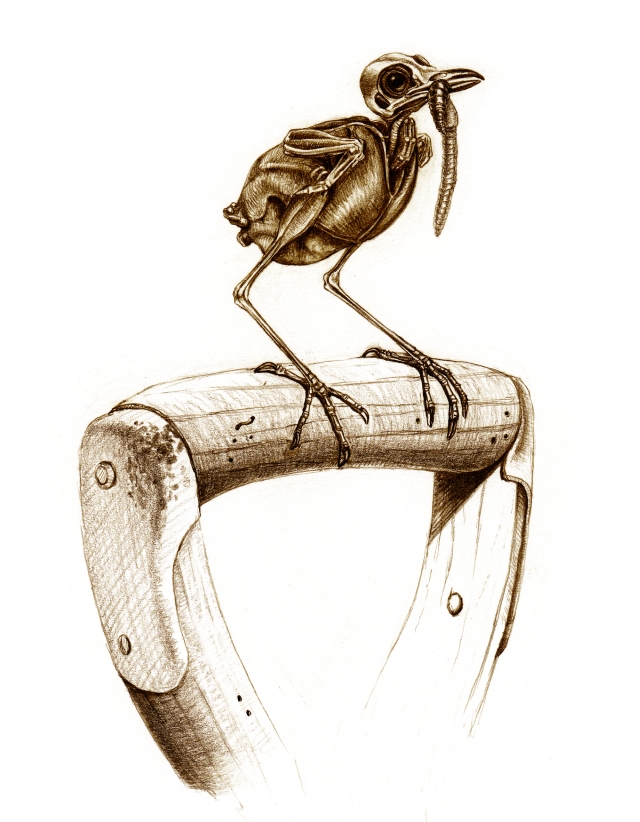
European Robin with worm
The book is organized is what seems at first a peculiar manner, following the original 1758 Systema Naturae of Linnaeus. Not only does this work well, as the reader quickly realizes, but it awakens in us a new-found respect for Linnaeus’ magnificent obsession: to organize all living beings in a sensible manner, ending confusion for all time. The alterations to his structure made since then by legions of scientists are beyond count, but Linnaeus, for the most part, got it right. It is such alterations that author van Grouw chose to avoid, as she explains in her introduction:
My answer – a somewhat unorthodox one – was to turn modern classification on its head and to base my order of chapters on a system that is concerned only with outward structural appearances….rapacious birds, swimming birds, gallinaceous birds, and so on are grouped together according to convergent evolution….I’ve attempted to place groups that are superficially similar next to each other for ease of comparison. Thus storks are next to cranes and swifts next to swallows. The actual relationships are discussed within the text at some length.
Part One concerns generic avian structures: trunk, head, neck, hind limbs, wings, and tail. The much longer Part Two illustrates and discusses most modern families, arranged into Linnaeus’ schema: Accipitres, Picae, Anseres, Grallae, Gallinae and Passeres. You’ll have to read the book to find out which family falls into which of these groups, but if you know what these six names refer to and guess where the families fall, you’ll be close. Hint: Anseres includes ducks and penguins; Passeres includes pigeons, swifts and passerines. The book explains why. And it works.
Let’s sample some artwork and text without my comments.

Woodpecker skull & tongue – note groove around eye in right figure
Pgs 78-79 – Woodpeckers
The characteristic head shape of wood-pecking woodpeckers – with the braincase above the level of the bill – is another clue to their specialism. Simple but effective; this is to place the brain safely above the trajectory of impact. Any forces that do reach the cranium are absorbed by the thickened bone; its pockmarked surface a distinctive feature of woodpecker skulls. The skull of the excavating specialists also meets the neck at an almost perpendicular angle so that the bill faces the tree trunk rather than pointing vertically upward. This enables the bill to strike the wood at right angles to it with a smooth swinging motion like using a hammer and to avoid the jarring that would result from a forward thrust….They do, however, share one important attribute that has been the key to their success – an extensible tongue. The basic structure of this organ is the same as in all birds: a tongue anchored to the floor of the mouth just in front of the opening to the windpipe, where it divides into two branches called hyoid horns. These “horns” extend backward along the inside of the lower jaw and behind the ear openings, hugging the back of the skull. In most birds the tongue cannot be extended beyond the tip of the bill, but woodpeckers, among others, are an exception. Their long tongue, tipped with various barbs or bristles and coated with sticky saliva from a well-developed salivary gland at the base of the jaw, can be shot out rapidly to trap insects. It’s all achieved by the action of the muscles surrounding the flexible and whip-like hyoid horns. But the horns do need to be considerably longer than those of other birds. So long are they in some species that they meet at the back of the head, extending right over the top of the cranium along a channel in the skull and may even twirl around the right eyeball or plunge into the right nostril. When the bird is feeding the slack in the hyoid horns is pulled sharply taut, thrusting the tongue forward.
Pg 122 – Grebes
The attractively striped chicks spend their first few weeks of life being carried on their parents’ back. Among more “normal” foodstuffs, the chicks are fed on feathers that the adults pluck from their breast and flanks. The adults eat these, too, and they are thought to serve as a wrapping for fish bones and other indigestible material ejected from the mouth as pellets.
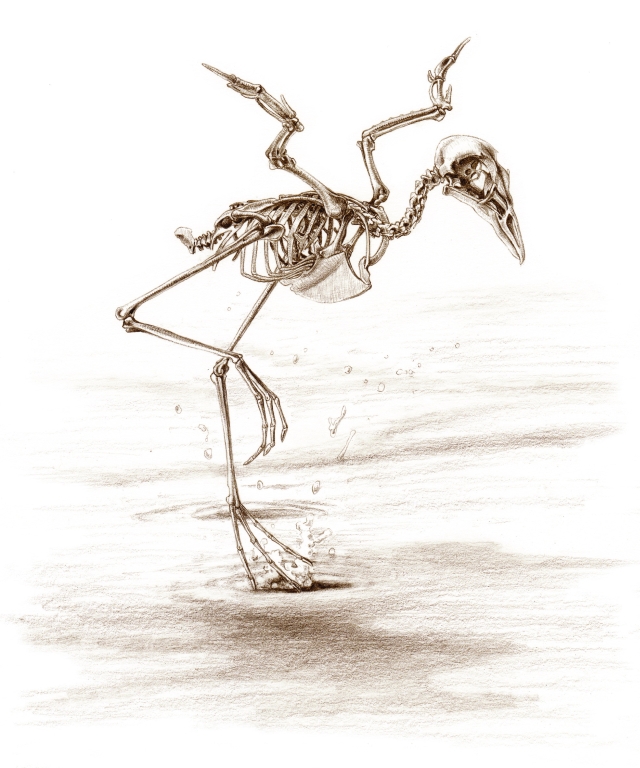
Storm Petrel dancing on the water
Pg 130 – Storm petrels
In all petrels the upper arm and forearm bones are of approximately equal length. It’s the length of the hand that varies, and in general the larger the bird, the smaller the hand. Albatrosses have really long “arms” but small “hands.” But in storm petrels it’s the other way around. The section from the wrist to the wingtip is significantly longer than the bones of the upper and lower arm. They correspondingly have more functional primary flight feathers (attached to the hand) and fewer secondary flight feathers (attached to the arm) than do albatrosses. The breastbone, too, is long, and the wishbone curves outward to give the maximum area for the attachment of the well-developed flight muscles. Storm petrels may not be able to soar effortlessly for long periods like their long-winged cousins, but they can fly like butterflies and change direction with the slightest movement.
Their nocturnal habits are facilitated by their strong sense of smell – unusual in birds but common to most petrels whose well-developed olfactory apparatus is linked with the characteristic tubular nostrils. The birds use their sense of smell to locate and identify their nest site, find food, and even recognize one another. Indeed, most petrels have a pungent odor, but most breed in inaccessible areas such as islands and stacks, free from mammalian predators that would be able to detect them in this way. The aroma of storm petrels is sensual and complex; as enigmatic as the birds themselves.
Pg 178 – Storks
Considering storks as waterbirds, the carrion-eating habits of Marabou Storks seem rather incongruous. This habit was conveniently rationalized when researchers pioneering DNA hybridization techniques in the 1980s revealed the storks’ closest living relatives to be, not the herons, nor even the ibises and spoonbills, but the New World vultures. In fact, some late nineteenth-century taxonomists had arrived at the same conclusion from a purely anatomical standpoint. The two groups certainly do share many similarities, including the bare facial skin and soaring flight. However, more recent molecular studies have blasted this theory – at least for now: Marabou Storks are probably not, after, long-legged vultures but simply rather vulturesque storks.
Pg 194 – Plovers
The plovers hunt by sight rather than by touch. In most, the bill is shorter, for aimed pecks rather than opportunistic probing, and their eyes are much larger than those of the sandpipers. In fact plovers are also nocturnal feeders, so having large eyes maximizes the amount of light hitting the retina. They also have a high density of rod cells in the eye, which aids vision under poor light conditions, though at the expense of some color perception. Like those of the woodcocks, plovers’ eyes are raised above the level of the cranium, but these are directed much farther forward to give the birds the good field of binocular vision they need. Stone curlews, too – same order, different family – have similarly large eyes to help with night feeding.
[End of excerpted portions]
*****************
You may have noticed that the images are not merely of bare bones lying there – most of them depict active birds, in motion, doing things. In my experience, this is utterly unique. Not only is the text graceful and uncluttered, but highly informative and always interesting. I’ve been a bird lover for almost 40 years, but I quite literally learned something new on every page. It’s a book, it’s a work of art, it’s both. It is unique.
All book reviews are supposed to be critical in nature and thus must point out shortcomings, even if they don’t amount to much. I had two points which I presented to the author, whose explanation follows my comment.
1. No drawing(s) at the beginning of the book of a generic bird with labels on all the various bones, organs & muscles mentioned in the text. Von Grouw replies: “I did consider the generic bird idea, but dismissed it early on as being unnecessary….Firstly, an illustration with pointer arrows labeling the different parts would be rather like a textbook diagram, which is the very thing I was trying to avoid. Everything in The Unfeathered Bird is a deliberate antithesis of the textbook stereotype! Secondly, you’ll notice that I went to great lengths to avoid the use of any jargon. This was to make readers who are unfamiliar with technical anatomical terms feel more comfortable reading the text and, again, to make it seem less like a textbook. So it would have seemed a bit strange to then label a diagram with technical terms that were not used in the text, or a bit unscientific to label it with descriptive terms that speak for themselves like ‘upper arm’ and ‘breastbone’.”
2. More complete index – the text was so interesting and useful that I was disappointed to find the index didn’t really cover it, only the pictures. Von Grouw replies: “…we (the publishers and myself) kept [the index] deliberately brief for the same reason – the avoidance of textbookishness and the desire to keep it simple. But if I’d made the Index bigger there would have been less room in my 304 pages for the content of the book, so something would have had to go. Every page was precious!”
My quibbles are minor; I find Von Grouw’s explanations entirely satisfactory.
The author lives in England not far from Oxford, is a former curator of the ornithological collections at London’s Natural History Museum, hikes in the nearby hills where she enjoys Neolithic and Iron Age earthworks, hill forts, flowers, butterflies and the occasional horse figure cut into white chalk downs. Her current project is Unnatural Selection, a similar book about about domesticated birds and mammals, which she describes as “a sort of update of Darwin’s ‘Variations’ in which he used domesticated animals to explain evolution by natural selection.” Following that will be a book about mammals, which I hope includes a few hominids.
Link to the book’s website: http://www.unfeatheredbird.com/index.html
The book is available at the Los Angeles Public Library but after reading it you’ll want to have your own copy. If my review hasn’t convinced you to buy it, here’s a Barnes & Noble interview with the author, featuring many more pictures. [Chuck Almdale]
Puffins! Live! and other Wildlife Cameras
Puffins were the first birds ever to capture my interest. Starting at age 10, I collected postage stamps for a couple of years, and my favorites were a series of puffin stamps issued by the short-lived independent nation of Puffin Island, which in reality was a small islet somewhere off the coast of England. Apparently its independence lasted just long enough to run off a load of stamps before the British government landed a boat and shut them down. Their validity as true postage stamps was a bit “dodgy” as the Brits might say, but they were lovely portraits of beautiful birds. Alas, long since gone, as is the nation which issued them.
However, you can see live Atlantic Puffins right now, in the comfort of your very own home as they cavort on the rocks of Seal Island National Wildlife Refuge off the coast of Maine, accompanied, of course, by their friends the terns. There are a few decoys in the bunch which will never move, and occasionally the camera freezes up. Be patient, or re-load the site, and you will be rewarded.
http://explore.org/#!/live-cams/player/puffin-loafing-ledge-cam
What’s more, you can see one fuzzball puffin chick, doodling about in it’s burrow, waiting for the occasional feeding from a parent.
http://explore.org/#!/live-cams/player/puffin-burrow-cam
If for some reason those links don’t work for you – they occasionally go wonky – here’s the main Audubon page for all their live cams. I counted 51 different cams. http://explore.org/#!/live-cams/player
Now go and while away the hours.
[Chuck Almdale]



 SANTA MONICA BAY AUDUBON SOCIETY BLOG