Free email delivery
Please sign up for email delivery in the subscription area to the right.
No salesman will call, at least not from us. Maybe from someone else.
The Ribbon is Cut at Malibu Lagoon! A personal view.
The official opening of Malibu Lagoon State Park was on Friday, May 3. Santa Monica Bay Audubon was specially invited to attend, both to receive a award in recognition of our support, and to bring a few telescopes to show birds to anyone who wanted a closer look.
It’s difficult to believe that it’s taken almost 20 years to get to this point. I began attending the lagoon planning sessions in the mid-’90’s, and even then I was a late-comer to the meetings. Sometime around 2001, after many officially mediated meetings, the plan was approved by the committee as a whole. It then took about five years to get any money for it, one of those numerous proposition-bond measures being the source. Phase I of the project was completed sometime thereafter, consisting primarily of the parking lot & picnic area remodel. Years more went by. People bearing petitions began appearing at the lagoon, claiming that suddenly, out of nowhere, the State, in its clanking, mechanistic boots of death, was about to shove some horrific project down the throats of lagoon users, spreading ruination, with much weeping and gnashing of teeth. It took a while for me to realize that this was the same project approved by many dozens of stakeholders, including myself, many years before. I had come to expect the plan to vanish without a trace.
In one recent discussion at the beach, one surfer-looking man, probably not yet born when the process began, complained, “No one ever invited me to any meetings!” A blindingly naive comment. I doubt the ocean sends this fellow written invitations, yet still he makes it to the beach. So far as I know, only Jury Duty people send out invitations; they’ll even come and collect you when you fail to respond. Beyond that, responsibility falls on the individual.
For anyone who still thinks that almost 20 years is an extraordinary amount of time for a relatively modest project such as this to be planned, approved, funded and completed, I’ll mention this: discussions about the removal of Rindge Dam, located in Malibu Canyon below the highway tunnel, began before I attended my first Malibu Lagoon meeting in the mid-90’s. The dam remains firmly in place.
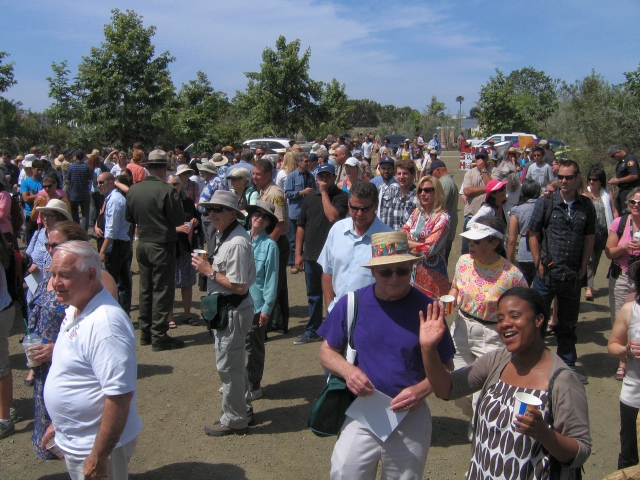
- Part of the crowd (L. Johnson 5/3/13)
Far more people came than I expected. Politicians, Malibu locals, government employees of various agencies, members of environmental groups, and of course a few protestors. The last group bore signs which, curiously, seemed more concerned with Ballona Wetlands than with Malibu Lagoon.
Tables held snacks and – very necessary on this very hot day – lemonade. Telescope in hand, passing the snack table on my way out to the viewing point, I picked up what looked like a chicken wrap, only to discover to my dismay, after taking a bite, it was a fish wrap. Uh oh. Those who know me know what that means.
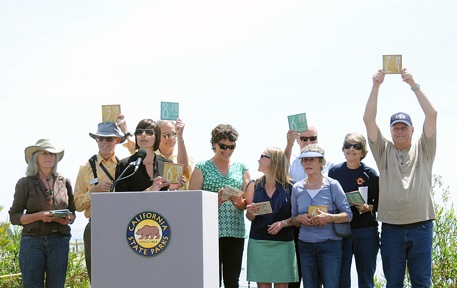
Plaque awardees (J. Kenney 5/3/13)
The speeches and presentations, scheduled to begin at 11am, finally got underway about 11:30. The delay was partially due to the reluctance of attendees to leave the comfort of what little shade was available, and stand in the blazing sun near the podium. Some nice speeches ensued, some attractive awards were given (I received a yellow tile which read, succinctly, 9.6 in.), and – finally! – the official ribbon was officially cut with the official ribbon-cutting hedge clippers. Very appropriately, the ribbon was a long strand of Giant Kelp.
Afterwards, a rumor was passed along to me that UCLA ornithologist Dr. Hartmut Walter thought the tens of thousands of little waving flags might be annoying/alarming/distracting to the birds, something I hadn’t previously considered. Birds are extremely sensitive to motion, as it might signal a predator, and constant feather-like motion of innumerable tiny flags may constantly stimulate their alarm system. I passed this comment along to Suzanne Goode of California State Parks. They had already been considering replacing the flags with something less fluttery. I suggested colored golf tees which a footstep could put in place, yet not be visible unless you were looking down on them from close by. Their downside is that if the water rose, they might dislodge and float away.
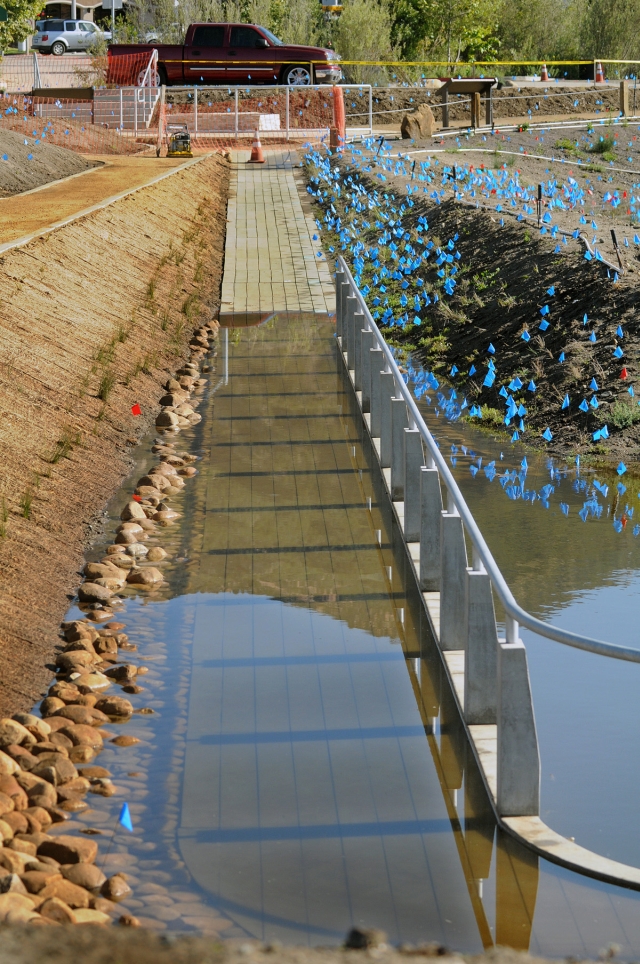
Tidal Clock path (J. Kenney 4/16/13)
We hung around for a while, talking with friends and strangers, and managed to show a few birds to a few interested parties. A White-tailed Kite was reported in the vicinity. Someone asked me if I thought an Osprey might nest on the large trunk placed upright in the channel. [I didn’t. It would need a platform affixed to the top on which the Osprey could build a nest.] We saw a bunch of tiny, tiny fish at the water’s edge in the channel. A Spotted Sandpiper, landing nearby, resplendent with breastful of spots, pushed a few viewers over the edge into a chorus of Oohs! and Ahs! When a Mallard pair paddled their way from the PCH bridge over to one of the new channel islands, complete with two downy ducklings in tow, we decided that would not be topped and it was time to leave.
Addendum: On our April birdwalk, some birders speculated about the “Winter Tidal Clock,” with questions phrased in the mode of, “What the heck is that thing for?” My reply, while accurate, insufficiently dampened their doubts.
A far more eloquent explanation was given in the course of a short speech by Clark Stevens, architect and professor, present at the ceremony in his capacity as Executive Officer of the Resource Conservation District of the Santa Monica Mountains. I quote:
We have created places here where visitors will be able to hide in a sandbar willow thicket, or stand on top of a high tide, literally to walk on water for a few days each wet season. We have made the cycles of this uniquely seasonal tidal system more visible here, celebrating the intricacies of this magical ecosystem.
One feature has generated a number of questions: The winter ramp, or summer clock- they are one and the same, but change functions and names each spring and fall. When the lagoon is open to the tides, the winter ramp will take you down into the heart of the tidal range. But in the spring- like now- after the building sands succeed in blocking the dwindling flows of Malibu creek from reaching the high tides, this same path will become the summer clock, marking the passage of time as the waters advance four feet up the shallow ramp for every inch that the lagoon rises.
And if you are fortunate or observant enough to be here when the first big winter rain is delivered from the mountains to the lagoon, you will see the water race up the last of its path, at which time summer will end and winter will begin, as the heavy lagoon and rain-filled currents will break the sands again and our creek will rejoin the tides for another winter.
Clark added, in a follow-up email to me: “Although the winter ramp/summer clock is obviously not a pure wetland feature, it has become a favorite inlet for small fish and fry, including a goby which our biologists sighted yesterday [5/3/13].”
He gave a great deal of additional commentary, which I am placing on a special Malibu Lagoon Project Page devoted entirely to the Winter Ramp/Summer Clock.
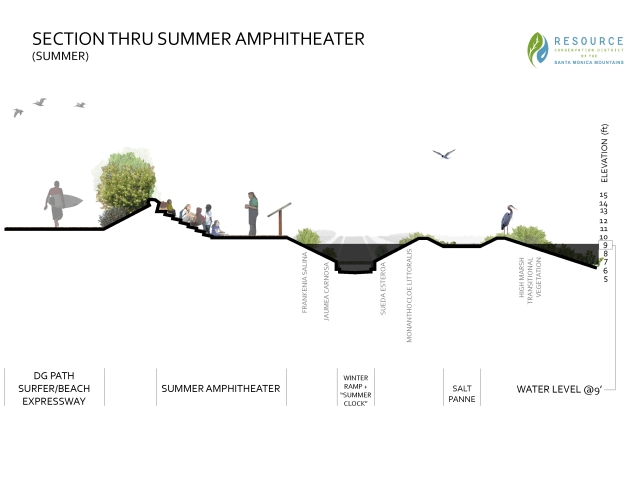
Summer water level at 9 feet –
Courtesy of Resource Conservation District of the Santa Monica Mountains
After the previous reconfiguration in the early 1980’s, it took years for plants to grow. It was probably 10 years before any reeds appeared. People forget. In my opinion, it will take time for the inundated channel soil to populate with sufficient invertebrates to support many birds, although invertebrates were present for the opening ceremony, much to the delight of the biologists. It will also take at least a year, probably longer, for the new plants to form a nice ground cover. State Parks will soon be looking for volunteer help with weeding. We’ll keep you posted. [Chuck Almdale]
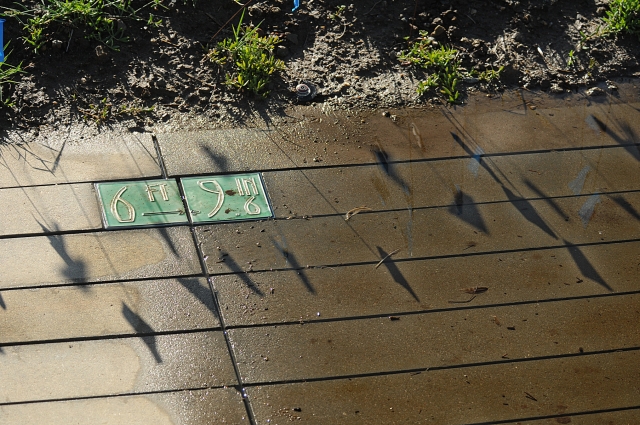
Tidal Clock elevation markers (J. Kenney 4/16/13)
State of the Birds or Birds of the State?
Last Friday the online journal “Slate” published a great article on the official birds of the 50 states of the union, and what they should be. If you’re serious you’ll read more than the first three paragraphs, if you’re not so determined you’ll get your laughs quickly and leave it be.
You asked about eagle action…
For those who asked to whom you should write concerning the Fish and Wildlife Service’s planned long (30-50 year) “take” permit plans for wind farms, the American Bird Conservancy has prepared the outline of a letter to which you can easily add a comment. The letter will be mailed to three officials when you fill in your address and hit the send button.
Mary Prismon and I have already written on behalf of the Chapter, however, please write on your own.
It’s not too late to send an email asking that the feds drop their plans for permits that would allow wind energy companies and others to legally kill eagles at their facilities for up to 30 years, instead of the current five: http://org2.salsalabs.com/o/5400/p/dia/action3/common/public/?action_KEY=13726
Lucien Plauzoles, Co-chair Conservation
Washington is NOT helping the birds!
We have received and read a small storm of articles in the past five days that tell us the same sad story. The Department of Interior in this Administration seems to value wind energy investment more than the life of birds–even that of the California Condor and Bald and Golden Eagles!
So much effort and money has been spent helping those birds avert extinction, yet non-enforcement and deregulation by exception seem to rule in the current Administration. Here are two links recently posted on the American Bird Conservancy alert:
There was also a companion video link:
http://landing.newsinc.com/shared/video.html?freewheel=90121&sitesection=ap&VID=24819212
Another regulatory exception was announced for Tejon Ranch’s planned development of thousands of homes between L.A. and Bakersfield as noted in the Los Angeles Times on Sunday.
http://www.latimes.com/news/local/la-me-killing-condors-20130511,0,1790222.story
This is probably of much lesser threat than existing and future wind farms in the Tehachepi Mountains.
We are preparing a chapter response to be filed with the US Fish and Wildlife Service within the week.
Lu Plauzoles, Co-chair Conservation
The weekend turned out to be a series of life birds for several people. Jean finally got the Pinyon Jay on Saturday at Black Rock. They were in a flock and, as Chuck Almdale pointed out, moved down the slope and across the valley as Bushtit flocks roll from bush to bush, trailing birds flying past leading birds and landing, so you are given a lot of chances to see them. When that show was over a Scott’s Oriole posed for us for several minutes, giving us every view we could wish for. Thanks to Chuck’s good eyes we even found a Brewer’s Sparrow. Then there were the Eurasian Collared-Doves with their strange sounds, Western Bluebirds, Gambel’s Quail, Cactus Wren, and Ash-throated Flycatcher.
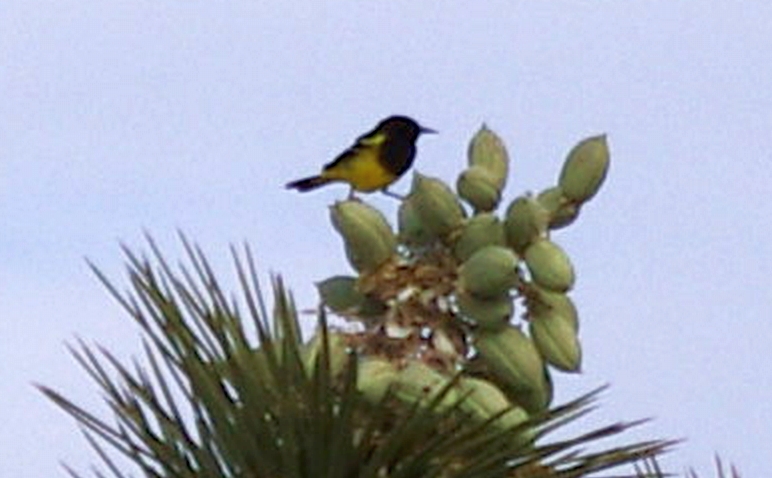
Scott’s Oriole on a Joshua Tree seed pod (D. Roberts 5/4/13)
At Morongo Canyon Preserve on Sunday, the wind was blowing about 10 knots, and we were not sure if the birding would be affected. At the entrance where the trailer sits with several bird feeders , we saw the Townsend’s Solitaire who was brown, indicating a 1st year bird and it was obviously exhausted judging by the lethargic movements. I don’t know if anyone has ever had such an opportunity to repeatedly look at a solitaire. But that wasn’t the only show. Lillian said, “is that a Calliope [Hummingbird] on the feeder?” We all looked and realized it was one.
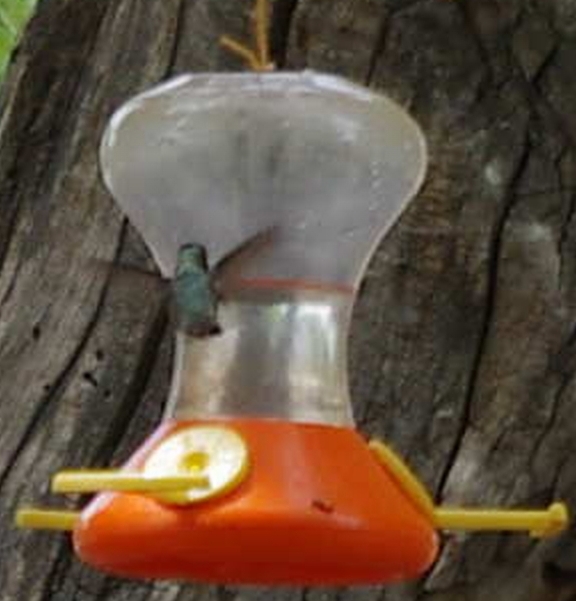
Hummer at the Morongo feeders (D. Roberts 5/5/13)
He came back several times in case everyone had not gotten a picture and then a female started coming to the feeder. For a lot of people, that bird is not easy to get a good view of. We also had Costa’s & Black-chinned Hummingbirds at the same bird feeders. Because of the wind, it looked like a fall-out of Western Tanagers because, as someone said, you could have a binocular filled with them.

Summer Tanager looking for a quick meal (D. Roberts 5/5/13)
The Summer Tanagers were also around so everyone saw a least four of them and fortunately the male & female Vermilion Flycatchers were near their nest. Also, in a tree nearby, a pair of juvenile Red-tailed Hawks were found in their nest, stretching their wings. Later, we could see one of the adults hunting for food.
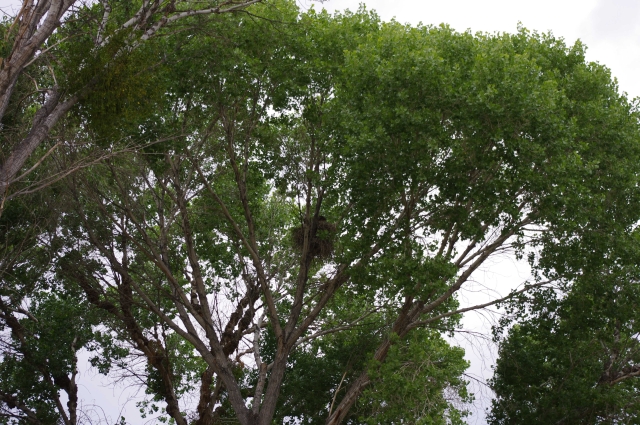
The lump in the tree is a nest holding two young Red-tailed Hawks (D. Roberts 5/5/13)
We did pretty well with warblers seeing seven, including the Yellow-breasted Chat, who teased us until he finally perched where all could see him. The two more unusual warblers, for Morongo, were the Hermit & the Black-throated Gray. All I can say is this was a good year so any one who didn’t attend missed a great week-end. [Jean Garrett & Liz Galton]
| Trip List | |
| Code: B – Black Rock, M – Morongo Valley | |
| H – Heard only | |
| Name | 5/4-5/13 |
| Gambel’s Quail | MB |
| Turkey Vulture | M |
| Cooper’s Hawk | M |
| Red-tailed Hawk | M |
| Virginia Rail | M-H |
| Rock Pigeon | MB |
| Eurasian Collared-Dove | M |
| White-winged Dove | MB |
| Mourning Dove | MB |
| White-throated Swift | M |
| Black-chinned Hummingbird | MB |
| Anna’s Hummingbird | MB |
| Costa’s Hummingbird | MB |
| Calliope Hummingbird | M |
| Ladder-backed Woodpecker | MB |
| Nuttall’s Woodpecker | M |
| American Kestrel | B |
| Olive-sided Flycatcher | M |
| Western Wood-Pewee | MB |
| Willow Flycatcher | M |
| Pacific-slope Flycatcher | M |
| Black Phoebe | MB |
| Vermilion Flycatcher | M |
| Ash-throated Flycatcher | B |
| Brown-crested Flycatcher | M |
| Cassin’s Kingbird | MB |
| Western Kingbird | MB |
| Loggerhead Shrike | M |
| Bell’s Vireo | M |
| Cassin’s Vireo | M |
| Warbling Vireo | M |
| Pinyon Jay | B |
| Western Scrub-Jay | MB |
| Common Raven | MB |
| Mountain Chickadee | M |
| Oak Titmouse | M |
| Bushtit | M |
| House Wren | M |
| Bewick’s Wren | MB |
| Cactus Wren | B |
| Western Bluebird | MB |
| Townsend’s Solitaire | M |
| Swainson’s Thrush | M |
| Northern Mockingbird | B |
| California Thrasher | MB |
| European Starling | MB |
| Phainopepla | MB |
| Orange-crowned Warbler | M |
| Nashville Warbler | M |
| Common Yellowthroat | M |
| Yellow Warbler | M |
| Yellow-rumped Warbler – Audubon | M |
| Black-throated Gray Warbler | M |
| Townsend’s Warbler | M |
| Hermit Warbler | M |
| Wilson’s Warbler | MB |
| Yellow-breasted Chat | M |
| Spotted Towhee | MB |
| California Towhee | MB |
| Brewer’s Sparrow | B |
| Song Sparrow | M |
| Summer Tanager | M |
| Western Tanager | M |
| Black-headed Grosbeak | M |
| Blue Grosbeak | M |
| Lazuli Bunting | M |
| Great-tailed Grackle | M |
| Brown-headed Cowbird | M |
| Hooded Oriole | M |
| Bullock’s Oriole | M |
| Scott’s Oriole | B |
| House Finch | MB |
| Pine Siskin | M |
| Lesser Goldfinch | MB |
| Lawrence’s Goldfinch | M |
| House Sparrow | MB |
| Total Species | 76 |



 SANTA MONICA BAY AUDUBON SOCIETY BLOG