Free email delivery
Please sign up for email delivery in the subscription area to the right.
No salesman will call, at least not from us. Maybe from someone else.
Antelope Valley Raptor Search Report, Saturday, 12 January 2013
It was 30 degrees, sunny and windless when we turned off Hwy 14 at Palmdale Blvd. and drove east. Our first stop was at an undeveloped area along E10th St. north of Rancho Vista (Ave. Q). The area was not as productive as it has been in past years but we saw the first raptors of the day: a Northern Harrier that flew by and several Red-tailed Hawks.
Our next stop was on the shoulder of the road by the Desert Aire Golf Club (Ave. P x E40th St.). A puddle of water on the grass near the edge of the golf course was attracting a mixed flock of passerines including White-crowned Sparrows & House Finches. In the scrub across the road, we found a small flock of California Quail, a Loggerhead Shrike and more sparrows and finches, including one Golden-crowned Sparrow.
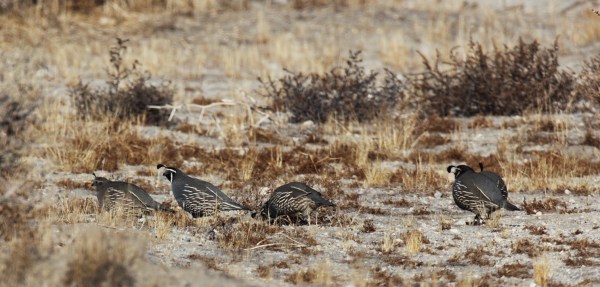
California Quail, S. Baker, 01/12/13
From the Golf Club, we drove north on E40th St. Just after E40th St. turns right and becomes Ave. N we stopped and scanned the sod fields. In the distance, we saw a flock of Horned Larks that we estimated at 1,000+ birds. It was impressive to see the flock in the air and we were disappointed that the strong sun that was making the cold temperature more tolerable for us was also causing heat shimmer that reduced the clarity of the views through our scopes.
Our next stop was along E40th St. just north of Ave. M (Columbia Way). There were many Brewer’s Blackbirds, some Killdeer, and at least one Say’s Phoebe in the field where a large flock of sheep was grazing.
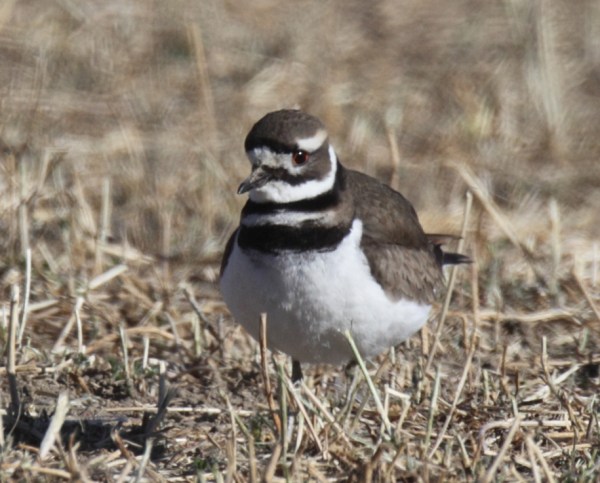
Killdeer, S. Baker, 01/12/13
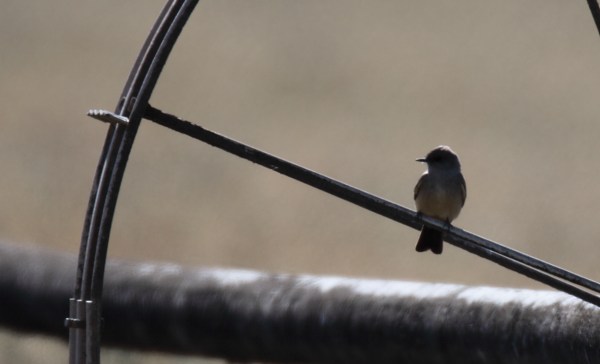
Say’s Phoebe, S. Baker, 01/12/13
Although there had been Mountain Plovers close to the road one week earlier, the only birds resembling Mountain Plovers that we could see were at the back of the field where they were barely visible. Our disappointment was quickly forgotten when one of the members of the group spotted a Prairie Falcon perched on a power pole across the road. We watched it for a time, getting excellent looks at the bird when it was perched and as it flew from one perch to another.
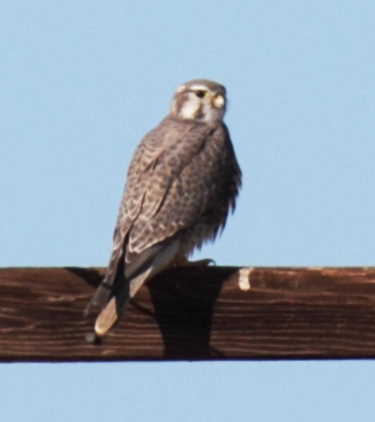
Prairie Falcon, S. Baker, 01/12/13
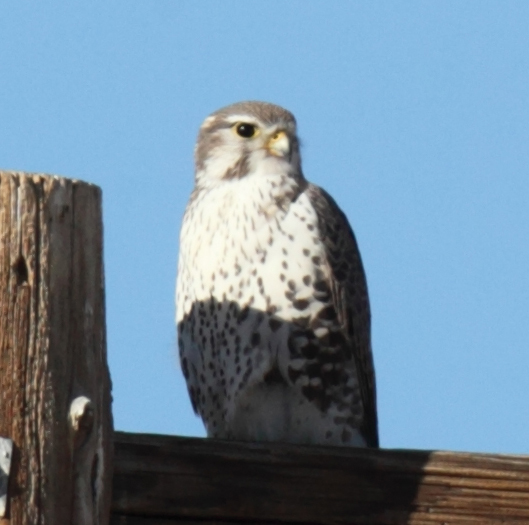
Prairie Falcon, S. Baker, 01/12/13
As we drove north on E40th St we noticed a flock of Western Meadowlarks in the field south of Ave. L. We turned onto Ave. L where we found 2 Eurasian Collared-Doves, several Savannah Sparrows and a Cooper’s Hawk that was perched in a tree behind a house.
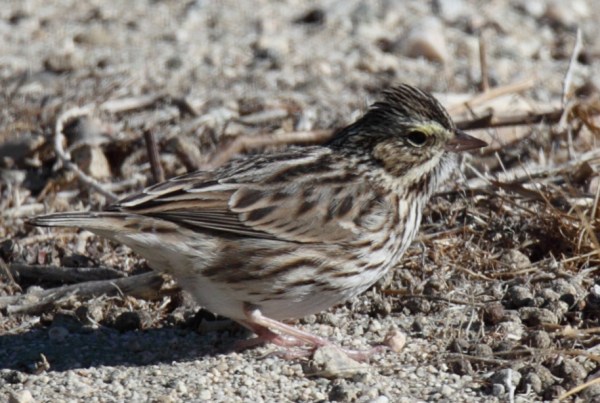
Savannah Sparrow, S. Baker, 01/12/13
From there we went east on Ave. K, turned north and drove east on Ave. J. After we crossed E110th St., we saw several Red-tailed Hawks. A flock of sheep was grazing in a field on the north side of Ave. J so we went 1 block north to Ave. I so we could look at the field from the north side. As we turned onto Ave. I we saw a Ferruginous Hawk perched on a power pole beside the road and we stopped our cars so we could get a good look at the bird without flushing it. As we looked around, we realized that there were numerous raptors in the immediate area so we pulled off the road and got out of our cars.
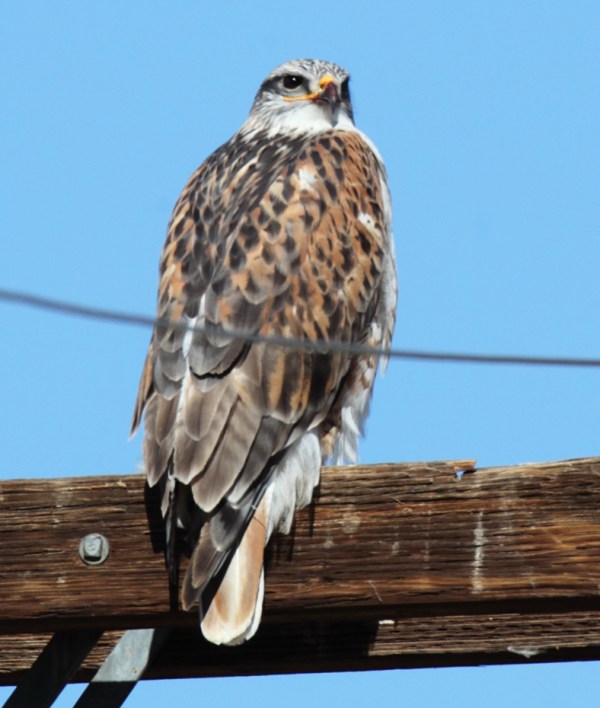
Ferruginous Hawk, S. Baker, 01/12/13
The viewing conditions could not have been better. The sky was clear, the vegetation in the fields was short and there were numerous power poles on which raptors could perch. It was easy to see and compare the general size & shape as well as the field marks of some of the Red-tailed Hawks, Ferruginous Hawks and Common Ravens while they were flying as well as when they were perched.
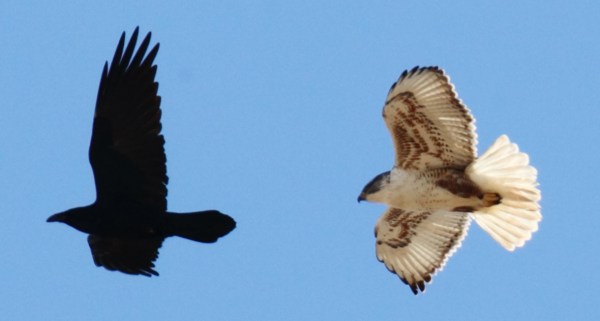
Common Raven & Ferruginous Hawk, S. Baker, 01/12/13
After a short time, a truck pulled up and the driver got out and walked over to talk with us. When we explained that we had come to look at the birds, he was genuinely pleased. He told us that bird numbers seemed low, probably because the past two years had been dry. He said that the sheep had been brought down from the high country just for the winter. He told us that Mountain Plovers seem to prefer pasture that has just been grazed so they usually stay close to the sheep. Unfortunately for us, at that moment the sheep were in the middle of the field so we were only able to see the silhouettes of a few Mountain Plovers in the distance though there were Killdeer, American Pipits, Savannah Sparrows and Western Meadlowlarks in the fields.
After we talked for several minutes, we thanked him and said goodbye. We started to drive away but stopped when we saw a dark buteo soaring nearby. It proved to be a stunning dark morph Ferruginous Hawk that flew right over us.
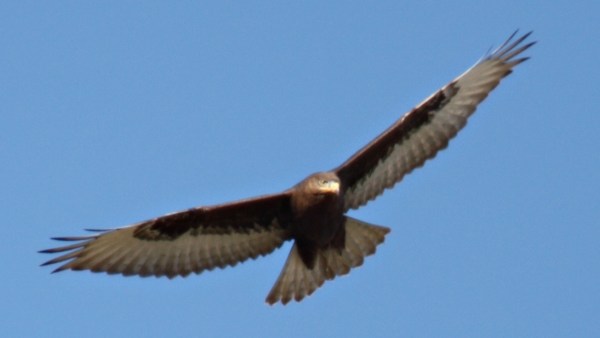
Dark morph Ferruginous Hawk, S. Baker, 01/12/13
Our final raptor tally for that site was 4 light & 1 dark morph Ferruginous Hawks, 8 or more Red-tailed Hawks, 3 Norther Harriers and an American Kestrel.
Since it was nearly lunch time we drove to Apollo Park, which was busy despite the chilly weather. As usual, we birded while we ate lunch. In addition to the usual assortment of ducks and geese of questionable ancestry, we saw 2 Ross’s Geese, several Eared Grebes, 8 American White Pelicans, some Northern Shovelers and Hooded Mergansers. The only passerines we saw were Brewer’s Blackbirds and House Sparrows.
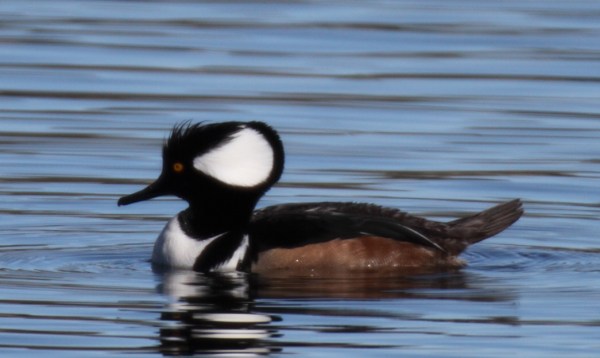
Hooded Merganser, S. Baker, 01/12/13
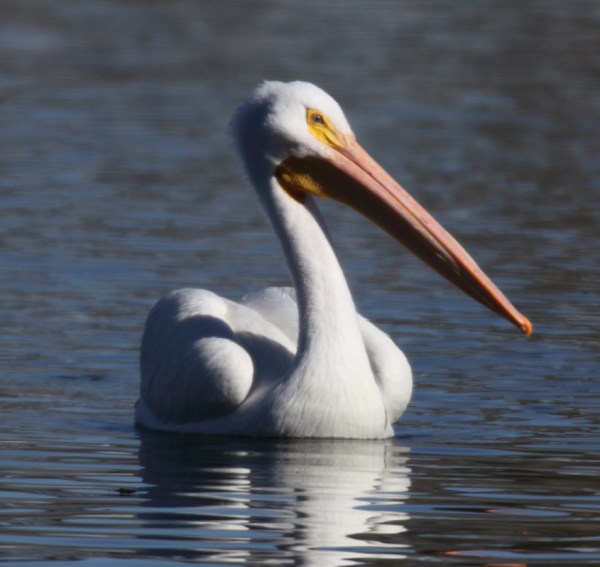
American White Pelican, S. Baker, 01/12/13
From Apollo Park we drove north on W60th St. The farm fields were dry and the flocks of passerines were scattered and small but we found a Northern Harrier, a Merlin and a Prairie Falcon.
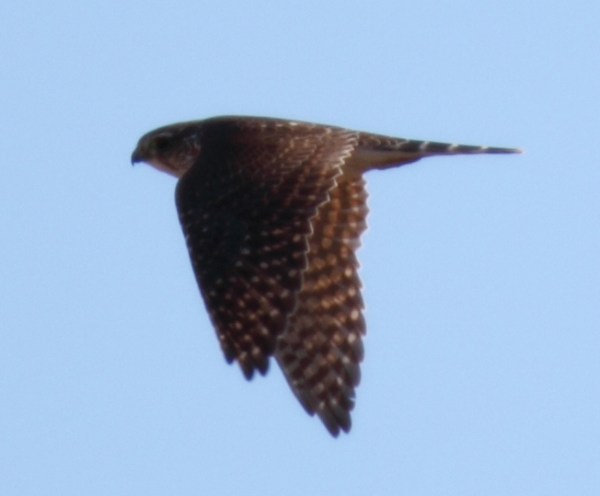
Merlin, S. Baker, 01/12/13
We turned onto Gaskell Road and drove west. As in past years, the area was good for raptors. We saw several Red-tailed Hawks (including 2 that were sparring in flight), 4 light morph Ferruginous Hawks and a few more Prairie Falcons. Passerine numbers and diversity were lower than in past years but we had good looks at a small flock of American Pipits, a Loggerhead Shrike and some Say’s Phoebes. A Coyote was hunting in one of the fields. The best bird was a dark morph Ferruginous Hawk that we first noticed when it was soaring nearby. As we watched, it came closer and closer and finally flew right over our heads.
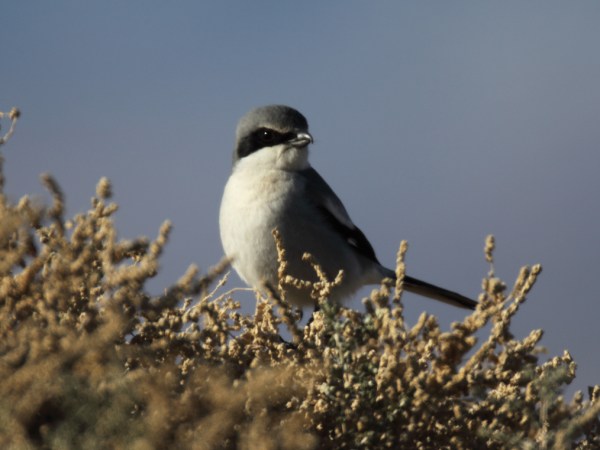
Loggerhead Shrike, S. Baker, 01/12/13
At that point we assumed — incorrectly, as it turned out — that we’d seen our last, best raptor of the day so we turned around and started back toward Hwy 14. As we drove east along Ave. A, we noticed a small, dark bird on a power pole. It was a very dark male Merlin that remained perched as we stopped to watch it in the afternoon light. It was the perfect end to an excellent day of raptor watching in the Antelope Valley.
Thanks to everyone who participated and a special “thank you” to Scott Baker for sharing his photos.
|
Sat, 12 Jan 2013 |
SMBAS, Antelope Valley |
||
|
numbers |
location |
||
|
Ross’s Goose |
Chen rossii |
2 |
Apollo Pk |
|
Canada Goose |
Branta canadensis |
10 |
Apollo Pk |
|
Mallard |
Anas platyrhynchos |
30 |
Apollo Pk |
|
Northern Shoveler |
Anas clypeata |
10 |
Apollo Pk |
|
Bufflehead |
Bucephala albeola |
2 |
Apollo Pk |
|
Hooded Merganser |
Lophodytes cucullatus |
6 |
Apollo Pk |
|
Ruddy Duck |
Oxyura jamaicensis |
2 |
Apollo Pk |
|
California Quail |
Callipepla californica |
9 |
Av P x E40th |
|
Eared Grebe |
Podiceps nigricollis |
3 |
Apollo Pk |
|
American White Pelican |
Pelecanus erythrorhynchos |
8 |
Apollo Pk |
|
Double-crested Cormorant |
Phalocrocorax auritus |
6 |
Apollo Pk |
|
Great Blue Heron |
Ardea herodias |
1 |
Apollo Pk |
|
Northern Harrier |
Circus cyaneus |
5 |
E10th x Rancho Vista; Av I x E110th; W60th x Av B |
|
Cooper’s Hawk |
Accipiter cooperii |
1 |
Av L x E40th |
|
Red-tailed Hawk |
Buteo jamaicensis |
50+ |
widespread |
|
Ferruginous Hawk |
Buteo regalis |
10 |
Av I x E110th; Gaskell Ave |
|
American Kestrel |
Falco sparverius |
15 |
scattered sites |
|
Merlin |
Falco columbarius |
3 |
W60th x Av B; Gaskell Rd; Av A x W100th |
|
Prairie Falcon |
Falco mexicanus |
6 |
E40th no. of Av M; W60th x Av D; Gaskell Av |
|
American Coot |
Fulica americana |
40 |
Apollo Pk |
|
Killdeer |
Charadrius vociferus |
100 |
widespread |
|
Mountain Plover |
Charadrius montanus |
10+ |
E40th St X Av M (prob); Av I x E110th |
|
Ring-billed Gull |
Larus delawarensis |
10 |
Apollo Pk |
|
California Gull |
Larus californicus |
225 |
E 10th north of Palmdale Blvd; Apollo Pk |
|
Rock Pigeon [I] |
Columba livia |
35 |
Palmdale Blvd; W60th St x Ave D |
|
Eurasian Collared-Dove [I] |
Streptopelia decaoto |
4 |
Av L x E4th; Gaskell Rd |
|
Mourning Dove |
Zenaida macroura |
6 |
scattered sites |
|
Say’s Phoebe |
Sayornis saya |
12 |
scattered sites |
|
Loggerhead Shrike |
Lanius ludovicianus |
15 |
scattered sites |
|
American Crow |
Corvus brachyrhynchos |
4 |
Palmdale Blvd; E10th x Rancho Vista |
|
Common Raven |
Corvus corax |
100+ |
widespread |
|
Horned Lark |
Eremophila alpestris |
1,500+ |
several sites inc Av N x E40th |
|
Western Bluebird |
Sialia currucoides |
1 |
Av P x E40th St |
|
Northern Mockingbird |
Mimus polyglottos |
2 |
Av P x E40th St; Gaskell |
|
European Starling [I] |
Sturnus vulgaris |
25 |
several sites, inc E40th x Av P |
|
American Pipit |
Anthus rubescens |
150 |
Gaskell Rd |
|
Sage Sparrow |
Amphispiza belli |
2 |
Av I x E120th St |
|
Savannah Sparrow |
Passerculus sandwichensis |
75 |
scattered sites |
|
Song Sparrow |
Melospiza melodia |
1 |
E40th north of Av M |
|
White-crowned Sparrow |
Zonotrichia leucophrys |
100 |
widespread |
|
Golden-crowned Sparrow |
Zonotrichia atricapilla |
1 |
Av P x E40th |
|
Western Meadowlark |
Sturnella neglecta |
100 |
widespread |
|
Brewer’s Blackbird |
Euphagus cyanocephalus |
150 |
widespread |
|
House Finch |
Carpodacus mexicanus |
200 |
widespread |
|
Lesser Goldfinch |
Carduelis psaltria |
1 |
Av P x E40th |
|
House Sparrow [I] |
Passer domesticus |
60 |
Palmdale Blvd; Apollo Pk |
Arctic Loon at Malibu Pier – Now!
Arctic Loons are extremely rare this far south on the west coast. Twenty years ago they were common, until the species was split into the Arctic and Pacific Loons. We haven’t had a real Arctic Loon here since then. It’s the Pacific Loon that’s fairly common here in the winter.
So it’s a big deal when one show up, as one did (and still is) by the Malibu Pier last Saturday, Jan. 12. Photos are still being studied, but consensus among local birders seems to lean very strongly towards calling it an Arctic.

Arctic Loon at Malibu Pier (Todd McGrath 1/14/13)
This photo is one of nine taken today by Todd McGrath. The entire set is here: http://www.flickr.com/photos/35719772@N06/sets/72157632525495380/
Todd had this to say about the bird: The size and structure of the bird favored Arctic, and the flank patches were present on both sides, and appeared to be the proper shape. The bird looked like a worn Juv, which may explain the faded look to the back of the head. The bill looked a little on the smaller side to me, although comparing the photos it looks in the ballpark for Arctic. I look forward to hearing the opinion of others on this interesting bird.
The bird was discovered when local birding expert Gene Cardiff was leading his UC Riverside Winter Birds Class at Malibu Pier. Class member Kyri Freeman was apparently the first to suggest that it might be an Arctic.
I am including a copy of Kyri’s report which Kimball Garrett posted today on LACoBirds. I think it is an excellent example of the kind of thought process and observations that a good birder goes through when dealing with a difficult identification.
[“We were watching a Common Loon, and initially when the mystery loon reappeared having caught a fish, we thought it was the same bird, until I pointed out it did not have “thumbprints” on its neck, the neck being clearly delineated between darker back and pale front. At this point we thought it must be a Pacific Loon. The bird then approached the north side of the pier so closely we could look straight down on it and didn’t need binoculars. At this point, I looked at the head and bill shape and the fact that I could see white on the rear corners of the bird when I was looking straight down on it, and I thought the head and bill looked exactly like the pictures of the Arctic Loon that SCBC have been posting from Monterey. I said, “Why isn’t this an Arctic Loon?”
Guidebooks were gotten out, and we noted that this bird did not have a chinstrap, but that does not eliminate a young Pacific Loon. Gene Cardiff felt that the bill looked heavier/longer than on a Pacific, in keeping with my feeling it looked just like the SCBC pictures, but that would not be diagnostic without a Pacific right there to compare, I don’t think. We also noted the warning in the Nat Geo guide that Pacific “can show some white” on the flank. At this point we were looking down on the bird and could not see how far above the waterline the white extended. The bird then hid under the pier for the next hour or so.
After walking back down the beach to observe the low tide changes, we came back to the pier area and saw the loon very close to the beach, maybe 15 feet off shore. At this point, we had a side view and saw that the white flanks curved upward in a half-circle, well above water line, both when the bird was swimming and when it flapped its wings. At this point, Gene said we had confirmed it as an Arctic Loon. It didn’t vocalize at any point. I thought its coming so close to shore and its confiding behavior seemed unusual, but don’t know if that is of any significance.
I can’t claim to be totally sure about this bird, since I am not an expert and have never seen a Pacific Loon at such close range for comparison. I do feel that the relevant field marks were seen very clearly and that it definitely did have white flanks above the waterline. If this is of any use, it most closely resembled Sibley’s painting of the first summer bird rather than the illustration of the adult which appears a bit darker in the dark parts.”]
David Bell supplies an additional photo as well as a video of the bird bobbing about on the water.
Difficult identifications depend on an assembly of details. You notice something odd. Check out that detail in a field guide if you have one. Often the guide will suggest something else to look for. Check that out. Don’t rely on a single field mark to nail it down.
Kimball Garrett passed along these comments from Todd and David as they were photographing the bird: Good Arctic characters include: consistent white flank patches, apparently large overall size, Arctic head shape (less rounded than Pacific), lack of chinstrap. However, the bill doesn’t look exceptionally large (but maybe within the range of female Arctic?) and the hindneck is paler than normally seen on Arctic (variable?). The bird is a juvenile, but not as heavily patterned on the upperparts as the bird currently in Monterey.
Additional Photo & Video from Chris Taylor: On 1/15/13 Chris posted this video of the bird. It bobs so buoyantly in the water I would think it was a cork decoy were it not for its constant looking around. He also has a really good photo here. Warning to the unwary: I find looking at Chris’ photos just a bit depressing because they are so astronomically better than mine.
I suggest that you get out your field guides, look at the various pictures, watch the videos, and figure out why other birders think it’s an Arctic and not a Pacific Loon, and whether you agree with them or not.
Congratulations to the finders and photographers.
[Chuck Almdale]
Malibu Lagoon Trip Lists July – December 2012
This list was created at a later date in order to have a complete record on the blog site. [Chuck Almdale]
| Malibu Census 2012 | 7/22 | 8/26 | 9/23 | 10/28 | 11/25 | 12/23 |
| Temperature | 64-70 | 70-78 | 73-80 | 72-78 | 60-62 | 50-60 |
| Tide Lo/Hi Height | H +2.34 | H +2.59 | L +2.88 | H +5.93 | H +5.83 | H +5.40 |
| Tide Time | 1121 | 1136 | 1021 | 0845 | 0647 | 0544 |
| Snow Goose | 1 | |||||
| Brant | 1 | 1 | ||||
| Gadwall | 4 | 8 | 12 | 12 | ||
| American Wigeon | 16 | 9 | ||||
| Mallard | 42 | 32 | 34 | 10 | 18 | 22 |
| Northern Shoveler | 4 | 11 | 18 | 18 | 14 | |
| Green-winged Teal | 3 | 9 | ||||
| Surf Scoter | 5 | |||||
| White-winged Scoter | 1 | |||||
| Bufflehead | 3 | 6 | ||||
| Red-brstd Merganser | 2 | 1 | 1 | 7 | 4 | |
| Ruddy Duck | 5 | 4 | 48 | 47 | ||
| Red-throated Loon | 7 | 3 | ||||
| Pacific Loon | 10 | 3 | ||||
| Common Loon | 1 | |||||
| Pied-billed Grebe | 4 | 10 | 7 | 2 | 4 | 4 |
| Horned Grebe | 2 | 1 | ||||
| Eared Grebe | 3 | 4 | 4 | 4 | ||
| Western Grebe | 3 | 12 | 5 | 27 | 35 | |
| Clark’s Grebe | 1 | |||||
| Blk-vented Shearwater | 200 | |||||
| Brandt’s Cormorant | 1 | 4 | 6 | 30 | ||
| Dble-crstd Cormorant | 24 | 34 | 45 | 45 | 24 | 42 |
| Pelagic Cormorant | 2 | 1 | 3 | |||
| Brown Pelican | 17 | 37 | 22 | 6 | 32 | 35 |
| Great Blue Heron | 1 | 5 | 5 | 2 | 2 | 2 |
| Great Egret | 1 | 1 | 1 | 6 | 1 | 2 |
| Snowy Egret | 11 | 14 | 8 | 6 | 10 | 18 |
| Blk-crwnd N-Heron | 1 | 1 | ||||
| Turkey Vulture | 2 | |||||
| Osprey | 1 | |||||
| Cooper’s Hawk | 1 | 1 | ||||
| Red-shouldered Hawk | 1 | |||||
| Red-tailed Hawk | 1 | 1 | ||||
| Peregrine Falcon | 1 | |||||
| American Coot | 12 | 33 | 270 | 250 | 194 | 210 |
| Blk-bellied Plover | 45 | 64 | 160 | 75 | 217 | 35 |
| Snowy Plover | 22 | 45 | 46 | 62 | 61 | 45 |
| Semipalmated Plover | 2 | 1 | ||||
| Killdeer | 3 | 5 | 6 | 12 | 11 | 2 |
| Black Oystercatcher | 1 | 1 | ||||
| Spotted Sandpiper | 1 | 4 | 3 | 3 | 2 | 1 |
| Greater Yellowlegs | 2 | |||||
| Willet | 2 | 3 | 7 | 34 | 6 | |
| Whimbrel | 42 | 52 | 38 | 2 | 1 | 4 |
| Marbled Godwit | 3 | 31 | 18 | |||
| Ruddy Turnstone | 5 | 9 | 14 | 15 | 5 | 6 |
| Black Turnstone | 2 | 2 | ||||
| Sanderling | 1 | 200 | 11 | 40 | ||
| Western Sandpiper | 2 | 6 | ||||
| Least Sandpiper | 3 | 6 | 14 | 21 | ||
| Pectoral Sandpiper | 1 | |||||
| Dunlin | 2 | |||||
| Short-billd Dowitcher | 2 | 3 | ||||
| Red-necked Phalarope | 1 | |||||
| Boneparte’s Gull | 1 | |||||
| Heermann’s Gull | 12 | 17 | 8 | 8 | 21 | 9 |
| Ring-billed Gull | 4 | 1 | 39 | 25 | 150 | |
| Western Gull | 95 | 134 | 93 | 6 | 55 | 300 |
| California Gull | 2 | 4 | 7 | 60 | 215 | 2150 |
| Herring Gull | 2 | |||||
| Glaucous-wingd Gull | 1 | 1 | 1 | |||
| Least Tern | 3 | |||||
| Forster’s Tern | 1 | 22 | 14 | 5 | ||
| Royal Tern | 3 | 3 | 11 | 11 | 3 | |
| Elegant Tern | 45 | 69 | 87 | 2 | ||
| Black Skimmer | 1 | |||||
| Rock Pigeon | 2 | 12 | 4 | 20 | 38 | 12 |
| Mourning Dove | 2 | 2 | 2 | |||
| Anna’s Hummingbird | 1 | 1 | 1 | |||
| Allen’s Hummingbird | 9 | 7 | 3 | 7 | 3 | 3 |
| Belted Kingfisher | 1 | 1 | 1 | |||
| Black Phoebe | 5 | 8 | 9 | 8 | 5 | 12 |
| Say’s Phoebe | 1 | 2 | 1 | |||
| Western Kingbird | 4 | |||||
| Western Scrub-Jay | 1 | 2 | 2 | 1 | ||
| American Crow | 6 | 5 | 1 | 9 | 5 | 6 |
| Rough-wingd Swallow | 5 | 2 | ||||
| Tree Swallow | 1 | |||||
| Barn Swallow | 20 | 22 | ||||
| Cliff Swallow | 15 | 1 | ||||
| Oak Titmouse | 1 | 1 | ||||
| Bushtit | 8 | 14 | 4 | 30 | ||
| Bewick’s Wren | 2 | 1 | ||||
| House Wren | 1 | 1 | ||||
| Ruby-crowned Kinglet | 1 | 1 | 1 | |||
| Wrentit | 1 | |||||
| Northern Mockingbird | 5 | 4 | 3 | 2 | 2 | |
| European Starling | 17 | 28 | 45 | 10 | 18 | |
| Ornge-crwnd Warbler | 1 | 3 | 1 | |||
| Yellow-rumpd Warbler | 25 | 12 | 16 | |||
| Common Yellowthroat | 1 | 1 | 2 | 5 | 3 | 2 |
| Spotted Towhee | 1 | |||||
| California Towhee | 1 | 1 | 3 | 2 | 2 | |
| Savannah Sparrow | 1 | |||||
| Song Sparrow | 4 | 3 | 1 | 3 | 4 | 8 |
| Lincoln’s Sparrow | 1 | |||||
| White-crwnd Sparrow | 4 | 4 | ||||
| Red-winged Blackbird | 8 | 40 | ||||
| Western Meadowlark | 1 | |||||
| Great-tailed Grackle | 5 | 7 | 6 | 8 | 7 | 9 |
| Hooded Oriole | 2 | |||||
| Bullock’s Oriole | 1 | 1 | ||||
| House Finch | 35 | 1 | 4 | 5 | 2 | |
| Lesser Goldfinch | 4 | 4 | 3 | 10 | ||
| American Goldfinch | 3 | |||||
| Totals by Type | July | Aug | Sep | Oct | Nov | Dec |
| Waterfowl | 49 | 36 | 51 | 57 | 120 | 120 |
| Water Birds-Other | 57 | 121 | 363 | 315 | 309 | 570 |
| Herons, Egrets | 13 | 20 | 14 | 15 | 14 | 22 |
| Raptors | 1 | 1 | 2 | 1 | 1 | 3 |
| Shorebirds | 128 | 196 | 275 | 400 | 394 | 158 |
| Gulls & Terns | 161 | 232 | 207 | 149 | 335 | 2617 |
| Doves | 4 | 14 | 4 | 20 | 38 | 14 |
| Other Non-Pass. | 10 | 7 | 3 | 9 | 5 | 4 |
| Passerines | 133 | 105 | 90 | 133 | 84 | 96 |
| Totals Birds | 556 | 732 | 1009 | 1099 | 1300 | 3604 |
| Total Species | July | Aug | Sep | Oct | Nov | Dec |
| Waterfowl | 4 | 2 | 4 | 6 | 10 | 9 |
| Water Birds-Other | 4 | 8 | 7 | 8 | 10 | 12 |
| Herons, Egrets | 3 | 3 | 3 | 4 | 4 | 3 |
| Raptors | 1 | 1 | 2 | 1 | 1 | 2 |
| Shorebirds | 11 | 13 | 10 | 12 | 10 | 10 |
| Gulls & Terns | 7 | 7 | 6 | 8 | 8 | 7 |
| Doves | 2 | 2 | 1 | 1 | 1 | 2 |
| Other Non-Pass. | 2 | 1 | 1 | 3 | 3 | 2 |
| Passerines | 18 | 16 | 15 | 21 | 15 | 16 |
| Totals Species – 106 | 52 | 53 | 49 | 64 | 62 | 63 |
“Al the Albatross,” Malibu Lagoon & Tidbits
Al the Albatross has returned to Pt. Arena yet again
Last January Lillian and I stopped by Pt. Arena in Northern California to look for Al. We’d been standing on the pier-end in a chill wind for about an hour, watching the surfers ride the large swells far offshore, when Al came swooping in past us and landed on the water. A few minutes later one of the surfers paddled over to Al and they appeared to have a very friendly meeting and conversation. When we left after an hour or so, Al was still there. A very attractive and informative sign at the foot of the pier tells visitors about Al.

Al the Albatross in his/her element. (MCS)
Mendocino County Audubon has put up a nice webpage about Al – or Alice, as the case may be. No one knows the sex. The page records sightings from Feb. 1993 through Dec. 2011. Mendocino recently learned that an albatross was reported on 2/15/91 and it assumed that it was Al, but this data isn’t on the page.
Check it out, and if you’ve never seen an albatross in person, go see Al. Seeing one in flight is, in my opinion, one of the great moments in any birder’s life.
*************************
Malibu Lagoon Update
As usual, we continually add photos, data and links to our Malibu Lagoon 2012 Project Page, including a recent aerial photo, more photos including the big gull flock in mid-December, and data for Oct – Dec. Species diversity during the project period still remains a tad (1.6 birds or -3%) under average. Total birds remains high, jumping from 17% over average at the end of November to +30% on Dec. 23, due to the big gull flock which showed up after the lagoon breached the beach early in the month.
Malibu Patch posted a Dec. 25 blog about the extension of the project permit to March 15, 2013.
In an email to Patch editor Jessica Davis, Craig Sap, CSP Angeles District Superintendent explained that the extension request was caused by unexpected delays, which were, briefly:
1. Longer than expected nesting by migratory birds [Mallards & Black Phoebes – Ed.]
2. The June 19 designation by USFWS of Snowy Plover habitat within the channel project area [where they’ve never been seen – Ed.]
3. Path grading necessitated by settlement with the colony about not building a border wall.
4. Unstable soil under structures required additional excavation & cement.
5. Interpretive area plan errors needed redesign.
6. Intricate designs of some structures need additional time to fabricate.
7. Legal proceedings delayed upland plant propagation which delayed implantation.
8. December was very rainy, preventing equipment use in soggy soils.
The Malibu Patch article has much more detail.
*************************
A brief story about a Christmas Curlew of a century ago, from Rick Wright. [Rick says it’s really a Whimbrel.]
*************************
If you haven’t heard about the YouTube video of an “eagle” snatching a human “baby,” here’s a link to one site which has the film and briefly discusses it. One comment I read elsewhere said the bird in the video was a Steppe Eagle, a species that barely makes it to Manchuria, China, let alone Montreal, Canada, where the film was made. So…don’t believe everything you read on the net – unless you read it here of course (unless it’s an April 1 posting). [Chuck Almdale]

Steppe Eagle – a real one (Lynx Editions)
Malibu Lagoon Field Trip Report: 23 Dec. 2012
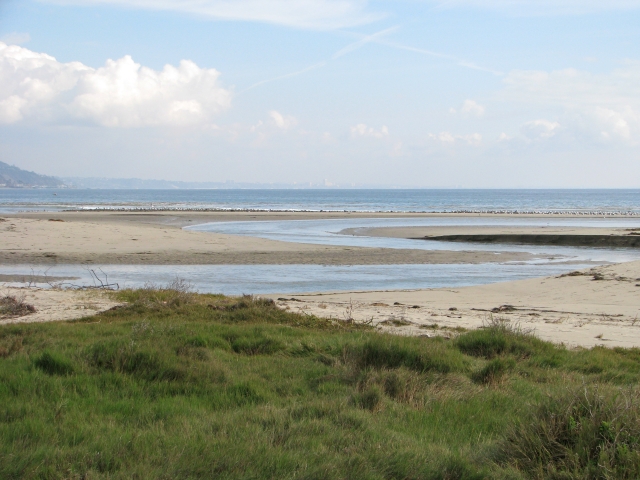
The beach breach (C. Almdale 12/23/12)
Within a few days after rain-swelled Malibu Creek broke through the beach, reports about hordes of gulls at the lagoon began flowing in from L.A. area birders. Estimates ranged from 2000 to 5000 birds. Always on the lookout for storm-brought vagrants, birders searched through the crowd; alas, nothing rare was found.
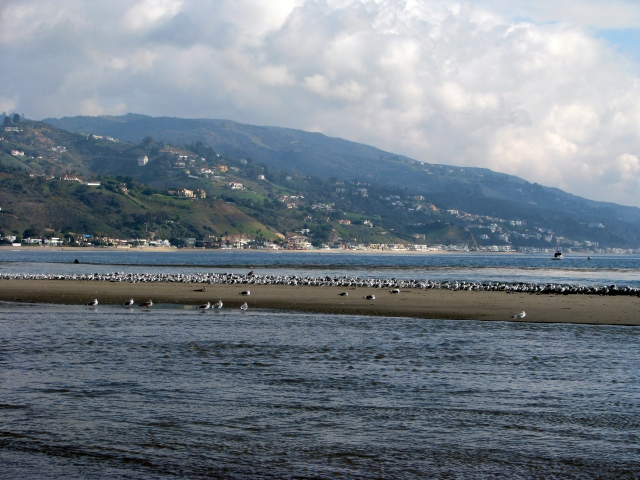
Gulls on low tide exposed beach, Santa Monica Mtns in background
(C. Almdale 12/23/12)
We found the largest gull flock on the mud flat between the channel mouth and the west end of PCH bridge. Every 10-20 minutes they’d fling themselves into the sky to swirl in a dense cloud; we looked for raptors – Peregrine Falcon for instance – frightening them, but saw none. Perhaps they were just jumpy. By the time we got to the beach and began sorting through them, most had moved to the sand and stones exposed by the lowering tide. I counted (roughly) 2600 birds. Out on the sea, well past the kelp beds were two additional gull flocks with easily as many as on shore. Even farther out were many more gulls as well as Brown Pelicans and cormorants flying and diving; southbound shearwaters streamed through them. Except for the shearwaters, none of these birds are included in the counts below. There were probably far more shearwaters than the 200 I recorded, Although they were really too far for positive ID, I’m calling them Black-vented, as this species will now be heading south to their nesting islands off the coast of Baja California. As usual, the Brandt’s and Pelagic Cormorants were on the offshore rocks or swimming nearby, while the Double-crested Cormorants occupied the snags in the lagoon.
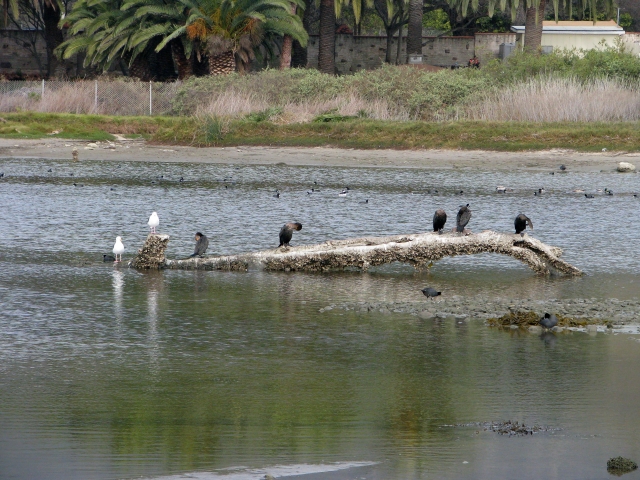
Some of the snag-loving cormorants (C. Almdale 12/23/12)
Dredging work on the channel is finished. More flagged plants are in appearance. The cement ‘winter tidal clock’ path has advanced, and one of the bird observation platforms is going up. The originally scheduled completion date was Jan. 31, but Mark Abramson informed me that the contractor received a time extension for additional work, and worst case completion date should be March 1.
Migrants and wintering birds continue to arrive, including: Surf Scoter, Turkey Vulture, Herring Gull, Wrentit and American Goldfinch.. The last two species are certainly commonly seen in SoCal but have appeared on our monthly walks only 13 and 10 times, respectively, out of 279 recorded trips. The Wrentit was in a bush near Adamson boat house; the goldfinches were eating berries in the brush between PCH and the lagoon parking lot.
Other continuing wintering birds were: Brant, Green-winged Teal, Bufflehead, Red-throated & Pacific Loons, Glaucous-winged Gull, the female Belted Kingfisher, Say’s Phoebe, Ruby-crowned Kinglet, Orange-crowned and Yellow-rumped Warblers, and Lesser Goldfinch. A juvenile Red-tailed Hawk was apparently snoozing in one of the cypresses at the SW corner of the channel area, a common raptor roosting site.
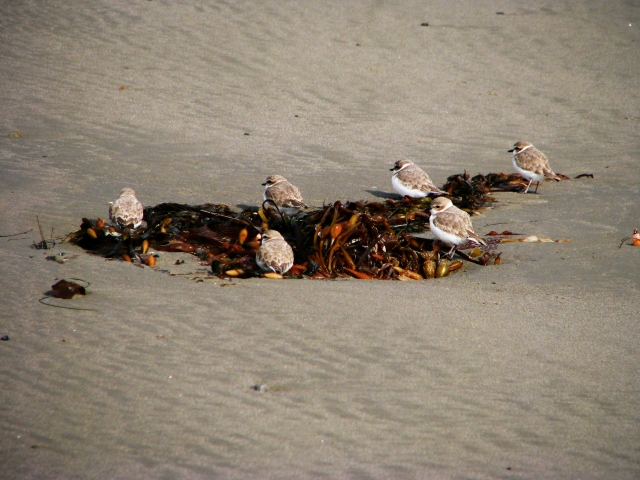
Six Snowy Plovers surround beach wrack (C. Almdale 12/23/12)
Snowy Plover PV:YB (left leg Pink above Violet: right leg Yellow above Blue), present on Surfrider Beach since Sept., is still there. Most of the 45 Snowy Plovers were found alongside the gulls on the exposed sand and rocky shore.
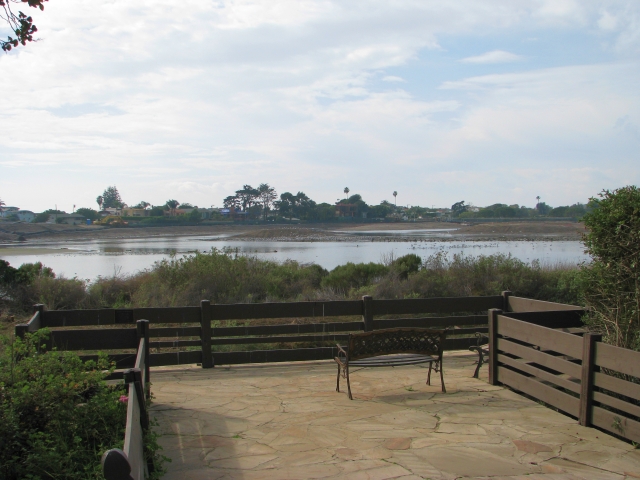
Adamson boat house view of channel & gulls (C. Almdale 12/23/12)
Although cool, it was a very pleasant, sunny day. About a half dozen new faces were with us, including Lucinda, a young woman from Argentina who has been watching and photographing birds for about 1½ years. Mary Ann Webster of the Sierra Club Angeles Chapter stopped to thank us for our many comments on Malibu Patch blog. Some small children played in the outlet stream until I warned their parents that the water is most polluted right after rainstorms such as we’d recently seen.
Our next three field trips: Antelope Valley Raptor Search, 12 Jan., 8:00am; Malibu Lagoon, 27 Jan., 8:30am; Ballona Creek Jetty, 9 Feb., 8:00am.
Our next program: Tuesday, 5 Feb., 7:30 pm. Bird Photography, presented by Ralph Clevenger. The usual reminders will be emailed from the blog.
NOTE: Our 10 a.m. Parent’s & Kids Birdwalk will probably resume on 24 March, 2013.
Links: Unusual birds at Malibu Lagoon
Aerial photo of Malibu Lagoon from 9/23/02.
Prior checklists: July-Dec’11, Jan-June’11, July-Dec ’10, Jan-June ’10, Jul-Dec ‘09, and Jan-June ‘09.
Comments on Bird Lists Below
Total Birds: Dec. total birds of 3604 are 30% above average primarily due to the gulls which were 50% above average. This is not outrageously high; we’ve recorded similar numbers previously in Nov, Dec, or Jan, including over 4000 gulls on 12/26/10. Monthly total bird numbers relative to average continue to be up, down, up, down since the project began last June.
Species Diversity: December 2012 with 63 species was slightly below (-4%) the 6-year average of 65.7.
Summary of species diversity from the 6-year average so far: June -10%, July +10%, Aug. -6%, Sep. -20%, Oct. +5%, Nov +2%, Dec -4%. Still, the only constant is constant change.
10-year comparison summaries are available near the bottom of our Lagoon Project Page. [Chuck Almdale]
| Malibu Census | 2007 | 2008 | 2009 | 2010 | 2011 | 2012 | |
| December 2007-12 | 23-Dec | 28-Dec | 27-Dec | 26-Dec | 25-Dec | 23-Dec | |
| Temperature | 50-60 | 50-62 | 50-66 | 50-60 | |||
| Tide Lo/Hi Height | H +7.2 | H +6.0 | L +0.2 | L +2.13 | H +6.80 | H +5.40 | Ave. |
| Tide Time | 0745 | 0850 | 1241 | 0649 | 0850 | 0544 | Birds |
| Snow Goose | 3 | 0.5 | |||||
| Ross’ Goose | 4 | 0.7 | |||||
| Brant | 1 | 0.2 | |||||
| Gadwall | 14 | 18 | 23 | 16 | 35 | 12 | 19.7 |
| American Wigeon | 6 | 26 | 8 | 4 | 7.3 | ||
| Mallard | 7 | 8 | 16 | 29 | 8 | 22 | 15.0 |
| Cinnamon Teal | 1 | 0.2 | |||||
| Northern Shoveler | 18 | 32 | 15 | 18 | 30 | 14 | 21.2 |
| Northern Pintail | 1 | 7 | 1.3 | ||||
| Green-winged Teal | 10 | 8 | 8 | 17 | 40 | 9 | 15.3 |
| Lesser Scaup | 1 | 0.2 | |||||
| Surf Scoter | 25 | 16 | 50 | 10 | 5 | 17.7 | |
| Long-tailed Duck | 1 | 0.2 | |||||
| Bufflehead | 5 | 25 | 6 | 12 | 6 | 9.0 | |
| Red-brstd Merganser | 7 | 6 | 3 | 3 | 4 | 4 | 4.5 |
| Ruddy Duck | 14 | 23 | 25 | 51 | 40 | 47 | 33.3 |
| Red-throated Loon | 3 | 1 | 3 | 1.2 | |||
| Pacific Loon | 1 | 5 | 5 | 3 | 2.3 | ||
| Common Loon | 2 | 2 | 1 | 1 | 1.0 | ||
| Pied-billed Grebe | 6 | 3 | 5 | 4 | 3 | 4 | 4.2 |
| Horned Grebe | 3 | 2 | 1 | 1.0 | |||
| Eared Grebe | 6 | 2 | 1 | 2 | 3 | 4 | 3.0 |
| Western Grebe | 55 | 2 | 4 | 35 | 25 | 35 | 26.0 |
| Blk-vented Shearwater | 200 | 200 | 66.7 | ||||
| Brandt’s Cormorant | 1 | 12 | 6 | 30 | 8.2 | ||
| Dble-crstd Cormorant | 37 | 33 | 35 | 47 | 62 | 42 | 42.7 |
| Pelagic Cormorant | 2 | 3 | 1 | 1 | 3 | 1.7 | |
| Brown Pelican | 33 | 67 | 56 | 13 | 12 | 35 | 36.0 |
| Great Blue Heron | 7 | 5 | 4 | 1 | 2 | 2 | 3.5 |
| Great Egret | 2 | 1 | 3 | 2 | 1.3 | ||
| Snowy Egret | 13 | 8 | 20 | 16 | 22 | 18 | 16.2 |
| Cattle Egret | 1 | 0.2 | |||||
| Blk-crwnd N-Heron | 11 | 2 | 6 | 5 | 4.0 | ||
| Turkey Vulture | 2 | 0.3 | |||||
| Osprey | 2 | 1 | 0.5 | ||||
| Cooper’s Hawk | 1 | 0.2 | |||||
| Red-shouldered Hawk | 1 | 1 | 1 | 0.5 | |||
| Red-tailed Hawk | 2 | 1 | 2 | 1 | 1.0 | ||
| Peregrine Falcon | 1 | 0.2 | |||||
| Virginia Rail | 1 | 2 | 0.5 | ||||
| Sora | 2 | 3 | 2 | 1.2 | |||
| American Coot | 323 | 210 | 403 | 237 | 280 | 210 | 277.2 |
| Blk-bellied Plover | 63 | 45 | 45 | 44 | 140 | 35 | 62.0 |
| Snowy Plover | 24 | 60 | 59 | 46 | 58 | 45 | 48.7 |
| Killdeer | 13 | 3 | 4 | 3 | 1 | 2 | 4.3 |
| Black Oystercatcher | 4 | 1 | 0.8 | ||||
| American Avocet | 5 | 1 | 1.0 | ||||
| Spotted Sandpiper | 1 | 1 | 2 | 3 | 2 | 1 | 1.7 |
| Willet | 5 | 27 | 12 | 8 | 1 | 6 | 9.8 |
| Whimbrel | 2 | 1 | 4 | 2 | 3 | 4 | 2.7 |
| Marbled Godwit | 23 | 8 | 14 | 43 | 1 | 18 | 17.8 |
| Ruddy Turnstone | 7 | 11 | 18 | 11 | 2 | 6 | 9.2 |
| Sanderling | 11 | 180 | 115 | 150 | 110 | 40 | 101.0 |
| Least Sandpiper | 1 | 3 | 35 | 12 | 8.5 | ||
| Wilson’s Snipe | 1 | 0.2 | |||||
| Boneparte’s Gull | 1 | 1 | 0.3 | ||||
| Heermann’s Gull | 6 | 15 | 24 | 11 | 13 | 9 | 13.0 |
| Mew Gull | 1 | 0.2 | |||||
| Ring-billed Gull | 57 | 45 | 360 | 130 | 175 | 150 | 152.8 |
| Western Gull | 113 | 82 | 68 | 110 | 90 | 300 | 127.2 |
| California Gull | 165 | 140 | 1060 | 3850 | 1200 | 2150 | 1427.5 |
| Herring Gull | 4 | 1 | 2 | 1.2 | |||
| Glaucous-wingd Gull | 1 | 3 | 1 | 4 | 1 | 1.7 | |
| Caspian Tern | 1 | 0.2 | |||||
| Forster’s Tern | 1 | 1 | 1 | 3 | 5 | 1.8 | |
| Royal Tern | 4 | 1 | 0.8 | ||||
| Black Skimmer | 6 | 1.0 | |||||
| Rock Pigeon | 6 | 8 | 4 | 13 | 4 | 12 | 7.8 |
| Mourning Dove | 3 | 2 | 2 | 1 | 2 | 2 | 2.0 |
| Anna’s Hummingbird | 8 | 2 | 3 | 3 | 1 | 2.8 | |
| Allen’s Hummingbird | 3 | 4 | 2 | 2 | 2 | 3 | 2.7 |
| Belted Kingfisher | 1 | 1 | 1 | 1 | 1 | 0.8 | |
| Black Phoebe | 4 | 10 | 5 | 5 | 3 | 12 | 6.5 |
| Say’s Phoebe | 2 | 2 | 2 | 1 | 2 | 1 | 1.7 |
| Western Scrub-Jay | 1 | 0.2 | |||||
| American Crow | 32 | 6 | 2 | 18 | 4 | 6 | 11.3 |
| Bushtit | 14 | 5 | 30 | 8.2 | |||
| Bewick’s Wren | 1 | 3 | 2 | 1.0 | |||
| House Wren | 1 | 2 | 0.5 | ||||
| Marsh Wren | 2 | 1 | 0.5 | ||||
| Ruby-crowned Kinglet | 2 | 1 | 1 | 1 | 0.8 | ||
| Wrentit | 1 | 0.2 | |||||
| Northern Mockingbird | 3 | 2 | 1 | 1 | 1.2 | ||
| European Starling | 41 | 6 | 10 | 15 | 5 | 18 | 15.8 |
| Ornge-crwnd Warbler | 1 | 1 | 1 | 0.5 | |||
| Yellow-rumpd Warbler | 35 | 40 | 12 | 12 | 8 | 16 | 20.5 |
| Common Yellowthroat | 5 | 6 | 5 | 4 | 4 | 2 | 4.3 |
| Spotted Towhee | 1 | 1 | 1 | 0.5 | |||
| California Towhee | 2 | 4 | 2 | 1.3 | |||
| Savannah Sparrow | 3 | 1 | 0.7 | ||||
| Song Sparrow | 4 | 5 | 4 | 4 | 4 | 8 | 4.8 |
| Lincoln’s Sparrow | 2 | 1 | 0.5 | ||||
| White-crwnd Sparrow | 18 | 1 | 9 | 15 | 4 | 7.8 | |
| Red-winged Blackbird | 10 | 2 | 15 | 4.5 | |||
| Western Meadowlark | 2 | 0.3 | |||||
| Brewer’s Blackbird | 8 | 6 | 2.3 | ||||
| Great-tailed Grackle | 1 | 2 | 9 | 2.0 | |||
| House Finch | 9 | 6 | 6 | 2 | 5 | 2 | 5.0 |
| Lesser Goldfinch | 4 | 2 | 7 | 5 | 10 | 4.7 | |
| American Goldfinch | 2 | 3 | 0.8 | ||||
| Totals by Type | 23-Dec | 28-Dec | 27-Dec | 26-Dec | 25-Dec | 23-Dec | Ave. |
| Waterfowl | 107 | 117 | 193 | 159 | 181 | 120 | 146 |
| Water Birds-Other | 467 | 333 | 519 | 349 | 598 | 570 | 473 |
| Herons, Egrets | 33 | 16 | 24 | 26 | 30 | 22 | 25 |
| Raptors | 2 | 2 | 1 | 6 | 2 | 3 | 3 |
| Shorebirds | 150 | 339 | 313 | 315 | 331 | 158 | 268 |
| Gulls & Terns | 348 | 291 | 1515 | 4113 | 1482 | 2617 | 1728 |
| Doves | 9 | 10 | 6 | 14 | 6 | 14 | 10 |
| Other Non-Pass. | 12 | 7 | 6 | 5 | 4 | 4 | 6 |
| Passerines | 184 | 113 | 61 | 86 | 111 | 96 | 109 |
| Totals Birds | 1312 | 1228 | 2638 | 5073 | 2745 | 3604 | 2767 |
| Total Species | 23-Dec | 28-Dec | 27-Dec | 26-Dec | 25-Dec | 23-Dec | Ave. |
| Waterfowl | 10 | 8 | 11 | 10 | 10 | 9 | 9.7 |
| Water Birds-Other | 10 | 9 | 11 | 11 | 13 | 12 | 11.0 |
| Herons, Egrets | 4 | 4 | 2 | 4 | 4 | 3 | 3.5 |
| Raptors | 1 | 2 | 1 | 4 | 2 | 2 | 2.0 |
| Shorebirds | 10 | 10 | 12 | 10 | 11 | 10 | 10.5 |
| Gulls & Terns | 8 | 8 | 7 | 8 | 6 | 7 | 7.3 |
| Doves | 2 | 2 | 2 | 2 | 2 | 2 | 2.0 |
| Other Non-Pass. | 3 | 3 | 3 | 2 | 3 | 2 | 2.7 |
| Passerines | 16 | 19 | 14 | 17 | 20 | 16 | 17.0 |
| Totals Species – 100 | 64 | 65 | 63 | 68 | 71 | 63 | 65.7 |



 SANTA MONICA BAY AUDUBON SOCIETY BLOG