Free email delivery
Please sign up for email delivery in the subscription area to the right.
No salesman will call, at least not from us. Maybe from someone else.
Lagoon Breach Photos & News Roundup
View of Malibu Lagoon and channel area from east side of the breach.
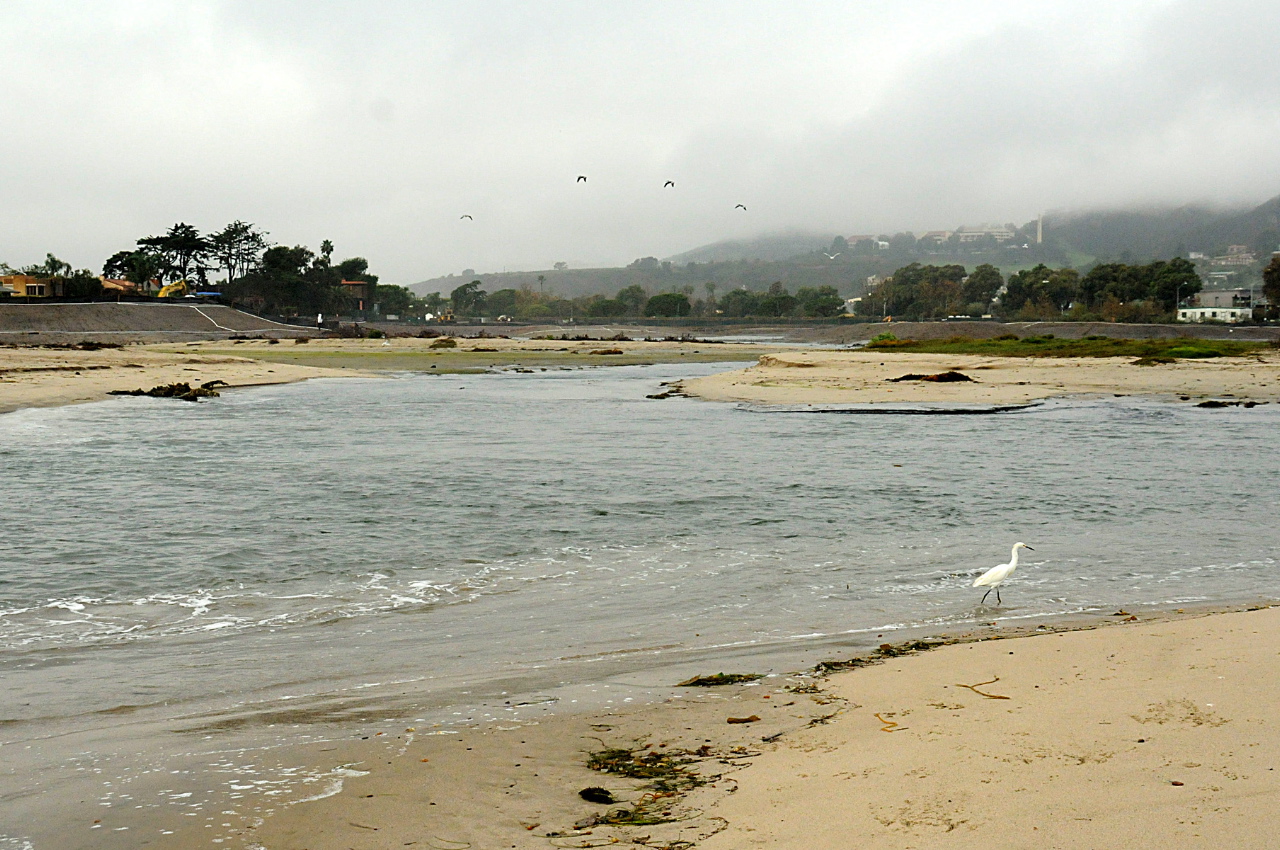
Rain causes Surfrider Beach to breach (J. Kenney 12/3/12)
- The usual suspects are at the scene but, as usual, “no one saw nothin’!”
**************************
Two articles from GrrlScientist at TheGuardian
Polly gets his own cracker: clever cockatoo manufactures, uses tools
Not known to manufacture or use tools in the wild, a captive cockatoo demonstrates that parrots can make tools to suit their needs. A captive Goffin’s Cockatoo named Figaro who has impressed scientists by spontaneously making and using tools to fetch cashew nuts. The story includes lots of photos and a video of the ten trials this bird “passed.”
Sing for Your Supper: Fairy-Wren Chicks Must Sing Vocal Password for Food
Female Superb Fairy-Wrens teach their chicks a vocal password before they hatch to distinguish them from brood parasitic Bronze-Cuckoo chicks. The authors show that superb fairy-wren chicks learn “song” whilst still embryos! Their mother sings a special incubation call to her eggs only before they hatch. After hatching, these chicks must sing this “auditory password” as their begging call in order for the parents to feed them. Since this species is host for the brood-parasite Horsfield’s bronze-cuckoo, this vocal password allows the parents to distinguish their chicks from the parasitic chicks and take evasive action.
**************************
And…
To Birds, Storm Survival is Only Natural
Biologists studying the hurricane’s aftermath say there is remarkably little evidence that birds, or any other countable, charismatic fauna for that matter, have suffered the sort of mass casualties seen in environmental disasters like the BP oil spill of 2010.
New York Times 11/12/12 – Natalie Angier
**************************
And three articles from Rick Wright at Birding New Jersey
Birds, Mirrors & 16th Pisa
Birders have probably been watching birds watch themselves in mirrors for about as long as there have been mirrors and bird watchers.
Birding New Jersey 11/17/12 – Rick Wright
Bioluminescent Bitterns
Whether for the birder on your shopping list or for yourself, a bedside table or backyard could use one of these.
Birding New Jersey 11/21/12 – Rick Wright
Spare Parts, Strange Bedfellows
The Mexican headdress in Vienna’s Museum for Ethnology.
You may know about the hundreds of Resplendent Quetzals, Lovely Cotingas, Squirrel Cuckoos, and Roseate Spoonbills that had surrendered their plumes to this spectacular object, but what you might not know is that a couple of dozen White-throated (Smyrna) Kingfishers also made the ultimate sacrifice–nearly four hundred years later.
Birding New Jersey 11/17/12 – Rick Wright
We now have a permanent link to Rick’s website “Birding New Jersey & the World” in the right margin under “Bird Links.”
**************************
[Chuck Almdale]
Bird Photo & News
Great Photo from SMBAS member James Kenney!
Northern Flicker – Red-shafted x Yellow-shafted hybrid or intergrade
Taken at King Gillette S.P, 11/26/12
Compare it to your field guide pictures.
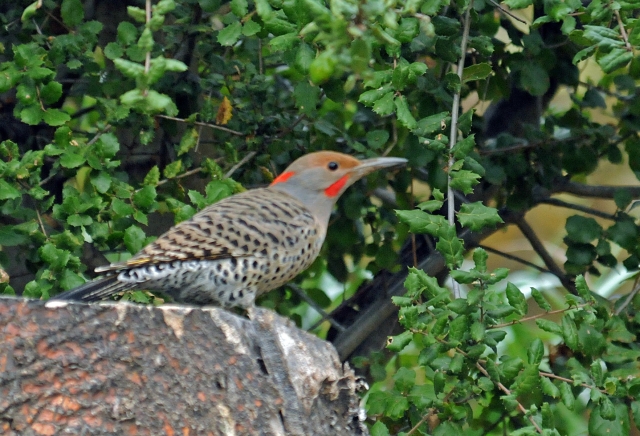
Northern Flicker Red-shafted x Yellow-shafted (J. Kenney 11/26/12)
**************************
New Link to Ornithologist Roger Lederer’s Ornithology.com
Loads of fascinating information
Now located permanently in our right margin under “Bird Links”
**************************
Malibu Lagoon Project Page
We’ve added two new films this week (nos. 13 & 14), about 20 new pictures, and summary data for October & November.
**************************
California Audubon’s Page on Protecting the Snowy Plover
A nestful of information.
**************************
Prehistoric Flamingo Nests Discovered in Spain
Huffington Post 10/20/12 – Megan Gannon
**************************
First Ever Family Tree for all Living Birds reveals Evolution and Divirsification
University of Sheffield News 10/30/12
**************************
[Chuck Almdale]
Malibu Lagoon Trip Report: 25 November, 2012
Don’t forget to visit our page devoted to the Malibu Lagoon 2012 Project, frequently updated with new photos. We recently added a new interview with Suzanne Goode, Also look for the link to the plant revegetation list.
Foggy and cool. We could barely see across the lagoon and by noon the temperature had climbed all the way from 60° to 62°. The photos tell the tale.
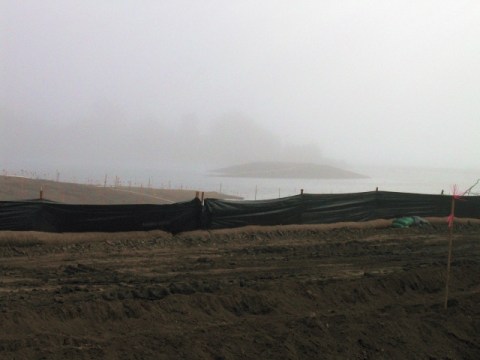
Foggy channel (L. Johnson 11/25/12)
Surf was so flat that only 2 surfers and 2 kayaks bothered to show. The birds were good though, and we almost had the beach to ourselves. The Revegetation continues, the grading appears complete and the channel is fully open to the lagoon. The paths, swale and various structures are still under construction. The path to the beach – like the proverbial path to heaven – is “strait and narrow.” Walking it is reminiscent of a trip to the funhouse.
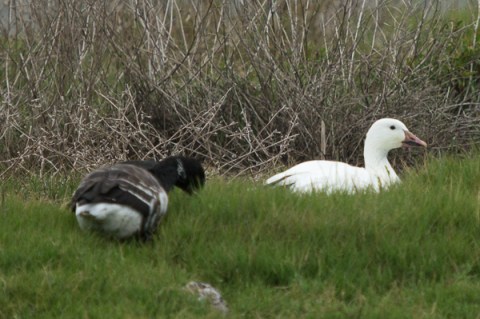
Brant keeps the Snow Goose company (C. Bragg 11/25/12)
Migrants continue to arrive, including: Snow Goose, Brant, Green-winged Teal, Bufflehead, Red-throated & Pacific Loons, Cooper’s Hawk, Boneparte’s Gull, and a Tree Swallow (a late migrant). We didn’t see any of last month’s Horned & Clark’s Grebes, Black Turnstone or Dunlin. The Red-tailed Hawk was probably snoozing, waiting for the sun to appear.
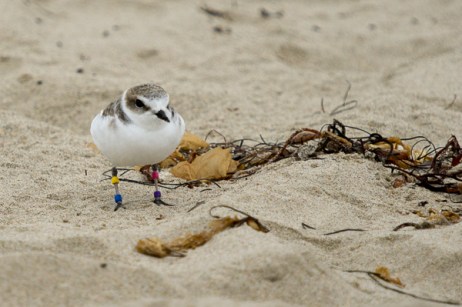
Snowy Plover PV:YB – winter beach resident (C. Bragg 11/25/12)
Snowy Plover PV:YB (bird’s left leg Pink above Violet: right leg Yellow above Blue), present on Surfrider Beach since Sept., was joined by his comrade-in-wings GG:AR (green/green:aqua/red), who was with us last December & January (and probably longer). The total Snowy Plover of 61 is an all-time high for November.

Snowy Plover PV:YB – closeup of legs (C. Bragg 11/25/12)
Our next three field trips: Carrizo Plains, 8 Dec., 9:00am; Butterbredt Christmas Count, 15 Dec., 8:00am., Malibu Lagoon, 23 Dec, 8:30am.
Our next program: Tuesday, 4 December, 7:30 pm. Anticoagulant Poisons and So. Californian Bobcats – Laurel Klein Serieys. The usual reminders will be emailed from the blog.
NOTE: Our 10 a.m. Parent’s & Kids Birdwalk remains canceled until the parking lot is again fully available.
Links: Unusual birds at Malibu Lagoon
Aerial photo of Malibu Lagoon from 9/23/02.
Prior checklists: July-Dec’11, Jan-June’11, July-Dec ’10, Jan-June ’10, Jul-Dec ‘09, and Jan-June ‘09.
Comments on Bird Lists Below
Total Birds: Nov. total birds of 1300 are 5% below average (Oct was up 3%), an insignificant amount. Brown Pelican numbers are finally average after being down since July. Willets and Marbled Godwits were well above average, but Sanderlings were nearly absent. European Starlings and Red-winged Blackbirds either decided to sleep in or we just couldn’t see them through the fog. Monthly total bird numbers have been up & down, up & down since the project began last June.
Species Diversity: Of 96 total species appearing in November for 2007-12, no more than about 5/8ths of them appear on any single day. October 2012 with 62 species was average, as were all 9 categories of birds.
Summary of species diversity from the 6-year average so far: May +4%, June -10%, July +10%, Aug. -6%, Sep. -20%, Oct. +5%, Nov +2%. Still, the only constant is change. [Chuck Almdale]
| Malibu Census | 2007 | 2008 | 2009 | 2010 | 2011 | 2012 | |
| November 2007-12 | 11/25 | 11/23 | 11/22 | 11/28 | 11/27 | 11/25 | |
| Temperature | 60-72 | 55-65 | 70 | 60-62 | |||
| Tide Lo/Hi Height | H +7.2 | H +5.8 | H +4.6 | L +2.59 | H +6.63 | H +5.83 | Ave. |
| Tide Time | 0839 | 0608 | 1137 | 0842 | 0945 | 0647 | Birds |
| Snow Goose | 1 | 0.2 | |||||
| Brant | 1 | 0.2 | |||||
| Canada Goose | 9 | 1.5 | |||||
| Gadwall | 10 | 35 | 7 | 6 | 4 | 12 | 12.3 |
| American Wigeon | 2 | 15 | 6 | 14 | 15 | 9 | 10.2 |
| Mallard | 30 | 22 | 15 | 18 | 30 | 18 | 22.2 |
| Northern Shoveler | 16 | 12 | 5 | 10 | 10 | 18 | 11.8 |
| Green-winged Teal | 4 | 6 | 7 | 4 | 3 | 4.0 | |
| Lesser Scaup | 8 | 1 | 1.5 | ||||
| Surf Scoter | 2 | 24 | 15 | 6.8 | |||
| Bufflehead | 8 | 5 | 6 | 8 | 3 | 5.0 | |
| Red-brstd Merganser | 3 | 2 | 1 | 5 | 9 | 7 | 4.5 |
| Ruddy Duck | 4 | 25 | 20 | 26 | 3 | 48 | 21.0 |
| Red-throated Loon | 7 | 1.2 | |||||
| Pacific Loon | 1 | 1 | 10 | 2.0 | |||
| Common Loon | 1 | 1 | 1 | 0.5 | |||
| Pied-billed Grebe | 10 | 6 | 5 | 2 | 1 | 4 | 4.7 |
| Horned Grebe | 1 | 0.2 | |||||
| Red-necked Grebe | 1 | 0.2 | |||||
| Eared Grebe | 2 | 6 | 6 | 4 | 3.0 | ||
| Western Grebe | 8 | 20 | 15 | 16 | 6 | 27 | 15.3 |
| Brandt’s Cormorant | 10 | 2 | 2 | 6 | 3.3 | ||
| Dble-crstd Cormorant | 13 | 25 | 29 | 37 | 31 | 24 | 26.5 |
| Pelagic Cormorant | 1 | 1 | 1 | 1 | 1 | 0.8 | |
| Brown Pelican | 92 | 18 | 12 | 40 | 8 | 32 | 33.7 |
| Great Blue Heron | 5 | 6 | 3 | 7 | 2 | 2 | 4.2 |
| Great Egret | 4 | 1 | 1 | 4 | 3 | 1 | 2.3 |
| Snowy Egret | 15 | 4 | 8 | 31 | 30 | 10 | 16.3 |
| Cattle Egret | 1 | 0.2 | |||||
| Green Heron | 1 | 0.2 | |||||
| Blk-crwnd N-Heron | 4 | 5 | 1 | 8 | 1 | 3.2 | |
| Osprey | 1 | 0.2 | |||||
| Cooper’s Hawk | 1 | 1 | 0.3 | ||||
| Red-shouldered Hawk | 1 | 0.2 | |||||
| Red-tailed Hawk | 2 | 2 | 1 | 0.8 | |||
| American Kestrel | 1 | 1 | 0.3 | ||||
| Merlin | 1 | 0.2 | |||||
| Peregrine Falcon | 1 | 0.2 | |||||
| Virginia Rail | 1 | 1 | 1 | 0.5 | |||
| Sora | 2 | 6 | 7 | 3 | 3.0 | ||
| American Coot | 320 | 85 | 295 | 206 | 57 | 194 | 192.8 |
| Blk-bellied Plover | 39 | 24 | 89 | 110 | 263 | 217 | 123.7 |
| Snowy Plover | 3 | 54 | 48 | 58 | 52 | 61 | 46.0 |
| Killdeer | 9 | 4 | 3 | 5 | 5 | 11 | 6.2 |
| Spotted Sandpiper | 2 | 1 | 2 | 2 | 2 | 2 | 1.8 |
| Greater Yellowlegs | 1 | 0.2 | |||||
| Willet | 11 | 12 | 18 | 2 | 4 | 34 | 13.5 |
| Whimbrel | 3 | 5 | 2 | 1 | 1.8 | ||
| Marbled Godwit | 4 | 8 | 14 | 31 | 9.5 | ||
| Ruddy Turnstone | 3 | 32 | 13 | 13 | 1 | 5 | 11.2 |
| Black Turnstone | 1 | 8 | 1 | 1.7 | |||
| Sanderling | 60 | 58 | 155 | 290 | 308 | 11 | 147.0 |
| Least Sandpiper | 1 | 7 | 15 | 21 | 7.3 | ||
| Boneparte’s Gull | 1 | 2 | 5 | 1 | 1.5 | ||
| Heermann’s Gull | 52 | 35 | 13 | 37 | 21 | 26.3 | |
| Mew Gull | 1 | 0.2 | |||||
| Ring-billed Gull | 42 | 18 | 50 | 800 | 60 | 25 | 165.8 |
| Western Gull | 150 | 68 | 67 | 130 | 50 | 55 | 86.7 |
| California Gull | 95 | 63 | 58 | 500 | 30 | 215 | 160.2 |
| Herring Gull | 1 | 1 | 1 | 0.5 | |||
| Glaucous-wingd Gull | 1 | 1 | 1 | 0.5 | |||
| Forster’s Tern | 2 | 5 | 2 | 14 | 3.8 | ||
| Royal Tern | 1 | 2 | 2 | 3 | 1.3 | ||
| Elegant Tern | 1 | 0.2 | |||||
| Rock Pigeon | 6 | 5 | 6 | 6 | 38 | 10.2 | |
| Mourning Dove | 2 | 6 | 3 | 2 | 2.2 | ||
| Anna’s Hummingbird | 4 | 4 | 3 | 2 | 1 | 2.3 | |
| Allen’s Hummingbird | 5 | 1 | 2 | 1 | 3 | 2.0 | |
| Belted Kingfisher | 1 | 2 | 1 | 1 | 1 | 1 | 1.2 |
| Black Phoebe | 6 | 6 | 6 | 6 | 5 | 5 | 5.7 |
| Say’s Phoebe | 2 | 1 | 1 | 1 | 2 | 1.2 | |
| Western Scrub-Jay | 1 | 0.2 | |||||
| American Crow | 2 | 6 | 6 | 3 | 4 | 5 | 4.3 |
| Common Raven | 1 | 0.2 | |||||
| Tree Swallow | 1 | 1 | 0.3 | ||||
| Bushtit | 40 | 22 | 40 | 30 | 30 | 27.0 | |
| Bewick’s Wren | 1 | 1 | 0.3 | ||||
| House Wren | 1 | 2 | 0.5 | ||||
| Marsh Wren | 1 | 1 | 1 | 0.5 | |||
| Ruby-crowned Kinglet | 1 | 0.2 | |||||
| Northern Mockingbird | 3 | 1 | 1 | 1 | 1 | 2 | 1.5 |
| European Starling | 125 | 5 | 6 | 40 | 29.3 | ||
| Ornge-crwnd Warbler | 1 | 3 | 0.7 | ||||
| Yellow-rumpd Warbler | 10 | 12 | 6 | 8 | 2 | 12 | 8.3 |
| Common Yellowthroat | 4 | 4 | 5 | 5 | 4 | 3 | 4.2 |
| Spotted Towhee | 1 | 0.2 | |||||
| California Towhee | 5 | 2 | 1.2 | ||||
| Song Sparrow | 5 | 2 | 4 | 2 | 3 | 4 | 3.3 |
| Lincoln’s Sparrow | 3 | 0.5 | |||||
| White-crwnd Sparrow | 18 | 4 | 8 | 5.0 | |||
| Red-winged Blackbird | 2 | 0.3 | |||||
| Western Meadowlark | 1 | 0.2 | |||||
| Brewer’s Blackbird | 6 | 1.0 | |||||
| Great-tailed Grackle | 4 | 3 | 1 | 4 | 7 | 3.2 | |
| House Finch | 5 | 6 | 4 | 30 | 5 | 8.3 | |
| Lesser Goldfinch | 4 | 2 | 2 | 3 | 1.8 | ||
| Totals by Type | 11/25 | 11/23 | 11/22 | 11/28 | 11/27 | 11/25 | Ave. |
| Waterfowl | 71 | 151 | 65 | 108 | 92 | 120 | 101 |
| Water Birds-Other | 446 | 170 | 367 | 319 | 115 | 309 | 288 |
| Herons, Egrets | 28 | 16 | 13 | 51 | 36 | 14 | 26 |
| Raptors | 4 | 1 | 3 | 3 | 1 | 1 | 2 |
| Shorebirds | 133 | 205 | 347 | 490 | 650 | 394 | 370 |
| Gulls & Terns | 342 | 191 | 190 | 1481 | 143 | 335 | 447 |
| Doves | 8 | 11 | 9 | 8 | 0 | 38 | 12 |
| Other Non-Pass. | 10 | 3 | 7 | 5 | 3 | 5 | 6 |
| Passerines | 242 | 67 | 92 | 37 | 134 | 84 | 109 |
| Totals Birds | 1284 | 815 | 1093 | 2502 | 1174 | 1300 | 1361 |
| Total Species | 11/25 | 11/23 | 11/22 | 11/28 | 11/27 | 11/25 | Ave. |
| Waterfowl | 8 | 9 | 8 | 10 | 9 | 10 | 9.0 |
| Water Birds-Other | 7 | 11 | 10 | 12 | 9 | 10 | 9.8 |
| Herons, Egrets | 4 | 4 | 4 | 5 | 4 | 4 | 4.2 |
| Raptors | 3 | 1 | 2 | 3 | 1 | 1 | 1.8 |
| Shorebirds | 10 | 11 | 9 | 10 | 8 | 10 | 9.7 |
| Gulls & Terns | 7 | 8 | 6 | 9 | 5 | 8 | 7.2 |
| Doves | 2 | 2 | 2 | 2 | 0 | 1 | 1.5 |
| Other Non-Pass. | 3 | 2 | 3 | 3 | 2 | 3 | 2.7 |
| Passerines | 19 | 13 | 15 | 13 | 13 | 15 | 14.7 |
| Totals Species | 63 | 61 | 59 | 67 | 51 | 62 | 60.5 |
Full Beaver Moon 11/28/12 6:46 a.m. PST
Here’s another update from SMBAS Blog on that large, disc-like, shining object which has frequently and mysteriously appeared in our nighttime sky this year (country folk call it the moon).
Nov. 28, 6:46 a.m. PST — Full Beaver Moon. Now it is time to set beaver traps before the swamps freeze to ensure a supply of warm winter furs. Another interpretation suggests that the name Beaver Full Moon comes from the fact that the beavers are now active in their preparation for winter. This full moon is also called the Frosty Moon. Since the moon arrives at apogee less than six hours later, this will also be the smallest full moon of 2012. In terms of apparent size, it will appear 12 percent smaller than the full moon of May 5. There is also a penumbral lunar eclipse with this full moon; observers in the western parts of the U.S. and Canada might notice the upper part of the moon appearing slightly darker as 92 percent of the moon’s diameter becomes immersed in the fainter penumbral shadow of Earth.
The next significant full moon will occur on Dec. 28, 2:21 a.m. PST. Keep an eye on this spot for additional breaking news on this unprecedented event.
This information comes to you courtesy of:
http://www.msnbc.msn.com/id/45911225/ns/technology_and_science-space/t/how-s-full-moons-got-their-strange-names/#.T16CDHlIXUx
But that’s way too long to type in, and besides, you don’t need to go there because SMBAS has done the work for you!
[Chuck Almdale]
Malibu Creek State Park field trip report, 10 November 2012
It was a perfect day for birding — clear, cool and calm — when we left the parking lot and started toward the High Road Trail. As we started down the slope toward Las Virgenes Creek, we saw a flock of Bushtits foraging in an oak beside the trail. There were 3 Mallards in the creek and these proved to be the only waterfowl we saw all day. Although there was water in Las Virgenes Creek, Malibu Creek was dry as far upstream as we could see. Since there was no water in Malibu Creek, we did not see many species that are usually found in the park at this time of year. For example, we saw no American Coots or Pied-billed Grebes and we neither heard nor saw any Common Yellowthroats.
We heard the melodious song of a Purple Finch and had good views of a female that perched atop a shrub above the trail. A Phainopepla was not so cooperative; it remained out of sight although it called repeated from a stand of oaks. As we walked on, we got scope views of a Loggerhead Shrike that was perched on some shrubs on the far side of the creek. Two Bewick’s Wrens perched in an oak by the trail long enough that we were able to see them well.

Bewick’s Wren, J. Kenney, 11/10/12
A Hermit Thrush came out in the open long enough for us to see its rufous tail and spotted breast and we saw several Black Phoebes during the walk.

Black Phoebe, J. Kenney, 11/10/12
We were admiring a handsome male Amerian Kestrel that regularly perches in a dead tree above the trail when a Red-tailed Hawk came soaring in our direction. The little Kestrel (wingspan ~21″) flew at the hawk (wingspan ~49″), calling loudly as it dived repeatedly at the hawk until the hawk flew away.

American Kestrel, J. Kenney, 11/12/12
We spent some time watching a group of Acorn Woodpeckers that were caching acorns in a dead tree above the trail.

Acorn Woodpecker, J. Kenney, 11/10/12

Acorn Woodpecker, J. Kenney, 11/10/12
While we were watching those woodpeckers, we spotted some other good birds in the nearby grasses and shrubs. These included a Rufous-crowned Sparrow, and adult Golden-crowned Sparrow and some California Towhees.
Before we crossed the bridge that goes to the Visitors’ Center, we saw a Cooper’s Hawk, an immature Red-shouldered Hawk, and 2 Northern Flickers. There were 2 Red-breasted Sapsuckers, a Nuttall’s Woodpecker and several Yellow-rumped Warblers in the Chinese Elm trees near the Visitors’ Center.

Red-breasted Sapsucker, J. Kenney, 11/10/12

Nuttall’s Woodpecker, J. Kenney, 11/10/12

Yellow-rumped Warbler, J. Kenney, 11/10/12
From the Visitors’ Center, we walked along the Crags Road Trail in the direction of the parking lot. We saw numerous White-crowned Sparrows, Dark-eyed Juncos and a small flock of handsome Lark Sparrows.
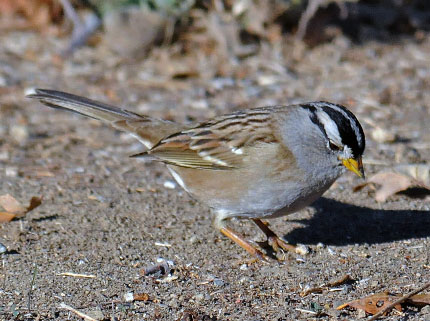
White-crowned Sparrow, J. Kenney, 11/10/12
As we neared the junction of the Crags & High Road Trails we heard a Phainopepla calling from the oaks. As we approached those trees, a male flew off but a female perched in the open where we were able to see her.
We were greeted by a couple of Western Bluebirds when we returned to the parking lot at midday. From there, several of us walked to the campground. That area is usually quite birdy but it was quiet when we looked around. The field by the Braille Trail was definitely worth a look. There was a Say’s Phoebe forging actively and a California Thrasher flew across the field twice so we all had a good look at it. That was a good way to end a very good day of birding in the park.
| MCSP, 10 Nov 2012 | final list | |
| Mallard | Anas platyrhynchos | 3 |
| Cooper’s Hawk | Accipiter cooperii | 1 ad, 1 imm |
| Red-shouldered Hawk | Buteo lineatus | 1 imm |
| Red-tailed Hawk | Buteo jamaicensis | 5 |
| American Kestrel | Falco sparverius | 1M |
| Black-hooded Parakeet [I] | Nandayus nenday | 20 |
| Acorn Woodpecker | Melanerpes formicivorus | 8 |
| Red-breasted Sapsucker | Sphyrapicus varius | 2 |
| Nuttall’s Woodpecker | Picoides nuttallii | 2 |
| Northern Flicker | Colaptes auratus | 2 |
| Black Phoebe | Sayornis nigricans | 6 |
| Say’s Phoebe | Sayornis saya | 3 |
| Loggerhead Shrike | Lanius ludovicianus | 1 |
| Western Scrub-Jay | Aphelocoma californica | 2 |
| American Crow | Corvus brachyrhynchos | 30 |
| Common Raven | Corvus corax | 2 |
| Oak Titmouse | Baeolophus inornatus | 20+ (most heard) |
| Bushtit | Psaltriparus minimus | 25+ |
| White-breasted Nuthatch | Sitta carolinensis | 2 |
| Bewick’s Wren | Thryomanes bewickii | 3 |
| House Wren | Troglodytes aedon | 1H |
| Ruby-crowned Kinglet | Regulus calendula | 2 |
| Western Bluebird | Sialia mexicana | 10 |
| Wrentit | Chamaea fasciata | 1 |
| California Thrasher | Toxostoma redivivum | 1 |
| Phainopepla | Phainopepla nitens | 1M, 1F |
| Yellow-rumped Warbler | Dendroica coronata | 40+ (most heard) |
| Spotted Towhee | Pipilo maculatus | 8 |
| California Towhee | Pipilo crissalis | 6 |
| Rufous-crowned Sparrow | Aimophila carpalis | 1 |
| Lark Sparrow | Chondestes grammacus | 10 |
| White-crowned Sparrow | Zonotrichia leucophrys | 20 |
| Golden-crowned Sparrow | Zonotrichia atricapilla | 1M |
| Dark-eyed Junco | Junco hyemalis | 25+ |
| Purple Finch | Carpodacus purpureus | 1F |
| House Finch | Carpodacus mexicanus | 30+ |
| Lesser Goldfinch | Carduelis psaltria | 4 |
| total = 37 species |
Thanks to all who came out with us and a special “thank you” to Jim Kenney for his outstanding photographs.



 SANTA MONICA BAY AUDUBON SOCIETY BLOG