Free email delivery
Please sign up for email delivery in the subscription area to the right.
No salesman will call, at least not from us. Maybe from someone else.
L.A. River Trip Report: 8 Sep., 2012
Our third annual field trip along the banks of the lower reaches of the L.A. River turned out to be relatively quiet. Our leader Dick Barth had urged us to set an early start time of 7:30 to avoid the seasonal heat. We were glad we did–it was quite warm by mid-morning. Some of us were stuck behind an accident clearing traffic break on the I-405 and we didn’t make it for the official start time near the Willow Street bridge.
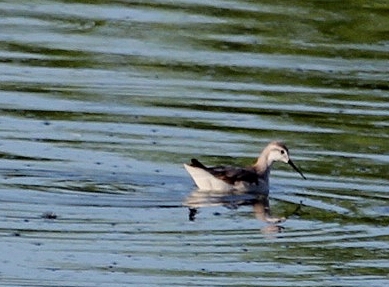
Notice the self-make whirlpool behind this basic-plumage Wilson’s Phalarope (J. Waterman 9/8/12)
This first stop features a look at the most vegetated area of the River, where the willows and other plants have succeeded in blocking most of the view of the Harbor’s huge derricks only a couple miles downstream. The brushy habitat provides cover and food for bush birds, and sediment makes many pools and sandbanks for ducks and waders. Even though there were fewer ducks than last year, almost all expected species were there. Hundreds of Black-necked Stilts browsed in the shallows of the river. The treat was a number of Wilson’s Phalaropes, in and out of the water. As we moved back toward the cars, we got to compare the features of a Red-necked Phalarope – juvenile moulting into basic plumage (see slideshow photo) – and compare it to the Wilson’s.
The most uncommon bird for this location was – oddly enough – a Brandt’s Cormorant. We see this normally pelagic species in small numbers on most Malibu Lagoon trips, swimming or sitting on the offshore rocks. Dick said he is unaware of any prior records of Brandt’s this far (3 miles) up the river.
Hoping to see some of the rarer
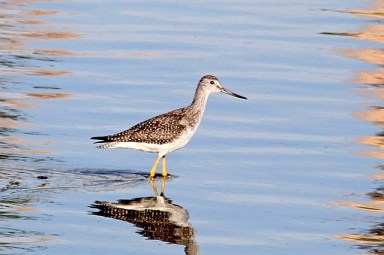
The bill of the Greater Yellowlegs has a slight upturn (unlike the slim straight bill of the Lesser). Fairly common at the Willow St. spot. (J. Waterman 9/8/12)
sandpiper species that have been spotted in the past few weeks, at 9AM we skipped all the way upstream to the Allondra bridge in Paramount. Our 40 minutes there gained us a few new species and we were able to spend time studying the proportions of the Lesser Yellowlegs which – at 3-4 birds – were almost abundant.
We then traveled back down river by car to De Forest Park. The park trees held only a few Yellow-rumped Warblers and our observations of the river were a repeat of the earlier species of our walk. At 11AM, just as we were preparing to leave, we saw a two-minute hunt from a juvenile Peregrine Falcon, followed by a Red-shouldered Hawk overflight.

Red-shouldered Hawk seems very interested in that tree to his left (J. Waterman 9/8/12)
We didn’t try to estimate numbers this trip. The most abundant birds, by far, were Black-necked Stilts and Long-billed Dowitchers.
Many thanks to Richard Barth who knows this area better than anyone. His knowledge and enthusiastic explanations of difficult plumage are invaluable, especially during migration season!
Link to 2011 LA River Trip Report
Link to 2010 LA River Trip Report
Link to Map of Trip
[Lucien Plauzoles]
| Los Angeles River Trip | 8 Sept., 2012 – 56 species |
| Mallard | Long-billed Dowitcher |
| Cinnamon Teal | Wilson’s Phalarope |
| Northern Shoveler | Red-necked Phalarope |
| Northern Pintail | Ring-billed Gull |
| Green-winged Teal | Western Gull |
| Ruddy Duck | California Gull |
| Pied-billed Grebe | Rock Pigeon |
| Brandt’s Cormorant | Eurasian Collared-Dove |
| Double-crested Cormorant | Mourning Dove |
| Brown Pelican | Anna’s Hummingbird |
| Great Blue Heron | Peregrine Falcon |
| Great Egret | Black Phoebe |
| Snowy Egret | Western Scrub-Jay |
| Green Heron | American Crow |
| Black-crwned Night-Heron | No. Rough-winged Swallow |
| Turkey Vulture | Cliff Swallow |
| Red-Shouldered Hawk | Barn Swallow |
| American Coot | Bushtit |
| Semipalmated Plover | Northern Mockingbird |
| Killdeer | European Starling |
| Black-necked Stilt | Common Yellowthroat |
| American Avocet | Yellow-rumped Warbler |
| Spotted Sandpiper | California Towhee |
| Greater Yellowlegs | Song Sparrow |
| Lesser Yellowlegs | Red-winged Blackbird |
| Western Sandpiper | House Finch |
| Least Sandpiper | House Sparrow |
| Short-billed Dowitcher | Orange Bishop |
Cliff Swallow needs Flock; Pesticide-laden Wild Bird Food
The California WIldlife Center in Malibu is urgently looking for a flock of Cliff Swallows that have not yet migrated south, in order to release a rehabbed bird to join them. If there are any sightings of cliff swallows, please notify them right away at 818-591-9453.
[Submitted by Monica Minden, volunteer at CWC]
[Note – I called them, suggesting checking Malibu Civic Center & lagoon to see if any Cliff Swallows were still around. Chukar.]
The Environmental Protection Agency on Friday slapped $12.5 million in fines and penalties on Scotts Miracle-Gro after the company admitted it had added pesticides to its wild bird food in order to protect the product while in storage. The EPA stated that, in an earlier plea deal, Scotts acknowledged the pesticides Actellic 5E and Storcide II were applied even though EPA had prohibited their use for that.
“Scotts admitted that it used these pesticides contrary to EPA directives and in spite of the warning label appearing on all Storicide II containers stating, ‘Storcide II is extremely toxic to fish and toxic to birds and other wildlife’,” said the EPA. [More on the website.]
[From NBC News.com, by Miguel Llanos, 9/7/12]
[Chuck Almdale]
Starving Brown Pelicans on the Beaches
I suppose I was paying attention elsewhere, because somehow I missed the news that sick, dying and dead Brown Pelicans have been showing up everywhere along the Pacific coast. After noticing at least 5 dead pelicans at the lagoon last Sunday, I did an RFI on LACoBirds chat line for information, thinking it might be domaic acid (Red Tide algae), and Aurelio Albaisa was kind enough to send me a video link.
Apparently there is a real dearth of right-sized bait fish. The young birds can’t catch enough to feed themselves, are collapsing, showing up on shore, begging from people, and being brought into various rescue operations.
Needless to say, the various rescue operations could use donations.
See our list of local rescue operations here: https://smbasblog.wordpress.com/bird-rescue/
Here are some links I found by googling “starving brown pelicans”:
WildRescue’s Blog: http://wildrescue.blogspot.com/2012/07/starving-young-pelicans.html
Several Science News Magazine Articles: http://esciencenews.com/dictionary/brown.pelican
KPCC Pacific Swell Pasadena: http://www.scpr.org/blogs/environment/2012/07/12/7037/brown-pelicans-turning-along-coast-should-they-all/
Morro Bay (this link is having download problems): http://www.ksby.com/videos/starving-brown-pelicans-keep-showing-up-dead-in-morro-bay/
Santa Cruz Patch blog: http://santacruz.patch.com/articles/starving-pelicans-turning-up-on-beaches
CBS News Sacramento: http://sacramento.cbslocal.com/2012/07/09/starving-pelicans-turn-up-on-bay-area-beaches/
Yuba.net: http://yubanet.com/california/Starving-Brown-Pelicans-Flock-to-Beaches-Concern-Beachgoers-Overwhelm-Rescue-Centers.php#.UD6WoCJIXUw
NWCN.com in Oregon: http://www.nwcn.com/news/Brown-pelicans-starving-on-Oregon-coast-82802277.html?gallery=y&img=3
CBS National Evening News: http://www.cbsnews.com/8301-201_162-57471448/baby-california-pelicans-starving-to-death/
[Chuck Almdale]
Printable 2012-13 Calendar available, plus a video
We have updated our Printable Calendar page on our blog site for 2012-13.
It list all our own field trips, programs and other events, and as an extra bonus to early subscribers, it includes the California birding festivals and a few other events by other organizations, with website links. It’s a 3-page PDF file.
While you’re printing that, you can watch this cool video of a very clever and patient Green Heron catching fish. Finally, someone has found a rational use for ordinary white bread!
[Chuck Almdale]
Full Corn Moon 8/31/12 6:58 a.m. PDT
Here’s another update from SMBAS Blog on that large, disc-like, shining object which has frequently and mysteriously appeared in our nighttime sky this year (those in the know call it the moon).
Aug. 31, 6:58 a.m. PDT — Full Corn Moon. Sometimes also called the Fruit Moon; such monikers were used for a full moon that occurs during the first week of September, so as to keep the Harvest Moon from coming too early in the calendar. This is the second time the moon turns full in a calendar month, so it is also popularly known as a “Blue Moon.” Full moons occur on average each 29.53 days (the length of the synodic month), or 12.3683 times per year; so months containing two full moons occur on average every 2.72 years, or every 2 years plus 8 or 9 months.
The next significant full moon will occur on Sept. 29, 8:19 p.m. PDT. Keep an eye on this spot for additional breaking news on this unprecedented event.
This information comes to you courtesy of:
http://www.msnbc.msn.com/id/45911225/ns/technology_and_science-space/t/how-s-full-moons-got-their-strange-names/#.T16CDHlIXUx
But that’s waaaaaay too long to type in, and besides, you don’t need to go there because SMBAS has done the work for you!
[Chuck Almdale]



 SANTA MONICA BAY AUDUBON SOCIETY BLOG