Free email delivery
Please sign up for email delivery in the subscription area to the right.
No salesman will call, at least not from us. Maybe from someone else.
Malibu Lagoon Trip Report: 26 August, 2012
Don’t forget to visit our new page for the Malibu Lagoon 2012 Project, frequently updated with new photos.
The west channels area begins to come into shape. There is a lot of water in the channels, but as the project proceeds, far more water is shifted between the basins than is piped out to the ocean. The berm is now a temporary path to the beach. Part of this berm will remain as the peninsula of “the boot” (see the drawing on our Project Page). The graded edges next to the water (see picture) look steep
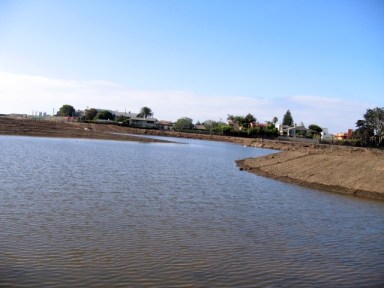
Looking south towards the beach, the channel edges are graded (L. Johnson 8/26/12)
to me; perhaps they’ll be graded further into gentler slopes. We couldn’t get to the vegetated area in the SW corner where a picnic area will be located, depressing our overall passerine sightings. Peering through holes in the fence netting into the channels area, we managed to spot: 8 Mallard, 1 Pied-billed Grebe, 1 Great Blue Heron, 3 Snowy Egret, 2 Coot, 2 Killdeer, 1 Spotted Sandpiper, 1 Pectoral Sandpiper, 2 Least Sandpiper, 1 Black Phoebe, 5 American Crow, 2 Rough-winged Swallow, 12 Barn Swallow, 1 Bewick’s Wren & 1 Song Sparrow (both in brush between the path & PCH), 3 Great-tailed Grackle; 16 species in all. The Pectoral Sandpiper is an early fall migrant, most pass through in September. All these birds are included in the trip list below.
As in July, very little was on the ocean except two kelp-walking Snowy Egret, 1 Common Loon, 3 Western Grebe, 2 Pelagic Cormorant and 1 Brandt’s Cormorant. Down the beach, the surfing competition had many tents and loudspeakers and little else. The ocean was unusually flat. If anything more than a foot high rolled in, I’d be surprised. The audience was nearly as non-existent as the waves.
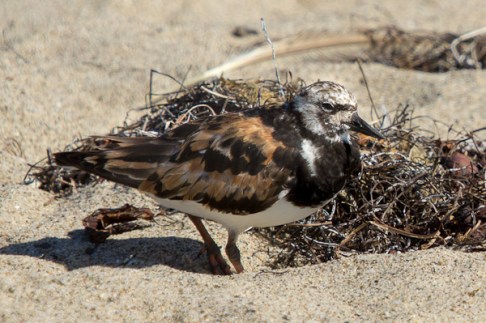
Still-colorful Ruddy Turnstone on the beach. Yes, they really do use their bill to turn over stones. (C. Bragg 8/26/12)
The Snowy Plovers were in their pre-high tide (scheduled for 11:36am) roost about 100 yds. east of the enclosure. Many people counted them many times, finally arriving at 45 birds, an all-time high for any August. Unfortunately, there are no banded birds. As usual, most other birds were on the sand islands near the lagoon’s south shore except for the gulls, mostly Western Gull, who were on the beach near the Snowies.
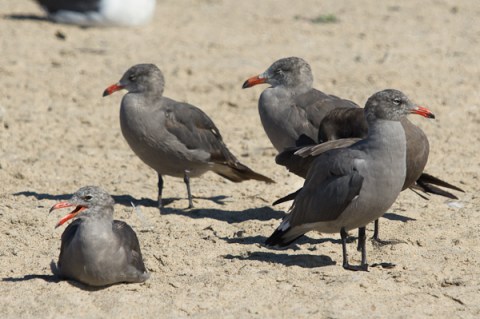
The boys are back in town. Post-breeding Heermann’s Gulls back from islands off the tip of Baja California. (C. Bragg 8/26/12)
We saw at least 5 dead Brown Pelicans on the beach, lagoon edge and sandy islands. I later found out that young Brown Pelicans have been appearing all up and down the West Coast for well over a month, starving, begging and dying. The problem seems to be that there aren’t enough right-sized fish in the ocean to feed all the pelicans. The young birds, less skilled than adults at finding and catching fish are suffering the consequences. The cause(s) for the dearth of fish is uncertain, but I can think of plenty of “usual suspects.”
Birds at Adamson House were mostly Allen’s Hummingbirds, busily poking around in the flowers, not one Anna’s among them. A young Bullock’s Oriole, some Song Sparrows and a California Towhee also appeared. Just before we did our final bird count we were treated to an Osprey soaring high over the lagoon. All were surprised to learn we had seen 53 species; guesses ranged from 25 to 45.
The morning began relatively cool (70°) and cloudy, but the clouds left and it was sufficiently warm by the time we left.
Our next three field trips: Lower Los Angeles River, 8 Sep., 7:30am; Malibu Lagoon, 23 Sep., 8:30am.; Bolsa Chica, 6 Oct. 8:30am.
Our next program: Tuesday, 2 October, 7:30 pm. Water Conservation and Sustainability – Kimberly O’Cain. The usual blog reminders will be emailed.
NOTE: Our 10 a.m. Parent’s & Kids Birdwalk remains canceled until the lagoon project is completed and the parking lot is again fully available.
Links: Unusual birds at Malibu Lagoon
Aerial photo of Malibu Lagoon from 9/23/02.
Prior checklists: July-Dec’11, Jan-June’11, July-Dec ’10, Jan-June ’10, Jul-Dec ‘09, and Jan-June ‘09.
Comments on Bird List Below
Total Birds: Total birds numbers for August were down the same 9% as in July, or 732 of the 6-year average of 807, which is not really significant. Low numbers of Mallard (32) and Brown Pelican (37) were the primary reason. However, the 10-year comparison chart on our Project Page shows August 2012 as 9% above average. Go figure! Notably, August 2012 was an all-time August high count of 45 Snowy Plovers.
Species Diversity: Of 103 total species appearing in August for 2007-12, no more than 68% of them appeared on any one count day, something to keep in mind if you wonder why what is there is much less than what could be there. Since we began these 6-year comparisons in May, this “maximum appearance rate” has fluctuated from 61% to 68%, intriguingly consistent, I think. It seems to indicate that – whenever you visit – what you see will be 1/2 – 2/3rds of what is possible to see there at that time of year. August 2012 with 53 species is slightly (6%) below average.
Summary of species diversity from the 6-year average so far: May +4%, June -10%, July +10%, August -6%. If anyone can draw significance from that fluctuation, let me know, because I can’t, other than thinking that the project is not having a significant adverse or beneficial effect on diversity.
[Chuck Almdale]
| Malibu Census | 2007 | 2008 | 2009 | 2010 | 2011 | 2012 | |
| August 2007 – 2012 | 8/26 | 8/24 | 8/23 | 8/22 | 8/28 | 8/26 | |
| Temperature | 65-75 | 68-75 | 72-81 | 70-78 | |||
| Tide Lo/Hi Height | H +4.4 | L +2.9 | H +5.7 | H +4.32 | H +5.03 | H +2.59 | Ave. |
| Tide Time | 0928 | 0819 | 1201 | 0933 | 0942 | 1136 | Birds |
| Brant | 5 | 0.8 | |||||
| Gadwall | 5 | 4 | 1.5 | ||||
| Mallard | 35 | 42 | 35 | 55 | 60 | 32 | 43.2 |
| Northern Shoveler | 4 | 0.7 | |||||
| Northern Pintail | 6 | 1.0 | |||||
| Green-winged Teal | 6 | 1.0 | |||||
| Surf Scoter | 4 | 0.7 | |||||
| Ruddy Duck | 3 | 5 | 5 | 2.2 | |||
| Common Loon | 1 | 0.2 | |||||
| Pied-billed Grebe | 10 | 3 | 7 | 9 | 15 | 10 | 9.0 |
| Western Grebe | 3 | 0.5 | |||||
| Brandt’s Cormorant | 3 | 1 | 0.7 | ||||
| Dble-crstd Cormorant | 22 | 18 | 12 | 30 | 48 | 34 | 27.3 |
| Pelagic Cormorant | 6 | 2 | 3 | 2 | 2.2 | ||
| Brown Pelican | 66 | 15 | 185 | 163 | 77 | 37 | 90.5 |
| Great Blue Heron | 9 | 8 | 7 | 6 | 3 | 5 | 6.3 |
| Great Egret | 14 | 5 | 5 | 4 | 2 | 1 | 5.2 |
| Snowy Egret | 31 | 23 | 17 | 19 | 15 | 14 | 19.8 |
| Cattle Egret | 1 | 0.2 | |||||
| Green Heron | 1 | 0.2 | |||||
| Blk-crwnd N-Heron | 15 | 2 | 3 | 7 | 4 | 5.2 | |
| Osprey | 1 | 1 | 1 | 0.5 | |||
| Cooper’s Hawk | 1 | 1 | 0.3 | ||||
| Red-tailed Hawk | 1 | 2 | 0.5 | ||||
| Sora | 1 | 0.2 | |||||
| American Coot | 25 | 15 | 28 | 75 | 33 | 29.3 | |
| Blk-bellied Plover | 52 | 45 | 71 | 55 | 46 | 64 | 55.5 |
| Snowy Plover | 26 | 41 | 36 | 44 | 36 | 45 | 38.0 |
| Semipalmated Plover | 8 | 2 | 10 | 4 | 2 | 4.3 | |
| Killdeer | 3 | 6 | 3 | 3 | 8 | 5 | 4.7 |
| Black Oystercatcher | 1 | 0.2 | |||||
| Black-necked Stilt | 2 | 0.3 | |||||
| Spotted Sandpiper | 8 | 2 | 2 | 1 | 2 | 4 | 3.2 |
| Wandering Tattler | 1 | 0.2 | |||||
| Greater Yellowlegs | 2 | 0.3 | |||||
| Willet | 24 | 18 | 16 | 10 | 4 | 2 | 12.3 |
| Lesser Yellowlegs | 1 | 0.2 | |||||
| Whimbrel | 10 | 12 | 29 | 8 | 41 | 52 | 25.3 |
| Marbled Godwit | 2 | 3 | 2 | 2 | 1.5 | ||
| Ruddy Turnstone | 18 | 4 | 11 | 3 | 4 | 9 | 8.2 |
| Black Turnstone | 1 | 1 | 0.3 | ||||
| Red Knot | 1 | 0.2 | |||||
| Sanderling | 17 | 20 | 105 | 30 | 15 | 1 | 31.3 |
| Western Sandpiper | 25 | 12 | 8 | 4 | 11 | 10.0 | |
| Least Sandpiper | 20 | 13 | 3 | 4 | 6 | 6 | 8.7 |
| Pectoral Sandpiper | 1 | 0.2 | |||||
| Short-billd Dowitcher | 1 | 3 | 3 | 1.2 | |||
| Red-necked Phalarope | 2 | 7 | 1.5 | ||||
| Boneparte’s Gull | 2 | 0.3 | |||||
| Heermann’s Gull | 45 | 8 | 21 | 62 | 24 | 17 | 29.5 |
| Mew Gull | 1 | 0.2 | |||||
| Ring-billed Gull | 4 | 2 | 4 | 1.7 | |||
| Western Gull | 204 | 108 | 132 | 66 | 146 | 134 | 131.7 |
| California Gull | 3 | 1 | 1 | 3 | 8 | 4 | 3.3 |
| Least Tern | 35 | 20 | 1 | 9.3 | |||
| Caspian Tern | 1 | 1 | 13 | 12 | 4.5 | ||
| Common Tern | 2 | 0.3 | |||||
| Forster’s Tern | 40 | 2 | 5 | 3 | 1 | 8.5 | |
| Royal Tern | 1 | 3 | 2 | 18 | 3 | 4.5 | |
| Elegant Tern | 20 | 4 | 1 | 45 | 36 | 69 | 29.2 |
| Black Skimmer | 103 | 1 | 17.3 | ||||
| Rock Pigeon | 6 | 3 | 6 | 4 | 5 | 12 | 6.0 |
| Mourning Dove | 4 | 3 | 2 | 2 | 1.8 | ||
| Anna’s Hummingbird | 5 | 1 | 2 | 4 | 2.0 | ||
| Allen’s Hummingbird | 4 | 2 | 2 | 4 | 7 | 3.2 | |
| Belted Kingfisher | 1 | 1 | 2 | 0.7 | |||
| Nuttall’s Woodpecker | 1 | 0.2 | |||||
| Downy Woodpecker | 1 | 0.2 | |||||
| Western Wood-Pewee | 1 | 0.2 | |||||
| Pac.Slope Flycatcher | 1 | 0.2 | |||||
| Black Phoebe | 8 | 3 | 6 | 5 | 10 | 8 | 6.7 |
| Ash-throated Flycatcher | 1 | 0.2 | |||||
| Cassin’s Kingbird | 1 | 1 | 0.3 | ||||
| Western Kingbird | 3 | 5 | 2 | 4 | 4 | 4 | 3.7 |
| Western Scrub-Jay | 2 | 0.3 | |||||
| American Crow | 6 | 5 | 3 | 4 | 3 | 5 | 4.3 |
| Rough-wingd Swallow | 4 | 1 | 3 | 3 | 22 | 2 | 5.8 |
| Tree Swallow | 1 | 0.2 | |||||
| Barn Swallow | 12 | 6 | 25 | 8 | 45 | 22 | 19.7 |
| Cliff Swallow | 15 | 2 | 2 | 1 | 3.3 | ||
| Oak Titmouse | 2 | 0.3 | |||||
| Bushtit | 15 | 17 | 6 | 14 | 8.7 | ||
| Bewick’s Wren | 1 | 2 | 0.5 | ||||
| House Wren | 1 | 0.2 | |||||
| Marsh Wren | 1 | 0.2 | |||||
| Northern Mockingbird | 5 | 1 | 2 | 5 | 3 | 4 | 3.3 |
| European Starling | 2 | 15 | 8 | 7 | 20 | 28 | 13.3 |
| Ornge-crwnd Warbler | 3 | 0.5 | |||||
| Yellow Warbler | 5 | 0.8 | |||||
| Yellow-rumpd Warbler | 2 | 0.3 | |||||
| Common Yellowthroat | 2 | 4 | 1 | 5 | 8 | 1 | 3.5 |
| Wilson’s Warbler | 1 | 1 | 0.3 | ||||
| California Towhee | 1 | 1 | 1 | 0.5 | |||
| Song Sparrow | 2 | 3 | 4 | 3 | 5 | 3 | 3.3 |
| Western Tanager | 1 | 0.2 | |||||
| Red-winged Blackbird | 2 | 1 | 2 | 32 | 6.2 | ||
| Brewer’s Blackbird | 3 | 0.5 | |||||
| Great-tailed Grackle | 5 | 7 | 2.0 | ||||
| Brwn-headed Cowbird | 1 | 1 | 0.3 | ||||
| Hooded Oriole | 1 | 1 | 0.3 | ||||
| Bullock’s Oriole | 1 | 0.2 | |||||
| House Finch | 4 | 4 | 5 | 4 | 8 | 4.2 | |
| Lesser Goldfinch | 1 | 3 | 4 | 1.3 | |||
| Totals by Type | 8/26 | 8/24 | 8/23 | 8/22 | 8/28 | 8/26 | Ave. |
| Waterfowl | 53 | 42 | 39 | 71 | 65 | 36 | 51 |
| Water Birds-Other | 129 | 53 | 204 | 231 | 221 | 121 | 160 |
| Herons, Egrets | 70 | 38 | 32 | 37 | 24 | 20 | 37 |
| Raptors | 2 | 1 | 1 | 0 | 3 | 1 | 1 |
| Shorebirds | 217 | 180 | 303 | 162 | 187 | 196 | 208 |
| Gulls & Terns | 356 | 145 | 162 | 299 | 248 | 232 | 240 |
| Doves | 6 | 3 | 10 | 7 | 7 | 14 | 8 |
| Other Non-Pass. | 10 | 2 | 3 | 8 | 7 | 7 | 6 |
| Passerines | 98 | 51 | 64 | 76 | 181 | 105 | 96 |
| Totals Birds | 941 | 515 | 818 | 891 | 943 | 732 | 807 |
| Total Species | 8/26 | 8/24 | 8/23 | 8/22 | 8/28 | 8/26 | Ave. |
| Waterfowl | 5 | 1 | 2 | 4 | 2 | 2 | 2.7 |
| Water Birds-Other | 5 | 5 | 3 | 5 | 6 | 8 | 5.3 |
| Herons, Egrets | 5 | 4 | 4 | 5 | 4 | 3 | 4.2 |
| Raptors | 2 | 1 | 1 | 0 | 2 | 1 | 1.2 |
| Shorebirds | 15 | 14 | 16 | 10 | 14 | 13 | 13.7 |
| Gulls & Terns | 11 | 7 | 8 | 8 | 8 | 7 | 8.2 |
| Doves | 1 | 1 | 2 | 2 | 2 | 2 | 1.7 |
| Other Non-Pass. | 3 | 1 | 2 | 4 | 3 | 1 | 2.3 |
| Passerines | 23 | 14 | 13 | 19 | 18 | 16 | 17.2 |
| Totals Species – 103 | 70 | 48 | 51 | 57 | 59 | 53 | 56.3 |
Malibu Lagoon Project Updates; L.A. County Birding Guide
The California Coastal Commission met yesterday, Wednesday 8/8/12 and voted to deny the request to revoke the lagoon restoration project permit, brought by project opponents. The project will continue. Work on the channels is scheduled to be completed by Oct. 16, 2012. Work on the various interpretive features will continue for a while after that.
“There’s not a single shred of evidence that would have to be proven for us to entertain revocation,” said Commissioner Jana Zimmer. David Wiseman, attorney for Cal. State Parks, said: “ [The request] was not timely and not filed with due diligence….These types of revocation requests are really broad for the intention of causing delay.” He also asked the commission to consider granting a request from State Parks to recoup attorneys fees and other costs to staff.
Link to Malibu Patch blog article on the CCC decision.
****************************************
Sometime next week the path to the beach will be changed to follow the newly-constructed berm. Some mechanical work will be done on the current pathway. While it is, we’ll be using the berm.
Our Malibu Lagoon 2012 Project page has links to this patch article, YouTube interviews with the project staff (latest is 8/3 interview with Mark Abramson, talking about how the channel and island grading work is going, the path change, and just what was going on with that weird classification by the USF&G of Snowy Plover critical habitat, which included areas covered by fill dirt, brush and the southern channel.
****************************************
In our never-ending effort to bring you quality birding information and news, we now announce that our Los Angeles County Birding Spots page is now, finally (more-or-less) complete. Give it a try. Tell your friends. Comments and suggestions welcome!
I put this page together primarily as a service to birders visiting or passing through L.A., new birders looking for good birding spots in their area, and…me! I get a lot of email from strangers looking for information (RFI – request for information) on when & where to bird in L.A. From now on, I’m going to send them a link to this page, adding that if they have any additional questions, send me an email. A big time saver in the long run.
[Chuck Almdale]
Blogs & Websites
Series on the Western Snowy Plover
I recently finished a 7-part series on Western Snowy Plovers, which is now posted on the Malibu (California) Patch blogsite.
It contains a couple of typographical errors.
*************************************
If you’ve looked at our permanent page on the Malibu Lagoon Restoration Project, you know that we’ve been doing 10-year comparative censuses of the birds of the lagoon. I recently put these figures into a Malibu Patch blog, with a bit more explanation for the general reader who might not know a raptor from a passerine. Bottom line: So far, the project is not having a significant effect on the birds.
*************************************
The Cornell Laboratory of Ornithology is a great outfit, well worth supporting if you have a few extra dollars rattling around. They also have a great website. One of their useful features is All About Birds. On various species it has photos, sounds, videos, facts of all sorts. One useful feature, difficult to find elsewhere, is it shows the entire range of a species including its wintering range south of the border. So if you’re wondering about the Cerulean Warbler, for example, a name-search will quickly show you that it breeds in the Eastern U.S., migrates through eastern Mexico and winters in South America from Venezuela to Bolivia.
[Chuck Almdale]

One of the Ballona Salt Marsh channels (Leslie Davidson ’07)
Ballona Wetlands is recruiting volunteers for the Audubon Society’s education program to lead small groups of schoolchildren on nature walks. No experience necessary. Six Tuesday classes of docent training will be offered beginning Sept 11, 2012 from 9 a.m. to noon. For more information call Diana at 310-821-6444.
Link to our website.
Thanks so much.
Diana Spurlin
SANTA MONICA BAY AUDUBON SOCIETY
STATEMENT OF SUPPORT FOR
THE MALIBU LAGOON RESTORATION PROJECT
August 3, 2012
The Board of Directors of Santa Monica Bay Audubon Society (SMBAS) supports the Malibu Lagoon Restoration Project. This is not a new position for us. Members of SMBAS began attending the Malibu Lagoon Task Force (MTLF) meetings in the 1990’s. We took part in the numerous MLTF discussions, and our suggestion to add ornithological expert Kimball Garrett to the Lagoon Technical Advisory Committee was accepted. At the conclusion of the planning phase, we voted in favor of the MTLF final recommendations. In October 2010, we sent a statement to the California Coastal Commission affirming our support for the project; we now reiterate our continuing support.
Over the past two months we have observed the progress of the project and have witnessed nothing unexpected, unplanned or dangerous. We continue to hold monthly bird walks at the lagoon as we have done for almost thirty years. We continue our monthly censusing of the birds at the lagoon and of the Western Snowy Plovers at their winter roost on the beach. Our results indicate that as yet the project has had no affect on the lagoon’s birdlife, either in species diversification or total bird numbers; both quantities are varying within their usual ranges for the most recent ten-year period. Western Snowy Plovers, a threatened species which roosts on Surfrider Beach adjacent to the lagoon, are similarly unaffected.
Based on our observations, bird population in the channels average approximately five percent of that in the main lagoon. Our understanding is that low oxygen and high bacteria levels in the channels severely limited invertebrate populations in the mud substrate, leaving little for the birds to eat.
We continue to support the plan: to remove the fill dirt placed there decades ago, redesign the channels to create better water circulation and increase ground area subject to water level fluctuation, replant the area with native plants appropriate to a brackish wetland, and redesign the pathway to the beach.
The Board of Santa Monica Bay Audubon Society
Charles G. Bragg, President
*******************************************
The above notice was sent on August 3, 2012 to California State Parks for their records. It also was sent to the California Coastal Commission, to reiterate SMBAS’s support for the project. The Coastal Commission currently is reviewing a petition from project opponents to revoke the project permit. [Chuck Almdale]



 SANTA MONICA BAY AUDUBON SOCIETY BLOG