Free email delivery
Please sign up for email delivery in the subscription area to the right.
No salesman will call, at least not from us. Maybe from someone else.
Full Strawberry Moon 6/4/12 4:12 a.m. PDT
Here’s another update from SMBAS Blog on that large shining object which has frequently and mysteriously appeared in our nighttime sky this year (known to many as the moon).
June 4, 4:12 a.m. PDT — Full Strawberry Moon. Known to every Algonquin tribe, Europeans called it the Rose Moon. A partial eclipse of the moon will be visible chiefly favoring those living around the Pacific Rim. Observers in Japan and Australia for instance, can see it at, or soon after, moonrise, while those in the western United States and western Canada see it at, or just before, moonset. At maximum, about 37 percent of the moon’s diameter will be immersed in the dark umbra shadow of the Earth.
The next significant full moon will occur on July 3, 11:52 a.m. PDT. Keep an eye on this spot for additional breaking news on this unprecedented event.
This information comes to you courtesy of:
http://www.msnbc.msn.com/id/45911225/ns/technology_and_science-space/t/how-s-full-moons-got-their-strange-names/#.T16CDHlIXUx
But that’s waaay too long to type in, and besides, you don’t need to go there because SMBAS has done the work for you!
[Chuck Almdale]
Solstice Canyon Trip Report: 5/12/12
We had a great attendance of eighteen people, including some students from Cindy’s birding class. People in the parking lot were greeted by a Red-tailed Hawk sitting in one of the trees, as well as a puffed-out Olive-sided Flycatcher.

Olive-sided Flycatcher displaying his ‘tufts’ for all to see (J. Kenney 5/12/12)
At the entrance to the trail, there was a tree with a nest of Nuttall’s Woodpeckers. Everyone got a good look because the parents were feeding them often. Later on we stood and watched a Common Raven gathering nesting material. We kept waiting to see where it was nesting and finally the bird landed at the site but it was not visible like the Nuttall’s nest. All along the trail, Black-headed Grosbeaks were serenading us but it was some time before anyone saw one of them. Later, at the granary tree we saw just a few Acorn Woodpeckers.

Yellow-breasted Chat – not easy to find in western L.A. County (J. Kenney 5/12/12)
The area was not as active with families of woodpeckers as we are used to seeing. Sound-wise, besides the Black-headed Grosbeaks, we could hear the Hutton’s Vireo, Pacific-slope Flycatcher, Lesser Goldfinch, and Purple Finch and could find all of the birds except the Purple Finch. Chuck Almdale called the Canyon Wren in but it took a lot of coaxing to get it to quit hiding behind the leaves. Finally we could see a silhouette as it stood on a snag one third of the way up the slope. It really gave us a chance to see how the long bill is. On the horizon there was another Red-tailed Hawk and a Turkey Vulture. Our trip was also a good day for hummingbirds since we found 3 species: Allen’s, Anna’s, & Black-chinned.

California Wild Rose in magnificent bloom (J. Kenney 5/12/12)
The flowers were quite good for a year that was short on rain. This walk always offers a chance to compare the Bush Sunflower we see along the roadside (brown center) and the canyon sunflower (yellow center) which likes a little more protection. This year the Deer Weed seemed to have formed larger and very good looking bushes whereas the Hummingbird Sage was much more modest from the lack of rain. [Jean Garrett]

Her cryptically-colored fawn is close behind (J. Kenney 5/12/12)
Birds
Red-tailed Hawk Buteo jamaicensis
Turkey Vulture Cathartes aura
Common Raven Corvus corax
American Crow Corvus brachyrhynchos
Western Scrub-Jay Aphelocoma californica
Acorn Woodpecker Melanerpes formieivorus
Nuttall’s Woodpecker Picoides nuttallii
Bewick’s Wren Thryomanes bewickii
Canyon Wren Catherpes mexicanus
House Wren Troglodytes aedon
Western Bluebird Sialia mexicana
Common Yellowthroat Geothlypis trichas
Yellow-breasted Chat Icterria virens
Orange-crowned Warbler Oreothlypis celata
Townsend’s Warbler Setophaga townsendi
California Towhee Melozone crissalis
Spotted Towhee Pipilo maculatus
Song Sparrow Melospiza melodia
Black-headed Grosbeak Pheucticus melanocephalus
Black-hooded Parakeet Nandayus nenday
Lesser Goldfinch Spinus psaltria
House Finch Carpodacus mexicanus
Purple Finch Carpodacus purpureus
Black-chinned Humingbird Archilochus alexandri
Allen’s Hummingbird Selasphorus sasin
Anna’s Hummingbird Calypte anna
Olive-sided Flycatcher Contopus cooperi
Pacific-slope Flycatcher Empidonax difficilis
Western Wood-Pewee Contopus sordidulus
Ash-throated Flycatcher Myiarchus cinerascens
Black Phoebe Sayornis nigricans
Hutton’s Vireo Vireo huttoni
Oak Titmouse Baeolophus inornatus
Bushtit Psaltriparus minimus
Wrentit Chamaea fasciata
Ruby-crowned Kinglet Regulus calendula
Flowers
Golden Yarrow (Sunflower Family)
Cheeseweed (Mallow Family)
Hedge Nettle (Mint Family)
Humingbird Sage (Mint Family)
Caterpillar Phacelia (Waterleaf Family)
Deer Weed (Pea Family)
Wild Rose
Sticky Phacelia
California Everlasting (Sunflower Family)
Canyon Sunflower
Bush Sunflower
Malibu Lagoon Trip Report: 27 May, 2012
This is our last lagoon trip report before the scheduled start of the reconfiguration process, so we made a few changes to our usual trip report format. We’ve put a bunch of scenery shots in, and the bird list compares the months of May across the past six years. We’ll follow this format until after the project is

North channel view to west towards golf course (L. Johnson 5/27/12)
done; the data should be useful to compare during-project months to prior years. I keep my count numbers as honest as I can; there’s never any attempt to jack any number up or down. My obvious and mostly worthless prediction: count totals and species diversification will drop during the project, then rebound. No prediction how much the change will be. This is like J.P. Morgan’s stock market prediction: “The market will fluctuate.”
The slideshow shows what the area looked like this day, excepting Jim Kenney’s February scenic photo. The lagoon outlet closed within the past 7 days:, lagoon water level had risen so much that Snowy Plover enclosure fenceposts I’d stood next to 8 days earlier were now partially submerged.

Whimbrel on low tide rocks (J. Kenney 5/27/12)
The birds were pretty much what we’d expect for late May: a few migrant shorebirds (Whimbrel, Black-bellied Plover); some nesting birds (Mallard, Black Phoebe, Barn & Cliff Swallow, Northern Mockingbird, House Finch). The egrets are developing a large heronry next to Starbuck’s in the shopping center: Great Blue Heron, Great Egret, Snowy Egret and Black-crowned Night Heron are all nesting there. 15 Heermann’s Gulls had arrived from their breeding grounds on islands near the southern tip of Baja California; they were all 1st-year birds. One Belted Kingfisher perched on dead branches in front of Adamson House. We found a pair of Black Phoebes feeding 4 fledglings near the Adamson Boat House, as well as a female Mallard with 5 fluffy ducklings. No project activity is scheduled for this side of the lagoon. We didn’t see the young Killdeer spotted a month ago: it’ll be full-sized and flying by now, but it won’t yet have adult plumage.
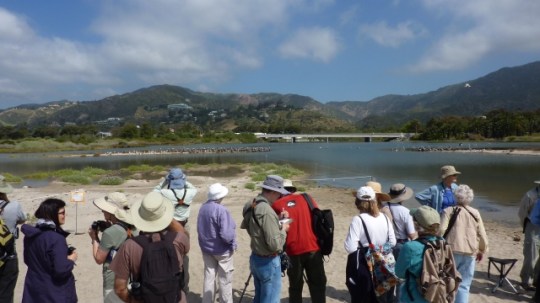
View from beach across lagoon (L. Plauzoles 5/27/12)
Our next three field trips: Mt. Piños Birds & Butterflies, June 16/17, 8 am; Malibu Lagoon, 24 June, 8:30 am; Malibu Lagoon, 22 July, 8:30 am.
Our next program: Tuesday, 2 October, 7:30 pm. The usual reminders will be emailed from the blog.
Picnic: The usual June chapter picnic is canceled.
NOTE: Our 10 a.m. Parent’s & Kids Birdwalk is canceled until the lagoon project is completed and the parking lot is again available.
Links: Unusual birds at Malibu Lagoon
Aerial photo of Malibu Lagoon from 9/23/02.
Prior checklists: July-Dec’11, Jan-June’11, July-Dec ’10, Jan-June ’10, Jul-Dec ‘09, and Jan-June ‘09.
Comments on list below: Of 75 total species appearing in May for 2007-12, no more than 62% of them have appeared on any one day, something to keep in mind if you wonder why what is there is much less than what could be there. Species low of 39 in 2010 is 17% below the highs of 47 for 2007, 2008 & 2012, not a huge drop. Total birds low of 413 in 2011 is 66% (787 birds) below the high of 1200 in 2007. Species making up most of this difference: Brown Pelicans – 549, Western Gulls – 109 and Heermann’s Gull – 61 (total of 719 birds, 91% of total difference).
NOTE: Right column averages of less than 1 bird/month are shown in tenths; all other averages are rounded to nearest whole number. [Chuck Almdale]
| Malibu Lagoon Census | 2007 | 2008 | 2009 | 2010 | 2011 | 2012 | |
| May 2007 – 2012 | 5/27 | 5/25 | 5/24 | 5/23 | 5/22 | 5/27 | |
| Temperature | 54-62 | 54-68 | 68-72 | ||||
| Tide Lo/Hi Height | H+3.4 | L+0.1 | H+3.7 | H+3.76 | L-.13 | L+0.38 | Ave. |
| Tide Time | 0742 | 0801 | 1042 | 0638 | 0816 | 0844 | Birds |
| Brant | 4 | 7 | 2 | ||||
| Gadwall | 6 | 8 | 12 | 12 | 3 | 5 | 8 |
| Mallard | 45 | 20 | 20 | 18 | 48 | 32 | 31 |
| Surf Scoter | 9 | 2 | |||||
| Red-brstd Merganser | 1 | 2 | 0.5 | ||||
| Ruddy Duck | 5 | 1 | 2 | 3 | 2 | ||
| Pacific Loon | 1 | 5 | 1 | ||||
| Common Loon | 2 | 0.3 | |||||
| Pied-billed Grebe | 3 | 3 | 2 | 3 | 2 | ||
| Western Grebe | 3 | 1 | 0.7 | ||||
| Brandt’s Cormorant | 5 | 1 | 1 | ||||
| Dble-crstd Cormorant | 7 | 5 | 28 | 7 | 46 | 15 | 18 |
| Pelagic Cormorant | 1 | 0.2 | |||||
| Brown Pelican | 630 | 231 | 70 | 124 | 81 | 265 | 234 |
| Great Blue Heron | 5 | 2 | 1 | 2 | 1 | 3 | 2 |
| Great Egret | 3 | 4 | 4 | 2 | 3 | 3 | |
| Snowy Egret | 12 | 9 | 7 | 12 | 3 | 14 | 10 |
| Green Heron | 1 | 0.2 | |||||
| Blk-crwnd N-Heron | 6 | 10 | 2 | 3 | 4 | ||
| Osprey | 1 | 0.2 | |||||
| Cooper’s Hawk | 1 | 0.2 | |||||
| Red-tailed Hawk | 1 | 1 | 1 | 1 | 0.7 | ||
| Peregrine Falcon | 1 | 0.2 | |||||
| American Coot | 25 | 6 | 32 | 8 | 25 | 30 | 21 |
| Blk-bellied Plover | 3 | 22 | 4 | ||||
| Killdeer | 1 | 1 | 4 | 2 | 3 | 2 | |
| Willet | 3 | 4 | 1 | ||||
| Whimbrel | 4 | 1 | 20 | 4 | |||
| Marbled Godwit | 1 | 0.2 | |||||
| Black Turnstone | 1 | 0.2 | |||||
| Western Sandpiper | 6 | 1 | |||||
| Dunlin | 1 | 0.2 | |||||
| Boneparte’s Gull | 26 | 2 | 1 | 1 | 5 | ||
| Heermann’s Gull | 61 | 1 | 20 | 17 | 15 | 19 | |
| Ring-billed Gull | 5 | 2 | 1 | 2 | 16 | 4 | |
| Western Gull | 119 | 56 | 65 | 68 | 10 | 85 | 67 |
| California Gull | 1 | 95 | 8 | 4 | 18 | ||
| Glaucous-wingd Gull | 1 | 1 | 0.3 | ||||
| Caspian Tern | 7 | 61 | 15 | 25 | 4 | 6 | 20 |
| Royal Tern | 2 | 1 | 2 | 5 | 2 | ||
| Elegant Tern | 15 | 23 | 40 | 9 | 12 | 35 | 22 |
| Rock Pigeon | 8 | 2 | 6 | 6 | 8 | 2 | 5 |
| Eur. Collared-Dove | 3 | 1 | 0.7 | ||||
| Mourning Dove | 1 | 4 | 6 | 1 | 2 | 2 | |
| White-throated Swift | 5 | 2 | 1 | ||||
| Anna’s Hummingbird | 6 | 2 | 2 | 1 | 1 | 2 | 2 |
| Allen’s Hummingbird | 4 | 8 | 6 | 4 | 5 | 5 | |
| Belted Kingfisher | 1 | 0.2 | |||||
| Western Wood-Pewee | 2 | 0.3 | |||||
| Pac.Slope Flycatcher | 1 | 0.2 | |||||
| Black Phoebe | 12 | 6 | 12 | 10 | 4 | 13 | 10 |
| American Crow | 8 | 4 | 6 | 4 | 3 | 5 | 5 |
| Common Raven | 1 | 2 | 0.5 | ||||
| Rough-wingd Swallow | 6 | 10 | 10 | 1 | 2 | 5 | |
| Violet-green Swallow | 6 | 2 | 1 | 1 | 2 | ||
| Barn Swallow | 12 | 6 | 1 | 8 | 8 | 2 | 6 |
| Cliff Swallow | 55 | 40 | 12 | 12 | 31 | 12 | 27 |
| Oak Titmouse | 1 | 0.2 | |||||
| Bushtit | 4 | 20 | 4 | 4 | 5 | ||
| Bewick’s Wren | 1 | 0.2 | |||||
| Northern Mockingbird | 3 | 5 | 6 | 4 | 2 | 6 | 4 |
| European Starling | 20 | 20 | 2 | 3 | 40 | 45 | 22 |
| Cedar Waxwing | 32 | 5 | |||||
| Common Yellowthroat | 4 | 2 | 2 | 3 | 2 | ||
| Spotted Towhee | 1 | 2 | 0.5 | ||||
| California Towhee | 1 | 1 | 5 | 1 | 1 | 2 | |
| Song Sparrow | 10 | 2 | 8 | 10 | 4 | 12 | 8 |
| Red-winged Blackbird | 20 | 6 | 4 | 2 | 10 | 7 | |
| Brewer’s Blackbird | 2 | 0.3 | |||||
| Great-tailed Grackle | 1 | 4 | 16 | 2 | 4 | ||
| Brwn-headed Cowbird | 2 | 1 | 3 | 1 | 1 | ||
| Hooded Oriole | 4 | 1 | 1 | 1 | |||
| Bullock’s Oriole | 2 | 1 | 1 | 0.7 | |||
| House Finch | 10 | 3 | 8 | 6 | 8 | 8 | 7 |
| Lesser Goldfinch | 2 | 1 | 2 | 4 | 2 | ||
| Totals by Type | 5/27 | 5/25 | 5/24 | 5/23 | 5/22 | 5/27 | Ave. |
| Waterfowl | 57 | 38 | 38 | 37 | 51 | 42 | 44 |
| Water Birds-Other | 668 | 252 | 132 | 148 | 152 | 313 | 278 |
| Herons, Egrets | 26 | 25 | 13 | 16 | 6 | 23 | 18 |
| Quail & Raptors | 1 | 1 | 1 | 1 | 3 | 1 | |
| Shorebirds | 10 | 1 | 5 | 5 | 5 | 51 | 13 |
| Gulls & Terns | 235 | 148 | 144 | 216 | 51 | 151 | 158 |
| Doves | 12 | 2 | 10 | 12 | 9 | 5 | 8 |
| Other Non-Pass. | 15 | 4 | 10 | 7 | 5 | 8 | 8 |
| Passerines | 176 | 139 | 79 | 106 | 131 | 127 | 126 |
| Totals Birds | 1200 | 610 | 432 | 548 | 413 | 720 | 654 |
| Total Species | 5/27 | 5/25 | 5/24 | 5/23 | 5/22 | 5/27 | Ave. |
| Waterfowl | 4 | 4 | 4 | 3 | 2 | 4 | 4 |
| Water Birds-Other | 5 | 6 | 5 | 7 | 3 | 4 | 5 |
| Herons, Egrets | 4 | 4 | 4 | 3 | 3 | 4 | 4 |
| Quail & Raptors | 1 | 1 | 1 | 1 | 3 | 0 | 1 |
| Shorebirds | 3 | 1 | 2 | 2 | 2 | 6 | 3 |
| Gulls & Terns | 7 | 9 | 7 | 6 | 6 | 7 | 7 |
| Doves | 3 | 1 | 2 | 2 | 2 | 3 | 2 |
| Other Non-Pass. | 3 | 2 | 2 | 2 | 2 | 3 | 2 |
| Passerines | 17 | 19 | 16 | 19 | 16 | 16 | 17 |
| Totals Species – 75 |
47 | 47 | 43 | 45 | 39 | 47 | 45 |
Maliboupourri
Being a collection of miscellany concerning Malibu Lagoon.
Jim Kenney, SMBAS member and major photographic contributor to our blogs and FaceBook photo albums, was recently interviewed by the Palisades Post about Malibu Lagoon and the reconfiguration project. Here’s a link to Libby Motika’s article “Malibu Lagoon: A Birds Paradise.” If you like the photo of the Snowy Egret in the article, here’s a link to two albums of Jim’s photographs, jam-packed with fascinating facts written by SMBAS members: one on passerine birds and one on non-passerine birds.
*************************************
The Malibu City Council is still looking for ways to exercise their – newly found, it seems to me – opposition to the reconfiguration, acording to a blog posted 5/30/12 on Malibu Patch. I posted a comment on this particular blog – about 8 comments down – mentioning that the City of Malibu had been intimately involved in the project decision process, and wondering why they are so opposed to it now.
*************************************
A message dated 5/28 from Bob Purvey of EcoMalibu. Their website has lots of information and interesting photos on it.
For the second time in a little over a year, the Obstructionist’s of the Malibu Lagoon Restoration and Enhancement Project had filed a court action with a petition seeking a stay of the project. The first petition seeking a stay had to be reviewed in depth. The review process caused a year’s delay to clean up the polluted waters in the Malibu Lagoon because the project is scheduled around the appropriate season, summer.
According to the laws of justice the Obstructionists had to show irreparable harm and “that ‘substantial questions’ would be raised on the appeal and must explain the underlying case in a manner that ‘facially’ demonstrates the merits of their issues.”
Yesterday, the petition was denied as appellants have not met that burden; specifically, they have not demonstrated that the appeal presents an exceptional situation presenting a substantial issue on appeal that, even facially, has merit. Now, the 99% will benefit.
*************************************
Over the past 15 years, Mark Abramson has worked with Heal the Bay, Santa Monica Baykeeper and most recently as Senior Watershed Advisor for Santa Monica Bay Restoration Foundation. He did a 25-minute presentation last December on the lagoon project, which has recently been put on YouTube. Well worth the watch! As mentioned in earlier blogs, Mark was a frequent attendee at the lagoon meetings. Bob Purvey, co-editor of this film, makes the following comments.
I am very excited about what I learned, in detail and first hand from Mark Abramson, while we edited the video of his PowerPoint presentation of the Malibu Lagoon Restoration and Enhancement Project.
This environmental restoration project is technically detailed and is the culmination of an extraordinary amount of hearts & minds that came together over the course of 23 years. I’m calculating from the first significant study: Dillingham and Manion’s 1989, Malibu Lagoon: A Baseline Ecological Survey and to most every study since.
As you may know now, Abramson is the manager of the project and he knows practically everything there is to know about it. He has nurtured this situation since he joined Heal the Bay and the Watershed effort in 1997.
Wow, and what a project. What gets me most excited is that the net result will be a baseline wildlife restoration that will set an example and as a sensitive habitat it will be protected by everybody. For all intensive purposes, the water will become cleansed and the enhanced habitat will work to keep it that way, inviting Steelhead Trout to return. The new avian islands will become havens for wildlife and invite the Bald Eagle to return.
Malibu’s headwaters at the Creek’s terminus will gain far more protection now that all the environmental groups and government agencies have successfully come together to create this model for restoration. The importance of this project is far greater than anyone of us and will have resounding impact on generations to come.
You will get great impressions from Mark’s presentation, but nothing will be like the real thing. Also, with a healthy imagination, I’m sure you’ll glance into the future when you see this presentation. It has to be one of the State’s most sensational projects ever.
On another note, I’d like to recognize the fact that many who have been supportive of the project have taken a beating from the opposition in the past year and now feel vindicated since the courts have decided to recognize the lack of merits in the opposition’s petition to stay the project.
Many withstood unbelievably offensive insults and threats, and stood ground. Bravo and Brava! The fights fought against many falsehoods and two media efforts to gain readership from the conflict, making out honest efforts to be controversial, were difficult on many and unfairly time consuming. But, as it may turnout, it will be time well spent because many became engaged and learned more about this precious Malibu eco-system as a result of the conflict. Surfers around the world are becoming better stewards of the environment because of it.
*******************************
Collected by [Chuck Almdale]
Malibu Surfers Discuss Lagoon Project at Meeting
We previously announced that Real Malibu 411 was holding a Public Informational Meeting at the Point Dume Clubhouse on Sunday. Jim Kenney, SMBAS member and major photographic contributor our blog, was in the audience at the meeting and submitted this report. [Chuck Almdale]
********************************
NOTE: This discussion will be held again on Thursday, May 24th, 7 p.m. at Duke’s Restaurant (PCH & Las Flores Cyn. Rd.)
********************************
The meeting was not well attended, with most, such as Bob Purvey, being in favor of the restoration. The main idea put forth by surfers Glenn Hening and Steve Woods, is that restoring the western channels would in no way effect the condition of the waves. They pointed out that wave excellence depends on the deposition of rocks and boulders brought [the creek] down after heavy storms. In 1969 a massive storm brought excellent conditions that lasted for 15 years. So….it’s the main channel, not the side channels that is in play. Andy Lyon, an outspoken restoration opponent, (not at this meeting) has claimed that the eastern (Adamson House) breach-point should not be the favored one. It was pointed out with historical photographs and personal experience, that nature is in charge and favors the eastern breach. This year was an example,,,,,it breached in the west, but gradually moved east. (It closed completely this week.) The 3rd speaker, Ken Seino, related his near death experience from the pollution brought down from Malibu Canyon. Anecdotal evidence lists three actual deaths from surfing off the lagoon. Ken probably had bacterial endocarditis, as did the others. Hening and Seino discussed the “possibility” that restoring the west channels would help relieve pollution in the surf, even though much of it comes from the watershed of Malibu Creek. One of the opposition was furious that no proof existed that restoring the west channels would in fact be helpful. Another opponent claimed that it is too much money for the project with no guarantees. [Jim Kenney]
******************
Editorial Comment:
The historical record shows that no matter where the lagoon is breached to the ocean, the outlet always moves to the east towards Adamson House. This is likely due to the direction of the current flow immediately offshore. In recent decades, the “late-night” breaches by persons unknown were done as far to the west, as close to the “cliff” of dirt, as possible. But over the following few months, the outlet moves eastward. I’ve seen this happen every year. The map below is from 1877, discovered by local historian Tony Shafer and among many items posted on a Malibu Patch blog by Ben Marcus on 10/24/11. The course of Malibu Creek once it passes west of the knoll where the Serra Retreat Center now sits is a bit different than now, flowing farther east and then farther west until it gets to the beach, where it takes a sharp turn to the east as it backs up behind the sand. There are 14 other interesting photos on local historian and standup paddler Marcus’ blog. Read the blog, while you’re at it, for a view that’s different from what you usually hear. [Chuck Almdale]
- 1877 Map of Malibu (courtesy of Tony Shafer, Ben Marcus & Malibu Patch)



 SANTA MONICA BAY AUDUBON SOCIETY BLOG