Free email delivery
Please sign up for email delivery in the subscription area to the right.
No salesman will call, at least not from us. Maybe from someone else.
Touring Malibu Lagoon with Matthew Horns 5/19/12
NOTE: Matthew is leading one more lagoon walk this coming Saturday, May 26 at 1 P.M. Lagoon reconfiguration is scheduled to start June 1.

State Parks Lagoon Restoration Plot Map
Our first major stop around the lagoon perimeter was midway down the west side of west channel, next to the depth gauge. The number scale on the lower portion of the gauge is covered by an encrustation of barnacles and ‘crud.’ Inside there is a device to record salinity, but we didn’t have access to it. Amid much discussion – Jane and I on birds, Matthew on water – he measured the dissolved oxygen level at about 130%. This seemed high to me.
Matthew explained: The lagoon channel is currently open and we were at high tide, so the channels were full of ocean water, which is highly oxygenated from ocean turbulence. Plus there were ocean diatoms (single-celled photosynthesizing organisms) busily converting carbon dioxide into food and oxygen, thus raising the oxygen level even higher. The diatoms were so numerous they turned the water a murky brown. Both these factors raise the oxygen levels well above what we get at low water. Unfortunately, the lagoon is closed to the ocean from 1/3rd to 1/2 of the year, primarily in the summer, preventing tidal inflows.
We saw numerous chunks of giant kelp leaves, washed in on the tide, floating in the usual surface detritus of wood pieces, innumerable bits of plastic and a pair of flip-flops. There were two dead pelicans: one completely submerged in west channel, one on the middle channel shore.
We took the next measurement out on the lagoon’s beach edge; results were about the same for the same reasons. I counted about 150 Brown Pelicans and at least as many gulls on the nearby sand islands. Elegant Terns flew above the lagoon, calling horsely. I told Matthew about the reasoning behind the virtual fence enclosure for the Snowy Plovers: in a nutshell, to provide them a human-free area where they can get some shut-eye during the 12-16 hours out of 24 hours they aren’t actively feeding. Unfortunately someone had swiped about half of the rope linking the fence posts.
A close look at the “cliff” of dirt at the west end of the beach showed that it was all landfill, as the bottom of it consisted of chunks of concrete and asphalt. Floating in the nearby detritus we found a blue egg, no doubt belonging to a Styrofoam Gull (see picture).

Blue egg of the Styofoam Gull with handy carrying loop; land fill and concrete behind. (J. Beseda 5/19/12)
We discussed dirt. Matthew told us: In the years since the 1983 lagoon project, soil has been developing on top of the remaining fill. Three general habitat types exist at the lagoon; aquatic, inter-tidal, and upland. In each of these habitats, unique physical characteristics develop within the soil. Also, equally important, unique biological communities of invertebrates, microorganisms, and other life forms become established. At the onset of grading operations, the top one-foot-deep layer of soil will be excavated from each habitat type and the soil will be stored in separate piles. At the close of grading operations, this soil will be re-spread over the ground surface in appropriate locations. This should “jump start” the process of natural ecosystem development after the project is completed.
The oxygen measurements we took from the middle of each footbridge again yielded about the same results for the same reasons. By this time, several hours had passed – most of it in conversation. Tide was falling; water flowed out of the lagoon and channels.
Bob Purvey brought his video camera and struggled to get good angles for a film. When it’s available we’ll provide a link to it so you can see us in action. (Inaction?) Matthew is leading one more lagoon walk this coming Saturday, 1 PM, May 26. Lagoon reconfiguration is scheduled to start June 1. The lagoon will remain open to foot traffic, and we expect to continue our SMBAS 4th-Sunday-of-the-Month 8:30 AM birdwalks. The parking lot will be closed and we won’t be doing our 10 AM parents & kids walk.
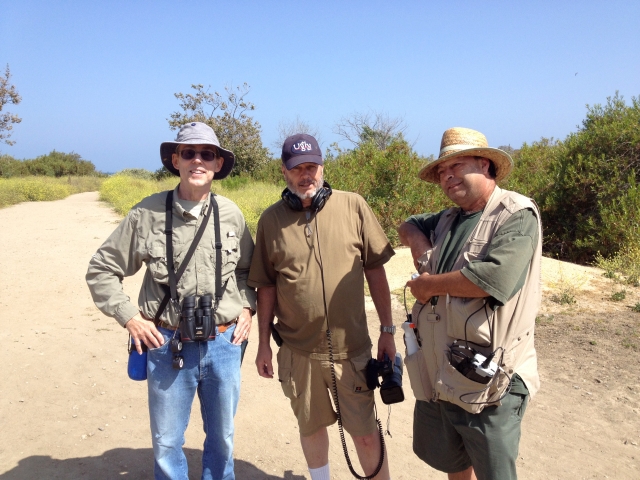
Almdale, Purvey & Horns (J. Beseda 5/19/12)
Surfrider Beach and MRSA
MRSA (Methicillin-Resistant Staphylococcus aureus) is present in the sand at Malibu’s Surfrider Beach. It is also present in the nearby ocean. It is also present at many – perhaps all – other beaches and adjacent ocean waters in L.A. County. It is also present at other American ocean beaches and waters. It has been present at all these locations for years. It may well be on your skin, right now.
According to the CDC, 20 to 25 percent of us have S.aureus (primarily in our nose) and about 2% of us have MRSA (also primarily in the nose). Many people have MRSA and never get sick, but they can transmit it. Other authoritative websites say 20-30% or 20-40% of us have S.aureus on our skin. Take your pick.
Studies (here’s one) (and another, and another, and another – see Google for more) seem to show that the bacteria in the sand and ocean comes from contact with human skin: the more humans present (and the warmer the water the more present we’ll be), especially if they’re blowing their noses, the more bacteria is present. This goes for not just MRSA, but for forms of FIB (fecal indicator bacteria) and S.aureus in general.
So, with that in mind, here’s some more on the ongoing discussion on the Malibu Lagoon Restoration Project.
Here’s a link to a short film featuring various people who are involved – probably, after all these years, way more than they’d like to be – people like Suzanne Goode from Calif. State Parks and Shelley Luce of the Santa Monica Bay Restoration Commission. It addresses the five most common ‘errors’ (to be polite) of belief concerning the restoration.
Here’s a link to what Heal the Bay has to say. It also has a link to the above film.
Finally, here’s two letters-to-the-editor from the May 10, 2012 issue of Malibu Surfside News (scroll down to page 15 for PDF), which will bring us back to the MRSA topic. By the way and for what it’s worth, I stopped body surfing at Will Rogers State Beach decades ago because I got sick and tired of the inevitable sinus infections which immediately followed. [Chuck Almdale]
Editor:
I am disappointed by the level of fear-mongering and misinformation in the May 3, 2012 letter written by Lawrence Stock and Lisa Plano. Stock and Plano’s letter incorrectly implies that the Malibu Lagoon Restoration Project will increase the danger of Staphylococcus infections to users of Surfrider Beach. This could not be further from the truth. In fact, bacteria-laden waters move freely from the western
arms of the lagoon into the creek and onto the beach during normal, everyday lagoon conditions.
The restoration project will separate the western arms of the lagoon from the main lagoon and creek channel with a physical barrier that will prevent water moving back and forth. The restoration project will then remove water from the western arms and thoroughly disinfect it, killing all bacteria including Staphylococcus aureus (staph bacteria) and methicillin-resistant S. aureus (MRSA), before the water is
discharged at the mean high tide line of the beach. If there are MRSA or staph in the sand, they are already constantly mobilized into the swimming zone by waves naturally breaking on the beach. Therefore if anything, the disinfected water released by the restoration project will dilute and decrease the concentrations of bacteria including staph and MRSA in the water and sand at Surfrider Beach.
Stock and Plano refer to a recent NOAA study but fail to mention an important point: that staph bacteria and MRSA were found at three California beaches and “beach prevalence was similar to that in homes.” The study finds that MRSA and staph concentrations are lowest at Surfrider Beach, and are at least 1000 times lower than concentrations that cause infections on normal human skin. The study also states that swimmers themselves are a source of the bacteria. In fact, one in three people carry staph on their skin, and community facilities where lots of people interact, such as hospitals and schools, are where the greatest concentrations of staph and MRSA are found (http://www. phac-aspc.gc.ca/id-mi/mrsa-eng.php). The website of the U.S. Centers for Disease Control states that “MRSA in the community is widespread and therefore, anyone is at risk…People may be more at risk in…athletic facilities, dormitories, military barracks, correctional facilities, and daycare centers” (http://www.cdc.gov/mrsa/riskfactors/index.html).
The Santa Monica Bay Restoration Commission, State Parks and the State Coastal Conservancy have worked extremely hard to design a project that will benefit people and wildlife now and for many generations to come. These agencies would never support a project that would endanger public health or well-being. I am frustrated and disappointed by attacks based on misinformation, and the seemingly
deliberate misleading of a concerned public. I look forward to celebrating a healthy, restored lagoon that is better for birds, better for fish and better for people after our project is completed. Shelley Luce, executive director SMBRC
*******************************************
Editor:
In response to a previous letter, staphylococcus is indeed in the sand at Surfrider. It is in the creek. It is in the lagoon. It is all over the place. It has been flowing out to the surfers at First Point for decades. Here is another attempt by the people opposing the restoration project to use fear mongering spin to try to convince the naive to believe that the project will be solely responsible for releasing dangerous levels of MRSA into the environment.
I cannot believe that in this letter the author says, “Scientific studies are currently being conducted investigating the connection of oceanborne MRSA and the risk of infections to swimmers and surfers.” Duh, really. Of course, there is. And how dare these doctors allude that the restoration project will expose surfers and swimmers to higher levels of MRSA than they are now. The creek is now flowing out to First Point after flowing through the same sands in the western channels and main channel that is full of MRSA.
Presently, swimmers and surfers are exposed to untreated creek water exiting the lagoon, which is full of MRSA that is in the sands of the lagoon and beach sand. The restoration’s custom built dewatering treatment facility will be taking the water that would have left the lagoon untreated and decontaminate it, making it safer than what is flowing out of the lagoon now.
Many years ago, I was on a surfing boat trip in Indonesia with the great Dusty Peak (Skylar Peak’s dad). One day, after surfing good waves at Lances Right, he told me he thinks he got a staph infection in his leg after surfing Surfrider. The infection never completely abated, complications persisted, and may have led to his unfortunate passing, which had nothing to do with the proposed restoration project.
Other surfers have died from surfing Surfrider who contracted the coxsackie B4 virus. My friend Ken Sieno is one of the few who survived the virus that attacks the right heart ventricle only because he had a pacemaker placed in his chest. Some of these deaths occurred while Tapia was still discharging and other victims died after Tapia stopped discharging. Meanwhile antiquated septic systems have continued to discharge into overly saturated leach fields that have direct hydraulic connections to creeks, lagoons and beaches, which caused me to get dysentery for five days last June after surfing First Point. Steve Woods
Malibu Lagoon Restoration – Important Update
To all SMBAS members and friends: Please read the following message from Bob Purvey. Bob is a writer, film producer, surfer, activist and long time Malibu resident. I don’t know Bob well, but I distinctly recall his presence at the very first Malibu Lagoon and Watershed meetings I attended back in the 90’s, and at innumerable meetings after that. His concern for the lagoon is long-term, ongoing, deep and well-informed. Please follow the weblinks supplied below, especially the one to the YouTube video by Aquatic Field Scientist Matthew Horns, who will be conducting Lagoon tours at 1 PM on Saturdays 5/19 & 5/26. [***See Biographical information on Horns in 2nd comment following this article.] Please also read the letter of Anthony I. Perez, Deputy Director of Parks Operations written to Ms. Agi Kessler, Chair of the Resolution Committee of the Los Angeles County Democratic Party (see link to PDF file below). [Chuck Almdale]
**************************
Dear Friends:
Last night I read an article on Surfline, which clearly takes sides in opposition to the Malibu Lagoon project without fully reviewing the facts and merits of the project. There are many serious misleading allegations in the Surfline article that I feel must be addressed immediately.
Surfline falsely likened the Malibu Lagoon project to a project planned at Trestles that had a freeway (toll road) going across San Mateo Creek, failed to address Steelhead Trout and their survivability, failed to address the persistent poor water quality issues and was planning to remove access to the surf spot.
Quite the contrary: The Malibu Lagoon Restoration and Enhancement Project plan, set to begin on June 1st, 2012, was started in 2000 with the Malibu Lagoon Task Force.
The Malibu Lagoon Task Force includes all the environmental organizations and the lagoon project has been properly planned after an extensive and exhaustive planning process. All the environmental organizations still stand strongly united in support of the project. There are two rogue groups known as Save the Lagoon and Wetland Defense Fund and a newly formed group known as the Surfer’s Coalition that are behind the disinformation campaign.
The Malibu Lagoon Restoration and Enhancement project has far reaching benefits. Please read the attached letter response from California State Parks Deputy Director Anthony Perez addressing the Los Angeles County Democratic Party’s short-sighted opposition of the lagoon project. His eloquent letter thoroughly corrects all the misleading half-truths the Democratic Party was misled by.
Seems like Surfline and the Los Angeles County Democratic Party are not the only one’s that have been misinformed. Glenn Hening, Surfrider Foundation’s Founder replies to this situation succinctly in a YouTube video.
I cannot blame anyone for wanting to protect Malibu and when faced with emotionally charged information that may appear threatening, one’s guard would be naturally raised. However, the facts of the matter must be shared so that one can make an informed decision on their own. The lagoon project is far too important to me as a long-standing Malibu surfer to allow any misinformation go unnoticed.
It’s nice to know that 99% of us will benefit from the Malibu Lagoon project: Scientist Matthew Horns explains why in his YouTube video tour recorded May 3, 2012.
Aquatic field scientist Matthew Horns has many years of expertise and experience in the Malibu Creek Watershed and Lagoon. In this 14-minute video tour of the Malibu Lagoon, Matt shows and tells us about the pollution problems plaguing the lagoon. He explains how depleted dissolved oxygen is the cause of many life-threatening problems and what the Malibu Lagoon Restoration and Enhancement project will do to resolve these problems in this magnificent and significant wildlife habitat. [Link to Bio of Matthew Horns.] [***See Biographical information on Horns in 2nd comment following this article.]
As a competitive surfer from Malibu since 1963 and considered one of the first professionals in the sport, I truly care about Malibu Surfrider Beach, which is why in 1992 I joined the Malibu Creek Watershed effort to clean up the water pollution at Surfrider and I am fully aware of the pollution problems and what is being done to resolve them.
I am therefore surprised and shocked that Surfline claims to have signatures on a petition opposing the project from such luminaries in the sport of surfing as Nat Young. I respect Nat immensely and consider him a good friend but in my opinion, it would have been a bit more responsible for Nat and any of the sport’s representatives to have taken a more pro-active position and reviewed the matter fully, but it seems that if Surfline‘s claim is true, then they may be the victim of the same emotionalism that is played on to convey the opposition’s message filled with half-truths.
I know they are half truths and I also know the merits of the project because I have been participating in the development of the project from the beginning. My friend Nat and some of my other friends have been duped and I hope Surfline and everyone who is questioning the Malibu Lagoon Project, first read State Park’s Deputy Director’s letter response to the Los Angeles County Democratic Party, which is attached. This letter serves to clarify the situation completely. Letter from Director Perez
Also, please review the 14-minute video tour given by Malibu Lagoon Field Scientist Matt Horns, which should help you to understand why I am convinced that the Malibu Lagoon Restoration and Enhancement project is worthy.
Bob Purvey
PS: Matt is conducting two more Saturday, 1 PM, tours on May 19 & May 26, 2012.
Please share this with your world.
Full Flower Moon 5/5/12 8:35 p.m. PDT
Here’s another update from SMBAS Blog on that large shining object which has frequently and mysteriously appeared in our nighttime sky this year (known to many as the moon).
May 5, 8:35 p.m. PDT — Full Flower Moon. Flowers are abundant everywhere at this time. May’s full moon was also known as the Full Corn Planting Moon or the Milk Moon. The moon will also be at perigee just 25 minutes after turning full, at 12:00 a.m. EDT on May 6, at a distance of 221,801 miles from Earth. Very high ocean tides can be expected from the coincidence of perigee with the full moon.
The next significant full moon will occur on June 4, 4:12 a.m. PDT. Keep an eye on this spot for additional breaking news on this unprecedented event.
This information comes to you courtesy of:
http://www.msnbc.msn.com/id/45911225/ns/technology_and_science-space/t/how-s-full-moons-got-their-strange-names/#.T16CDHlIXUx
But that’s way too long to type in, and besides, you don’t need to go there because SMBAS has done the work for you!
[Chuck Almdale]
Help Monitor Least Terns at Venice Beach!
The California Least Tern is listed as endangered by both Federal and California state authorities, and Los Angeles Audubon Society is looking for dedicated volunteers to help monitor them at Venice Beach.

Least Tern chick
In Los Angeles County, this species returns to only two breeding colonies, one at Venice Beach and one at the Port of Los Angeles. Los Angeles Audubon works with project biologists and the California Department of Fish & Game studying the tern colony in Venice by coordinating a community-based science monitoring program during the nesting season. Volunteers receive training and then help monitor the colony for one hour each week from mid-April to mid-August. This is a great opportunity for families looking for a way to learn about nature together, for students looking to gain some field experience in environmental science, or anyone who’d like to know more about urban wildlife.
If this sounds like something you’re interested in, then we’d love to meet you at one of the following training sessions:
Wednesday, May 2nd, 630pm to 730pm, or
Sunday, May 6th, 9am to 10am, or
Wednesday, May 9th, 630pm to 730pm
Training Location: Training sessions will take place at the Least Tern Colony enclosure on Venice Beach. The enclosure is located at the very southern end of Venice Beach near the Ballona Channel. There is metered parking along the channel where Pacific Ave turns into Via Marina, and there’s a public pay lot at the intersection of Via Marina and Captain’s Row. There’s technically free parking along Pacific Ave, but the spots get taken up fast.
Binoculars are essential to monitoring, so please bring them with you if you own them (if you don’t own any, we can lend you a pair for the season). If this date doesn’t work for you but you’re still interested in helping, please let me know and I’ll see if we can arrange an alternative training session.
Questions?: Please contact the Volunteer Coordinator at 323-481-4037 or tern [AT] laaudubon.org.
From: Stacy Vigallon



 SANTA MONICA BAY AUDUBON SOCIETY BLOG