Free email delivery
Please sign up for email delivery in the subscription area to the right.
No salesman will call, at least not from us. Maybe from someone else.
Butterbredt Spring Springtime Outing: 27-30 April, 2012

Bush Lupine (R. Seidner 4/27/12)
We had a very successful outing on our traditional spring-migrant trip to this spring which draws hoards of birds and birders. I stretched my part to four days: Friday night, Saturday, Sunday and Monday morning which allowed me to see (on a camera picture) the Hooded Warbler. It was discovered by a couple I met Monday at the Spring on my way home, who had camped there Sunday night. But, sadly, of course, nowhere was it to be found when I searched the trees Monday afternoon.
Our ranks were few, but fortified by visitors from the combined Tehachapi and Bakersfield Audubon chapters, and our own Chris Lord who came early and stayed late, Friday and Saturday, scouting all the slopes, canyons, trees and byways to provide a fortified final list of 70 species.

A lovely yellow flower (R. Seidner 4/27/12)
Other visitors on Saturday at Sageland Ranch, our camp site, hosted there by owner Keith Axelson, and itself a nature refuge, were various members of the local community, friends, birders and two members of the Student Conservation Association, a conservation and restoration oriented organization of young adults which SMBAS has been supporting since we found out about them. They devote huge amounts of time and energy to restoring damaged natural habitats all over the nation. It was very good to meet them, to observe how competently and cooperatively they work together under very primitive and strenuous conditions.
The annual wildflower show was somewhat minimal this year because of an unusually dry season, but we saw patches of the expected Deep Blue Lupine, and brilliant gold Bigelow Coreopsis with a few other smaller specimens.
Animals, however, were interesting, beginning with a fast stop for a beautifully marked Gopher Snake on the drive down Butterbredt Canyon road. Lys Axelson jumped out of the car and ushered it off, out of harm’s way on this busy off-road vehicle route. I personally saw two more snakes, none rattlers, one not identified and the other a Garter Snake, and three Greater Roadrunners while I was driving the Jawbone Canyon road home. There was a very interesting raptor also. I called it a Swainson’s Hawk, but of course, no one can verify that. The field marks fit, but the location and fact it was alone, and quickly out of sight, did not.

Hoary Bat (R. Seidner 4/27/12)
Most interesting creature was the Hoary Bat discovered by a fellow birder at Butterbredt. It was hanging, sleeping on a branch above the lower canyon trail, only a few feet above our heads and oblivious to our stares. We could see every identifying feature. Furthermore, sleeping in trees was indicated as its habit.
There were, of course, numerous lizards, including a fleeing Whip-tailed, various Skinks, many Black Fence Lizards among the rocks, one of which provided us views while being fed to the female American Kestrel by her mate at Sageland. The Kestrels are nesting in the box Keith set for them on his water tank, and he observes lizards apparently are the bird’s chief prey source.

Whiptail Lizard (R. Seidner 4/27/12)
Some of our prize birds of the trip were the Green-tailed Towhee Chris found under a Joshua Tree up on the canyon slope; great looks at MacGillivray’s Warblers, one perched up on brush for full views of its every feather at the water trough area at Butterbredt, and another in the spring area of Keith’s creek. Other favorites, beautiful male Western Tanagers, Yellow Warblers, almost all the western warblers, Bullock’s Orioles, Greater Roadrunners, male Costa’s Hummingbirds, and, especially the magnificent Scott’s Orioles coming to the feeder where we were having our meals.
I must mention the lone Golden Eagle that Chris, while he waited for our cars, watched from the pass on the Butterbredt Spring road, leave the cliff and sail away north. It was the only one of the trip. All are in very serious danger there, as roads have been graded along the ridge south and in Kelso Valley, and pads prepared for the installation of huge wind turbines. Stacks of metal sheaths for the turbines lay along the gated entry roads. These wind turbine installations seem nearly impossible to forestall, despite ample evidence presented that they are being located in very sensitive bird areas where at least eight federally protected Golden Eagles have been struck down in the LADWP Pine Tree unit not far west, without consequence to the operators. For us especially, who have valued these magnificent birds sighted there over the years, it is a very sad prospect.
I hope we will still see more very rewarding trips to our Butterbredt Sanctuary, however. The roads were in excellent shape, well graded, the weather near perfect. Our bird list follows. [Mary Prismon, leader]
Map of Butterbredt Spring area
Butterbredt Spring Trip April 27-30, 2012
68 species (plus one identifiable morph) in no particular order
Great Horned Owl
Sage Sparrow
Mourning Dove
Northern Raven
Red-tailed Hawk
Eurasian Collared-Dove
California Thrasher
Costa’s Hummingbird
Western Kingbird
Bullock’s Oriole
California Towhee
Scrub Jay
Western Tanager
Ladder-backed Woodpecker
Ruby-crowned Kinglet
Olive-sided Flycatcher
Nuttall’s Woodpecker
American Kestrel
Western Wood Pewee
Anna’s HummingBird
Say’s Phoebe
Chukar
Lincoln Sparrow
Red-winged Blackbird
Red-winged “Bicolored” Blackbird (at Keith’s)
California Quail
Common Yellowthroat
Pacific-slope Flycatcher
Lawrence’s Goldfinch
Sharp-shinned Hawk
Hammond’s Flycatcher
Lazuli Bunting
Mountain Quail
House Finch
Ash-throated Flycatcher
Western Screech-Owl
White-crowned Sparrow
Greater Roadrunner
Bushtit
Chipping Sparrow
Loggerhead Shrike
European Starling
Green-tailed Towhee *
Scott’s Oriole
Brewer’s Sparrow
Yellow Warbler
Western Meadowlark
Black-throated Sparrow
Wilson’s Warbler
Black-headed Grosbeak
Lesser Goldfinch
Nashville Warbler
Townsend’s Warbler
Brown-headed Cowbird
MacGillivray’s Warbler
Cassin’s Vireo
Warbling Vireo
Yellow-rumped Warbler
Cactus Wren
Spotted Towhee
Orange-crowned Warbler
Golden Eagle
American Coot
Bewick’s Wren
Western Bluebird
Mallard
Golden-crowned Sparrow
Hermit Warbler
Swainson’s Hawk
New Photos from Malibu Lagoon

Killdeer chick, as leggy as a Secretary-Bird (J.Waterman 4/21/12)
Joyce Waterman, who, with husband Doug, has supplied many photos to this blog over the past few years, took a couple of photos last Saturday, April 21, the day before our last lagoon walk.
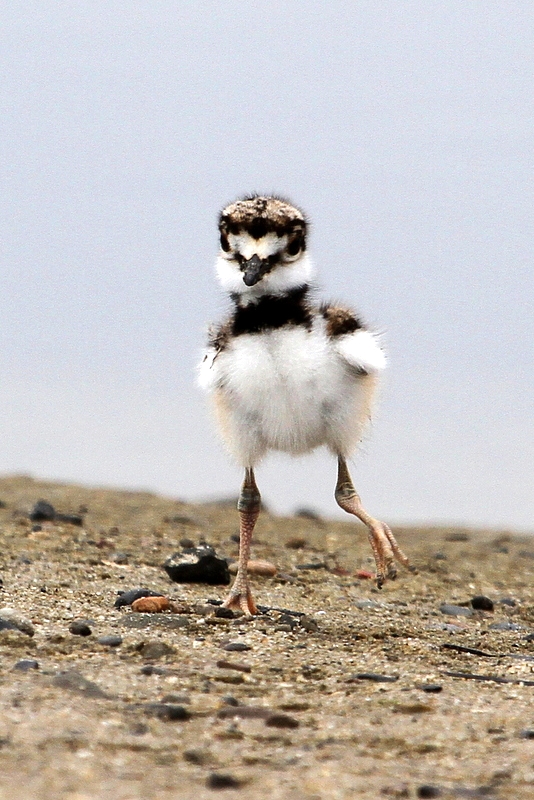
Killdeer chick, a little unsteady. (J.Waterman 4/21/12)
Unfortunately she sent them to me after I’d already posted the blog. They are so cute that I wanted everyone to see them. They have also been added to the trip report blog already posted, as well as to our special page of Lagoon Birds (which I’m sure everyone knows has been on our blogsite for well over a year).
These photos were taken at the same place we saw the Killdeer nest last year, which was on a small “island” (or bump) inland of the Snowy Plover enclosure. So…watch your step out there!
*****
*****
James Kinney, major photographic contributor to our blog, just sent this photo of a

With "eyebrows" much like some of our older chapter members, this Double-crested Cormorant displays the crests for which it was named. (J.Kenney 4/26/12)
bird we all saw on Sunday, a Double-crested Cormorant in alternate (breeding) plumage proudly displaying the crests for which it was named. [It reminds me of George Burns.] Most west coast birds have white crests whereas the crests of most east coast birds are black. There was at least one bird at the lagoon with black crests.
If you have not yet visited our chapter’s Facebook page, then you’ve missed the huge albums of James Kenney’s photos of local birds, many from Malibu Lagoon, currently totaling over 210 photos, each one annotated with loads of interesting information. It’s a public page so you don’t need to be a Facebook member or sign up to become one in order to visit.
*****
Finally, having nothing to do with the lagoon but everything to do with birding, here’s a link to a “News” story which recently showed up on BIRDCHAT, the U.S. chatline for birders. [If you don’t subscribe, think about signing up. It’s free. No salesman will call.] You’ll see why I put “News” in quotes. Have your bird book close at hand while you watch the video. This story is an “onion” – just when you think there are no more layers of stupidity to be revealed, you see that you are mistaken. No one escapes. [Chuck Almdale]
Malibu Lagoon Trip Report: 22 April, 2012
We lead off with a couple of great photos from Joyce Waterman.
Killdeer chick, a little unsteady. (J.Waterman 4/21/12)
This Killdeer chick was photographed on Saturday, the day before our monthly lagoon walk. It was inland of the Snowy Plover enclosure, in the same location where the adult Killdeer were photographed (see below) the following day, and where we found a Killdeer nest last year. This next shot makes me think of the Secretary-Bird of the African veldt.
Killdeer chick, as leggy as a Secretary-Bird (J.Waterman 4/21/12)
Today was Earth Day, kept cool by the morning fog. It was nice to see so many caring people out on the beach, picking up trash. But this ‘celebration’ really works only when people carry their concern over into daily life. So think about: reducing water waste, fewer flushes, reduce driving, reduce driving speeds. When I drive the speed limit on the freeway and many dozens of cars pass me every minute and I pass no one except semis, I have to think that the price of gasoline is still far too low. At today’s prices, the EPA says that every 5 mph you drive over 60 mph costs you 31¢ per gallon. Slow down: reduce frustration, save fuel, save lives.
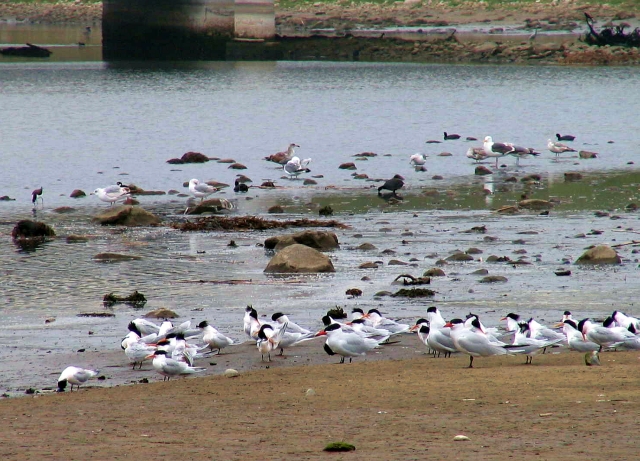
Lagoon flock front to rear: Elegant & Caspian Terns, California & Western Gulls, American Coot, & Black-necked in left center. (Lee Huniu 4/22/12)
Time marches on. Birds come and go. The elegantly crested Elegant and Caspian Tern numbers grew with each passing minute. A beautifully plumaged Sora appeared all ready to breed somewhere, perhaps right here. The gulls and terns weren’t waiting: we frequently saw them (ahem) standing atop one another; perhaps it was to admire the view. A small flock of Western Sandpipers appeared out of nowhere. A Peregrine Falconshot through, sending the birds up in a cloud of wings.
With “eyebrows” much like some of our older chapter members, this Double-crested Cormorant displays the crests for which it was named. (J.Kenney 4/26/12)
Three Semipalmated Plovers – absent since last August’s southerly migrants passed through – were on the mud. A Pacific Loon in alternate plumage repeatedly dove out past the kelp and surf zone. On the outer rocks, two Black Turnstones braved the over-breaking waves. In the reeds and trees, Red-winged Blackbirds ground out their songs and displayed their bright red epaulets. Nearby, Great-tailed Grackles bowed and tail-pointed, while a pair of Brown-headed Cowbirds waited patiently for someone – anyone! – to get on the stick and build a nest so they could dump their eggs into it. Four Black-necked Stilts – on their 6th visit in 32 years –rested, fed and rested again.
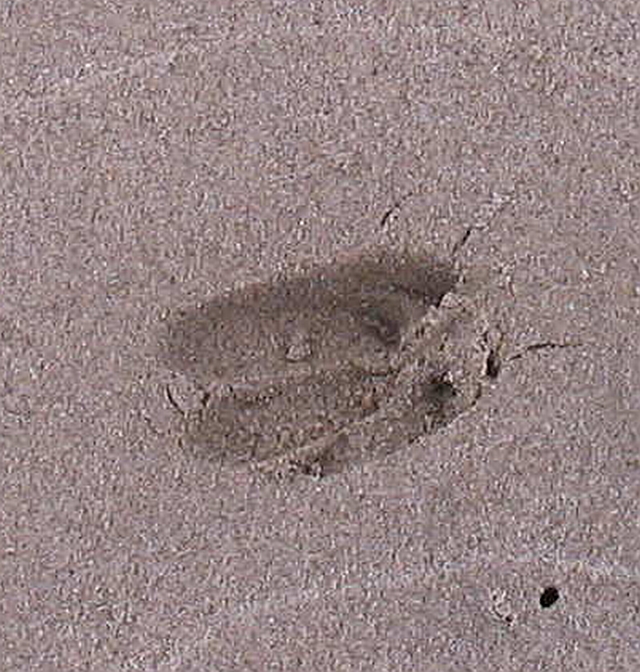
Deer footprint in beach sand (Lee Huniu 4/22/12)
Just after finding a deer footprint in the damp sand – something I don’t recall previously seeing – we spotted four actual deer inland of the highway bridge on the east side of the creek. They wandered back and forth for a few minutes, then disappeared into the brush.

Killdeer inspects us. (Lee Huniu 4/22/12)
This Killdeer patrolled the sand between the lagoon and the Snowy Plover enclosure. It was probably keeping such a close eye on us because its chick was nearby, unbeknownst to us at the time. This is where we found a Killdeer nest last year.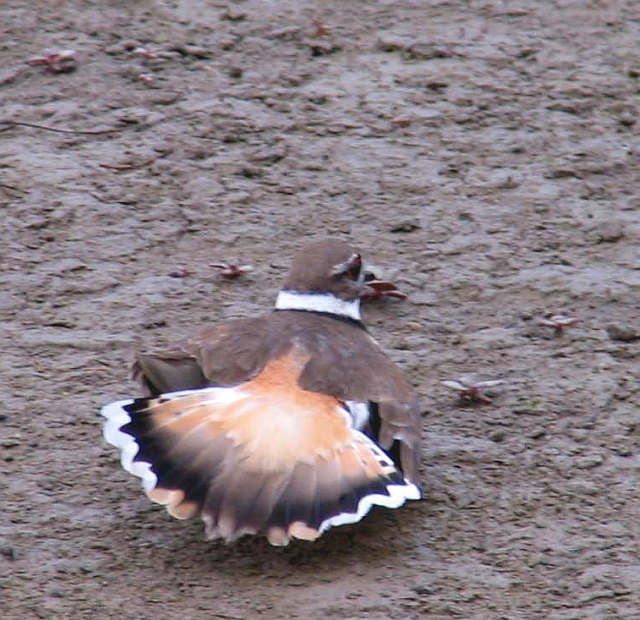
- The Killdeer shows us his new tail (Lee Huniu 4/22/12)
The Snowy Plover Enclosure was doing fine, although the 3 remaining Snowies chose not to utilize it today. There were plenty of footprints – dog and human – inside it, plus wrack and growing vegetation, so it wasn’t because they couldn’t find any little depressions to lounge in. Besides, they can scrape them out themselves without much effort, should they choose to do so.
A sizable group of Cub “Webelo” Scouts showed up, to our surprise, with many parents in tow, so the “parents & kids” leaders showed them around. [We encourage organizers to please let us know they’re coming so that we’re here to meet them.] We received this note from Cub Scout Stanley Funnell:
Our next three field trips: Solstice Canyon 12 May, 8 am; Malibu Lagoon, 27 May, 8:30 & 10 am; Mt. Piños Birds & Butterflies, June 16-17, 8 am.
Our next program: Tuesday, 1 May, 7:30 pm – Alaska, presented by Guy Commeau. The usual reminders will be emailed from the blog.
As a reminder to those coming to our 10 a.m. Parent’s & Kids Birdwalk, it meets at the beach trail footbridge closest to the parking lot.
Links: Unusual birds at Malibu Lagoon
Aerial photo of Malibu Lagoon from 9/23/02.
Prior checklists: July-Dec’11, Jan-June’11, July-Dec ’10, Jan-June ’10, Jul-Dec ‘09, and Jan-June ‘09.
[Chuck Almdale]
| Malibu Census 2012 |
22-Jan |
26-Feb |
25-Mar |
22-Apr |
| Temperature |
68-75 |
48-64 |
54-61 |
60-65 |
| Tide Height |
+6.49 |
+3.37 |
+3.64 |
+3.67 |
| Low/High &Time |
H:0803 |
H:1136 |
H:1146 |
H:1106 |
| Snow Goose | 1 | |||
| Brant | 1 | |||
| Gadwall | 31 | 35 | 18 | 14 |
| American Wigeon | 2 | 8 | 3 | 9 |
| Mallard | 23 | 30 | 24 | 16 |
| Northern Shoveler | 46 | 35 | 18 | 12 |
| Northern Pintail | 10 | 8 | 5 | |
| Green-winged Teal | 37 | 38 | 11 | |
| Surf Scoter | 14 | 40 | ||
| Bufflehead | 26 | 4 | ||
| Red-brstd Merganser | 6 | 8 | 2 | 5 |
| Ruddy Duck | 59 | 24 | 20 | 9 |
| Red-throated Loon | 2 | |||
| Pacific Loon | 1 | 3 | 3 | |
| Common Loon | 1 | |||
| Pied-billed Grebe | 3 | 2 | 2 | |
| Eared Grebe | 4 | 2 | 2 | |
| Western Grebe | 8 | 40 | 1 | |
| Brandt’s Cormorant | 3 | 15 | 1 | 1 |
| Dble-crstd Cormorant | 37 | 28 | 30 | 65 |
| Pelagic Cormorant | 1 | 2 | ||
| Brown Pelican | 48 | 12 | 40 | 80 |
| Great Blue Heron | 7 | 1 | ||
| Great Egret | 2 | 2 | 1 | 2 |
| Snowy Egret | 7 | 8 | 12 | 9 |
| Green Heron | 1 | |||
| Blk-crwnd N-Heron | 2 | 1 | ||
| Osprey | 1 | |||
| Red-shouldered Hawk | 1 | 2 | ||
| Peregrine Falcon | 1 | |||
| Sora | 2 | 3 | 1 | |
| American Coot | 345 | 285 | 20 | 95 |
| Blk-bellied Plover | 65 | 93 | 7 | 11 |
| Snowy Plover | 81 | 54 | 14 | 3 |
| Semipalmated Plover | 3 | |||
| Killdeer | 2 | 10 | 4 | |
| Black Oystercatcher | 5 | 2 | ||
| Black-necked Stilt | 4 | |||
| American Avocet | 2 | 1 | ||
| Spotted Sandpiper | 2 | 1 | 1 | |
| Willet | 3 | 3 | ||
| Whimbrel | 1 | 2 | 18 | 5 |
| Marbled Godwit | 2 | 8 | ||
| Ruddy Turnstone | 15 | 13 | 1 | |
| Black Turnstone | 2 | |||
| Sanderling | 200 | 100 | ||
| Western Sandpiper | 16 | |||
| Least Sandpiper | 12 | 20 | 5 | |
| Boneparte’s Gull | 2 | |||
| Heermann’s Gull | 16 | 1 | ||
| Ring-billed Gull | 150 | 35 | 8 | 20 |
| Western Gull | 120 | 55 | 30 | 85 |
| California Gull | 1900 | 360 | 12 | 75 |
| Glaucous-wingd Gull | 5 | 2 | 1 | |
| Caspian Tern | 3 | 25 | ||
| Forster’s Tern | 1 | |||
| Royal Tern | 16 | 1 | ||
| Elegant Tern | 65 | |||
| Rock Pigeon | 5 | 4 | 3 | |
| Mourning Dove | 2 | 2 | 2 | |
| Anna’s Hummingbird | 2 | 2 | 2 | |
| Allen’s Hummingbird | 2 | 1 | 2 | |
| Belted Kingfisher | 1 | 1 | ||
| Black Phoebe | 3 | 4 | 4 | |
| Say’s Phoebe | 1 | |||
| Cassin’s Kingbird | 2 | |||
| Western Kingbird | 16 | |||
| American Crow | 4 | 8 | 3 | 5 |
| Rough-wingd Swallow | 2 | 6 | 6 | |
| Barn Swallow | 1 | |||
| Bushtit | 26 | 4 | 2 | |
| Bewick’s Wren | 1 | 1 | ||
| Marsh Wren | 1 | |||
| Ruby-crowned Kinglet | 2 | |||
| Hermit Thrush | 1 | |||
| Northern Mockingbird | 1 | 2 | 2 | |
| European Starling | 1 | 15 | 4 | |
| Yellow-rumpd Warbler | 3 | 1 | ||
| Common Yellowthroat | 4 | 2 | 1 | 3 |
| Spotted Towhee | 1 | 1 | ||
| California Towhee | 2 | |||
| Savannah Sparrow | 2 | |||
| Song Sparrow | 2 | 8 | 13 | 8 |
| White-crwnd Sparrow | 22 | 4 | ||
| Red-winged Blackbird | 15 | 2 | 6 | |
| Brewer’s Blackbird | 1 | |||
| Great-tailed Grackle | 13 | 8 | 8 | |
| Brwn-headed Cowbird | 2 | 2 | ||
| House Finch | 25 | 10 | 19 | 6 |
| Lesser Goldfinch | 2 | |||
| Totals by Type | Jan | Feb | Mar | Apr |
| Waterfowl | 255 | 231 | 101 | 65 |
| Water Birds-Other | 452 | 395 | 91 | 250 |
| Herons, Egrets | 18 | 10 | 14 | 13 |
| Quail & Raptors | 2 | 2 | 0 | 1 |
| Shorebirds | 388 | 275 | 65 | 63 |
| Gulls & Terns | 2207 | 455 | 53 | 272 |
| Doves | 7 | 6 | 0 | 5 |
| Other Non-Pass. | 5 | 4 | 0 | 4 |
| Passerines | 110 | 92 | 62 | 60 |
| Totals Birds | 3444 | 1470 | 386 | 733 |
| Total Species | Jan | Feb | Mar | Apr |
| Waterfowl | 11 | 11 | 8 | 6 |
| Water Birds-Other | 10 | 12 | 4 | 9 |
| Herons, Egrets | 4 | 2 | 3 | 4 |
| Quail & Raptors | 2 | 1 | 0 | 1 |
| Shorebirds | 11 | 8 | 7 | 12 |
| Gulls & Terns | 6 | 7 | 4 | 7 |
| Doves | 2 | 2 | 0 | 2 |
| Other Non-Pass. | 3 | 3 | 0 | 2 |
| Passerines | 16 | 18 | 9 | 15 |
| Totals Species – 90 | 65 | 64 | 35 | 58 |
Despite our weather concerns, it turned out to be a perfect day for a hike. We almost canceled twice – once because there had been no rain – then because there had suddenly been a lot of rain.

Golden Current closeup (J.Kenney 4/15/12)
As usual, some flowers were blooming, some weren’t. The Yearling Trail through “Ronald Reagan Meadow” had a few muddy spots, but nothing not easily avoidable.

Rabbit licking his muddy feet (J. Waterman 4/15/12)
We tried a new route this year. Rather than hiking to Malibu Creek State Park parking lot and car-shuttling back to Paramount Ranch, we hiked a loop which was more of a “lasso”: Yearling Trail to Lookout Trail down to Century Lake on Crags Rd., then back up the hill via Cage Creek Trail to Yearling Trail and back to Paramount Ranch. I thought this would be a shorter route, but now I’m not so sure. It was definitely tougher, with an all-uphill trek on the way back rather than a gentle amble alongside Malibu Creek.
As always, the hike was led by Peggy Burhenn, Calif. State Parks docent specializing in native plants and wildflowers. This year, Jim Kenney was with us, taking many of the photographs that grace this posting. Jim took most or all (not sure which) of the photographs in the very thick wildflower book** that Peggy always has in hand.

Indian Paintbrush (J.Kenney 4/15/12)
We saw a lot of great flowers and birds, the air was filled with birdsong, and no one got hit by a bicycle. No rain and cool temperatures topping out around 70°.

Male House Finch is almost same shade of red as Indian Paintbrush (J. Waterman 4/15/12)
Dew-damp funnel spider webs were in the meadow, and best of all, we started off with a family of three coyotes crossing the trail about 100 ft. ahead. Birding and “wildflowering” are tough, tough tasks, but someone has to do this filthy, grinding work.

Waiting Coyote (J.Kenney 4/15/12)
All the participants, although tired at the end, thoroughly enjoyed themselves. If you didn’t make it, think about it for next year.

Red-shouldered Hawk at Reagan Ranch (J.Kenney 4/15/12)
The lists below give a four-year comparison of flowers and birds seen on this hike. Because we changed the route this year, some plants and birds, found in particular locations, didn’t make the list this year. We always find Chia, for example, on a hillside near the Malibu Creek S.P. parking lot. The waterfowl and shorebirds are found mostly in the open sections of Malibu Creek. [Chuck Almdale]
** Wildflowers of the Santa Monica Mountains by Milt McAuley (1985 & 1996)
| PLANTS |
4/15 |
4/9 |
4/10 |
3/29 |
| WHITE |
2012 |
2011 |
2010 |
2009 |
| Ashy-leafed Buckwheat | X | X | ||
| Big Pod Ceanothus | X | X | ||
| California Buckwheat | X | X | ||
| California Everlasting | X | X | ||
| Cliff Aster | X | |||
| Coyote Brush | X | |||
| Dodder | X | X | ||
| Elderberry | X | X | X | |
| Horehound* | X | X | X | X |
| Miner’s Lettuce | X | X | X | |
| Morning Glory | X | X | ||
| Mulefat | X | X | X | |
| Narrow-leafed Bedstraw | X | |||
| Poison Hemlock | X | |||
| Poison Oak | X | |||
| Popcorn Flower | X | X | X | |
| White Nightshade | X | X | ||
| White Sage | X | X | X | X |
| Wild Cucumber | X | X | X | X |
| Yucca | X | X | X | |
| YELLOW | ||||
| Burr Clover* | X | |||
| Canyon Sunflower | X | |||
| Collarless California Poppy | X | |||
| Common Fiddleneck | X | X | X | X |
| Common Goldfields | X | |||
| Deerweed | X | X | ||
| Golden Currant | X | X | X | X |
| Golden Yarrow | X | X | ||
| Johnny Jump-up | X | X | X | X |
| Lomatium | X | |||
| Microseris | X | |||
| Mountain Dandelion | X | X | ||
| Mustard* | X | X | X | X |
| Pineapple Weed* | X | X | X | X |
| Stringose Lotus | X | X | ||
| Western Wallflower | X | X | ||
| ORANGE | ||||
| Bush/sticky Monkeyflower | X | X | ||
| California Poppy | X | X | X | |
| Scarlet Pimpernel* | X | X | ||
| RED | ||||
| Crimson Pitcher Sage | X | X | X | |
| Indian Paintbrush | X | X | ||
| PINK | ||||
| Bush Mallow | X | |||
| Milk Thistle* | X | X | ||
| Prickly Phlox | X | X | ||
| Purple Clarkia | X | |||
| Purple Owl’s Clover | X | X | ||
| Purple Sage | X | X | X | X |
| Red-stem Filaree* | X | X | X | X |
| Spring Vetch* | X | X | X | |
| Tom Cat Clover | X | |||
| Wild Radish* | X | X | X | X |
| Wild Sweet Pea | X | X | ||
| Wooly Aster | X | |||
| PURPLE / BLUE | ||||
| Baby Blue Eyes | X | X | ||
| Bajada Lupine | X | |||
| Black Sage | X | X | X | |
| Blue Dicks | X | X | X | X |
| Blue Larkspur | X | |||
| Bush Lupine | X | X | X | X |
| California Peony | X | |||
| Caterpillar Phacelia | X | X | X | X |
| Chia | X | X | X | |
| Chinese Houses | X | X | X | X |
| Common Vervain | X | X | ||
| Danny’s Skullcap | X | X | ||
| Dove Lupine | X | X | X | |
| Fern-leaf Phacelia | X | X | ||
| Fiesta Flower | X | X | X | X |
| Green Bark Ceanothus | X | X | X | |
| Henbit* | X | |||
| Italian Thistle* | X | |||
| Parry’s Phacelia | X | X | X | |
| Purple Nightshade | X | X | X | X |
| Winter Vetch* | X | X | ||
| BROWN | ||||
| Curly Dock | X | X | ||
| English Plantain* | X | |||
| Lace Pod (green) | X | X | ||
| TREES, SHRUBS, OR | ||||
| NOT IN BLOOM | ||||
| Arroyo Willow | X | X | X | X |
| Ashy-leafed Buckwheat | X | |||
| Big Pod Ceanothus | X | |||
| Bush/Sticky Monkeyflower | X | |||
| California Bay Laural | X | X | ||
| California Bickelbush | X | |||
| California Buckwheat | X | |||
| California Sagebrush | X | X | X | |
| Chamise | X | X | X | |
| Coast Live Oak | X | X | X | X |
| Coffee Berry | X | |||
| Coyote Brush | X | X | X | |
| Crimson Pitcher Sage | X | |||
| Dudleaya | X | |||
| Elderberry | X | |||
| English Plantain* | X | |||
| Green Bark Ceanothus | X | |||
| Hog Fennel | X | X | ||
| Indian Paintbrush | X | |||
| Laural Sumac | X | X | X | X |
| Milk Thistle* | X | X | ||
| Mistletoe | X | X | X | X |
| Mugwort | X | X | X | X |
| Poison Hemlock* | X | X | ||
| Poison Oak | X | X | X | |
| Scrub Oak | X | X | ||
| Soap Plant | X | X | ||
| Squaw Bush | X | |||
| Stinging Nettle | X | |||
| Sugarbush | X | X | X | |
| Toyon | X | X | X | X |
| Valley Oak | X | X | X | X |
| Western Sycamore | X | X | X | X |
| Whitethorn | X | |||
| Wild Rose | X | X | X | X |
| Yucca | X | |||
| Total Species – 97 |
74 |
61 |
71 |
56 |
|
* – Introduced species |
*****
| BIRD LIST |
4/15 |
4/9 |
4/10 |
3/29 |
| Name |
2012 |
2011 |
2010 |
2009 |
| Canada Goose | 4 | 2 | ||
| Gadwall | X | |||
| American Wigeon | X | |||
| Mallard | 8 | 7 | 10 | X |
| Bufflehead | X | |||
| Ruddy Duck | X | |||
| California Quail | 20 | 6 | 4H | |
| Pied-billed Grebe | X | |||
| Great Blue Heron | 1 | 2 | ||
| Turkey Vulture | 3 | 4 | 2 | X |
| Sharp-shinned Hawk | 1 | 1 | ||
| Cooper’s Hawk | 1 | 1 | X | |
| Red-shouldered Hawk | 1 | 6 | 2 | X |
| Red-tailed Hawk | 3 | 3 | 5 | X |
| American Kestrel | X | |||
| American Coot | 4 | 4 | X | |
| Spotted Sandpiper | 1 | |||
| Band-tailed Pigeon | 3 | 9 | ||
| Mourning Dove | 4 | 8 | 12 | |
| Black-hooded Parakeet | 3 | 1 | ||
| Vaux’s Swift | 20 | |||
| White-throated Swift | 2 | 4 | 12 | X |
| Black-chinned Hummingbird | 1 | 1 | ||
| Anna’s Hummingbird | 1 | 2 | 4 | X |
| Allen’s Hummingbird | 1 | 1 | X | |
| Belted Kingfisher | 1 | X | ||
| Acorn Woodpecker | 9 | 8 | 11 | X |
| Nuttall’s Woodpecker | 5 | 2 | 2H | X |
| Downy Woodpecker | X | |||
| Northern Flicker | 3 | 2 | X | |
| Hammond’s Flycatcher | 1 | |||
| Pacific-slope Flycatcher | 1 | 2 | X | |
| Black Phoebe | 4 | 8 | 8 | X |
| Say’s Phoebe | 1 | 3 | 1 | |
| Cassin’s Kingbird | 3 | 4 | 2 | X |
| Western Kingbird | 1 | 4 | 3 | X |
| Hutton’s Vireo | 1 | |||
| Warbling Vireo | 2 | X | ||
| Western Scrub-Jay | 10+20H | 12 | 14 | X |
| American Crow | 15 | 20 | 6 | X |
| Common Raven | 2 | 4 | 5 | X |
| Tree Swallow | 6 | 4 | ||
| Violet-green Swallow | 20 | 20 | 12 | |
| Northern Rough-winged Swallow | 25 | 35 | 24 | X |
| Cliff Swallow | 3 | 1 | 20 | X |
| Barn Swallow | 2 | X | ||
| Oak Titmouse | 2+20H | 9 | 4 | X |
| Bushtit | 8 | 8 | 4 | X |
| White-breasted Nuthatch | 2 | 2 | 2 | X |
| Canyon Wren | 1 | 1H | 1H | |
| Bewick’s Wren | 4 | 12 | 2 | X |
| House Wren | 4+40H | 25 | 32 | X |
| Blue-gray Gnatcatcher | 3H | 1 | ||
| Ruby-crowned Kinglet | 1 | 2 | 2 | X |
| Wrentit | 20H | 7H | H | X |
| Western Bluebird | 10 | 13 | 10 | X |
| Hermit Thrush | 1 | X | ||
| American Robin | 1 | |||
| Northern Mockingbird | 2 | X | ||
| California Thrasher | 1+3H | 4H | H | |
| European Starling | 1 | 6 | 12 | X |
| Orange-crowned Warbler | 1H | 5 | 6 | X |
| Common Yellowthroat | 1H | 6 | 2 | X |
| Yellow Warbler | 1+6H | H | ||
| Yellow-rumped Warbler | 6 | 6 | 10 | X |
| Black-throated Gray Warbler | X | |||
| Townsend’s Warbler | X | |||
| Spotted Towhee | 5+15H | 8 | 5 | x |
| California Towhee | 10 | 20 | 6 | x |
| Savannah Sparrow | 1 | |||
| Song Sparrow | 7+6H | 13 | 7 | X |
| Lincoln’s Sparrow | x | |||
| White-crowned Sparrow | 10 | 1 | X | |
| Golden-crowned Sparrow | 2 | |||
| Dark-eyed Junco | 10 | X | ||
| Black-headed Grosbeak | 8 | 3 | 4 | |
| Red-winged Blackbird | 12 | 20 | X | |
| Western Meadowlark | X | |||
| Brown-headed Cowbird | 2 | 1 | ||
| Hooded Oriole | 4 | 6 | ||
| Bullock’s Oriole | 6 | 3 | 6 | |
| Purple Finch | H | |||
| House Finch | 90 | 60 | 20 | X |
| Lesser Goldfinch | 8 | 12 | 16 | X |
| American Goldfinch | 30 | |||
| House Sparrow | X | |||
| Total Species – 86 |
62 |
52 |
60 |
58 |
| H = Heard X = Present |
|
|
|
|
Magnetic Birds? Or not? Birds & Other Science in the News
Here’s a good article with lots of pictures of fossil birds. Because birds have such thin bones (pneumaticized and all that), there really aren’t many good fossils of them.
Paleobirding: What Birds Looked Like 125 Million Years ago
By Daniela Hernandez
From: Wired Science, April 9, 2012
http://www.wired.com/wiredscience/2012/04/paleo-birding/?pid=3498&viewall=true
**********************************************
New Study Overturns Prevailing Theory of How Birds Navigate
By Matt Mendenhall
From: Bird Watching Daily, April 13, 2012
Scientists have thrown cold water on the theory that iron-rich nerve cells in birds’ bills help them navigate using Earth’s magnetic field.
http://cs.birdwatchingdaily.com/BRDCS/blogs/field_of_view/archive/2012/04/11/New-study-overturns-prevailing-theory-of-how-birds-navigate.aspx
**********************************************
The Los Angeles Times reports on the same study.
Bird’s Sense of Direction Still Up In the Air
A new study undermines a long-held theory that certain cells in the beak act as magnetoreceptors to detect the Earth’s magnetic field. The findings conclude those cells just fight off infection.
By Amina Khan
From: Los Angeles Times, April 13, 2012
http://www.latimes.com/news/science/la-sci-bird-navigation-beaks-20120414,0,4807202.story
**********************************************
**********************************************
If you are a regular reader of the Los Angeles Times, you may have noticed that many of the science articles are written by Amina Khan. The only biographical information I could find on her was: “Science writer at the Los Angeles Times. I geek out for a living.” She’s very good: she writes on great topics, she’s succinct and clear. I’m a fan of hers. Here’s a few of her many many articles from the LA Times.
***********************
Supernova Traced to Collision of White Dwarf Stars
Two scientists studying a Type 1a supernova may have pinned down the cause of such massive stellar explosions, they report in the journal Nature. 1/14/12
[This is one of my favorites, as it discusses the impact this discovery may have on the existence (or non-existence) of “dark energy”, the proposed driver of the presumed increasing speed of expansion of the universe.]
http://www.latimes.com/news/science/la-sci-supernova-20120114,0,2324818.story
**********************************************
Dinosaur feathers: Fossils indicate T. rex cousin had shaggy coat
Yutyrannus huali fossils, found in China, show that the giants had primitive fuzzy feathers at least in patches and probably in a full coat, a scientist says. 1/4/12
http://www.latimes.com/news/science/la-sci-giant-feathered-dinosaur-20120405,0,5455707.story
**********************************************
A gun in hand makes a man look taller, study says
In a study of how people assess danger, participants who looked at photos of hands holding different objects thought the gun bearers were the tallest. 4/12/12
http://www.latimes.com/news/science/la-sci-weapons-height-20120412,0,809520.story
**********************************************
Study finds link between autism and obesity during pregnancy
Women with diabetes or hypertension were also more likely to have children with developmental delays. 4/8/12
http://www.latimes.com/health/la-he-autism-obese-mothers-20120409,0,1741964.story
**********************************************
Human ancestors used fire earlier than thought, study says
Charred bones in a South African cave suggest that Homo erectus was utilizing fire a million years ago, and may even have been cooking, researchers say. 4/3/12
http://www.latimes.com/news/science/la-sci-fire-20120403,0,5516323.story
**********************************************
[Chuck Almdale]



 SANTA MONICA BAY AUDUBON SOCIETY BLOG