Free email delivery
Please sign up for email delivery in the subscription area to the right.
No salesman will call, at least not from us. Maybe from someone else.
Walker Ranch Trip Report: Sat. 7 April, 2012
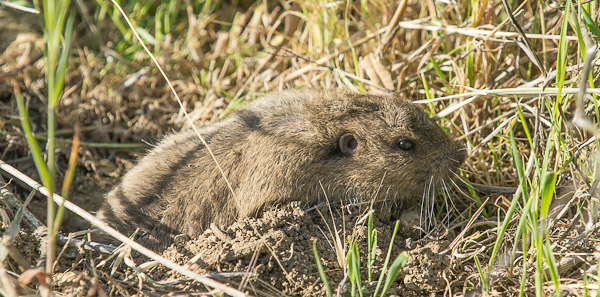
Pocket Gopher, most likely Botta's - Thomomys bottae. (C.Bragg 4/7/12)
A shame we didn’t have more people out for this trip – the weather was perfect and the warblers were moving through. We started the day with a UFO (Unidentified Furry Object) that we suppose was a vole. [Later examination makes me think it is a pocket gopher. – Ed.] Down in the many many oak trees we found many many Acorn Woodpeckers, more Nuttall’s Woodpeckers heard than seen, and a few flickers.
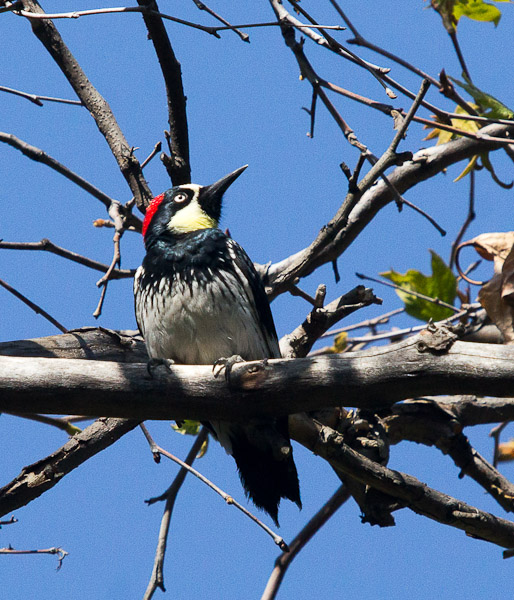
Acorn Woodpeckers were everywhere. (C.Bragg 4/7/12)
Walker Ranch is well-known among local birders as one of the few places where you can find Western Scrub-Jay and Steller’s Jays in the same trees. The chaparral-loving ‘scrubbies’ are usually found at lower altitudes than the Steller’s, which are more commonly found in conifers. Upstream in the early morning, Mountain Quail come down to drink, and can often be heard calling.
Warblers abounded (see list below).
The Nashville Warbler was probably the most notable; although most people saw only one or two, the other Chuck saw a larger group when he wandered off through the picnic area. There were at least a dozen or so Black-throated Gray Warblers, and one of them was incautious enough to be photographed. [Check out the difficult-to-see yellow loral spot! – Ed]
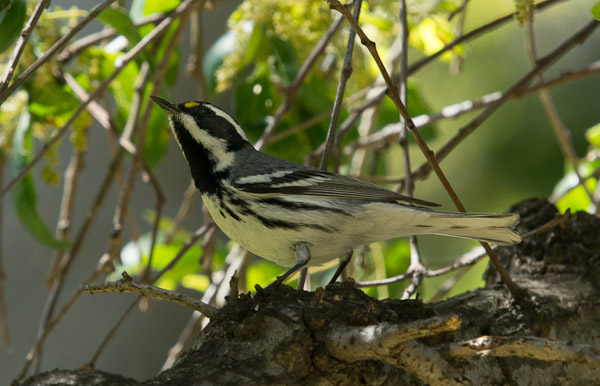
Black-throated Gray Warbler dressed in his breeding best. (C.Bragg 4/7/12)
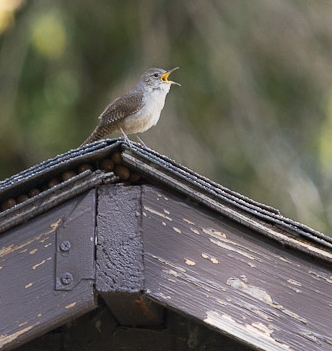
House Wren loudly singing. (C.Bragg 4/7/12)
House Wrens did most of the singing and seemed to be everywhere. All in all we didn’t walk very far because there were birds everywhere!
[Chuck Bragg]
To give you an idea of the racket these small (4.75″) birds can make, here’s a link to a YouTube video of a House Wren in his house, and singing:
http://www.youtube.com/watch?v=W8wjCGQhhRI
Read more about Pocket Gophers – beloved by gardeners everywhere – at:
http://acwm.lacounty.gov/scripts/gophers.htm
| Placerita Canyon S.P. |
Date |
| Walker Ranch section |
4/7/12 |
| California Quail | 5 |
| Turkey Vulture | 10 |
| White-tailed Kite | 2 |
| Cooper’s Hawk | 2 |
| Red-shouldered Hawk | 2 |
| Red-tailed Hawk | 2 |
| Rock Pigeon | 2 |
| Band-tailed Pigeon | 1 |
| Mourning Dove | 10 |
| White-throated Swift | 6 |
| Anna’s Hummingbird | 3 |
| Allen’s Hummingbird | 3 |
| Acorn Woodpecker | 30 |
| Nuttall’s Woodpecker | 4 |
| Northern Flicker | 4 |
| Hammond’s Flycatcher | 3 |
| Pacific-slope Flycatcher | 1 |
| Black Phoebe | 2 |
| Warbling Vireo | 4 |
| Steller’s Jay | 3 |
| Western Scrub-Jay | 8 |
| American Crow | 8 |
| Common Raven | 6 |
| Oak Titmouse | 10 |
| Bushtit | 15 |
| White-breasted Nuthatch | 5 |
| Bewick’s Wren | 3 |
| House Wren | 25 |
| Ruby-crowned Kinglet | 10 |
| Wrentit | 3 Heard |
| Western Bluebird | 8 |
| Hermit Thrush | 6 |
| Northern Mockingbird | 1 |
| Phainopepla | 2 |
| Orange-crowned Warbler | 20 |
| Nashville Warbler | 10 |
| Yellow Warbler | 4 |
| Yellow-rumped Warbler-Audubon | 60 |
| Black-throated Gray Warbler | 20 |
| Wilson’s Warbler | 1 |
| Spotted Towhee | 6 |
| Rufous-crowned Sparrow | 1 |
| California Towhee | 8 |
| Fox Sparrow | 1 |
| Song Sparrow | 2 |
| Lincoln’s Sparrow | 2 |
| White-crowned Sparrow | 1 |
| Golden-crowned Sparrow | 3 |
| Dark-eyed Junco | 10 |
| Black-headed Grosbeak | 12 |
| Brown-headed Cowbird | 2 |
| Bullock’s Oriole | 6 |
| Purple Finch | 2 |
| House Finch | 10 |
| Lesser Goldfinch | 2 |
| Total Species | 55 |
Wildflowers of Mineral King show at Theodore Paine
Wildflowers of Mineral King
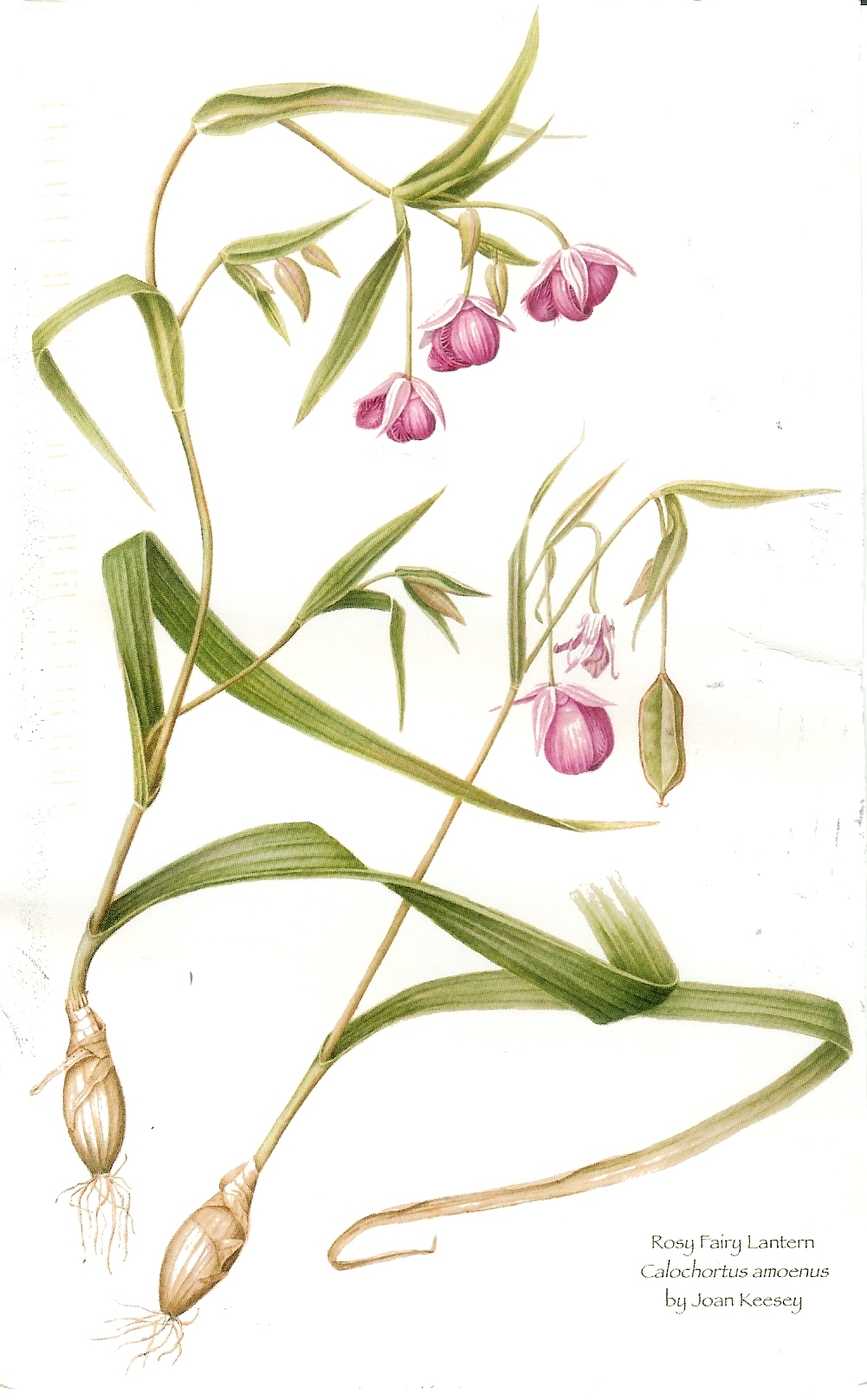
Rosy Fairy Lantern - Calochortus amoenus watercolor by Joan Keesey
An exhibition of botanical watercolors by Joan Keesey,
is now on show at the Theodore Payne Foundation for Wild Flowers and Native Plants.
When:
Friday, March 30 through Saturday, June 30, 2012
Tuesday – Saturday,
8:30 a.m. – 4:30 p.m.
Where:
Theodore Payne Foundation for Wild flowers and Native Plants, Inc.
10459 Tuxford Street
Sun Valley, CA 91352
818-768-1802
theodorepayne.org
Google Map
[Chuck Almdale]
Full Pink Moon 6 April, 7:21 a.m.
Here’s another update from SMBAS Blog on that large, round, shining object which has frequently appeared in our nighttime sky this year (known to many as the moon).
April 6, 7:21 a.m. PDT — Full Pink Moon. The grass pink, or wild ground phlox, is one of the earliest widespread flowers of spring. Other names for this month’s moon were the Full Sprouting Grass Moon, the Egg Moon, and — among coastal tribes — the Full Fish Moon, when the shad came upstream to spawn. This is also the Paschal Full Moon; the first full moon of the spring season. The first Sunday following the Paschal Moon is Easter Sunday, which indeed will be observed two days later on Sunday, April 8. [Gallery: The Fantastic Full Moon]
The next significant full moon will occur on May 5 at 8:35 p.m. PDT. Keep an eye on this spot for additional breaking news on this unprecedented event.
This information comes to you courtesy of:
http://www.msnbc.msn.com/id/45911225/ns/technology_and_science-space/t/how-s-full-moons-got-their-strange-names/#.T16CDHlIXUx
But that’s way too long to type in, and besides, you don’t need to go there because SMBAS has done the work for you!
[Chuck Almdale]
More Birds in the Science Press
Here’s some more bird-related articles that have appeared in recent months.
Hitchcock Horror Mystery Possibly Solved
Scientists have finally found an explanation to the real events that inspired Alfred Hitchcock’s 1963 classic, “The Birds.”
http://www.mail.com/scitech/news/938468-hitchcock-horror-mystery-solved.html#.23140-stage-hero1-3
From Mail.Com Sci/Tech Online – 12/29/11
********************************************
Mere fear shrinks bird families
Just hearing recordings of predators, in the absence of any real danger, caused sparrows to raise fewer babies.
http://www.sciencenews.org/view/generic/id/336823/title/Mere_fear_shrinks_bird_families
From Science News Online – 12/9/11
********************************************
Pigeons rival primates in number task
Trained on one-two-three, the birds can apply the rule of numerical order to such lofty figures as five and nine.
http://www.sciencenews.org/view/generic/id/337104/title/Pigeons_rival_primates_in_number_task
From Science News Online – 12/23/11
********************************************
Archaeopteryx wore black
Microscopic structures in an iconic fossil feather suggest that it was the color of a crow.
http://www.sciencenews.org/view/generic/id/337887/title/Archaeopteryx_wore_black
From Science News Online – 1/22/12
********************************************
Nurturing Nests Lift These Birds to a Higher Perch
The quietly dogged parenting style of the New Caledonian crow
http://www.nytimes.com/2011/02/01/science/01angier.html?_r=1&nl=todaysheadlines&emc=tha210
From New York Times Science Online – 1/31/12
********************************************
Bird flu leaves tracks in brain
H5N1 infection might make survivors vulnerable to Parkinson’s or other neurological disorders, a study in mice indicates.
http://www.sciencenews.org/view/generic/id/338071/title/Bird_flu_leaves_tracks_in_brain
From Science News Online – 2/01/12
********************************************
Bird flu less deadly, but more widespread, than official numbers suggest
The H5N1 virus appears to have infected far more than the 573 officially confirmed victims.
http://www.sciencenews.org/view/generic/id/338725/title/Bird_flu_less_deadly%2C_but_more_widespread%2C_than_official_numbers_suggest
From Science News Online – 2/24/12
********************************************
Pesticide-dosed bees lose future royalty, way home
Unusual field tests reveal how common insecticides, even at nonfatal doses, can erode colonies and threaten the future of bumblebees and honeybees.
[Not birds, and yet they fly]
http://www.sciencenews.org/view/generic/id/339548/title/Pesticide-dosed_bees_lose_future_royalty%2C_way_home
From Science News Online – 3/30/12
********************************************
And finally, this might be a look in your mirror…
“Things” Birder’s Say
A YouTube short film on what may be the archetypal birder’s conversation.
http://www.youtube.com/watch?v=NaX7i1Q7-Rw&feature=share
From Boulder Oak Films – 3/25/12
********************************************
[Chuck Almdale]
Canyonland Roadrunner Captured on Film
While the official consensus of the western American ornithological community is that there is only one form of Geococcyx californianus, the Greater Roadrunner, there have long been whispers in back corridors of biological institutions scattered across the western states that the systematics of this species are more complex than officially recognized, even – it was hinted – that evidence of this complexity had been suppressed by mysterious persons with sinister motives. This suspicion was strengthened recently when the unique and until-now elusive central New Mexican form was captured on newly-developed high-speed film equipment. Close examination of this footage by specialists in Geococcyx revealed a bird quite unlike the form familiar to Americans from California to Oklahoma. Leading roadrunner specialist, Dr. Thaddeus “kook” Kookaburra, BS, MS., PhD, LSMFT, avers it is a new species altogether. “Well,” said Dr. Kookaburra, located in his laboratory at Central Texas University – Midland: “We will of course make our final determination after a full DNA analysis has been completed, but just look at it, for cryin’ out loud! It’s completely different! Any idiot can see that!” he said, laughing loudly. Calming down, he added, “In my humble scientific opinion of course. We’re calling it the ‘Canyonland Roadrunner’.”

Numerous Morphological Differences
One frame of the film sequence is reproduced below. A cursory comparison of the two forms reveals certain morphological differences. In the new bird (G.c.sp.nov.) overall plumage is a plain, unstreaked gray to blue-gray. Crown feathers extend into a dark, long and flowing crest. Eyes are located at the front of the head, rather than the side, presumably producing improved frontal binocular vision while impairing peripheral vision. The bill is thick and upcurved, giving the bird a permanent amused expression. The neck is extremely elongated and slender, resembling that of an egret more than the nominate G.californianus. Wings are stunted, extending only slightly past the base of the tail; primaries are so weak and abbreviated that the bird must be flightless, and indeed, has never been seen to leave the ground, except when suddenly accelerating or making a U-turn. The tail is long and flowing, unlike the stiffened retrices of the nominate form. The body is extremely small. The legs are very long, especially the tarsometatarsi; again, they resemble those of an egret rather than the typical roadrunner. The feet are disproportionately large and thick.
Taxonomic Problems, Classification Uncertain
According to Dr. Kookaburra, this bird presents several taxonomic problems, causing it’s classification to remain far from certain.
Plumage – Nominate form is dark brown above with whitish edging on the back feathers, lighter brown below, cryptic plumage in its brushy, rocky habitat. The Canyonland form is gray with gray-blue wings and crest. In brush it would be easily seen by predators; on highways it blends in well with the gray pavement. Dust clouds kicked up by its large feet are often the only indication of its presence.
Long Crest feathers – Do they serve a function other than sexual attraction for a prospective mate?
Cervical Vertebrae – How many are there? Until an actual specimen is obtained – a difficult endeavor – this cannot be determined.
Digestive System – The torso is so small, one wonders how it can contain a system capable of digesting anything, yet it must contain systems for respiration, circulation and reproduction as well.
Feet – Bioengineers quickly see the problem of having large, fleshy, weighty feet on the ends of long, thin legs; every step tends to throw the creature off balance. It’s incredible speed demonstrates that somehow evolution overcame this problem. The feet may be quite light, like foam rubber, and serve as insulation from the hot, stony surfaces prevalent in its habitat. If so, this is a unique adaptation.
Voice: The nominate roadrunner call is a series of 5-10 soft “coos”, much like that of many other members of Cuculiformes, as well as many Columbiformes species. The call of G.c.sp.nov. (G.accelleratii-incredulus if full species status is accepted) is radically different: a two-note call, described variably as “meep meep,” “beep beep” or “bweep bweep;” the tone resembles that of the horn of a very small car.
The problem of the cervical vertebrae and several other important morphological and behavioral differences has led some ornithologists, particularly Dr. Kookaburra, to maintain this to be not just a new species, not just a new avian Family, but a unique and monotypic Order, tentatively called “Rapidiaviiformes,” or “fast-bird-form.”

Not Significantly Different, says Expert
Leading spokesman for the the opposing viewpoint is Dr. William C. Oyote, Vice President in charge of Pursuit Vehicle Research at Acme Industries, and world-renowned expert on G.californianus. We met at his research facility at Acme Industries Plaza, located on the outskirts of Albuquerque, NM. Dr. Oyote, who prefers the sobriquet “Dr. Willie” [pronounced ‘Wiley’ locally], was elegantly dressed in a long fur jacket and pants, despite the 110° temperature outside. I asked about the origin of his odd name. “First American,” he replied. “My people go back a long, long way in these parts. We honor all those who call it home, including roadrunners. Especially roadrunners,” he added, with a wide, toothy grin.
“I have studied this high-speed footage in detail,” he mused, ” and frankly, I don’t see anything warranting species status. Those who speak of elevation to new family or even order status are – in a word – cuckoo. I grew up in this region of New Mexico, as I said, and in my younger years became well acquainted with this species in general and this local morph in particular. And that’s all it is: a regional color morph with a few insignificant phenotypical variations, well within the general range of variation for this species. They’re fast and they look slightly odd, but that’s all. Their apparent preference for highways is an illusion: people often see them there because that’s where people usually are. I call that “the streetlight effect.” Like most cuckoos, these birds are not very bright, and they elude easy capture only because of their speed. Their flavor is rather delicate: a delightful blend of Western Fence Lizard, sage and southern-slope cactus fruit. This bird needs no special protection; they take care of themselves quite well, and there’s plenty of them out there, if you know where to look.”
The complete film – first ever for this interesting bird – was removed from YouTube by evildoers (They who shall not be named), but alternate footage can be found here: http://www.youtube.com/watch?v=KJJW7EF5aVk
Warning: This film contains scenes some viewers may find disturbing. Natural selection in action is often not pretty to see.
If you found this article plausible, you may be interested in other installments in our Early Spring Monograph Series (ESMS):
2013: Birders Take Their Lumps With Their Splits
2011: New Hummingbird Species Discovered in Los Angeles County!
2010: The Western Roof-Owl: Bird of Mystery
and not to be overlooked,
2026: Save the endangered Pacific Northwest Tree Octopus from Extinction
[Chuck Almdale, on behalf of Society 401]



 SANTA MONICA BAY AUDUBON SOCIETY BLOG