Free email delivery
Please sign up for email delivery in the subscription area to the right.
No salesman will call, at least not from us. Maybe from someone else.
Lagoon Project Visit 6/29/12
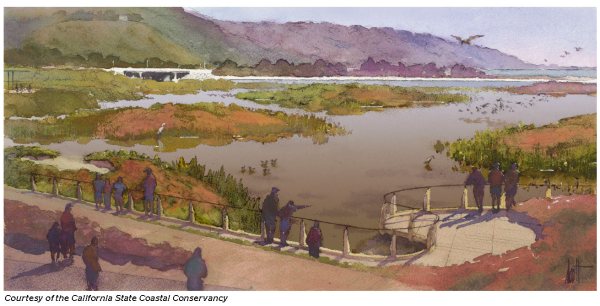
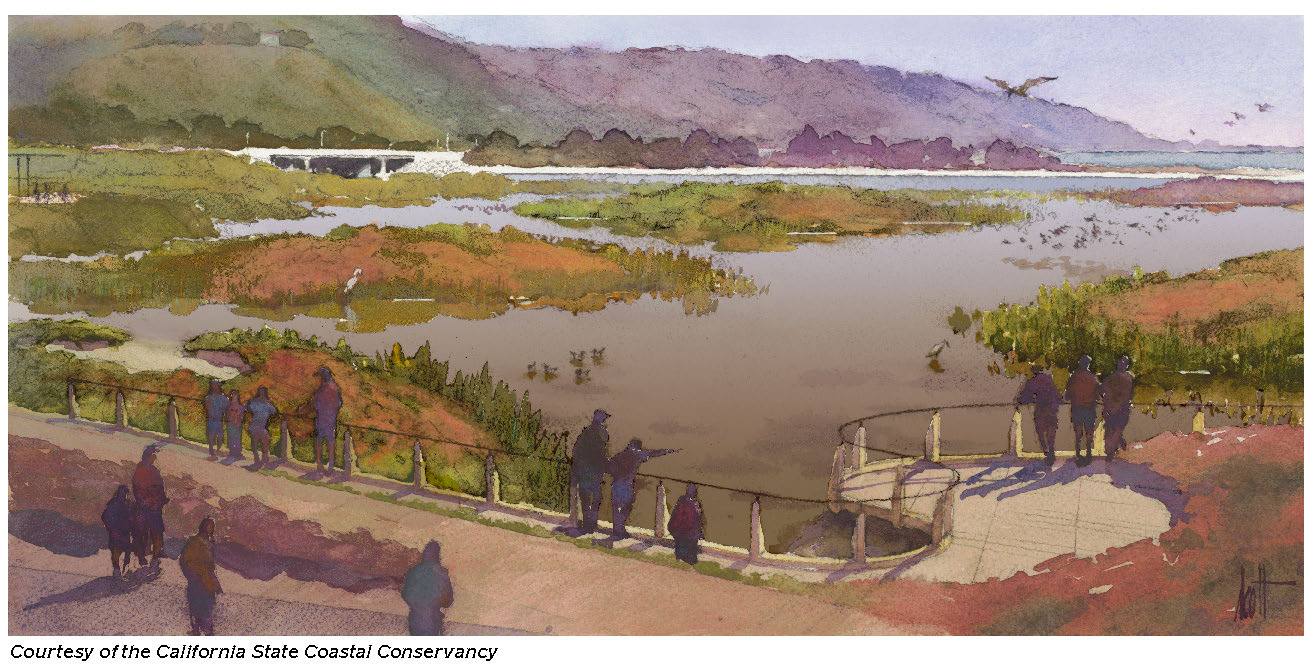
Artist’s perspective of west channels view from SW corner (RestoreMalibuLagoon . com)
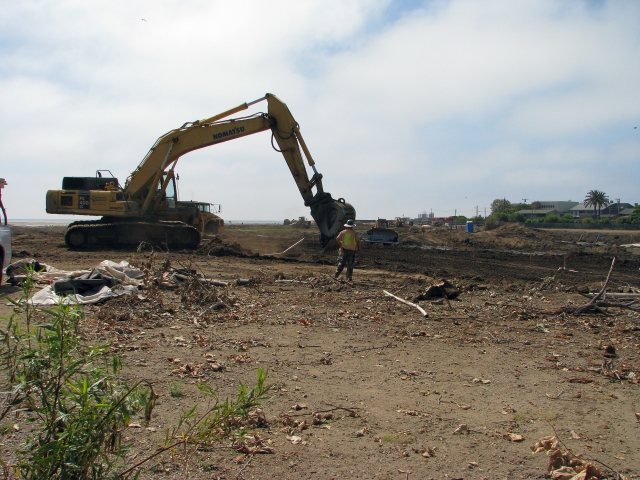
Nearly a month has passed since the project started, and the changes are significant. Vegetation and footbridges are gone except where birds (Mallards and a Black Phoebe) are nesting. The big scoops are removing the top layer of fill dirt which Calif. DOT/Cal Trans began dumping in the 1920/30’s, and trucks are taking it to the Calabasas dump. The soil beneith the fill is being sculpted to create the elevated islands. Nearly completed is the berm separating the channels from the main lagoon. Contouring of what will be the new channels is beginning.
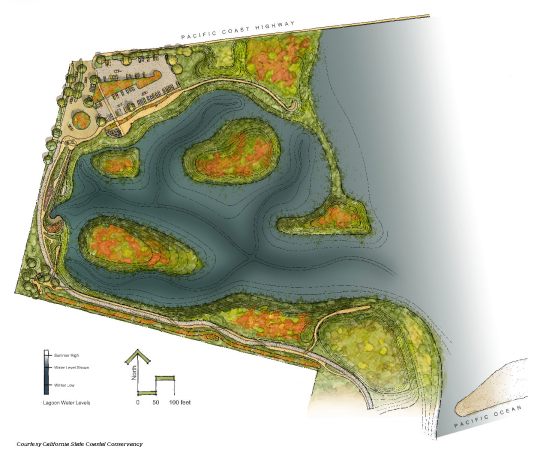
Artist’s rendering of west channels at 5.5′ high tide (RestoreMalibuLagoon . com)
Despite the noise and the activity, several coots and mallards came in from the main lagoon and paddled around in the water in what’s left of the middle channel. They ignored us as we passed.
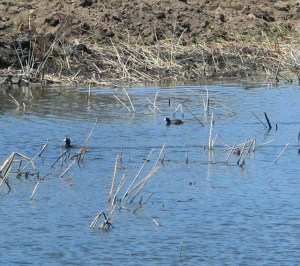
Two coots in middle channel water (L. Johnson 6/29/12)
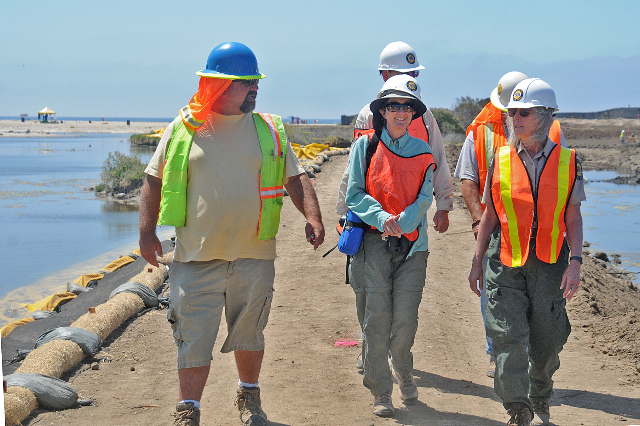
Mark Abramson had invited me to view the project up close; Lillian and Jim Kenney came as well and Suzanne Goode from State Parks joined us. [Jim has been quite busy taking photos of the project; see them on our continually updated special lagoon project page.] We spent about 90 minutes walking around and talking. We hadn’t seen Suzanne or Mark in years. since the last lagoon meeting we’d simultaneously attended.
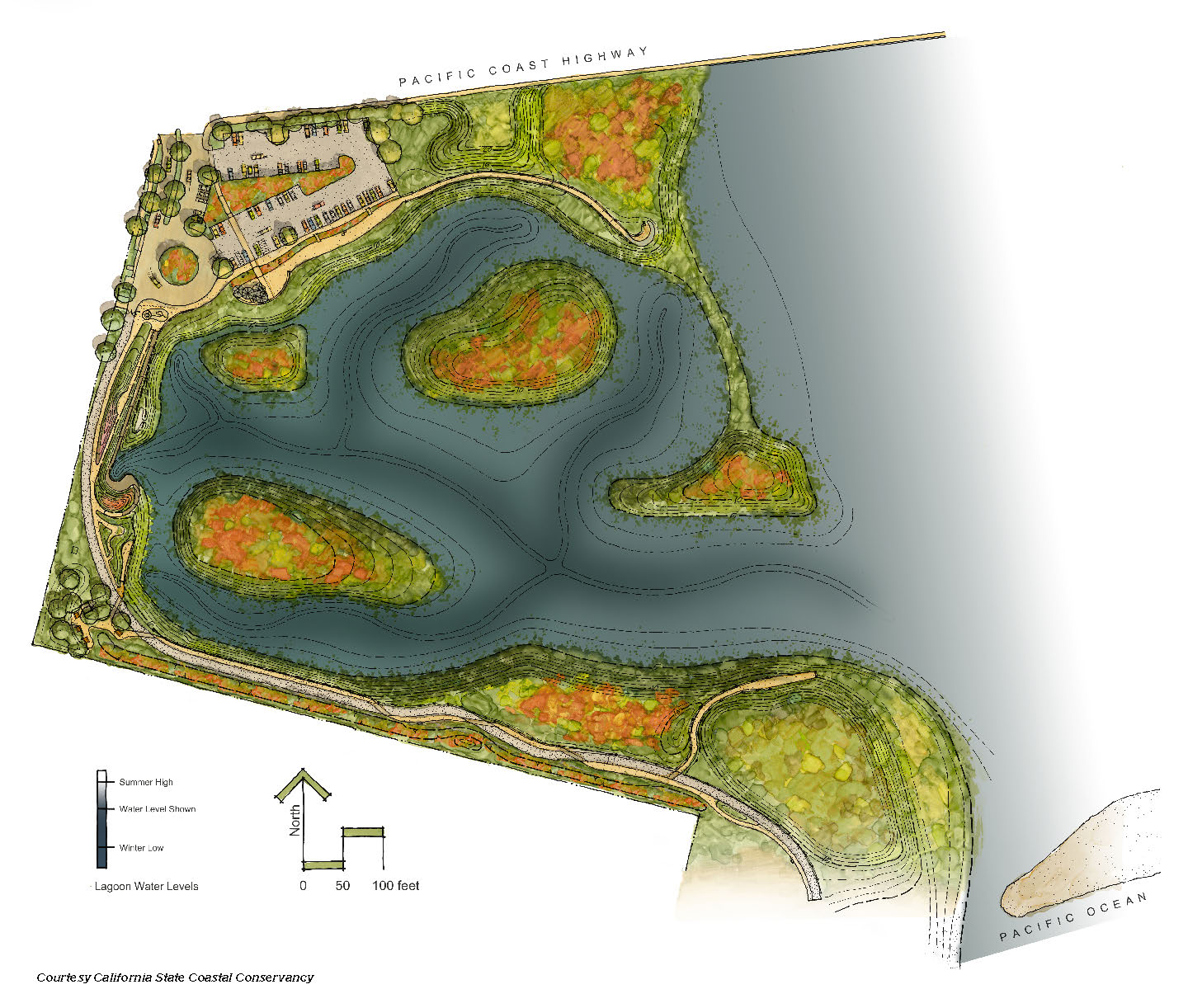
The main lagoon, the Adamson House side, and the beach are not part of the project. After the few remaining birds in the channels area are finished nesting, the rest of the fill dirt layer will be removed and hauled off. The underlying original soil will be contoured to look as in the drawing above. This drawing depicts the channels when the water level is at 5.5 feet, the height of the highest tides of the year. We’re trying to get a map which shows the planned gradations in detail and will add it here if we do.
The tops of the four islands will remain above water level, even at the highest level of 9 feet which can occur when the beach outlet is closed and water has flowed all summer. At this level, most of the long peninsula will be covered, permitting channel water to be wind-blown to the east. The mouth of the main channel will be about 120 feet wide, far larger than any of the current channels, ensuring maximum circulation and minimizing stagnant pools. There will be no intentional narrowing of any of the channels. The three footbridges, as lovely and popular as they were, were narrow ‘pinch-points’, restricting water flow and helping to create the stagnant, anoxic pools devoid of life which in turn prevented invertebrates from flourishing in the mud.
Native pickleweeds and other salt-tolerant plants will be widely planted. With luck and the passage of a few years, we might see the return of the Belding’s race of Savannah Sparrow, a pickleweed obligate which used to live there until a few decades ago. Before the grading began, seed and plants were collected for propagation by a nursery in Santa Barbara. This nursery helped in the re-vegetation of some of the Channel Islands.

The berm will occasionally be used as beach path during the project (J. Kenney 6/29/12)
The berm and the long yellow plastic sheeting keeps the lagoon water from getting into the channels. However, ground water seeps into the channels area and is expected to continue doing so throughout the project. The berm will be occasionally serve as the path to the beach when work must be done on the current perimeter path. Many viewing features will be created along the perimeter path. [Mark explains these in detail in his YouTube video.]
All work in the channels is scheduled to be finished by October 16. Some peripheral work – re-vegetation, viewing platforms, benches, picnic tables and the like – may take a bit longer. The new channels will be much more gradually sloped, creating a far larger intertidal zone. This is the sort of habitat which substrate invertebrates prefer, not to mention the birds that eat them.
One cool idea is a path which doubles as a water level indicator called the Summer Clock – Winter Platform. I can’t describe how it works so we’ll just have to wait and see.
A problem arose when a governmental employee in some nameless far-off land made a map of Snowy Plover winter roosts locations. He got it wrong at the lagoon, placing it right where the the south channel mouth passes the large brushy mound of fill dirt, several hundred yards (approximately) WNW of where the plovers actually roost, which is out on the beach on the inland slope of the berm. Presumably everyone is aware of this error, but until the correction moves through official channels, work can’t start in the erroneous plover area.
Speaking of plovers, alert reader Kevin Anderson’s blog comment of 6/18 clued us to the fact that project guards were walking through the Snowy Plover virtual enclosure on the beach. I passed this info on to Mark and several State Parks personnel and everyone has been told to stay out of the enclosure. However, people being…well, people…don’t be shocked to see “official”-looking personnel wander into it. So stay alert and send me a message if you see anyone doing this. In fact, feel free to politely inform such people that they are not supposed to be in there, whomever they are. The sole exception to this are the people (me, for example) who census the plovers, look for banded birds or adjust the fence.
The planning and approval for this project began so long ago and it was so difficult getting the funding, that I – among many – never thought it would actually happen. When people asked me about it, my response for many years was a dry, “Yeah…I’ll believe it when I see it.” Well, seeing is believing, so believe it. The more I see what’s going to be done, the more excited I get. Once it’s finished, when the walkways are done, the viewpoints are done, the plants are growing and spreading, the water starts moving and the birds begin finding food in the channel mud and using the islands, I’m sure you’ll like it.
Link to CeCe Stein (of RealMalibu411) 12.5 minute interview with Mark Abramson & Suzanne Goode, recorded 6/26/12. CeCe plows through a long list of questions submitted by a host of people. If this doesn’t answer any questions you might still have after viewing Mark Abramson’s YouTube presentation (see below), send them to CeCe Stein at RealMalibu411. She will be doing more of these interviews and we will post links to all of them on our permanent project page.
Link to our Malibu Lagoon 2012 Project page.
Link to YouTube film of Mark Abramson’s presentation of the restoration plan for the lagoon. 25 minutes. Highly Recommended.
Link to Malibu Lagoon Restoration Project website. Various links to reports. Not all the links work.
Enlarge any gallery picture below by clicking on it. This takes you to a slideshow where you can go through all the pictures backwards & forwards. Press escape to return to this page.
-
- 6/29/12: Artist’s perspective of west channels view from W. side (RestoreMalibuLagoon . com)
-
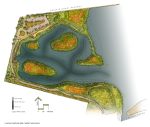
- 6/29/12: Artist’s Rendering of west channels (RestoreMalibuLagoon . com)
-

- 6/29/12: View SW towards colony & cypresses (Lillian Johnson)

-

- Removing old highway fill dirt (C.Almdale 6/29/12)

-
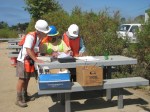
- 6/29/12: Jim and Lillian check the plans with Mark (Lillian Johnson)

-

- Down the berm we go (J. Kenney 6/29/12)

-

- 6/29/12: View south over middle channel water towards beach, dewatering towers, colony (Lillian Johnson)
-
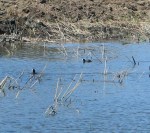
- 6/29/12: Two Coots in middle channel water (Lillian Johnson)
-

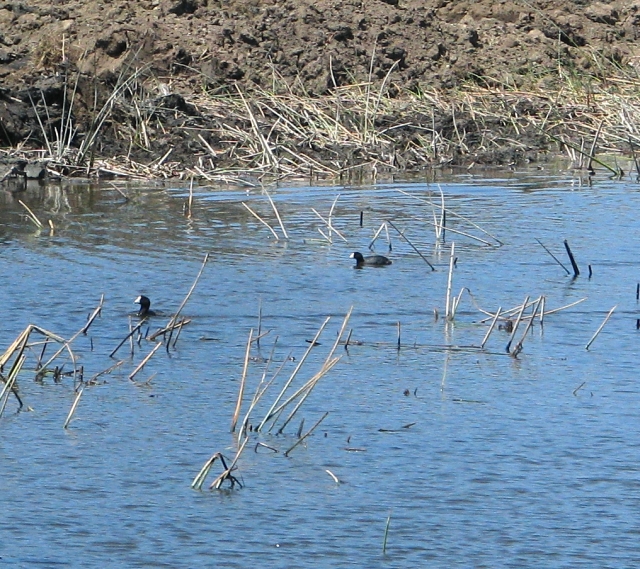
- 6/29/12: View north over middle channel water towards PCH bridge (Jim Kenney)

-
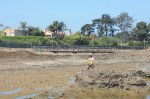
- 6/29/12: Footbridge stays until Black Phoebes finish nesting underneath (Jim Kenney)

-
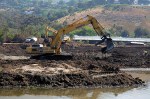
- 6/29/12: Scoop at north edge of middle channel (Lillian Johnson)

-
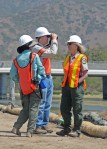
- 6/29/12: Lillian & Suzanne Goode talk; Chuck spots a Ruddy Duck in main lagoon (Jim Kenney)

-
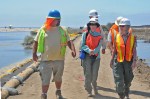
- 6/29/12: Back down the berm we come (Jim Kenney)
-

- Scoop at work 1 (L.Johnson 6/29/12)

-
- Scoop at work 2 (L.Johnson 6/29/12)
-

- Scoop at work 3 (L.Johnson 6/29/12)

Full Buck Moon 7/3/12 11:52 a.m. PDT
Here’s another update from SMBAS Blog on that large, circular, shining object which has frequently and mysteriously appeared in our nighttime sky this year (known to many as the moon).
July 3, 11:52 a.m. PDT — Full Buck Moon. This full moon was so called because it occurs when the new antlers of buck deer push out from their foreheads in coatings of velvety fur. It was also often called the Full Thunder Moon, thunderstorms being most frequent at this time. Sometimes this is also called the Full Hay Moon. Since the moon arrives at apogee less than 13 hours later, this will also be smallest full moon of 2012. In terms of apparent size, it will appear 12 percent smaller than the full moon of Jan. 10.
The next significant full moon will occur on Aug. 1, 4:27 p.m. PDT. Keep an eye on this spot for additional breaking news on this unprecedented event.
This information comes to you courtesy of:
http://www.msnbc.msn.com/id/45911225/ns/technology_and_science-space/t/how-s-full-moons-got-their-strange-names/#.T16CDHlIXUx
But that’s waaaay too long to type in, and besides, you don’t need to go there because SMBAS has done the work for you!
[Chuck Almdale]
Malibu Lagoon Trip Lists January – June 2012
This list was created at a later date in order to have a complete record on the blog site. [Chuck Almdale]
| Malibu Census 2012 | 1/22 | 2/26 | 3/25 | 4/22 | 5/27 | 6/24 |
| Temperature | 50-59 | 48-64 | 51-54 | 60-65 | 68-72 | 70-76 |
| Tide Lo/Hi Height | H +6.49 | H +3.37 | H +3.64 | H +3.67 | L +0.38 | L +0.07 |
| Tide Time | 0803 | 1136 | 1146 | 1106 | 0844 | 0714 |
| Snow Goose | 1 | |||||
| Brant | 1 | |||||
| Gadwall | 31 | 35 | 18 | 14 | 5 | 2 |
| American Wigeon | 2 | 8 | 3 | 9 | ||
| Mallard | 23 | 30 | 24 | 16 | 32 | 24 |
| Northern Shoveler | 46 | 35 | 18 | 12 | ||
| Northern Pintail | 10 | 8 | 5 | |||
| Green-winged Teal | 37 | 38 | 11 | |||
| Surf Scoter | 14 | 40 | ||||
| Bufflehead | 26 | 4 | ||||
| Red-brstd Merganser | 6 | 8 | 2 | 5 | 2 | |
| Ruddy Duck | 59 | 24 | 20 | 9 | 3 | |
| Red-throated Loon | 2 | |||||
| Pacific Loon | 1 | 3 | 3 | |||
| Common Loon | 1 | |||||
| Pied-billed Grebe | 3 | 2 | 2 | 3 | 4 | |
| Eared Grebe | 4 | 2 | 2 | |||
| Western Grebe | 8 | 40 | 1 | |||
| Brandt’s Cormorant | 3 | 15 | 1 | 1 | ||
| Dble-crstd Cormorant | 37 | 28 | 30 | 65 | 15 | 17 |
| Pelagic Cormorant | 1 | 2 | 3 | |||
| Brown Pelican | 48 | 12 | 40 | 80 | 265 | 340 |
| Great Blue Heron | 7 | 1 | 3 | 1 | ||
| Great Egret | 2 | 2 | 1 | 2 | 3 | |
| Snowy Egret | 7 | 8 | 12 | 9 | 14 | 4 |
| Green Heron | 1 | |||||
| Blk-crwnd N-Heron | 2 | 1 | 3 | |||
| Osprey | 1 | |||||
| White-tailed Kite | 1 | |||||
| Red-shouldered Hawk | 1 | 2 | ||||
| Peregrine Falcon | 1 | |||||
| Sora | 2 | 3 | 1 | |||
| American Coot | 345 | 285 | 20 | 95 | 30 | 4 |
| Blk-bellied Plover | 65 | 93 | 7 | 11 | 22 | 15 |
| Snowy Plover | 81 | 54 | 14 | 3 | ||
| Semipalmated Plover | 3 | |||||
| Killdeer | 2 | 10 | 4 | 3 | 1 | |
| Black Oystercatcher | 5 | 2 | 1 | |||
| Black-necked Stilt | 4 | |||||
| American Avocet | 2 | 1 | ||||
| Spotted Sandpiper | 2 | 1 | 1 | 1 | ||
| Willet | 3 | 2 | 3 | 4 | ||
| Whimbrel | 1 | 2 | 18 | 5 | 20 | 8 |
| Marbled Godwit | 2 | 8 | 1 | |||
| Ruddy Turnstone | 15 | 13 | 1 | |||
| Black Turnstone | 2 | 1 | ||||
| Sanderling | 200 | 100 | ||||
| Western Sandpiper | 16 | |||||
| Least Sandpiper | 12 | 20 | 5 | |||
| Boneparte’s Gull | 1 | |||||
| Heermann’s Gull | 16 | 1 | 15 | 44 | ||
| Ring-billed Gull | 150 | 35 | 8 | 20 | ||
| Western Gull | 120 | 55 | 30 | 85 | 85 | 84 |
| California Gull | 1900 | 360 | 12 | 75 | 4 | |
| Glaucous-wingd Gull | 5 | 2 | 1 | 1 | ||
| Caspian Tern | 3 | 25 | 6 | 1 | ||
| Forster’s Tern | 1 | |||||
| Royal Tern | 16 | 1 | 5 | 4 | ||
| Elegant Tern | 65 | 35 | 240 | |||
| Rock Pigeon | 5 | 4 | 3 | 2 | 3 | |
| Eur. Collared-Dove | 1 | |||||
| Mourning Dove | 2 | 2 | 2 | 2 | 1 | |
| Anna’s Hummingbird | 2 | 2 | 2 | 2 | 3 | |
| Allen’s Hummingbird | 2 | 1 | 2 | 5 | 8 | |
| Belted Kingfisher | 1 | 1 | 1 | 1 | ||
| Black Phoebe | 3 | 4 | 4 | 13 | 5 | |
| Say’s Phoebe | 1 | |||||
| Cassin’s Kingbird | 2 | |||||
| Western Kingbird | 16 | |||||
| American Crow | 4 | 8 | 3 | 5 | 5 | 4 |
| Rough-wingd Swallow | 2 | 6 | 6 | |||
| Violet-green Swallow | 1 | |||||
| Barn Swallow | 1 | 2 | 4 | |||
| Cliff Swallow | 12 | 4 | ||||
| Bushtit | 26 | 4 | 2 | 4 | ||
| Bewick’s Wren | 1 | 1 | 1 | |||
| Marsh Wren | 1 | |||||
| Ruby-crowned Kinglet | 2 | |||||
| Hermit Thrush | 1 | |||||
| Northern Mockingbird | 1 | 2 | 2 | 6 | 6 | |
| European Starling | 1 | 15 | 4 | 45 | 5 | |
| Yellow-rumpd Warbler | 3 | 1 | ||||
| Common Yellowthroat | 4 | 2 | 1 | 3 | 3 | 1 |
| Spotted Towhee | 1 | 1 | 2 | |||
| California Towhee | 2 | 1 | ||||
| Savannah Sparrow | 2 | |||||
| Song Sparrow | 2 | 8 | 13 | 8 | 12 | 6 |
| White-crwnd Sparrow | 22 | 4 | ||||
| Red-winged Blackbird | 15 | 2 | 6 | 10 | ||
| Brewer’s Blackbird | 1 | |||||
| Great-tailed Grackle | 13 | 8 | 8 | 2 | 2 | |
| Brwn-headed Cowbird | 2 | 2 | 1 | |||
| Hooded Oriole | 1 | |||||
| Bullock’s Oriole | 1 | 2 | ||||
| House Finch | 25 | 10 | 19 | 6 | 8 | 8 |
| Lesser Goldfinch | 2 | |||||
| Totals by Type | Jan | Feb | Mar | Apr | May | Jun |
| Waterfowl | 255 | 231 | 101 | 65 | 42 | 26 |
| Water Birds-Other | 452 | 395 | 91 | 250 | 313 | 368 |
| Herons, Egrets | 18 | 10 | 14 | 13 | 23 | 5 |
| Raptors | 2 | 2 | 0 | 1 | 0 | 1 |
| Shorebirds | 388 | 278 | 65 | 63 | 51 | 25 |
| Gulls & Terns | 2207 | 455 | 53 | 272 | 151 | 373 |
| Doves | 7 | 6 | 0 | 5 | 5 | 4 |
| Other Non-Pass. | 5 | 4 | 0 | 4 | 8 | 12 |
| Passerines | 110 | 93 | 62 | 60 | 127 | 49 |
| Totals Birds | 3444 | 1474 | 386 | 733 | 720 | 863 |
| Total Species | Jan | Feb | Mar | Apr | May | Jun |
| Waterfowl | 11 | 11 | 8 | 6 | 4 | 2 |
| Water Birds-Other | 10 | 12 | 4 | 9 | 4 | 5 |
| Herons, Egrets | 4 | 2 | 3 | 4 | 4 | 2 |
| Raptors | 2 | 1 | 0 | 1 | 0 | 1 |
| Shorebirds | 11 | 10 | 7 | 12 | 6 | 4 |
| Gulls & Terns | 6 | 7 | 4 | 7 | 7 | 5 |
| Doves | 2 | 2 | 0 | 2 | 3 | 2 |
| Other Non-Pass. | 3 | 3 | 0 | 2 | 3 | 3 |
| Passerines | 16 | 19 | 9 | 15 | 16 | 13 |
| Totals Species – 96 | 65 | 67 | 35 | 58 | 47 | 37 |
Bird News Roundup
From National Audubon, a live Osprey nest-cam: http://explore.org/#!/live-cams/player/live-osprey-cam
**************************
T. rex has another fine, feathered cousin
A trio of fossils from China may tip the scales on dinosaurs’ public image.
From Science News Online – 5/5/12
http://www.sciencenews.org/view/generic/id/339679/title/T._rex_has_another_fine%2C_feathered_cousin
**************************
Pigeon navigation finding called off-course
Iron-containing cells that had been reported in beaks look mostly like immune system components, a new study finds.
From Science News Online – 5/19/12
http://www.sciencenews.org/view/generic/id/339890/title/Pigeon_navigation_finding_called_off-course
**************************
Albatross forage with fractal-like flight
New data offer support for a modified mathematical pattern in birds’ hunting behavior.
From Science News Online – 6/2/12
http://www.sciencenews.org/view/generic/id/340221/title/Albatross_forage_with_fractal-like_flight_
**************************
Better bird nesting also good for giant manta rays
Disrupting tree canopies on a Pacific atoll discourages big fish off shore through a long chain of ecological consequences.
From Science News Online – 6/2/12
http://www.sciencenews.org/view/generic/id/340803/title/Better_bird_nesting_also_good_for_giant_manta_rays
**************************
Egg wars
Birds engage in evolutionary arms race
From Science News Online – 6/2/12
http://www.sciencenews.org/view/generic/id/340827/title/Egg_wars
**************************
Ancient birds wiped out huge insects
Competition in the air trumped the advantage of extra atmospheric oxygen.
From Science News Online – 6/4/12
http://www.sciencenews.org/view/generic/id/341275/title/Ancient_birds_wiped_out_huge_insects
**************************
Chicks do worse in noisy nests
Baby bluebirds, and their parents, appear to have trouble communicating over the racket made by nearby humans.
From Science News Online – 6/15/12
http://www.sciencenews.org/view/generic/id/341554/title/Chicks_do_worse_in_noisy_nests
**************************
[Chuck Almdale]
Malibu Lagoon Trip Report: 24 June, 2012
This slideshow follows the same path as the 27 May show. Compare them to see the changes. Don’t forget to visit our new page for the Malibu Lagoon 2012 Project, frequently updated with new photos.
As expected, the west channels area is a muddy mess. The parking lot is about 1/3rd size, holding 35-40 cars, and the perimeter access road is now the beach path, fenced with chain link and plastic mesh along the channel side. We looked through the various viewing holes, but there was little to see. Overall, we saw two areas taped off, indicating the presence of active nests, although there may be more. A few passerines were along the other side of the path, but most of the land birds we saw (see trip list below) were either in the air or at Adamson House. We saw four families of Mallard: two in the south channel and two in the main lagoon. The White-tailed Kite which has been hanging around for about a week was patrolling the hill northeast of the lagoon.
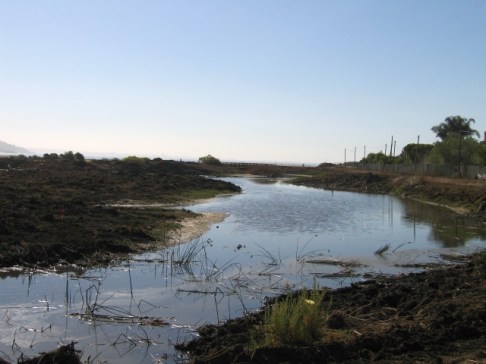
South channel view from west end (L. Johnson 6/24/12)
Two juvenile Bullock’s Orioles chased each other in the large colony cypresses near the southwest corner of the channels area, but no other roosting birds were there. These cypresses have looked increasing “ill” for quite a while. I suspect that when the foundation was laid for the house going up just below their east side, the tree’s roots were severed or otherwise damaged. I would not be surprised to see the trees gone within a few years.
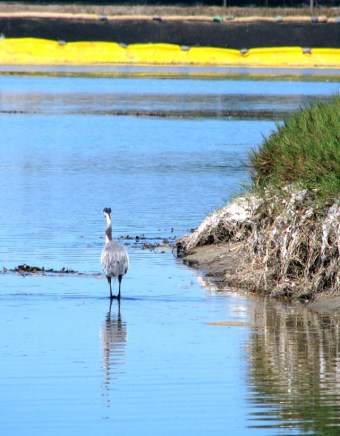
Great Blue Heron patrols lagoon near Adamson House (C.Almdale 6/24/12)
It was about 90 minutes after low tide when we arrived on the beach, and many Elegant Terns were resting on the exposed cobbles at sea’s-edge while the Whimbrels foraged among them. As the tide rose and waves began crashing on the cobbles, the terns began relocating to the sand islands along the lagoon’s beach edge, where the gulls and pelicans already loafed. A small raft of Brown Pelicans was offshore just past the many surfers, while the slim Pelagic Cormorants surface-dived for fish near them. Far offshore was a huge, uncounted, flock of pelicans plunge-diving. Snowy Egrets and a Great Blue Heron patrolled the edges of the main lagoon.
The beach breach of a few weeks ago was quite obvious, with 3-6 ft. ‘cliffs’ of sand on each side. The longshore ocean current from the west has already caused the ocean end of the outlet channel to shift eastward about 50-75 yds. No water flowed out, but the sand looked wet and I suspect that high tide could still flow into the lagoon, with the lagoon flowing back out until its level reached that of the beach.
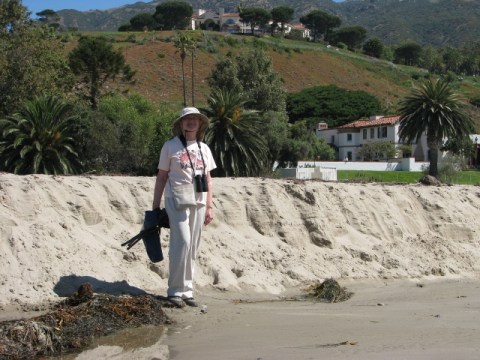
Sand ‘cliff’ at breach east edge, Adamson House in background (C.Almdale 6/24/12)
Adamson House had an unusual number of hummingbirds, it seemed to me, most of them Allen’s and the rest Anna’s, as usual. There was an adult male Hooded Oriole in the palms. We counted up our checklist on the deck of the boathouse. The inlet below us, so full a month ago, was dry, with a Killdeer (see below)wandering through. Song Sparrows and Black Phoebes flitted about, while one of the world’s loudest Northern Mockingbirds sang from a nearby bush.

Killdeer in the Adamson boat house lagoon inlet, now dry (C.Almdale 6/24/12)
Crossing back over the highway bridge we saw the egret colony in the trees behind Starbuck’s: at least 16 birds, evenly split between Great and Snowy Egrets (not included in the count). The remaining north channel reed bed was still intact, surrounded by yellow plastic tape. Two American Coots were adding reeds to their nest at the edge of the reeds, while their orange-headed juvenile floated nearby. Coots build their nests of floating vegetation, in this case, of reeds; as the dead reeds on the undersurface of the nest rot and become soggy, the birds must continually add fresh reeds at the top. The young are able to swim almost immediately; it’s 7-8 weeks before they can fly.
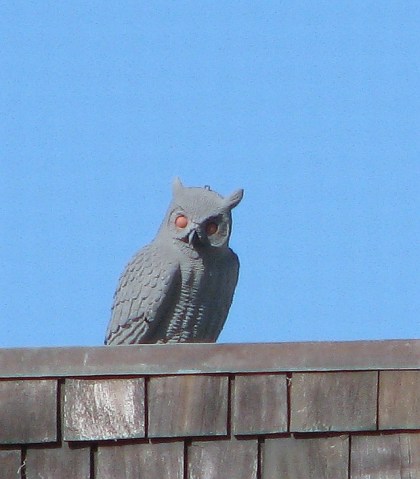
Fortunately the endemic Western Roof Owl is high and dry on a colony housetop – right-facing behavioral morph shown (C.Almdale 6/24/12)
Our next three field trips: Malibu Lagoon, 22 July, 8:30 am; Malibu Lagoon, 26 August, 8:30 am; Los Angeles River, 8 Sept., 8am.
Our next program: Tuesday, 2 October, 7:30 pm. The usual reminders will be emailed from the blog.
NOTE: Our 10 a.m. Parent’s & Kids Birdwalk is canceled until the lagoon project is completed and the parking lot is again available.
Links: Unusual birds at Malibu Lagoon
Aerial photo of Malibu Lagoon from 9/23/02.
Prior checklists: July-Dec’11, Jan-June’11, July-Dec ’10, Jan-June ’10, Jul-Dec ‘09, and Jan-June ‘09.
Comments on Bird List Below
Species Diversity: No census was taken in June 2008, so June 2006 is included to keep the comparison at six years. Of 72 total species appearing in June for 2006-12, no more than 62% of them appeared on any one count day, something to keep in mind if you wonder why what is there is much less than what could be there. June 2012 gets the species low count of 37, 18% below 2011’s high of 45, and 4 species below average. This is the same variance we had for May when 2010 was the low year. I expect species diversity to continue to run lower than average while the project is underway.
Total Birds: Species diversity was low, but total numbers of 863 was high, 2nd only to 2008’s 897 total birds. High numbers of Brown Pelican (340) and Elegant Tern (240) accounted for the higher than average numbers.
[Chuck Almdale]
| Malibu Census | 2006 | 2007 | 2009 | 2010 | 2011 | 2012 | |
| June 2006 – 2012 | 6/25 | 6/24 | 6/28 | 6/27 | 6/26 | 6/24 | |
| Temperature | 66-74 | 65-75 | 68-72 | 70-76 | |||
| Tide Lo/Hi Height | H +3.0 | H +3.0 | L +0.4 | H +3.81 | H +3.0 | L +0.07 | Ave. |
| Tide Time | 0626 | 0626 | 0838 | 1139 | 0754 | 0714 | Birds |
| Brant | 1 | 1 | 1 | 11 | 2.3 | ||
| Gadwall | 3 | 14 | 15 | 4 | 5 | 2 | 7.2 |
| Mallard | 35 | 40 | 25 | 40 | 41 | 24 | 34.2 |
| Red-brstd Merganser | 1 | 0.2 | |||||
| Ruddy Duck | 6 | 7 | 2.2 | ||||
| Pied-billed Grebe | 4 | 2 | 2 | 3 | 4 | 2.5 | |
| Clark’s Grebe | 1 | 0.2 | |||||
| Dble-crstd Cormorant | 7 | 6 | 22 | 5 | 54 | 17 | 18.5 |
| Pelagic Cormorant | 1 | 1 | 3 | 0.8 | |||
| Brown Pelican | 19 | 239 | 71 | 205 | 28 | 340 | 150.3 |
| Great Blue Heron | 2 | 3 | 8 | 6 | 4 | 1 | 4.0 |
| Great Egret | 2 | 4 | 3 | 2 | 5 | 2.7 | |
| Snowy Egret | 8 | 8 | 14 | 14 | 8 | 4 | 9.3 |
| Little Blue Egret | 1 | 0.2 | |||||
| Green Heron | 3 | 1 | 0.7 | ||||
| Blk-crwnd N-Heron | 5 | 3 | 6 | 1 | 2.5 | ||
| Osprey | 1 | 1 | 0.3 | ||||
| White-tailed Kite | 1 | 0.2 | |||||
| Cooper’s Hawk | 1 | 1 | 0.3 | ||||
| Red-shouldered Hawk | 1 | 0.2 | |||||
| Red-tailed Hawk | 1 | 1 | 2 | 0.7 | |||
| Peregrine Falcon | 1 | 0.2 | |||||
| American Coot | 4 | 20 | 22 | 5 | 12 | 4 | 11.2 |
| Blk-bellied Plover | 6 | 15 | 3.5 | ||||
| Killdeer | 2 | 5 | 1 | 1.3 | |||
| Black Oystercatcher | 1 | 0.2 | |||||
| Willet | 19 | 3 | 3 | 4.2 | |||
| Whimbrel | 5 | 8 | 2.2 | ||||
| Western Sandpiper | 1 | 2 | 0.5 | ||||
| Bonaparte’s Gull | 1 | 2 | 0.5 | ||||
| Heermann’s Gull | 24 | 16 | 48 | 17 | 15 | 44 | 27.3 |
| Ring-billed Gull | 15 | 7 | 3.7 | ||||
| Western Gull | 153 | 380 | 72 | 61 | 68 | 84 | 136.3 |
| California Gull | 1 | 1 | 0.3 | ||||
| Least Tern | 1 | 0.2 | |||||
| Caspian Tern | 15 | 3 | 9 | 10 | 1 | 6.3 | |
| Forster’s Tern | 4 | 0.7 | |||||
| Royal Tern | 4 | 6 | 2 | 1 | 4 | 2.8 | |
| Elegant Tern | 120 | 25 | 15 | 4 | 240 | 67.3 | |
| Black Skimmer | 5 | 1 | 1.0 | ||||
| Rock Pigeon | 8 | 4 | 6 | 4 | 4 | 3 | 4.8 |
| Mourning Dove | 2 | 4 | 4 | 5 | 1 | 2.7 | |
| Anna’s Hummingbird | 1 | 1 | 2 | 2 | 1 | 3 | 1.7 |
| Allen’s Hummingbird | 2 | 1 | 4 | 1 | 8 | 2.7 | |
| Belted Kingfisher | 1 | 0.2 | |||||
| Downy Woodpecker | 1 | 0.2 | |||||
| Black Phoebe | 6 | 2 | 15 | 2 | 10 | 5 | 6.7 |
| Cassin’s Kingbird | 1 | 1 | 0.3 | ||||
| Western Scrub-Jay | 1 | 0.2 | |||||
| American Crow | 6 | 6 | 12 | 4 | 4 | 4 | 6.0 |
| Rough-wingd Swallow | 4 | 6 | 6 | 1 | 2.8 | ||
| Tree Swallow | 6 | 1.0 | |||||
| Barn Swallow | 16 | 30 | 8 | 40 | 25 | 4 | 20.5 |
| Cliff Swallow | 8 | 8 | 7 | 30 | 15 | 4 | 12.0 |
| Oak Titmouse | 1 | 0.2 | |||||
| Bushtit | 9 | 4 | 8 | 3.5 | |||
| Marsh Wren | 1 | 0.2 | |||||
| Wrentit | 1 | 0.2 | |||||
| Northern Mockingbird | 6 | 3 | 2 | 2 | 3 | 6 | 3.7 |
| European Starling | 10 | 8 | 20 | 65 | 21 | 5 | 21.5 |
| Common Yellowthroat | 3 | 3 | 1 | 1 | 1 | 1.5 | |
| Spotted Towhee | 2 | 2 | 0.7 | ||||
| California Towhee | 1 | 1 | 4 | 1 | 1.2 | ||
| Song Sparrow | 8 | 4 | 6 | 3 | 3 | 6 | 5.0 |
| Red-winged Blackbird | 13 | 1 | 55 | 11.5 | |||
| Great-tailed Grackle | 3 | 3 | 2 | 1.3 | |||
| Brwn-headed Cowbird | 1 | 1 | 2 | 1 | 0.8 | ||
| Hooded Oriole | 4 | 1 | 1 | 1.0 | |||
| Bullock’s Oriole | 1 | 2 | 0.5 | ||||
| House Finch | 8 | 5 | 6 | 4 | 14 | 8 | 7.5 |
| Lesser Goldfinch | 2 | 4 | 1.0 | ||||
| House Sparrow | 8 | 2 | 1.7 | ||||
| Malibu Census | 2006 | 2007 | 2009 | 2010 | 2011 | 2012 | |
| Totals by Type | 6/25 | 6/24 | 6/28 | 6/27 | 6/26 | 6/24 | Ave. |
| Waterfowl | 39 | 62 | 41 | 62 | 46 | 26 | 46.0 |
| Water Birds-Other | 31 | 271 | 117 | 217 | 97 | 368 | 183.5 |
| Herons, Egrets | 12 | 24 | 28 | 28 | 19 | 5 | 19.3 |
| Quail & Raptors | 0 | 2 | 3 | 1 | 4 | 1 | 1.8 |
| Shorebirds | 25 | 3 | 9 | 2 | 7 | 25 | 11.8 |
| Gulls & Terns | 333 | 433 | 139 | 105 | 96 | 373 | 246.5 |
| Doves | 10 | 4 | 10 | 8 | 9 | 4 | 7.5 |
| Other Non-Pass. | 3 | 2 | 6 | 3 | 2 | 12 | 4.7 |
| Passerines | 94 | 96 | 93 | 220 | 122 | 49 | 112.3 |
| Totals Birds | 547 | 897 | 446 | 646 | 402 | 863 | 634 |
| 2006 | 2007 | 2009 | 2010 | 2011 | 2012 | ||
| Total Species | 6/25 | 6/24 | 6/28 | 6/27 | 6/26 | 6/24 | Ave. |
| Waterfowl | 3 | 5 | 3 | 4 | 2 | 2 | 3.2 |
| Water Birds-Other | 4 | 6 | 4 | 4 | 4 | 5 | 4.5 |
| Herons, Egrets | 3 | 6 | 4 | 4 | 5 | 2 | 4.0 |
| Quail & Raptors | 0 | 2 | 3 | 1 | 3 | 1 | 1.7 |
| Shorebirds | 2 | 1 | 3 | 1 | 2 | 4 | 2.2 |
| Gulls & Terns | 8 | 6 | 5 | 7 | 6 | 5 | 6.2 |
| Doves | 2 | 1 | 2 | 2 | 2 | 2 | 1.8 |
| Other Non-Pass. | 2 | 2 | 2 | 2 | 2 | 3 | 2.2 |
| Passerines | 14 | 15 | 16 | 15 | 19 | 13 | 15.3 |
| Totals Species | 38 | 44 | 42 | 40 | 45 | 37 | 41 |



 SANTA MONICA BAY AUDUBON SOCIETY BLOG