Free email delivery
Please sign up for email delivery in the subscription area to the right.
No salesman will call, at least not from us. Maybe from someone else.
Full Worm Moon
Just in case you missed this important news, this is an alert from SMBAS blog that the full moon on March 8 at 1:39 a.m., only 4 days ago was the Full Worm Moon. Here is the explanation for this significant event.
In this month, the ground softens and the earthworm casts reappear, inviting the return of the robins. The more northern tribes called this the Full Crow Moon, when the cawing of crows signals the end of winter, or the Full Crust Moon because the snow cover becomes crusted from thawing by day and freezing at night. The Full Sap Moon, marking the time to tap maple trees, is another variation.
The next significant full moon will occur on April 6 at 7:21 a.m. PDT. Keep an eye on this spot for additional breaking news on this unprecedented event.
This information comes to you courtesy of:
http://www.msnbc.msn.com/id/45911225/ns/technology_and_science-space/t/how-s-full-moons-got-their-strange-names/#.T16CDHlIXUx
But that’s way too long to type in, so don’t bother going there.
[Chuck Almdale]
More on Spiders & Birds in the Science Press
As our program this week was on spiders, we thought the following item might interest you.
Spiders Spin Wet Blanket over Wagga Wagga
Rising flood waters endanger thousands of spiders
So many webs it looks like snow.
From: Herald Sun: 3/7/12
********************************************
Now, on to more Birds In The News.
********************************************
News in Brief: Neurons make Owls Take Notice
Food tastes less fatty to overweight people, plus an itch protein and thirsty rats in this week’s news.
http://www.sciencenews.org/view/generic/id/72403/title/News_in_Brief_Body_%2B_Brain
From Science News Online
********************************************
News in Brief: Secret to birds’ steady gaze
http://www.sciencenews.org/view/generic/id/331530/title/News_in_Brief_MoleculesMatter_%2B_Energy
From Science News Online
********************************************
News in Brief: Penguins smells dinnertime
Krill-sniffing penguins in this week’s news.
http://www.sciencenews.org/view/generic/id/332513/title/News_in_Brief_MoleculesMatter_%2B_Energy
From Science News Online
********************************************
News in Brief: Zebra Finches without Mommas
Stay-at-home finch dads in this week’s news.
http://www.sciencenews.org/view/generic/id/332797/title/News_in_Brief_Life
From Science News Online
********************************************
Early stress is contagious in adulthood
A zebra finch’s tough childhood shortens both its life and its mate’s.
http://www.sciencenews.org/view/generic/id/333416/title/Early_stress_is_contagious_in_adulthood
From Science News Online
********************************************
News in Brief: Ancient Big Bird
Ancient Big Bird found in Kazakhstan in this week’s news.
http://www.sciencenews.org/view/generic/id/333436/title/News_in_Brief_Life
From Science News Online
********************************************
The Iceman’s last meal: goat, deer, vegetables & wheat
Two decades after he was discovered sticking out of an Alpine glacier, a famous 5,300-year-old mummy’s diet details and hiking habits are revealed.
http://www.sciencenews.org/view/generic/id/333533/title/The_Icemans_last_meal_goat
From Science News Online
********************************************
The Sopranos with feathers
Stories from a day of bird searching
http://www.sciencenews.org/view/generic/id/333765/title/The_Sopranos_with_feathers
From Science News Online
********************************************
[Chuck Almdale]
Rescuing Birds – Information
After our earlier posting about oiled birds, I was alerted that I overlooked several other wildlife rescue organizations in our area. Here is all the information I currently have. We now have a permanent Bird Rescue page on our blog with this information, listed just below our Snowy Plover picture. If you learn of any other organization, let me know and I will update this page. All of these organizations are non-profit, need donations and frequently solicit volunteers. [Chuck Almdale]
California Wildlife Center
In the Malibu area, CWC is the closest place to call.
Emergency Hotline Number: (310) 458-WILD [9453]
PO Box 2022
Malibu, CA 90265
Phone (818) 222-2658 Fax: (818) 222-2685
Email:
Website: http://www.cawildlife.org/
Email Contacts:
Marine Mammal Response: rescue@cawildlife.org
Hospital: jo@cawildlife.org or 818.591.9453
Administration: admin@cawildlife.org or 818.222.2658
Donations of any kind: admin@cawildlife.org or 818.222.2658
Media Inquiries/Communications: cindy@cawildlife.org or 818.222.2658
Volunteer Inquiries: volunteer@cawildlife.orgor 818.222.2658
International Bird Rescue:
Website: http://www.bird-rescue.org/
San Pedro Office:
Phone: 310-514-2573
Fax: 310-514-8219
3601 South Gaffey Street
San Pedro, Ca. 90731
South Bay Wildlife Rehab
26363 Silver Spur Rd., Rancho Palos Verdes, California 90275
Phone: (310) 378-9921 Fax: (310) 378-0969
Email: info@sbwr.org
Website: http://www.sbwr.org/
Project Wildlife
Wildlife Triage Center
887 1/2 Sherman Street
San Diego, CA 92110
Phone: 619-225-9453
Hours: 9:00a.m. – 5:00p.m.
Open 7 days a week (except Thanksgiving, Christmas & New Year’s Day)
Website: http://www.projectwildlife.org/index.php
Recent Increase in Oiled Birds
At our monthly Malibu Lagoon walk on Feb. 26, many participants noticed that there seemed to be an unusual number of dead birds on the beach. I saw at least a half dozen Cormorants and one Coot. On Feb. 15 chapter member Jim Kenney photographed this Common Murre with a large oil patch on its belly, sitting on the beach cobbles.
Generally speaking, seabirds such as Loons, Grebes or any of the Alcids such as Common Murre, really don’t like to come to land – especially if humans are present – except when breeding. If you see one sitting on the beach, there’s probably something wrong with it: oiled, sick or wounded in some way. If you help it, it may survive.
Link to Malibu Lagoon Trip Report
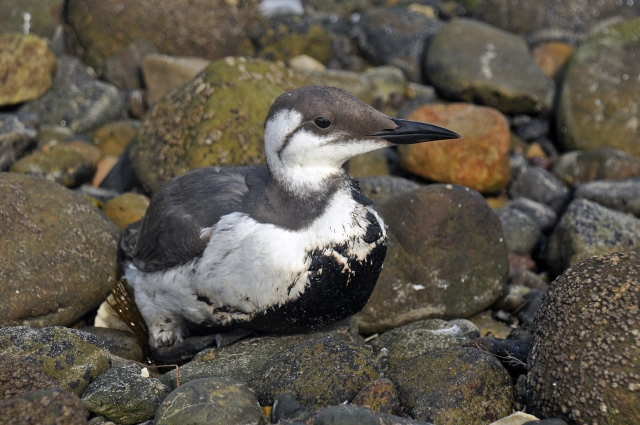
Common Murre oiled on belly (J.Kenney 2/15/12)
The oil-caused seabird mortality has now hit the local newspapers. According to the LA Times, seepage from the seafloor in the Santa Barbara Channel near Coal Oil Point amounts to thousands of gallons a day. For unknown reasons, Common Murres have been more abundant off Southern California during the past three winters than they were in previous years, and thus more oiled Murres are showing up at rescue stations. They’ve been appearing SoCal beaches as far south as Orange County, oiled, dying or dead. International Bird Rescue in San Pedro has treated over 140 birds of various species since Jan. 1, including at least 124 Common Murres.
Read more about it at these two articles:
Los Angeles Times – Natural Oil Seepage Off Santa Barbara Takes a Toll on Seabirds – March 7, 2012
Writer: Tony Barboza
http://www.latimes.com/news/local/la-me-oil-birds-20120307,0,3147878.story
Daily Breeze – Oiled Seabirds Crowd Rescue Center in San Pedro – March 6, 2012
Writer: Sanda Mazza
http://www.dailybreeze.com/ci_20115250/oiled-seabirds-crowd-rescue-center-san-pedro
And in case you missed it, here’s the earlier LA Times story on the albatross which showed up back in January.
Los Angeles Times – Albatross Wanders into L.A. – February 1, 2012
Writer: Tony Barboza
http://www.latimes.com/news/local/la-me-albatross-20120201,0,6654678.story
********************
********************
We now have a permanent Bird Rescue page on our blog.
********************
********************
The following organizations are non-profit, need donations and frequently solicit volunteers.
In the Malibu area, CWC is the closest place to call.
California Wildlife Center
Emergency Hotline Number: (310) 458-WILD [9453]
PO Box 2022
Malibu, CA 90265
Phone (818) 222-2658 Fax: (818) 222-2685
Email:
Website: http://www.cawildlife.org/
Volunteer Inquiries: volunteer@cawildlife.orgor 818.222.2658
International Bird Rescue:
Website: http://www.bird-rescue.org/
San Pedro Office:
Phone: 310-514-2573
Fax: 310-514-8219
3601 South Gaffey Street
San Pedro, Ca. 90731
South Bay Wildlife Rehab
26363 Silver Spur Rd., Rancho Palos Verdes, California 90275
Phone: (310) 378-9921 Fax: (310) 378-0969
Email: info@sbwr.org
Website: http://www.sbwr.org/
[Chuck Almdale]
Malibu Lagoon Trip Report: 26 February, 2012
SMBAS Links: Website Blog Facebook
Cool but clear at the lagoon. Tide was rising towards high at 11:30, so many of the shorebirds, including most of the Snowy Plovers, were resting. A great many gulls were on the beach, but most flew away before we got there and only about 450 remained. Ducks numbers remained high. Especially interesting was the offshore rocks and the sea out past the surf zone. On the rocks were 2 Pelagic Cormorant and a relatively large number of Brant’s Cormorant, 15 to be exact, an all-time high for our monthly census. As neither of these species like coming as far inland as the lagoon – all of 30 yards or so – the only roosting space within good view is on these few rocks, and they don’t amount to much. In the proper season, you might see thousands of them on the offshore jetty at Marina del Rey. A couple of the Brant’s were developing the blue gular pouches of breeding season.
Meanwhile, busily diving both in and just beyond the surf zone were all three Loon species: Common, Red-throated and Pacific. Farther out were flotillas of Western Grebe and Surf Scoter. On the sand the 54 Snowy Plovers present were busy dodging the Lifeguard truck and the numerous walkers. The two Black Oystercatchers as well as the Ruddy Turnstones were foraging among the cobbles not yet covered by the rising tide.
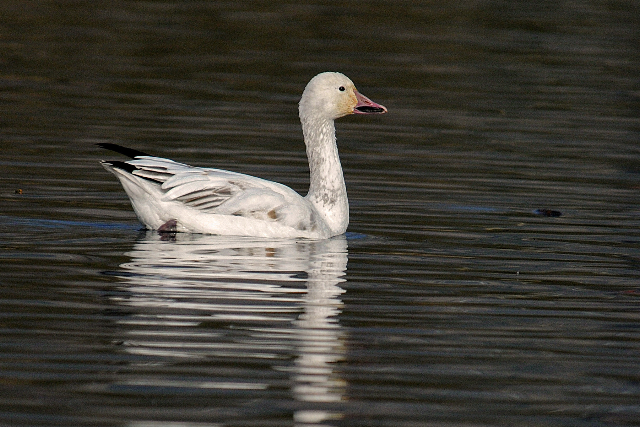
Juvenile Snow Goose (J. Kenney 2/24/12)
On one of the sandy islands in the lagoon we found the Snow Goose which had shown up a few days earlier. Their Goth-style ‘black lips’ make them easy to locate among the gulls, not to mention that they’re a lot taller.
Breeding season approaches and migration starts to happen. Among the Ruddy Ducks that have been wintering just inland of the highway bridge we found three males changing into breeding plumage, all rusty colored. One was very well along and had a bright blue bill. Meanwhile, two Rough-winged Swallows, recent arrivals from the south, entertained us by chasing insects overhead and resting on a nearby branch.
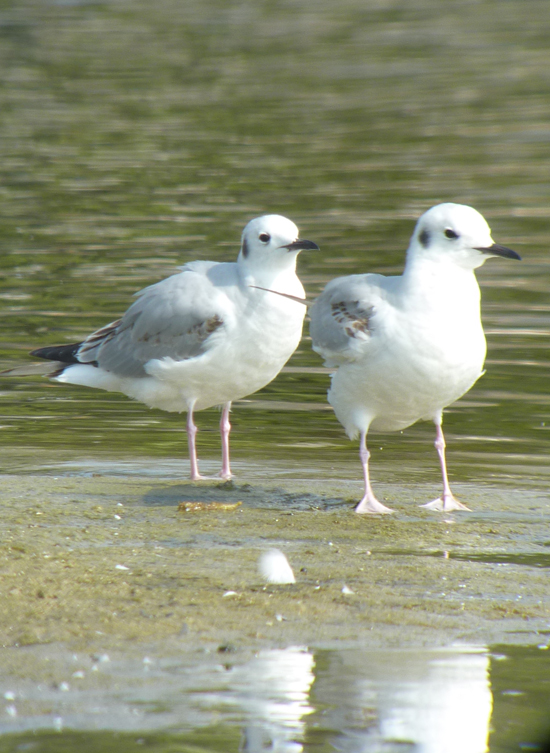
A brace of Bonaparte's Gulls (A.Albaisa 2/26/12)
The two Boneparte’s Gulls present were a pale reminder of their abundant presence in the past. Some examples: 3/15/80 – 1600, 11/29/80 – 530, 11/29/81 – 950, 12/12/82 – 1095. Over the past 12 years, the highest number was 26 on 5/27/07. In the early 80’s there was a large sand/gravel island in the middle of the lagoon which, except when the highest tides covered it, was the favorite roosting spot for all the gulls and shorebirds. Surrounded by water, they didn’t have to contend with humans and their pets and small children, both of whom love to charge into large flocks of birds in order to see them fly. Now these birds are relegated to the far more dangerous lagoon edges, where they are frequently disturbed and harassed by humans. Currently they have a couple of sandy islands where they are mostly undisturbed, so life is good for them. So to speak. Humans mostly stay out of the lagoon water as it is so polluted with bacteria that their toes would probably instantly glow and fall off. The birds must be far tougher than we are, or they aren’t as bothered by the bacteria so dangerous to us.

Common Murre oiled on belly (J.Kenney 2/15/12)
Perhaps unrelated to this, there seemed to be more dead birds on the beach than is usual. Most were cormorants. Earlier this month there was a significantly oiled Common Murre on the beach, but it had left.
Our next three field trips: Sycamore Canyon 10 Mar., 8:30am; Malibu Lagoon 25 March 8:30 & 10am; Placerita Canyon / Walker Ranch 7 April, 8:30am.
Our next program: Tuesday, 6 March, 7:30 pm – The Lives of Spiders, presented by Martin Ramirez.
The usual reminders will be emailed from the blog.
As a reminder to those coming to our 10 a.m. Parent’s & Kids Birdwalk, it meets at the beach trail footbridge closest to the parking lot.
Links: Unusual birds at Malibu Lagoon
Aerial photo of Malibu Lagoon from 9/23/02.
Prior checklists: July-Dec’11, Jan-June’11, July-Dec ’10, Jan-June ’10, Jul-Dec ‘09, and Jan-June ‘09.
[Chuck Almdale].
| Malibu Census 2012 |
22-Jan |
26-Feb |
| Temperature |
68 – 75 |
48 – 64 |
| Tide Height |
+6.49 |
+3.37 |
| Low/High &Time |
H:0803 |
H:1136 |
| Snow Goose |
1 |
|
| Brant |
1 |
|
| Gadwall |
31 |
35 |
| American Wigeon |
2 |
8 |
| Mallard |
23 |
30 |
| Northern Shoveler |
46 |
35 |
| Northern Pintail |
10 |
8 |
| Green-winged Teal |
37 |
38 |
| Surf Scoter |
14 |
40 |
| Bufflehead |
26 |
4 |
| Red-brstd Merganser |
6 |
8 |
| Ruddy Duck |
59 |
24 |
| Red-throated Loon |
2 |
|
| Pacific Loon |
1 |
3 |
| Common Loon |
1 |
|
| Pied-billed Grebe |
3 |
2 |
| Eared Grebe |
4 |
2 |
| Western Grebe |
8 |
40 |
| Brandt’s Cormorant |
3 |
15 |
| Dble-crstd Cormorant |
37 |
28 |
| Pelagic Cormorant |
1 |
2 |
| Brown Pelican |
48 |
12 |
| Great Blue Heron |
7 |
|
| Great Egret |
2 |
2 |
| Snowy Egret |
7 |
8 |
| Blk-crwnd N-Heron |
2 |
|
| Osprey |
1 |
|
| Red-shouldered Hawk |
1 |
2 |
| Sora |
2 |
3 |
| American Coot |
345 |
285 |
| Blk-bellied Plover |
65 |
93 |
| Snowy Plover |
81 |
54 |
| Killdeer |
2 |
10 |
| Black Oystercatcher |
5 |
2 |
| American Avocet |
2 |
1 |
| Spotted Sandpiper |
2 |
|
| Willet |
3 |
|
| Whimbrel |
1 |
2 |
| Ruddy Turnstone |
15 |
13 |
| Sanderling |
200 |
100 |
| Least Sandpiper |
12 |
|
| Boneparte’s Gull |
2 |
|
| Heermann’s Gull |
16 |
|
| Ring-billed Gull |
150 |
35 |
| Western Gull |
120 |
55 |
| California Gull |
1900 |
360 |
| Glaucous-wingd Gull |
5 |
2 |
| Forster’s Tern |
1 |
|
| Royal Tern |
16 |
1 |
| Rock Pigeon |
5 |
4 |
| Mourning Dove |
2 |
2 |
| Anna’s Hummingbird |
2 |
2 |
| Allen’s Hummingbird |
2 |
1 |
| Belted Kingfisher |
1 |
1 |
| Black Phoebe |
3 |
4 |
| Say’s Phoebe |
1 |
|
| Cassin’s Kingbird |
2 |
|
| American Crow |
4 |
8 |
| Rough-wingd Swallow |
2 |
|
| Bushtit |
26 |
4 |
| Bewick’s Wren |
1 |
|
| Marsh Wren |
1 |
|
| Ruby-crowned Kinglet |
2 |
|
| Hermit Thrush |
1 |
|
| Northern Mockingbird |
1 |
2 |
| European Starling |
1 |
15 |
| Yellow-rumpd Warbler |
3 |
|
| Common Yellowthroat |
4 |
2 |
| Spotted Towhee |
1 |
|
| California Towhee |
2 |
|
| Savannah Sparrow |
2 |
|
| Song Sparrow |
2 |
8 |
| White-crwnd Sparrow |
22 |
4 |
| Red-winged Blackbird |
15 |
|
| Brewer’s Blackbird |
1 |
|
| Great-tailed Grackle |
13 |
8 |
| Brwn-headed Cowbird |
2 |
|
| House Finch |
25 |
10 |
|
|
|
|
| Totals by Type |
Jan |
Feb |
| Waterfowl |
255 |
231 |
| Water Birds-Other |
452 |
395 |
| Herons, Egrets |
18 |
10 |
| Quail & Raptors |
2 |
2 |
| Shorebirds |
388 |
275 |
| Gulls & Terns |
2207 |
456 |
| Doves |
7 |
6 |
| Other Non-Pass. |
5 |
4 |
| Passerines |
110 |
92 |
| Totals Birds |
3444 |
1471 |
| Total Species |
Jan |
Feb |
| Waterfowl |
11 |
11 |
| Water Birds-Other |
10 |
12 |
| Herons, Egrets |
4 |
2 |
| Quail & Raptors |
2 |
1 |
| Shorebirds |
11 |
8 |
| Gulls & Terns |
6 |
7 |
| Doves |
2 |
2 |
| Other Non-Pass. |
3 |
3 |
| Passerines |
16 |
18 |
| Totals Species |
65 |
64 |



 SANTA MONICA BAY AUDUBON SOCIETY BLOG