Free email delivery
Please sign up for email delivery in the subscription area to the right.
No salesman will call, at least not from us. Maybe from someone else.
Sycamore Canyon Field Trip Report: 10 March, 2012
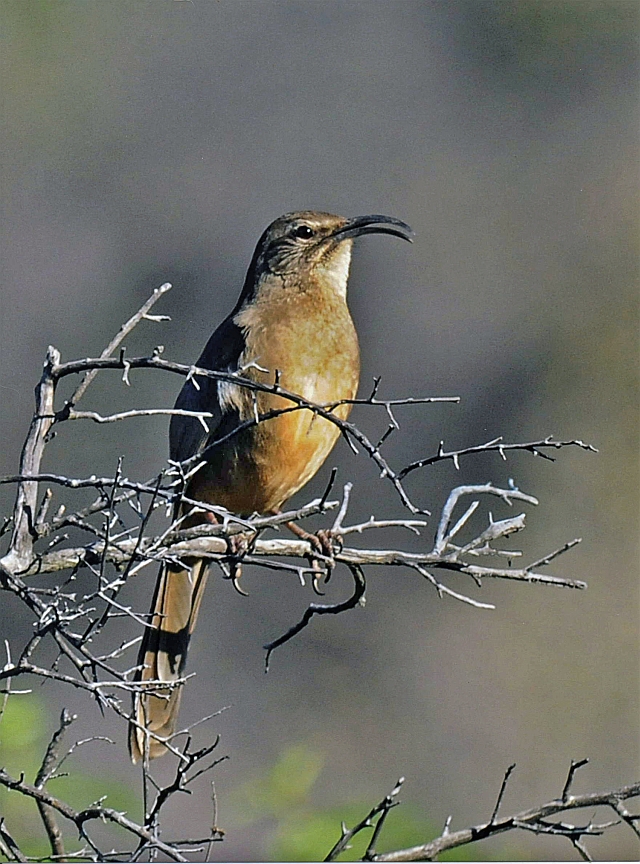
California Thrasher singing (J.Kenney 2011)
As we walked further up the canyon, we were serenaded by several Orange-crowned Warblers but they were tough to see. Just at the entry to the road going into the canyon we saw two California Thrashers at the water spigot and they were not shy. Later,a Dark-eyed Junco joined them. The walk on the road (where the runners were) was exceptionally dry. The two rivers we normally cross had no water at all. We saw quite a show with a Common Raven mobbing a Red-tailed Hawk. This was not the usual display for the Raven was exceptionally aggressive and the hawk was turning and showing talons.
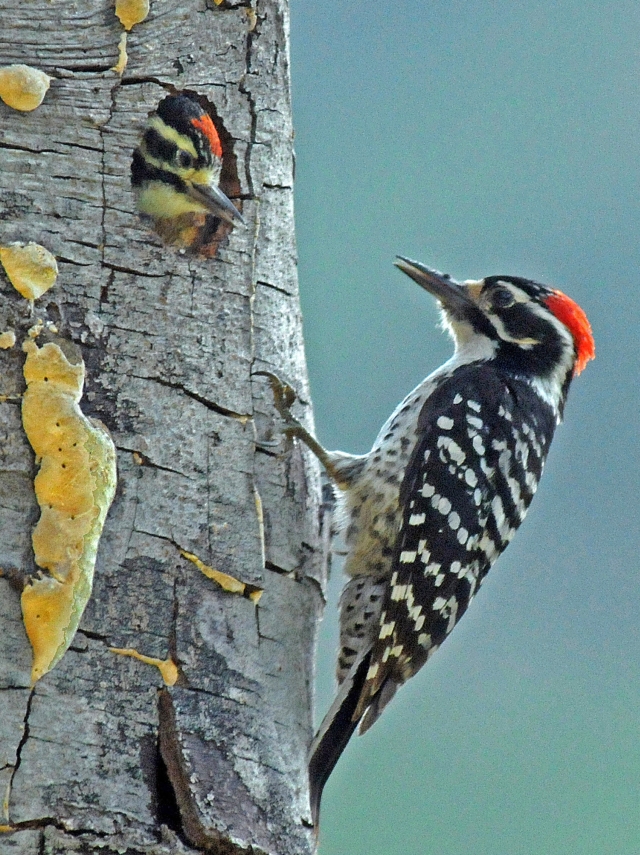
Male Nuttall's Woodpecker at the nesthole. Note wide dark area at top of back. Same area on Ladderbacked is quite narrow; cheek is also whiter and breast is creamy, not white. (J.Kenney 2011)
A Northern Flicker was calling and we finally saw the bird. An Acorn Woodpecker was there along with a Nuttall’s Woodpecker and Carol said she saw a Ladder-backed Woodpecker. Later on an American Kestrel was seen along with a Ruby-crowned Kinglet and some Bushtits. The most dominant sound on the field trip came from the Black-hooded Parakeets. We probably saw about 10 of the parakeets, with several up-close views and lots of noise.
[Jean Garrett]
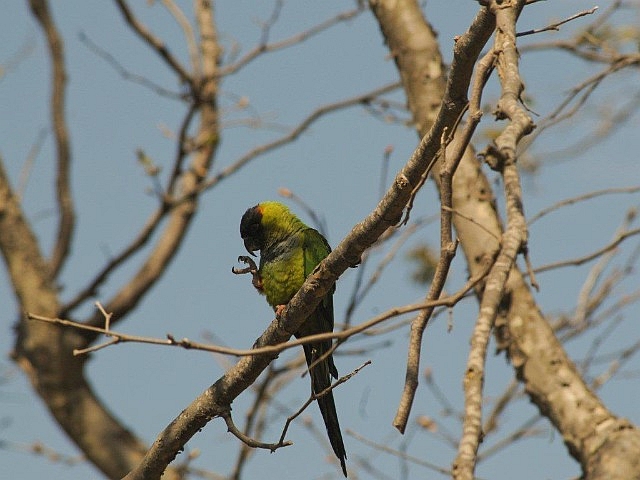
Black-hooded Parakeet cleaning its talon. All parakeets have long pointed tails and aren't necessarily small. This 12" bird is longer than many "parrots." (Mark Farber 3/10/12)
Sycamore Canyon Field Trip – The Newmarkian View
Today’s reporter is trip participant Mary Lou Newmark . Photos are courtesy of her friend, Mark Farber. Mary Lou is a multifaceted person: writer, poet, playwright, actor, musician, composer and photographer. Several of her photos graced our Paramount to Malibu Hike, 4/9/11 report. I don’t know how she has time for birding. See what else Mary Lou is up to and check out her stunning, electric-green electric violin on her website: http://www.greenangelmusic.com/

Dark-eyed Junco by the picnic tables. (Mark Farber 3/10/12)
Our adventure began at the wash near the parking lot where we spotted several small birds. My first attempts to emulate my fellow birder’s binocular positions were in vain. I had much better luck when I looked for bird flight movement with the naked eye and guessed where the bird might be perched in the bushes. When I did get a bright green finch in my binos it was quite a pleasant shock! Our small, but intrepid group made its way through the campgrounds, seeing birds on the ground and near water faucets. Butterflies accompanied us as we moseyed along. Little kids rode their bicycles between the campers and dads doused the last of their breakfast barbecues. High in the trees above the camp activity was a hawk’s nest with the parent bird sitting inside. Other than occasionally giving us a warning stare, she was content to let us watch and attempt to take pictures. She was wearing red, but whether on her shoulders or tail, I don’t recall.

Black-hooded Parakeet trio. (Mark Farber 3/10/12)
On Wednesday, March 15, Stacey Vigallon (Los Angeles Audubon & Snowy Plover Coordinator), Eleanor Osgood (LA Audubon & Snowy Plover Volunteer), Jamie King (California State Parks), Jamie’s mom, and I (Chuck Almdale) met to erect a Snowy Plover “virtual enclosure” on Malibu Beach, adjacent to the lagoon. [Jamie’s mom, whose name I didn’t catch, was in town on a visit and came along both to help and to see the lagoon and beach.] We spent a couple of hours driving a lot of metal poles into the sand, running a rope through the poles and hanging plenty of signs on the poles and rope. Stacey had been out a few days earlier to see where the plovers were currently roosting. But it’s impossible to be certain about these little birds: their preferred roosting site changes with the tides, lagoon outlet location, human beach use, and – one can only suppose – their mood of the day.

Snowy Plover information sign created by local artist. (C.Almdale (3/15/12)
Making the location even more a matter of guesswork was the fact that n0t one of the birds was roosting: all were running around down by the water’s edge and “nosing” around in the numerous clumps of wrack dotting the beach.

Snowy Plover contemplates beach wrack clump. (C.Almdale)
This is a “symbolic fence” because it consists of only a line of fence posts connected by a rope. Signs are hung are regular intervals, but it’s far from an impenetrable barrier. However, in my experience, it adequately serves to eliminate the vast majority of beach traffic. I’d guesstimate that 95% of people stay out. The plovers are so small and cryptically plumaged that people simply don’t see them, especially if they are walking along deep in thought or conversation and unaware of tiny birds at their feet. The Snowies also look a lot like the far more numerous and definitely not-threatened Sanderlings: with what seems like hundreds or thousands of the same tiny bird running all over, the uninformed person is far less likely to be concerned.
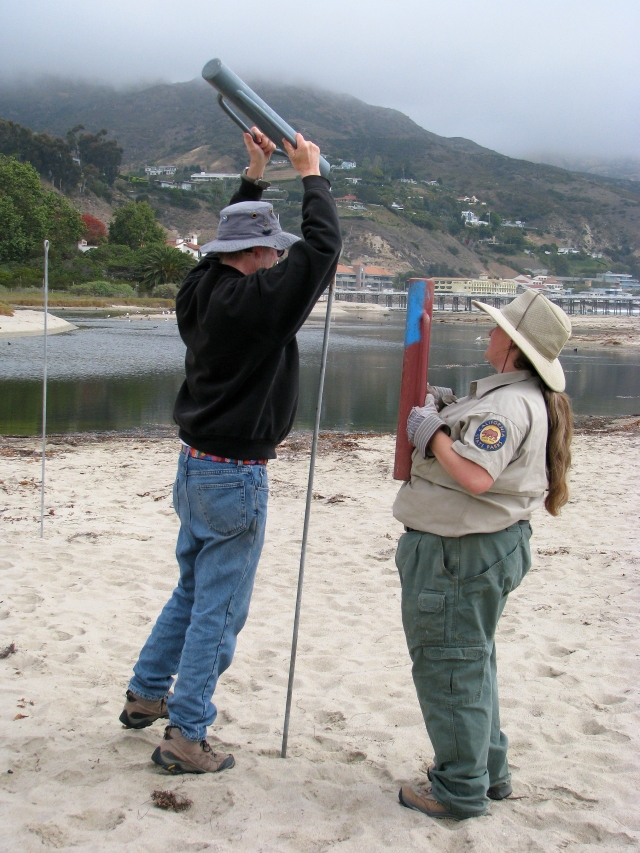
Chuck handles the tall posts. Some people pay health club dues to get this kind of exercise. (C.Almdale (3/15/12)
But they are quite threatened. Total west coast population in 2011 was under 2300 birds, breeding at only 28 sites. The Los Angeles County winter population had fluctuated in recent years from 200 to about 350 birds, concentrated exclusively in only seven roosting locations, of which Malibu Lagoon is one. So chances are that the roosting flock of Snowies which people perpetually saunter through comprises about 20% of their total LA County population, and about 3% of the total west coast population. Compare that to the millions of humans populating the same area and you’ll see what these tiny birds are up against. People need to be more careful and – when informed – are more careful.
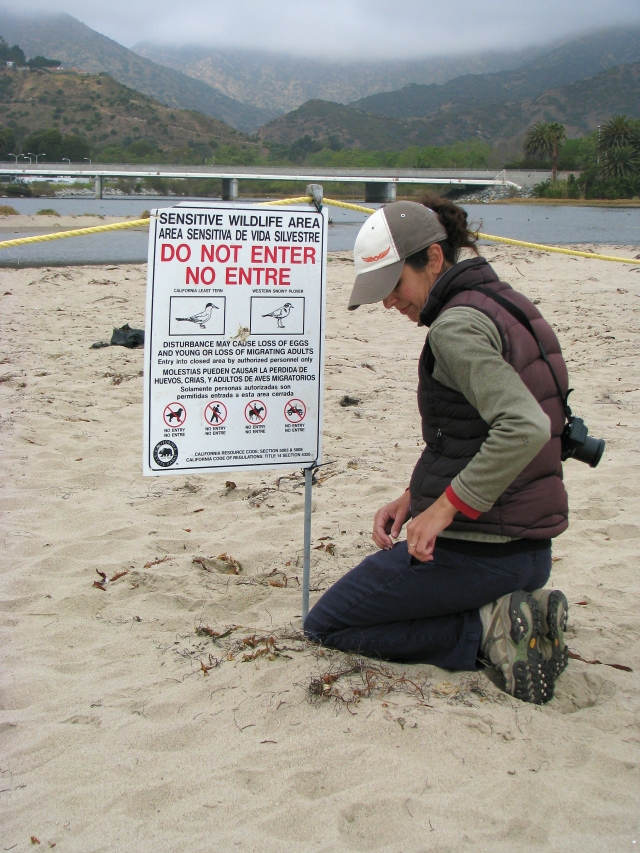
Stacey: professional sign hanger. (C.Almdale (3/15/12)
So the fence and the signs inform the public while setting aside a small area for the birds, a place where we hope they can get a bit of shut-eye. The current plan is to leave the enclosure up until October 1 and see what happens. Keep an eye on the enclosure: in the past, quite a bit of vegetation began reappearing within a few weeks, demonstrating that without foot traffic and beach cleaning, it could actually be a real habitat. [Chuck Almdale]
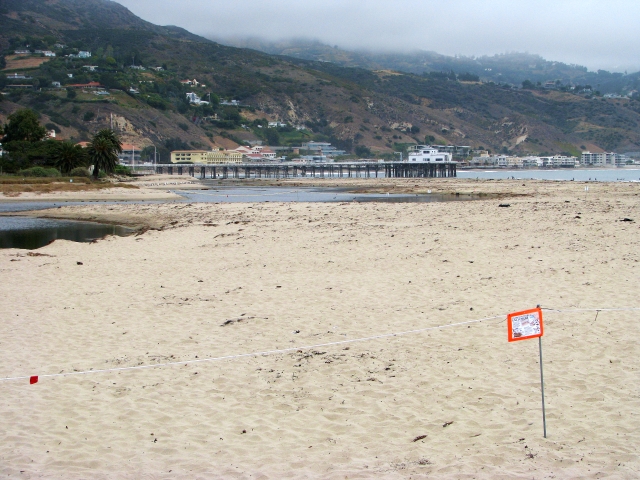
Completed fence, pier in background. Note lack of vegetation. (C.Almdale (3/15/12)
Birds in the Science Press
News in Brief: Urban Noise Ruined My Marriage
Bird marriages of Great Tits hurt by city hubbub in this week’s news.
http://www.sciencenews.org/view/generic/id/333954/title/News_in_Brief_Life
From Science News Online
********************************************
News in Brief: Killer baby birds
Honeyguide chicks kill their nestmates in this week’s news.
http://www.sciencenews.org/view/generic/id/334336/title/News_in_Brief_Life
From Science News Online
********************************************
Dinosaur-era feathers sealed in amber
The richest collection yet of primordial plumage preserves pigment and fine details found modern birds.
http://www.sciencenews.org/view/generic/id/334380/title/Dinosaur-era_feathers_sealed_in_amber
From Science News Online
********************************************
Penguins may sniff out relatives
A zoo study sees hints of odor-based kin recognition in colony-dwelling birds.
http://www.sciencenews.org/view/generic/id/334672/title/Penguins_may_sniff_out_relatives
From Science News Online
********************************************
News in Brief: Birds’ share of dinosaur extinction
Birds’ share of dinosaur extinction in this week’s news.
http://www.sciencenews.org/view/generic/id/334775/title/News_in_Brief_Life
From Science News Online
********************************************
[Chuck Almdale]
Full Worm Moon
Just in case you missed this important news, this is an alert from SMBAS blog that the full moon on March 8 at 1:39 a.m., only 4 days ago was the Full Worm Moon. Here is the explanation for this significant event.
In this month, the ground softens and the earthworm casts reappear, inviting the return of the robins. The more northern tribes called this the Full Crow Moon, when the cawing of crows signals the end of winter, or the Full Crust Moon because the snow cover becomes crusted from thawing by day and freezing at night. The Full Sap Moon, marking the time to tap maple trees, is another variation.
The next significant full moon will occur on April 6 at 7:21 a.m. PDT. Keep an eye on this spot for additional breaking news on this unprecedented event.
This information comes to you courtesy of:
http://www.msnbc.msn.com/id/45911225/ns/technology_and_science-space/t/how-s-full-moons-got-their-strange-names/#.T16CDHlIXUx
But that’s way too long to type in, so don’t bother going there.
[Chuck Almdale]



 SANTA MONICA BAY AUDUBON SOCIETY BLOG