Free email delivery
Please sign up for email delivery in the subscription area to the right.
No salesman will call, at least not from us. Maybe from someone else.
Malibu Lagoon Trip Report: 23 October, 2011
SMBAS Links: Website Blog Facebook
Fog and cool temperatures of 59° – 64° didn’t keep the surfers or the birders away. You could tell that that birding movie was now playing in the theaters as several passersby asked if we were working on a “Big Year.” No one was.
Birds always look a bit strange in the gray light which fog brings, and this had something to do with our difficulty with one duck. It started as a Cinnamon Teal, morphed into an American Wigeon, then morphed again into a Eurasian Wigeon, a rarity at the lagoon. It looked like a rufous morph female to me, according to my handy NGS Field Guide. A few minutes later, someone said that it had been reported on the web (LACoBirds@yahoogroups.com), and sure enough when I got home, there it was, a female EuWi reported 10/22 as having been seen on 10/21 by Cal Yorke & Guy McCaskie. My records show 3 previous EuWi at the lagoon, all singletons: a bird that stayed from 1/18/81 to at least 3/8/81, one on 11/24/91 and one on 4/24/94. So far this current bird has been there at least 3 days and chances are (based on this extremely small sample of 3 birds) 33% that it’ll stay around for a while. [Link to Cal Yorke’s 10/21 report, with pictures.]

Eurasian Wigeon - female (Callyn Yorke 10/21/11)
We had a few more new faces: Ken, Dawn, Grace & Daniel, and Femi. Clara, new last month, returned, busily recording her sightings onto a thin rectangular electronic device, which I’ve been told is some sort of telephone. News to me. What’s next? Recorded bird calls you can dial up?
Notable among the many birds were the flocks of Black-bellied Plover which kept coming in and flying out. I guesstimated 700 total but it could easily have been well over 1000. Down on the mud, hiding among the ‘Black-bellies’ were 3 Black Turnstone, which show up just about ½ as often as do Ruddy Turnstone, 10 of which were also present. If you go birding in England, our Ruddy Turnstone is known as “The Turnstone”. I don’t know who Mr. The was, but there are an awful lot of British birds named after him. And yes, as we are often asked, Turnstones are aptly named, as they often do flip over pebbles to see if anyone edible hides underneath. Two Dunlin also showed up, wandering among the plovers and Killdeer.
The recent rain (with perhaps some help from the Surfers’ Midnight Shovel Brigade) opened up a channel through the west end of the beach. The water level was very low and dropping with the tide, so a great deal of mud was exposed throughout the lagoon and channels. We did manage to find a couple of Virginia Rail and at least one Sora, who was very vocal, calling all morning at regular intervals. The beach channel prevented us from reaching the Snowy Plover winter roost site and doing a census, but I did manage to find 5 of them at great distance through the telescope.

Malibu winterer Snowy Plover GG:AR (Cal Yorke 10/21/11)
Also notable were raptors: 2 Red-tailed Hawk perched in a dead tree across the road from the Adamson House, 1 Osprey which flew up-canyon, then back down-canyon about ½ hour later, and one each of Peregrine Falcon and Merlin, both of which – at different times – did very fast flybys of the lagoon. Lagoon birds usually panic into flight when a Peregrine comes by, but they didn’t seem to notice this one.
Our next three field trips: Butterbredt Spring Campout – 29/30 October; Malibu Creek State Park – 12 November, Malibu Lagoon 27 November.
Our next program: Tuesday, 1 November – A Century of Change in Bird Life in Los Angeles, presented by Kimball Garrett.
Reminders will be emailed from the blog.
As a reminder to those coming to our 10 a.m. Parent’s & Kids Birdwalk, it meets at the beach trail footbridge closest to the parking lot.
Links: Unusual birds at Malibu Lagoon
Aerial photo of Malibu Lagoon from 9/23/02.
Prior checklists: Jan-June’11, July-Dec ’10, Jan-June ’10, Jul-Dec ‘09, and Jan-June ‘09.
[Chuck Almdale]
| Malibu Census 2011 |
24-Jul |
28-Aug |
25-Sep |
23-Oct |
| Temperature |
65-72 |
72 – 81 |
61-69 |
59-64 |
| Tide Height |
+2.61 |
+5.03 |
+5.33 |
+5.40 |
| Low/High &Time |
L:0947 |
H:0942 |
H:0830 |
H:0178 |
| Gadwall |
10 |
6 |
||
| Eurasian Wigeon |
1 |
|||
| American Wigeon |
3 |
|||
| Mallard |
54 |
60 |
48 |
25 |
| Blue-winged Teal |
2 |
|||
| Northern Shoveler |
10 |
12 |
||
| Green-winged Teal |
2 |
|||
| Ruddy Duck |
2 |
5 |
8 |
|
| Pacific Loon |
1 |
|||
| Common Loon |
1 |
|||
| Pied-billed Grebe |
4 |
15 |
13 |
4 |
| Eared Grebe |
5 |
3 |
||
| Western Grebe |
10 |
|||
| Brandt’s Cormorant |
3 |
1 |
3 |
|
| Dble-crstd Cormorant |
31 |
48 |
47 |
32 |
| Pelagic Cormorant |
1 |
3 |
2 |
1 |
| Brown Pelican |
407 |
77 |
60 |
12 |
| Great Blue Heron |
6 |
3 |
2 |
3 |
| Great Egret |
4 |
2 |
2 |
2 |
| Snowy Egret |
11 |
15 |
23 |
26 |
| Green Heron |
1 |
|||
| Blk-crwnd N-Heron |
11 |
4 |
12 |
|
| Osprey |
1 |
1 |
||
| Red-tailed Hawk |
2 |
2 |
||
| Merlin |
1 |
|||
| Peregrine Falcon |
1 |
1 |
||
| Virginia Rail |
1 |
2 |
||
| Sora |
3 |
1 |
||
| American Coot |
20 |
75 |
410 |
370 |
| Blk-bellied Plover |
4 |
46 |
40 |
700 |
| Snowy Plover |
13 |
36 |
62 |
5 |
| Semipalmated Plover |
2 |
4 |
||
| Killdeer |
2 |
8 |
6 |
15 |
| Black Oystercatcher |
2 |
|||
| Black-necked Stilt |
1 |
|||
| Spotted Sandpiper |
2 |
2 |
3 |
|
| Wandering Tattler |
1 |
|||
| Willet |
4 |
7 |
10 |
|
| Whimbrel |
41 |
26 |
28 |
|
| Marbled Godwit |
2 |
2 |
||
| Ruddy Turnstone |
7 |
4 |
7 |
10 |
| Black Turnstone |
1 |
3 |
||
| Sanderling |
15 |
3 |
||
| Western Sandpiper |
2 |
11 |
1 |
|
| Least Sandpiper |
1 |
6 |
3 |
16 |
| Dunlin |
2 |
|||
| Long-billed Dowitcher |
2 |
2 |
||
| Red-necked Phalarope |
7 |
|||
| Heermann’s Gull |
41 |
24 |
15 |
14 |
| Ring-billed Gull |
1 |
7 |
18 |
|
| Western Gull |
107 |
146 |
66 |
80 |
| California Gull |
8 |
16 |
120 |
|
| Herring Gull |
1 |
|||
| Least Tern |
13 |
|||
| Caspian Tern |
3 |
12 |
||
| Common Tern |
1 |
|||
| Forster’s Tern |
3 |
|||
| Royal Tern |
18 |
15 |
1 |
|
| Elegant Tern |
8 |
36 |
4 |
|
| Black Skimmer |
1 |
1 |
||
| Rock Pigeon |
6 |
5 |
5 |
4 |
| Mourning Dove |
3 |
2 |
2 |
2 |
| Vaux’s Swift |
100 |
|||
| Anna’s Hummingbird |
3 |
4 |
3 |
2 |
| Allen’s Hummingbird |
3 |
2 |
2 |
|
| Belted Kingfisher |
2 |
1 |
2 |
|
| Nuttall’s Woodpecker |
1 |
|||
| Western Wood-Pewee |
1 |
|||
| Black Phoebe |
8 |
10 |
6 |
10 |
| Say’s Phoebe |
1 |
2 |
||
| Cassin’s Kingbird |
1 |
|||
| Western Kingbird |
1 |
4 |
||
| Western Scrub-Jay |
2 |
|||
| American Crow |
4 |
3 |
2 |
4 |
| Rough-wingd Swallow |
20 |
22 |
1 |
|
| Barn Swallow |
18 |
45 |
30 |
|
| Cliff Swallow |
25 |
2 |
||
| Oak Titmouse |
2 |
|||
| Bushtit |
8 |
6 |
6 |
20 |
| Bewick’s Wren |
1 |
1 |
1 |
1 |
| House Wren |
1 |
1 |
||
| Wrentit |
1 |
|||
| Northern Mockingbird |
2 |
3 |
2 |
2 |
| European Starling |
38 |
20 |
23 |
60 |
| Ornge-crwnd Warbler |
1 |
|||
| Yellow-rumpd Warbler |
8 |
|||
| Common Yellowthroat |
1 |
8 |
5 |
9 |
| Wilson’s Warbler |
1 |
2 |
||
| California Towhee |
3 |
1 |
||
| Savannah Sparrow |
1 |
|||
| Song Sparrow |
1 |
5 |
3 |
4 |
| White-crwnd Sparrow |
18 |
|||
| Bobolink |
1 |
|||
| Red-winged Blackbird |
17 |
32 |
18 |
|
| Brewer’s Blackbird |
2 |
|||
| Great-tailed Grackle |
3 |
5 |
12 |
8 |
| Brwn-headed Cowbird |
6 |
|||
| Hooded Oriole |
6 |
|||
| House Finch |
4 |
8 |
12 |
5 |
| Lesser Goldfinch |
4 |
2 |
1 |
|
| Totals by Type |
July |
Aug |
Sep |
Oct |
| Waterfowl |
56 |
65 |
79 |
48 |
| Water Birds-Other |
463 |
221 |
542 |
440 |
| Herons, Egrets |
32 |
24 |
40 |
31 |
| Quail & Raptors |
0 |
3 |
1 |
5 |
| Shorebirds |
32 |
187 |
161 |
797 |
| Gulls & Terns |
175 |
248 |
124 |
233 |
| Doves |
9 |
7 |
7 |
6 |
| Other Non-Pass. |
6 |
7 |
106 |
6 |
| Passerines |
167 |
181 |
133 |
157 |
| Totals Birds |
940 |
943 |
1193 |
1723 |
| Total Species |
July |
Aug |
Sep |
Oct |
| Waterfowl |
2 |
2 |
5 |
6 |
| Water Birds-Other |
5 |
6 |
9 |
12 |
| Herons, Egrets |
4 |
4 |
5 |
3 |
| Quail & Raptors |
0 |
2 |
1 |
4 |
| Shorebirds |
8 |
14 |
12 |
13 |
| Gulls & Terns |
8 |
8 |
7 |
5 |
| Doves |
2 |
2 |
2 |
2 |
| Other Non-Pass. |
2 |
3 |
4 |
3 |
| Passerines |
19 |
18 |
23 |
17 |
| Totals Species – 100 |
50 |
59 |
68 |
65 |
Bolsa Chica Reserve Field Trip Report: 8 October, 2011
SMBAS Links: Website Blog Facebook
Bolsa Chica Ecological Reserve parallels Pacific Coast Hwy. between Seal Beach and Huntington Beach in Orange County. Bolsa Chica means “little pocket” in Mexican Spanish as once the area was all swamp with “little pockets” of dry land. Nowadays it’s a large sandy series of mostly man-made lagoons, restored a few years back when a direct channel was dug under the highway and through the beach out to the ocean. It’s a very good spot for all sorts of water birds, raptors, Belding’s race of the Savannah Sparrow, and the occasional oddity like the Lesser Sand (Mongolian) Plover than showed up there last summer.
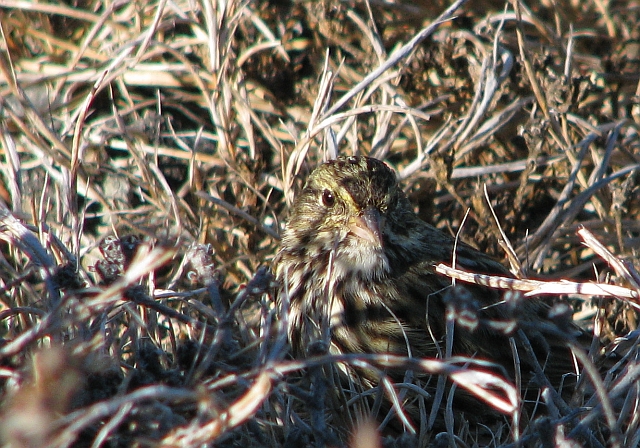
Savannah Sparrow - salt-marsh loving Belding's race (C. Almdale 10/8/11)
It was a Goldilocks day – not too cold, not too hot – just right.
The down side is that the birding stalwarts stayed out well past the lunch hour. There were lots of birds and new surprises kept appearing. We thought we had seen most of the Grebes (Western, Pied-Billed, and Horned) when up popped an Eared Grebe and its lunch… an eel which was fighting back. The hoped-for Reddish Egret was there – actually there were at least three of them, and we greatly enjoyed their prancing manner of foraging for fish. We had Terns: Forster’s, Royal, Elegant and the uncommon Common. The Osprey perching high in a tree with a large fish in its talons was having a tough time hopping down the branch with one slippery foot while hanging onto the fish with the other. We had Long-Billed Curlews – amazing how they can fly with that bill. We had a Downy Woodpecker in the east side forest fringe, and quite a few Belted Kingfishers. There were Greater Yellowlegs, Long-Billed Dowitchers and those wretched Willets which seem so bland until they fly and then I wonder what my problem was. The lucky ones saw the Parasitic Jaeger (aka the Arctic Skua) – a wanderer who is rarely seen here.
We had a total of 71 species ranging from Herons and Egrets to tiny peeps and we had lots of Belding’s Savannah Sparrows and a Loggerhead Shrike. We had a grand day – easy walking, visible birds and – it goes without saying – a great leader ( moi)! [Ellen Vahan]
Map to Meeting Place and planned (not actual) walking route.
| Bolsa Chica Reserve |
|
| 10/8/2011 | |
| X = present | |
| Brant |
1 |
| American Wigeon |
X |
| Mallard |
X |
| Blue-winged Teal |
8 |
| Ruddy Duck |
X |
| Pied-billed Grebe |
X |
| Horned Grebe |
X |
| Eared Grebe |
X |
| Western Grebe |
X |
| Brown Pelican |
X |
| Double-crested Cormorant |
X |
| Great Blue Heron |
X |
| Great Egret |
X |
| Snowy Egret |
X |
| Reddish Egret |
3 |
| Green Heron |
X |
| Black-crowned Night-Heron |
X |
| Turkey Vulture |
X |
| Osprey |
1 |
| White-tailed Kite |
2 |
| Northern Harrier |
1 |
| Cooper’s Hawk |
1 |
| Red-tailed Hawk |
X |
| Eurasian Kestrel |
1 |
| American Coot |
X |
| Black-bellied Plover |
X |
| Semipalmated Plover |
X |
| Killdeer |
X |
| American Avocet |
2 |
| Spotted Sandpiper |
1 |
| Greater Yellowlegs |
6 |
| Willet |
X |
| Long-billed Curlew |
X |
| Marbled Godwit |
X |
| Ruddy Turnstone |
X |
| Sanderling |
X |
| Western Sandpiper |
X |
| Least Sandpiper |
X |
| Dunlin |
6 |
| Long-billed Dowitcher |
X |
| Heermann’s Gull |
X |
| Ring-billed Gull |
x |
| Western Gull |
x |
| California Gull |
x |
| Common Tern |
2 |
| Forster’s Tern |
x |
| Royal Tern |
x |
| Elegant Tern |
x |
| Parasitic Jaeger |
1 |
| Rock Pigeon |
x |
| Mourning Dove |
x |
| Anna’s Hummingbird |
x |
| Belted Kingfisher |
3 |
| Downy Woodpecker |
1 |
| Black Phoebe |
x |
| Say’s Phoebe |
x |
| Cassin’s Kingbird |
x |
| Loggerhead Shrike |
1 |
| American Crow |
x |
| Tree Swallow |
X |
| Marsh Wren |
x |
| Northern Mockingbird |
X |
| European Starling |
x |
| Common Yellowthroat |
x |
| California Towhee |
x |
| Savannah Sparrow |
x |
| Savannah Sparrow – Belding’s |
x |
| Song Sparrow |
x |
| White-crowned Sparrow |
x |
| Western Meadowlark |
x |
| House Finch |
x |
| Total Birds |
70 |
Malibu Lagoon Trip Report: 25 September, 2011
SMBAS Links: Website Blog Facebook
Please make sure to go to the blogsite to see the full slideshow of new photos.
Even though today was abnormally cool, it’s unlikely that climate change has been called off: 61°F at 8:30 a.m. and 69°F at noon; cloudy with hints of rain or precipitating fog. The waves were crowded: plenty of surfers on a descending tide, plus a big class of paddleboarders (or whatever people who stand on a surfboard and move themselves along with a long-stemmed oar call themselves).
Some new faces: a woman from Brazil and her friends from Colombia. They were introduced as such by one of our members so I [naturally] assumed they were fresh off the plane and hungry to see local birds. It turned out they’ve lived here almost 20 years, working in the film industry. We hope they’ll join us again.
Ducks, grebes and shorebirds are returning, as are the rails; at least 3 Sora plus one very dark juvenile Virginia Rail, oddly located on the grassy channel edge about 20 ft. NW of the 2nd footbridge. American Coot numbers exploded, and a overflight of about 100 Vaux’s Swifts surprised early birders. Snowy Egrets were relatively abundant, while the Snowy Plover population nearly doubled from August, with 62 birds on the beach. They were very busy dodging the numerous humans, especially one jogger who – lost in his own world, apparently – continually ran back and forth through the middle of the flock. We found a new banded bird – GG:AR. [Left leg: green over green – right leg: aqua over red.] This bird was one of three fledglings banded with this combination this summer at Oceano Dunes, just south of the cities of Pismo Beach & Oceano on the central California coast.
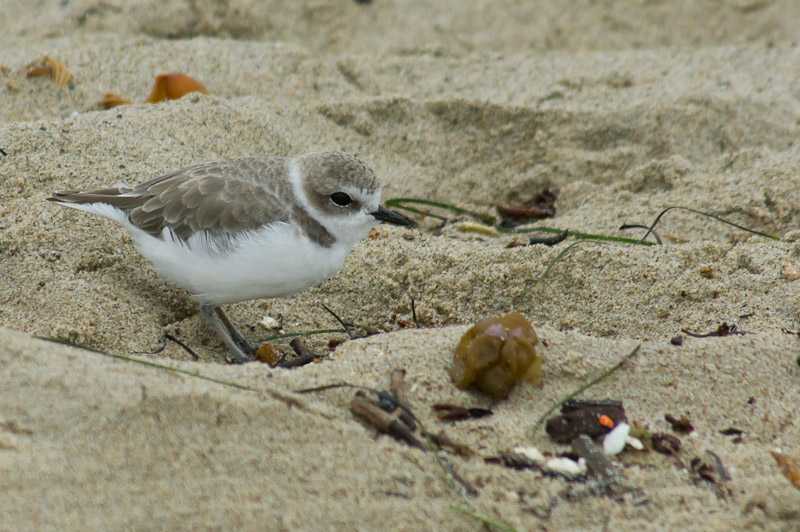
Snowy Plover in his habitat, cute as a button (C. Bragg 9/25/11)
Among returning passerines (songbirds) were Say’s Phoebe and Cassin’s Kingbird, who usually stay the winter, and several warblers passing through, including Orange-crowned and Wilson’s Warblers. Common Yellowthroats, denizens of the reeds and nearby brush, will be with us all winter.
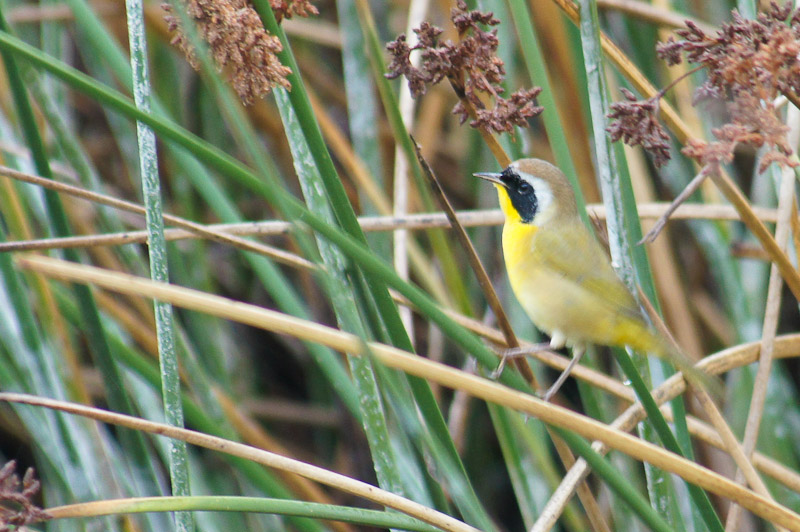
A pale fall male Common Yellowthroat in the reeds(C. Bragg 9/25/11)
Early Fall is a good time for unusual birds at the lagoon, and on Friday 9/23 a Northern Wheatear was reported. (Wheatear translates roughly as “white rump.”) This species has what is probably the longest migration route of any land bird in the world: from their wintering grounds in Southern Africa they migrate NW through England & Iceland to Greenland and NE Canada, as well as NE to Siberia, Alaska and NW Canada, possibly meeting somewhere in central northern Canada. The bird at the lagoon (for which I’m trying to get permission to reproduce) is far, far off it’s usual route. It could not be refound on Saturday, but searchers did see a 2nd year hybrid Black-crowned X Yellow-crowned Night-Heron, probably the juvenile seen last year, now one year older. Unfortunately, we did not see this bird, although some struggled to turn a juvenile Black-crowned into a hybrid.
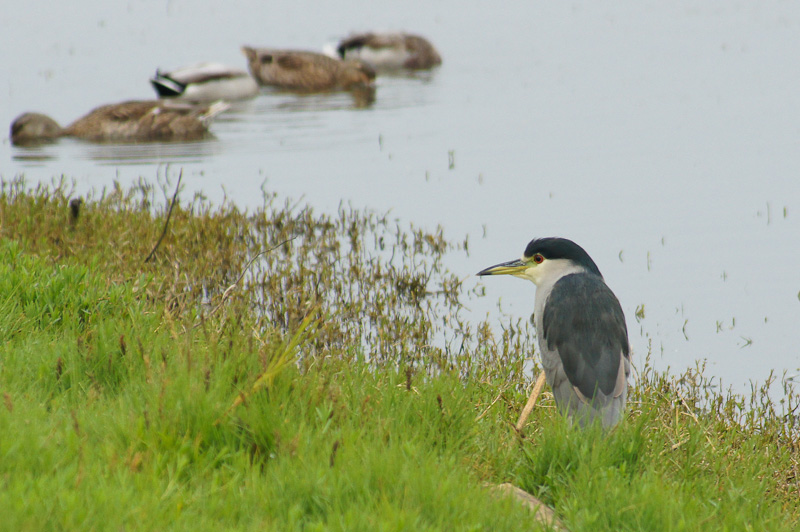
Supposedly a twilight-hunter, Black-crowned Night-Heron is out and about (C. Bragg 9/25/11)
What we DID find was pretty good. A fall plumage Bobolink – a species which usually stays east of the Rockies on it’s southward migration – showed itself for about 30-45 seconds before flying off towards the east end of the Colony, never to be seen again. It was a life bird for some, and a state or county bird for others, and was the 1st sighting for this species at the lagoon. Flycatching from the brush on the lagoon west edge was a migrating Western Wood Pewee, our 6th sighting in 30 years. On the sand island in the lagoon was a Black-necked Stilt – not a rarity except at the lagoon, and our 8th lagoon sighting of this species.
Our next three field trips: Bolsa Chica Preserve – 8 October; Malibu Lagoon – 23 October, Butterbredt Spring Campout – 29/30 October.
Our next program: Tuesday, 4 October – Birds of California, Part III with Guy Commeau.
Reminders will be emailed from the blog.
As a reminder to those coming to our 10 a.m. Parent’s & Kids Birdwalk, it meets at the beach trail footbridge closest to the parking lot.
Links: Unusual birds at Malibu Lagoon.
Aerial photo of Malibu Lagoon from 9/23/02.
Prior checklists: Jan-June’11, July-Dec ’10, Jan-June ’10, Jul-Dec ‘09, and Jan-June ‘09.
[Chuck Almdale]
| Malibu Census 2011 |
24-Jul |
28-Aug |
25-Sep |
| Temperature |
65 – 72 |
72 – 81 |
61 – 69 |
| Tide Height |
+2.61 |
+5.03 |
+5.33 |
| Low/High &Time |
L:0947 |
H:0942 |
H:0830 |
| Gadwall |
10 |
||
| American Wigeon |
3 |
||
| Mallard |
54 |
60 |
48 |
| Northern Shoveler |
10 |
||
| Ruddy Duck |
2 |
5 |
8 |
| Pied-billed Grebe |
4 |
15 |
13 |
| Eared Grebe |
5 |
||
| Brandt’s Cormorant |
3 |
1 |
|
| Dble-crstd Cormorant |
31 |
48 |
47 |
| Pelagic Cormorant |
1 |
3 |
2 |
| Brown Pelican |
407 |
77 |
60 |
| Great Blue Heron |
6 |
3 |
2 |
| Great Egret |
4 |
2 |
2 |
| Snowy Egret |
11 |
15 |
23 |
| Green Heron |
1 |
||
| Blk-crwnd N-Heron |
11 |
4 |
12 |
| Osprey |
1 |
||
| Red-tailed Hawk |
2 |
||
| Peregrine Falcon |
1 |
||
| Virginia Rail |
1 |
||
| Sora |
3 |
||
| American Coot |
20 |
75 |
410 |
| Blk-bellied Plover |
4 |
46 |
40 |
| Snowy Plover |
13 |
36 |
62 |
| Semipalmated Plover |
2 |
4 |
|
| Killdeer |
2 |
8 |
6 |
| Black-necked Stilt |
1 |
||
| Spotted Sandpiper |
2 |
2 |
|
| Wandering Tattler |
1 |
||
| Willet |
4 |
7 |
|
| Whimbrel |
41 |
26 |
|
| Marbled Godwit |
2 |
2 |
|
| Ruddy Turnstone |
7 |
4 |
7 |
| Black Turnstone |
1 |
||
| Sanderling |
15 |
3 |
|
| Western Sandpiper |
2 |
11 |
|
| Least Sandpiper |
1 |
6 |
3 |
| Long-billed Dowitcher |
2 |
||
| Red-necked Phalarope |
7 |
||
| Heermann’s Gull |
41 |
24 |
15 |
| Ring-billed Gull |
1 |
7 |
|
| Western Gull |
107 |
146 |
66 |
| California Gull |
8 |
16 |
|
| Herring Gull |
1 |
||
| Least Tern |
13 |
||
| Caspian Tern |
3 |
12 |
|
| Common Tern |
1 |
||
| Forster’s Tern |
3 |
||
| Royal Tern |
18 |
15 |
|
| Elegant Tern |
8 |
36 |
4 |
| Black Skimmer |
1 |
1 |
|
| Rock Pigeon |
6 |
5 |
5 |
| Mourning Dove |
3 |
2 |
2 |
| Vaux’s Swift |
100 |
||
| Anna’s Hummingbird |
3 |
4 |
3 |
| Allen’s Hummingbird |
3 |
2 |
|
| Belted Kingfisher |
2 |
1 |
|
| Nuttall’s Woodpecker |
1 |
||
| Western Wood-Pewee |
1 |
||
| Black Phoebe |
8 |
10 |
6 |
| Say’s Phoebe |
1 |
||
| Cassin’s Kingbird |
1 |
||
| Western Kingbird |
1 |
4 |
|
| American Crow |
4 |
3 |
2 |
| Rough-wingd Swallow |
20 |
22 |
1 |
| Barn Swallow |
18 |
45 |
30 |
| Cliff Swallow |
25 |
2 |
|
| Oak Titmouse |
2 |
||
| Bushtit |
8 |
6 |
6 |
| Bewick’s Wren |
1 |
1 |
1 |
| House Wren |
1 |
||
| Wrentit |
1 |
||
| Northern Mockingbird |
2 |
3 |
2 |
| European Starling |
38 |
20 |
23 |
| Orange-crwnd Warbler |
1 |
||
| Common Yellowthroat |
1 |
8 |
5 |
| Wilson’s Warbler |
1 |
2 |
|
| California Towhee |
3 |
1 |
|
| Savannah Sparrow |
1 |
||
| Song Sparrow |
1 |
5 |
3 |
| Bobolink |
1 |
||
| Red-winged Blackbird |
17 |
32 |
18 |
| Great-tailed Grackle |
3 |
5 |
12 |
| Brwn-headed Cowbird |
6 |
||
| Hooded Oriole |
6 |
||
| House Finch |
4 |
8 |
12 |
| Lesser Goldfinch |
4 |
2 |
|
| Totals by Type |
July |
Aug |
Sep |
| Waterfowl |
56 |
65 |
79 |
| Water Birds-Other |
463 |
221 |
542 |
| Herons, Egrets |
32 |
24 |
40 |
| Quail & Raptors |
0 |
3 |
1 |
| Shorebirds |
32 |
187 |
161 |
| Gulls & Terns |
175 |
248 |
124 |
| Doves |
9 |
7 |
7 |
| Other Non-Pass. |
6 |
7 |
106 |
| Passerines |
167 |
181 |
133 |
| Totals Birds |
940 |
943 |
1193 |
| Total Species |
July |
Aug |
Sep |
| Waterfowl |
2 |
2 |
5 |
| Water Birds-Other |
5 |
6 |
9 |
| Herons, Egrets |
4 |
4 |
5 |
| Quail & Raptors |
0 |
2 |
1 |
| Shorebirds |
8 |
14 |
12 |
| Gulls & Terns |
8 |
8 |
7 |
| Doves |
2 |
2 |
2 |
| Other Non-Pass. |
2 |
3 |
4 |
| Passerines |
19 |
18 |
23 |
| Totals Species – 87 |
50 |
59 |
68 |
Snowy Plover picture voted BEST on Supervisor Yaroslavsky’s web page
It may be that we’ve “packed the ballot box” on Super Zev’s webpage, but I suppose that’s legitimate. If you haven’t admired this picture yet…well, what are you waiting for? Go see it and vote it the BEST. And – as with all elections in our democratic system – vote early, vote often. You know…like on “America’s Got Talent.”
http://zev.mycapture.com/mycapture/photos/Album.aspx?EventID=1132036&CategoryID=45413
The picture is of famous Malibu Lagoon resident Snowy Plover NO:WW. [The code refers to the leg band colors: left leg – light brown over orange; right leg – white over white.] I sent it to County Supervisor Zev Yaroslavsky’s website about a month ago. They published it a week later and – only 18 days after many of you saw it and left comments – they notified me today that comments had actually been left. Instantaneous it is not.
Take a look, make it bigger by clicking the picture or the little stickpin to the right of the picture, and then click “BEST” in the box supplied.
Leave a comment if you like.
You never know what might increase awareness of our favorite Threatened Species.
[Chuck Almdale]
Coastal Cleanup at Malibu Lagoon Report: Sat. 17 Sep, 2011
-

- The SMBAS group and their sign of the times (G Bando 9/17/11)
-

- Ellen’s famous T-shirt (G Bando 9/17/11)
-

- Ellen, Jean & Liz brace themselves for the onslaught (G Bando 9/17/11)
-

- John, Gloria & Mary deal with the documentation (G Bando 9/17/11)
-

- John & Cris ready to take on the trash (G Bando 9/17/11)
-

- Chuck A poles channel #2 (C Bragg 9/17/11)
-

- Lillian cleans up on channel #2 (C Bragg 9/17/11)
-
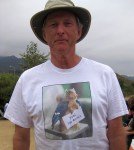
- Check closely the begging “bird” on the T-shirt (G Bando 9/17/11)
-
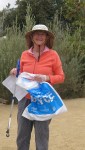
- Liz and her can-grabber (G Bando 9/17/11)
-
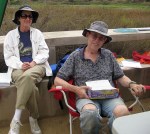
- Check that guy’s knees – those pants were new at 9am! (G Bando 9/17/11)
-
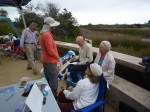
- Taking a noontime break (C Bragg 2/17/11)
-
- Hey! Look guys! You can see the bottom! (J Kenney)
SMBAS Links: Website Blog Facebook
Click on the pictures above to make them larger. September 17th was the 27th International Coastal Cleanup….. as my t-shirt said “Mi costa es su costa” and so it is.Santa Monica Bay Audubon Board and members were out in force as the organizers of the Malibu Lagoon cleanup site – for the nthyear – enthusiastically giving back to the environment. It may have been an overcast day, but there were many smiles and for a change, no sunburns. SMBAS was cheered by the 419 total volunteers – our biggest turn out yet – who gave up some of their Saturday to pick up 290 pounds of trash and to make a difference.
Per preliminary reports, the almost 11,000 volunteers in Los Angeles County picked up 22 tons of debris. This is even more impressive when one realizes that much of the debris is tiny, tiny stuff – cigarette butts, Styrofoam bits, plastic and paper wrapper parts; heavy things – wood, metal, ceramics, etc. – are the exception. One of our members recorded picking up over 1100 items in 3 hours, about 30 of which were identifiable – the rest were little pieces of who-knows-what.
So what was there ? One person found a bag of rotting oranges and two plates and another an electric mixer ( sorry, no beaters) – could someone be whipping up a cake at Malibu? A dead television, an ex-cell phone, a switchblade knife, tennis balls, a lacrosse ball (where did that come from?), single flip flops and a humongous amount of…well, trash… were bagged, weighed and removed. The encouraging part of the day is the learning possibility; do not let things end up in the ocean. We can protect birds, other wildlife, and our environment one little bit at a time.
NOTE: Our board decided to not make public photos of people, especially kids, who didn’t officially OK our posting their pictures. That’s why there’s no pictures of the other 400 people who showed up to work. [Ellen Vahan]



 SANTA MONICA BAY AUDUBON SOCIETY BLOG