Free email delivery
Please sign up for email delivery in the subscription area to the right.
No salesman will call, at least not from us. Maybe from someone else.
Coastal Cleanup at Malibu Lagoon Report: Sat. 17 Sep, 2011
-

- The SMBAS group and their sign of the times (G Bando 9/17/11)
-

- Ellen’s famous T-shirt (G Bando 9/17/11)
-

- Ellen, Jean & Liz brace themselves for the onslaught (G Bando 9/17/11)
-

- John, Gloria & Mary deal with the documentation (G Bando 9/17/11)
-

- John & Cris ready to take on the trash (G Bando 9/17/11)
-

- Chuck A poles channel #2 (C Bragg 9/17/11)
-

- Lillian cleans up on channel #2 (C Bragg 9/17/11)
-
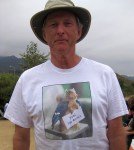
- Check closely the begging “bird” on the T-shirt (G Bando 9/17/11)
-
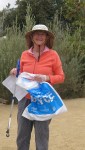
- Liz and her can-grabber (G Bando 9/17/11)
-
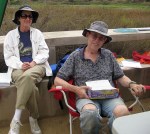
- Check that guy’s knees – those pants were new at 9am! (G Bando 9/17/11)
-
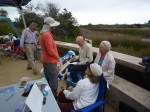
- Taking a noontime break (C Bragg 2/17/11)
-
- Hey! Look guys! You can see the bottom! (J Kenney)
SMBAS Links: Website Blog Facebook
Click on the pictures above to make them larger. September 17th was the 27th International Coastal Cleanup….. as my t-shirt said “Mi costa es su costa” and so it is.Santa Monica Bay Audubon Board and members were out in force as the organizers of the Malibu Lagoon cleanup site – for the nthyear – enthusiastically giving back to the environment. It may have been an overcast day, but there were many smiles and for a change, no sunburns. SMBAS was cheered by the 419 total volunteers – our biggest turn out yet – who gave up some of their Saturday to pick up 290 pounds of trash and to make a difference.
Per preliminary reports, the almost 11,000 volunteers in Los Angeles County picked up 22 tons of debris. This is even more impressive when one realizes that much of the debris is tiny, tiny stuff – cigarette butts, Styrofoam bits, plastic and paper wrapper parts; heavy things – wood, metal, ceramics, etc. – are the exception. One of our members recorded picking up over 1100 items in 3 hours, about 30 of which were identifiable – the rest were little pieces of who-knows-what.
So what was there ? One person found a bag of rotting oranges and two plates and another an electric mixer ( sorry, no beaters) – could someone be whipping up a cake at Malibu? A dead television, an ex-cell phone, a switchblade knife, tennis balls, a lacrosse ball (where did that come from?), single flip flops and a humongous amount of…well, trash… were bagged, weighed and removed. The encouraging part of the day is the learning possibility; do not let things end up in the ocean. We can protect birds, other wildlife, and our environment one little bit at a time.
NOTE: Our board decided to not make public photos of people, especially kids, who didn’t officially OK our posting their pictures. That’s why there’s no pictures of the other 400 people who showed up to work. [Ellen Vahan]
L.A. River Field Trip Report: 10 Sep., 2011
All invited.
Free Car Wash! (to every carpool driver)
A solid mile of drenching rain greeted us on the I-405 early Saturday morning as we headed for the LA River by the Willow St. bridge.

Half of the group, trying to stay out of the bicyclists’ way. Richard Barth in the blue jacket. (C. Almdale 9-10-11)
That certainly did not deter the 23 participants nor the thousands of birds we saw in five hours at four locations in the last few miles (see map link below) of our region’s largest waterway. We started downstream within viewing distance of the giant harbor derricks in an area where vegetation is allowed to grow in the river channel. We ended north of DeForest Park where only a few islands of green are on the concrete surface.
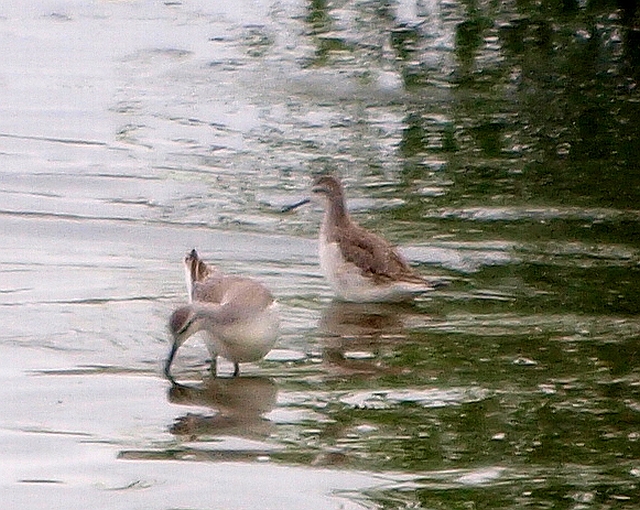
Wilson’s Phalaropes – pale & slim with a needle-like bill (J. Waterman 9-10-11)
Clouds of Red-winged Blackbirds and Brown-headed Cowbirds rose from the shrubs; the deeper pools hosted Blue-winged and Cinnamon Teal, Northern Shoveler, Mallard and thousands of Black-necked Stilt. As we worked our way north we saw large flocks of Western Sandpipers; among them lurked some Least Sandpipers and even fewer of the rarer species of the family.

White-faced Ibis feeding (C. Almdale 9-10-11)
At our first location the exceptional birds were Wilson’s and Red-necked Phalaropes, a Pectoral Sandpiper, one White-faced Ibis, and dozens of American Avocets. Only three heron species: Great Blue Heron, Snowy Egret and one adult Black-capped Night-Heron. The Gulls were mostly Western with an occasional California. A small number of Killdeer and their cousins the Semipalmated Plover were scattered about, busily foraging. The best views of the whole day featured four Pectoral Sandpipers and three Solitary Sandpipers, all juveniles, and several very bright Orange Bishop males in breeding plumage. The rarity of the day was a single, 1st Summer (i.e. born summer 2010) Common Tern, slightly oiled, with a huge black carpel bar. We also saw three Greater Yellowlegs. At DeForest Park, trees sheltered a number of warbler species as well as several Black Phoebes.

Common Tern landing – note oiled plumage on side (J. Waterman 9-10-11)
The most colorful bird of the day, well out-of-place among all the cryptic-colored shorebirds, was a day-glo yellow-green Budgerigar, escaped no doubt from some local bird-fancier. All parrots are very social birds: this unfortunate Budgie was trying to hang out with a Western Sandpiper flock. Wherever they flew or landed, so would the Budgie, who would perch and watch while the peeps poked the wet mud for food. This is not how Budgies normally feed and I wonder how long he’ll last in this habitat.
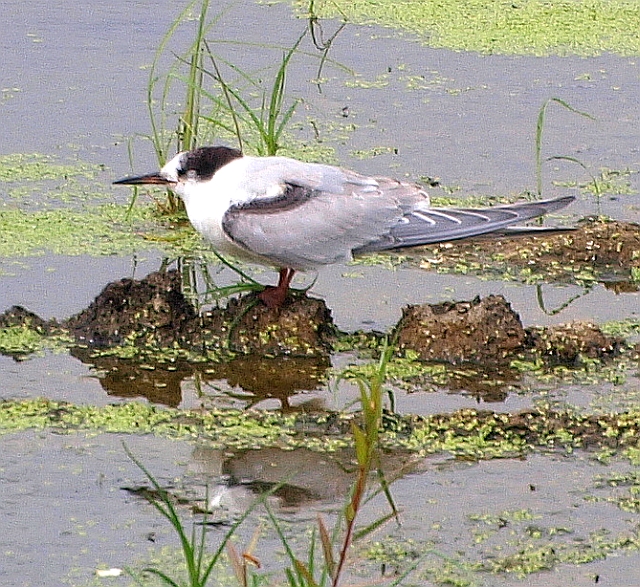
Common Tern with large black carpal bar & black (not gray) on nape (J. Waterman 9-10-11)
Surprisingly enough, although nature unleashed its wrath early in the day, we enjoyed a rainless cloud cover that kept the temperatures in the upper sixties throughout the very pleasant morning.
Very special thanks to Richard Barth who frequently birds this area. His knowledge and enthusiastic explanations of difficult plumage are invaluable, especially during migration season!
Link to 2010 LA River Trip Report
Link to Map of Trip
[Lucien Plauzoles]

Yellow-headed Blackbirds – young males (J. Waterman 9-10-11)
| Los Angeles River Trip |
|
| 10 Sept., 2011 |
Number |
| Canada Goose |
25 |
| Mallard |
100 |
| Blue-winged Teal |
3 |
| Cinnamon Teal |
20 |
| Northern Shoveler |
10 |
| Double-crested Cormorant |
10 |
| Great Blue Heron |
4 |
| Snowy Egret |
2 |
| Black-crowned Night-Heron |
1 |
| White-faced Ibis |
1 |
| Cooper’s Hawk |
1 |
| Red-tailed Hawk |
2 |
| American Kestrel |
2 |
| Peregrine Falcon |
1 |
| American Coot |
10 |
| Semipalmated Plover |
30 |
| Killdeer |
20 |
| Black-necked Stilt |
1000’s |
| American Avocet |
100’s |
| Spotted Sandpiper |
2 |
| Solitary Sandpiper – juv |
3 |
| Greater Yellowlegs |
3 |
| Western Sandpiper |
1000’s |
| Least Sandpiper |
50 |
| Pectoral Sandpiper – juv |
4 |
| Long-billed Dowitcher |
100’s |
| Wilson’s Phalarope |
6 |
| Red-necked Phalarope |
10 |
| Ring-billed Gull |
20 |
| Western Gull |
100’s |
| California Gull |
50 |
| Caspian Tern |
8 |
| Common Tern – 1st summer |
1 |
| Rock Pigeon |
40 |
| Anna’s Hummingbird |
6 |
| Downy Woodpecker |
1 |
| Black Phoebe |
20 |
| American Crow |
20 |
| Barn Swallow |
100 |
| Northern Mockingbird |
2 |
| Orange-crowned Warbler |
1 |
| Yellow Warbler |
2 |
| Black-throated Gray Warbler |
1 |
| Wilson’s Warbler |
4 |
| California Towhee |
2 |
| Savannah Sparrow |
1 |
| Red-winged Blackbird |
100’s |
| Yellow-headed Blackbird |
5 |
| Brown-headed Cowbird |
100’s |
| House Finch |
30 |
| Lesser Goldfinch |
1 |
| House Sparrow |
30 |
| Budgerigar |
1 |
| Orange Bishop |
20 |
| Total Species |
54 |
Barbara Courtois Memorial Page

Barbara Courtois 1935 - 2011
I had the privilege to know Barbara since the mid 1990s through her work/volunteerism with the Ballona Audubon Education Program. In addition to the education program, Barbara was involved with Snowy Plover and Least Tern censusing along our local coast. She also spent several years doing California Gnatcatcher Surveys around Southern California. Barbara was ever the educator and will be missed by the docents at Ballona, who turned to her to answer all questions bird related.
We pass allong this message from Patrick Tyrrell at Friends of Ballona on to all who knew Barbara Courtois.[Lillian Johnson}
Lisa Fimiani wrote a lovely article in honor of Barbara Courtois.
Link: http://www.ballonafriends.org/blog/2011/09/ballona-audubon-icon-passes/
http://www.flickr.com/photos/friends-of-ballona-wetlands/sets/72157627453170827/with/6106144591/
If you have a story or memory you’d like to share, please leave a comment on the page. Stories, quotes, fun facts, etc. about this wonderful person – whatever comes to mind when you think about Barbara. We thought it would be great to collect all of our memories of her in once place. If it’s easier, you can send your remembrances to me and I’ll be happy to add them to the page.
Best,
Patrick
—-
Patrick Tyrrell
Friends of Ballona Wetlands
http://www.ballonafriends.org
Snowy Plover picture on Supervisor Yaroslavsky’s web page
I sent a photo of famous Malibu Lagoon resident Snowy Plover NO:WW (that’s the colors of the leg bands) to County Supervisor Zev Yaroslavsky’s website about 2 weeks ago and they finally published it.
http://zev.mycapture.com/mycapture/photos/Album.aspx?EventID=1132036&CategoryID=45413
Take a look, make it bigger by clicking the picture or the little stickpin to the right of the picture, and then click “BEST” in the box supplied.
Leave a comment if you like.
You never know what might increase awareness of our favorite Threatened Species.
[Chuck Almdale]
Malibu Lagoon Trip Report: 28 August, 2011
SMBAS Links: Website Blog Facebook
Our August birdwalk at the lagoon was typically hot: 72°F at 8:30 a.m. and 81°F at 11:30 a.m.; clear sky with no breeze. For comparison, it was 104° at our house in the valley by the time we got home.
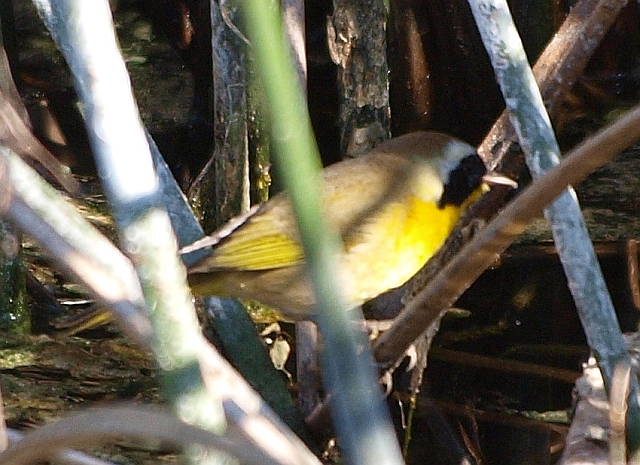
Common Yellowthroat skulking in his usual reedy habitat (J. Waterman 8/28/11)
The surfers had a great time. The ocean was relatively flat, but every so often a big set came out of nowhere and everyone made their move. A few new people joined us: four women who found out about us through the Malibu paper – I don’t know how that information gets in there – and a young couple from Holland who took lots of pictures. I’m hoping they’ll send us a few.
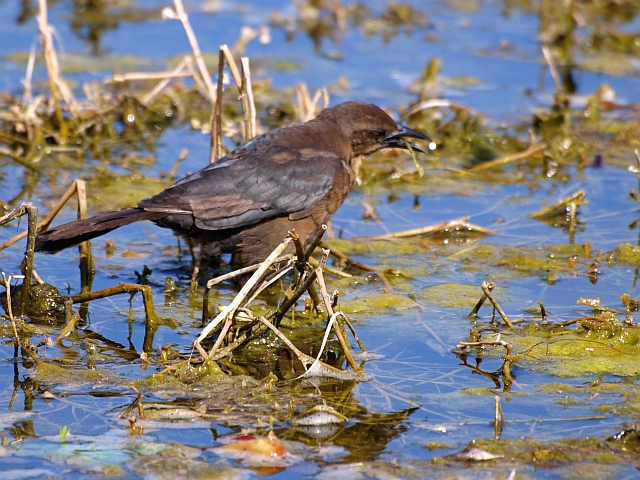
Great-tailed Grackle female on lagoon vegetation (J. Waterman 8/28/11)
It was pretty birdy for August. Migrants are definitely returning – primarily shorebirds but also one Wilson’s Warbler in the parking lot shrubs. Our 59 species and 943 birds was well above the August averages of 47 and 567, respectively. I don’t know if this indicates anything; it may simply be an anomaly.
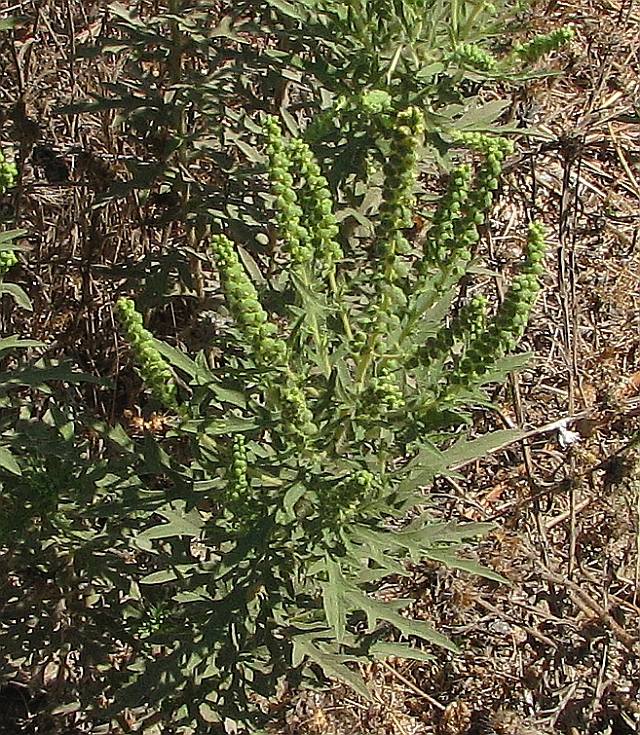
Ragweed - Everyone's favorite pollen-producer (C.Almdale 8/28/11)
Notable sightings were four Western Kingbirds near the 3rd footbridge. They were probably a family, with two adults and two young, and they perched together several times in the same bush. At other times they’d spread out over several bushes from which they’d sally out to snag flies. The Plover population jumped from last month: Snowies rose from 13 to 36 (no bands were found) and Black-bellied rose from 4 to 46. Some of the latter still had very black bellies. The Whimbrel population rose from 25 to 41 during the 45 minutes we stood on the beach, with more arriving all the time. This was our fourth highest Whimbrel count, behind Aug’80 – 66, July’10 – 48, July’05 – 47 and Apr’81 – 44. Terns were diverse: the Least Terns had left but we still had four species. The Sora and Virginia Rails have not yet arrived; at least none were seen or heard.
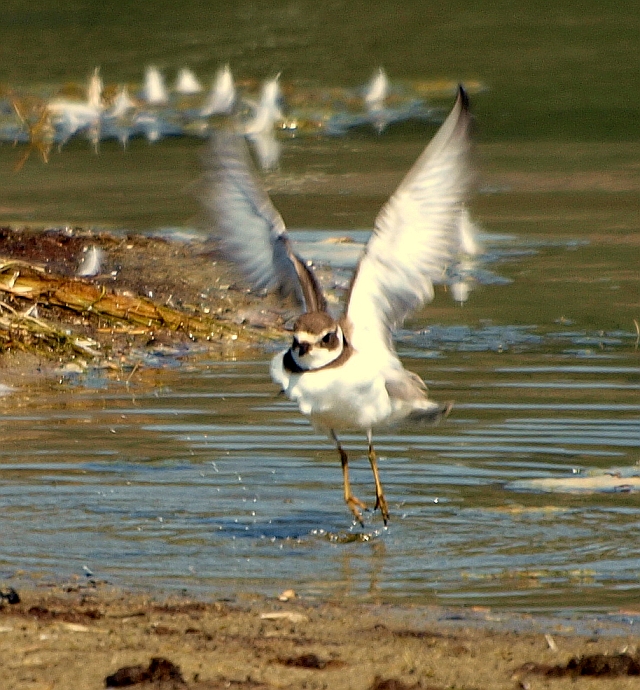
Semipalmated Plover has just left the premises (J. Waterman 8/28/11)
The two most uncommon (for the lagoon) birds were the Nuttall’s Woodpecker that perched briefly in the dead tree near the 1st footbridge after working over the nearby Sycamore. This is only the 4th sighting of Nuttall’s in 30 years for our Lagoon trips.
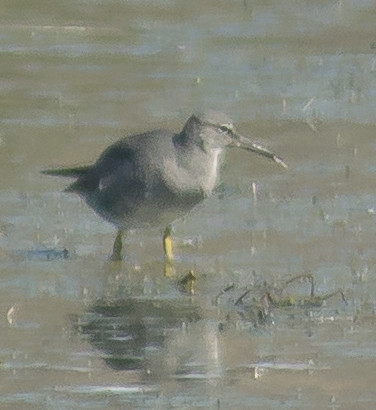
Wandering Tattler looking a bit fuzzy in the lagoon (C. Bragg 8/28/11)
The other uncommon bird was a Wandering Tattler for which we’ve had only 7 prior sightings: 3 in Nov-Dec’79 which were probably the same individual bird, 1 in Jul’80, 1 in Oct’83 and finally 1 in Apr’00. So it’s been a while. But that’s not the unusual part.
Wandering Tattlers are denizens of rocky shores. They nest up in Alaska and Yukon and winter on our coasts from around San Francisco to the tip of Baja and well down the mainland Mexican coast. If you go to Marina del Rey outer channel and spend a while looking around during their wintering season, you’re likely to see one. Out on the rocky shores of the Channel Islands is another likely spot. But they’re nearly always on rocks, not sand. I don’t think I’ve ever seen one anywhere except on rocks. If my recollection is correct, the previous birds at Malibu were either on the offshore rocks or among the exposed cobbles on a low-tide beach. So this was a very nice sighting.
Our next two field trips are: Lower L.A. River 10 September; Malibu Lagoon 25 September. Reminders will be emailed from the blog.
As a reminder to those coming to our 10 a.m. Parent’s & Kids birdwalk, it meets at the beach trail footbridge closest to the parking lot.
Links: Unusual birds at Malibu Lagoon.
Aerial photo of Malibu Lagoon from 9/23/02.
Prior checklists: Jan-June’11, July-Dec ’10, Jan-June ’10, Jul-Dec ‘09, and Jan-June ‘09.
[Chuck Almdale]
| Malibu Census 2011 |
24-Jul |
28-Aug |
| Temperature |
65-72 |
72 – 81 |
| Tide Height |
+2.61 |
+5.03 |
| Low/High &Time |
L:0947 |
H:0942 |
| Mallard |
54 |
60 |
| Ruddy Duck |
2 |
5 |
| Pied-billed Grebe |
4 |
15 |
| Brandt’s Cormorant |
3 |
|
| Dble-crstd Cormorant |
31 |
48 |
| Pelagic Cormorant |
1 |
3 |
| Brown Pelican |
407 |
77 |
| Great Blue Heron |
6 |
3 |
| Great Egret |
4 |
2 |
| Snowy Egret |
11 |
15 |
| Blk-crwnd N-Heron |
11 |
4 |
| Osprey |
1 |
|
| Red-tailed Hawk |
2 |
|
| American Coot |
20 |
75 |
| Blk-bellied Plover |
4 |
46 |
| Snowy Plover |
13 |
36 |
| Semipalmated Plover |
2 |
4 |
| Killdeer |
2 |
8 |
| Spotted Sandpiper |
2 |
|
| Wandering Tattler |
1 |
|
| Willet |
4 |
|
| Whimbrel |
41 |
|
| Marbled Godwit |
2 |
|
| Ruddy Turnstone |
7 |
4 |
| Black Turnstone |
1 |
|
| Sanderling |
15 |
|
| Western Sandpiper |
2 |
11 |
| Least Sandpiper |
1 |
6 |
| Red-necked Phalarope |
7 |
|
| Heermann’s Gull |
41 |
24 |
| Ring-billed Gull |
1 |
|
| Western Gull |
107 |
146 |
| California Gull |
8 |
|
| Least Tern |
13 |
|
| Caspian Tern |
3 |
12 |
| Common Tern |
1 |
|
| Forster’s Tern |
3 |
|
| Royal Tern |
18 |
|
| Elegant Tern |
8 |
36 |
| Black Skimmer |
1 |
1 |
| Rock Pigeon |
6 |
5 |
| Mourning Dove |
3 |
2 |
| Anna’s Hummingbird |
3 |
4 |
| Allen’s Hummingbird |
3 |
|
| Belted Kingfisher |
2 |
|
| Nuttall’s Woodpecker |
1 |
|
| Black Phoebe |
8 |
10 |
| Western Kingbird |
1 |
4 |
| American Crow |
4 |
3 |
| Rough-wingd Swallow |
20 |
22 |
| Barn Swallow |
18 |
45 |
| Cliff Swallow |
25 |
2 |
| Oak Titmouse |
2 |
|
| Bushtit |
8 |
6 |
| Bewick’s Wren |
1 |
1 |
| Wrentit |
1 |
|
| Northern Mockingbird |
2 |
3 |
| European Starling |
38 |
20 |
| Common Yellowthroat |
1 |
8 |
| Wilson’s Warbler |
1 |
|
| California Towhee |
3 |
|
| Song Sparrow |
1 |
5 |
| Red-winged Blackbird |
17 |
32 |
| Great-tailed Grackle |
3 |
5 |
| Brwn-headed Cowbird |
6 |
|
| Hooded Oriole |
6 |
|
| House Finch |
4 |
8 |
| Lesser Goldfinch |
4 |
|
| Totals by Type |
July |
Aug |
| Waterfowl |
56 |
65 |
| Water Birds-Other |
463 |
221 |
| Herons, Egrets |
32 |
24 |
| Quail & Raptors |
0 |
3 |
| Shorebirds |
32 |
187 |
| Gulls & Terns |
175 |
248 |
| Doves |
9 |
7 |
| Other Non-Pass. |
6 |
7 |
| Passerines |
167 |
181 |
| Totals Birds |
940 |
943 |
| Total Species |
July |
Aug |
| Waterfowl |
2 |
2 |
| Water Birds-Other |
5 |
6 |
| Herons, Egrets |
4 |
4 |
| Quail & Raptors |
0 |
2 |
| Shorebirds |
8 |
14 |
| Gulls & Terns |
8 |
8 |
| Doves |
2 |
2 |
| Other Non-Pass. |
2 |
3 |
| Passerines |
19 |
18 |
| Totals Species – 68 |
50 |
59 |



 SANTA MONICA BAY AUDUBON SOCIETY BLOG