Free email delivery
Please sign up for email delivery in the subscription area to the right.
No salesman will call, at least not from us. Maybe from someone else.
Important Notice to all Blog Subscribers
Because of the ongoing problem of our current emails system sending out old, duplicate blogs, we have changed to a new email system.
Today we added everyone onto the new system. You do NOT have go to the blog and sign up.
You should have received by now an automated message from WordPress (our blog supporter) asking you to follow a link (supplied in the email) to confirm that you want subscription to our blog email.
What You Need to Do
1. Follow this link, which will take you to a WordPress website.
2. Once there, it doesn’t seem that you need to do anything. Merely following the link confirms your subscription.
3. You’ll need to be prompt about following the link. It expires after a set time limit (I don’t know how long).
4. Within about 30 minutes after following the link, WordPress will send you a second automated message confirming your subscription.
That’s all you need to do.
Our next email – a reminder for our Malibu Lagoon 2/27/11 field trip – is scheduled to be posted on 2/19/11 at 10:10 pm. You will receive two emails for this posting.
2. The other will be sent out the following day around 11:30 am. This is the old email from the old email system.
3. If everything goes OK, we’ll delete the old email system a day or two later. Thereafter you’ll get only 1 email for each blog.
4. The new system will deliver email as soon as the articles are posted on the blog, not 1-3 days later as has been the case.
5. The new system delivers ALL postings – we cannot choose categories any longer. We figured that faster and error-free delivery was worth this change and hope you agree.
If you have any problems, drop me a line.
Chuck Almdale
IT’S RIGHT THERE…IN THE GREEN TREE! Getting Others Onto That Bird
[Introductory Note: Feel free to copy this document. To satisfy our boundless curiosity, please take a minute and drop us a line to let us know you did. Also, sign up on our blog to receive our future brilliant, useful, lovely and informative missives. A shorter version is also posted on the American Birding Association website here.]
For many of us birding is both fun and art. As with any art, the better you get, the more you enjoy it and vice versa. But like any art, there are certain techniques you can learn that will enhance both your enjoyment and ability to share that enjoyment with others. Many of these techniques and skills are covered in field guide introductions or magazine articles. Neglected – until now – is the skill of getting others onto the bird you’ve found. The joy of finding a new, interesting or beautiful bird increases when you share it with others. But you can’t share the joy if you can’t help others find the bird. In our years of birding, we have personally made and witnessed others make every single error mentioned below, and we find the suggested techniques to be the most useful and easily learned. Of the five basic points presented here, the final point is the least known, most difficult to learn and gets the longest explanation.
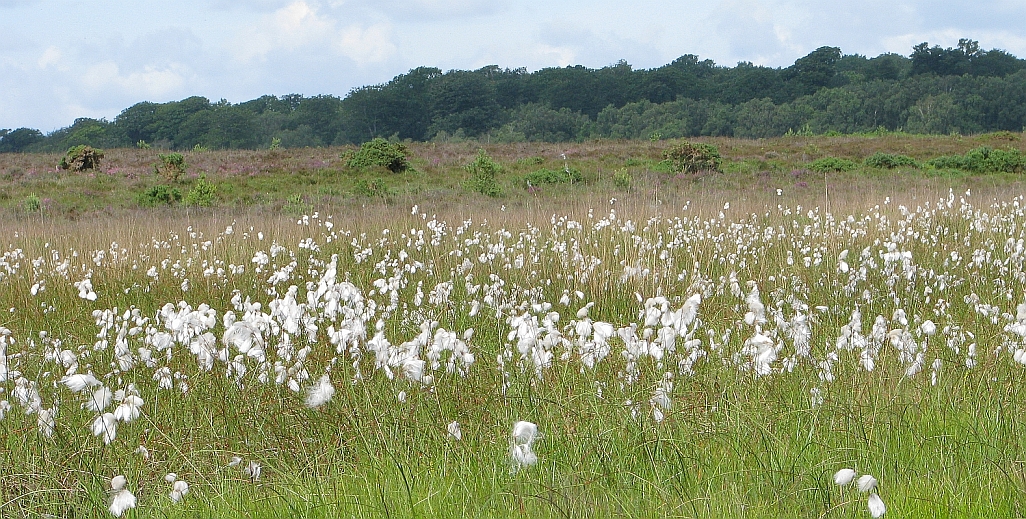
“Next to the white flower, you say?” (C.Almdale)
Five Basics Points
1. Scope: If you have a scope, it’s easy to put it on the bird and let others look through it. This works well with birds like shorebirds, ducks or resting raptors which don’t move around quickly; it’s nearly useless with birds flitting through foliage. When the bird is cryptic, partially hidden or distant and small, give useful additional hints: look in the upper left portion of the field of view; behind that vertical snag, at the base of the red rock. Knowing which part of the scope’s view contains the bird can quickly ensure a useful look. (When a group of people are waiting to use the scope, it’s good birding etiquette to take the briefest look possible, yet still see the bird. However, if you just can’t find the bird in a “reasonable” amount of time, move aside and let others take a first quick look, before returning to the scope to try again. Second looks are for lingering.) If people of widely varying heights will likely be using your scope, the 45°-angled eyepiece is easiest for everyone, especially tall people who won’t have to stoop so much.
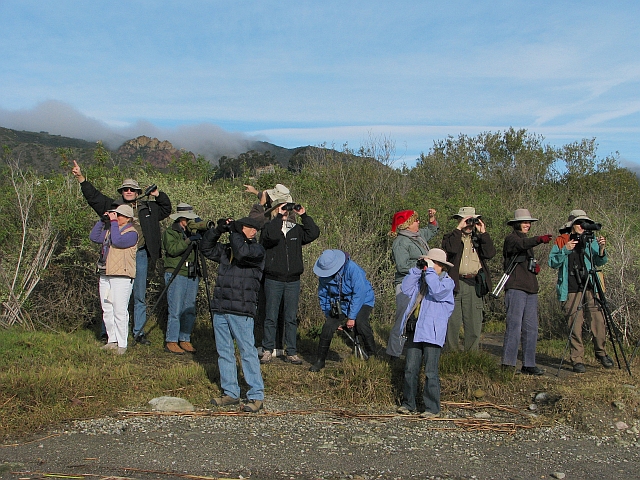
2. Make sure they are looking in the same direction as you are: If possible, just glance around. Birders are often looking in completely different directions while arguing about what they’re seeing. This happens so frequently that it’s a standing joke. A quick, “Stand behind me and look where I’m looking,” can at least get them into the general area.
3. Clock face: In many situations, using a clock face can aid speedy location. In an open area, twelve o’clock is always straight ahead, six is directly behind, three and nine are 90 degrees right and left, respectively. Other hours fall in between. For a vertical object such as a tree, twelve is the top, three is ½ way down on the right side, and so on. On a boat or in a car (or line of cars), twelve is always straight ahead down the road, six is straight behind down the road, and so on. It should go without saying (but won’t) that 12 o’clock is not simply the direction in which you happen to be looking at that moment. [I once had to ask a professional bird tour leader why everything was always at 12 o’clock.] If you’re young and don’t know how to read an analog clock, now is a good time to learn.
4. Laser Pointers: Pen-sized lasers are now available in various powers and produce either a red or a (preferred) green beam. Many professional tour guides have them, but not all are equally adept at using them. The key is to start from something obvious like a large rock or tree trunk. Starting somewhere close to the bird is far less important. Once everyone
Flash Gordon’s Laser Gun
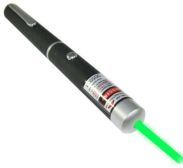
5mW green laser pointer from SciPlus.com
sees your laser “dot”, they can follow it as you move it along trunk, limb and twig to the bird. Never shine the beam on the bird. Keep the dot where the bird can’t see it so you don’t startle it. Just below the bird works well, as does slowly circling the bird. The dot will display better on solid objects like trunks or twigs than on leaves. Avoid jerky movements. In a forest of leaves, a moving beam scatters over many yards. Birders more than a few feet to either side of the pointer-holder sees only a series of bright dots scattered over many leaves and won’t have a clue as to which dot is nearest the bird. Warn the viewers of this scattering and reduce beam movement to a minimum. In southern California where the sun always shines and the forests can be thin, lasers aren’t as useful. An alternative low-tech solution is a small hand mirror of glass or polished metal, for which you will need the friendly cooperation of the sun.
Start from something obvious, easily locatable or describable: How many times have you heard someone say “Near the red leaf in the green tree,” or “By the tall grass stem”? You look around and are confronted with dozens of trees with hundreds of red leaves or an entire field of grass. Which tree, which leaf, which stem? Which direction, how far? This person has forgotten that no one else can see from their exact perspective. They’ve also forgotten that what is absurdly obvious to them through their own binocular’s tiny field of view is not at all obvious to anyone else confronted with a 360° view of the whole, wide world.
The Toughest Basic: Starting from the Obvious
Selecting the Obvious: So what’s considered obvious? Here are some examples: a lone tree, bush, rock or structure; the largest, tallest, darkest, lightest of an assortment of such items; the only group of trees; the leftmost or rightmost tree in a line of trees; the only cloud in the sky; the sun; the only red house in sight; the only house on the left side of the road; the only green sailboat on the sea. Something unique (in the proper sense of one-of-a-kind).
Often the bird is in a flock which everyone has already spotted. “There’s a Ominous Cleft-toe in with that flock of warblers.” They now know that you’ve seen the warblers, are not simply misidentifying one of them, and it helps someone who is way off target to know that they can first find a larger target (a flock) and then look for one individual.
Watch the Birdie: Keep your eye on the bird while giving directions: if it flies, you can follow it and give information about its movements (“going left through the foliage, watch for movement”). Often you can anticipate its movements, especially useful when someone is looking through a scope’s small field of vision. If it flies out of sight, you don’t waste your time telling people where the bird used to be.
Moving from the Obvious: Once you’ve gotten everyone looking in the same direction with your “see the big red house on the hill?”, you can bring them along step-by-step to the bird. “OK, starting from the house, come down to seven o’clock ½ way down the hill to a large brown rock with a big white spot on the bottom left side. Got that? OK, from four o’clock on the rock, go about three times the width of the rock to a round gray-green bush with a forked leafless stick pointing out ten o’clock from the center of the bush. The bird is on the left fork.”
Occasionally someone “jumps the gun” on your instructions. They hear the first instruction, “See the big red house…” and immediately complain that they can’t see the bird. Deal with this as best you can. We tend to steamroll right over such comments and restate, perhaps enunciating slightly more forcefully: “Now, from the red house on the hill, come down to seven o’clock…”, and so on. We figure that getting many or most of the people on the bird is good for the first pass; there is always someone who wasn’t listening or couldn’t follow. If the bird stays put long enough, we try again.
Distance: Use fractions or multiples of an obvious dimension: ½ way down the hill; ¾ of the distance from bottom to top of the tree; 1/3 of distance from trunk to the left edge of the tree; twice as high as that radio tower; ½ way from the sun to the left edge of the lake. Although the size of the field of vision varies widely among binoculars, the number of binocular fields often works as a rough estimate, especially for small specks in the sky: “About two binocular fields 12 o’clock from the red house.” Absolute distances such as 30 ft or 200 yards are of little use. Most people are poor judges of distance or size (although few will agree), and we underestimate distances more often than overestimate. When you do give a distance, qualify it with a phrase like “about”, “approximately” or “between” to indicate that this is a rough estimate. Saying “about 20 to 40 ft away” or “less than 50 feet” can keep people from searching in vain 200-500 feet away. The exact distance does not matter, it’s the order of magnitude which is important. At sea, where people are looking at a lot of water, distance should be relative to the horizon. Hearing, “Plummeting Mackerel-Snapper, Ten o’clock, ½ way to the horizon,” is a lot more useful than “500 meters off the port bow.”
Practice this on your own, in your own mind. Assume your friends are down the trail when you spot the extremely rare and highly-prized Divested Widget and signal them. They come running. The bird is in the middle of a bunch of trees and bushes, not thrashing around, nor drawing attention to itself. Start from the obvious, and work your way to the bird, using the clock and relative distances. After a while, this sort of verbal guidance becomes close to second nature.
A starting point can be near or far from the bird, above or below, closer or farther. It only has to be OBVIOUS to everyone. Sometimes a building two miles away is the best point from which to start. Sometimes it’s a knee high red flower 5 feet away. It could be a group of bushes halfway across a field. It could be a moving car, boat or airplane, or even another bird that everyone has already seen. It all depends on the situation.
Other Problems
Partially Obscured Birds & Parallax: Sometimes you see a bird through a hole in foliage or twiggy brush. It can’t be seen except from exactly where you are standing. You can confirm this by moving a bit and seeing if the bird becomes obscured. In this case, you either hog the view for yourself, or you move aside and give someone else your spot. We recommend the latter. Birders are typically polite, and you’ll rarely be criticized for staying put. But your courteous behavior will be appreciated and you’ll likely be helped in return soon or later by legions of grateful fellow-birders. When a bird is likely to be obscured from points of view other than your own, and you sense that someone simply cannot see it from where they are standing, you can either advise them of this or physically move them into a better location. This is a matter of putting yourself into their shoes, which comes with experience.
Bird Color, Shape, Orientation, and Relative Size: Sometimes leaves, grass or twigs obscure a bird, or it blends into the background. In these cases, giving a description of the relative size, color, bill shape, or body orientation e.g. “hanging upside down” can help. Woodpeckers often blend into the trunk or limbs to which they cling. Warblers are famous for moving through the canopies of leafy trees. Towhees and thrashers match their dead leaf feeding grounds in coloration. “Facing left, body almost horizontal, shoulder hunched, tail hidden” can get someone onto a well-camouflaged motionless bird.
Dealing with Beginners: The special problems beginners experience usually fade with time, so you’ve probably forgotten that you once had them too. Try to figure out their views and put them into perspective for them and others in the group. When one person says that he is looking at a “really big bird way up high” and others can’t find the soaring eagle, the leader who sees where the beginner is looking can help by saying something like, “that robin ten feet up in the oak does look huge and high compared to the juncos on the ground we have just been watching.” A statement like that explains the original observer’s perspective to more experienced participants, helps the others to know what they are looking for (if they want to see the robin), teaches the beginner something about perspective and comparison, and probably won’t be interpreted as an insult. A similar problem arises after looking at very small birds – sparrows or warblers for example – for a long time, and you then spot something larger like a thrush, and it looks enormous. Alternatively, watch geese for a while, and the sparrows will look like gnats.
It Won’t Always Work
You will not always be successful. Accept that. You’re just birding, not solving world peace; keep your sense of humor about this. Some people are not listening, some are hard of hearing, some have vision problems, some may be angry about the coffee they spilled on themselves, and some have bad binoculars or dirty glasses. Sometimes you’re off your own game, thinking about something else, short-tempered, irritated, too cold, too hot, or you brain just isn’t working properly that day. That’s life. Some people seemingly cannot follow directions from anyone. Some people can never learn to give them. Some of the best birders in the world are unable to give decent directions to anyone else, no matter what. And then there are those most fortunate and irritating few who seem to never need directions. They instantly see everything, everywhere, until you want to bop them on the head from frustration with your own inability.
Main Points to Remember
If you learn these basics and pay attention to your words, you’ll find that you are actually practicing a form of mindfulness which benefits yourself as well as others. Start from the obvious: something they can’t miss, unique in color, shape, size, type, or direction. Use clock face directions. Identify which member of a group (e.g. 2nd tree from the right). Use fractions and multiples of visible and identified objects rather than absolute distances. Identify bird color and other characteristics when needed. After a short while, you’ll find it actually takes less time and energy to give good directions than to give poor ones. When others quickly get onto the bird, you don’t have to keep repeating your inadequate directions. In the amount of time it takes to say, “It’s right there, in the green tree,” you can say, “Single oak, 8 o’clock, 50 meters, 9 o’clock at the foliage edge.” And you will have said something useful.
And Finally – What Not To Say
There’s no end to the list of unhelpful, frustrating and irritating directions one might give. And – like speaking to someone in a foreign language – emphasis, raising your voice and waving your arms around does little more than scare away the bird.
Here is a small sampling: It’s right there. Just look. Over there. IT’S RIGHT THERE! There! No, there! Are you blind? It’s right behind the green leaf.
Some useless directions are situation specific. For example: out there in the grass (in a large grassy field); on the phone wire (in a city forest of wires); on the pole (with dozens of phone poles stretching off to the horizon); on the bush (in the chaparral); on the water (from the beach). And the ever-favorite classic, frequently heard in the forest: it’s in the tree, the green tree. You get the idea.
Getting into details of distance and size can mislead. “A foot high bird on a 100-foot boulder 500 yards away,” can be really misleading when the bird is really a Rock Wren 50 yards away on a car-size boulder.
Americans and British traveling overseas should avoid our imperial system of inches, feet, yards and miles. Metric system users vastly outnumber us. Most Americans have a vague notion that a meter is about the same as a yard, so it’s easy to stick to meters. Metric system users probably won’t have a clue as to what an inch, foot or a mile means, nor will they see any point in learning unless they are aficionados of archaic systems of measurement.
When your knowledge of vegetation, rocks, soil, clouds and so forth is better than average, it’s easy to assume your audience knows what you know. “It’s in the Phalanopsis growing by the Dichrodendria next to that crumbled intrusion of franitactic gneiss,” can be as useless as saying “over there” to the person who cannot identify those objects. And you just might use the wrong term, thus confusing those that actually do know. Common English is best. It’s probably safe to point out the sole oak in a stand of conifers, or a brick among the rocks, but don’t assume too much.
And if you want to really irritate your birding mates, just give a lengthy description of the bird before giving any clue as to where you’re looking. Make sure you pop in such exclamations as, “Oooh….Wow…what IS that?…It’s soooo beautiful….Pleeeese tell me what it is!”, ad nauseam, finishing up with “well…it’s….geee…how can I – whoops!, it just took off! You missed it? Are you blind? It was right there…in the green tree!”
We wish to thank the following people who replied to our BirdChat and CalBird solicitations for comments: Brandon Best, Wim van Dam, Richard Danca, David Spector, John van der Woude, Bob & Carol Yutzy. Buried somewhere in the verbiage above, you will find your suggestions, perhaps mutilated beyond all recognition.
Authors Biographical Note, in case you reprint this. Chuck and Lillian live in a northern Los Angeles suburb where – when not peering at birds far and wide and jotting down notes – Lillian tends their ever-growing assortment of native California plants, fruit trees and vegetables, and maintains contacts with other humans. Meanwhile, Chuck practices piano, studies philosophy and edits their Santa Monica Bay Audubon chapter blog at https://smbasblog.wordpress.com/ (where you can see other examples of their off-kilter humor, especially their controversial monograph on the Western Roof Owl). They’ve been birding over thirty years and leading local bird trips for over twenty years. Now retired, they report that dinner time conversation is always “richly exciting” due their previous careers as accountants. [Chuck Almdale & Lillian Johnson]
News from the West Coast Snowy Plover Meeting
Every year in January a number of professionals and amateurs concerned with the fate of the threatened Western Snowy Plover meet at a West Coast site to exchange information and give reports on the status of those little birds we see eight months of the year at Malibu Lagoon.
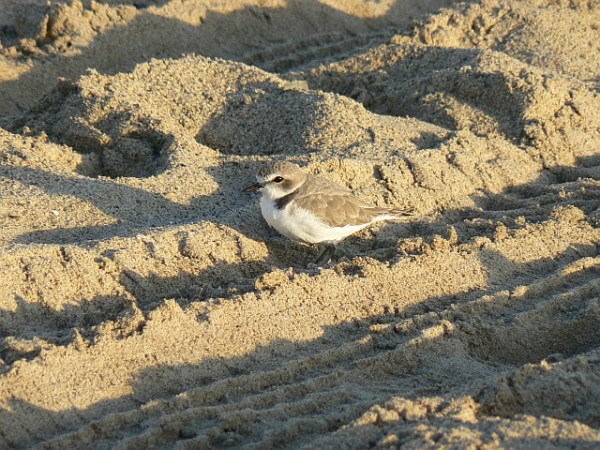
- Tire tracks are a preferred roosting spot (L.Plauzoles)

Nearly ninety interested stakeholders attended the January 19-20 meeting at the Museum of Natural History in Pacific Beach. This is the twelfth such meeting to my knowledge. Of the three I have attended, this was by far the best focused with a trove of technical knowledge, volunteer stories and pointed discussion. Welcome to Plover Tech!
Most locations of winter season roosts and breeding sites on the West Coast have been reliably mapped over the past ten years. To add to this knowledge base a report from Jim Lyons of US Fish and Wildlife presented the first North American survey to estimate the size of the inland and Gulf Coast populations of Snowy Plovers. The largest US breeding population is in Oklahoma! An early estimate of the total number of birds is in the range of only 26,000 for the entire continent. This report was closely followed by an enlightening exposé from Eduardo Palacios of CICESE in Mexico who managed the Mexican survey. San Quintin in Baja California seems to be the largest reliable site for the plovers in Mexico. The official results of this survey should be published next year.

How many Snowy Plovers can you find? Answer at bottom. (C.Almdale)
As is traditional in these meetings, each region (or Recovery Units in the Recovery Plan) of the Pacific Coast gave a short synopsis of the status of the birds, breeding, survival and variations in populations. For our Los Angeles County, in short, the population seems to be recovering from a radical decline on most beaches in Spring 2007. The exception is Zuma Beach which recently was counted at 90 birds, versus some 200 in 2005. Malibu Lagoon with 86 birds in early January, and Santa Monica with 58 birds last week have reached record levels for the ten-year period. Dockweiler Beach and Redondo have over 20 birds at each of three sites since October. Many of the areas north and south of us which have had some success in breeding continue to face predation problems, especially from Common Ravens and other avian species. Many of the regions have established or about to set up camera systems to monitor predator attacks and develop appropriate defenses.
The conference was hosted at the Museum by Monterey Audubon and organized by

Monterrey's unlucky denizens are forced to live in such surroundings (L.Plauzoles 1/11)
Point Reyes Bird Observatory (PRBO) and the Fish and Wildlife Service (USFWS). Significantly both Gary Page and Lynne Stenzel of PRBO who co-authored the seminal study on West Coast Snowy Plovers in 1981 addressed the audience with long-term statistics and trends about the Monterey area flocks that they have studied for years and whose members are almost all banded to allow detailed behavioral study. Gary Page addressed the changes in predation in some detail and Lynne focused on the sex lives of the little birds.
The liveliest discussions were about adult survival, especially over-winter survival which Humboldt State University Professor Mark Colwell considers key to the survival of the species—more important than breeding productivity. Other “hot” discussion subjects centered on “take” permits that allow stewards of nesting sites to haze or dispose of ravens and other predators, stable isotope studies that gave us insight into the methods and habits of ravens, and a new validation study that is used to extrapolate from the bi-annual “window” surveys to come up with a reliable census figure for the species. Also of interest were the experiences of CA State Parks’ experiments in removing European Beach Grass and the SF Bay Bird Observatory program to restore the wetlands that had previously been Cargill’s salt ponds. The area is now the largest California Gull breeding ground.
An entire afternoon session was occupied by a considerable number of examples of experiences by groups and individuals in successfully protecting plovers. The upcoming US Park Service rule concerning dogs in National Parks and Monuments was a climax. Look for it soon on your NPS website! It is announced at nearly 2500 pages, mostly due to the ongoing conflict between San Francisco leash-free advocates and Golden Gate Audubon Society. GGAS requests your comments to NPS as soon as the 60-day comment period is open.
My presence at the meeting was subsidized in part by Santa Monica Bay Audubon and I will be glad to share any of the information that I obtained with our members, those of other Audubon entities or various agencies. The opportunity to meet with other concerned plover activists and professionals will certainly add to our efforts on the LA County coast. [Lucien Plauzoles] [Answer: Six]
Malibu Lagoon Field Trip Report: 23 January, 2011

The male American Avocet's bill is longer and straighter than the female's (L.Johnson 1/11)
Yikes! 75° at the lagoon in January? Ridiculous. Equally absurd is the evil rumor going around that we might not get any more rain this season. After what was probably the wettest December on record we’ll have the driest January through March ever? They (the ever-mysterious them) must be messing around with our weather again. Moving on…bird species at the lagoon were below the January normal; numbers were up, mostly due to the large flocks of gulls. Unfortunately, most of them flew away – the result of rambunctious toddlers and oblivious strollers – before I could get a good count, so Ring-bills, Western and California Gulls totals are an educated guess.
We actually have two bird walks on our Malibu Lagoon field trips. Chuck leads the early one for (mostly) adults, leaving the 10 AM walk to those who are better with children. Here is a report from one such person on what it was like.
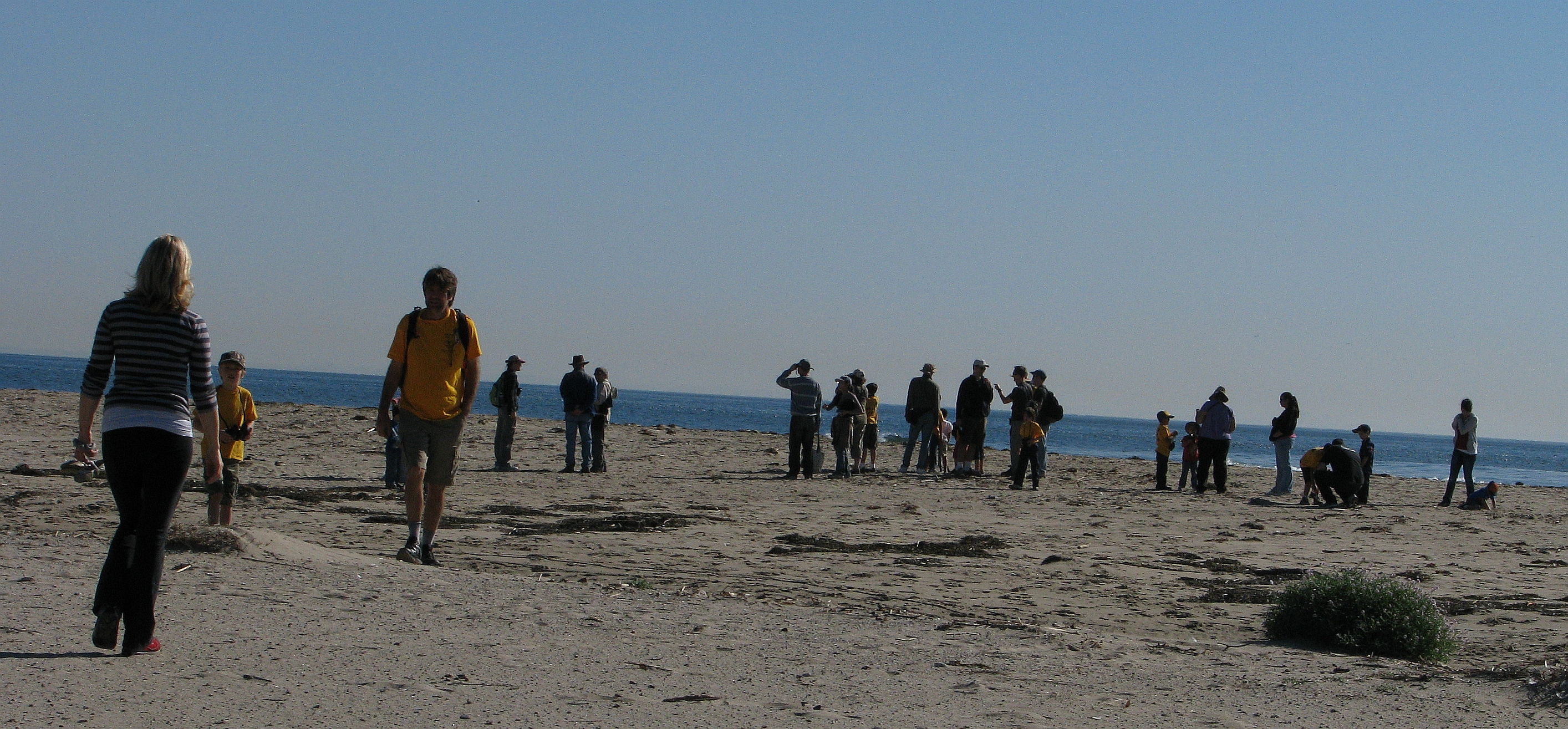
A warm day for Cub Scouts and family (L.Johnson 1/11)
This month we hosted a Cub Scout Troop from Grant Elementary in Santa Monica. Between the boys, their parents and their siblings, we had around 30 people….no one is sure how many; too busy to count. The boys liked the “big” birds: herons, egrets, pelicans, but more than the birds, they liked being out on the beach. Although we list this as a “children’s” walk, it is also for the parents. It’s a chance to get out, enjoy the birds and not have to worry about the kids distracting other birdwatchers. So if you have kids and would like to spend time outdoors some Sunday morning, come join us.
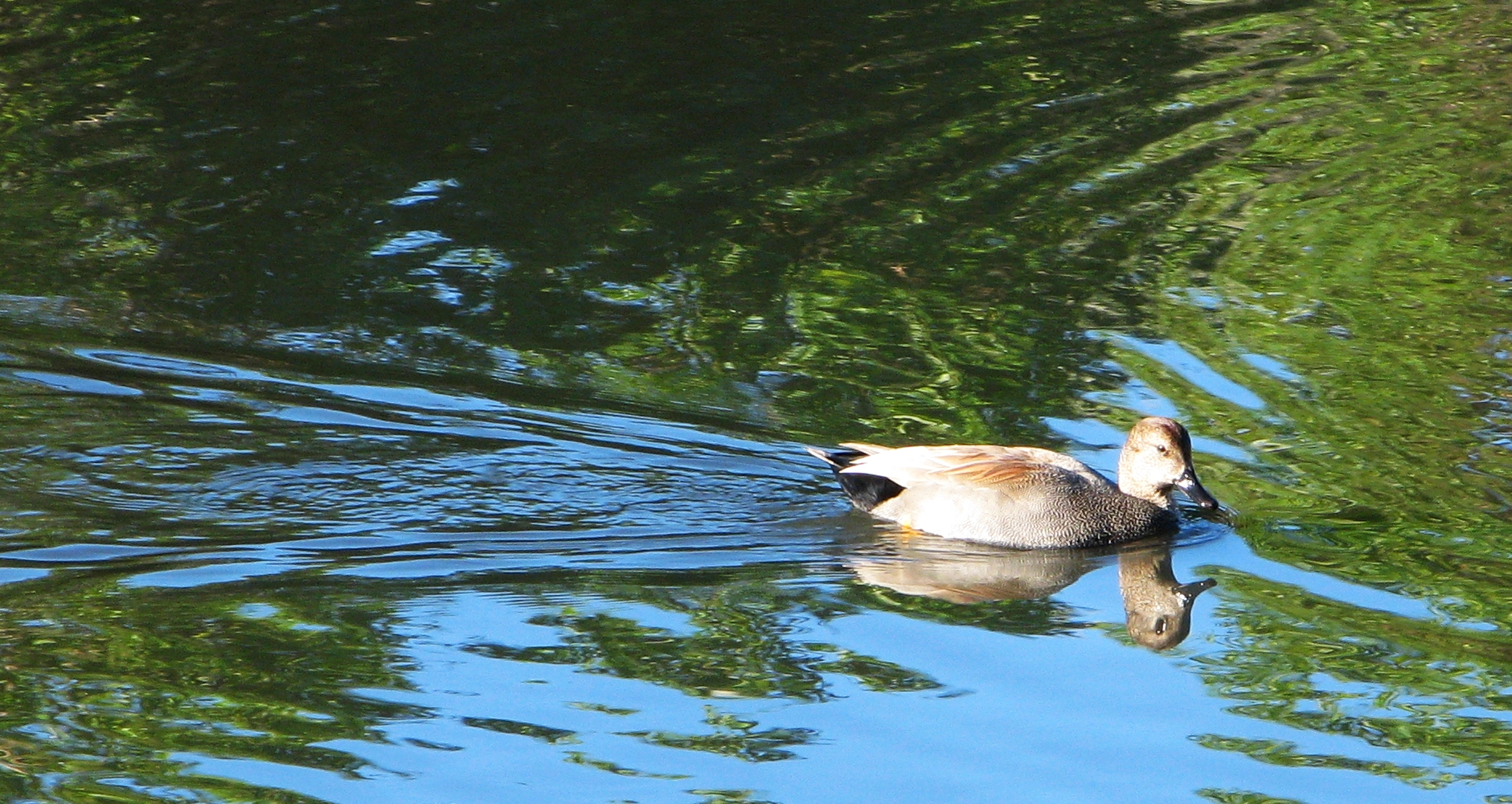
Male Gadwall cruising (L.Johnson 1/11)
Check out our other blog created especially for Unusual Birds at Malibu Lagoon, the permanent location for pictures of our uncommon birds. For prior period bird lists, follow these links to July-Dec ’10, Jan-June ’10, Jul-Dec ‘09, and Jan-June ‘09. For an aerial photo of the lagoon, go here. [Chuck Almdale & Lillian Johnson]
| Malibu Census 2011 | 23-Jan |
| Temperature | 68-75 |
| Tide Height | +4.94 |
| Low/High & Time | H:1117 |
| Gadwall | 15 |
| Mallard | 24 |
| Northern Shoveler | 4 |
| Green-winged Teal | 12 |
| Bufflehead | 5 |
| Red-brstd Merganser | 6 |
| Ruddy Duck | 40 |
| Pacific Loon | 1 |
| Pied-billed Grebe | 3 |
| Horned Grebe | 1 |
| Eared Grebe | 3 |
| Western Grebe | 6 |
| Dble-crstd Cormorant | 57 |
| Pelagic Cormorant | 4 |
| Brown Pelican | 42 |
| Great Blue Heron | 2 |
| Great Egret | 1 |
| Snowy Egret | 8 |
| Osprey | 1 |
| Red-tailed Hawk | 1 |
| Virginia Rail | 1 |
| Sora | 4 |
| American Coot | 145 |
| Blk-bellied Plover | 1 |
| Snowy Plover | 60 |
| Killdeer | 3 |
| American Avocet | 4 |
| Spotted Sandpiper | 2 |
| Willet | 1 |
| Whimbrel | 1 |
| Least Sandpiper | 10 |
| Heermann’s Gull | 62 |
| Ring-billed Gull | 120 |
| Western Gull | 100 |
| California Gull | 2500 |
| Herring Gull | 1 |
| Glaucous-wingd Gull | 2 |
| Rock Pigeon | 5 |
| Mourning Dove | 2 |
| Anna’s Hummingbird | 3 |
| Allen’s Hummingbird | 6 |
| Belted Kingfisher | 1 |
| Black Phoebe | 4 |
| Say’s Phoebe | 1 |
| American Crow | 6 |
| Tree Swallow | 8 |
| Barn Swallow | 1 |
| Bushtit | 9 |
| Bewick’s Wren | 2 |
| House Wren | 1 |
| Northern Mockingbird | 1 |
| Yellow-rumpd Warbler | 6 |
| Common Yellowthroat | 4 |
| Song Sparrow | 8 |
| White-crwnd Sparrow | 4 |
| Red-winged Blackbird | 1 |
| Great-tailed Grackle | 1 |
| House Finch | 5 |
| American Goldfinch | 8 |
| Totals by Type | Jan |
| Waterfowl | 106 |
| Water Birds-Other | 267 |
| Herons, Egrets | 11 |
| Quail & Raptors | 2 |
| Shorebirds | 82 |
| Gulls & Terns | 2785 |
| Doves | 7 |
| Other Non-Pass. | 10 |
| Passerines | 70 |
| Totals Birds | 3340 |
| Total Species | Jan |
| Waterfowl | 7 |
| Water Birds-Other | 11 |
| Herons, Egrets | 3 |
| Quail & Raptors | 2 |
| Shorebirds | 8 |
| Gulls & Terns | 6 |
| Doves | 2 |
| Other Non-Pass. | 3 |
| Passerines | 17 |
| Totals Species | 59 |
Bird Articles from the Science Press
Here’s another collection of interesting tidbits.
http://www.sciencenews.org/view/generic/id/61677/title/For_ducks%2C_penis_length_depends_on_the_other_guys
Male genitals grow longer with more competition from other males.
From Science News Online 8/28/10.
****************************
Bullied booby chicks end up OK
http://www.sciencenews.org/view/generic/id/61777/title/Bullied_booby_chicks_end_up_OK
In a seabird nest, abuse by older siblings doesn’t hamper fitness.
From Science News Online 8/3/10.
****************************
Robins reject red glowing grub
http://www.sciencenews.org/view/generic/id/68343/title/Robins_reject_red_glowing_grub
Parasitic worms induce a color change in their caterpillar victims that’s literally repulsive to predators. From Science News Online 1/3/11.
****************************
Arkansas birds died of trauma
http://www.sciencenews.org/view/generic/id/68363/title/Arkansas_birds_died_of_trauma
Necropsies suggest loud noises caused panic, killing thousands.
From Science News Online 1/3/11.
****************************
Quantum compass for birds
http://www.sciencenews.org/view/generic/id/68484/title/Quantum_compass_for_birds
Robins may use strange physics to migrate.
From Science News Online 1/7/11.
****************************
Penguins tracking bands hurt the birds
http://news.yahoo.com/s/ap/20110112/ap_on_sc/us_sci_penguin_harm
Metal bands on the flippers slow them down, make them work harder, and increases mortality. From Yahoo News 1/12/11.
****************************
One of the difficulties of birding has to do with the problems and vagaries of lighting, shading, whether you’re looking into or away from the sun. In short, light and vision. Our vision and nervous systems do not so much perceive the world as modelthe world. Our brain developed it’s method of modeling over millions of years as the result of our peculiar evolutionary history. It works adequately most of the time, but can be misled under certain circumstances. When such events are visual, we call them “optical illusions”.From an interesting discussion on BirdChat titled “It’s hard to notice when moving objects change“, here’s an interesting experiment from Harvard which you can do at home, right now. http://visionlab.harvard.edu/silencing/
And here’s a similar example of the illusions of our color vision, from David Sibley’s website. http://www.sibleyguides.com/2010/05/color-illusion-and-thrush-identification/
And finally, here’s some interesting comments from Consumers Reports Greener Choices website on “Winter Heating Myths“, something which everyone here in the frigid climes of Southern California needs to fret about.
http://www.greenerchoices.org/products.cfm?product=1210energymyths&pcat=homegarden&EXTKEY=NG0N01012 [Chuck Almdale]



 SANTA MONICA BAY AUDUBON SOCIETY BLOG