Free email delivery
Please sign up for email delivery in the subscription area to the right.
No salesman will call, at least not from us. Maybe from someone else.
A sparkling day at Ventura’s Water Reclamation Facility near the beach.
The temperature was in the mid-to-upper 60’s and the ponds all were well-populated with an assortment of ducks and a major presence of Black-crowned Night-Herons.
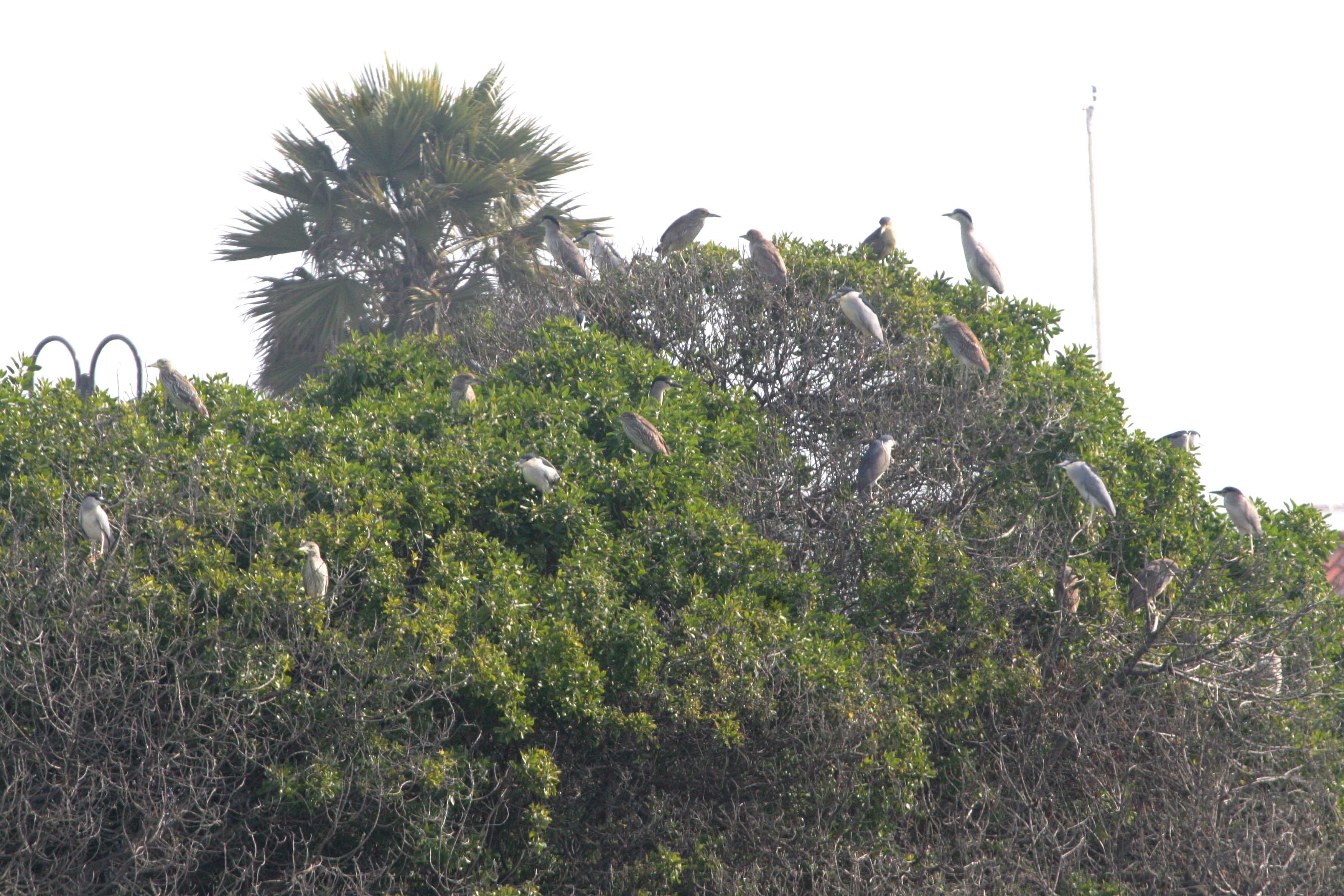
A small portion of the Black-crowned Night-Herons present (A.Kotin 3/12/11)
We were allowed into the enclosure through a small gate near the road where the first of many Song Sparrows was singing. As we wound our way along the edges of the ponds we caught quick looks at Common Yellowthroats and Bushtits in the mostly-non-native vegetation. By the time we left the first pond we had seen Cinnamon and Blue-winged Teals, American Wigeon, Mallard, Lesser Scaup, Ruddy Ducks, and two Mute Swans who flew in and glided to a stop in front of us.
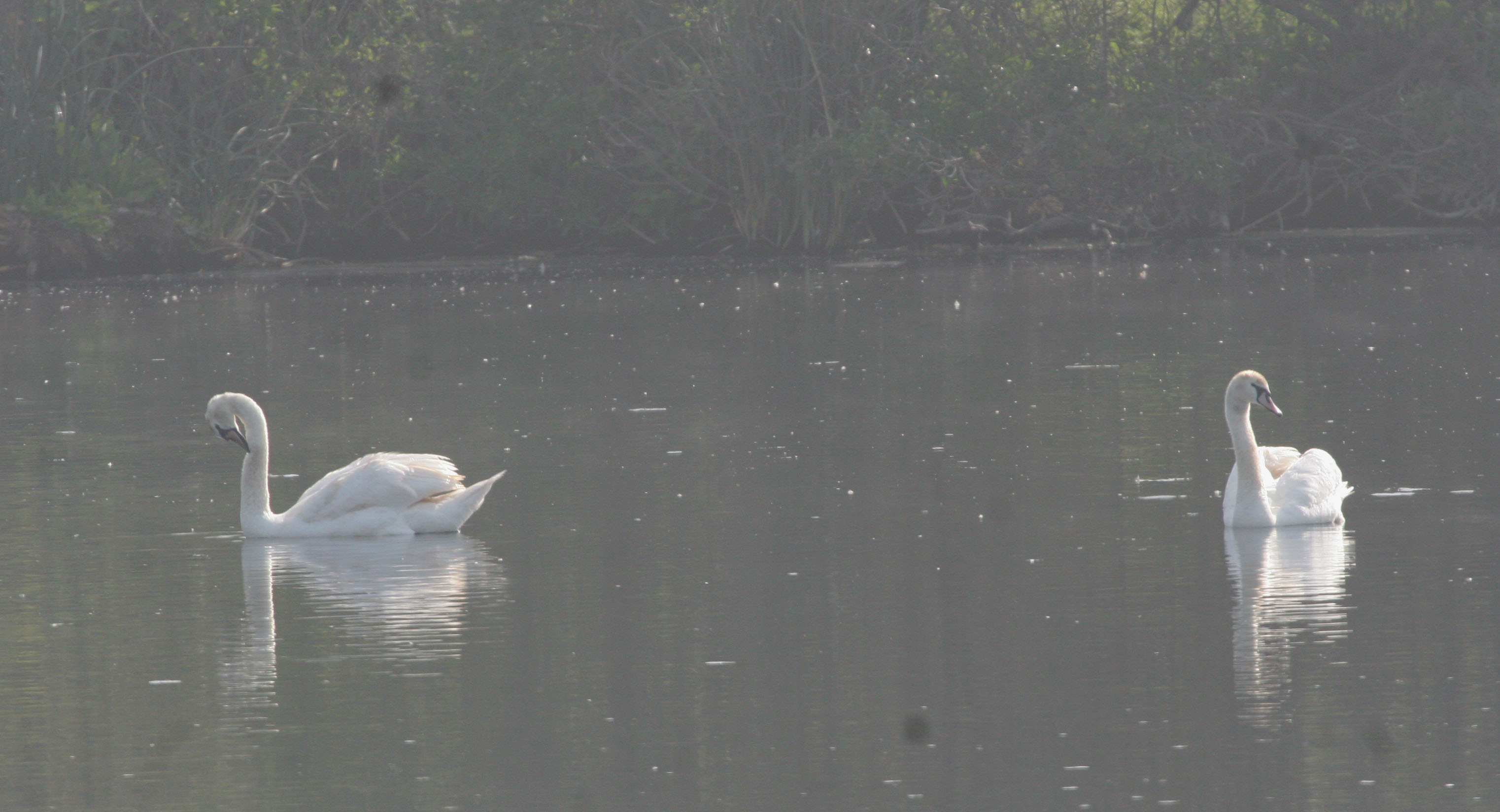
Swans in morning mist (A.Kotin 3/12/11)
Bufflehead and Green-winged Teal were at the last pond. Songbirds such as Bewick’s and Marsh Wren were actively singing. Only two warbler species, Yellow-rumped and Orange-crowned showed up in our binoculars. We had a good time tracking the numerous swallows catching insects above and on the water and ended up with four species, including good comparisons between the numerous Tree Swallows, and the few Violet-Greens.
We left the area at 11AM and continued along the marina road to look for shorebirds near the harbor mouth and were immediately rewarded by good looks at Surfbirds and Black Turnstones.

Black Turnstone between Tsunami surges (A.Kotin 3/12/11)
We scoped across to the breakwater and with some effort found a couple of Black Oystercatchers, as well as some Pelagic Cormorants. But we needn’t have gone to so much effort, because near the NPS headquarters we found two Oystercatchers quite close to us. A local boat owner informed us that the effects of the tsunami were still evident in the surf surges at 20-minute intervals. We completed our trip with a look at the marina’s mooring facilities but with little success except for a fleet of Double-crested Cormorants, including one large group flying high overhead in V formation. [Lucien Plauzoles]
| Bird Trip List | |
| Whooper Swan | 3 |
| Gadwall | 70 |
| American Wigeon | 25 |
| Mallard | 30 |
| Blue-winged Teal | 4 |
| Cinnamon Teal | 40 |
| Northern Shoveler | 15 |
| Green-winged Teal | 3 |
| Lesser Scaup | 12 |
| Bufflehead | 12 |
| Ruddy Duck | 150 |
| Pied-billed Grebe | 3 |
| Eared Grebe | 1 |
| Western Grebe | 20 |
| Brown Pelican | 20 |
| Double-crested Cormorant | 60 |
| Pelagic Cormorant | 4 |
| Great Blue Heron | 4 |
| Great Egret | 3 |
| Snowy Egret | 1 |
| Black-crowned Night-Heron | 40 |
| Turkey Vulture | 1 |
| Sharp-shinned Hawk | 1 |
| American Coot | 80 |
| Black Oystercatcher | 4 |
| Willet | 2 |
| Ruddy Turnstone | 3 |
| Black Turnstone | 8 |
| Surfbird | 15 |
| Sanderling | 20 |
| Ring-billed Gull | 25 |
| Western Gull | 40 |
| California Gull | 10 |
| Glaucous-winged Gull | 1 |
| Rock Pigeon | 4 |
| Eurasian Collared-Dove | 15 |
| Anna’s Hummingbird | 5 |
| Black Phoebe | 4 |
| American Crow | 12 |
| Common Raven | 1 |
| Northern Rough-winged Swallow | 3 |
| Tree Swallow | 40 |
| Violet-green Swallow | 3 |
| Barn Swallow | 5 |
| Bushtit | 30 |
| Bewick’s Wren | 1 |
| Marsh Wren | 3 |
| Blue-gray Gnatcatcher | 1 |
| Ruby-crowned Kinglet | 1 |
| Northern Mockingbird | 2 |
| European Starling | 2 |
| Orange-crowned Warbler | 1 |
| Yellow-rumped Warbler | 30 |
| Common Yellowthroat | 6 |
| Spotted Towhee | 1 |
| Song Sparrow | 15 |
| White-crowned Sparrow | 3 |
| Great-tailed Grackle | 1 |
| House Finch | 30 |
| Lesser Goldfinch | 1 |
| American Goldfinch | 1 |
| Total Species | 61 |
Snowy Plover Monitor Training
The following message is from Stacey Vigallon at the LA County Snowy Plover Central Command Facility. You’ve read about them in our blogs. Now you too can help with this important project.
Interested in helping monitor threatened birds at the beach?

Long-term Malibu Lagoon resident, Snowy Plover NO:WW (C.Almdale)
Los Angeles Audubon will host the next volunteer training for Snowy Plover Monitoring on Saturday, March 5th, 8-10 am at Santa Monica Beach. We will meet in the parking lot at the Annenberg Community Beach House (just off Pacific Coast Highway). Feel free to contact the volunteer coordinator (tern@laaudubon.org) if you have any questions. If you’d like to participate in the monitoring program, but can’t make the March 5th date, alternative training can be arranged. Los Angeles Audubon, Santa Monica Bay Audubon Society, South Bay/Palos Verdes Audubon, and Ryan Ecological Consulting have been working together since 2007 to help monitoring Snowy Plovers in Los Angeles County. [Chuck Almdale]
Malibu Lagoon Field Trip Report: 27 February, 2011
Despite my January fears, a scorching summer is not yet upon us, nor is the rainy season over. It was a bright and sunny 45° at the lagoon when we arrived.
The terns are still off in parts unknown. Three Black Skimmers (oversized terns, if you will permit) showed up, but that’s it. There’s still a boodle (a scientific term of quantification) of gulls, mostly California Gulls. The Heermann’s Gulls were all gone (although a few were present the following day.) Heermann’s, in case you didn’t know, nest primarily on islands in the Sea of Cortez near the southern tip of Baja California. Late Spring and Summer is really hot there, so they leave their wintering grounds early to head south to nest, so as not to bake their brains. Yes, they migrate south to breed and north to spend the winter.
Tide was very low and lots of tidepool rocks were exposed, so the Black-bellied Plovers, Willets, Whimbrel, Ruddy Turnstones, Sanderlings, Least Sandpipers, and a few Snowy Egrets were having a profitable morning. Even a loudly squawking Black Oystercatcher flew in to join them. In 110 trips, we’ve seen only 18 of them, spread over 10 visits.
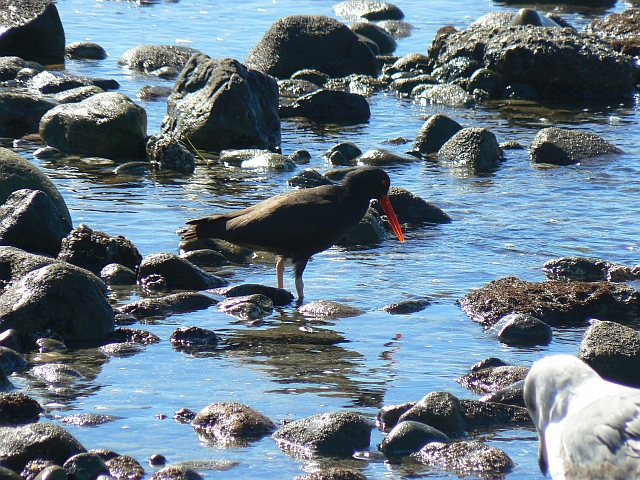
Black Oystercatcher in the tide pool (L.Plauzoles 2/11)
The Soras are still here. Two by the 1st footbridge were joined by a very cooperative Virginia Rail (4th month in a row for this bird), with another Sora over by the footbridge to the point (near the highway bridge).
The “Flap of the Day”
A Lesser Black-backed Gull (LBBG hereafter) was reported to us by several birders who preceded us to the beach. What our group studied intently for 30-60 minutes was a dark-mantled gull with a white unstreaked head, orangish tinge to the bill, bright single red spot on lower mandible, bright yellow legs, appearing to be the same size as the Western Gulls around it. Later discussion with two of the early bird finders revealed that this description fits their bird except they thought it significantly smaller than a Western. I don’t recall if they said there were other Western Gulls in its vicinity when they saw it, and as we all (should) know, determination of relative size can be tricky in absence of something nearby to compare it to. I’ve made this mistake so many times that I’ve learned my sense of size is unreliable when judging a solitary bird. Kimball Garrett commented on the LACoBirds chat line (to which you ought to subscribe) that there are only a couple of prior records for LBBG in LA County, so documentation (pictures!) is needed. If anyone out there got a picture of this bird(s) send it in! He also pointed out that Cal Yorke took a picture at the lagoon on 2/13/11 of a Western Gull with yellowish legs. I personally think this was the bird our group saw despite the fact that our bird’s legs were far more brightly yellow than the pictured bird. Lillian and I also found, upon searching in vain for the bird on the following day, that among the approximately 1100 California Gulls, there were 3-6 California Gulls which had very bright yellow legs and an orange tinge to the bill. Two possible explanation for these colors are: beginning to enter into breeding plumage (which often includes skin color changes, especially in seabirds); higher than usual levels of carotinoids (as in “carrot” -chemicals providing reddish colors ) in their diet, probably from crustaceans such as brine shrimp. In several other species of seabird – Roseate and Elegant Terns – carotinoids get concentrated in their oil gland; when they rub the oil on their plumage with their bills, the plumage can turn pinkish or rosy, usually most noticeable on their breast. I can’t think of a reason why this might not affect the bill’s color as well. Check the Elegant Terns at the lagoon in April – May, and you’ll likely see rosy breasts on at least a few birds. All this is to say that a reddish tinge on a gull’s bill may an indication of diet or readiness to breed, and not proof of a rare species. We have often noticed that the bills of Royal and Elegant Terns can range anywhere from light yellow to deep orange, and thus is unreliable as a tool to differentiate between these two species. Perhaps this color range is due to the same breeding and/or diet causes. These are conjectures, or “educated guesses”. I don’t know the answers.
Our Snowy Plover population remains high at 59, although the census takers had hard times due to all the inattentive people tromping up and down the beach – including, alas, myself, deep in some no-doubt immensely important bird-related conversation, until an alarmed Snowy darted off, bringing us up short and back to the world. We had two banded birds: long time Malibu resident NO:WW (first spotted Oct. ’09) and AY:AA (around since at least Nov. ’10).
All in all it was a nice day at the beach, filled with sound and fury, signifying…a nice day at the beach! Monday was equally beautiful, with even more birds and nearly no one on the great wide Malibu sands.
As a note to anyone reading this, our 10 AM Children and Parents Birdwalk meets on the beach trail footbridge closest to the parking lot.
Check out our new blog page created especially for Unusual Birds at Malibu Lagoon, the permanent location for pictures of our uncommon birds. Look for other new pages coming in the future. For prior period bird lists, follow these links to July-Dec ’10, Jan-June ’10, Jul-Dec ‘09, and Jan-June ‘09. For an aerial photo of the lagoon, go here. [Chuck Almdale]
| Malibu Census 2011 | 23-Jan | 27-Feb |
| Temperature | 68-75 | 45-60 |
| Tide Height | +4.94 | -0.41 |
| Low/High &Time | H:1117 | L:1243 |
| Canada Goose | 6 | |
| Gadwall | 15 | 22 |
| American Wigeon | 4 | |
| Mallard | 24 | 24 |
| Northern Shoveler | 4 | 2 |
| Green-winged Teal | 12 | 17 |
| Surf Scoter | 8 | |
| Bufflehead | 5 | 2 |
| Red-brstd Merganser | 6 | 8 |
| Ruddy Duck | 40 | 33 |
| Pacific Loon | 1 | 1 |
| Pied-billed Grebe | 3 | 2 |
| Horned Grebe | 1 | |
| Eared Grebe | 3 | |
| Western Grebe | 6 | 12 |
| Dble-crstd Cormorant | 57 | 37 |
| Pelagic Cormorant | 4 | 3 |
| Brown Pelican | 42 | 23 |
| Great Blue Heron | 2 | 1 |
| Great Egret | 1 | 1 |
| Snowy Egret | 8 | 9 |
| Blk-crwnd N-Heron | 1 | |
| Osprey | 1 | |
| Red-tailed Hawk | 1 | |
| Virginia Rail | 1 | 1 |
| Sora | 4 | 3 |
| American Coot | 145 | 175 |
| Blk-bellied Plover | 1 | 65 |
| Snowy Plover | 60 | 59 |
| Killdeer | 3 | 4 |
| Black Oystercatcher | 1 | |
| American Avocet | 4 | |
| Spotted Sandpiper | 2 | 2 |
| Willet | 1 | 7 |
| Whimbrel | 1 | 5 |
| Ruddy Turnstone | 5 | |
| Sanderling | 135 | |
| Least Sandpiper | 10 | 18 |
| Boneparte’s Gull | 13 | |
| Heermann’s Gull | 62 | |
| Mew Gull | 1 | |
| Ring-billed Gull | 120 | 250 |
| Western Gull | 100 | 120 |
| California Gull | 2500 | 1050 |
| Herring Gull | 1 | |
| Glaucous-wingd Gull | 2 | 3 |
| Black Skimmer | 3 | |
| Rock Pigeon | 5 | 4 |
| Mourning Dove | 2 | |
| Anna’s Hummingbird | 3 | 2 |
| Allen’s Hummingbird | 6 | 3 |
| Belted Kingfisher | 1 | 1 |
| Black Phoebe | 4 | 5 |
| Say’s Phoebe | 1 | |
| American Crow | 6 | 4 |
| Tree Swallow | 8 | |
| Barn Swallow | 1 | 3 |
| Cliff Swallow | 1 | |
| Bushtit | 9 | 6 |
| Bewick’s Wren | 2 | |
| House Wren | 1 | |
| Marsh Wren | 3 | |
| Northern Mockingbird | 1 | 2 |
| European Starling | 35 | |
| Yellow-rumpd Warbler | 6 | 2 |
| Common Yellowthroat | 4 | 2 |
| California Towhee | 1 | |
| Song Sparrow | 8 | 8 |
| White-crwnd Sparrow | 4 | |
| Red-winged Blackbird | 1 | 4 |
| Great-tailed Grackle | 1 | |
| House Finch | 5 | 3 |
| Lesser Goldfinch | 4 | |
| American Goldfinch | 8 | |
| Totals by Type | Jan | Feb |
| Waterfowl | 106 | 126 |
| Water Birds-Other | 267 | 257 |
| Herons, Egrets | 11 | 12 |
| Quail & Raptors | 2 | 0 |
| Shorebirds | 82 | 301 |
| Gulls & Terns | 2785 | 1440 |
| Doves | 7 | 4 |
| Other Non-Pass. | 10 | 6 |
| Passerines | 70 | 81 |
| Totals Birds | 3340 | 2227 |
| Total Species | Jan | Feb |
| Waterfowl | 7 | 10 |
| Water Birds-Other | 11 | 9 |
| Herons, Egrets | 3 | 4 |
| Quail & Raptors | 2 | 0 |
| Shorebirds | 8 | 10 |
| Gulls & Terns | 6 | 7 |
| Doves | 2 | 1 |
| Other Non-Pass. | 3 | 3 |
| Passerines | 17 | 15 |
| Totals Species – 74 | 59 | 59 |
Great Backyard Bird Count: 18-21 February
[NOTE: The Great Backyard Bird Count is an annual event, occurring over President’s Day weekend. Watch for the announcement next winter.]
Citizen Science Time !… Now is the time of the Great Backyard Bird Count (a joint project of Audubon and Cornell Lab of Ornithology) … a reminder that February 18th – 21st, 2011, (NOW !) is the time to go to http://www.birdsource.org/gbbc/howto.html and follow instructions – count your yard birds, seen from window birds, balcony birds, beach birds, park birds, neighborhood birds – your choice – do it alone, do it with friends, family, pets, have fun!
You never know what you might find in your own back yard!
Last year (the 13th Annual Great Backyard Bird Count) 97,331 lists were submitted, 602 species were counted and 11,233,609 individual birds were counted (which is about 115 plus birds per list – some big some small) – so join the fun ; count birds and share the totals – be a part of something bigger – http://www.birdsource.org/gbbc/
Field Trip Report: Ballona Creek, del Rey Lagoon & Ballona Fresh Water Marsh, 12 Feb., 2011
[IMPORTANT NOTE TO ALL SUBSCRIBERS. If you do not receive an email of this blog dated 2/17/11, between 2pm – 5pm, you have not yet confirmed your subscription to our new email system. Unless you confirm, your subscription will cease in about 10 days. Please confirm. We don’t want to lose you! See prior blog for additional information.]
This day was Mr. Lincoln’s 202nd birthday. He was unavailable, but the rest of us on this lovely sunny day should have worn our sunscreen. We had great views of birds in the lagoon, from the jetty, in the wetlands and in the fresh water marsh. There were favorites each place….there was a female Ring-necked Duck in the lagoon – with Lesser Scaup. On the rocks by the jetty were a Black Turnstone and a Ruddy Turnstone side by side…how helpful of them to show how alike and

Black Turnstone on the Jetty (C.Almdale)
different they are. We also had a lesson with a Clark’s Grebe and a Western Grebe. The out-of- towners got new birds! We also had a few Black Oystercatchers (shouldn’t that be Oysterfinders – how tricky can it be to catch an oyster?), and many, many Brandt’s Cormorants. My favorites were the Surf Scoters which seemed to be having a grand day in the channel and ignoring the rowing teams working back and forth. Back by the wetlands we did indeed see the Burrowing Owl – well, Chuck Almdale found it and showed the rest of us where it was lurking in the red, yellow and orange ice plant.

Surfbird on Ballona Jetty (C.Almdale)
The freshwater marsh had Cinnamon Teal, Green-winged Teal, Common Moorhens and ubiquitous American Coots. The big lesson was the difference between the two Yellow-rumped Warblers, Western and Eastern or Audubon’s and Myrtle. And maybe, someday…I too will be able to tell them apart – I was just thankful there was not a written quiz.

Willet, in a pensive moment (C.Almdale)
This was a wonderful day to be outside AND to see lots of our local birds. Many thanks to Chuck Almdale for leading this informative walk. [Ellen Vahan]
| Ballona Field Trip 2/12/11 | Jetty & | |
| Trip List | Lagoon | FWM |
| Gadwall | 10 | |
| American Wigeon | 2 | |
| Mallard | 30 | 30 |
| Cinnamon Teal | 10 | |
| Northern Shoveler | 50 | |
| Green-winged Teal | 12 | |
| Ring-necked Duck | 1 | |
| Lesser Scaup | 15 | |
| Surf Scoter | 40 | |
| Bufflehead | 4 | |
| Red-breasted Merganser | 2 | |
| Ruddy Duck | 15 | 50 |
| Pied-billed Grebe | 2 | 10 |
| Horned Grebe | 2 | |
| Eared Grebe | 25 | 8 |
| Western Grebe | 1 | |
| Clark’s Grebe | 1 | |
| Brown Pelican | 30 | |
| Brandt’s Cormorant | 1000 | |
| Double-crested Cormorant | 30 | 12 |
| Great Blue Heron | 4 | |
| Great Egret | 1 | 3 |
| Snowy Egret | 2 | 4 |
| Green Heron | 1 | |
| Red-tailed Hawk | 1 | 1 |
| American Kestrel | 2 | |
| Sora | 1 | |
| Common Moorhen | 3 | |
| American Coot | 40 | 80 |
| Black-bellied Plover | 1 | |
| Killdeer | 2 | |
| Black Oystercatcher | 2 | |
| Black-necked Stilt | 1 | |
| Willet | 20 | |
| Whimbrel | 4 | |
| Marbled Godwit | 30 | |
| Ruddy Turnstone | 4 | |
| Black Turnstone | 2 | |
| Surfbird | 45 | |
| Sanderling | 6 | |
| Western Sandpiper | 50 | |
| Least Sandpiper | 10 | |
| Dunlin | 4 | |
| Heermann’s Gull | 4 | |
| Ring-billed Gull | 60 | |
| Western Gull | 30 | |
| California Gull | 20 | |
| Royal Tern | 1 | |
| Rock Pigeon | 10 | |
| Eurasian Collared-Dove | 2 | |
| Mourning Dove | 10 | |
| Red-crowned Parrot | 3 | |
| Burrowing Owl | 1 | |
| Anna’s Hummingbird | 5 | |
| Allen’s Hummingbird | 4 | |
| Black Phoebe | 2 | 8 |
| Say’s Phoebe | 1 | 2 |
| American Crow | 35 | |
| No. Rough-winged Swallow | 1 | |
| Tree Swallow | 5 | |
| Bushtit | 14 | |
| Blue-gray Gnatcatcher | 3 | |
| Northern Mockingbird | 1 | 2 |
| Orange-crowned Warbler | 1 | |
| Yellow-rumped Warbler – Audubon | 2 | 16 |
| Yellow-rumped Warbler – Myrtle | 2 | |
| Common Yellowthroat | 3 | |
| Savannah Sparrow | 6 | |
| Song Sparrow | 6 | |
| White-crowned Sparrow | 25 | |
| Red-winged Blackbird | 20 | |
| Western Meadowlark | 4 | |
| Great-tailed Grackle | 2 | |
| House Finch | 10 | |
| Lesser Goldfinch | 5 | |
| American Goldfinch | 1 | |
| Total Birds – 76 | 45 | 44 |



 SANTA MONICA BAY AUDUBON SOCIETY BLOG