Free email delivery
Please sign up for email delivery in the subscription area to the right.
No salesman will call, at least not from us. Maybe from someone else.
Astounding as it may seem, a new species of hummingbird has been discovered in the foothills of the southern slope of the San Gabriel Mountains. As yet, the only known location is near an industrial-residential section in the small town of Monrovia, where they have been filmed performing territorial flight displays.
Tentatively classified as a member of genus Calypte, scientists assume they’ve previously been mistaken for their congener, the locally common and resident Anna’s Hummingbird, Calypte anna, although they bear only a superficial resemblance. DNA samples will presumably be taken. Nucleotide base pair analysis should reveal the bird’s closest affinities. Until results are released, final taxonomic classification cannot be ascertained with certainty.
Pending such definitive analysis, the bird is currently referred to as Calypte timconverensis, after the local resident who first saw it hovering outside his kitchen window next to a hummingbird feeder. “I like to watch them in the morning while I have a cup of coffee,” he said. “I was working on my third cuppa Joe when I noticed this one hanging there, just the other side of the glass, like it was watching me. It was kind of spooky! I went over to the window to get a better look and it just hovered there, looking right back at me. I walked back and forth a couple of times and darned if it didn’t follow along, watching me the whole time! Its eyes were kind of funny, like they were glass or something. I could see right away it wasn’t one of your typical hummers. I get mostly Anna’s and Allen’s here of course, and the occasional Rufous in springtime.”
He continues. “It had this big red bill like the Broad-billed which lives over in Arizona, according to my bird book, but beyond that, it sure didn’t look like the picture in the book. Then there’s this tiny little gorget, sort of like a female Anna’s, but it’s just a little round spot. It was all pale underneath, so I figured it wasn’t an adult male, but it sure had me flummoxed. I called a local birder friend of mine, and he came and looked at it and got all excited and waving his arms around and called someone else and he came over and took a few pictures and the next thing I knew, people were tromping all over my yard with mist nets and who-knows-what. They wiped out my peonies.”
“It’s really the friendliest little thing. I’ve actually gotten it to land on my hand (see picture below) on that weird tail, after it visits the feeder. Its feet aren’t much to see, that’s for sure.”

The tail – certainly one of its strangest characteristics – is the source for its probable English name, Four-wired Hummingbird. Despite the juvenile appearance of the pale plumage, at least one adult male was filmed in his courting/territorial display. Similar to the “J-shaped” flight of the Anna’s, it rises straight up to approximately 75 ft. above the ground. But – unlike the rapid descent and tail snap of the Anna’s – he then slowly descends and hovers directly in front of his potential mate (or rival).
For a brief film of the mating/territorial display flight, go here. As no female or encroaching male was sighted, it is unknown which form of display flight this is.
Actual mating has not yet been observed; nor have nests been found. Population size is unknown, as no more than two have ever been seen at any one time. The extent of their range also is unknown as they have never been recorded outside the immediate area of discovery.
Local civic authorities are greatly excited by this unexpected fame. Discussions are underway to make it the official City Bird and put it onto their Great Seal of the City of Monrovia.
The discoverer – a garage-workshop tinkerer – has requested that his name and address be withheld, as he wishes not to be overwhelmed by battalions of birders battling it out with tripods while trying to spot the bird. “I’m putting the finishing touches on my perpetual motion machine,” he states confidently, “and it’s going to revolutionize the pencil-sharpening industry just as soon as I can find some funding.”
Best of luck to any birder who goes chasing the bird, and stay off the peonies!
If you found this article plausible, you may be interested in other installments in our Early Spring Monograph Series (ESMS):
2010: The Western Roof Owl: Bird of Mystery
2012: Canyonlands Roadrunner Captured on Film
2013: Birders Take Their Lumps with their Splits
and not to be overlooked,
2026: Save the endangered Pacific Northwest Tree Octopus from Extinction
[Chuck Almdale, on behalf of Society 401]
Malibu Lagoon Field Trip Report: 27 March, 2011
Our rains continue and Governor Brown just declared that the California drought is officially over. No doubt everyone will celebrate by watering their lawns while the rain falls and leaving the hose run while they wash their car. (As if they ever stopped.)
At 54° when we started, and a very light wind, the weather at the lagoon was quite pleasant, despite the numerous dark and threatening clouds all around. Surf was nearly flat, and only a couple ever-hopeful diehards were in the water.
Species diversity took an upward bump. A single Brandt’s Cormorant joined the lonely Pelagic Cormorant on the offshore rocks. Reports of Pacific Loons off our coast were supported by the raft of 15 swimming just beyond the surf zone. The terns are returning (no pun intended) in small numbers: Caspian, Forster’s, Royal and Elegant joined the 3 Black Skimmers (probably the same 2 adults and 1 juvenile as last month). Again, most of the gulls flew off just as we arrived at the beach; I estimated 1000 of them and added them to the counts.

Caspian Terns (C.Bragg 5/10)
Ducks were down: no Canada Geese, Wigeons, Shovelers or Buffleheads at all, and only 15 Ruddy Ducks. Two of the Ruddys were in bright breeding (alternate) plumage. Double-crested Cormorants – more and more of them sporting their white “eyebrow” crests – were abundant: 90 scattered about, a count second only to 97 on 11/27/05. The Virginia Rail was still in his usual spot in the reed bed near the footbridge to the point near the highway. That’s the 5th month running for what must be the same individual bird. The Soras are still relatively numerous, with at least 4 seen, including one juvenile.
The Osprey was back. Perhaps he never left, but we didn’t see it in February, after hosting it October through January. He doesn’t seem to bother the other birds much as they never seem to leap into the air when he cruises by or kites over the lagoon. As the beach breach has been open all winter, there’s probably plenty of mullet hanging around in the deeper waters below the highway bridge.
Other signs of spring appeared in addition to the budding trees. Two Western Kingbirds busily hawked insects over the marsh grass and pickleweed, and…TA DA! – a Rufous Hummingbird was discovered among the usual Anna’s and Allen’s Hummers. This is the 1st Rufous we’ve found at the lagoon. They are a common migrant through California this time of year, heading (as I’m sure you know) as far north as Alaska to breed. But it’s hard to separate them from the far more common, and now resident, Allen’s. The green on this bird’s back was so reduced that we felt (fairly) confident in calling it a Rufous.
Five Savannah Sparrows were on the sandy edge of the middle channel, next to the pickleweed, which is still covered with bright red tips. Back near the parking lot, 3 Brown-headed Cowbirds were high in the Sycamore tree, looking for mates, no doubt, and generally making pests of themselves.
As a reminder to those who plan to come to our 10 am Parent’s & Kids birdwalk, they meet at the beach trail footbridge closest to the parking lot.
Check out our new blog page created especially for Unusual Birds at Malibu Lagoon, the permanent location for pictures of our uncommon birds. Look for other new pages coming in the future. For prior period bird lists, follow these links to July-Dec ’10, Jan-June ’10, Jul-Dec ‘09, and Jan-June ‘09. For an aerial photo of the lagoon, go here. [Chuck Almdale]
| Malibu Census 2011 | 23-Jan | 27-Feb | 27-Mar |
| Temperature | 68-75 | 45-60 | 54-61 |
| Tide Height> | +4.94 | -0.41 | +0.05 |
| Low/High &Time> | H:1117 | L:1243 | L:1216 |
| Canada Goose | 6 | ||
| Gadwall | 15 | 22 | 32 |
| American Wigeon | 4 | ||
| Mallard | 24 | 24 | 30 |
| Northern Shoveler | 4 | 2 | |
| Green-winged Teal | 12 | 17 | 10 |
| Surf Scoter | 8 | 8 | |
| Bufflehead | 5 | 2 | |
| Red-brstd Merganser | 6 | 8 | 4 |
| Ruddy Duck | 40 | 33 | 15 |
| Pacific Loon | 1 | 1 | 15 |
| Common Loon | 1 | ||
| Pied-billed Grebe | 3 | 2 | 1 |
| Horned Grebe | 1 | ||
| Eared Grebe | 3 | ||
| Western Grebe | 6 | 12 | 20 |
| Brandt’s Cormorant | 1 | ||
| Dble-crstd Cormorant | 57 | 37 | 90 |
| Pelagic Cormorant | 4 | 3 | 1 |
| Brown Pelican | 42 | 23 | 89 |
| Great Blue Heron | 2 | 1 | 1 |
| Great Egret | 1 | 1 | 1 |
| Snowy Egret | 8 | 9 | 5 |
| Blk-crwnd N-Heron | 1 | ||
| Turkey Vulture | 3 | ||
| Osprey | 1 | 1 | |
| Red-tailed Hawk | 1 | 2 | |
| Virginia Rail | 1 | 1 | 1 |
| Sora | 4 | 3 | 4 |
| American Coot | 145 | 175 | 153 |
| Blk-bellied Plover | 1 | 65 | |
| Snowy Plover | 60 | 59 | 42 |
| Killdeer | 3 | 4 | 2 |
| Black Oystercatcher | 1 | ||
| American Avocet | 4 | ||
| Spotted Sandpiper | 2 | 2 | 1 |
| Willet | 1 | 7 | 3 |
| Whimbrel | 1 | 5 | 1 |
| Ruddy Turnstone | 5 | ||
| Sanderling | 135 | ||
| Western Sandpiper | 2 | ||
| Least Sandpiper | 10 | 18 | 20 |
| Boneparte’s Gull | 13 | 4 | |
| Heermann’s Gull | 62 | ||
| Mew Gull | 1 | ||
| Ring-billed Gull | 120 | 250 | 50 |
| Western Gull | 100 | 120 | 100 |
| California Gull | 2500 | 1050 | 1100 |
| Herring Gull | 1 | ||
| Glaucous-wingd Gull | 2 | 3 | |
| Caspian Tern | 5 | ||
| Forster’s Tern | 1 | ||
| Royal Tern | 3 | ||
| Elegant Tern | 4 | ||
| Black Skimmer | 3 | 3 | |
| Rock Pigeon | 5 | 4 | 2 |
| Mourning Dove | 2 | 2 | |
| Anna’s Hummingbird | 3 | 2 | 2 |
| Rufous Hummingbird | 1 | ||
| Allen’s Hummingbird | 6 | 3 | 4 |
| Belted Kingfisher | 1 | 1 | 1 |
| Black Phoebe | 4 | 5 | 12 |
| Say’s Phoebe | 1 | 1 | |
| Western Kingbird | 2 | ||
| American Crow | 6 | 4 | 6 |
| Rough-wingd Swallow | 2 | ||
| Tree Swallow | 8 | ||
| Barn Swallow | 1 | 3 | |
| Cliff Swallow | 1 | ||
| Bushtit | 9 | 6 | 4 |
| Bewick’s Wren | 2 | 1 | |
| House Wren | 1 | ||
| Marsh Wren | 1 | ||
| Northern Mockingbird | 1 | 2 | 1 |
| European Starling | 35 | ||
| Yellow-rumpd Warbler | 6 | 2 | 8 |
| Common Yellowthroat | 4 | 2 | 3 |
| California Towhee | 1 | 1 | |
| Savannah Sparrow | 5 | ||
| Song Sparrow | 8 | 8 | 12 |
| White-crwnd Sparrow | 4 | 3 | |
| Red-winged Blackbird | 1 | 4 | 6 |
| Great-tailed Grackle | 1 | ||
| Brwn-headed Cowbird | 3 | ||
| House Finch | 5 | 3 | 20 |
| Lesser Goldfinch | 4 | 4 | |
| American Goldfinch | 8 | ||
| Totals by Type | Jan | Feb | Mar |
| Total Birds | 3340 | 2227 | 1935 |
| Totals by Type | |||
| Waterfowl | 106 | 126 | 99 |
| Water Birds-Other | 267 | 257 | 376 |
| Herons, Egrets | 11 | 12 | 7 |
| Quail & Raptors | 2 | 0 | 6 |
| Shorebirds | 82 | 301 | 71 |
| Gulls & Terns | 2785 | 1440 | 1270 |
| Doves | 7 | 4 | 4 |
| Other Non-Pass. | 10 | 6 | 8 |
| Passerines | 70 | 81 | 94 |
| Totals Birds | 3340 | 2227 | 1935 |
| Total Species | Jan | Feb | Mar |
| Waterfowl | 7 | 10 | 6 |
| Water Birds-Other | 11 | 9 | 11 |
| Herons, Egrets | 3 | 4 | 3 |
| Quail & Raptors | 2 | 0 | 3 |
| Shorebirds | 8 | 10 | 7 |
| Gulls & Terns | 6 | 7 | 9 |
| Doves | 2 | 1 | 2 |
| Other Non-Pass. | 3 | 3 | 4 |
| Passerines | 17 | 15 | 18 |
| Totals Species – 87 | 59 | 59 | 63 |
Local Hiking Trails Converted into Bike Roads
I’ll bet you didn’t know:
The State Parks are swimming in money!
Looking and listening to nature is a complete waste of time!
This must be true. If it weren’t, why would our parks convert beautiful foot trails into bicycle freeways?
[NOTE] At the end of this message, you will be asked to write a letter or send an email. I implore you to do so.
The Yearling Trail runs through the Reagan Ranch section of Malibu Creek State Park from the ranch house area to the top of Cage Creek Trail (where apes penned up humans in the first Planet of the Apes movie). The Lookout Trail continues from that intersection on into Malibu Creek State Park (MCSP), meeting Crags Rd. near Century Lake. These are beautiful trails, leading through fields of wildflowers and grass and downhill through oak woodlands and chaparral. Santa Monica Bay Audubon Society has led a “wildflowers, butterflies and birds” walk along these trails for several years. (Our next is on Saturday, April 9, starting at Paramount Ranch. Join us!)
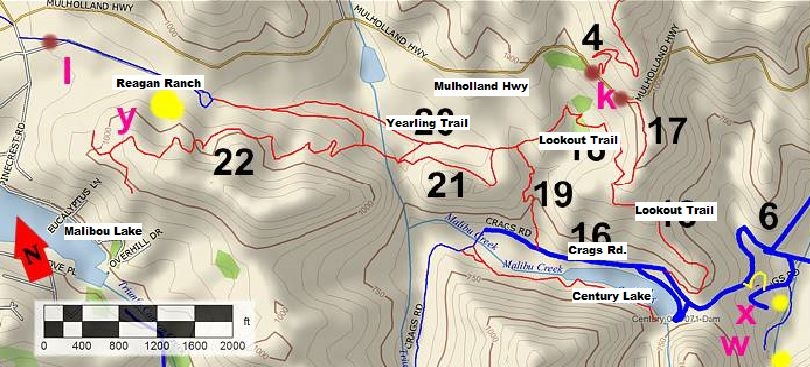
Yearling & Lookout Trails from Reagan Ranch to Century Lake
We take about 4 hours to cover the 4 mile distance to the MCSP parking lot. There’s so much to see, smell, hear; moving quickly defeats the purpose. Here’s a link to our last trip, where we saw, sniffed or heard at least 70 species of flowering plants and 60 species of birds.
These are “single-track” trails, one person wide.

The Yearling "Single Track" Trail
When people meet, someone steps aside. People who study flowers or birds tend to stand around a lot looking at stuff, preferably on the trail so as not to stand on the plants you’re studying.
Why would anyone want to spend our vanishing dollars converting such beautiful trails – perfect, as is, for hiking and nature study – into much wider bicycle trails, with graded hillside descents so bikers won’t bounce too much while they careen down the slopes? Why indeed.
I’ve hiked Santa Monica Mountain trails for decades, both before and after the bicycles began to appear. Certain trails, like the main trail through Pt. Mugu State Park (aka Sycamore Canyon), have been ruined for hiking by the bikers. Our Audubon chapter used to bird there twice a year, in addition to our individual hikes up the canyon. Because of the bicycles, we stopped going there several years ago. It is no fun standing and watching a Flicker popping his head out of a tree-hole or a Kestrel working over some hapless vole, when suddenly a bicycle comes ripping down the trail and shoots past or even through the middle of your group.
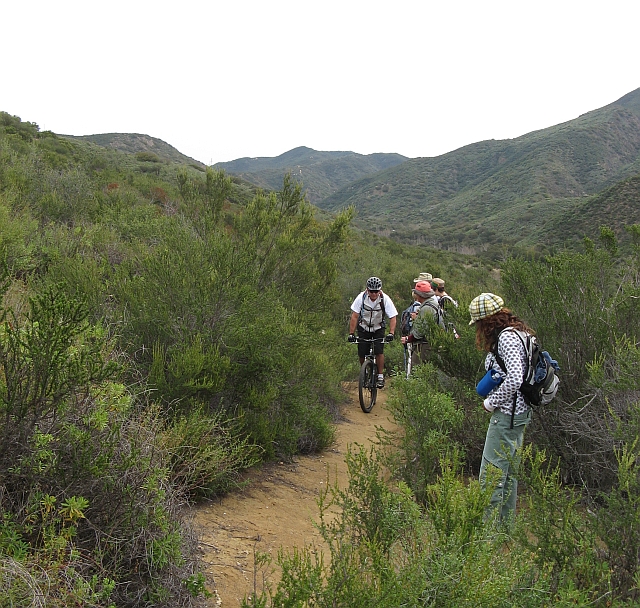
Biker on Hidden Pond non-bike Trail in Point Mugu State Park
No warning bell, no horn, no shout, no “pardon me”, no nothing except the all-too-frequent rude comment. Many bikers we see now wear earphones and iPods while they tear down the trail. This is understandable: who wants to hear birds sing in the bush or hikers shout after you’ve just whacked them with your handlebars?
In 2007, over 600 bikers converged on MCSP for a “Fat-Tire Festival.” There were “Poker Runs” and “wheelie contests.” This is not use, this is abuse. MCSP should not become a bicycle playground to the exclusion of all other activities. The Yearling/Lookout trail loop is one of the few places remaining where we could avoid bicycle abuse.
Must every mountain trail be degraded into a bicycle freeway, filled with zooming oblivioids barely aware they’re riding through fields and forests rather than brickyards? I don’t think so. When is enough, enough? Hikers and birders should not need to risk life and limb to enable bikers to reach every conceivable destination from every possible starting point in the shortest possible time. Apparently CORBA (Concerned Off-Road Bicyclists Association) won’t be happy until they get exactly that: every trail a bike trail. According to them, converting the Yearling and Lookout Trails will set a “precedent that would open even more trails to bicyclists, much of it single track, in the Santa Monica Mountains National Recreation Area.” That’s right, they really, really want to use the trails where hikers will have to leap out of their way. Their website also – fallaciously – states: “More trails open to bicycles means reduced congestion on other trials and an improved trail experience for all users.” If “all users” includes anyone not on a bike, forget about it.
In a March 23 Malibu Times article Superintendent Craig Sap is quoted as saying: “the creation of step-off areas or “passing” lanes could accommodate both [horses & cyclists] since the trails are naturally very narrow, where blind spots are common.” I suppose that the cyclists will conveniently come speeding at you only when you happen to be next to such a “step-off” zone. The entire Sycamore Canyon trail is wide enough to accommodate park rangers’ vehicles, yet hiking is still unsafe.
A blog reader pointed out to me (private correspondence) that the CORBA website has “Rules of the Trail” which include: Ride on open trails only; Leave no trace; Control Your Bicycle!; Always Yield the Trail to Other Trail Users; Never Scare Animals. This is very commendable. And I’m sure that in our society where no one ever breaks the law or speeds on the freeway or tosses litter out the car window, every cyclist need read this only once on the CORBA website for them to instantly and forever adhere to these excellent precepts. (If you believe this, there are some money managers in Nigeria who need your assistance in a financial matter.)
If you value your trails and want to be able to bird, hike, study the flowers, admire the butterflies, ride your horse or merely stand and admire the scenery, you need to act now. [Chuck Almdale]
Please send an email (or even better, a letter) to:
Superintendent Craig Sap
“Craig Sap” <CSAP@parks.ca.gov>
Mailing Address:
California Department of Parks and Recreation, Los Angeles District
1925 Las Virgenes Road,
Calabasas, CA 91302
And send a copy to:
“Director Ruth Coleman, DPR” <RUTH@parks.ca.gov>
Bad news from Midway
An update on the tsunami effect on Pacific seabirds in breeding season can be found at http://www.cnn.com/2011/US/03/18/tsunami.birds.deaths/index.html?eref=igoogledmn_topstories
Bird Articles from the Science Press
An item from Adrian:
The Dodos of the island of Mauritius were flightless birds related to the pigeon and the dove. They had no natural predators on the island prior to its discovery by explorers in 1505. It built its nest on the ground, and after the arrival of Portuguese explorers and the introduction of animals such as pigs, dogs and rats, the eggs were vulnerable to being preyed upon.
It was thought that the diet of the Dodo consisted mainly of fruit although observers did note they saw the Dodos eating iron and stones. It is now believed that the rocks eased the dodo’s digestion.
Although this unusual bird suffered extinction in 1681, the story does not stop there. The potential widespread effects of an extinction of a species are just beginning to be understood. It was recently appreciated that a certain type of tree on Mauritius was becoming quite rare and that all of the 13 trees of the species that remain were approximately 300 years old. It has been determined this type of tree lives to be about 300 years old and this means the species will become extinct. It seems awfully coincidental that this tree had stopped reproducing about 300 years ago just about the time that the Dodo became extinct.
It turns out that the Dodo’s diet consisted of the fruit that this tree produced. The seeds of this tree could only become active and grow after they passed through the Dodo’s digestive system. Therefore the Dodo’s extinction has a direct bearing on this tree’s extinction.
And while we’re on the subject of Dodos:
The slimmer, trimmer Dodo; New Caledonian Crows use tools to poke spiders; plus more.
http://www.sciencenews.org/view/generic/id/69650/title/News_in_Brief_Life
From Science News Online 2/09/11.
****************************
American Goldfinchs’ testosterone surges at sight of thistle blooms
Seeing the right flowers in summer temperatures triggers male goldfinches’ reproductive readiness.
http://www.sciencenews.org/view/generic/id/68646/title/Songbirds_testosterone_surges_at_sight_of_thistle_blooms
From Science News Online 1/12/11.
****************************
On Midway Island, 60-year-old Laysan Albatross, “Wisdom,” and her chick survived the Japan Tsunami
http://www.suite101.com/content/oldest-albatross-survives-tsunami-damage-to-midway-atoll-a358474
From Suzan Phillips. Suite101, 3/13/11
****************************
If that piqued your interest in albatrosses, here’s a beautiful essay on these beautiful birds, from Carl Safina
http://ngm.nationalgeographic.com/2007/12/albatross/safina-text/1
On the presumption that you simply can’t know too much about the albatross.
From National Geographic December 2007
****************************
[Chuck Almdale]



 SANTA MONICA BAY AUDUBON SOCIETY BLOG