Free email delivery
Please sign up for email delivery in the subscription area to the right.
No salesman will call, at least not from us. Maybe from someone else.
“Bicolored” Blackbird found at Malibu Lagoon
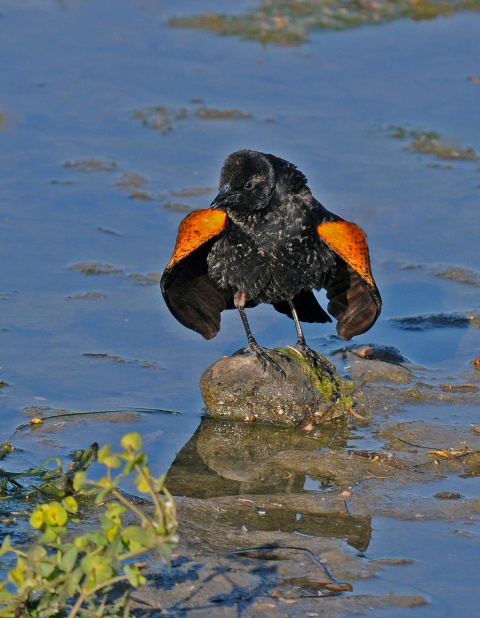
Bicolored Blackbird - note lack of yellow margin on epaulets (J.Kenney 4/11)
A few years back, while watching either a Red-winged or Tricolored Blackbird (getting old, don’t remember which), I made a personal discovery. Until then, I had always assumed that the yellow or white “margin” on the red epaulets was the terminal end of the mostly red feather. This bird was in full display; it erected its epaulets to the maximum, I could see right to the base of the feathers, I saw that the “margin” was actually a separate set of feathers lying below the red epaulet feathers, and these sub-epaulet feathers were completely white (or yellow) right to where they grew from the skin.

Bicolored Blackbird - subspecies or accidental aberration of Red-winged? (J.Kenney 4/11)
These pictures were taken by local photographer James Kenney on 4/30/11 about 8 a.m, at the 2nd footbridge on the path to the beach. So far as I know at this time, it’s the first appearance of the Bicolored Blackbird at the lagoon, and it may well be its southernmost sighting. Dan Cooper commented on the pictures, “I can’t remember seeing one down here, though it’s a common form up in central California to the Bay Area, and probably occurs rarely throughout populations.” He also passed on a Wikipedia citation written by central Californian bird maven Alvaro Jaramillo: “There are a number of subspecies, some of doubtful status, which are mostly quite similar in appearance, but the ‘Bicolored Blackbird’ A. p. gubernator of California and central Mexico is distinctive. The male lacks the yellow wing patch of the nominate race, and the female is much darker than the female nominate. The taxonomy of this form is little understood.” Commenting on Alvaro’s citation, Dan added, “I can’t imagine that a race occurs as disjunct in both coastal California and central Mexico (and not in between), so it may be, as I suspect, a normal/relatively common variation – like the yellow house finch, that simply”pops up” here and there across the huge range of the species.” I concur with Dan, but I wonder whether the margin feathers in the Bicolored are merely shortened or are completely absent. If anyone knows, drop me a line or post a reply here. I found an interesting article on the web but – lacking sufficient academic credentials – could get access to only the first page: The Status of the California Bi-colored Blackbird, Joseph Mailliard, The Condor (Cooper Ornithological Union), March 1910. If anyone can send this article to me, I’d greatly appreciate it and will report what (if anything) I discover.
These pictures and comments have been added to our Unusual Birds at Malibu Lagoon page (aka Lagoon Birds). [Chuck Almdale]
Pelicans and other Birds in the News
In our blog on the Malibu Lagoon 4/24/11 field trip, we noted that there were 740 Brown Pelicans resting at the lagoon. This was 110 more than our previous high count of 630 on 5/27/07, but we didn’t know why so many were there. This phenomenon is larger than the lagoon, and others are wondering as well. [Chuck Almdale]
Buzz rising over local pelican population
San Diego Union; Tues., 4/26/11. Matthew T. Hall
Thanks to alert reader Muriel Kotin for sending this to us.
****************************
Pelican population soaring in San Diego
San Diego Union; Tues., 4/26/11. Matthew T. Hall
****************************
Here’s an article from March, 2010 which may turn out to have some bearing
Brown Pelicans washing up dead and dying on California beaches
Great-Western-Pacific Coastal Post; Weds., 3/31/10. Paul Rogers
****************************
Elsewhere in the news.
News in Brief: Colorful duck bills hint at sperm quality.
http://www.sciencenews.org/view/generic/id/73215/title/News_in_Brief_Life
From Science News Online 4/21/11.
****************************
The eyespots have it after all
New experiments may reconcile conflicting views regarding what makes a peacock’s plumage attractive to females.
http://www.sciencenews.org/view/generic/id/73585/title/The_eyespots_have_it_after_all
From Science News Online 4/27/11.
****************************
Malibu Lagoon Field Trip Report: 24 April, 2011
It’s still unseasonably cold. Most of us never got our jackets off, and a breeze of 5-8 mph made it feel chillier. I know, I know, I shouldn’t be complaining about temperatures in the high 60’s when people are freezing in Mongolia or fighting tyranny house-to-house in Libya, Yemen, Sudan, Ivory Coast, Liberia, and on and on. But if you can’t complain about the weather, what else is there to complain about? Politics? Why, everything in politics is perfect, in this best of all possible worlds.
The peculiarity of the day was the enormous number of Brown Pelicans. I counted 740, an all-time high, but there could easily have been many more, as they kept coming and going in droves. Here are all the prior counts over 200:
315 5/22/05, 400 3/26/06, 230 4/22/07, 630 5/27/07, 239 6/24/07, 320 3/23/08, 231 5/25/08, 256 1/25/09, 205 6/27/10, 740 4/24/11.
And here are the past six Aprils:
79 – 2005, 47 – 2006, 230 – 2007, 35 – 2008, 78 – 2009, 182 – 2010, 740 – 2011
The only pattern I see is that this is an all-time high, which we already knew, and that the numbers bounce around a lot, although usually below 100 for April. A number of passersby asked us if we knew why there were so many. One person thought there had been some sort of general nesting failure on the local Channel Islands (primarily Anacapa), possibly due to lack of food. Another had heard that the pelicans were sensitive to the vast amounts of radiation pouring out of the damaged Fukushima Daiichi nuclear reactor and had fled Japan and across the Pacific Ocean to safety in California. The PQ* of that explanation seemed quite high to me, not least for the fact than none of the world’s eight (some say seven) species of pelicans regularly occur in Japan. (This is a waffling way of saying they just aren’t there.) We here at SMBAS Central Command don’t know why all these pelicans showed up, and a few minutes searching Google didn’t turn up any answers or even any mentions. Anyone out there know anything? * – PQ – Preposterosity Quotient
The total species count at 55 seemed a bit low for April, so I checked and for the past eleven years, we’ve averaged 59 species in April, with a low of 52 and a high of 70.
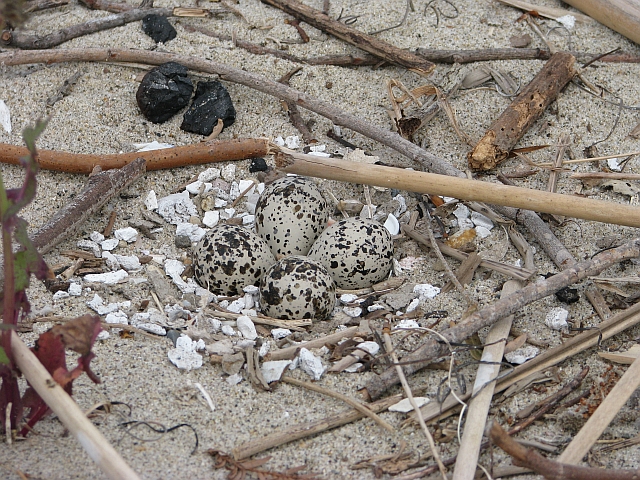
Cryptic Killdeer eggs (C. Almdale 4/24/11)
Out on the beach inland of the (now deserted) Snowy Plover enclosure, we startled a Killdeer, who proceeded to stagger and flop off with what appeared to be a broken wing. As most birders should know, this is a distraction display the adult puts on to lure a potential predator away from its nest. Lu quickly found the nest about 10 ft away from where we stood. I took a few pictures and then we dutifully followed the adult away so it could win this skirmish. Hopefully no crow or gull was paying attention and the nest remains safe among the sticks and pebbles.
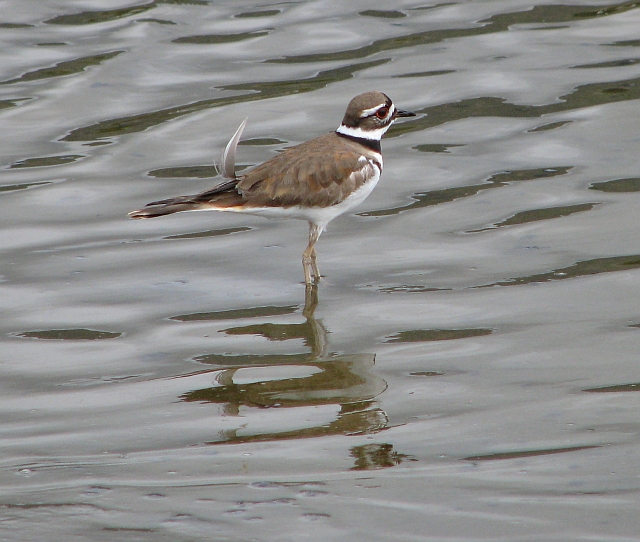
Adult Killdeer lures me to water's edge and continues to keep an eye on me (C.Almdale 4/24/11)
As a reminder to those who plan to come to our 10 am Parent’s & Kids birdwalk, they meet at the beach trail footbridge closest to the parking lot.
Check out our new blog page created especially for Unusual Birds at Malibu Lagoon, the permanent location for pictures of our uncommon birds. Look for other new pages coming in the future. For prior period bird lists, follow these links to July-Dec ’10, Jan-June ’10, Jul-Dec ‘09, and Jan-June ‘09. For an aerial photo of the lagoon (9/23/02), go here. [Chuck Almdale]
| Malibu Census 2011 | 23-Jan | 27-Feb | 27-Mar | 24-Apr |
| Temperature | 68-75 | 45-60 | 54-61 | 59-68 |
| Tide Height> | +4.94 | -0.41 | +0.05 | +0.19 |
| Low/High &Time> | H:1117 | L:1243 | L:1216 | L:1014 |
| Canada Goose | 6 | |||
| Gadwall | 15 | 22 | 32 | 24 |
| American Wigeon | 4 | |||
| Mallard | 24 | 24 | 30 | 22 |
| Northern Shoveler | 4 | 2 | ||
| Green-winged Teal | 12 | 17 | 10 | 2 |
| Surf Scoter | 8 | 8 | ||
| Bufflehead | 5 | 2 | ||
| Red-brstd Merganser | 6 | 8 | 4 | |
| Ruddy Duck | 40 | 33 | 15 | 3 |
| Pacific Loon | 1 | 1 | 15 | 20 |
| Common Loon | 1 | 1 | ||
| Pied-billed Grebe | 3 | 2 | 1 | |
| Horned Grebe | 1 | |||
| Eared Grebe | 3 | |||
| Western Grebe | 6 | 12 | 20 | 2 |
| Brandt’s Cormorant | 1 | 3 | ||
| Dble-crstd Cormorant | 57 | 37 | 90 | 19 |
| Pelagic Cormorant | 4 | 3 | 1 | 2 |
| Brown Pelican | 42 | 23 | 89 | 740 |
| Great Blue Heron | 2 | 1 | 1 | 4 |
| Great Egret | 1 | 1 | 1 | |
| Snowy Egret | 8 | 9 | 5 | 11 |
| Blk-crwnd N-Heron | 1 | 1 | ||
| Turkey Vulture | 3 | |||
| Osprey | 1 | 1 | 1 | |
| Red-tailed Hawk | 1 | 2 | 2 | |
| Virginia Rail | 1 | 1 | 1 | 1 |
| Sora | 4 | 3 | 4 | |
| American Coot | 145 | 175 | 153 | 32 |
| Blk-bellied Plover | 1 | 65 | ||
| Snowy Plover | 60 | 59 | 42 | |
| Semipalmated Plover | 25 | |||
| Killdeer | 3 | 4 | 2 | 8 |
| Black Oystercatcher | 1 | |||
| American Avocet | 4 | |||
| Spotted Sandpiper | 2 | 2 | 1 | |
| Willet | 1 | 7 | 3 | |
| Whimbrel | 1 | 5 | 1 | 3 |
| Ruddy Turnstone | 5 | |||
| Sanderling | 135 | |||
| Western Sandpiper | 2 | 12 | ||
| Least Sandpiper | 10 | 18 | 20 | 25 |
| Dowitcher species flying | 1 | |||
| Boneparte’s Gull | 13 | 4 | 2 | |
| Heermann’s Gull | 62 | 3 | ||
| Mew Gull | 1 | |||
| Ring-billed Gull | 120 | 250 | 50 | 52 |
| Western Gull | 100 | 120 | 100 | 160 |
| California Gull | 2500 | 1050 | 1100 | 450 |
| Herring Gull | 1 | |||
| Glaucous-wingd Gull | 2 | 3 | 2 | |
| Caspian Tern | 5 | 61 | ||
| Forster’s Tern | 1 | 1 | ||
| Royal Tern | 3 | |||
| Elegant Tern | 4 | 12 | ||
| Black Skimmer | 3 | 3 | ||
| Rock Pigeon | 5 | 4 | 2 | 4 |
| Eur. Collared-Dove | 1 | |||
| Mourning Dove | 2 | 2 | 4 | |
| Anna’s Hummingbird | 3 | 2 | 2 | 2 |
| Rufous Hummingbird | 1 | |||
| Allen’s Hummingbird | 6 | 3 | 4 | 2 |
| Belted Kingfisher | 1 | 1 | 1 | |
| Black Phoebe | 4 | 5 | 12 | 8 |
| Say’s Phoebe | 1 | 1 | ||
| Western Kingbird | 2 | |||
| American Crow | 6 | 4 | 6 | 5 |
| Rough-wingd Swallow | 2 | 16 | ||
| Tree Swallow | 8 | 1 | ||
| Barn Swallow | 1 | 3 | 10 | |
| Cliff Swallow | 1 | |||
| Bushtit | 9 | 6 | 4 | |
| Bewick’s Wren | 2 | 1 | 2 | |
| House Wren | 1 | |||
| Marsh Wren | 1 | |||
| Northern Mockingbird | 1 | 2 | 1 | 2 |
| California Thrasher | 2 | |||
| European Starling | 35 | |||
| Ornge-crwnd Warbler | 1 | |||
| Yellow-rumpd Warbler | 6 | 2 | 8 | 4 |
| Common Yellowthroat | 4 | 2 | 3 | 6 |
| California Towhee | 1 | 1 | ||
| Savannah Sparrow | 5 | |||
| Song Sparrow | 8 | 8 | 12 | 10 |
| White-crwnd Sparrow | 4 | 3 | 2 | |
| Red-winged Blackbird | 1 | 4 | 6 | 1 |
| Great-tailed Grackle | 1 | 2 | ||
| Brwn-headed Cowbird | 3 | |||
| House Finch | 5 | 3 | 20 | 10 |
| Lesser Goldfinch | 4 | 4 | 1 | |
| American Goldfinch | 8 | |||
| Totals by Type | Jan | Feb | Mar | Apr |
| Waterfowl | 106 | 126 | 99 | 51 |
| Water Birds-Other | 267 | 257 | 376 | 820 |
| Herons, Egrets | 11 | 12 | 7 | 16 |
| Quail & Raptors | 2 | 0 | 6 | 3 |
| Shorebirds | 82 | 301 | 71 | 74 |
| Gulls & Terns | 2785 | 1440 | 1270 | 743 |
| Doves | 7 | 4 | 4 | 9 |
| Other Non-Pass. | 10 | 6 | 8 | 4 |
| Passerines | 70 | 81 | 94 | 83 |
| Totals Birds | 3340 | 2227 | 1938 | 1803 |
| Total Species | Jan | Feb | Mar | Apr |
| Waterfowl | 7 | 10 | 6 | 4 |
| Water Birds-Other | 11 | 9 | 11 | 9 |
| Herons, Egrets | 3 | 4 | 3 | 3 |
| Quail & Raptors | 2 | 0 | 3 | 2 |
| Shorebirds | 8 | 10 | 7 | 6 |
| Gulls & Terns | 6 | 7 | 9 | 9 |
| Doves | 2 | 1 | 2 | 3 |
| Other Non-Pass. | 3 | 3 | 4 | 2 |
| Passerines | 17 | 15 | 18 | 17 |
| Totals Species – 92 | 59 | 59 | 63 | 55 |
From the President….
Where do birders go when they are not out birding on their home turf ? Some go to other parts of their own country to see birds. Some go to other continents to see exotic birds and completely different countries and peoples. Ghana certainly qualifies as different from Southern California; it has its unique birds and it is in Western Africa, a far part of the world .
I went to Ghana which is fascinating, hot, humid, colorful and near the Equator. We spent most of the trip in our “coaster” van/bus on the road driving to places to see birds who were sometimes seen and sometimes not. In Kakum National Park, home of a rather scary canopy walk from tree to tree over a hundred feet in the air, we saw two elephants and wonderful Hornbills. In the north of Ghana (near Bolgatanga) we saw donkey carts, in the south near the coast we saw bicycles and motor bikes. In the north we saw mosques and mud villages and town pumps. In the south we saw evangelical churches and more mud villages and town pumps. I think we were on every major road in the country (I would hesitate to call them highways as few had more than two lanes – one each way) and we visited most of the National Parks in the country. But one of the favorite things of the trip was reading the sayings on the back of the taxis and buses and the names on the stalls lining streets. Most of these were in the Christian south and the exuberant imagination was very evident. A few favorites:
God Loves Furniture
Kindness and Mercies Catering
King of Glory Bakery
Christ is the Almighty Plumbing Works
Merciful God Vulcanization
God is Able Consultancy
Oh My God (on the back of a bus – considering the accidents)
No Money No Honey (on a vendor’s t-shirt selling….)
Secret of My Joy is Jesus Printing & Photography
Only God Knows Hair Dying
God’s Way Special Rice
Fingers of God Phone Shops
Naked I Came Water Co.
… and my favorite..
With God All Things Are Possible Cosmetics Shop
and there were so many more.
We did see hundreds of birds as well and many of them new. Hooray. One of my favorite birds was the Woodland Kingfisher which darted in front of me in a flash of blue, snapped up a hapless lizard and was last seen whacking it on a tree branch with great abandon. Go nature !
…Ellen Vahan
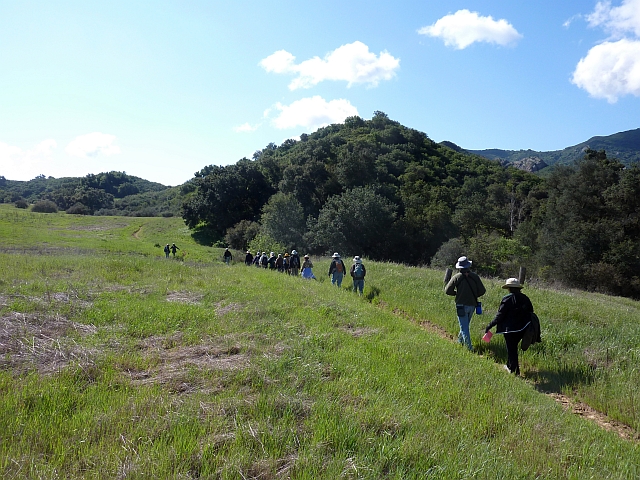
Yearling Trail across Reagan meadow (Aurelio Albaisa 4/9/11)
It was a slow day for the wildflowers. We had a lot of rain this year and it has been colder than usual this spring, which probably is the reason for the poor showing of wildflowers. We were able to identify 58 varieties, but some of them were not actually blooming yet. (See list below.) The Chia on High Rd. not far from the
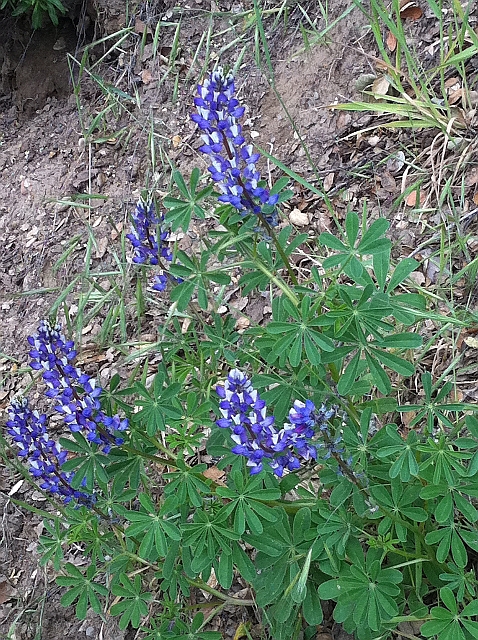
Bush Lupine (Mary Lou Newmark 4/9/11)
Malibu Creek SP parking lot was spectacular and in full bloom. Interestingly, many non-natives were thriving and in full force, among them: Burr Clover, Milk Thistle, Spring Vetch, Wild Radish, Horehound, Mustard and Red-stem Filaree. Strangely absent was our State Flower the California Poppy. The shade loving natives also seemed to be more prominent, including: both Purple and White Nightshade, Skullcap, Fiesta Flower, and Wild Cucumber.
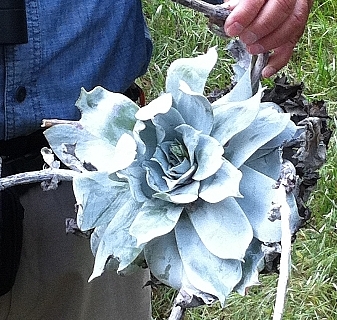
Dudleaya - Not a cabbage (Mary Lou Newmark 4/9/11)
Many plants were quite leafy although lacking flowers. Perhaps it will just be a late year and the blooms will come out in a few weeks. You might want to check back again along the trail to see what is out there. [Peggy Burhenn]
As usual, the weather was variable. It was around 35° with a cloudless sky when we started, got up to 64° around 11 a.m., dropped back down to 59° when clouds came in, then popped back up for lunch. The 20 of us walked around the Paramount old west town to start, then set off toward Reagan Ranch. Lots of plants and flowers, kept us company and gave us plenty to look at and listen to. Spring is definitely here.
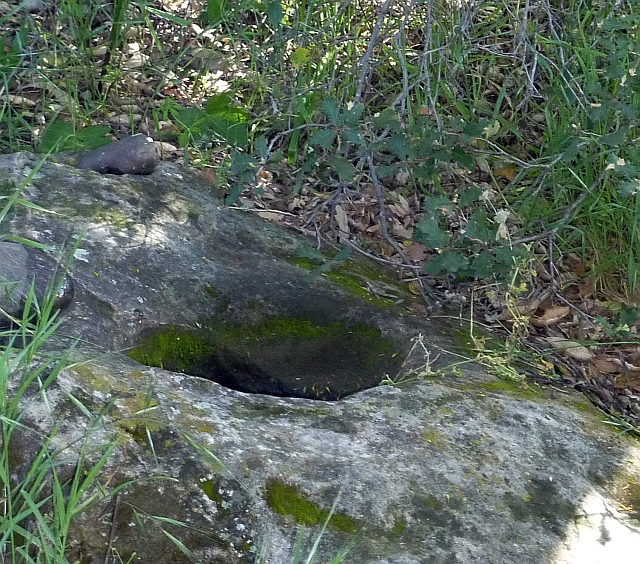
Mataté - for grinding acorns into meal (Aurelio Albaisa 4/9/11)
Birds were singing everywhere. Especially notable were the House and Bewick’s Wrens, California and Spotted Towhees, Song Sparrows and House Finches. Just uptrail from Century Lake two Canyon Wrens were heard in the distance, their liquid, waterfall-dropping song bouncing off the spectacular cliffs. A Red-tailed Hawk was carrying sticks to build a nest near the Reagan ranchhouse and – back at Paramount Ranch – a pair of Red-shouldered Hawks decided that it was the proper time for mating on a limb during our lunch. (Paaleeze! We’re eating here!) Some birds have no sense of propriety.
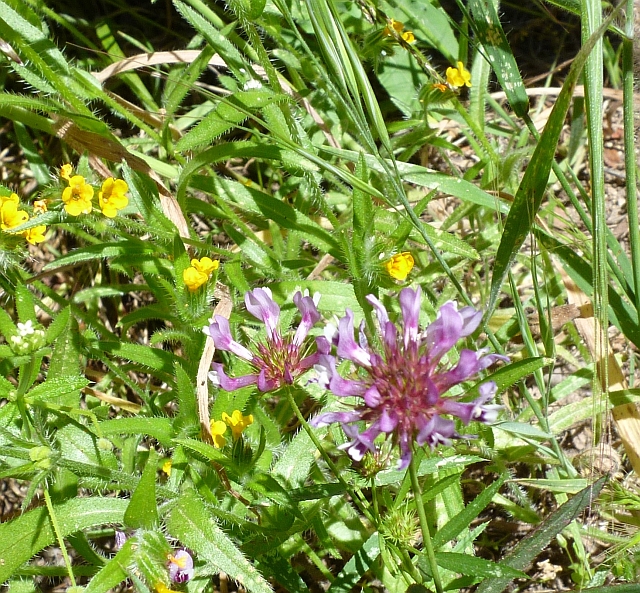
Tom's Clover - an ID toughy (Peggy Burhenn 4/9/11)
House Wrens were commonly heard, less commonly seen. Both Hooded and Bullock’s Orioles were in the trees overhanging the Reagan Ranch access road; Western and Cassin’s Kingbirds were in the grassy fields nearby. Farther along, at the edge of the chaparral we came across both Golden-crowned and White-crowned Sparrows next to one of the numerous, singing, California Towhees in a bush. During the brief period when these birds sing, rather than just Chink!, it’s tough to tell their song from that of the Wrentit. Sometimes all certainty as to which is which disappears. California Thrashers burbled at us
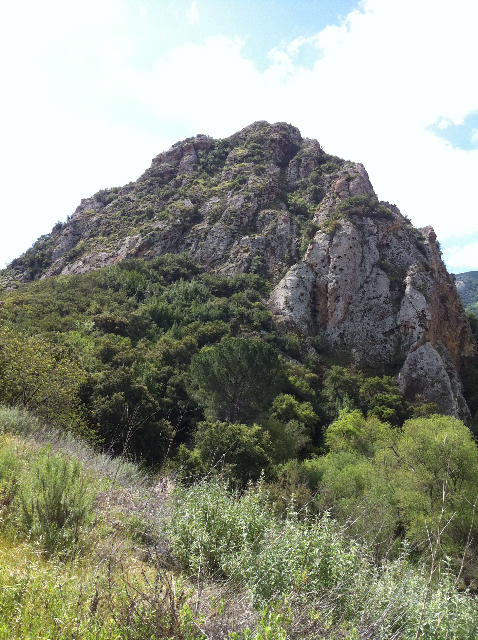
One of many crags on Crags Rd. (Mary Lou Newmark 4/9/11)
from the oak-chaparral as we descended Cage Creek Trail. Apparently those pesky local apes have ceased capturing humans, or have moved elsewhere, as the cage was empty.
At one point, trip leader and State Park docent Peggy Burhenn commented that about 15% of people are not allergic to Poison Oak (“leaves of three – let it be”). Yours truly decided to lend support to this statement with a small demonstration. I have never been affected by Poison Oak, Poison Ivy, Poison Sumac or Mango fruit skins. Black Flies, on the other hand…well anyway, I broke off a sprig and rubbed the leaves around my wrist and back of hand, at which point many onlookers got really excited, for some unknown reason. Oh Ye of little faith! As of this moment, three days later, no ill effects, other than my wife becoming very peeved at me, afraid that I might get some Ivy oil on her.

View east from Crags Rd (Mary Lou Newmark 4/9/11)
Peggy also commented that the Wild Cucumber seedpods (when dried, they look like brown Sea Urchins) while not edible, were used as toys by the Native Americans.
Everyone enjoyed the meandering Yearling Trail (and the lack of bicycles thereon) through the Reagan Ranch meadow. I read somewhere recently that Ronald Reagan (during his pre-President days) laid the trail out himself for hiking and horseback riding over to Malibu Creek. Nice choice, Ronnie! We salute you.
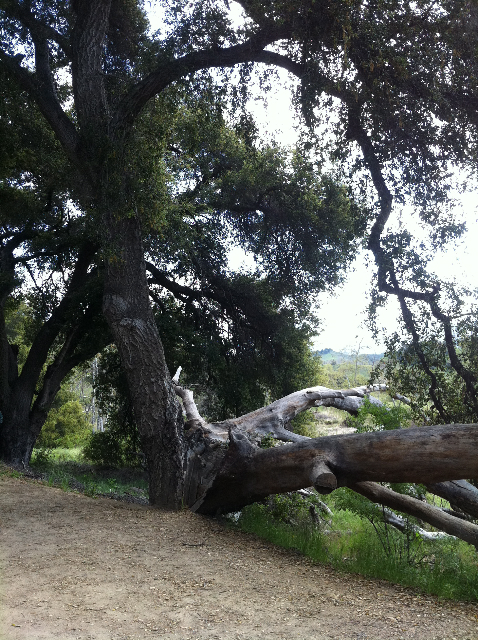
High Rd. has huge Coastal Live Oaks (M.L. Newmark 4/9/11)
Links to April, 2010 and March, 2009 trip reports.
Link to NPS website of Santa Monica Mountains flowers.
Link to March, 2011 blog and reader comments concerning conversion of Yearling & Lookout trails from hiking to biking trails.
[Chuck Almdale]
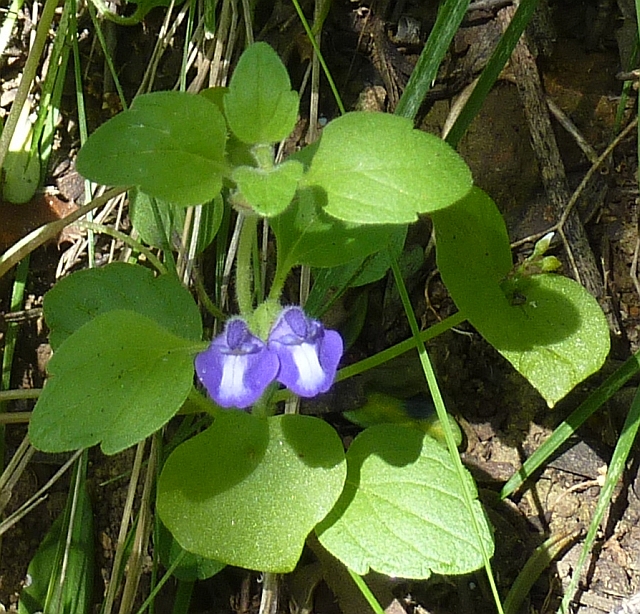
Danny's Skullcap (A.Albaisa (4/9/11)
| TRIP LIST – PARAMOUNT RANCH TO MALIBU CREEK STATE PARK – 4/09/11 | ||
| PLANTS | BIRDS | Nos. |
| WHITE | Canada Goose | 2 |
| Ashy-leafed Buckwheat | Mallard | 7 |
| California Buckwheat | California Quail | 6 |
| California Everlasting | Great Blue Heron | 1 |
| Dodder | Turkey Vulture | 4 |
| Horehound* | Cooper’s Hawk | 1 |
| Miner’s Lettuce | Red-shouldered Hawk | 6 |
| Popcorn Flower | Red-tailed Hawk | 3 |
| White Nightshade | American Coot | 4 |
| White Sage | Spotted Sandpiper | 1 |
| Wild Cucumber | Band-tailed Pigeon | 9 |
| YELLOW | Mourning Dove | 8 |
| Burr Clover* | White-collared Swift | 4 |
| Common Fiddleneck | Anna’s Hummingbird | 2 |
| Golden Currant | Acorn Woodpecker | 8 |
| Golden Yarrow | Nuttall’s Woodpecker | 2 |
| Mustard* | Northern Flicker | 2 |
| Pineapple Weed* | Black Phoebe | 8 |
| Johnny Jump-up | Say’s Phoebe | 3 |
| ORANGE | Cassin’s Kingbird | 4 |
| Scarlet Pimpernel* | Western Kingbird | 4 |
| RED | Western Scrub-Jay | 12 |
| Crimson Pitcher Sage | American Crow | 20 |
| PINK | Common Raven | 4 |
| Milk Thistle* | No. Rough-winged Swallow | 35 |
| Purple Sage | Violet-green Swallow | 20 |
| Red-stem Filaree* | Cliff Swallow | 1 |
| Spring Vetch* | Oak Titmouse | 9 |
| Wild Radish* | Bushtit | 8 |
| PURPLE / BLUE | White-breasted Nuthatch | 2 |
| Baby Blue Eyes | Canyon Wren ** | 1 |
| Bajada Lupine | Bewick’s Wren | 12 |
| Black Sage | House Wren | 25 |
| Blue Dicks | Ruby-crowned Kinglet | 2 |
| Bush Lupine | Western Bluebird | 13 |
| Caterpillar Phacelia | Wrentit ** | 7 |
| Chia | California Thrasher ** | 4 |
| Chinese Houses | European Starling | 6 |
| Danny’s Skullcap | Orange-crowned Warbler | 5 |
| Fern-leaf Phacelia | Yellow-rumped Warbler | 6 |
| Fiesta Flower | Common Yellowthroat | 6 |
| Henbit* | Spotted Towhee | 8 |
| Parry’s Phacelia | California Towhee | 20 |
| Purple Nightshade | Song Sparrow | 13 |
| Winter Vetch* | White-crowned Sparrow | 1 |
| TREES, SHRUBS, ON | Golden-crowned Sparrow | 2 |
| NOT IN BLOOM | Black-headed Grosbeak | 3 |
| Arroyo Willow | Red-winged Blackbird | 12 |
| Big Pod Ceanothus | Hooded Oriole | 4 |
| California Sagebrush | Bullock’s Oriole | 3 |
| Coast Live Oak | House Finch | 60 |
| Coyote Bush | Lesser Goldfinch | 12 |
| Dudleaya | Total Birds | 52 |
| Elderberry | ** – Heard only | |
| English Plantain* | ||
| Green Bark Ceanothus | ||
| Laural Sumac | ||
| Mistletoe | ||
| Mugwort | ||
| Poison Hemlock* | ||
| Poison Oak | ||
| Squaw Bush | ||
| Sugarbush | ||
| Toyon | ||
| Wild Rose | ||
| Yucca | ||
| Total Plants — 58 | ||
| * – Introduced species | ||



 SANTA MONICA BAY AUDUBON SOCIETY BLOG