Skip to content

Free email delivery

Please sign up for email delivery in the subscription area to the right.
No salesman will call, at least not from us. Maybe from someone else.

Mt. Piños Field Trip: 18 June, 2011

June 21, 2011
by

About 90 minutes north of Santa Monica, just over the border into Kern County, lies Mt. Piños, rising 3300 ft. from Cuddy Valley Rd. to 8843 ft. In olden days when the road was maintained, it was easy to drive all the way to the top for a 360° chance to spot the California Condors that occasionally soared by. The last time we tried that, the road became impassable and we walk the final ½ mile. I suppose no one has seen a condor from this location in well over 15 years.

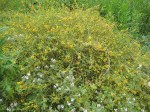
Mountain Whitethorn (Snowbush), Ceanothus cordulatus in bloom near "the triangle" ~5500 ft. (L.Johnson 6/11)

We birded the meeting area for a short while to let the upper slopes warm up. Birds were few, but we managed to find a friendly covey of California Quail, a Western Wood Pewee calling loudly and flycatching, the first of many families of Violet-green Swallows and both Western Scrub Jays (in the open scrub) and Steller’s Jays (in the forest). We searched for Brewer’s Sparrow, but it’s been at least 4 years since we’ve seen them at this location.

[Note added later] In researching the above photo, I ran across an interesting and useful website which has pictures, maps, records and other information on plants all over California. If you’re trying to figure out a plant,  try CalFlora. Here’s their write-up of the Mountain Whitethorn.

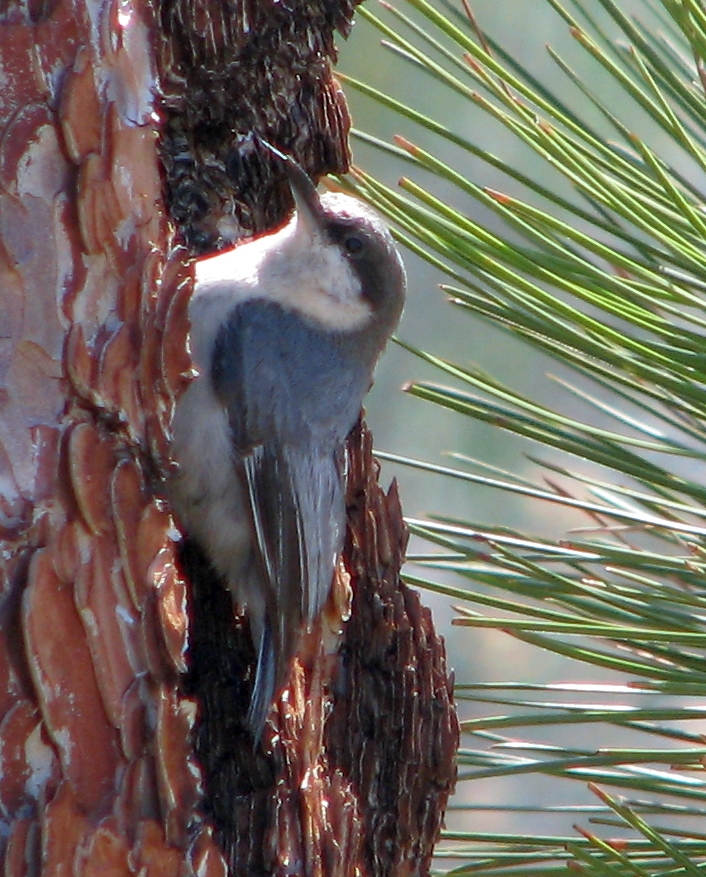
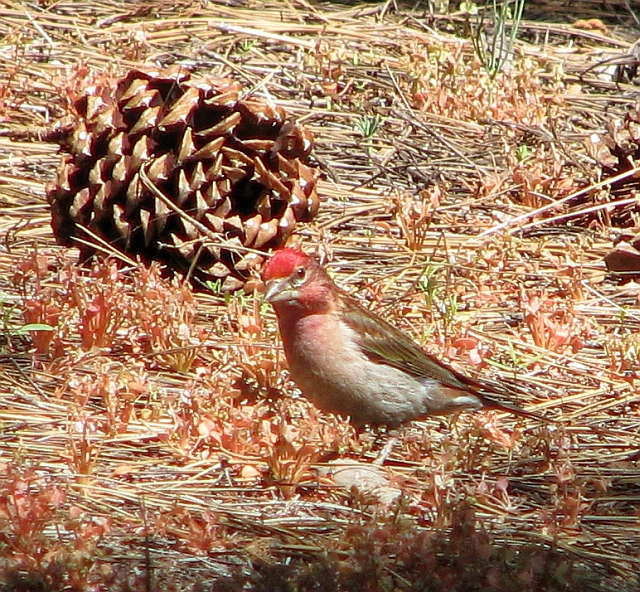
Ascending Mt. Piños, bird speciation changes. Scrub Jays disappear, Steller’s Jays become more common and, at the highest levels, Clark’s Nutcrackers loudly call. Crows are replaced by Ravens. House Finches disappear and Cassin’s Finches appear, often in company with Purple Finches, who utilize a middle range overlapping both House & Cassin’s. White-breasted Nuthatches – which can be found down close to sea level – are joined by the noisily peeping Pygmy Nuthatches who typically forage in family flocks, and the more solitary Red-breasted Nuthatches (a species absent from the nearby San Gabriel Mtns.). In the higher levels, it is possible (or at least used to be) to find Calliope Hummingbirds, feeding at the tiny flowers of current bushes and other low flowering plants. About 5-10% of the currents were in flower and hosting insects hordes, but no hummers.

Pygmy Nuthatch (L.Johnson 6/11)

Fox Sparrows and Green-tailed Towhees were foraging and loudly singing at McGill Campgound. I think these two birds are probably the most beautiful songsters in the entire US sparrow family, with rich, liquid and varied songs, subtly varied with each repetition. I think it extremely odd that they would live in such close proximity to one another, and can’t help wondering if there wasn’t some sort of mutual interspecies singing competition driving their evolution.

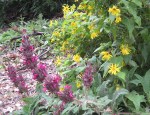
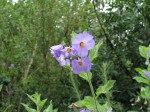
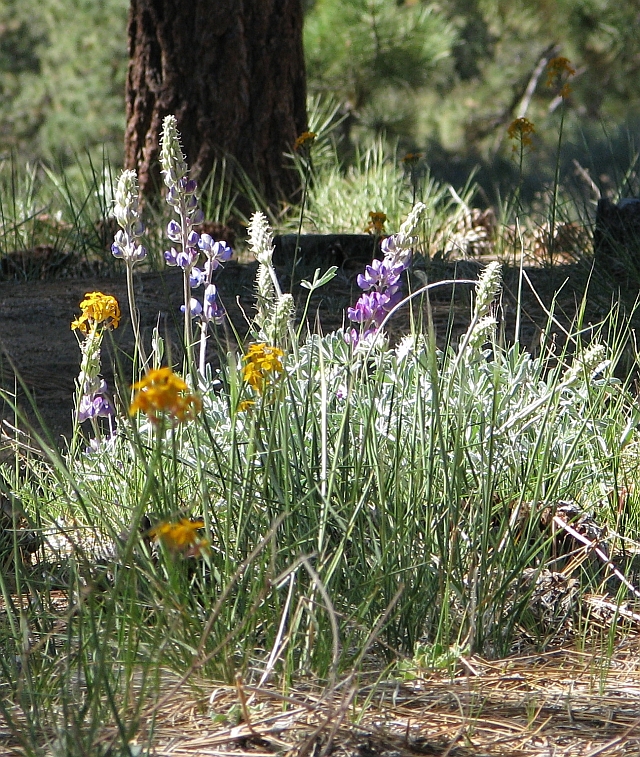
Flowers in sunlight (primarily lupine & wallflower) (L.Johnson 6/11)

We also found Violet-green Swallows bringing food to their nest in a small hole in a large pine tree; the sharper hearing among us could hear the young in the nest peeping. A female Purple Finch was busily building a nest in a needle-tuft at the end of a low limb; I wonder how it will do when strong winds blow. Band-tailed Pigeons passed back and forth but never stopped. Mountain Chickadees were gathering food among the needles and on the ground, as were both Purple & Cassin’s Finches. Western Bluebirds were feeding their young.

Male Cassin's Finch (L.Johnson 6/11)

At the end-of-the-road Iris Meadow area, we searched the current patches but found no Calliope’s, but the Fox Sparrows were very entertaining. White-headed Woodpeckers were carrying food. We intended to picnic by the meadow, but – judging by the drumming – a Native American Powwow was taking place, and several people didn’t think they could handle the thumping. We picnicked down at Mt. Piños Campground, then vainly searched one more location for Calliope’s, and left for home.

The weather was great, the birds are busy, the flowers are coming into bloom – Telegraph Weed, Indian Paintbrush and various lupines, among others, were everywhere – and the campgrounds were nearly empty. It’s a great place to camp and clear nights are great for star gazing & satellite spotting. Call the local ranger station for information at 661-245-3731; camping reservations are 877-444-6777, but frankly, the campgrounds were so empty you could probably just show up and get a site.  [Chuck Almdale]

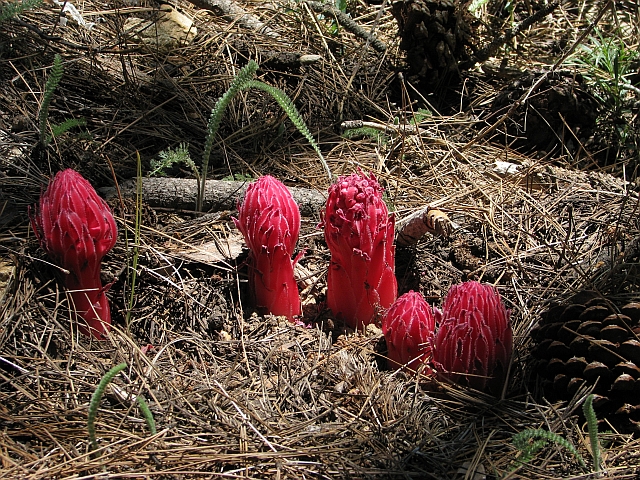
Snow Plant (L Johnson 6/11) Put cursor over picture for additional information

Mt. Pinos ranger district website.

Mt. Piños Field Trip


18 June, 2011

Number

California Quail

10

Band-tailed Pigeon

12

Mourning Dove

8

Black-chinned Hummingbird

1

Acorn Woodpecker

6

White-headed Woodpecker

2

Northern Flicker

2

Western Wood-Pewee

10

Steller’s Jay

12

Western Scrub-Jay

3

American Crow

6

Common Raven

4

Violet-green Swallow

30

Mountain Chickadee

7

Red-breasted Nuthatch

4

White-breasted Nuthatch

4

Pygmy Nuthatch

15

Western Bluebird

20

American Robin

1

European Starling

8

Yellow-rumped Warbler

1

Green-tailed Towhee

4

Spotted Towhee

2

Chipping Sparrow

18

Fox Sparrow

6

Dark-eyed Junco

2

Purple Finch

4

Cassin’s Finch

10

House Finch

2

Total Species

29

In the News: Wind Turbines; Malibu Lagoon Restoration

June 6, 2011
by

Running the Gantlet at Altamont Pass
An average of 67 Golden Eagles annually die negotiating the 5,000 windmill thicket. It would take 167 pairs of locally nesting eagles to replace that loss; only 60 pairs remain. Includes a short video. From the Los Angeles Times, 6 June. Writer: Louis Sahagun.
http://www.latimes.com/news/local/la-me-adv-wind-eagles-20110606,0,4078175.story
***************************************

AND NOW A BRIEF WORD FROM OUR SPONSOR…
What species is this bird?  Identity is revealed at bottom.

Mystery Bird: 6 June, 2011; No. San Fernando Valley

MALIBU LAGOON
The lagoon seems to show up in the news nearly as often as its movie star neighbors. If you missed the recent dustup, here’s some articles to bring you up to date. [Other websites, especially those of newspapers, sometimes change the location of an article. If a link supplied below fails to connect, let me know it’s not working and try to find it yourself.]

Years ago, Heal The Bay took a leadership role (my impression at the time?: because no one else wanted to) in bringing the everlasting scientific analysis of the lagoon to completion and dragging people together to agree on a course of action. They’re still involved. Additional links are available at this HTB website article posted in late May.  http://www.healthebay.org/blogs-news/malibu-lagoon-restoration-delayed
***************************************

Judge Delays Malibu Lagoon Restoration for at least a year
Environmentalists are divided over the project, which was halted by a suit saying it would damage existing habitat, including aquatic vegetation and fish, and would remove a pathway to popular Surfrider Beach. From Los Angeles Times, 1 June. Writer: Tony Barboza.
http://www.latimes.com/news/local/la-me-malibu-lagoon-20110601,0,1568244.story
***************************************

Going back in time a little bit, here’s some pertinent background information.
Surf, Sewage Form a Combustible Mix in Malibu
The city is eager to complete Legacy Park, where storm water would be treated. But environmental groups say officials aren’t taking adequate steps to prevent sewage from leaching into the ocean. From Los Angeles Times, 7 January, 2009. Writer: Martha Groves.
http://www.latimes.com/news/local/la-me-malibu7-2009jan07,0,6899598.story
***************************************

The New York Times decides to weigh in.
Battle Over Lagoon Cleanup Divides a Surfing Haven
Some surfers worry that a $7 million plan to dredge the Malibu Lagoon could affect the sand flow to the beach, destroying what many call the perfect wave. The New York Times, 25 May. Writer: Adam Nagourney.
http://www.nytimes.com/2011/05/26/us/26malibu.html
***************************************

I’m printing this following article in its entirety. I thought it a nicely written outsider viewpoint, but all the links to it were severed since it was sent to me two weeks ago and it took me about a hour to track it down elsewhere. The link I eventually found took me to the “Wine Industry Insight” Newsletter, of all places: http://www.wineindustryinsight.com/RSS//index.php/hop/latest/1/50345

Malibu lagoon cleanup turns messy

By NOAKI SCHWARTZ Associated Press
Posted: 05/21/2011 01:06:13 PM PDT

MALIBU, Calif.—It seemed like a green dream: clean water groups, scientists, state agencies and surfers were communing with each other to restore a stagnant seaside lagoon.But environmental issues in Malibu, one of California’s most scenic stretches of coastline, are never simple and this one has become especially murky. In a town where ecological activism thrives, green comes in many stripes. Residents have fought to keep leaky septic tanks to prevent more development. And one of the latest dust-ups is a proposal by U2 guitarist the Edge to build what he claims are environmentally friendly mansions that some say are not so green.

Seven months since the Coastal Commission approved the multimillion-dollar plan one-time participants have become enemies and squared off in a battle that is unusual in a conservationist culture where disagreements are rarely aired publicly.

Lawsuits have been filed. Accusations of people selling out are flying. Each camp is arguing over who has better experts. One of the nonprofits even alerted police that protesters were mobilizing on Facebook to disrupt their annual fundraising dinner this week.

On Friday, a judge issued a preliminary injunction to halt the project, but that is unlikely to settle the matter or quell criticisms lobbed between conservationists.

“Everybody supports this, it’s just these fringe groups,” said Mark Abramson of Santa Monica Bay Restoration Commission, who has spent a decade

working on the project. “They followed this unbelievable process of public participation and got the best of the best to work on it.”The site in question is a 13-acre lagoon located where Malibu Creek meets the Pacific Ocean at famed Surfrider Beach. Streams tumble down through canyons in the Santa Monica Mountains, past an upscale strip mall and across a coastal highway where they eventually make their way into the lagoon.

Now part of a state park, the wetlands were used as a dump by the state Transportation Department until the 1970s when it was converted into baseball fields.

An effort to restore the wetlands in 1983 dredged out a lagoon and created three channels but also created stagnant water. With little oxygen in the water for fish, green scum and dead zones thrived in the channels, say scientists.

On a recent day after some rains, the pungent odor of guano mixed with the scent of the surrounding California sage brush. Ducklings swam upstream through the low waters. White egrets stood in the lagoon as brown pelicans roosted on a sandbar.

The restoration plan calls for herding all the fish and other animals from the three channels into the main lagoon and creating berms to keep them there temporarily during wetlands work. The three channels will be reconfigured into a single wider channel that scientists say will allow for better water flow and encourage a larger variety of birds and marine life.

A bridged path to Surfrider Beach would be removed to make room for the new wider channel. A second entrance to the beach would be widened and picnic tables and bird watching areas would be added.

Work was scheduled to start next month and finish by October, but is now likely to be delayed by a year until a court makes a final decision on the proposal. A hearing is scheduled in October.

The project, which has been supported by the Santa Monica Baykeeper, Surfrider and Sierra Club chapters, is estimated to cost as much as $6.5 million, bond money that is coming from the Wildlife Conservation Board and Santa Monica Bay Restoration Commission..

Opponents, including the Wetlands Defense Fund, Access for All and Coastal Law Enforcement Action Network, filed suit in San Francisco last year to stop the project because they said it would violate the California Coastal Act by damaging sensitive habitat and demolishing a public access point. The lawsuit also contends that proponents did not consider an alternative plan by a scientist named in the suit.

Marcia Hanscom, who heads two organizations opposing the project, said bond money is “overtaking rational thought” and blinding restoration supporters. She also said proponents don’t understand wetlands.

“The people who are related to this project have a marine biology bias and I don’t believe they understand the habitat on the land,” said Hanscom, who has a degree in communications. She said she lives with a biologist, so she “gets a lot of it by osmosis.”

Steve Hoye, with Access for All, is particularly upset about the loss of one of the original entrances to the beach and said input by those who oppose the restoration plan have been ignored.

“There’s no corruption here, we just don’t agree with their program,” he said. “They’ve really refused us entry into the process. Nobody takes any notice of what we have to say, they just blithely go forward and we don’t like it. If you’re not in the clique you don’t get listened to.”

Some in the restoration camp say opposition arose after they refused to hire Hanscom’s boyfriend, Robert “Roy” Van de Hoek, on the project’s scientific team, saying he was unqualified and too much of an advocate to be unbiased.

“They were on the original lagoon task force that signed off on this project in the first place,” said Suzanne Goode, senior environmental scientist for the project’s lead agency, California State Parks. “Roy did have a very emotional outburst at one of the meetings so from that moment forward I felt there was going to be a lawsuit.”

Hanscom and Van de Hoek, who worked for the Bureau of Land Management and U.S. Forest Service has a degree in biology and geography, denied supporting the project or angling to be on the scientific team.

“It’s not true, it’s a false statement. I’ve never tried to be on the science advisory committee of Malibu Lagoon,” he said. “I think we have been ignored.”

Mark Gold, president of Heal the Bay, which prepared the current restoration plan in collaboration with two state agencies, said he doesn’t understand why the accusations have become so personal.

“We now have people lying about us, questioning our technical credentials, saying we’re accepting bribes,” said Gold who has degrees in biology, terrestrial ecology and a doctorate in environmental science and engineering. “It’s the lowest kind of opposition.”
*********************************
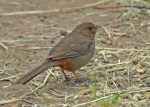
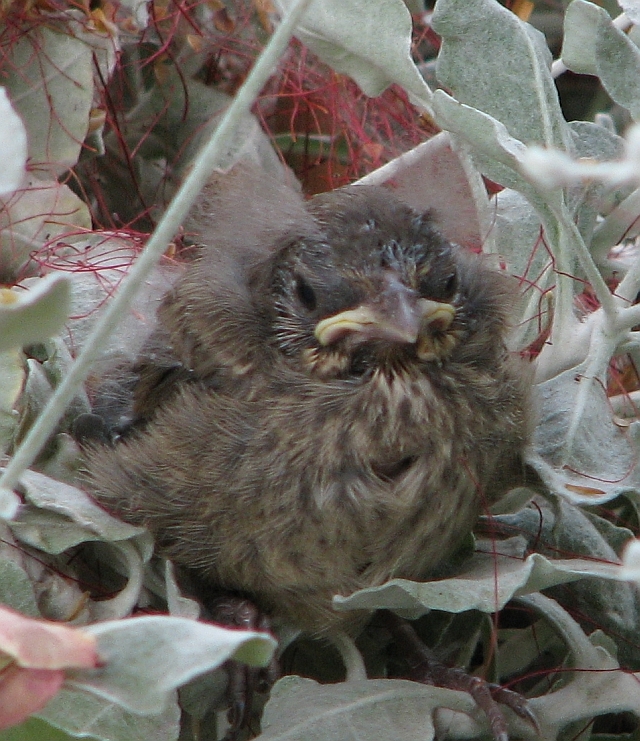
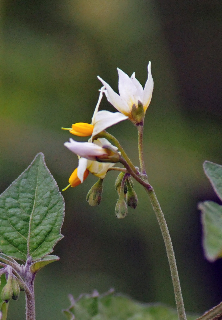
It’s a baby Brown Towhee in our back yard.
[Chuck Almdale]
Malibu Lagoon Field Trip Report, 22 May, 2011

May 30, 2011

Despite the oft-predicted and much-vaunted “End of the World” and/or “Day of Judgment”, Saturday, May 21 was no more noteworthy than usual for a Saturday in May, or for a Day of Judgment, for that matter. I think there’s been several dozen such days in the past 150 years, and so far…well, I hope none of you were surprised or disappointed by the lack of events. My absence caused a momentary riffle of consternation that I’d been raptured, an unlikely event under any scenario, but actually we were at the Grand Canyon, which is close enough to rapture for me. We saw a condor there, #246, very low overhead, much to our delight.

As a result, on Sunday, May 22, the coast was clear for some good ol’ Malibu Lagoon birding, led by the able and energetic Lucian, who supplied this report. Fourteen friendly people attended including a few new faces. Apparently Spring migration is almost complete, with few seasonal birds in attendance. The general species count was low, as were the number of beach people. There weren’t even many surfers. The outlet is currently a well-behaved stream, exiting far to the east near the lifeguard tower closest to the pier, but not endangering the riprap wall of the Adamson House. The beach berm is vegetated mostly with Sea Rocket and the sand mound is high and at least 100 feet deep. The Snowy Plover virtual fencing has been removed and – as last month – we saw no Snowies.

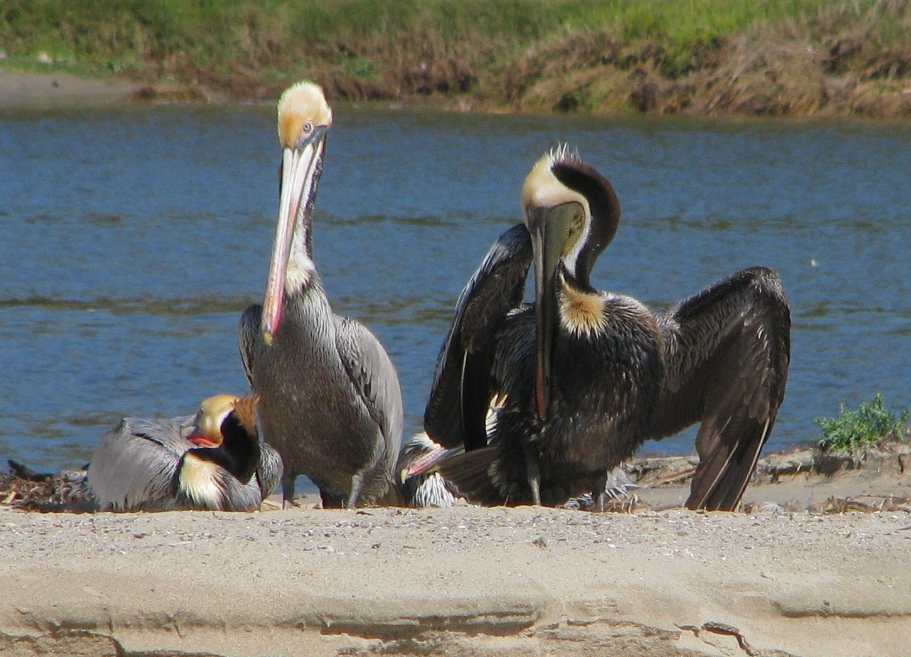
Brown Pelican adult and sub-adult (C.Almdale)

Gull count was extremely low; the Brown Pelicans were down to a more typical number. The most surprising sighting, surprisingly enough, was 7 Great-tailed Grackles. This species has been present at the lagoon 65 times since they first showed up in April 1995 and, except for 25 birds on 8/27/06, we’ve never seen more than 6 at a time. [OK, OK, 1 more than 6 doesn’t amount to much more, I admit.]

After birding the marsh and the beach for about two hours, a few hardy souls drive up to the Pepperdine reclamation ponds, but no new species were found.

As a reminder to those who plan to come to our 10 a.m. Parent’s & Kids birdwalk, they meet at the beach trail footbridge closest to the parking lot.

Check out our new blog page created especially for Unusual Birds at Malibu Lagoon, the permanent location for pictures of our uncommon birds. Look for other new pages coming in the future. For prior period bird lists, follow these links to July-Dec ’10Jan-June ’10, Jul-Dec ‘09, and Jan-June ‘09.  For an aerial photo of the lagoon (9/23/02), go here.   [Lucien Plauzoles & Chuck Almdale]

Malibu Census 2011

23-Jan

27-Feb

27-Mar

24-Apr

22-May

Temperature

68-75

45-60

54-61

59-68

64-68

Tide Height

+4.94

-0.41

+0.05

+0.19

-0.13

Low/High &Time

H:1117

L:1243

L:1216

L:1014

L:0816

Canada Goose

6

Gadwall

15

22

32

24

3

American Wigeon

4

Mallard

24

24

30

22

48

Northern Shoveler

4

2

Green-winged Teal

12

17

10

2

Surf Scoter

8

8

Bufflehead

5

2

Red-brstd Merganser

6

8

4

Ruddy Duck

40

33

15

3

Pacific Loon

1

1

15

20

Common Loon

1

1

Pied-billed Grebe

3

2

1

Horned Grebe

1

Eared Grebe

3

Western Grebe

6

12

20

2

Brandt’s Cormorant

1

3

Dble-crstd Cormorant

57

37

90

19

46

Pelagic Cormorant

4

3

1

2

Brown Pelican

42

23

89

740

81

Great Blue Heron

2

1

1

4

1

Great Egret

1

1

1

Snowy Egret

8

9

5

11

3

Blk-crwnd N-Heron

1

1

2

Turkey Vulture

3

Osprey

1

1

1

1

Cooper’s Hawk

1

Red-tailed Hawk

1

2

2

Peregrine Falcon

1

Virginia Rail

1

1

1

1

Sora

4

3

4

American Coot

145

175

153

32

25

Blk-bellied Plover

1

65

3

Snowy Plover

60

59

42

Semipalmated Plover

25

Killdeer

3

4

2

8

2

Black Oystercatcher

1

American Avocet

4

Spotted Sandpiper

2

2

1

Willet

1

7

3

Whimbrel

1

5

1

3

Ruddy Turnstone

5

Sanderling

135

Western Sandpiper

2

12

Least Sandpiper

10

18

20

25

Short-billd Dowitcher

1

Boneparte’s Gull

13

4

2

1

Heermann’s Gull

62

3

Mew Gull

1

Ring-billed Gull

120

250

50

52

16

Western Gull

100

120

100

160

10

California Gull

2500

1050

1100

450

8

Herring Gull

1

Glaucous-wingd Gull

2

3

2

Caspian Tern

5

61

4

Forster’s Tern

1

1

Royal Tern

3

Elegant Tern

4

12

12

Black Skimmer

3

3

Rock Pigeon

5

4

2

4

8

Eur. Collared-Dove

1

Mourning Dove

2

2

4

1

Anna’s Hummingbird

3

2

2

2

1

Rufous Hummingbird

1

Allen’s Hummingbird

6

3

4

2

4

Belted Kingfisher

1

1

1

Black Phoebe

4

5

12

8

4

Say’s Phoebe

1

1

Western Kingbird

2

American Crow

6

4

6

5

3

Rough-wingd Swallow

2

16

2

Tree Swallow

8

1

Violet-green Swallow

1

Barn Swallow

1

3

10

8

Cliff Swallow

1

31

Bushtit

9

6

4

Bewick’s Wren

2

1

2

House Wren

1

Marsh Wren

1

Northern Mockingbird

1

2

1

2

2

California Thrasher

2

European Starling

35

40

Ornge-crwnd Warbler

1

Yellow-rumpd Warbler

6

2

8

4

Common Yellowthroat

4

2

3

6

2

California Towhee

1

1

1

Savannah Sparrow

5

Song Sparrow

8

8

12

10

4

White-crwnd Sparrow

4

3

2

Red-winged Blackbird

1

4

6

1

2

Great-tailed Grackle

1

2

7

Brwn-headed Cowbird

3

3

House Finch

5

3

20

10

8

Lesser Goldfinch

4

4

1

4

American Goldfinch

8

Totals by Type

Jan

Feb

Mar

Apr

May

Waterfowl

106

126

99

51

51

Water Birds-Other

267

257

376

820

152

Herons, Egrets

11

12

7

16

6

Quail & Raptors

2

0

6

3

3

Shorebirds

82

301

71

74

5

Gulls & Terns

2785

1440

1270

743

51

Doves

7

4

4

9

9

Other Non-Pass.

10

6

8

4

5

Passerines

70

81

94

83

122

Totals Birds

3340

2227

1935

1803

404

           
Total Species

Jan

Feb

Mar

Apr

May

Waterfowl

7

10

6

4

2

Water Birds-Other

11

9

11

9

3

Herons, Egrets

3

4

3

3

3

Quail & Raptors

2

0

3

2

3

Shorebirds

8

10

7

6

2

Gulls & Terns

6

7

9

9

6

Doves

2

1

2

3

2

Other Non-Pass.

3

3

4

2

2

Passerines

17

15

18

17

16

Totals Species – 95

59

59

63

55

39

L.A. County Breeding Bird Atlas: Sponsor a Bird!

May 16, 2011
by

To All: We’re sending you this message on behalf of Larry Allen, local birder extraordinaire (especially gulls), who has indefagitably labored for years getting the Los Angeles County Breeding Bird Atlas organized, censused, collated and soon, very very soon, off to the printer. Lillian and I sponsored the Burrowing Owl page, but there are still species available for you! I encourage everyone to help the book, help the birds and help Larry get this book out.
[Chuck Almdale]
**********************************

What is faster than a speeding hummingbird, with more impact than a Peregrine hitting its prey?

You guessed it — a Breeding Bird Atlas Species Sponsorship!  They are going fast, and your $100 tax-deductible donation will have an impact now more than ever as we near the final publication of our Los Angeles County Breeding Bird Atlas.  Of 246 birds addressed in the Species Accounts, only 53 remain unsponsored.  Here are our orphans, crying for your help:

Fulvous Whistling Duck Western Wood-Pewee
Mute Swan Willow Flycatcher
[Ringed Teal] Gray Flycatcher
Gadwall Dusky Flycatcher
Northern Shoveler Ash-throated Flycatcher
Redhead Gray Vireo
Ring-necked Pheasant Plumbeous Vireo
[Wild Turkey] Cassin’s Vireo
[Brandt’s Cormorant] Purple Martin
[American Bittern] Tree Swallow
[Great Egret] Northern Rough-winged Swallow
[Snowy Egret] [Bank Swallow]
[Bald Eagle] Golden-crowned Kinglet
[Clapper Rail] Blue-gray Gnatcatcher
Virginia Rail [Common Myna]
Common Moorhen Nashville Warbler
Caspian Tern Virginia’s Warbler
Royal Tern [Hooded Warbler]
African Turtle-Dove Chipping Sparrow
Eurasian Collared-Dove Lincoln’s Sparrow
Inca Dove Yellow-headed Blackbird
Common Ground-Dove Brewer’s Blackbird
Blue-crowned Parakeet Great-tailed Grackle
White-winged Parakeet Brown-headed Cowbird
White-fronted Parrot European Goldfinch
Blue-fronted Parrot Pine Siskin
Yellow-headed Parrot

[Bracketed birds are: post-Atlas, historical, and island-breeding species, and will not have maps].

Don’t miss out! Order through Los Angeles Audubon’s website:
www.losanglelesaudubon.org
Click on Online Nature Store on right side of screen, then on Sponsor a Breeding Bird Species at the top.

Or, call Audubon House (323-876-0202), or send your check for $100 to Los Angeles Audubon (P. O. Box 931057, Los Angeles, CA 90093-1057) to sponsor your species. As an added bonus, Species Sponsors receive a free Atlas t-shirt, but these are limited in supply as well, so please sponsor now! (And watch this space for the announcement of a special pre-publication price on the Atlas volume.)

Larry Allen
Atlas Project Coordinator

Field Trip Report: Solstice Canyon, 7 May, 2011

May 15, 2011

The lovely riparian environment of Solstice Canyon greeted us with the Canyon Sunflower, California Towhees, Spotted Towhees, Wrentits, and this time, several Orange-crowned Warblers.  Each one of these species offered their own variety of the trill.  It either became confusing or the repetition helped people learn to distinguish the songs.

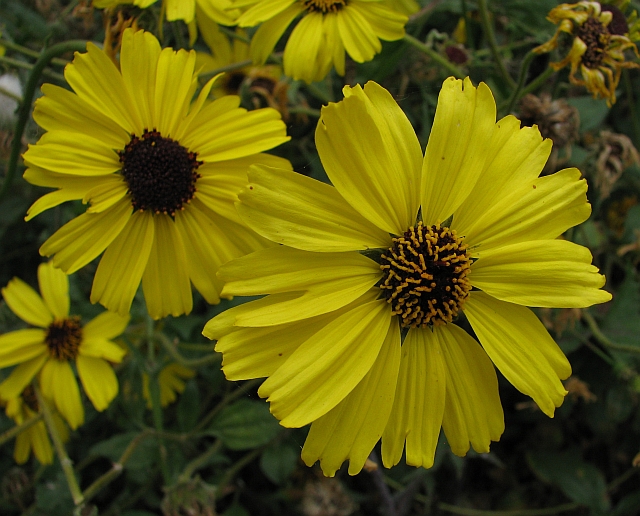
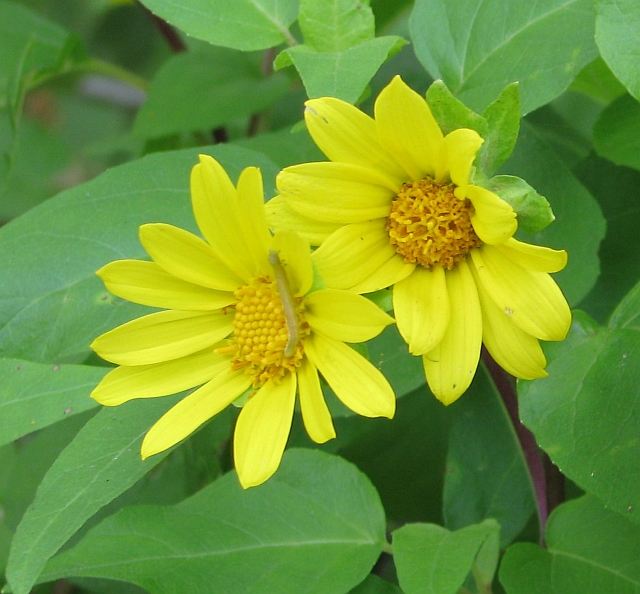
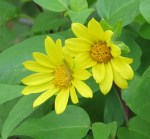
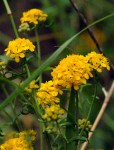
With the Canyon Sunflower (yellow center) on the moist side and the Bush Sunflower (brown center) on the dry side of the trail we could easily separate the two species.

Bush Sunflower (C.Almdale 5/11)

Canyon Sunflower - abundant this year (C.Almdale 5/11)

Margaret Huffman reminded us that there are only 3 rivers in the Santa Monica Mountains that have water during the Summer, and Solstice is one of them (Cold Creek & Malibu Creek are the others). Near the river we saw and heard a lot of Lesser Goldfinches and Pacific-slope Flycatchers. I didn’t realize that the California Bay trees need to be near the water which is why we see so many of them at Solstice.

When we made the big right turn to go up to the house, the Sycamore tree at the corner was still being used as a granary by the Acorn Woodpeckers.

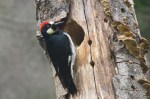
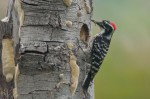
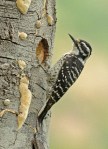
Female Nuttall's Woodpecker at nest-hole (J.Kenney 5/11)

A little further up the trail we found the nests of an Acorn family and a Nuttall’s Woodpecker family.  The last fire occurred in 2007 and it looks like the trees that died are just right for woodpeckers.  Perhaps we can look forward to more nests.  Along the slope towards the house, we could see Purple Sage, Black Sage and one White Sage and we managed to see Red-tailed Hawks & a Northern Flicker.  The racket from the Black-hooded Parakeets was deafening but we were rewarded with the sighting of two Mitred Parakeets among the group.

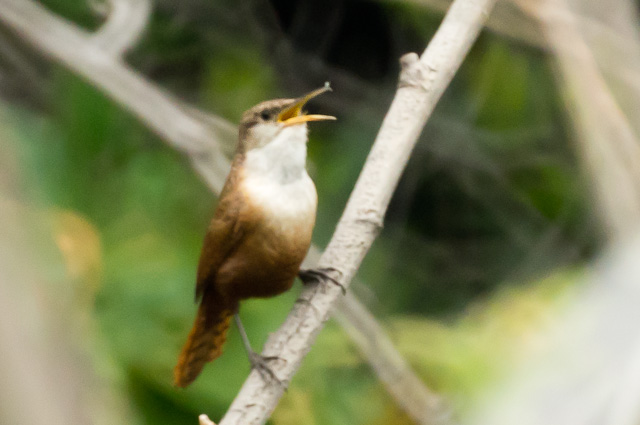
Canyon Wren singing downstream of burned house (C.Bragg 5/11)

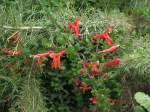
**** **** A Canyon Wren responded to our tape and perched in the branches of a dead tree for quite a while.  We got the 4 most likely Hummingbirds: Anna’s, Allen’s, Costa’s, & Black-chinned.  Common Yellowthroats, Black Phoebes, Bushtits, Dark-eyed Juncos, Song Sparrows, Bewick’s Wrens, Western Scrub Jays, Black-headed Grosbeaks all made their appearances.  The House Wrens serenaded us all the way up the slope.  At the top where the house is we saw the Hooded Orioles among the palms and heard another Canyon Wren.  The surprises were: Brown Pelican (a lot of them are being seen this year along our coast), California Thrasher (which I wish we could count on more often), White-breasted Nuthatch, Red-shouldered Hawk, and Phainopepla.  On our way back, we could hear the Purple Finch but it took a long time to spot it in the granary Sycamore.  We did see some Crows, Ravens, a Starling, an unknown empidonax flycatcher, and a Brown-headed Cowbird.

The butterflies must have felt it was not warm enough because we hardly saw any today but the flowers were great.  The yellow Bush Monkey-Flowers were growing in large patches and we got a first in this canyon: the Fringed Indian Pink.   [Jean Garrett]

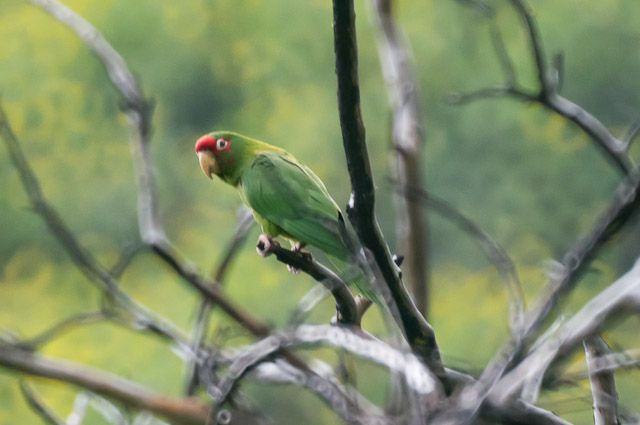
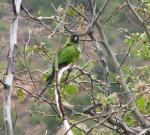
Mitered Parakeet (C.Bragg 5/11)

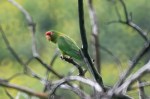
Parakeets: We were about 5 minutes walk below the burned house when a pair of Black-hooded Parakeets flew by, loudly squawking. I squawked back at them and – surprisingly – they lit in a nearby dead bush. We squawked some more and two more flew in and landed. These parakeets (all parakeets have long pointed tails) had red faces so they were something different. One had a bit of red on the forehead (see photo); on the other the red spread from the crown to behind the eye and below the bill. They both had prominent white eyerings, large pale bills, irregularly scattered red flecks on their head, neck and shoulders, but no visible red at bend of wing, tail or “leggings”. The more red-faced bird looked like Red-masked Parakeet, while the pictured bird looked more like Mitered. Both species are in the general  Malibu-Pt. Dumé area (as is Red-Crowned Parrot) although I had not seen either here before. Further research at home – confirmed by Kimball Garrett – convinced me they were both Mitered Parakeets, which are variable in the amount of red they show, the result of both age (less red on younger birds) and individual variation. If either were Red-masked, we should have seen red at the bend of the wing. [Chuck Almdale]
Trip report & checklist from May, 2010.
Triplist follows photo gallery below.
[Jean Garrett & Chuck Almdale]
On the website, click on a photo below to enlarge it & reveal additional notes.

TRIP LIST – SOLSTICE CANYON  5/07/11
PLANTS BIRDS

Nos.

WHITE Brown Pelican

1

California Blackberry California Quail

**

Lupine Red-shouldered Hawk

2

Morning Glory Red-tailed Hawk

4

White (Douglas’s) Nightshade Mourning Dove

4

White Sage Black-hooded Parakeet

14

YELLOW Mitered Parakeet

2

Bush Monkey-Flower White-collared Swift

3

Bush Sunflower Anna’s Hummingbird

12

Canyon Sunflower Costa’s Hummingbird

1

Deer Weed Allen’s Hummingbird

3

Golden Yarrow Acorn Woodpecker

10

Mustard* Nuttall’s Woodpecker

6

Pineapple Weed* Northern Flicker

3

RED Pacific-slope Flycatcher

8

Fringed Indian Pink Emipdonax ssp

1

Heart-leaved Penstemon Black Phoebe

6

PINK Western Scrub-Jay

6

Bush Mallow American Crow

12

Wild Rose Common Raven

6

PURPLE / BLUE Oak Titmouse

1

Black Sage Bushtit

12

Bull Thistle White-breasted Nuthatch

2

Bush Lupine Canyon Wren

2

Caterpillar Phacelia Bewick’s Wren

12

Common Vervain (Verbena) House Wren

20

Hummingbird Sage Wrentit

20

Milk Thistle* California Thrasher

1

Purple Nightshade European Starling

1

Purple Sage Phainopepla

1

Star Thistle Orange-crowned Warbler

8

TREES, SHRUBS, ON Common Yellowthroat

6

NOT IN BLOOM Spotted Towhee

10

California Bay California Towhee

12

California Walnut Song Sparrow

20

California Sagebrush Dark-eyed Junco

6

Coast Live Oak Black-headed Grosbeak

6

Coyote Bush Lazuli Bunting

2

Laural Sumac Brown-headed Cowbird

1

Mistletoe Hooded Oriole

2

Poison Oak Purple Finch

2

Spurge (Wood?) House Finch

30

Yucca – Whipplei Lesser Goldfinch

15

Total Plants  —  36 Total Bird Species

43

* – Introduced species

** – Heard only