Free email delivery
Please sign up for email delivery in the subscription area to the right.
No salesman will call, at least not from us. Maybe from someone else.
Field Class in Bird Identification
[Note: We have taught this class annually for the past five years. It will likely be offered again in February 2012. Watch for the announcement in late fall or early winter.]
This spring, SMBAS will offer a five-session field course in bird identification.The course is designed to help new or novice birders improve their observational skills while learning how to identify some of the species commonly found in the Los Angeles basin.
Beginning in February, 2011, the Saturday morning classes take place outside among the birds. Each class meets in a different local park or natural area so that participants may gain experience with the relationship between habitats and the species that rely on them.
Enrollment is limited to 8. A donation of $50 per SMBAS member or $75 per non-member will be requested. For further information, please contact Chuck at webinfo49 [AT] att.net or 310-617-8904. [Chuck Almdale]

Are we all looking at the same bird? (C.Almdale 12/10)
The deluge of rain broke for a few days (6” in 3 days at our house) and we found sunny skies at the lagoon. As expected, the lagoon was largely dry. I was surprised to find the outlet channel at the east end of the lagoon; usually the rain-filled creek blows straight through the beach, taking the sand with it. Instead, the beach was relatively intact, although obviously much water had washed over it and out to sea. The largest tree between the parking lot and the north channel has fallen. Salt water intrusion into the soil (since the park stopped watering the lawn) probably killed it and recent high winds blew it down.
In case anyone reading this has never visited the lagoon, the coastline runs east-west in Malibu. Thus the lagoon is south of the highway, with the beach and the ocean farther southward. Here’s an aerial photo. There are three channels in the green area left of the lagoon: the northernmost, nearest the parking lot, is so reed-filled in the photo that you can’t see any water. We reach the beach via the narrow brown path. If you look closely at the Malibu Colony houses in the lower left, you might find a Hollywood star reading a script (then again, probably not) or spot a Western Roof-Owl (more likely).
Gulls. Whew! Over 4000 gulls, most of them California, but also Ring-billed, Western, a handful of Heermann’s, even fewer Glaucous-winged, and 1 each of Boneparte’s and Herring to round out the lot. Plovers and shorebirds were down from November, but ducks were up, especially Ruddy Ducks, with 51 of them slowly drifting around on the north side of the highway bridge. A lone male Cinnamon Teal was in the 3rd (southernmost) channel. Cinnamon’s used to be quite common in the lagoon. For example, they averaged 25 in number during four visits in Feb-Apr 1981, 29 years ago!. It’s been over 20 years since they’ve numbered in the double digits.

Local film star NO:WW spends his 2nd winter at the Colony (C.Almdale)
Pelicans, herons & egrets, sandpipers and plover numbers all dropped. Our Snowy Plover population was 46 (down from November’s 58). Incidentally, last September’s count of 62 Snowies was an all-time high for the lagoon. Last month’s AY:AA (A=aqua, Y=Yellow) was joined by fellow bandee NO:WW (left: tan over orange, right: white over white). NO:WW was at the lagoon Oct ’09 – Jan ’10. I guess he (or she) liked it and came back. This bird was banded as a nestling in Summer ‘09 at Vandenberg Air Force Base west of Santa Barbara. (In case you didn’t know, our coastal military bases are excellent breeding habitats for our endangered Least Terns and threatened Snowy Plovers, as they keep out pesky human foot traffic and condo developers.)
We found only two Soras, both in the 1st channel reed beds. A Virginia Rail was in the same patch of reeds where we found it last month, so it’s probably the same individual. A Sora got quite miffed by the Virginia and hotly pursued it. It was odd to see the smaller Sora chase off the
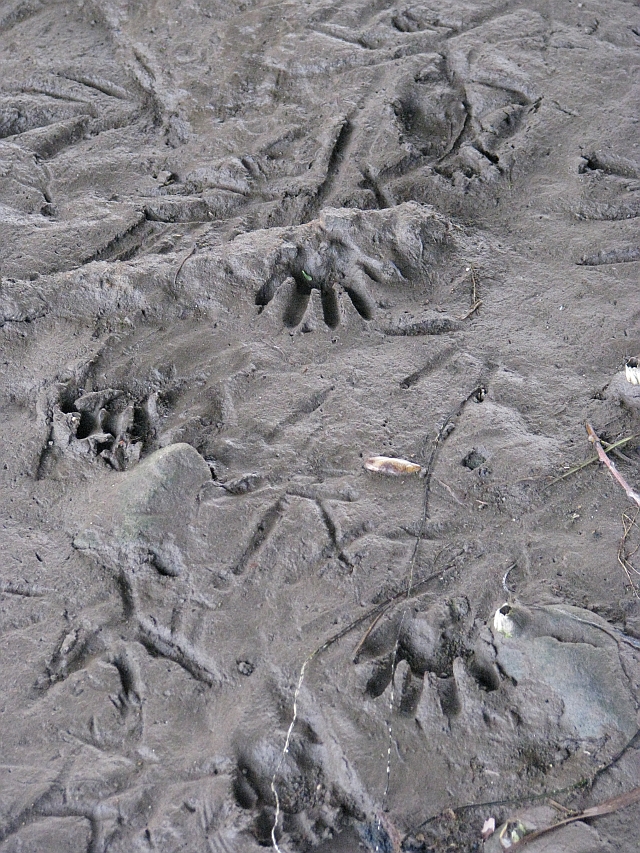
Proof that mysterious Handwalkers live under the highway bridge (C.Almdale 12/10)
larger bird. Raptors were more numerous: a pair of Red-tailed Hawks soared high overhead, while two Osprey took turns kiting over the lagoon, looking for a fish (big & juicy mullet preferred). Several times the gulls startled into flight by the Peregrine Falcon zooming past their heads, but we didn’t see it catch anything. A Red-shouldered Hawk snoozed in the cypresses near the golf course. A small flock of White-crowned Sparrows gleaned the brush not far from the parking lot. Even the hummingbirds were out and about, so I guess it wasn’t all that cold.
Check out our previous blog created especially for Unusual Birds at Malibu Lagoon, the permanent location for pictures of our uncommon birds. For prior period bird lists, follow these links to Jan-Jun‘10, Jul-Dec‘09, and Jan-June‘09. Trip lists for July – Dec. 2010 follow. [Note: we have little control over how this list appears in your email, so if you can’t make heads or tails of it, check the blogsite.] [Chuck Almdale]
| Malibu Census 2010 | 25-Jul | 22-Aug | 26-Sep | 24-Oct | 28-Nov | 26-Dec |
| Temperature | 60-67 | 68-75 | 70-79 | 60-65 | 55-65 | 50-62 |
| Tide Height | 4.05 | +4.32 | +5.54 | +6.02 | +2.59 | +2.13 |
| Low/High & Time | H:1036 | H:0933 | H:1055 | H:0952 | L:0842 | L:0649 |
| Brant | 6 | 5 | 5 | |||
| Gadwall | 20 | 2 | 6 | 16 | ||
| American Wigeon | 1 | 1 | 14 | 8 | ||
| Mallard | 49 | 55 | 48 | 10 | 18 | 29 |
| Cinnamon Teal | 1 | |||||
| Northern Shoveler | 4 | 8 | 10 | 18 | ||
| Northern Pintail | 6 | |||||
| Green-winged Teal | 7 | 17 | ||||
| Lesser Scaup | 1 | |||||
| Surf Scoter | 15 | 10 | ||||
| Bufflehead | 6 | 6 | ||||
| Red-brstd Merganser | 5 | 3 | ||||
| Ruddy Duck | 3 | 5 | 15 | 7 | 26 | 51 |
| Pacific Loon | 1 | 5 | ||||
| Common Loon | 1 | 1 | ||||
| Pied-billed Grebe | 5 | 9 | 18 | 3 | 2 | 4 |
| Horned Grebe | 1 | |||||
| Eared Grebe | 2 | 5 | 6 | 2 | ||
| Western Grebe | 4 | 6 | 16 | 35 | ||
| Brown Pelican | 187 | 163 | 46 | 40 | 40 | 13 |
| Dble-crstd Cormorant | 20 | 30 | 38 | 15 | 37 | 47 |
| Pelagic Cormorant | 1 | 1 | ||||
| Great Blue Heron | 6 | 6 | 5 | 3 | 7 | 1 |
| Great Egret | 4 | 4 | 6 | 2 | 4 | 3 |
| Snowy Egret | 14 | 19 | 14 | 2 | 31 | 16 |
| Green Heron | 1 | 1 | 1 | |||
| Blk-crwnd N-Heron | 4 | 7 | 10 | 6 | 8 | 6 |
| Osprey | 1 | 1 | 2 | |||
| Cooper’s Hawk | 1 | |||||
| Red-shouldered Hawk | 1 | |||||
| Red-tailed Hawk | 1 | 1 | 2 | |||
| American Kestrel | 1 | 1 | ||||
| Merlin | 1 | |||||
| Peregrine Falcon | 1 | |||||
| Sora | 1 | 1 | 1 | 7 | 3 | |
| Virginia Rail | 1 | 1 | ||||
| American Coot | 15 | 28 | 230 | 100 | 206 | 237 |
| Blk-bellied Plover | 55 | 78 | 100 | 110 | 44 | |
| Snowy Plover | 26 | 44 | 62 | 58 | 46 | |
| Semipalmated Plover | 6 | 11 | ||||
| Killdeer | 3 | 3 | 1 | 5 | 3 | |
| American Avocet | 5 | |||||
| Willet | 7 | 10 | 56 | 26 | 2 | 8 |
| Spotted Sandpiper | 1 | 2 | 3 | 2 | 3 | |
| Whimbrel | 48 | 8 | 17 | 2 | 2 | |
| Long-billed Curlew | 1 | |||||
| Marbled Godwit | 22 | 43 | ||||
| Ruddy Turnstone | 3 | 3 | 10 | 5 | 13 | 11 |
| Black Turnstone | 8 | 1 | ||||
| Sanderling | 4 | 30 | 20 | 290 | 150 | |
| Western Sandpiper | 20 | 4 | 28 | |||
| Least Sandpiper | 2 | 4 | 14 | 7 | ||
| Pectoral Sandpiper | 1 | |||||
| Short-billd Dowitcher | 1 | |||||
| Long-billed Dowitcher | 30 | |||||
| Wilson’s Phalarope | 1 | |||||
| Boneparte’s Gull | 5 | 1 | ||||
| Heermann’s Gull | 125 | 62 | 68 | 41 | 37 | 11 |
| Mew Gull | 1 | |||||
| Ring-billed Gull | 4 | 30 | 97 | 800 | 130 | |
| California Gull | 1 | 3 | 22 | 8 | 500 | 3850 |
| Herring Gull | 1 | 1 | ||||
| Western Gull | 80 | 66 | 73 | 52 | 130 | 110 |
| Glaucous-wingd Gull | 1 | 4 | ||||
| Caspian Tern | 13 | 13 | ||||
| Royal Tern | 2 | 2 | 1 | 2 | ||
| Elegant Tern | 10 | 45 | 40 | 4 | ||
| Common Tern | 8 | |||||
| Forster’s Tern | 5 | 6 | 5 | |||
| Least Tern | 36 | |||||
| Black Tern | 1 | |||||
| Black Skimmer | 35 | 103 | 6 | |||
| Rock Pigeon | 6 | 4 | 12 | 45 | 6 | 13 |
| Mourning Dove | 4 | 3 | 2 | 1 | 2 | 1 |
| Anna’s Hummingbird | 1 | 2 | 2 | 10 | 3 | 3 |
| Allen’s Hummingbird | 6 | 4 | 1 | 6 | 1 | 2 |
| Belted Kingfisher | 1 | 1 | 1 | 1 | ||
| Downy Woodpecker | 1 | |||||
| Gray Flycatcher | 1 | |||||
| Black Phoebe | 2 | 5 | 5 | 8 | 6 | 5 |
| Say’s Phoebe | 1 | 1 | ||||
| Cassin’s Kingbird | 1 | 2 | ||||
| Western Kingbird | 4 | 4 | ||||
| Western Scrub-Jay | 1 | 1 | ||||
| American Crow | 6 | 4 | 3 | 18 | 3 | 18 |
| Common Raven | 1 | |||||
| Tree Swallow | 1 | |||||
| Rough-wingd Swallow | 5 | 3 | 4 | |||
| Cliff Swallow | 10 | |||||
| Barn Swallow | 20 | 8 | 1 | |||
| Bushtit | 6 | 17 | 11 | |||
| Bewick’s Wren | 1 | 2 | 3 | |||
| House Wren | 2 | 2 | 2 | 2 | ||
| Marsh Wren | 4 | 1 | ||||
| Northern Mockingbird | 2 | 5 | 3 | 1 | ||
| European Starling | 80 | 7 | 62 | 15 | ||
| Yellow Warbler | 2 | |||||
| Yellow-rumpd Warbler | 15 | 8 | 12 | |||
| Blk-throated G. Warbler | 1 | |||||
| Townsend’s Warbler | 1 | |||||
| Common Yellowthroat | 4 | 5 | 4 | 10 | 5 | 4 |
| Wilson’s Warbler | 1 | |||||
| Western Tanager | 1 | |||||
| Spotted Towhee | 1 | 1 | ||||
| California Towhee | 2 | 1 | 4 | |||
| Savannah Sparrow | 1 | |||||
| Song Sparrow | 3 | 3 | 4 | 1 | 2 | 4 |
| White-crwnd Sparrow | 4 | 10 | 9 | |||
| Blue Grosbeak | 1 | |||||
| Lazuli Bunting | 6 | |||||
| Red-winged Blackbird | 1 | 2 | 14 | 2 | ||
| Western Meadowlark | 3 | 1 | ||||
| Brewer’s Blackbird | 15 | 1 | ||||
| Great-tailed Grackle | 1 | 1 | ||||
| Brwn-headed Cowbird | 3 | 1 | 3 | |||
| Hooded Oriole | 4 | 1 | ||||
| House Finch | 2 | 4 | 10 | 4 | 2 | |
| Lesser Goldfinch | 2 | 3 | 2 | 5 | 2 | |
| Lawrence’s Goldfinch | 2 | |||||
| American Goldfinch | 2 | |||||
| Totals by Type | July | Aug | Sep | Oct | Nov | Dec |
| Waterfowl | 58 | 71 | 93 | 28 | 108 | 159 |
| Water Birds-Other | 227 | 231 | 339 | 170 | 319 | 349 |
| Herons, Egrets | 28 | 37 | 36 | 13 | 51 | 26 |
| Quail & Raptors | 1 | 0 | 1 | 3 | 3 | 6 |
| Shorebirds | 127 | 162 | 325 | 164 | 490 | 315 |
| Gulls & Terns | 306 | 299 | 249 | 203 | 1481 | 4113 |
| Doves | 10 | 7 | 14 | 46 | 8 | 14 |
| Other Non-Pass. | 7 | 8 | 4 | 17 | 5 | 5 |
| Passerines | 152 | 76 | 176 | 76 | 37 | 86 |
| Totals Birds | 916 | 891 | 1237 | 720 | 2502 | 5073 |
| Total Species | July | Aug | Sep | Oct | Nov | Dec |
| Waterfowl | 3 | 4 | 6 | 5 | 10 | 10 |
| Water Birds-Other | 4 | 5 | 7 | 7 | 12 | 11 |
| Herons, Egrets | 4 | 5 | 5 | 4 | 5 | 4 |
| Quail & Raptors | 1 | 0 | 1 | 3 | 3 | 4 |
| Shorebirds | 10 | 10 | 16 | 5 | 10 | 10 |
| Gulls & Terns | 9 | 8 | 9 | 6 | 9 | 8 |
| Doves | 2 | 2 | 2 | 2 | 2 | 2 |
| Other Non-Pass. | 2 | 4 | 3 | 3 | 3 | 2 |
| Passerines | 16 | 19 | 29 | 14 | 13 | 17 |
| Totals Species – 120 | 51 | 57 | 78 | 49 | 67 | 68 |
Butterbredt Spring Christmas Count: Saturday, 18 Dec., 2010
Our count day came in the middle of all those rainy days in December, but since there were no weather breaks forecast, we decided to go ahead. Chris Lord, myself and Alice joined Jean Garrett and Ellen Vahan at the edge of the circle in Jawbone Canyon about 8:15 a.m. It was a little below 50 degrees and raining very lightly – but that was enough to keep most birds in hiding. We moved up a mile or so and got lucky – most of us spotted a Le Conte’s Thrasher. Little did we know that was to be the high point of the day, and at 9 a.m.!
As we made our way to Butterbredt Spring we began to slip a little in the very fine mud on the road. It was only an inch deep, but it was a perfect lubricant. By the time we reached the Butterbredt turnoff we were having difficulty going forward on the slightest of grades. So, thinking about the steeper roads to come, and the lack of cell phone coverage and other road traffic, we decided we had to turn back. Rats.
On the other side of the 15-mile diameter count circle people were having more luck. Keith Axelson and Mary Prismon covered the back roads near Sageland Ranch without difficulty. Bob Barnes had to skip part of his area, but only a part. Ali Sheehey covered several habitats without spinning out. Everybody reported fewer birds than usual, so we ended up about 10-12 species short of a typical count, and below half the number of birds.
Thanks to all the participants for coming out this year. If you believe in Birding Karma, next year we’ll get record numbers and the weather will be perfect. See you then! [Chuck Bragg]
| Butterbredt Christmas Count 12/18/10 | ||
| Mountain Quail | Oreortyx pictus | 1 |
| California Quail | Callipepla californica | 45 |
| Red-tailed Hawk | Buteo jamaicensis | 4 |
| Mourning Dove | Zenaida macroura | 4 |
| Western Screech-Owl | Megascops kennicottii | 1 |
| Great Horned Owl | Bubo virginianus | 2 |
| Ladder-backed Woodpecker | Picoides scalaris | 1 |
| Nuttall’s Woodpecker | Picoides nuttallii | 1 |
| Hairy Woodpecker | Picoides villosus | 1 |
| Northern (Red-shafted) Flicker | Colaptes auratus | 4 |
| Say’s Phoebe | Sayornis saya | 1 |
| Loggerhead Shrike | Lanius ludovicianus | 2 |
| Steller’s Jay | Cyanocitta stelleri | 31 |
| Western Scrub-Jay | Aphelocoma californica | 16 |
| Pinyon Jay | Gymnorhinus cyanocephalus | 3 |
| Common Raven | Corvus corax | 13 |
| Oak Titmouse | Baeolophus inornatus | 3 |
| Rock Wren | Salpinctes obsoletus | 1 |
| Bewick’s Wren | Thryomanes bewickii | 2 |
| Wren sp. | 1 | |
| Ruby-crowned Kinglet | Regulus calendula | 1 |
| Western Bluebird | Sialia mexicana | 18 |
| Hermit Thrush | Catharus guttatus | 1 |
| California Thrasher | Toxostoma redivivum | 2 |
| Le Conte’s Thrasher | Toxostoma lecontei | 1 |
| Yellow-rumped (Audubon’s) Warbler | Dendroica coronata | 2 |
| Spotted Towhee | Pipilo maculatus | 4 |
| California Towhee | Pipilo crissalis | 13 |
| Black-throated Sparrow | Amphispiza bilineata | 2 |
| Sage Sparrow | Amphispiza belli | 19 |
| Song Sparrow | Melospiza melodia | 7 |
| Lincoln’s Sparrow | Melospiza lincolnii | 2 |
| White-crowned Sparrow | Zonotrichia leucophrys | 436 |
| Golden-crowned Sparrow | Zonotrichia atricapilla | 12 |
| Dark-eyed (Oregon) Junco | Junco hyemalis | 233 |
| Dark-eyed (Slate-colored) Junco | Junco hyemalis | 1 |
| House Finch | Carpodacus mexicanus | 2 |
| Pine Siskin | Spinus pinus | 62 |
| Totals | 955 | |
| Species Total | 36 | |
The International Ornithological Congress has recognized the split between our New World Snowy Plover (Charadrius nivosus) and the Old World Kentish Plover (Charadrius alexandrinus), and it seems likely that the American Ornithological Union (AOU) will do the same. If they do, the US Fish and Wildlife Service will most likely also recognize this split. Here’s the write-up submitted to the AOU.
****************************************************************
Long term lagoon resident, Snowy Plover NO:WW (C.Almdale)
2010-A-1 N&MA Classification Committee p. 145-146
Separate Snowy Plover Charadrius nivosus from Kentish Plover C. alexandrinus
Description of the problem:
Despite their distinct geographic distributions, Palaearctic and Nearctic populations of Snowy Plover Charadius alexandrinus are currently considered to be a single species. Snowy Plovers in America were first described as Aegialitis nivosa by Cassin in 1858 (cited by Oberholser 1922), but the differences in adult plumage to Eastern Snowy Plovers were not deemed to be consistent enough to warrant full species status (Oberholser 1922).
New information:
Genetic differences between Eurasian and American populations of Snowy Plovers are substantial (Küpper et al. 2009). Mitochondrial DNA sequences of ND3 and ATPase differ by more than 6% between American and Eurasian populations. Φst values for North American and Eurasian populations are large (all population comparisons ≥ 0.95). Autosomal and sex chromosomal markers show distinct alleles for Eurasian and American Snowy Plovers. Fst values based on microsatellite analyses are above 0.25 for all population comparisons between Eurasian and North American Snowy Plovers. The American and Eurasian Snowy Plovers are more genetically differentiated than the Eurasian Snowy Plovers and African White-fronted Plovers C. marginatus (described by Vieillot 1818).
Genetic differences are also reflected in morphological and behavioural differences. Eurasian Snowy Plovers are larger than American Snowy Plovers. There are also differences in chick plumage and male advertisement calls (Küpper et al. 2009).
The North American subspecies nivosus, tenuirostris and occidentalis show genetic structuring, but mitochondrial sequence differences between subspecies are comparatively low (< 1%, Funk et al. 2007).
Recommendations:
1. Split Kentish Plover from Snowy Plover and adopt ‘Kentish Plover’ for Palaearctic populations
2. Change scientific name of Snowy Plover to Charadrius nivosus (Cassin 1858) with three subspecies: C. nivosus nivosus (currently C. alexandrinus nivosus), C. nivosus tenuirostris (currently C. alexandrinus nivosus) and C. nivosus occidentalis (currently C. alexandrinus occidentalis)
3. Keep scientific name Charadrius alexandrinus (Linneaus 1758) for Kentish Plover
Literature cited:
Funk, W. C., T. D. Mullins, and S. M. Haig. 2007. Conservation genetics of snowy plovers (Charadrius alexandrinus) in the Western Hemisphere: population genetic structure and delineation of subspecies. Conservation Genetics 8:1287-1309.
Küpper, C., J. Augustin, A. Kosztolányi, J. Figuerola, T. Burke, and T. Székely. 2009. Kentish versus Snowy Plover: Phenotypic and genetic analyses of Charadrius alexandrinus reveal divergence of Eurasian and American subspecies. Auk 126:839−852.
Linnaeus, C. 1758. Systema naturae per regna tria naturae :secundum classes, ordines, genera, species, cum characteribus, differentiis, synonymis, locis. 10th edition
Oberholser, H. C. 1922. Notes on North American birds. XI. Auk 39:72-78.
Vielliot, J. 1818. Ornithologie.
Submitted by:
Clemens Küpper, Department of Biology and Biochemistry, University of Bath, Bath, BA2 7AY, UK
Tamás Székely, Department of Biology and Biochemistry, University of Bath, Bath, BA2 7AY, UK
Terry Burke, Department of Animal and Plant Sciences, University of Sheffield, S10 2TN
Date of proposal: 23 Dec 2009
*********************************************
By following this link and then opening up the PDF file “Proposal 2010-A“, you can read the AOU document from which the above was extracted. Some of the other items of interest under consideration by the AOU and discussed in this document are:
1). Split Mountain Chickadee Poecile gambeli into two species:
A). Gambel’s Chickadee P. gambeli including subspecies P.g. gambeli, P.g. grinelli, P.g. inyoensis, P.g. wasatchensis.
B). Bailey’s Chickadee Poecile baileyae – the coastal California, Sierra Nevada, and Cascade populations, including subspecies: P.b. baileyae, P.b. abbreviatus, P.b. atratus.
2). Split the Common Moorhen (or Gallinule) Gallinula chloropus into:
A). Old World species Common Moorhen Gallinula chloropus
B). New World species Common Gallinule Gallinula galeata. An alternative English name suggested is Laughing Gallinule due to its distinctive call.
3). Split Yellow-rumped Warbler Dendroica coronata into two, three, or four species. You read that right! This one is really up in the air. If any of the proposed splits are accepted, our local subspecies D.c. auduboni will again be classified a full species, D.auduboni, probably again known as Audubon’s Warbler (the name which some of us have never stopped using).
4). Farther afield, yet fascinating to bird-geeks like me, the Sapayoa Sapayoa aenigma may get its own monotypic family, Sapayoidae. The species name aenigma (enigma) is extremely apt, as this little bird of Central Panama to extreme NW Ecuador continues to bamboozle ornithologists. Depending on which organization or ornithologist is talking, it’s a Mannakin, or a Tyrant Flycatcher, or in it’s own family, or a Broadbill, or even an Asity (a small family of 4 species endemic to Madagascar). Twenty years ago, Sibley & Monroe classified it incertae sedis (“uncertain position” or “We don’t know what the heck it is!”), and many Central/South American field guides still classify it as such. The Broadbill classification seems very odd to me, as the 15 recognized species of Broadbills are all Old World species, found in various tropical localities from Sierra Leone in west Africa to the central Philippine Islands. To be some sort of Broadbill would mean that the Sapayoa has somehow maintained it’s existence and integrity as a species for at least 52 million years, which seems extraordinary. I suspect that the dust will not soon settle on where the Sapayoa belongs on the evolutionary tree of birds. Don Roberson of Monterey, Ca., has a nice picture and write-up of this bird’s story on his website Birds Families of the World. [Chuck Almdale]
Field Trip Report: Wind Wolves Preserve, 4 Dec., 2010
[This report is a bit longer than usual because we found the preserve to be an especially beautiful and interesting place.]
Wind Wolves Preserve is located on the north slope of the Tecuya Ridge, the mountains on the south end of the San Joachin Valley, about 15 miles west of the Tejon (Grapevine) Pass and the #5 freeway. It was acquired about 16 years ago by The Wildlands Conservancy (TWC), a privately funded foundation. Weekdays are primarily devoted to programs for school children, with the weekends open for public use. It is very popular with bike riders who ride back and forth across the mountains from Pine Mountain Club, or car-shuttle back.
We’d arranged to meet with docents at 9 AM, so we had to speed past many grassland birds, including a Roadrunner, on the 3 mile drive from Hwy 166 to the front gate. TWC’s Ecologist Dave Clendenen, Preserve Education Director Sherryl Clendenen and Preserve Naturalist Paige O’Mara met us at the trailhead, and then graciously drove us in their large van several miles further up the canyon to “The Willows”, a beautiful riparian area filled with enormous ancient cottonwoods

At "The Willows" (L.Johnson 12/4/10)
and streamside willows. I was particularly impressed by one spot where the stream ran through the crotch of a huge cottonwood limb which – still living – was half-buried in the ground, blocking the flow. We stopped once on our way up Emigdio Canyon to check out the Golden Eagle sitting on the canyon ridge, but apparently it didn’t like the looks of the biped-filled metal box far below it, and flew away before most of us clambered out the van doors.

Anna's Hummingbird at Fuschias (Dan Siegler 12/4/10)
Emigdio Canyon was the route favored by the Indians and early Spanish to descend northward into the San Joachin valley. The bottom of the aptly named “Grapevine” route we currently use was then filled with brambly grapevines, bears and other such wildlife; thus, relegating foot traffic to the steep sides of the pass. Emigdio pass was a far easier route. The Canyon became part of a Spanish land grant and passed through several hands before TWC bought it. Altitude at the preserve ranges from about 800 ft near the north-end entrance to about 6000 ft. at its southern border in the mountains.

White-crowned Sparrow (Dan Siegler 12/4/10)
We wandered around the willows area for several hours, spotting birds, a few chill-tolerant butterflies and flowers, deer on the hillsides and bobcat scat (white and conical) at our feet. Red-tailed and Ferruginous Hawks, American Kestrels and a Prairie Falcon flew overhead, occasionally diving on a prospective breakfast, and we eventually saw the eagle again, unmistakable with its long, broad wings, finger-like spread primaries, slowly gliding down the ridgeline. On the rocky cliffs above us we found at least 4 eagle nests: the local pair doesn’t use the same nest every year. Dave informed us that the area is very popular in the spring with nesting Lawrence’s Goldfinches: anyone seeking this species – beautiful but tricky to reliably locate – should try this location. We tracked down a call in the willows to a Hutton’s Vireo (listen to it), gleaning on the willow stems. This is another species frequently difficult to find, and I don’t think that all of us got onto it before it moved off.
The latter half of March appears to be the best time for wildflowers, although this is variable, depending on winter rains and springtime temperatures. Late April – early May is best for nesting birds, especially Bullock’s Orioles and the goldfinches.
After lunch, those of us who didn’t have to immediately return home dawdled
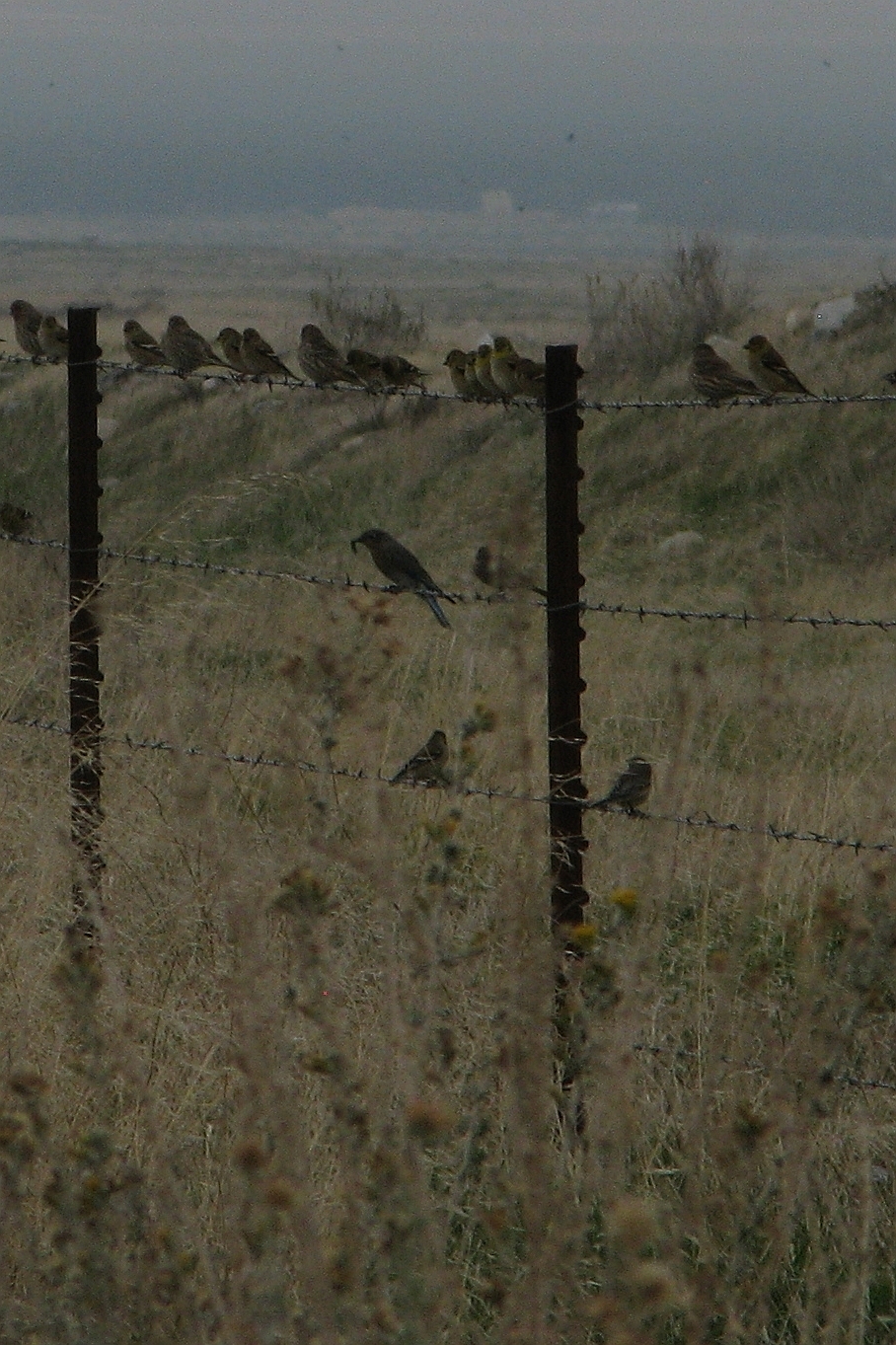
Mountain Bluebird, American Goldfinches & House Finches on fence (L.Johnson 12/4/10)
along the entrance road, adding species to the trip list. Most noteworthy were the enormous number of Mountain Bluebirds on the roadside fences and fields. We settled on a count of 200, but they were so numerous and constantly moving, that there could easily have been ten times that number. There were far more than any of us had ever seen anywhere before. We also saw the Roadrunner again, plus various blackbird species, Lark Sparrows and dozens of American Goldfinches.
Driving back down the #5, we decided to stop off at Quail Lake near Gorman and check the outlet channel for goldeneyes, as it had hosted a Barrow’s Goldeneye last winter. We didn’t find this species, but did find a small flock of diving ducks including Buffleheads and Common Goldeneyes among the Lesser Scaup. A chilly wind blowing down off the mountains finally drove us back into our cars.
We highly recommend Wind Wolves Preserve for hiking, birding, wildflowers & butterflies (in season) and biking. They also have campsites available (by reservation).
Thanks to everyone who came, and especially thanks to Dave, Sherryl & Paige for showing us around. Link to Wind Wolves Preserve website. [Chuck Almdale]
| Wind | Entrance | Quail | |
| TRIP LIST 12/4/10 |
Wolves | Road | Outlet |
| Lesser Scaup | 30 | ||
| Bufflehead | 20 | ||
| Common Goldeneye | 14 | ||
| Ruddy Duck | 3 | ||
| California Quail | 25 | ||
| Eared Grebe | 1 | ||
| Double-crested Cormorant | 3 | ||
| Northern Harrier | 6 | 2 | |
| Cooper’s Hawk | 1 | ||
| Red-tailed Hawk | 3 | ||
| Ferruginous Hawk | 1 | ||
| Golden Eagle | 1 | ||
| American Kestrel | 4 | 2 | |
| Prairie Falcon | 1 | ||
| Killdeer | 2 | ||
| Mourning Dove | 4 | 3 | |
| Greater Roadrunner | 1 | ||
| Anna’s Hummingbird | 2 | ||
| Nuttall’s Woodpecker | Heard | ||
| Northern Flicker | 2 | ||
| Black Phoebe | 4 | 7 | |
| Say’s Phoebe | 4 | 1 | |
| Loggerhead Shrike | 2 | ||
| Hutton’s Vireo | 1 | ||
| Common Raven | 12 | 15 | 3 |
| Bushtit | 15 | ||
| Rock Wren | 1 | ||
| Blue-gray Gnatcatcher | 1 | ||
| Ruby-crowned Kinglet | 6 | ||
| Mountain Bluebird | 200 | ||
| Hermit Thrush | Heard | ||
| American Robin | 3 | ||
| European Starling | 40 | ||
| American Pipit | 1 | ||
| Yellow-rumped Warbler | 4 | ||
| Spotted Towhee | 2 | ||
| California Towhee | 3 | ||
| Lark Sparrow | 8 | ||
| Savannah Sparrow | 20 | ||
| Song Sparrow | 1 | ||
| White-crowned Sparrow | 2 | 6 | |
| Golden-crowned Sparrow | 3 | ||
| Red-winged Blackbird | 1 | ||
| Western Meadowlark | 40 | ||
| Brewer’s Blackbird | 25 | ||
| House Finch | 12 | 18 | |
| Lesser Goldfinch | 8 | ||
| American Goldfinch | 70 | ||
| House Sparrow | 12 | ||
| Totals – 49 species | 28 | 21 | 9 |



 SANTA MONICA BAY AUDUBON SOCIETY BLOG