Free email delivery
Please sign up for email delivery in the subscription area to the right.
No salesman will call, at least not from us. Maybe from someone else.
Malibu Lagoon Trip Report: 23 May, 2010

Breakers over outer Malibu rocks (C.Bragg 5/10)
We thought April was a chilly day! It never rains in SoCal in May, but today was our second rainy day this month. OK, it was maybe 1/10 of an inch, but around here, that constitutes a major shower this time of year. Fortunately no rain at the lagoon, but it was very windy, dark clouds threatened in the distance and we never got our jackets off. The surfers were out in great numbers as big breakers were rolling in, but they were a bit blown out at the tops.
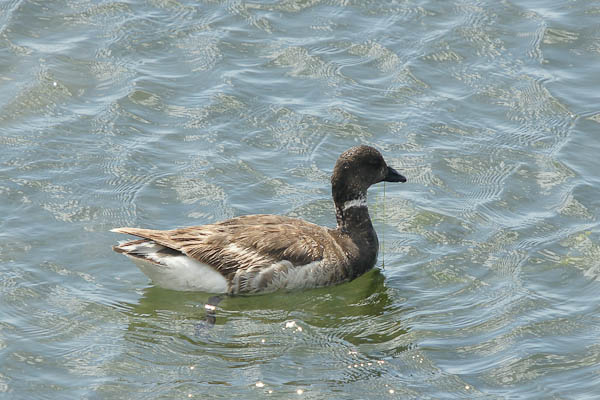
Brant (C.Bragg 5/10)
Numbers are definitely dwindling, as usual, heading for our usual low counts of June, the month when we often get the most people who want to look at birds. The swallows and Black Phoebes were very busy catching bugs. Some Mallard ducklings were closely trailing their parents around in the backs of the channels, and one Mockingbird was on the ground, busily hammering a hapless fence lizard into submission. The number of Brant had increased from April’s three to seven, all hanging out near the PCH bridge. In my 30 years of record keeping for the lagoon, this is the first time we’ve had more than three Brant at one time.

Caspian Terns (C.Bragg 5/10)
Out on the mudflat in the lagoon, there were still lots of Caspian Terns. One pair was busy courting: one brought the other a wriggling fish and not long afterwards he had mounted her. Afterwards, he remained standing on her back for what seemed longer than absolutely necessary, as if admiring the view from his lofty perch. Male and female seabirds are identical, so the only way for us to tell what sex they are is by who’s on top. There were also two Elegant Terns but – like last month – their numbers kept growing. I wonder if they might be feeding offshore nearby and come in to rest for a while, or if they’re sen route to a breeding ground farther north.

Plumy Snowy Egrets were in abundance (C.Bragg 5/10)
There wasn’t much birdlife at Adamson House (yes, the gate was open) but we spotted 32 Cedar Waxwings flying around overhead. They finally settled down somewhere across PCH. The end of May seems very late for these birds to still be here. Surprises never cease in the world of birding.
Links to 2009 Bird Counts: July-December 2009
| Malibu Bird Census | |||||
| for 2010 | Jan | Feb | Mar | Apr | May |
| Temperature | 45-65 | 55-61 | 68-80 | 62-70 | 54-62 |
| Tide Height | +.65 | +6.19 | +5.48 | +4.57 | +3.76 |
| Low/High & Time | L:1131 | H:0835 | H:0840 | H:0744 | H:0638 |
| (Black) Brant | 3 | 7 | |||
| Gadwall | 20 | 35 | 16 | 12 | 12 |
| American Wigeon | 12 | 14 | |||
| Mallard | 10 | 13 | 12 | 20 | 18 |
| Northern Shoveler | 4 | 8 | |||
| Green-winged Teal | 7 | 2 | 1 | ||
| Lesser Scaup | 1 | ||||
| Surf Scoter | 35 | 4 | 18 | ||
| Long-tailed Duck | 1 | ||||
| Bufflehead | 6 | ||||
| Red-brstd Merganser | 8 | 5 | 1 | 3 | |
| Ruddy Duck | 30 | 14 | |||
| Red-throated Loon | 1 | 1 | |||
| Pacific Loon | 1 | 1 | 5 | 4 | 5 |
| Common Loon | 1 | 3 | |||
| Pied-billed Grebe | 1 | 1 | 2 | ||
| Horned Grebe | 1 | ||||
| Eared Grebe | 3 | ||||
| Western Grebe | 15 | 6 | 27 | 35 | 1 |
| Brown Pelican | 35 | 81 | 184 | 182 | 124 |
| Brandt’s Cormorant | 1 | 2 | 2 | ||
| Dble-crstd Cormorant | 42 | 21 | 42 | 22 | 7 |
| Pelagic Cormorant | 1 | 1 | 1 | 1 | |
| Great Blue Heron | 2 | 2 | 2 | ||
| Great Egret | 3 | 3 | 2 | 2 | 2 |
| Snowy Egret | 15 | 4 | 7 | 13 | 12 |
| Blk-crwnd N-Heron | 1 | ||||
| Red-shouldered Hawk | 1 | ||||
| Red-tailed Hawk | 1 | 3 | 2 | 1 | |
| Peregrine Falcon | 2 | ||||
| Sora | 1 | 1 | 1 | 1 | |
| American Coot | 284 | 175 | 92 | 35 | 8 |
| Blk-bellied Plover | 45 | 59 | 25 | 7 | |
| Snowy Plover | 54 | 49 | 25 | ||
| Semipalmated Plover | 1 | 13 | |||
| Killdeer | 4 | 1 | 4 | 4 | |
| Black Oystercatcher | 2 | ||||
| American Avocet | 2 | 2 | |||
| Greater Yellowlegs | 1 | ||||
| Willet | 15 | 15 | 4 | 1 | |
| Spotted Sandpiper | 4 | 2 | 1 | 3 | |
| Whimbrel | 2 | 3 | 5 | 1 | |
| Marbled Godwit | 4 | 17 | 12 | 4 | |
| Ruddy Turnstone | 13 | 11 | 2 | 2 | |
| Surfbird | 3 | ||||
| Sanderling | 85 | 172 | |||
| Least Sandpiper | 21 | 14 | 30 | ||
| Boneparte’s Gull | 2 | 5 | |||
| Heermann’s Gull | 5 | 7 | 4 | 45 | 17 |
| Ring-billed Gull | 55 | 42 | 2 | 4 | 2 |
| California Gull | 875 | 45 | 27 | 108 | 95 |
| Western Gull | 45 | 74 | 48 | 105 | 68 |
| Glaucous-wingd Gull | 6 | 3 | 1 | 1 | |
| Caspian Tern | 2 | 30 | 25 | ||
| Royal Tern | 12 | 32 | 1 | ||
| Elegant Tern | 1 | 1 | 47 | 40 | 9 |
| Forster’s Tern | 1 | ||||
| Black Skimmer | 6 | 5 | |||
| Rock Pigeon | 8 | 4 | 4 | 4 | 6 |
| Mourning Dove | 2 | 2 | 6 | 6 | |
| Anna’s Hummingbird | 3 | 3 | 3 | 2 | 1 |
| Allen’s Hummingbird | 2 | 3 | 3 | 3 | 6 |
| Black Phoebe | 4 | 5 | 6 | 10 | 10 |
| Say’s Phoebe | 1 | 1 | |||
| Western Scrub-Jay | 1 | ||||
| American Crow | 5 | 4 | 4 | 4 | 4 |
| Rough-wingd Swallow | 1 | 3 | 10 | 1 | |
| Cliff Swallow | 2 | 12 | |||
| Barn Swallow | 2 | 8 | |||
| Oak Titmouse | 1 | ||||
| Bushtit | 4 | 5 | 4 | 6 | 4 |
| Bewick’s Wren | 2 | 1 | 1 | ||
| Northern Mockingbird | 2 | 3 | 2 | 2 | 4 |
| European Starling | 35 | 41 | 8 | 4 | 3 |
| Cedar Waxwing | 20 | 32 | |||
| Yellow-rumpd Warbler | 8 | 4 | 5 | 2 | |
| Common Yellowthroat | 3 | 1 | 1 | ||
| Wilson’s Warbler | 1 | ||||
| Spotted Towhee | 1 | 1 | 4 | ||
| California Towhee | 2 | 1 | 3 | 1 | |
| Song Sparrow | 3 | 6 | 8 | 12 | 10 |
| White-crwnd Sparrow | 4 | ||||
| Red-winged Blackbird | 3 | 2 | 1 | 4 | |
| Western Meadowlark | 1 | ||||
| Great-tailed Grackle | 1 | ||||
| Brwn-headed Cowbird | 2 | 1 | 1 | ||
| Hooded Oriole | 1 | ||||
| Bullock’s Oriole | 1 | ||||
| House Finch | 12 | 3 | 6 | 6 | 6 |
| Lesser Goldfinch | 4 | 2 | 2 | ||
| Totals by Type | Jan | Feb | Mar | Apr | May |
| Waterfowl | 134 | 73 | 70 | 38 | 37 |
| Water Birds-Other | 386 | 289 | 354 | 284 | 148 |
| Herons, Egrets | 20 | 7 | 12 | 15 | 16 |
| Quail & Raptors | 4 | 3 | 2 | 0 | 1 |
| Shorebirds | 251 | 328 | 87 | 73 | 5 |
| Gulls & Terns | 1006 | 209 | 133 | 339 | 216 |
| Doves | 10 | 4 | 6 | 10 | 12 |
| Other Non-Pass. | 5 | 6 | 6 | 5 | 7 |
| Passerines | 90 | 81 | 53 | 92 | 106 |
| Totals Birds | 1906 | 1000 | 723 | 856 | 548 |
| Total Species | Jan | Feb | Mar | Apr | May |
| Waterfowl | 11 | 6 | 7 | 4 | 3 |
| Water Birds-Other | 12 | 9 | 8 | 9 | 7 |
| Herons, Egrets | 3 | 2 | 4 | 2 | 3 |
| Quail & Raptors | 3 | 1 | 1 | 0 | 1 |
| Shorebirds | 12 | 9 | 9 | 11 | 2 |
| Gulls & Terns | 9 | 8 | 8 | 9 | 6 |
| Doves | 2 | 1 | 2 | 2 | 2 |
| Other Non-Pass. | 2 | 2 | 2 | 2 | 2 |
| Passerines | 16 | 15 | 14 | 18 | 19 |
| Totals Species – 90 | 70 | 53 | 55 | 57 | 45 |
Bird Gleanings from “Science News”
Alternative flame retardants leach into the environment
Supposedly safer chemicals are spotted in peregrine falcon eggs in California.
http://www.sciencenews.org/view/generic/id/57666/title/Alternative_flame_retardants
***********************
First songbird genome arrives with spring
The genome of a songbird has been decoded for the first time. Zebra finches join chickens as the only birds to have detailed maps of their genetic blueprints.
http://www.sciencenews.org/view/generic/id/57818/title/First_songbird_genome_arrives_with__spring
***********************
Pigeons usually let best navigator take the lead
One bird usually leads the flock, but sometimes another gets a turn at the helm.
Make sure you watch the short video.
http://www.sciencenews.org/view/generic/id/57997/title/Pigeons_usually_let_best_navigator_take_the_lead
***********************
Dinos molted for a new look
In one species, adolescents appear to have sprouted a new type of feathers as they matured.
http://www.sciencenews.org/view/generic/id/58693/title/Dinos_molted_for_a_new_look
***********************
Archaeopteryx fossil seen in new light
X-ray technique reveals original tissue in the feathers of a primitive bird fossil.
http://www.sciencenews.org/view/generic/id/59062/title/Archaeopteryx_fossil_seen_in_new_light_
***********************
Earliest birds didn’t make a flap
The feathers of Archaeopteryx and Confuciusornis probably were not strong enough to support sustained flight.
http://www.sciencenews.org/view/generic/id/59174/title/Earliest_birds_didnt_make_a_flap
North American Butterfly Association Count Program
SMBAS members:
As birders tend to appreciate all flying things (well…maybe not mosquitoes and houseflies so much) we’re passing this message along to you.

We invite you to join NABA’s Butterfly Count Program so that scientists studying butterfly distribution and population fluctuations will have the benefit of important data from your area. Now is the time to plan a new count – it’s a great way both to help the environment and to have an exciting day in the field with friends who enjoy the natural world.
Butterflies are ideal indicators of the health of the environment because they are exquisitely sensitive to small changes in their world. Yet surprisingly little is known about butterfly population fluctuations and distributions throughout North America. Gathering information about these important pollinators is the goal of the annual Butterfly Count Program organized by NABA, the North American Butterfly Association.
Celebrating its 36th year in 2010, the Butterfly Count Program is a long-term citizen-scientist project, involving almost 500 counts and thousands of volunteers throughout the United States, Canada, and Mexico. Volunteers select a count area with a 15-mile diameter count circle and assemble a group to conduct a one-day census of all butterflies sighted within that circle.
As a result of a variety of unfavorable weather conditions in 2009, many counts recorded declines of as much as 50% in the number of butterflies observed. Participants in the upcoming 2010 butterfly counts will provide important data on how butterfly numbers rebound.
Published annually in the NABA Count Report, count data provide critical information about the geographical distributions and population sizes of the species counted. Increasingly, these data are being used by scientists to help address a wide variety of topics, including the fall migration of Monarchs and the effects of habitat changes on butterflies.
If a count already exists in your area, we hope that you can participate in and facilitate the existing count. [There are five counts in the LA area. Map and contact info. is HERE . CVA] Location of all US counts and contact information for their compilers can be found on the NABA website at www.naba.org/counts/maps08.html.
Sincerely,
Field Trip Report: Solstice Canyon, 8 May, 2010

Caterpillar Phacelia & busy pollinator (L.Johnson 5/10)
Solstice Canyon is one of the prettiest canyons around. Although it is an uphill walk, it is not steep. The first mile or so is paved, permitting wheelchair accessibility. As a result, our resident flowers & butterflies expert Margaret Huffman was able to accompany us and keep us entertained with her encyclopedic knowledge. Leader Jean Garrett kept us moving along, but there was so much to see and hear and smell, that our 3-hour trip stretched out to over four hours.

A very cryptic Fence Lizard (L.Johnson 5/10)
Most of the local chaparral and riparian birds were building nests or hauling food to hungry nestlings or busily singing up a storm. On this warm day, the air was filled with insects which the various flycatchers were happily thinning out. The Black-hooded Parakeets – now resident in nearly all of our Westside canyons – were flying in and out of nesting holes in the sycamores. The numerous small holes in the large granary tree by the bridge was nearly depleted of acorns: apparently the local Acorn Woodpecker clan had used up their stores and would have to rely on insects until the next crop comes in.
We heard at least 3 Canyon Wrens: 2 below the ruined house at the end of the trail, and one above the waterfall which was briefly spotted flying away from its song-perch. Hikers were in abundance on this beautiful day.
Next year we may begin this hike a few hours later in order to maximize the presence of butterflies. Cold-blooded creatures, they don’t really get moving until it’s nice and warm.

Pacific-slope Flycatcher (L.Johnson 5/10)
| Flowering Plants | Bird List | Nos. |
| Black Mustard – I | California Quail | 1+H |
| Black Sage | Red-tailed Hawk | 3 |
| Bristly Mallow – I | American Kestrel | 2 |
| Bull Thistle – I | Mourning Dove | 15 |
| Bush Mallow | Black-hooded Parakeet | 7 |
| Bush Sunflower | White-throated Swift | 7 |
| California Bay | Black-chinned Hummingbird | 3 |
| California Sycamore | Anna’s Hummingbird | 8 |
| California Walnut | Costa’s Hummingbird | 5 |
| Canyon Sunflower | Allen’s Hummingbird | 2 |
| Caterpillar Phacelia | Acorn Woodpecker | 12 |
| Cliff Aster | Nuttall’s Woodpecker | 6 |
| Deer Weed | Northern Flicker | 1 |
| Elderberry | Pacific-slope Flycatcher | 3 |
| Euphorbia Terracina – I | Black Phoebe | 6 |
| Filaree – I | Ash-throated Flycatcher | 5 |
| Fringed Indian Pink | Warbling Vireo | 6 |
| Giant Wild Rye | Western Scrub-Jay | 10 |
| Hummingbird Sage | American Crow | 10 |
| Milk Thistle – I | Common Raven | 3 |
| Purple Nightshade | Violet-green Swallow | 8 |
| Purple Sage | Oak Titmouse | 2 |
| Purple Sage | Bushtit | 6 |
| Sagebrush | Canyon Wren | 1+H |
| Scarlet Pimpernel – I | Bewick’s Wren | 3 |
| Sow Thistle – I | House Wren | 8+H |
| Sticky Monkeyflower | Ruby-crowned Kinglet | 1 |
| Sticky Phacelia | Western Bluebird | 1 |
| White Alder | Wrentit | H |
| White Nightshade | Northern Mockingbird | 2 |
| Wild Cucumber | European Starling | 16 |
| Wild Morning Glory – I | Orange-crowned Warbler | 2+H |
| Yarrow | Yellow-rumped Warbler | 3 |
| Yellow Sweet Clover – I | Common Yellowthroat | 4+H |
| Yucca | Wilson’s Warbler | 3 |
| Total Flowering Plants-35 | Spotted Towhee | 6 |
| I – Introduced | California Towhee | 4 |
| Song Sparrow | 6+H | |
| Butterflies | Dark-eyed Junco | 2 |
| Buckeye | Black-headed Grosbeak | 4 |
| Cabbage White | Lazuli Bunting | 2 |
| California Sister | Red-winged Blackbird | 2 |
| Checkered White | Hooded Oriole | 1 |
| Lorquin’s Admiral | House Finch | 30+H |
| Painted Lady | Lesser Goldfinch | 20+H |
| Pale Swallowtail | Total Birds | 45 |
| Sara Orangetip | H = Frequently heard | |
| Spring Azure | ||
| Western Tiger Swallowtail | ||
| Total Butterflies – 10 |

Indian Paintbrush (G.Bando 5/10)
Great weather was the rule, although powerful, gusty winds on Highway 14 challenged control of my Dolphin RV on Friday evening. Three of us were en route to Sageland, in preparation for our Saturday morning meeting with the rest of our group at Butterbredt Spring.
Next morning, warmly dressed, we drove up and down through a frosty Butterbredt Canyon in Roxie’s 4WD hybrid Ford. We chose that route partly to test the road – which is often messed up by motorcycles and tricky to drive –but also to catch migrants. It was a hasty journey, but we heard unmistakable songs of Western Meadowlarks, briefly glimpsed a Mountain Quail scurrying up the hill, had a great look at a male Scott’s Oriole on a Joshua Tree, a Western Kingbird and a briefly perched Cooper’s Hawk. Approaching the spring, we saw large groups of migrants passing westward along the canyon’s sides and ridge, too quickly to count or even guess their names.

Western Kingbird (G.Bando 5/10)
We three – my daughter Roxane, my neighbor Linda Cady (retired Jr. High science teacher who loved camping with her students, is a nature enthusiast and new to birding) and I – met the rest of our group waiting at the Spring: Jean Garrett, Gloria Bando and Chris Lord. We later joined Keith Axelson at his Sageland Ranch where we camped and had dinner, including a cake to celebrate his 85th birthday on this trip, which he inaugurated many years ago. Many birders honor Keith as primarily responsible for establishing Butterbredt Spring as a premier birding destination and Sanctuary, supported by Santa Monica Bay Audubon.
8:15 a.m. is a little late to catch all the migrants, but we immediately found many species of birds. A beautiful male and female Black-throated Grey Warbler, Lesser Goldfinches, Chipping Sparrows, Dark-eyed Juncos, Wilson’s Warblers dripping off willow branches, male and female Black-headed Grosbeaks, Yellow-rumped Warblers in eye-popping breeding plumage and White-crowned Sparrows to list a few. Mourning Doves and House Finches were numerous. California Towhees, Bewick’s Wrens, House Wrens and Rock Wrens were all singing. Long-eared Owls and Roadrunners were absent, but maybe next year! Floral bonuses included: deep pink Beavertail Cactus on the slopes, many yellows, especially brilliant Biglow’s Coreopsis, Golden Bush, and other yellow composites. Purple Chia was also common, and deep blue, fragrant Bush Lupine warranted numerous pictures.
An interesting variety of difficult-to-identify lizards were a frequent distraction: we think they included a yellowish Southern Alligator Lizard, a Common Leopard Lizard, a Western Skink, a Whiptail and numerous Fence Lizards. I hesitate to speculate on butterflies, but American Ladies and small Blues were common.

Common Leopard Lizard. Cryptic, isn't it? (G.Bando 5/10)
While walking back up-canyon, Jean spotted a House Finch, seeming secure in its nest built in a very prickly cholla cactus. An Ash-throated Flycatcher perched and called. Hammond’s Flycatcher’s were in the Spring’s cottonwoods and along the trail. A couple of Loggerhead Shrikes sat on trailside Joshua trees. California and Mt. Quail and Chukar lurked and chattered in the shrubbery. The call of a male Mt. Quail tantalizingly, and invisibly, echoed down the canyon.
To our surprise we found both an out-of-place Acorn Woodpecker on a cottonwood tree in the desert canyon, and an excellent look at Green-tailed Towhee. Even more surprising was a Yellow-breasted Chat foraging low in trailside bushes and the base of willows beyond the large cottonwood. It was uncharacteristically silent, but willing to be seen!
Exploring independently around the spring, Chris found a MacGillivray’s Warbler, both Cassin’s and Warbling Vireos, and a Costa’s Hummingbird. We joined him and saw Hermit Thrushes working the ground and three Great Horned Owls in the trees. A Black-throated Sparrow was viewed singing.
Chris needed to leave early, so after lunch he took Jawbone Road to Sageland Ranch to say hi to Keith. Our two remaining vehicles tackled the sandy track back up Butterbredt Canon in hopes of eagles and other rarities. Jean, expertly driving her non-4WD car, managed the challenge. We saw Common Ravens and Red-tailed Hawks, but no Pinyon Jays or Golden Eagles by the time we exited onto Kelso Valley Rd. The pond and creek at Tunnel Well, which occasionally harbors Wilson’s Snipes, didn’t, but we added more Ruby-crowned Kinglets, Red-winged Blackbirds, a Killdeer and Spotted Towhee.
Welcomed at Sageland, we set up camp, explored the local canyon, relaxed and enjoyed observing the numerous nesting bird families as we added to our sightings. Of the dozens of wintering Pine Siskins, seven remained to swarm Keith’s finch feeders. Three nest boxes held active Western Bluebird families. One of the male bluebirds pounded a window periodically, as it had been doing for some weeks. A pair of Say’s Phoebes tended their nest under an eve. A pair of Phainopeplas displayed in the tree tops and an American Kestrel pair, nesting in the large box on the water tank, entertained us, with the male bringing lizards to feed his mate and spell her on egg duty. They eat a lot of lizards! At sundown, Kingbirds twittered as they settled to sleep in the trees, and groups of quail fluttered and chattered as they found their night’s roosts.
The Western Scrub-Jays patronized other feeders while small flocks of California Quails cleaned up below; the chipmunks vacuumed their share despite Keith’s black kitty watching for a chance to grab one.
The admirable Saki has learned never to make a move on a bird! He is probably one of the world’s few well-trained cats. Occasionally, a handsome little male Costa’s hummer with brilliant magenta georgette came to sip at the nectar feeder but, unfortunately, male or female Scott’s Orioles chose not to appear. A male Bullock’s Oriole did visit in the trees. Nuttall’s Woodpeckers, male and female, drummed to mark territory and find insects. More unique were the pair of Hairy Woodpeckers seen foraging in the grounds. I must mention the California Thrasher pouring out song up on the hillside, along with Bewick’s Wrens, and an Oak Titmouse sounding off. Morning calls included the unmistakable coo of a Eurasian Collared Dove, which has found its way to Keith’s land, and, of course, European Starlings.

Baby Blue Eyes on sandy soil (G.Bando 5/10)
Keith had prepared, mowed clear paths, cut away overgrown branches, improved the trail in his canyon for our safety and convenience. The stream flows continuously. It is an idyllic place. We were able to add Song Sparrow, Western Wood Pewee, Orange-crowned Warbler, Brewer’s Sparrow to our lists, if they had not been seen before, along with a debated empidonax flycatcher.
Townsend’s Warblers and a Plumbeous Vireo were seen later. At night, Western Screech-Owls gave their little warbling contact calls to prove their presence in a hollow cottonwood limb, where we hope they are raising a family. Also distant Great Horned Owls hooted under the ever brilliant desert starry sky.
On Sunday morning a pair of Ash-throated Flycatchers entertained us by continually examining the empty, for rent, nest boxes, bringing material with obvious thoughts of setting up housekeeping.
We we then hiked through fences and brush to Dove Spring Rd., admiring the flowers and checking Joshua Tree nest holes.

House Finch nest in Cholla cactus - Watch that first step when leaving! (G.Bando 5/10)
We found a pair of Cactus Wrens with a nest in progress in their favorite nesting location, a cholla cactus. We saw Western Kingbirds with similar intentions. Occasionally we needed to dodge roaring motorcycles (the only sour note in Paradise). Sadly, their idea of “fun” doesn’t merely miss the wonder of their surroundings but often defies all laws protecting that environment. Fortunately, the Friends of Jawbone Canyon, the BLM, and the SCA organization of young volunteers (which SMBAS supports financially), have made huge improvements in blocking and obliterating their illegal trails.
We also found a House Finch nest in a cholla. Theirs is an open-bowl nest unlike the Cactus Wren’s nest which is a roughly globe-shaped nest with a side entrance, always well-buried among the extremely thorny cholla branches. Incidentally, a cholla location did not save a wren nest last season when a bear came along, tore the nest and birds out of the cholla and devoured them!
As we hiked we could hear the melodic songs of distant Scott’s Orioles and the ever elusive Mt. Quail calling. We can be glad those are so cautious. Hunting season will test their survival strategies.
Most of our participants needed to head back to Los Angeles in the afternoon, but took with them, I believe, memories of a beautiful experience. I thank them, as does Keith, for joining us and making the outing a success.
I often think how very fortunate we are to have this tradition and connection to the real, wild world, where there is escape from the insanity, the violence, the unending consumerism, commercialism, and banal entertainments which currently dominate human society and destroy Nature. There, in the desert wilderness, one can escape to a haven of sanity, quiet, where all living things – animal, plant, and even the earth itself – are allowed to exist in peace, work out destiny, and, you can hear the birds sing!
All this peace may be gone at some point, of course, under the groaning rumble of wind turbines on the ridges (ask someone who lives near one; they are not as ecologically benign as touted.) Or when development creeps south along the valley road. But for now, we are greatly privileged. I am sorry some, who wanted to come, could not make it after all this year. Perhaps they and others will join us on another occasion. My species count may not be altogether complete. But it I will add it to almost 30 years of memorable Butterbredt Spring spring trips! Thanks, Keith, for having made them possible.
| Butterbredt Trip List | May 1-2, 2010 |
| Chukar | Western Bluebird |
| Mountain Quail | Hermit Thrush |
| California Quail | Northern Mockingbird |
| Cooper’s Hawk | California Thrasher |
| Red-tailed Hawk | European Starling |
| American Kestrel | Phainopepla |
| Killdeer | Orange-crowned Warbler |
| Eurasian Collared Dove | Yellow-rumped Warbler |
| Mourning Dove | Black-throated Grey Warbler |
| Western Screech-Owl | Townsend’s Warbler |
| Great Horned Owl | MacGillivray’s Warbler |
| Costa’s Hummingbird | Wilson’s Warbler |
| Acorn Woodpecker | Yellow-breasted Chat |
| Nuttall’s Woodpecker | Green-tailed Towhee |
| Hairy Woodpecker | Spotted Towhee. |
| Western Wood Pewee | California Towhee |
| Hammond’s Flycatcher | Chipping Sparrow |
| Say’s Phoebe | Brewer’s Sparrow |
| Ash-throated Flycatcher | Black-throated Sparrow |
| Western Kingbird | Song Sparrow |
| Loggerhead Shrike | White-crowned Sparrow |
| Plumbeous Vireo | Dark-eyed Junco |
| Cassin’s Vireo | Black-headed Grosbeak |
| Warbling Vireo | Red-winged Blackbird |
| Western Scrub Jay | Western Meadowlark |
| Common Raven | Brewers Blackbird |
| Oak Titmouse | Bullock’s Oriole |
| Cactus Wren | Scott’s Oriole |
| Rock Wren | House Finch |
| Bewick’s Wren | Pine Siskin |
| House Wren | Lesser Goldfinch |
| Ruby-crowned Kinglet | 63 Species |



 SANTA MONICA BAY AUDUBON SOCIETY BLOG