Free email delivery
Please sign up for email delivery in the subscription area to the right.
No salesman will call, at least not from us. Maybe from someone else.
Help Monitor Least Terns at Venice Beach!
The California Least Tern is listed as endangered by both Federal and California state authorities, and Los Angeles Audubon Society is looking for dedicated volunteers to help monitor them at Venice Beach.
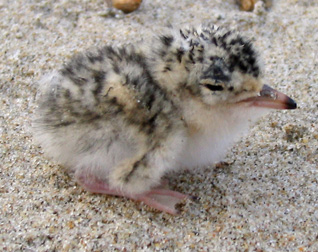
Least Tern chick
In Los Angeles County, this species has only two breeding colonies: Venice Beach and the Port of Los Angeles. L.A. Audubon works with project biologists and the California Department of Fish & Game studying the tern colony in Venice by coordinating a community-based science monitoring program during the nesting season. Volunteers receive training and then help monitor the colony for one hour each week from mid-April to mid-August. This is a great opportunity for families looking for a way to learn about nature together, for students looking to gain some field experience in environmental science, or anyone who’d like to know more about urban wildlife. Many Santa Monica Bay Audubon chapter members have volunteered in previous years.
If you’re interested, then they’d love to meet you at one of the following training sessions:
Monday, April 26th, 6:30 p.m. to 7:30 p.m.
Saturday, May 1st, 9:00 a.m. to 10:00 a.m.
Training Location: The sessions will take place at the Least Tern Colony enclosure on Venice Beach, located a few short blocks north of the Ballona Channel at the southern end of Venice Beach. There is metered parking along the channel where Pacific Ave. turns into Via Marina, and there’s a public pay lot at the intersection of Via Marina and Captain’s Row. There’s free parking along Pacific Ave. but the spots disappear quickly.
Volunteers need attend only one of these sessions, though you’re welcome to attend both. Binoculars are essential to monitoring, so please bring them with you if you own them. If you don’t own any, they can lend you a pair for the season. If neither of these dates work for you, please let them know and they’ll see if they can arrange an alternative training session.
Questions? Please contact the Volunteer Coordinator at (323) 481-4037 or email: tern@laaudubon.org.
From: Stacy Vigallon
Weeds and Springtime
WEEDS! The copious, welcome rain has invigorated trees and shrubs of the chaparral and brought forth a wealth of wildflowers. But they also have created a lush cover of weeds that smother and choke our lovely, treasured native plants and convert swathes of chaparral and coastal scrub into weed patches that turn into semi-desert in the fall and winter, ripe for invasion by other weeds or fire. We are witnessing a type conversion of native habitat into a fire-prone wasteland.
What to do? No one expects an average homeowner to take on the task of clearing all these weeds by her or himself. But each of us can make a contribution. Assuming you take care of an average homeowner’s piece of land, at the least, you should try to keep it weed-free. This means you should pull out or otherwise destroy non-native grasses. Almost any grass that “volunteers” in your yard is not native. You will also want to get rid of non-natives like oxalis (oxalis pes-caprae, or Bermuda buttercup), no matter how pretty they are.
Better yet, you may spend a few hours on a “weed war” with the California Native Plant Society, helping free habitat from nasty weeds. Call CNPS for information on how you can help.
I don’t think the temperature ever made it up to 70° and those of us (me) who assumed it would warm up significantly tended to be
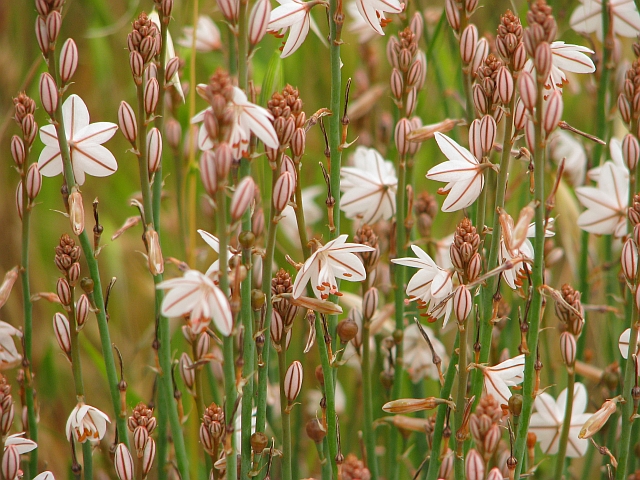
Garlic blooms (L.Johnson)
chilled for much of the hike. The flowers and birds, however, were certain it was spring. Many of the birds noted were never seen, only heard: of the House Wrens, for example, we probably didn’t see more than 4 of the 32 cited; the rest were gaily singing from hidden perches in nearly every tree we passed. We saw so many flowers that our four-mile hike stretched out to five hours long, as we continually asked Peggy Burhenn, our indefatigable leader, “Hey, what’s this flower?” (Repeat 1000 times.) What she didn’t immediately know, she diligently looked up in her large handbook of California flowering plants.
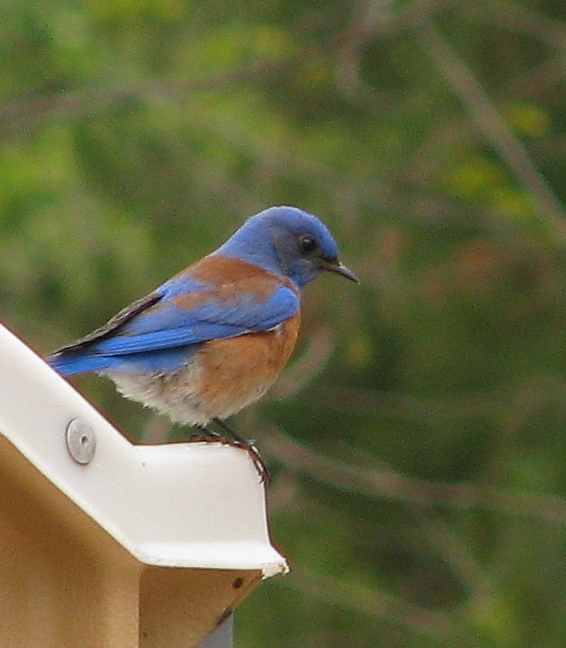
Western Bluebird male (L.Johnson)
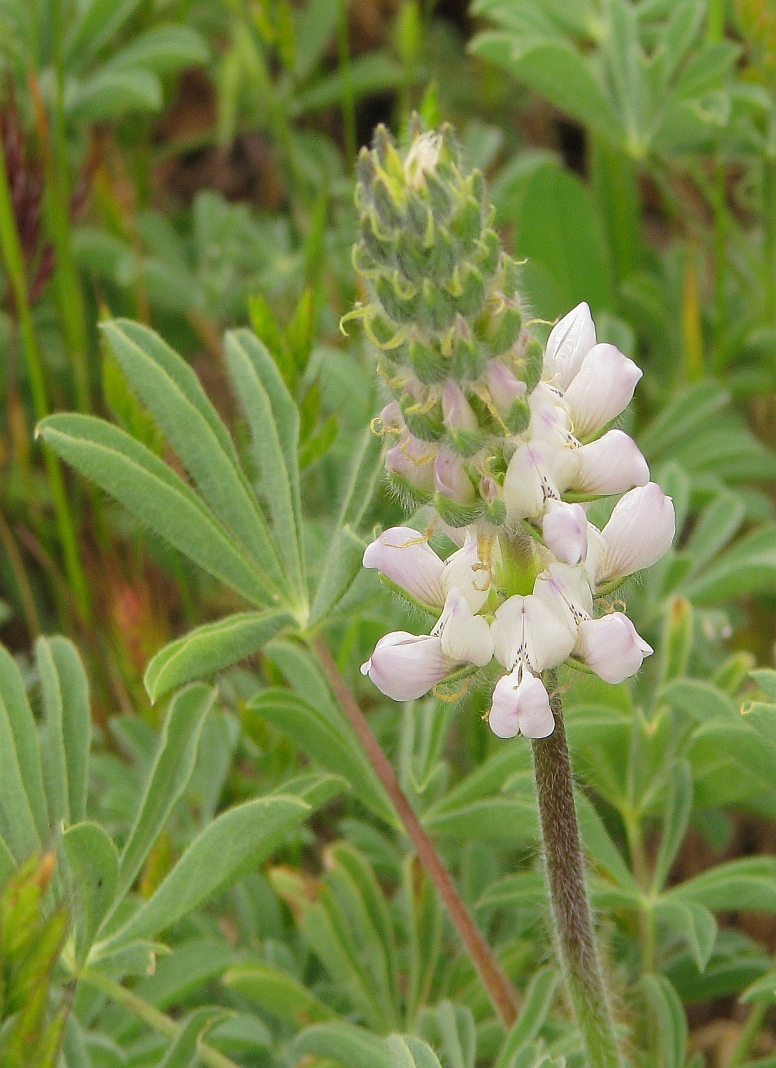
Valley Lupine (L.Johnson)
Western Bluebirds were in great evidence near all the buildings. At the Reagan Ranch we found both Cassin’s and Western Kingbirds bouncing over the flowers and grass. Four pairs of Orioles – both Hooded and Bullock’s – gurgled overhead in the roadside trees. At the Paramount Ranch western town a large flock of American Goldfinches contained several bright breeding plumage males among the numerous winter and molting plumage birds. Great Blue Herons stalked the fields looking for unwary ground squirrels, proving that they don’t have an exclusively aquatic menu. Overhead in several locations were flocks of swallows and swifts. We found most of the No. Rough-winged Swallows in a flock low over Malibu Creek flying through a gap in the reeds, feeding on a flock of insects close to the water.

Male Spotted Towhee in a Ceanothus
Many of the flowers were seen on our prior year’s trip but a few were new, perhaps because we were about 10 days further into Spring.
Among them were: Cliff Aster, Morning Glory, White Nightshade, Common Goldfields, Strigose Lotus, Western Wallflower, Chinese Houses, Prickly Phlox, Winter Vetch, California Bickelbush, and Fennel.
The weather, which looked like rain for a while, held, and we had a fine day. By the time we returned to Paramount Ranch, we were ready to eat.
Brian Cohee took a great selection of flower photos on this hike. You can find a nice slide show of them here.
There is also a website with hundreds, perhaps thousands of pictures of flowers of the Santa Monica Mountains National Recreation Area. If you can’t figure out what was that bloom you saw on a local hike, check this out.
| PARAMOUNT TO MALIBU CREEK 4/10/10 – TRIP LIST | ||
| PLANTS | BIRDS | Nos. |
| WHITE | Mallard | 10 |
| Big Pod Ceanothus | California Quail | H |
| Coyote Brush (not in bloom) | Great Blue Heron | 2 |
| Elderberry | Turkey Vulture | 2 |
| Mule Fat | Sharp-shinned Hawk | 1 |
| Poison Hemlock | Red-shouldered Hawk | 2 |
| Cliff Aster | Red-tailed Hawk | 5 |
| Horehound* | American Coot | 4 |
| Miner’s Lettuce | Mourning Dove | 12 |
| Morning Glory | Black-hooded Parakeet | 1 |
| Popcorn Flower | Vaux’s Swift | 20 |
| White Nightshade | White-throated Swift | 12 |
| White Sage | Blk-chinned Hummingbird | 1 |
| Wild Cucumber | Anna’s Hummingbird | 4 |
| Yucca | Allen’s Hummingbird | 1 |
| YELLOW | Belted Kingfisher | 1 |
| Johnny-Jump Up | Acorn Woodpecker | 11 |
| Common Fiddleneck | Nuttall’s Woodpecker | H |
| Common Goldfields | Pacific-slope Flycatcher | 2 |
| Deerweed | Black Phoebe | 8 |
| Golden Currant | Say’s Phoebe | 1 |
| Mountain Dandelion | Cassin’s Kingbird | 2 |
| Mustard* | Western Kingbird | 3 |
| Pineapple Weed* | Western Scrub-Jay | 14 |
| Strigose Lotus | American Crow | 6 |
| Western Wallflower | Common Raven | 5 |
| ORANGE | No. Rgh-winged Swallow | 24 |
| California Poppy | Tree Swallow | 4 |
| Sticky Monkey Flower | Violet-green Swallow | 12 |
| RED | Barn Swallow | 2 |
| Hummingbird Sage | Cliff Swallow | 20 |
| Indian Paintbrush | Oak Titmouse | 4 |
| PINK | Bushtit | 4 |
| Chinese Houses | White-breasted Nuthatch | 2 |
| Milk Thistle (not in bloom) | Canyon Wren | H |
| Prickly Phlox | Bewick’s Wren | 2 |
| Purple Owl’s Clover | House Wren | 32 |
| Purple Sage | Blue-gray Gnatcatcher | 1 |
| Red-stem Filaree* | Ruby-crowned Kinglet | 2 |
| Wild Radish* | Western Bluebird | 10 |
| Wild Rose (not in bloom) | American Robin | 1 |
| Wild Sweet Pea | Wrentit | H |
| PURPLE / BLUE | California Thrasher | H |
| Black Sage | European Starling | 12 |
| Blue Dicks | Orange-crowned Warbler | 6 |
| Bush Lupine | Yellow Warbler | H |
| Caterpillar Phacelia (2 types) | Yellow-rumped Warbler | 10 |
| Chia | Common Yellowthroat | 2 |
| Common Vervain | Spotted Towhee | 5 |
| Danny’s Skullcap | California Towhee | 6 |
| Fiesta Flower | Song Sparrow | 7 |
| Green Bark Ceanothus | Black-headed Grosbeak | 4 |
| Parry’s Phacelia | Red-winged Blackbird | 20 |
| Purple Nightshade | Brown-headed Cowbird | 1 |
| Valley Lupine | Hooded Oriole | 6 |
| Winter Vetch | Bullock’s Oriole | 6 |
| BROWN | Purple Finch | H |
| Curly Dock* | House Finch | 20 |
| Dodder | Lesser Goldfinch | 16 |
| Common Plantain | American Goldfinch | 30 |
| NOT IN BLOOM | Total Birds | 60 |
| Ashy-leafed Buckwheat | H – Heard only | |
| California Bickelbush | ||
| California Buckwheat | ||
| California Sagebrush | ||
| Chamise | ||
| Fennel | ||
| Laurel Sumac | ||
| Mistletoe | ||
| Mugwort | ||
| Poison Oak | ||
| Scrub Oak (with gall) | ||
| Toyon | ||
| TREES | ||
| California Bay Laurel | ||
| Coast Live Oak | ||
| Valley Oak | ||
| Western Sycamore | ||
| Willow | ||
| Total Plants — 70 | ||
| * – Introduced species | ||
The Western Roof-Owl: Bird of Mystery
First in a series of monographs of our local avifauna.

The Western Roof-Owl, Bubo pneumatikus (WERO), is in many regards unique among the owls of the world. Most owls are nocturnal predators which roost during the day in hard-to-see locations, deep in foliage, high in trees or cliff holes or on rafters in dark barns, in order to avoid detection by their justifiably annoyed prey. At night such owls are often heard calling and occasionally seen pursuing their prey: small mammals, especially rodents, and small songbirds.
In contradistinction, the WERO eschews dark and hidden perches and does its daytime roosting right out in the open, usually on peaks or edges of roofs, its preferred perch, occasionally also on large antennas and fence posts. This atypical behavior causes it to be perhaps the most commonly seen owl in Western North America, although it is not the most abundant.
This peculiar roosting behavior permits the easy observation of its most recognizable and remarkable behavioral characteristic – complete immobility. Once it has chosen its diurnal roosting spot, it never moves: neither broiling desert summer sun nor freezing winter mountain storm can cause this bird to do so much as blink an eye. Many species of small birds – potential nocturnal prey for the WERO, one presumes – notice this lack of movement and actually seek out its company. European Starlings and Rock Pigeons are often observed to perch right on the WERO’s head, sometimes for hours. It is conjectured that such birds are attempting to demonstrate friendship with this large predator, perhaps in order to impress their friends or frighten away potential rivals, but no one knows for sure. [This possibility provides an intriguing subject for a Ph.D. thesis in Avian Ethology.]
The Western Roof Owl – or at least the most intensively studied local subspecies B.p.immobilus – is about the size, shape and coloration of its more infrequently seen congener, the Great Horned Owl Bubo virginianus. In fact, the best way to separate these two species is by roosting location and behavior. If you see it roosting immobile on a roof, it is most likely the WERO. If you can’t see it, it’s the Great Horned Owl.
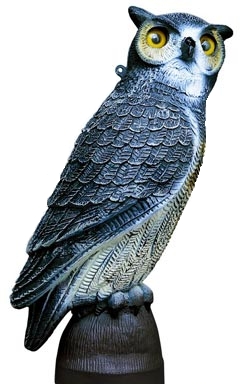
So secretive and little-known is the nesting and feeding behavior of the WERO that there is not a single recorded observation of the bird leaving or arriving at its roosting site. One millisecond they are not there, the next millisecond they are, never to move until they again vanish, unseen.
Researchers conjecture that they hunt only on moonless cloud-covered nights. In utter pitch-black skies, no living creature ever sees them in flight, and their prey die never knowing what hit them. If true, this would go far to explain the lack of fear they elicit from potential prey species at their roosting sites.
If these conjectures are correct, such behavior necessitates certain physiological characteristics. They must have exceptional hearing as does the Barn Owl which can locate a vole rustling in the grass at 100 meters in complete darkness. [Bizarrely, no researcher has ever been able to detect any external auditory canal on the WERO. However, unless the owl can detect body heat in the infra-red, they must have excellent hearing. This is another excellent subject for an enterprising Ph.D. candidate.] They must be able to catch great numbers of prey during their infrequent hunting expeditions, as it may be a long wait until the next suitably pitch-black night occurs. This explains why they are not found north of the Arctic Circle where the sun may not set for months. Their digestive systems must be extremely efficient in order to extract every calorie of energy from each morsel of whatever it is that they eat. This would explain the complete lack of regurgitated pellets around their roost sites: there are no pellets as they digest everything – fur, feather, bone, gristle, shell, skin. It would also explain why they never move: they are conserving energy in order to insure survival through what may be a very long fast. It should be noted that their apparent sleep must actually an exceptionally deep form of torpor, a form of near-suspended animation also used by hummingbirds at night and by the Common Poorwill during the winter. The WERO’s torpor is so deep that no medical equipment can detect any heartbeat, breathing or thermoregulatory activity.
Needless to say, nothing is known of their breeding biology. No nest has ever been found, no downy or juvenile bird has ever been seen. They simply appear, full size and in adult plumage. Neither has any sign of molting ever been detected.
The Western Roof Owl has yet one more unique feature: it is the only avian species known to have behavioral morphs. Many species have color morphs: dark-phase and light-phase Red-tailed Hawks for instance. Such color morphs do not indicate subspecies status, they are simply a coloration variation that the individual possesses throughout its life. As far as researchers can tell, the straight-ahead and the right-looking forms are lifelong and invariant behavioral morphs.
All-in-all, the Western Roof Owl is one of our most interesting local species. Its easy visibility when roosting recommends it to any diligent observer of birds. The difficulties one encounters in actually witnessing it doing anything only make the eventual documentation of its mysterious behavior that much more rewarding a pursuit.
If you found this article plausible, you may be interested in other installments in our Early Spring Monograph Series (ESMS):
2011: New Hummingbird Species Discovered in Los Angeles County
2012: Canyonlands Roadrunner Captured on Film
2013: Birders Take Their Lumps with their Splits
and not to be overlooked,
2026: Save the endangered Pacific Northwest Tree Octopus from Extinction
[Chuck Almdale, on behalf of Society 401]
Malibu Lagoon Trip Report: 28 March, 2010
You don’t need a weatherman to know which way the wind blows, and we didn’t need a calendar to see that Spring has arrived. All the bird groups and most species have dropped in numbers from February (see chart below). Breeding plumages are beginning to appear. (Pictures get bigger if you double-click them.)
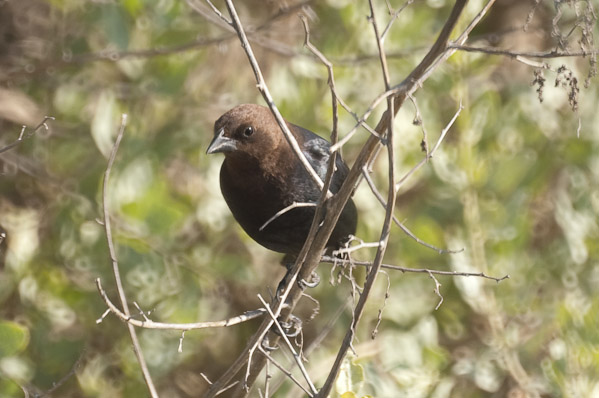
Brown-headed Cowbird (C.Bragg 3/10)
I had to keep recounting the Elegant Terns as their numbers continually climbed. (No Royal Terns among them. Of course not. They wouldn’t dare.) All the Pacific Loons were flying west along the shoreline. The Double-crested Cormorants are developing their bushy white eyebrows (crests, actually). The Say’s Phoebes and White-crowned Sparrows were gone, as were the adult Heermann’s Gulls;, Song Sparrows were singing everywhere, Brown-headed Cowbirds were following all the other birds around, probably hoping to find an unattended nest in which to dump an egg or two, and Black Phoebes kept vanishing under the footbridges, no doubt busily building nests.

Symbolic Fence 28 March (C.Almdale 3/10)
A brisk wind at the beginning fooled us into thinking it would be cool, but that soon disappeared,
forcing us to start removing clothing (jackets, no fear.) The lagoon outlet is still peculiarly configured, leaving a sand island parallel to the beach, with the outlet as far to the east as it can possibly
be, nearly undercutting the fence at the southeast corner of the Adamson property. Waves were nearly non-existent, yet a few bored surfers clung to hope like barnacles to boat bottoms. Judging by many of the conversations carried on about me, nous parlons français.

How many Snowy Plovers can you find in this picture? (C.Almdale 3/10)
We were delighted to see that the parks people had erected the “symbolic fence” enclosure as promised, and the sand inside was strewn with seaweed wrack, supplying plenty of food for the little invertebrates which in turn are food for our beleaguered Snowy Plovers. We counted 25 of them, none banded.
The stubborn little Snowies were ignoring their private reserve and sitting on the sand outside the seaward “fence”, but our passage by convinced them they ought to move back inside.
Further along the beach we found a pair of Caspian Terns, probably the tern with the largest breeding range in the world, and, as you may have guessed, named for that inland sea near Iran.
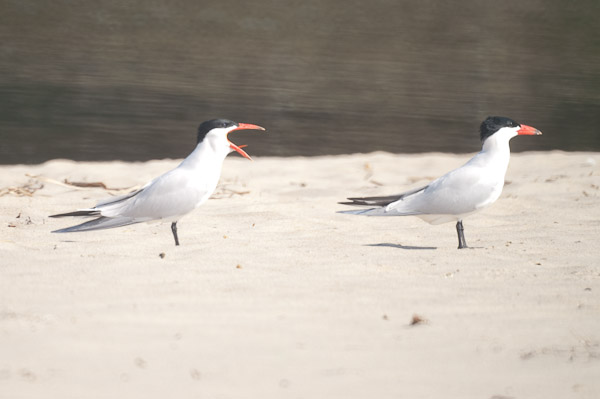
Caspian Tern pair (C.Bragg 3/10)
A lot of Brown Pelicans were still around and one lone 1st-year Glaucous-winged Gull was among the Western Gulls. In the middle side channel a small flock of Least Sandpipers were well on their way into their breeding (alternate) plumage. All-in-all, it was a beautiful day in the neighborhood.
We found out that the Adamson House is now closed on the weekends – no doubt a victim of the omnipresent budget cuts – so we couldn’t check its grounds for orioles and warblers as planned. We Californians seem determined to pinch our pennies until Lincoln screams and I sometimes wonder if we won’t end up with everything, everywhere shuttered for good.
| Malibu Bird | 2010 | 2010 | 2010 | 2010 | |
| Census for 2010 | Jan | Feb | Mar | Qtr 1 | |
| Temp> | 55-61 | 68-80 | Totals | ||
| Tide> | +.65 | +6.19 | +5.48 | ||
| Time> | L:1131 | H:0835 | H:0840 | ||
| 1 | Gadwall | 20 | 35 | 16 | 71 |
| 2 | American Wigeon | 12 | 14 | 26 | |
| 3 | Mallard | 10 | 13 | 12 | 35 |
| 4 | Northern Shoveler | 4 | 8 | 12 | |
| 5 | Green-winged Teal | 7 | 2 | 1 | 10 |
| 6 | Lesser Scaup | 1 | 1 | ||
| 7 | Surf Scoter | 35 | 4 | 18 | 57 |
| 8 | Long-tailed Duck | 1 | 1 | ||
| 9 | Bufflehead | 6 | 6 | ||
| 10 | Red-breasted Merganser | 8 | 5 | 1 | 14 |
| 11 | Ruddy Duck | 30 | 14 | 44 | |
| 12 | Red-throated Loon | 1 | 1 | 2 | |
| 13 | Pacific Loon | 1 | 1 | 5 | 7 |
| 14 | Common Loon | 1 | 1 | ||
| 15 | Pied-billed Grebe | 1 | 1 | ||
| 16 | Horned Grebe | 1 | 1 | ||
| 17 | Eared Grebe | 3 | 3 | ||
| 18 | Western Grebe | 15 | 6 | 27 | 48 |
| 19 | Brown Pelican | 35 | 81 | 184 | 300 |
| 20 | Brandt’s Cormorant | 1 | 2 | 2 | 5 |
| 21 | Dble-crestd Cormorant | 42 | 21 | 42 | 105 |
| 22 | Pelagic Cormorant | 1 | 1 | 2 | |
| 23 | Great Blue Heron | 2 | 2 | 4 | |
| 24 | Great Egret | 3 | 3 | 2 | 8 |
| 25 | Snowy Egret | 15 | 4 | 7 | 26 |
| 26 | Blk-crwnd N-Heron | 1 | 1 | ||
| 27 | Red-shouldered Hawk | 1 | 1 | ||
| 28 | Red-tailed Hawk | 1 | 3 | 2 | 6 |
| 29 | Peregrine Falcon | 2 | 2 | ||
| 30 | Sora | 1 | 1 | 1 | 3 |
| 31 | American Coot | 284 | 175 | 92 | 551 |
| 32 | Blk-bellied Plover | 45 | 59 | 25 | 129 |
| 33 | Snowy Plover | 54 | 49 | 25 | 128 |
| 34 | Semipalmated Plover | 1 | 1 | ||
| 35 | Killdeer | 4 | 1 | 5 | |
| 36 | Black Oystercatcher | 2 | 2 | ||
| 37 | American Avocet | 2 | 2 | 4 | |
| 38 | Willet | 15 | 15 | 4 | 34 |
| 39 | Spotted Sandpiper | 4 | 2 | 1 | 7 |
| 40 | Whimbrel | 2 | 3 | 5 | |
| 41 | Marbled Godwit | 4 | 17 | 12 | 33 |
| 42 | Ruddy Turnstone | 13 | 11 | 2 | 26 |
| 43 | Sanderling | 85 | 172 | 257 | |
| 44 | Least Sandpiper | 21 | 14 | 35 | |
| 45 | Boneparte’s Gull | 2 | 2 | ||
| 46 | Heermann’s Gull | 5 | 7 | 4 | 16 |
| 47 | Ring-billed Gull | 55 | 42 | 2 | 99 |
| 48 | California Gull | 875 | 45 | 27 | 947 |
| 49 | Western Gull | 45 | 74 | 48 | 167 |
| 50 | Glaucous-winged Gull | 6 | 3 | 1 | 10 |
| 51 | Caspian Tern | 2 | 2 | ||
| 52 | Royal Tern | 12 | 32 | 44 | |
| 53 | Elegant Tern | 1 | 1 | 47 | 49 |
| 54 | Forster’s Tern | 1 | 1 | ||
| 55 | Black Skimmer | 6 | 5 | 11 | |
| 56 | Rock Pigeon | 8 | 4 | 4 | 16 |
| 57 | Mourning Dove | 2 | 2 | 4 | |
| 58 | Anna’s Hummingbird | 3 | 3 | 3 | 9 |
| 59 | Allen’s Hummingbird | 2 | 3 | 3 | 8 |
| 60 | Black Phoebe | 4 | 5 | 6 | 15 |
| 61 | Say’s Phoebe | 1 | 1 | 2 | |
| 62 | Western Scrub-Jay | 1 | 1 | ||
| 63 | American Crow | 5 | 4 | 4 | 13 |
| 64 | Rough-winged Swallow | 1 | 3 | 4 | |
| 65 | Bushtit | 4 | 5 | 4 | 13 |
| 66 | Bewick’s Wren | 2 | 1 | 3 | |
| 67 | Northern Mockingbird | 2 | 3 | 2 | 7 |
| 68 | European Starling | 35 | 41 | 8 | 84 |
| 69 | Yellow-rumped Warbler | 8 | 4 | 5 | 17 |
| 70 | Common Yellowthroat | 3 | 1 | 1 | 5 |
| 71 | Spotted Towhee | 1 | 1 | 2 | |
| 72 | California Towhee | 2 | 1 | 3 | |
| 73 | Song Sparrow | 3 | 6 | 8 | 17 |
| 74 | White-crowned Sparrow | 4 | 4 | ||
| 75 | Red-winged Blackbird | 3 | 2 | 5 | |
| 76 | Western Meadowlark | 1 | 1 | ||
| 77 | Great-tailed Grackle | 1 | 1 | ||
| 78 | Brown-headed Cowbird | 2 | 2 | ||
| 79 | House Finch | 12 | 3 | 6 | 21 |
| 80 | Lesser Goldfinch | 4 | 4 | ||
| Jan | Feb | Mar | Qtr 1 | ||
| Totals by Type | |||||
| Waterfowl | 134 | 73 | 70 | 277 | |
| Water Birds-Other | 386 | 289 | 354 | 1029 | |
| Herons, Egrets | 20 | 7 | 12 | 39 | |
| Quail & Raptors | 4 | 3 | 2 | 9 | |
| Shorebirds | 251 | 328 | 87 | 666 | |
| Gulls & Terns | 1006 | 209 | 133 | 1348 | |
| Doves | 10 | 4 | 6 | 20 | |
| Other Non-Pass. | 5 | 6 | 6 | 17 | |
| Passerines | 90 | 81 | 53 | 224 | |
| Totals Birds | 1906 | 1000 | 723 | 3629 | |
| Total Species | Jan | Feb | Mar | Qtr 1 | |
| Waterfowl | 11 | 6 | 7 | 11 | |
| Water Birds-Other | 12 | 9 | 8 | 13 | |
| Herons, Egrets | 3 | 2 | 4 | 4 | |
| Quail & Raptors | 3 | 1 | 1 | 3 | |
| Shorebirds | 12 | 9 | 9 | 13 | |
| Gulls & Terns | 9 | 8 | 8 | 11 | |
| Doves | 2 | 1 | 2 | 2 | |
| Other Non-Pass. | 2 | 2 | 2 | 2 | |
| Passerines | 16 | 15 | 14 | 21 | |
| Totals Species | 70 | 53 | 55 | 80 |



 SANTA MONICA BAY AUDUBON SOCIETY BLOG