Free email delivery
Please sign up for email delivery in the subscription area to the right.
No salesman will call, at least not from us. Maybe from someone else.
Malibu Lagoon Trip Report: 24 January, 2010
Clear and cold conditions at the start:
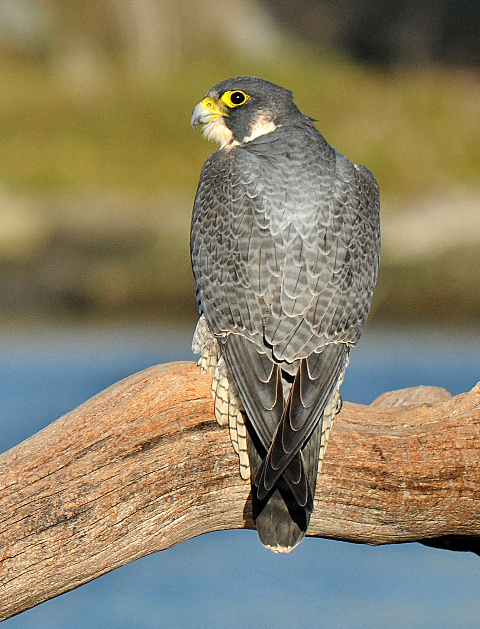
Peregrine Falcon (prob. ss. anatum) [James Kenney 1/24/10
| Malibu Bird Census | 2010 | |
| Collected by | Jan | |
| SMBAS Members | ||
| For Year 2010 | ||
| Species | ||
| 1 | Gadwall | 20 |
| 2 | American Wigeon | 12 |
| 3 | Mallard | 10 |
| 4 | Northern Shoveler | 4 |
| 5 | Green-winged Teal | 7 |
| 6 | Lesser Scaup | 1 |
| 7 | Surf Scoter | 35 |
| 8 | Long-tailed Duck | 1 |
| 9 | Bufflehead | 6 |
| 10 | Red-brstd Merganser | 8 |
| 11 | Ruddy Duck | 30 |
| 12 | Red-throated Loon | 1 |
| 13 | Pacific Loon | 1 |
| 14 | Common Loon | 1 |
| 15 | Pied-billed Grebe | 1 |
| 16 | Horned Grebe | 1 |
| 17 | Eared Grebe | 3 |
| 18 | Western Grebe | 15 |
| 19 | Brown Pelican | 35 |
| 20 | Brandt’s Cormorant | 1 |
| 21 | Dble-crstd Cormorant | 42 |
| 22 | Great Blue Heron | 2 |
| 23 | Great Egret | 3 |
| 24 | Snowy Egret | 15 |
| 25 | Red-shouldered Hawk | 1 |
| 26 | Red-tailed Hawk | 1 |
| 27 | Peregrine Falcon | 2 |
| 28 | Sora | 1 |
| 29 | American Coot | 284 |
| 30 | Blk-bellied Plover | 45 |
| 31 | Snowy Plover | 54 |
| 32 | Killdeer | 4 |
| 33 | Black Oystercatcher | 2 |
| 34 | American Avocet | 2 |
| 35 | Willet | 15 |
| 36 | Spotted Sandpiper | 4 |
| 37 | Whimbrel | 2 |
| 38 | Marbled Godwit | 4 |
| 39 | Ruddy Turnstone | 13 |
| 40 | Sanderling | 85 |
| 41 | Least Sandpiper | 21 |
| 42 | Heermann’s Gull | 5 |
| 43 | Ring-billed Gull | 55 |
| 44 | California Gull | 875 |
| 45 | Western Gull | 45 |
| 46 | Glaucous-wingd Gull | 6 |
| 47 | Royal Tern | 12 |
| 48 | Elegant Tern | 1 |
| 49 | Forster’s Tern | 1 |
| 50 | Black Skimmer | 6 |
| 51 | Rock Pigeon | 8 |
| 52 | Mourning Dove | 2 |
| 53 | Anna’s Hummingbird | 3 |
| 54 | Allen’s Hummingbird | 2 |
| 55 | Black Phoebe | 4 |
| 56 | Say’s Phoebe | 1 |
| 57 | American Crow | 5 |
| 58 | Bushtit | 4 |
| 59 | Bewick’s Wren | 2 |
| 60 | Northern Mockingbird | 2 |
| 61 | European Starling | 35 |
| 62 | Yellow-rumpd Warbler | 8 |
| 63 | Common Yellowthroat | 3 |
| 64 | Spotted Towhee | 1 |
| 65 | California Towhee | 2 |
| 66 | Song Sparrow | 3 |
| 67 | Red-winged Blackbird | 3 |
| 68 | Great-tailed Grackle | 1 |
| 69 | House Finch | 12 |
| 70 | Lesser Goldfinch | 4 |
| Totals by Type | ||
| Waterfowl | 134 | |
| Water Birds-Other | 386 | |
| Herons, Egrets | 20 | |
| Quail & Raptors | 4 | |
| Shorebirds | 251 | |
| Gulls & Terns | 1006 | |
| Doves | 10 | |
| Other Non-Pass. | 5 | |
| Passerines | 90 | |
| Totals Birds | 1906 | |
| Total Species* | ||
| Waterfowl | 11 | |
| Water Birds-Other | 12 | |
| Herons, Egrets | 3 | |
| Quail & Raptors | 3 | |
| Shorebirds | 12 | |
| Gulls & Terns | 9 | |
| Doves | 2 | |
| Other Non-Pass. | 2 | |
| Passerines | 16 | |
| Totals Species | 70 |
Winter Snowy Plover Survey
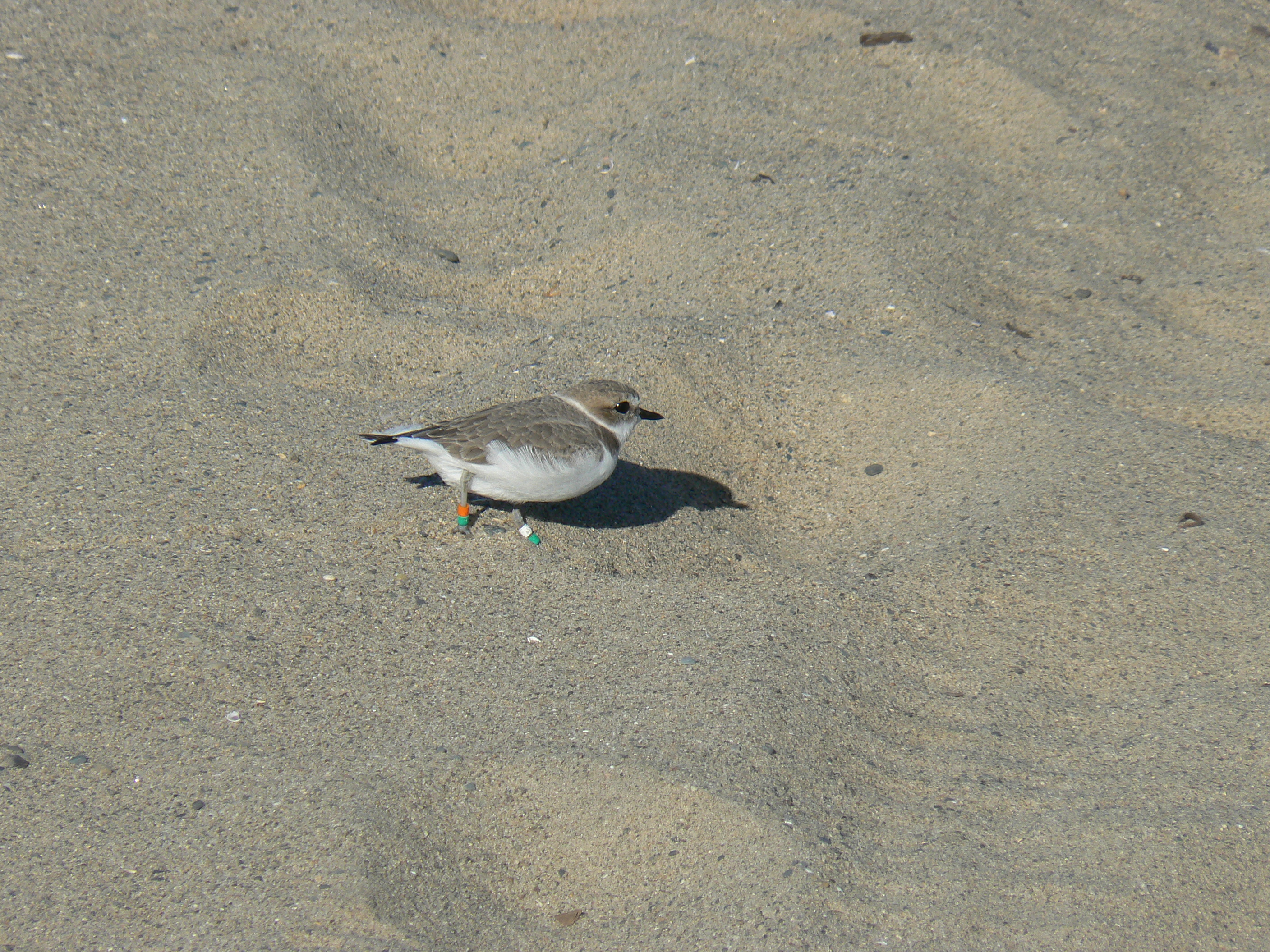
Banded Snowy Plover on SM beach 2009.
The range-wide survey of wintering birds started today along the entire Pacific Coast from Washington to the Tijuana Slough. It continues through the 23rd of January. There may also be some counts conducted in Mexico. This effort is led by the US Fish and Wildlife Service whose Arcata, CA office has become the de facto nerve center for the recovery effort of the threatened species. Locally in Los Angeles County there are 6 sites considered key because of repeated sightings of the birds from late July through April each year. Zuma Beach is the northernmost and hosts the largest population. Malibu Lagoon is often the second most populous, but, by this morning’s count, Santa Monica Beach with 49 birds, may become the second largest roost. Thanks to counters Erin Rowan and Allison Brandin for their assistance with the Santa Monica Beach count. Lu Plauzoles
Bird Articles from “Science News”
Bird feeding, migration change may split a species
http://www.sciencenews.org/view/generic/id/50358/title/Bird_feeding%2C_migration_change__may_split_a_species
German birds that spend the off-season at U.K. birdfeeders now look slightly different from neighbors that migrate to Spain
From Science News Online 12/4/09
Another livestock drug endangers vultures
http://www.sciencenews.org/view/generic/id/50556/title/Another_livestock_drug_endangers_vultures
After one veterinary NSAID almost wiped out vultures in South Asia, one of the possible replacements turns out to be toxic too.
From Science News Online 12/9/09
For coots, hatching order is crucial ID
http://www.sciencenews.org/view/generic/id/50881/title/For_coots%2C_hatching_order_is_crucial_ID
When birds sneak eggs into others’ nest, mom and dad can learn to find their own.
From Science News Online 12/17/09
Sexual conflict takes shape in ducks
http://www.sciencenews.org/view/generic/id/51448/title/Sexual_conflict_takes_shape_in_ducks
Up-close view of male ducks reveals extreme speed and extreme conflict.
From Science News Online 12/24/09
From The President
Happy 2010 to one and all ! We have been reaping the benefits of living in Southern California – birding has been wonderful and some plants have been sprouting and the sun has been shining – we have been having “Rose Bowl Days”. We hope to have winter next week – we dearly need rain and snow pack in the mountains.
Christmas Counts have been done around the country – the results are not in as yet. The next big milestone is the 13th Great Backyard Bird Count February 12-15, 2010 – check out www.birdcount.org – another little step of citizen science. Interesting to note the top bird reported in the 2009 GBBC was the Northern Cardinal – we need to report more Western birds !
Come join us for our month end fourth Sunday Malibu Lagoon walk, come to our first Tuesday General meeting, join us for our field trips – enjoy the birds, enjoy the weather, enjoy the people – learn and participate.
Best of birds in 2010.
Ellen V
Native Plants
It’s spring, and in spite of the drought, some chaparral plants are bravely in bloom. One of the commonest is Purple Nightshade (Solanum xantii), named in honor of the same Xantus as Xantus’ murrelet. The genus Solanum is large, including potato (Solanum tuberosum) and eggplant (Solanum melongena), as well as several more-or-less toxic species, of which Xanti is one. The green berries are the most toxic part of xanti. I haven’t tasted the berries.
Douglas’s Nightshade, which has smaller, white blossoms, comes into bloom later and has shiny, black berries that are edible when fully ripe.
Don’t confuse “our” nightshade with the European occurrence, DEADLY NIGHTSHADE, which is in the genus Atropa, an entirely different family. As few as three berries of this plant could kill a small child. It’s not surprising that Deadly Nightshade is rarely grown in California.



 SANTA MONICA BAY AUDUBON SOCIETY BLOG