Free email delivery
Please sign up for email delivery in the subscription area to the right.
No salesman will call, at least not from us. Maybe from someone else.
Malibu Lagoon Trip Report: 28 Feb. 2010

Beach-wrack & lagoon-foam (L.Johnson 2/10)
Fortunately the tsunami (if any) from the Chilean earthquake hit the lagoon on Saturday or we might all have been swept out to sea. As it was, about half of us got our feet wet when – backs to the ocean, diligently studying Black Skimmers and assorted gulls, terns and peeps across the narrow outlet stream – we were rudely assaulted by a 6-inch-high wall of water and foam lunging at us across the beach berm. Gradually the tide receded, but even three hours after (predicted) high tide, the occasional big one sent us scurrying. The surfers were having a great time frolicking in the water (check Kurt Vonnegut’s novel Galapagos for where this activity may lead).

American Avocets (L.Johnson 2/10)
The beach was significantly altered by the recent storm and the birds had a section all to themselves, separated from the “human-dominated” zones by two outlet streams running more-or-less parallel to the shore. Here they snoozed or stalked the water-edge searching for invertebrate snacks. Among them were 5 Black Skimmers (down from 6 in Jan.), 3 1st-year Glaucous-winged Gulls, 2 American Avocets, now with almost solid red heads (probably the same two birds we had in Jan.), and 7 Heermann’s Gulls, not yet fled to their breeding grounds on islands in the southern Sea of Cortez, where they nest early to avoid the fierce heat of late spring.
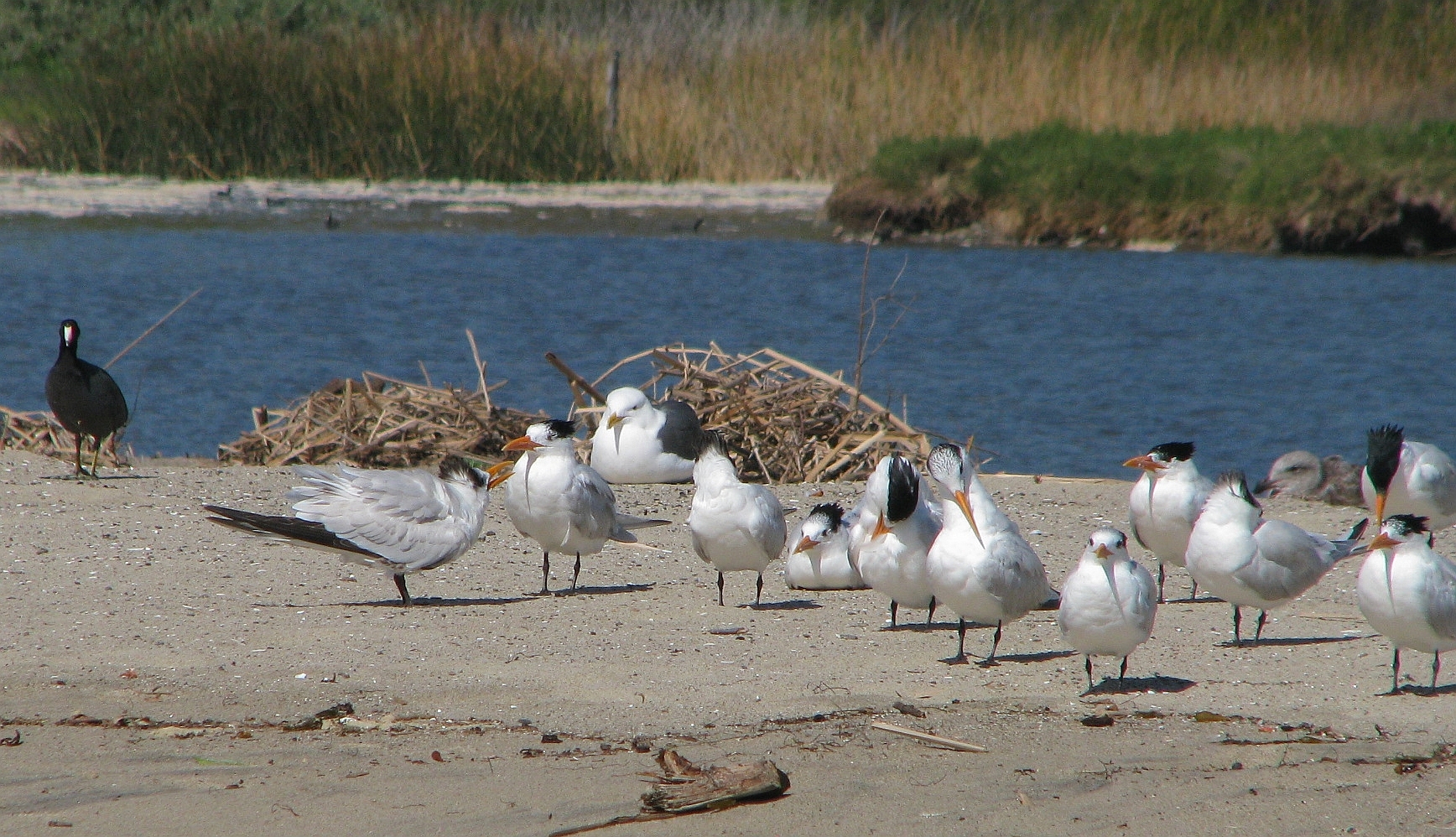
Leftmost Royal Tern begging food (L.Johnson 2/10)
32 terns in various postures and black-crown plumages initiated, as usual, a few debates among those who are never quite certain what differentiates a Royal Tern from an Elegant. After the combatants were separated, they unanimously agreed they were all Royal, or all Elegant, or some of each. Like all trip leaders who follow the Bird Guide’s Official Motto of “Often wrong but never in doubt”, I pronounced them all Royal Tern (save the solitary Elegant added later).
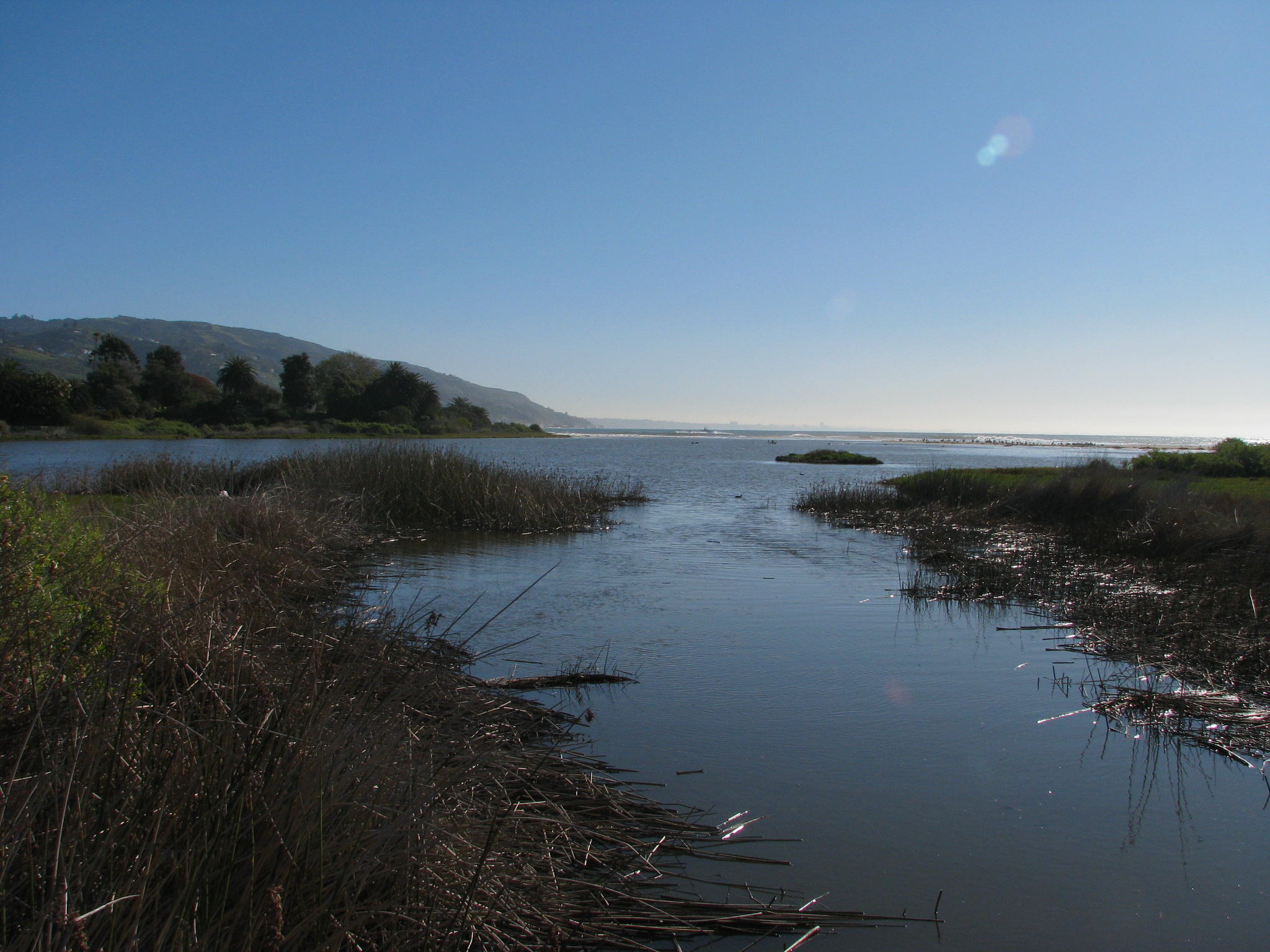
High tide in 1st channel (L.Johnson 2/10)
Other than that, 1 early Northern Rough-winged Swallow and 1 Semipalmated Plover were notable early additions to the 2010 list, the 35 Gadwall was the 2nd highest total ever, while the large drop in total numbers from January (especially California Gulls) was probably due to yesterday’s rainstorm, the condition of the beach and the high water in the lagoon created by high tide inflow.
| Malibu Lagoon Bird | 2010 | 2010 | 2010 | |
| Census for 2010 | Jan | Feb | Qtr 1 | |
| Temp> | 41-65 | 55-61 | Totals | |
| Tide> | +.65 | +6.19 | ||
| Time> | L:1131 | H:0835 | ||
| 1 | Gadwall | 20 | 35 | 55 |
| 2 | American Wigeon | 12 | 12 | |
| 3 | Mallard | 10 | 13 | 23 |
| 4 | Northern Shoveler | 4 | 4 | |
| 5 | Green-winged Teal | 7 | 2 | 9 |
| 6 | Lesser Scaup | 1 | 1 | |
| 7 | Surf Scoter | 35 | 4 | 39 |
| 8 | Long-tailed Duck | 1 | 1 | |
| 9 | Bufflehead | 6 | 6 | |
| 10 | Red-brstd Merganser | 8 | 5 | 13 |
| 11 | Ruddy Duck | 30 | 14 | 44 |
| 12 | Red-throated Loon | 1 | 1 | 2 |
| 13 | Pacific Loon | 1 | 1 | 2 |
| 14 | Common Loon | 1 | 1 | |
| 15 | Pied-billed Grebe | 1 | 1 | |
| 16 | Horned Grebe | 1 | 1 | |
| 17 | Eared Grebe | 3 | 3 | |
| 18 | Western Grebe | 15 | 6 | 21 |
| 19 | Brown Pelican | 35 | 81 | 116 |
| 20 | Brandt’s Cormorant | 1 | 2 | 3 |
| 21 | Dble-crstd Cormorant | 42 | 21 | 63 |
| 22 | Pelagic Cormorant | 1 | 1 | |
| 23 | Great Blue Heron | 2 | 2 | |
| 24 | Great Egret | 3 | 3 | 6 |
| 25 | Snowy Egret | 15 | 4 | 19 |
| 26 | Red-shouldered Hawk | 1 | 1 | |
| 27 | Red-tailed Hawk | 1 | 3 | 4 |
| 28 | Peregrine Falcon | 2 | 2 | |
| 29 | Sora | 1 | 1 | 2 |
| 30 | American Coot | 284 | 175 | 459 |
| 31 | Blk-bellied Plover | 45 | 59 | 104 |
| 32 | Snowy Plover | 54 | 49 | 103 |
| 33 | Semipalmated Plover | 1 | 1 | |
| 34 | Killdeer | 4 | 4 | |
| 35 | Black Oystercatcher | 2 | 2 | |
| 36 | American Avocet | 2 | 2 | 4 |
| 37 | Willet | 15 | 15 | 30 |
| 38 | Spotted Sandpiper | 4 | 2 | 6 |
| 39 | Whimbrel | 2 | 2 | |
| 40 | Marbled Godwit | 4 | 17 | 21 |
| 41 | Ruddy Turnstone | 13 | 11 | 24 |
| 42 | Sanderling | 85 | 172 | 257 |
| 43 | Least Sandpiper | 21 | 21 | |
| 44 | Heermann’s Gull | 5 | 7 | 12 |
| 45 | Ring-billed Gull | 55 | 42 | 97 |
| 46 | California Gull | 875 | 45 | 920 |
| 47 | Western Gull | 45 | 74 | 119 |
| 48 | Glaucous-winged Gull | 6 | 3 | 9 |
| 49 | Royal Tern | 12 | 32 | 44 |
| 50 | Elegant Tern | 1 | 1 | 2 |
| 51 | Forster’s Tern | 1 | 1 | |
| 52 | Black Skimmer | 6 | 5 | 11 |
| 53 | Rock Pigeon | 8 | 4 | 12 |
| 54 | Mourning Dove | 2 | 2 | |
| 55 | Anna’s Hummingbird | 3 | 3 | 6 |
| 56 | Allen’s Hummingbird | 2 | 3 | 5 |
| 57 | Black Phoebe | 4 | 5 | 9 |
| 58 | Say’s Phoebe | 1 | 1 | 2 |
| 59 | American Crow | 5 | 4 | 9 |
| 60 | Rough-wingd Swallow | 1 | 1 | |
| 61 | Bushtit | 4 | 5 | 9 |
| 62 | Bewick’s Wren | 2 | 2 | |
| 63 | Northern Mockingbird | 2 | 3 | 5 |
| 64 | European Starling | 35 | 41 | 76 |
| 65 | Yellow-rumped Warbler | 8 | 4 | 12 |
| 66 | Common Yellowthroat | 3 | 1 | 4 |
| 67 | Spotted Towhee | 1 | 1 | 2 |
| 68 | California Towhee | 2 | 1 | 3 |
| 69 | Song Sparrow | 3 | 6 | 9 |
| 70 | White-crwnd Sparrow | 4 | 4 | |
| 71 | Red-winged Blackbird | 3 | 3 | |
| 72 | Western Meadowlark | 1 | 1 | |
| 73 | Great-tailed Grackle | 1 | 1 | |
| 74 | House Finch | 12 | 3 | 15 |
| 75 | Lesser Goldfinch | 4 | 4 | |
| Jan | Feb | Qtr 1 | ||
| Site Visits | 1 | 1 | 2 | |
| Total Birds | 1906 | 1000 | 2906 | |
| Totals by Type | ||||
| Waterfowl | 134 | 73 | 207 | |
| Water Birds-Other | 386 | 289 | 675 | |
| Herons, Egrets | 20 | 7 | 27 | |
| Quail & Raptors | 4 | 3 | 7 | |
| Shorebirds | 251 | 328 | 579 | |
| Gulls & Terns | 1006 | 209 | 1215 | |
| Doves | 10 | 4 | 14 | |
| Other Non-Pass. | 5 | 6 | 11 | |
| Passerines | 90 | 81 | 171 | |
| Totals Birds | 1906 | 1000 | 2906 | |
| Total Species* | Jan | Feb | Qtr 1* | |
| Waterfowl | 11 | 6 | 9 | |
| Water Birds-Other | 12 | 9 | 11 | |
| Herons, Egrets | 3 | 2 | 3 | |
| Quail & Raptors | 3 | 1 | 2 | |
| Shorebirds | 12 | 9 | 11 | |
| Gulls & Terns | 9 | 8 | 9 | |
| Doves | 2 | 1 | 2 | |
| Other Non-Pass. | 2 | 2 | 2 | |
| Passerines | 16 | 15 | 16 | |
| Totals Species | 70 | 53 | 62 | |
| *Species quarterly | ||||
| totals averaged |
Meeting 20 Feb.: Sepulveda Basin Master Plan Community Workshop
When: Saturday, 20 February, 2010, 10 a.m. to 1 p.m.
Where: Sepulveda Garden Center, 16633 Magnolia Blvd., Encino, Ca. 91406
I encourage all of you who are not involved with the Audubon Southern California Coordinating Committee meeting on Saturday (Feb. 20) to attend this community workshop on the updating of the Sepulveda Basin Master Plan. This is part of updating the master land use plan of the entire Sepulveda Basin for the first time in over 30 years and will be important in shaping changes to the Basin.
You may want to express support for some of the ideas that I and other members of the Sepulveda Basin Wildlife Areas Steering Committee are promoting or have other suggestions. Here is a rough description of what I hope the new Master Plan will include:
1. The former corn maize field immediately east of Woodley Avenue and between Woodley Park and the Wildlife Reserve should become part of the Wildlife Reserve, as an enhancement and link to both Woodley Section 2 and the Wildlife Reserve.
2. The east bank of Haskell Creek and adjoining field along the stretch from the Reserve access road (“Wildlife Way”) to Victory Blvd. should be restored as riparian habitat.
3. The area north of the Reserve parking to the archery range and dam wall, which is currently but unclearly defined as Wildlife Reserve, should be protected and improved as part of the Wildlife Reserve.
4. All water courses within Sepulveda Basin, including those now treated as drainage channels, should be managed as riparian corridors, including Hayvenhurst, Woodley and Encino Channels/Creeks.
As meetings take place, these goals will be refined and improved.
I hope you will attend and actively participate in the meeting, including writing your own comments on what you want to keep as is and what changes you hope to see.
Muriel Kotin
Native Plants and Valentine Flowers
Margaret Huffman and I had some thoughts for Saint Valentine’s Day….. Should you give some flowers or plants to someone you care about, do you actually know what you are saying ?
A posy with roses is always welcome, although stick with red for passion as pink is sort of so so and means grace
Tulips have a fascinating history (remember Tulipmania of 1637 when hybrid tulips were used as currency and even quoted on the stock market – sort of the tech bubble of their day ?) And the meaning is perfect lover or fame..
Carnations run the gamut of meaning by color – red is fascination and yellow is rejection and lots of meanings in between
Geraniums are not a good idea as they represent stupidity, folly and / or comfort
and from the local garden:
Agapanthus means love letters and love – especially if you are a snail
Cactus means endurance and warmth
Fennel – our roadside grower – is strength and praise
Foxglove is insincerity (as well as digitalis and toxicity)
Lavender is devotion, happiness, luck
Mint is virtue, warmth, protection
Parsley is festivity and thanks (?)
Rosemary is remembrance and devotion
So happy St. Valentine’s Day – and maybe give candy ?
Bird Count aka GBBC
February 12 – 15th is the 13th Great Backyard Count – count for Fun, Count for the Future hosted by Cornell Lab of Ornithology and National Audubon Society – last year 94,165 checklists were submitted, 620 species were observed – which is about 2/3 of all species ever observed in the U.S., and 11,566,638 birds tallied – wow! You do not have to be a member of NAS to do this and all you have to have is a window to participate… you can do more – you can stay home, you can go out to a park, a school, a beach, any place – you can do many lists on all four days or you can do one on the day of your choice – global warming making a difference ? This may help show changes. So go to www.birdcount.org and spend your Valentine’s day with things we all love, birds.
South-end Salton Sea Trip Report: 6-7 Feb. 2010
Caliche. Ka-LEE-chay. Also know as hardpan. It’s a layer of calcium carbonate, impenetrable to water, near the top of the soil. It’s common in deserts and it’s good to know about when birding the south-end Salton Sea area during or after a rainstorm. When wet, this stuff glues itself to your tires (shoes, too!) in a layer an inch or more thick, immediately turning them into slicks for as long as you remain on dirt. Back on pavement, you’ll think you’re driving through gravel as it flies off your tires and rattles your floorboards. Loads of fun.
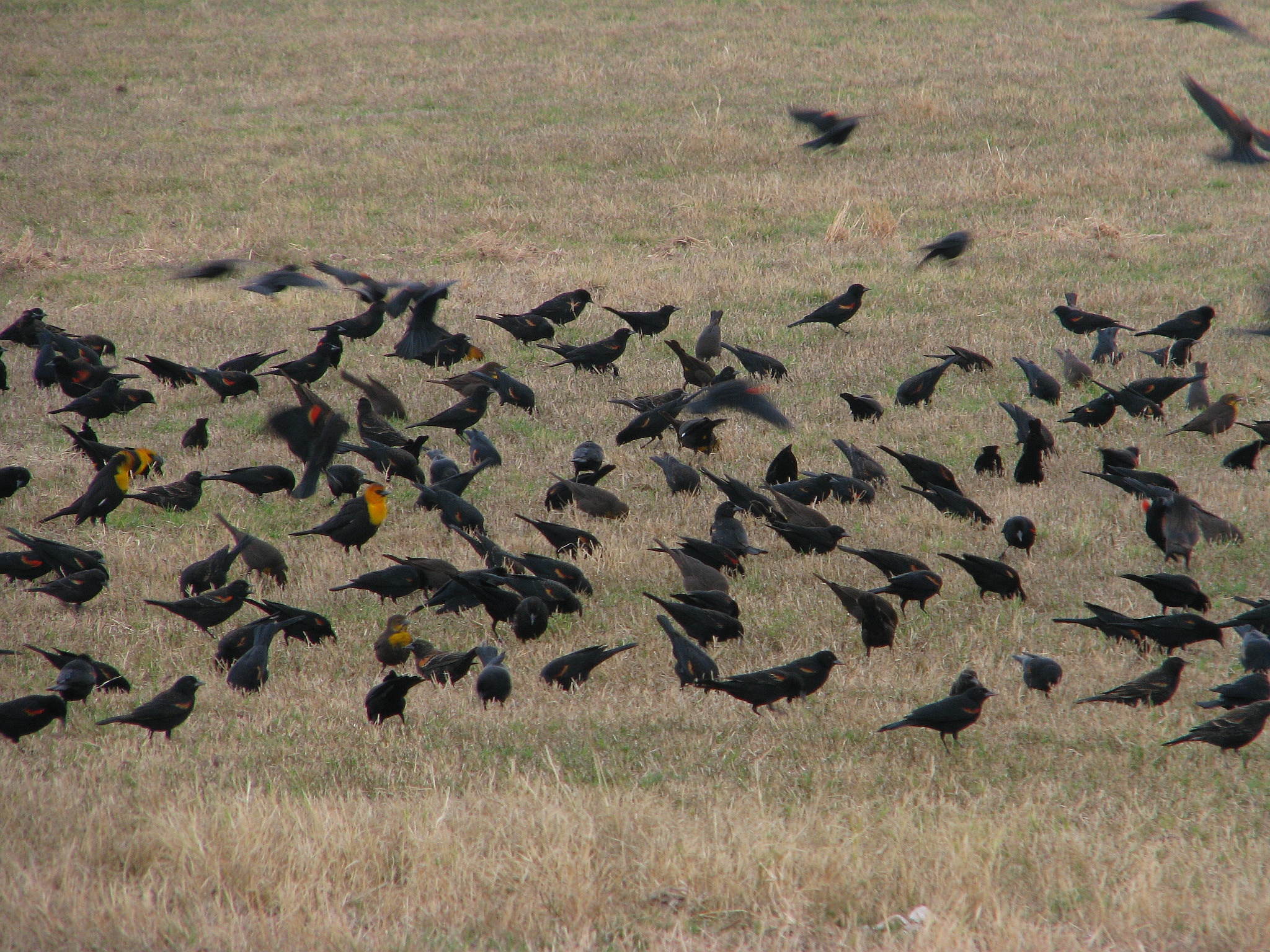
Red-winged & Yellow-headed Blackbirds (L.Johnson 2/10)
But the birds were good. We found many of the local target birds in between the light showers. Some, like Snow Goose and Cattle Egret, were in huge numbers. Others, such as No. Shoveler, No. Pintail, White Pelican, White-faced Ibis, Long-billed Curlew, Ring-billed Gull and Red-winged Blackbird are common around LA County, but not in such huge numbers. Even the Gambel’s Quail, Sandhill Crane, Mountain Plover, Yellow-footed Gull, Common Ground-Dove, Burrowing Owl and Abert’s Towhee were in larger than usual numbers. Saturday’s birding ended at Unit 1 in the SW corner of the sea: the cranes and geese ululating and honking; the geese and White Pelicans swirling in the sky. The Clapper Rail, calling from it’s reedy haunt, would not come out despite our enticing clicks and croaks.

Sandhill Cranes & Geese (L.Johnson 2/10)
Dinner was at Christina’s, a little Mexican restaurant with delicious food to which we were introduced a couple of years ago, located a few blocks east of the tracks in Brawley on the north side of Hwy 78 (Main St.). I highly recommend it.
After breakfast, Sunday birding started at Ramer Lake, searching for Crissal Thrashers to no avail. We skipped Finney Lake, expecting it would be caliche-impassable, so we set off towards the Calipatria Prison where we found a field full of Killdeer and Mountain Plover about a half mile south of the prison. In an attempt to get closer to the MoPl’s, we came close to getting bogged in the caliche. While looking for a suitable spot to turn the cars around we stumbled on our only Lapland Longspur and 2 Mountain Bluebirds.
The day ended before noon where it often does, in Brawley’s Cattle Call Park. Gila Woodpeckers in the palms, Vermilion Flycatcher busy at work, a Prairie Falcon in the distance and, just before we left, a Zone-tailed Hawk flew in and perched in a tree. It’s hard to top that, so we left. We stopped at Oasis Date Gardens in Indio (old Hwy 195 between Airport Rd. and Ave. 62, a few miles north of Mecca) for a date shake and burgers. We’ve gotten them here for years, but recently discovered that Shield’s Date Gardens (Indio, Hwy 111 between Jefferson & Monroe) makes a better shake. Both places have great selections of delicious dates.
Except for the Sandhill Cranes, the numbers higher than 20 in the list below are estimates, sometimes merely wild guesses. Birds of particular interest are in bold.
| Snow Goose | 6,000 | Long-billed Dowitcher | 200 |
| Ross’s Goose | 500 | Ring-billed Gull | 5,000 |
| Gadwall | 10 | Yellow-footed Gull | 4 |
| American Wigeon | 30 | Caspian Tern | 3 |
| Mallard | 60 | Rock Pigeon | 10 |
| Blue-winged Teal | 2 | Eur. Collared-Dove | 60 |
| Cinnamon Teal | 4 | White-winged Dove | 4 |
| Northern Shoveler | 1,000 | Mourning Dove | 300 |
| Northern Pintail | 1,000 | Com. Ground-Dove | 20 |
| Green-winged Teal | 30 | Greater Roadrunner | 1 |
| Redhead | 4 | Burrowing Owl | 9 |
| Lesser Scaup | 100 | Anna’s Hummingbird | 2 |
| Ruddy Duck | 300 | Costa’s Hummingbird | 1 |
| Gambel’s Quail | 16 | Belted Kingfisher | 1 |
| Am. White Pelican | 300 | Gila Flicker | 2 |
| Brown Pelican | 20 | Northern Flicker | 1 |
| Dbl-crestd Cormorant | 200 | Black Phoebe | 10 |
| Great Blue Heron | 10 | Say’s Phoebe | 3 |
| Great Egret | 20 | Vermilion Flycatcher | 1 |
| Snowy Egret | 4 | Loggerhead Shrike | 2 |
| Cattle Egret | 1,000 | Common Raven | 20 |
| Blk-crwned Night-Heron | 1 | Horned Lark | 100 |
| White-faced Ibis | 400 | Tree Swallow | 20 |
| Turkey Vulture | 15 | Verdin | 3 |
| Osprey | 1 | Cactus Wren | 2 |
| White-tailed Kite | 1 | Marsh Wren | 3 |
| Northern Harrier | 20 | Blue-gray Gnatcatcher | 2 |
| Sharp-shinned Hawk | 1 | Mountain Bluebird | 2 |
| Zone-tailed Hawk | 1 | Northern Mockingbird | 2 |
| Red-tailed Hawk | 25 | European Starling | 50 |
| American Kestrel | 20 | American Pipit | 100 |
| Peregrine Falcon | 1 | Yellow-rumped Warbler | 20 |
| Prairie Falcon | 1 | Abert’s Towhee | 12 |
| Clapper Rail (H) | 1 | Savannah Sparrow | 4 |
| Sora | 1 | Song Sparrow | 4 |
| American Coot | 500 | White-crownd Sparrow | 50 |
| Sandhill Crane | 185 | Lapland Longspur | 1 |
| Killdeer | 100 | Red-winged Blackbird | 10,000 |
| Mountain Plover | 60 | Tricolored Blackbird | 1 |
| Black-necked Stilt | 100 | Western Meadowlark | 200 |
| American Avocet | 30 | Yellow-head Blackbird | 30 |
| Greater Yellowlegs | 2 | Brewer’s Blackbird | 200 |
| Lesser Yellowlegs | 1 | Great-tailed Grackle | 40 |
| Long-billed Curlew | 500 | Brown-headed Cowbird | 20 |
| Marbled Godwit | 40 | House Finch | 30 |
| Least Sandpiper | 50 | House Sparrow | 30 |



 SANTA MONICA BAY AUDUBON SOCIETY BLOG