Free email delivery
Please sign up for email delivery in the subscription area to the right.
No salesman will call, at least not from us. Maybe from someone else.
Emperor Penguin chicks die in early ice breakup | CNN & WaPo
[Posted by Chuck Almdale, submitted by Lillian Johnson]

Above photo from Washington Post
Two articles about the same loss.
‘Catastrophic’ loss: Huge colonies of emperor penguins saw no chicks survive last year as sea ice disappears
CNN | Rachel Ramirez | 24 Aug 2023
Four out of five emperor penguin colonies analyzed in the Bellingshausen Sea, west of the Antarctic Peninsula, saw no chicks survive last year as the area experienced an enormous loss of sea ice, according to a study published Thursday in the journal Nature Communications Earth & Environment.
Thousands of penguin chicks killed by early sea ice breakup, study says
Last year saw record low levels of sea ice — and this year looks set to be even worse, scientists say
Washington Post | Victoria Bisset | 5 Aug 2023
More than 9,000 emperor penguin chicks were probably killed as ice broke up early in Antarctica last year, in what scientists called a “catastrophic breeding failure.”
Riders on the Storm | Birds
[Posted by Chuck Almdale]
As mentioned yesterday, just after our little earthquake (downgraded from 5.5 to 5.1), birds often show up on incoming storm winds, like our wimpy Hurricane Hilary, now gone. [I think the wind at our house maxed out around 10 MPH, but we did get 5.5 inches of rain. Probably an all-time record for our backyard.] Here are the reports that came in on the bird chat lines around Los Angeles, just to show you that these events did occur. If you didn’t get out and look around, remember this for the next time.
For those that don’t live in the area, Lake Palmdale is in the “high desert” 40 miles northeast of Santa Monica. Not exactly pelagic sea bird habitat.
20 Aug 5:12 pm Ryan Winkleman
Sam Bressler reports a dark-rumped storm-petrel on the Upper Santa Ana River at Lincoln just now. He is trying to refind it.
20 Aug 5:24 pm Nicholas Earnhart
Storm Petrel flying over the east side of UNB near Santa Isabel Ave. at 12:18 pm. It flew about 30 ft over head (I was not birding) and based on flight style, size and appearance I’m guessing Black- Storm Petrel. I quickly lost it in the fog flying east.
20 Aug 5:30 pm Derek Hameister
2 Least Storm Petrels at the Newport Pier.
21 Aug 6:25 am Loren Wright
Derek Hameister and myself have already had a BLACK STORM-PETREL and at least 4 fairly close LEAST STORM-PETRELS at the Newport Pier…
21 Aug 6:10 am Katz, Nurit
Lake Palmdale has 1 Wedge rumped, ~50 Least and 3 Black Storm-petrels, and an Arctic tern.
21 Aug 7:08 am Katz, Nurit
Jon Feenstra reports now three wedge-rumped at Lake Palmdale
21 Aug 7:26 am Tom Wurster
Several Least Storm-Petrals and 1 broadly white-rumped Storm-Petrel within 50 meters of pier. Many photos by Derek and others
21 Aug 8:04 am Derek Hameister
Needles to say it’s been a very good morning at the Newport Pier. We’ve had lots of Least Storm-petrels and 4 different white-rumped birds. At least a couple of them appear to be pretty good candidates for Wedge-rumped (some of the others look better for Townsend’s but good birds regardless)
21 Aug 10:04 am Cathy McFadden
Wedge-rumped Storm-Petrel on Puddingstone found by Keith C. Park at the airport and walk in to the overlook south of the RV Park. It’s a very distant scope view.
21 Aug 10:08 am Naresh Satyan
Lake Palmdale: At least 2 wedge rumps and 40 Leasts still continue at 10 am. They look comfortable on the water for now, and if they stick, light conditions will improve in the afternoon.
21 Aug 10:42 am James Bailey
For what it’s worth, there haven’t been any storm petrels or seabirds of any kind (save occasional cormorants and gulls) off Laguna Beach or Dana Point either today or yesterday starting from noon. I’ve been out since 11am yesterday to sunset, and spent a small period from 7-10am seawatching this morning. If they have shown up at Newport then they must have come by somewhere. Perhaps from an inland route? They can’t be that far out to sea if they are coming by the pier.
21 Aug 1:34 pm Chris Spurgeon
When I was there this morning the Palmdale Fin and Feather Club (which controls access to the lake) kindly let us enter. Here’s a step by step…
1) Take the Avenue S exit eastbound from route 14. The lake will be on your right.
2) Drive past the commuter parking lot and just past it turn into the lot for the Palmdale Fin and Feather Club.
3) Stop in at the little check-in building and tell them you’re a birder here to see the rare birds.
4) They’ll have you sign a waiver and they’ll ask you to limit your visit to about 20-30 min.
5) Once you’re checked in take a right at the check in building and drive along the gravel road that runs along the north side of the lake. You’ll pass many member’s boats on trailers. Continue on the road as it drops down to the water’s edge and reaches the end of the jetty that juts out into the lake.
6) Walk out to the end of the jetty and start scoping the lake for storm petrels, black terns, and whatever else you can see.
If for some reason you can’t enter via the Fin and Feather Club go back to the commuter parking area and scope the lake from that more distant vantage point.
21 Aug 2:30 pm Dave Bell, Catherine Hamilton, Luke Tiller, Jon Feenstra
Over a whirlwind day of birding the north and west of LA County, we had a remarkable scatter of storm-petrels. Our summary is as follows:
Lake Palmdale: 3 Wedge-rumped, about 50 Least, and 4 Black. The Black Storm-Petrels seemed to have departed early.
Lancaster Sewage Ponds: 2 Least
Lake Elizabeth: 1 Wedge-rumped
Lake Hughs: nada
Quail Lake: nada
Pyramid Lake: nada
Castaic Lagoon: 3 Wedge-rumped, 2 Least
Castaic Lake: 1 Wedge-rumped, 5 Least
The storm-petrels at Castaic Lagoon didn’t look too well, so iffy whether they’ll still be there later today or tomorrow morning.
We tried to get to Piute Ponds, but the surrounding desert was flooded. One could walk in, I suppose.
Now you know why they’re called “storm-petrels” and not “doldrums-petrels.”
Misc. Weather maps
(Chuck Almdale, suggested by Lillian Johnson & Ray Juncosa)
At this very moment as I begin writing this, we’re having an earthquake: the window rattled, the house shivered and my chair shifted a bit…a moment later…I googled “earthquake now los angeles” and this popped up:
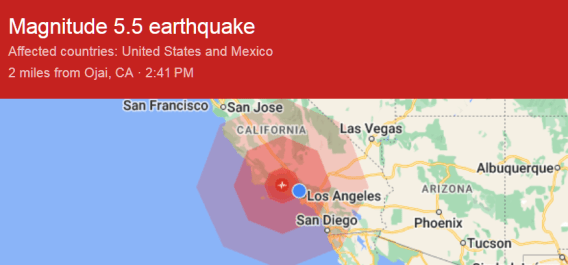
Ojai is 45 miles west of me, so it’s no big deal. But this post is about weather, not earthquakes, the floor has stopped moving, so we move on.
Working on the theory that this is a site about Audubon Society and birds, and birds often sail along on storm winds and so they can show up anywhere, and you, dear reader might like to know that so you can go outside and see them rocketing by, we present the following. All the sites below have options and displays not illustrated below. Have fun, play around. Watch the wind-blown birds, fires, heat waves, tornadoes, hurricanes, tsunamis, and just plain bad air moving along as they all come to get you.
WINDY.COM – Link to Windy.com
Winds, temperatures, forecasts, rain, thunder, clouds, waves.
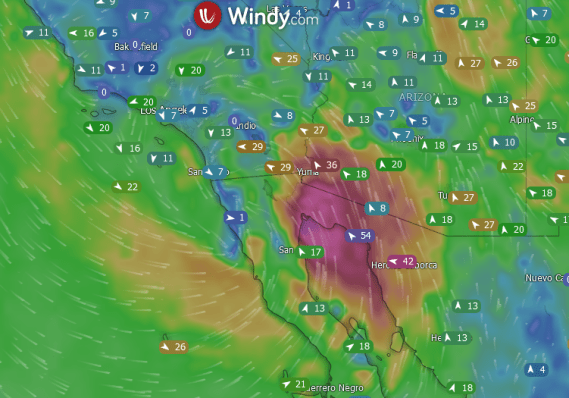
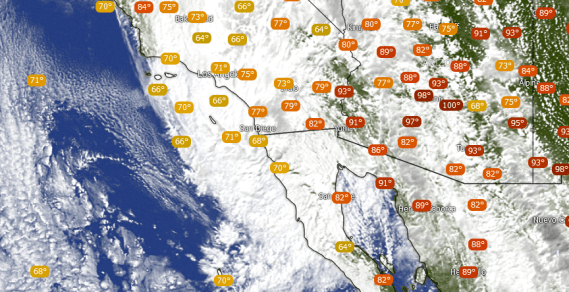
Zoom in and out. And so on. Lots of options. Here’s some screen snips. On the site things like currents and winds move. The snips below are stationary.
1. Wind, centered on our current incoming hurricane as of about 3PM. Hurricane Hilary is centered about 100 miles south of San Diego on the west edge of Baja. Wind speed & direction shown. Blue is slow: violet is fast.
2. Satellite picture with temperature overlay.
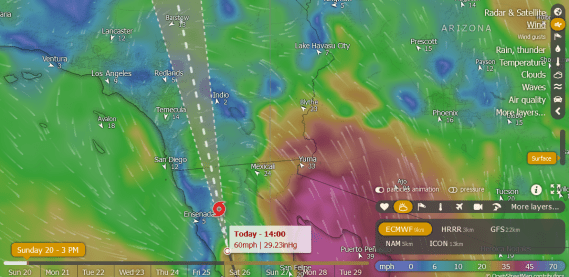
3. Hurricane Hilary tracker, Sunday 3 PM.
Earth : Link to Earth
- Great Wind graphic – online they move quite hypnotically, like long green hair. Hurricane Hilary below around 3 PM Sunday.

AirNow.gov – Link to AirNow.gov
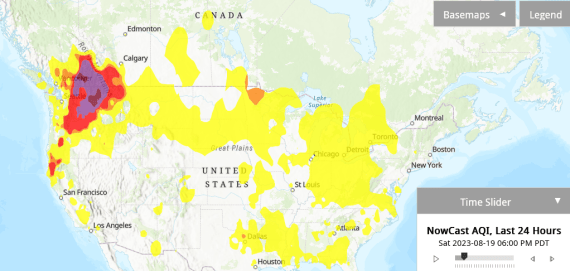
Fires/particulate matter. Online you can watch the fire forecast get worse.
[Posted by Chuck Almdale, suggested by Lucien Plauzoles]
African penguins could be extinct by 2035, campaigners say
The Guardian | Annalise Murray | 10 Aug 2023
Population has declined dramatically due to overfishing and environmental changes in the Indian Ocean
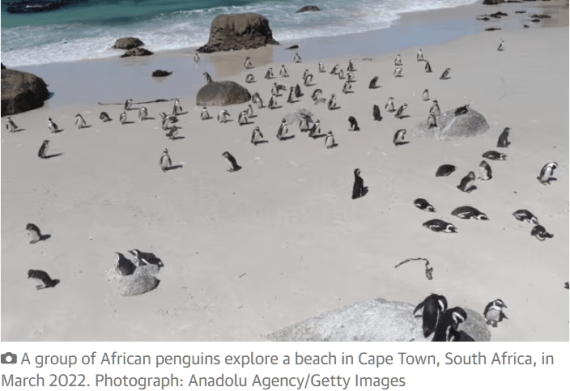
Above photo from the Guardian article.
The population of African penguins [formerly known as Jackass Penguins for their vocalizations] has declined dramatically over the past 100 years. In the early 20th century, it is thought that there were probably several million breeding pairs: today, fewer than 11,000 breeding pairs remain, and the population continues to fall sharply.
Roseate Spoonbill in Wisconsin | Smithsonian
[Posted by Chuck Almdale, submitted by roving French correspondent, Lucien Plauzoles]
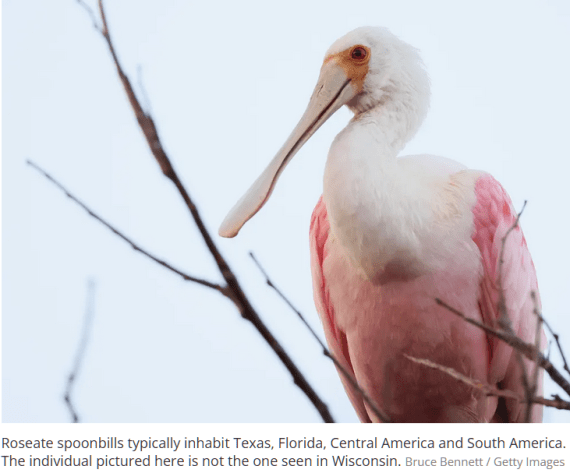
Lucky birders in Wisconsin are flocking to see this gulf coast resident. The last Roseate Spoonbill seen in Wisconsin was 178 years ago (1845) and was dead at the time.
Rare Pink Bird Spotted in Wisconsin for the First Time in 178 Years
A roseate spoonbill ventured far outside of its usual territory to make an appearance near Green Bay, delighting local birdwatchers in the process
Smithsonian Magazine | 1 Aug 2023
Enthusiasts flock to glimpse bird last seen in Wisconsin in 1845
Los Angeles Times | AP | 5 Aug 2023
University of Wisconsin wildlife ecology professor David Drake [good name!] offers this excellent suggestion well-known to all tickers and twitchers: Don’t go there and look for the bird, look for the crowd of birders.



 SANTA MONICA BAY AUDUBON SOCIETY BLOG