Free email delivery
Please sign up for email delivery in the subscription area to the right.
No salesman will call, at least not from us. Maybe from someone else.
The Northern Auroral Ring in Green | NASA
[Posted by Chuck Almdale]
Seen from Östersund, Sweden. Imagine that it’s really enormous and actually encircles the earth’s north magnetic pole and you’ll be closer to the truth than just pretty lights.
https://apod.nasa.gov/apod/ap240522.html
And in case you missed it, here’s the south polar auroral ring seen from near Christchurch, New Zealand.
Motus & the long-distance fliers
[Posted by Chuck Almdale]
Motus: Latin for movement, motion

If you haven’t heard of Motus Wildlife Tracking System, this is it (very short version):
- Attach a tiny radio transmitter (tag, $200-250 each) to an animal (see Piping Plover above); set it free
- As it moves around its location is received by the Motus antennas (Collaborative automated radio telemetry) in the area
- Motus gathers the locations; you see it on your computer

I received the following Motus summary from a member of COBOL – Central Oregon Birders OnLine – basically a hotline for birders, most of whom belong to East Cascades Audubon Society. I didn’t know these birds traveled this fast!
Speedy birds
From: Kevin Smith
Date: Fri, 17 May 2024 22:05:14 PDT
This in from the Oregon coast. Roy Low’s figures show that Dunlins can fly 58mph during migration!! AMAZING! The Motus system is posting some really speedy birds.
Kevin Smith
Msg: #6 in digest
From: Roy Lowe <roy.loweiii@gmail.com>
Date: Fri, 17 May 2024 17:24:41 -0700
Subject: [obol] Oregon Coast Motus Detections
Detections of marked birds at Motus towers along the Oregon Coast continues to provide intriguing information. Dunlin dominated the detections until late April when red knots took the lead. The following are a few nuggets from the detections.
On 4.23.24 dunlin flew from Llano Seco near Glenn, CA to Bullard’s Bridge in Bandon 6 hrs 47 min. If then was next detected at the Frazer River Mouth in Delta BC 17 hrs 19 min later.
On 4.25.24 a dunlin was detected in Newport that depart Salt Slough near Los Banos, CA 26 hrs 2 min earlier so it paused before reaching Newport but it was then detected in Cannon Beach 1 hr 32 min later of an average straight-line speed of 58.4 mph.
A dunlin departed Bandon and was detected in Cannon Beach 3 hrs 20 min later for an average straight-line speed of 57.8 mph.
On 5.3.24 a dunlin departed Rogue River Preserve near Eagle Point, OR and was detected in Newport 3 hrs 50 min later. After Newport it was detected 1 hr 30 min later at Cannon Beach for a straight-line average speed of 59.7 mph.
On 5.6.24 a long-billed dowitcher departed Sacramento NWR and was detected at Langlois 5 hrs 37 min later for a straight-line average speed of 47.8 mph.
On 5.6.24 a red knot departed Tomales Bay, CA and was next detected in Langlois 7 hrs 56 min later. It was then detected at Controller Bay, AK 1 day 13 hrs 31 min later after flying 2,327 miles at an average straight-line speed of 38.5 mph.
A Hermit Thrush was detected in Milpitas, CA (South San Francisco Bay) from March 15 to April 29. It was next detected in Langlois 6 days 6 hrs 46 min later so it took it’s time coming north.
On 5.8.24 a red knot departed Guerrero Negro, Baja California and then was detected near the Salton Sea and the next detection after that was at Cartago, CA east of the Sierra Nevada Mountains. It was then detected in Langlois 4 days 16 hrs and 46 min later. A number of marked knots are taking inland routes and reach the Oregon coast from Langlois to Cannon Beach or further north.
On 5.16.24 a red knot departed Colusa NWR and was next detected in Langlois and spent about 5 hrs in the New River area. It was detected Bullard’s Bridge in Bandon and then next at Ankeny NWR 13 hrs 24 min so it stopped along the way. But here’s the ringer, after the Ankeny detection the bird backtracked to the WSW arriving at Yaquina Bay in 1 hr and 5 min later for a straight-line speed of 46 mph!
Besides the above, something else I find interesting is that only a single bird (dunlin) has been recorded along the Oregon coast that was also recorded at Humboldt Bay and there have been no red knot detections at Humboldt Bay.
Roy Lowe
Waldport, OR
— Nature is my Religion. Wildlife has never said “Don’t take a photo of me while I’m laughing”
The American Ornithological Society wants your opinion on changing eponymous bird names
[Written by Chuck Almdale]
The American Ornithological Society (AOS) is soliciting opinions on the controversy of changing eponymous bird names (named for someone, e.g. Anna’s Hummingbird). If you need no more information than that, then they announced in their 13 May online posting AOS Pilot Project to Change Harmful English Common Bird Names:
Please submit your ideas and comments to us [AOS) through this online form by Friday, 31 May 2024.
I encourage you to submit your ideas and comments ASAP, as time is running out. If you need more information than that, read on. There will be a followup posting with an even more extensive history on this controversy posted here in a day or two.
The American Ornithological Society (AOS) has been embroiled in a divisive discussion for over six years having to do with eponymous names for birds (i.e. birds named for people, almost exclusive white people of European ancestry). It is difficult to read any AOS postings on this subject without seeing this quote:
“There is power in a name, and some English bird names have associations with the past that continue to be exclusionary and harmful today.” – AOS President Colleen Handel, Ph. D.
If – a big if – there actually is any power in a bird’s name, can it be maleficent? Can a bird’s name be truly “exclusionary” or “harmful”? Whom does “Lucy’s Warbler” or “Inca Dove” exclude? Whom does it harm? Did McCown’s name on a longspur bother more than one person in the entire United States before people began crying, “We should feel harmed and excluded by this name.” And lastly, there are the opportunity costs: what worthwhile projects are ignored while they argue about eponyms.
It is interesting to note the frequent display of the quotation above on the AOS website, and that it has been picked up by other organizations eager to “decolonize” bird names. If you don’t know of or doubt the purported relationship of “decolonization” to eponymous bird names, it was given as the reason for making these changes, as demanded in the opinion piece by “Bird Names For Birds” (BN4B) published on the Washington Post website on 4 Aug 2020: The stench of colonialism mars these bird names. They must be changed. Yes, that’s the article’s real name. This piece was published six weeks after BN4B sent their petition to the AOS requesting the change of eponymous English bird names.
Despite the high level of education and expertise within their membership, the AOS leadership Council has rarely solicited and sometimes deliberately ignored their opinions1,2,3,4,5,6 on this matter of eponyms. However, they are now asking the general bird-interested public as well as their members what they think. If you have an opinion on the wisdom and inclusiveness or stupidity and pointless virtue-signaling of eliminating eponymous bird names, now’s the time to let them have it. Buried near the end of one of their website articles, dated 13 May 2024, with the unpromising title AOS Pilot Project to Change Harmful English Common Bird Names, there was the following request:
Please submit your ideas and comments to us [AOS) through this online form by Friday, 31 May 2024.
I encourage you to submit your ideas and comments. They will ask you:
- Are you a present or past AOS member? (You don’t need to be a member.)
- Do you want to be involved in developing the English Common Names Pilot Project?
- Your expertise/experience? Describe it.
- Optional: Please share comments, suggestions, feedback, and ideas about the English Common Names Pilot Project.
- Optional: Please share comments about past AOS decisions and actions about English bird names.
- Optional: Please share content and format suggestions for the AOS Public Forum on English Common Names at the 2024 annual meeting in Estes Park, Colorado, in October.
- Optional: Please share general comments, suggestions, feedback, and ideas.
At the start you are given the opportunity of saving your work through Google Forms; at the end you may request a copy of all questions & your answers sent to you. Depending on the length, complexity and number of your answers, you can easily spend more than a couple of minutes on this. I recommend you utilize Google Forms and request the copy.
Some useful acronyms:
AOU – American Ornithological Union; merged with Cooper Ornithological Society in 2016 to become the AOS.
AOS – American Ornithological Society; successor to AOU; research, nomenclature, taxonomy, meetings; you can join for $90/year or less.
BN4B – Bird Names for Birds; a group favoring Decolonialism and elimination of eponymous bird names.
IOU – International Ornithologist’s Union; promoting ornithology and updating a world checklist.
LSU – Louisiana State University; heavily involved in Central/South American ornithology for many decades
NACC – North America Classification Committee; taxonomy & nomenclature
SACC – South America Classification Committee; taxonomy & nomenclature
WGAC – Working Groups Avian Checklists; groups affiliated with IOU
Notes on AOS lack of soliciting opinions and ignoring opinions proffered: Protests from AOS fellows, members, and outsiders.
1. 1 Nov 2023: South American Classification Committee (SACC), website based at Louisiana State University (LSU): SACC disaffiliates with AOS:
“SACC became affiliated with the American Ornithological Society in August 2002, but is no longer affiliated with the AOS, as of 1 November 2023, when the AOS leadership decided that all eponymous names were to be purged and that the South American Classification Committee would no longer be in charge of English names. SACC is now affiliated with the International Ornithologists’ Union as a regional committee working with the IOU’s Working Group Avian Checklists (WGAC), whose goal is to produce a global classification of birds.“
2. 13 May 2024: AOS website confirms that SACC disaffiliated with AOS and affiliated with International Ornithological Union (#1 above): AOS Pilot Project to Change Harmful English Common Bird Names:
“Our decision to change all eponymous English names of birds within our geographic purview triggered a marked response from the AOS’s South American Classification Committee (SACC), which has maintained the globally recognized checklist of South American birds since 1998. The SACC had been formally affiliated with the AOS since 2002, but after the AOS announced its decision to change all eponymous names, almost all members of the SACC joined the International Ornithologists’ Union (IOU) as a regional committee within the IOU’s Working Group on Avian Checklists, whose goal is to produce and maintain a global checklist of birds. This change in affiliation has resulted in an additional complexity relative to our decision, namely, the need to discuss and decide with other checklist committees and ornithological societies what is truly within the AOS’s geographic purview for naming (and renaming) birds.“
3. 28 Nov 2023: R.K. Hopper petition thru Change.Org: Petition to AOS Leadership on the Recent Decision to Change all Eponymous Bird Names. Over 6,300 signatures received; included comments from many very-well-known birding community members.
“We the undersigned strongly support diversity and inclusion in the birding community but disagree with this decision for the following reasons: The destabilization of 150 English bird names is unprecedented….The attempt by AOS leadership to appear more diverse and inclusive has created an unprecedented and unnecessary division within the birding community unseen in our lifetimes….We challenge the AOS to produce evidence that bird names are having a negative impact on the stated goals of the organization or birding in general….Rather than a total purge of eponyms, we suggest that the previous case-by-case method be resumed to remove offensive names rather than dishonoring the many people who founded ornithology in the Americas…This methodology was also endorsed by the entire North American Checklist Committee (NACC) and all but one member of the South American Checklist Committee (SACC) although the committees recommendations were ignored by the AOS.“
4. December 2023: J.V. Remsen, Jr., LSU, SACC founder and leader: Comments to AOS Council from J. V. Remsen (Chair and founder, South American Classification Committee, and member since 1984 of North American Classification Committee). Van Remsen’s initial critique of the AOS decision.
“The English Bird Names Committee report is antithetical to the AOS mission with respect to diversity and inclusion….censoring all eponyms smacks of an attempt to erase the cultural heritage and scientific accomplishment of “Western” culture in the Western Hemisphere….Because AOS names are used by federal agencies, the cost to taxpayers of those name changes needs assessment. USFWS, USDA, NPS, etc. all use standardized AOS names….A typical reaction to the controversy from the general public and scientists [paraphrase] ‘…of all the problems in need of solutions, the AOS is focusing on THIS!’”….If AOS adopts the proposal, it will be seen as a heavy-handed edict from the Global North without consideration of negative impacts….There is no direct evidence for any tangible, positive effect, other than to appease the BN4B [Bird Names for Birds] people….All but one SACC members are in favor of a case-by-case analysis to remove eponymous English for which continued use of that eponym is harmful to people or bird conservation…The ENBC report takes it as a given that its new names will help people learn bird identification. I regard this a classic False Premise….here we are, tearing each other apart over English bird names.“
5. 4 April 2024: AOS Fellows to AOS leadership: Resolution for a Moratorium on Changing Nonharmful Eponymous English Bird Names; PDF file, 231 AOS Fellows signers; includes name list and FAQs.
“This Resolution grew out of widespread member discord with the decision to eliminate all eponymous English bird names and the process that led to it. The lack of transparency and opportunities for participation in a decision as subjective and broadly impactful as the use of eponymous English bird names is not how many of our members want this professional society to operate. Right now, a substantial number of AOS members feel disenfranchised and ignored.“
6. 24 Apr 2024: J.V. Remsen, Jr., LSU, SACC founder and member, 26 page expansion of his Dec. 2023 critique:: Critique of the Ad Hoc English Bird Names Committee Recommendations for Council of the American Ornithological Society. It is devastating.
“[As AOS council voted to] replace all 257 eponymous bird names in the Western Hemisphere with new descriptive names….The final report itself was not made available to AOS membership for comment….A June 2023 draft of the report was made available to the members of the AOS’s NACC and SACC, on condition of secrecy. Committee members were given two weeks to respond….Collectively, NACC and SACC members voted 21-1 to reject the EBNC report and also provided extensive criticism, which was largely ignored in the final draft of the EBNC report other than correction of factual errors pointed out by committee members….[Remsen now gives them his 26-page critique].”
The Southern Aurora | NASA
[Posted by Chuck Almdale]
Today’s NASA picture is the lively aurora stimulated by the recent solar storm, as seen from near Christchurch, New Zealand. I can’t recall ever seeing a photo that captured so well the fact that the polar auroras are actually enormous rings around the earth’s magnetic pole, as usually only a small portion is captured by the lens.
[Text by Chuck Almdale, photos & 5/11/24 trip list by Chris Tosdevin]
While Chris Tosdevin and I agreed to co-lead this announced-at-the-last-minute trip, I think it was Ruth Tosdevin who pointed the way and kept us moving along. Whomever was in charge (if anyone) it was a beautiful day. It warmed from a cool upper 50s to a lovely 70° or so, the air was filled with bird song, especially the burble-babbling of House Wrens, and the landscape was dotted with flowers and butterflies. And no pesky biting insects. We’ll introduce you to a few of the more interesting and beautiful birds, then beleaguer you with a quiz. Some of the best photos will be in the quiz, so don’t ho-hum yourself into skipping it.
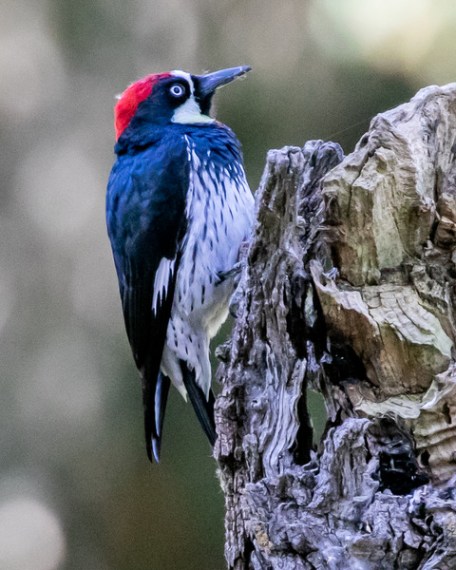
Acorn Woodpeckers were not the most abundant bird in the park but perhaps the most commonly seen as they fly around a lot, sit on bare branches, make loud weird calls, are relatively big and chunky and look like clowns. I spotted five in one tree next to the parking lot as I got out of my car. They were mobbing a perched youngish (not particularly red on the chest) Red-shouldered Hawk in a bare tree, who appeared imperturbable but left within a few minutes.
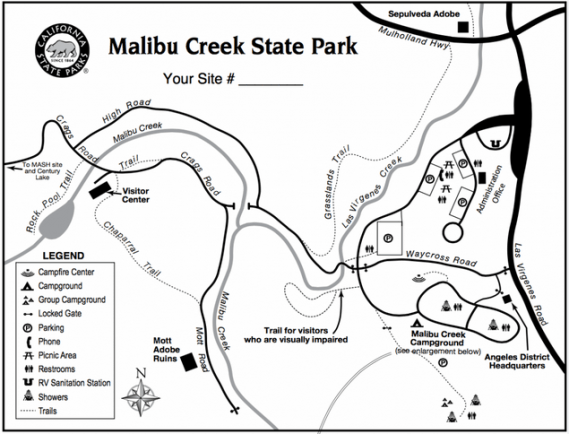
We first wandered up the former entrance road (Waycross) towards Las Virgenes Rd., crossing Stokes Creek which runs down from King Gillette SP on the other side of Las Virgenes, cut past the District HQ building whose roof was thoroughly plasticized against winter rains, back through the jam-packed campground ($45/night!) dodging frisbees and footballs on our way to the Braille Trail, then along Crags Rd. past the former Malibu Creek crossing, then about 1/2-way along the High Road to the Visitor Center, at which point we turned around. It took us about 3.5 hours to cover this short distance. Lots to look for, look at, listen to, poke at, and sniff. Then repeat.
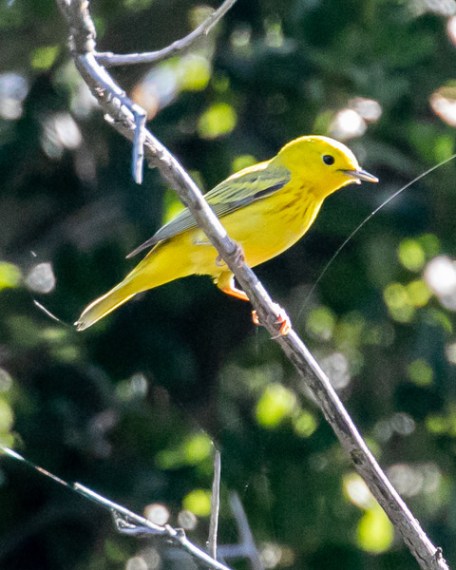
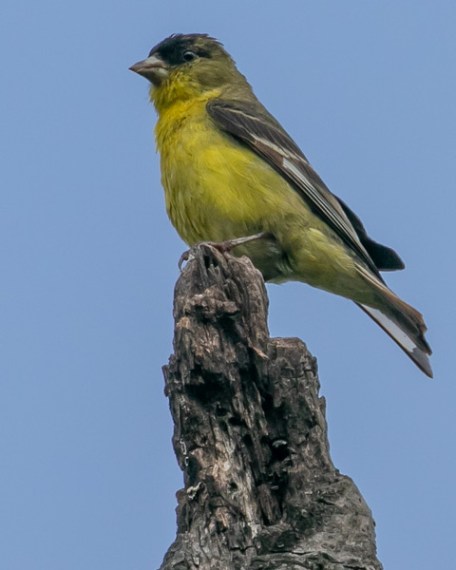
There was an abundance of yellow(ish) birds, the first of which was a Lesser Goldfinch, mournfully singing from a high twig. We also had multiple Yellow Warblers, Common Yellowthroats, Western Tanagers and a vaguely-yellow-underneath Ash-throated Flycatcher.
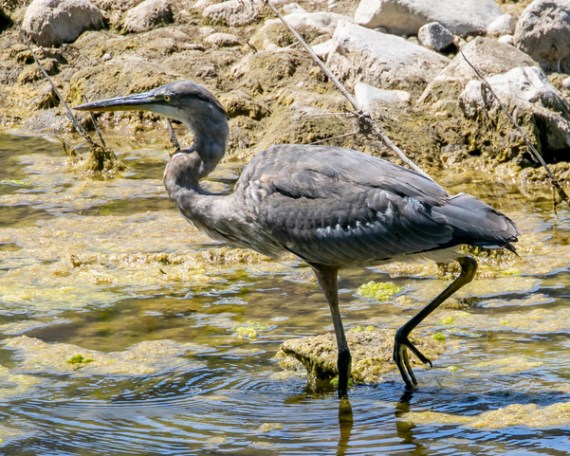
About every 20 minutes we’d see this Great-blue Heron go sailing by overhead, on its way to elsewhere. We finally caught up to it at Malibu Creek, upstream a bit from where the crossing roadway used to be (everyone knows where that is, right?). This where the creek becomes its widest and slowest, where Killdeer often nest on the sand & gravel banks. No Killdeer today, though.
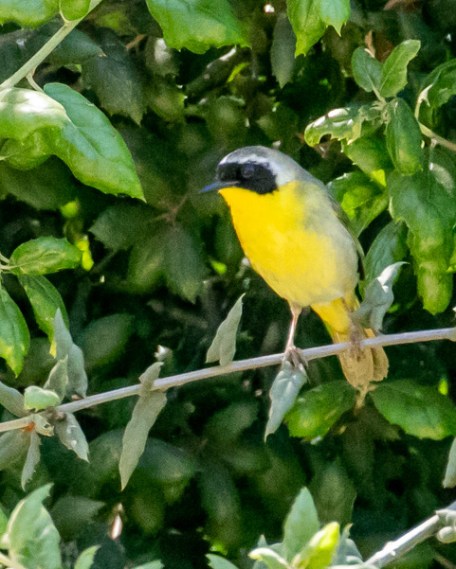
Some of the birds were blindingly colorfully bright. I don’t think I’ve ever seen a Common Yellowthroat look so uncommonly yellow as did one individual. The forehead/crown was so intensely gray that it looked blue.
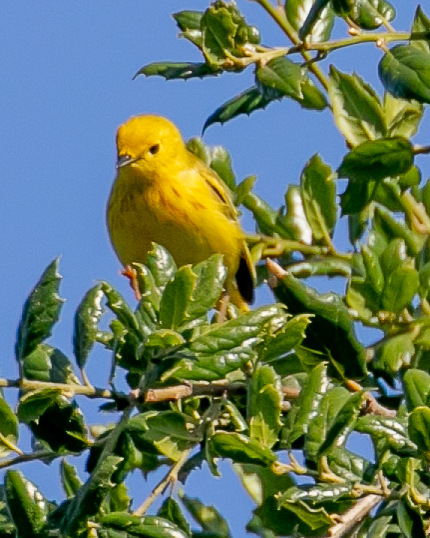
Some of the many male Yellow Warblers had bright thick red breast streaks. This one below was a bit less fervently marked. Of the many singing birds, this was probably the second-most commonly heard species, and the most common, the House Wrens, were everywhere, loudly singing. It seemed sometimes there were ten at a time burbling at the top of their lungs. For every one we actually saw, we could easily have heard 5-10 more.
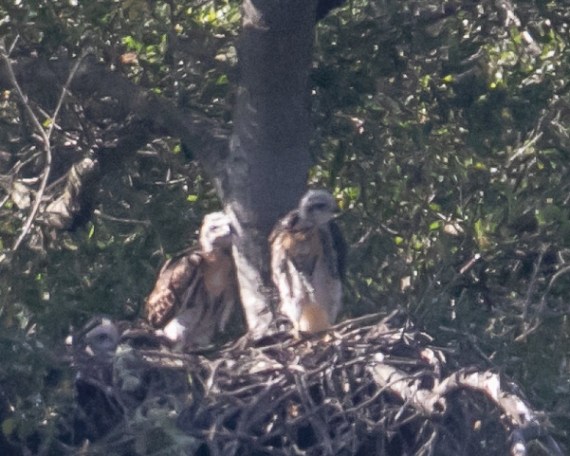
Chris and Ruth had a secret, which they kept to themselves until Chris’ telescope was properly focused. In a distant tree within a long line of trees there was a nest full of young Red-tailed Hawks. We counted four, although I can’t see more than two in the photo below. Sometimes they crouched down. Their heads were very white. Their feathers are growing out, but they were not yet anywhere near flying.
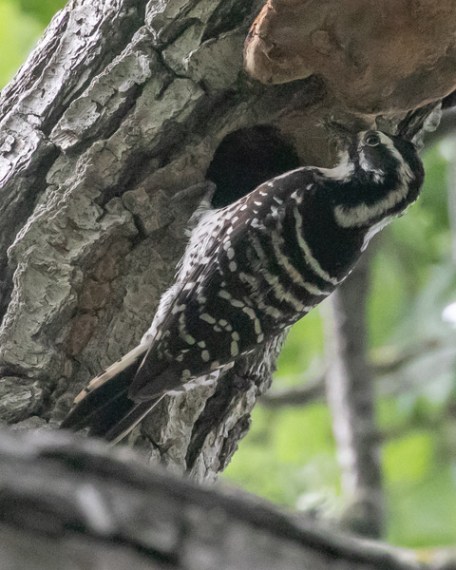
We found four Nuttall’s Woodpeckers, proving Acorn Woodpecker wasn’t the only woodpecker around. The female below was carrying food to her nest, which was on the underside of a mostly-horizontal limb, so she was literally hanging by her toes, although you can’t really tell that from the photo below. Chris had to lean way back and point the camera straight up to take this. The nest is just above her feet, so the entrance is more of a manhole (birdhole?) than a sidehole.
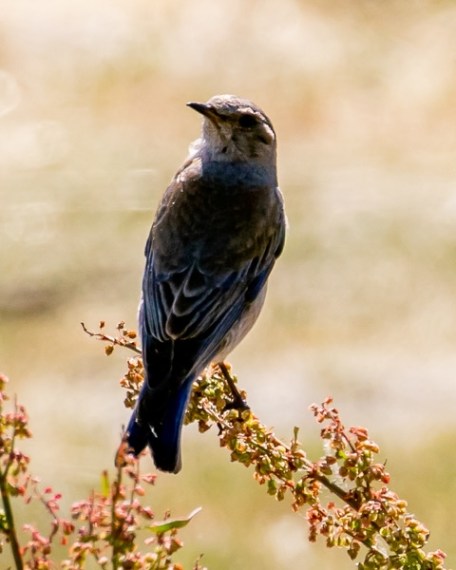
It’s pretty hard to see any blue on this female Western Bluebird, but the reddish breast and that innocent facial expression gives her away.

Male Blue-gray Gnatcatchers in breeding (alternate) plumage have a dark line over the eyes which meets just over the bill, giving them a slightly meaner expression.

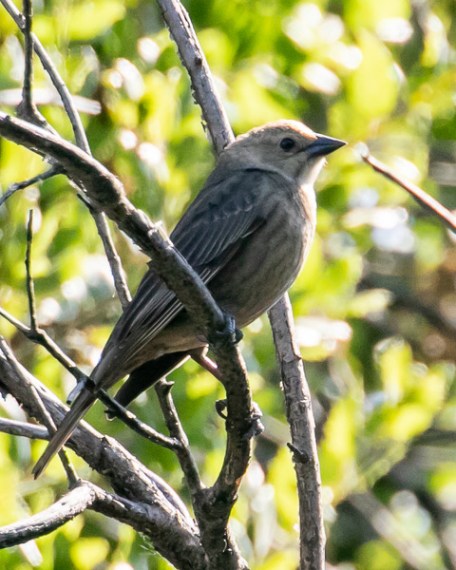
We came upon this female Brown-headed Cowbird, sitting sedately on a bare branch. For an Icterid (blackbird-oriole family) they have a very thick, almost finch-like bill, and this one’s plumage seemed a bit pale, although it could just have been an artifact of sunlight. She probably had her eye on someone’s nearby nest, waiting for the owners to leave so she could dump an egg or two into it.
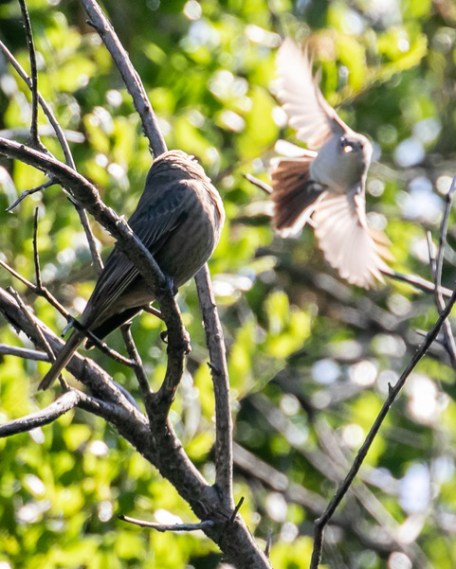
Unfortunately for her, she was seen and recognized by some of the smaller birds in the vicinity. A family of Bushtits moved in to drive her away, joined by Blue-gray Gnatcatchers and at least one Yellow Warbler and perhaps a few other species. This suggests that our local birds, unfamiliar with Cowbirds only a century ago, have now picked up on and passed on to others just what she’s really up to.

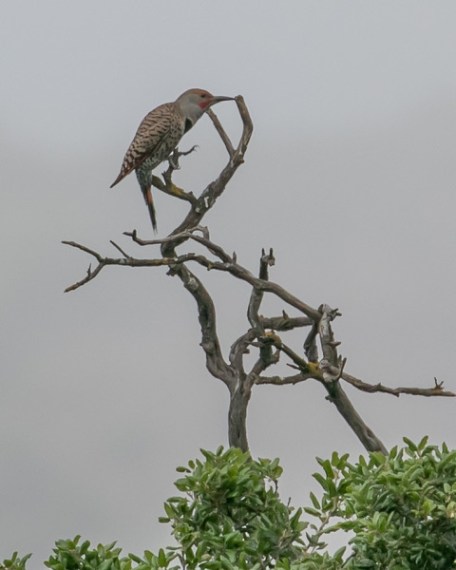
We’ll end with the traditional show-ending “flicker in the fog” photo. This is a true Red-shafted Flicker, just to show you that even with all the hybrid Red-shafted x Yellow-shafted Flickers and flat-out Yellow-shafted Flickers flying around SoCal these days, there are still some Red-shafted around. Note the red moustachial stripe, gray face, lack of red nape and a very faint ting of red in the side of the tail.
Last but not least we heard a Yellow-breasted Chat chortling down in the creek bed as we walked along Crags Rd. Couldn’t find it from the road, though, and the dirt cliff down to the water and brush looked too lethally slippery-steep for my sneakers.
Bird Quiz!
Fun for the whole family, for kids from three to one-hundred-and-three! All birds were photo’d on this field trip, no ringers snuck in from Colombia or Kavortistan or someone’s fevered imagination. We’ll begin with a few easy underhand pitches.

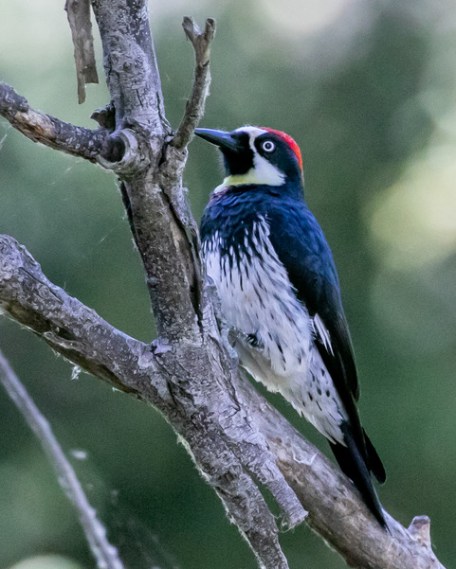
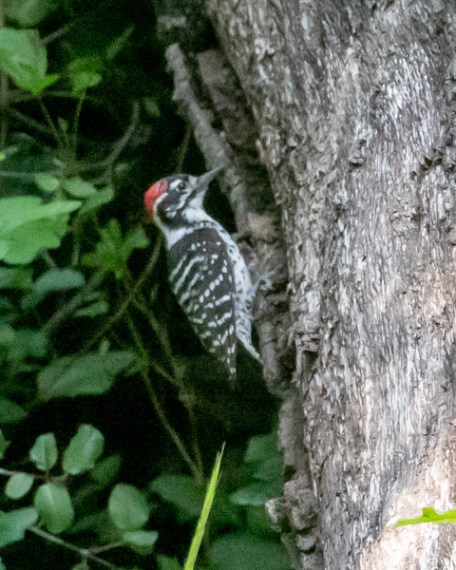

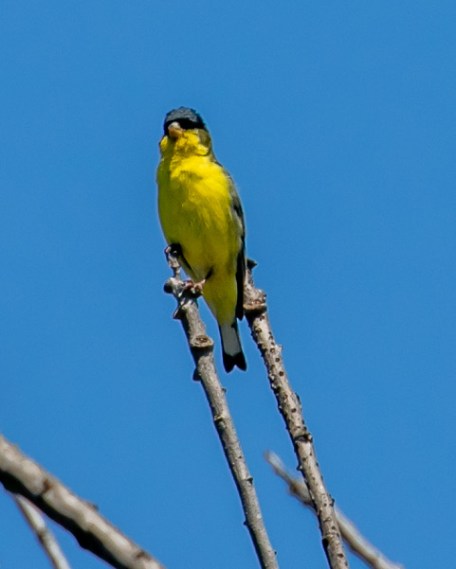
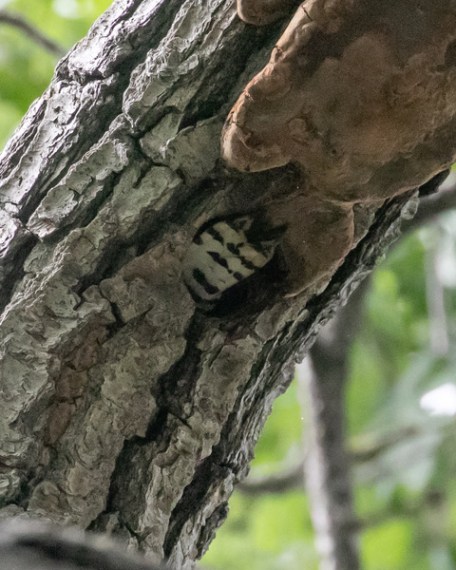

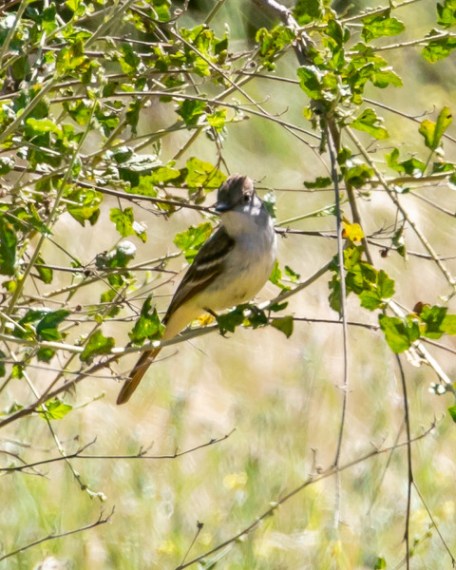

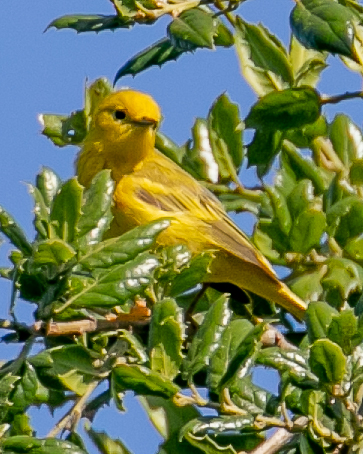

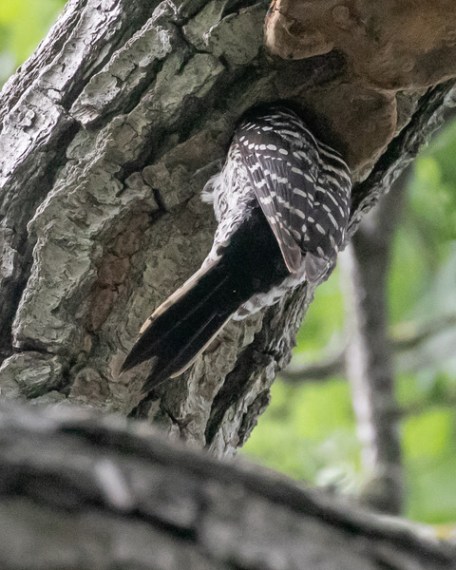
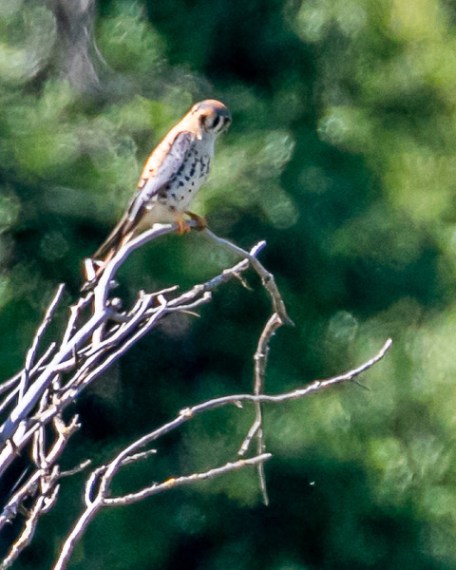
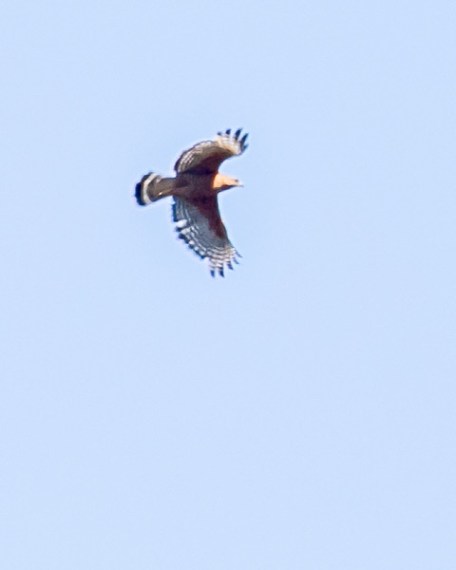
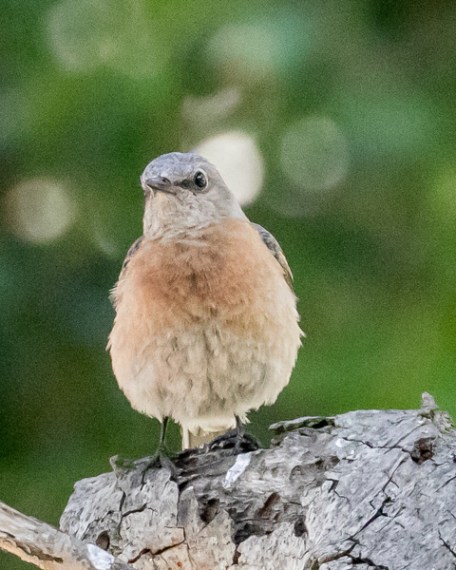
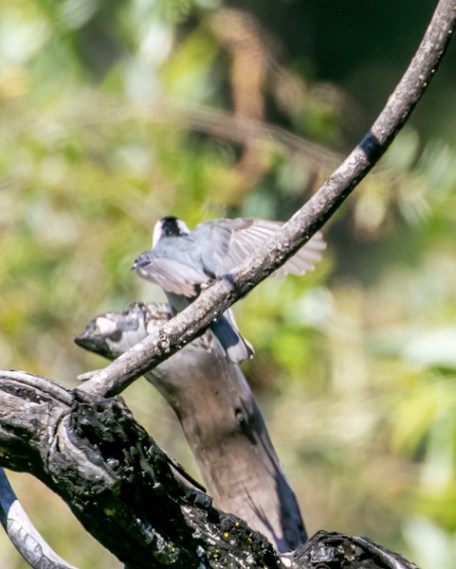
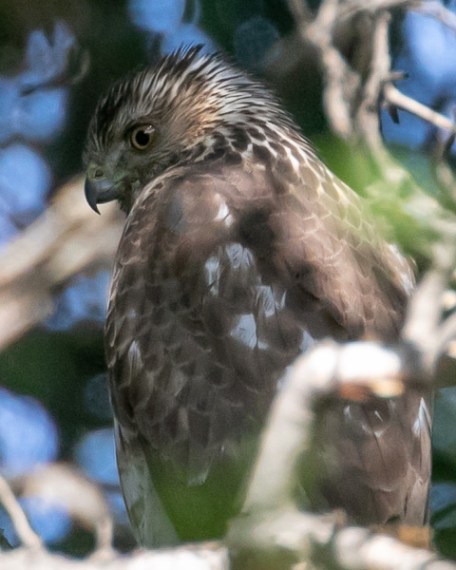


Quiz Answers: All photos by Chris Tosdevin, 11 May 2024, Malibu Creek State Park
#1. Dark-eyed Junco, Oregon-type
#2. Acorn Woodpecker, male
#3. Nuttall’s Woodpecker, male
#4. Song Sparrow
#5. Lesser Goldfinch, male
#6. Nuttall’s Woodpecker, female, not that you could tell sex from this photo.
#7. Blue-gray Gnatcatcher, male; note dark eyebrows.
#8. Ash-throated Flycatcher, who sings prrrrrt!
#9. Common Yellowthroat, male, unusual amount of white on head.
#10. Yellow Warbler, probably male but red streaks hidden.
#11. Western Tanager, young male, very faint red on crown.
#12. Nuttall’s Woodpecker, female, a bit more visible.
#13. American Kestrel
#14. Red-shouldered Hawk, previously mobbed by Acorn Woodpeckers.
#15. Western Bluebird, female.
#16. White-breasted Nuthatch, inconveniently viewed.
#17. Cooper’s Hawk, deep in foliage.
#18. Blue-gray Gnatcatcher on nest, female
#19. Brown-headed Cowbird, female, about to be mobbed.
#20. Brown-headed Cowbird, male, looking twisted.
#21. Western Bluebird, female, awkwardly perched.
In the interest of full disclosure and complete transparency, I didn’t know what #21 was and wasn’t too sure about #20 either.
The list below is the only record we have for our Malibu Creek SP bird walks. It’s odd to note that each trip had 47 species, but the total for all three species was 70 species, or 67% of the total. From the results of many other trips elsewhere I’ve learned that on any given trip to any particular location, a reasonably – but not obsessively – diligent search will turn up about 2/3rds of the birds likely to be present at that time of year.
| Malibu Creek S.P. Field Trips | 5/11/24 | 11/12/11 | 11/13/10 |
| Mallard | 5 | 20 | 15 |
| Ring-necked Duck | 1 | ||
| Bufflehead | 2 | ||
| Pied-billed Grebe | 1 | ||
| Band-tailed Pigeon | 6 | 80 | 12 |
| Mourning Dove | 5 | 2 | 2 |
| White-throated Swift | 20 | ||
| Anna’s Hummingbird | 3 | 1 | 2 |
| Allen’s Hummingbird | 2 | 1 | |
| American Coot | 20 | 15 | |
| Double-crested Cormorant | 1 | ||
| Great Blue Heron | 2 | 1 | 1 |
| Turkey Vulture | 10 | ||
| White-tailed Kite | 2 | 2 | |
| Cooper’s Hawk | 2 | 1 | |
| Red-shouldered Hawk | 2 | 3 | 1 |
| Red-tailed Hawk | 6 | 4 | 3 |
| Belted Kingfisher | 1 | ||
| Red-naped Sapsucker | 1 | ||
| Red-breasted Sapsucker | 2 | 1 | |
| Acorn Woodpecker | 15 | 8 | 15 |
| Downy Woodpecker | 1 | 2 | |
| Nuttall’s Woodpecker | 4 | 4 | 1 |
| Northern Flicker | 1 | 5 | 2 |
| American Kestrel | 2 | 4 | 1 |
| Nanday Parakeet | 8 | H | |
| Western Flycatcher | 4 | ||
| Black Phoebe | 2 | 6 | 6 |
| Say’s Phoebe | 3 | 2 | |
| Ash-throated Flycatcher | 5 | ||
| Cassin’s Kingbird | 2 | ||
| Hutton’s Vireo | 2 | 1 | |
| Loggerhead Shrike | 2 | 1 | |
| California Scrub-Jay | 6 | 2 | 6 |
| American Crow | 10 | 30 | 30 |
| Common Raven | 4 | 8 | 10 |
| Oak Titmouse | 10 | 20 | 12 |
| Violet-green Swallow | 1 | ||
| Northern Rough-winged Swallow | 5 | ||
| Cliff Swallow | 20 | ||
| Bushtit | 10 | 15 | 15 |
| Wrentit | 2 | 3 | 1 |
| Ruby-crowned Kinglet | 4 | 3 | |
| White-breasted Nuthatch | 3 | 6 | 6 |
| Blue-gray Gnatcatcher | 3 | ||
| Canyon Wren | 1 | ||
| House Wren | 12 | 1 | 3 |
| Bewick’s Wren | 2 | 2 | |
| Western Bluebird | 2 | 20 | 1 |
| American Robin | 1 | ||
| Phainopepla | 1 | 2 | |
| House Finch | 10 | 30 | 4 |
| Purple Finch | 6 | 2 | |
| Pine Siskin | 5 | ||
| Lesser Goldfinch | 10 | 1 | |
| Lark Sparrow | 20 | ||
| Dark-eyed Junco | 8 | 30 | 12 |
| White-crowned Sparrow | 40 | 20 | |
| Song Sparrow | 6 | 4 | 1 |
| California Towhee | 9 | 12 | 4 |
| Spotted Towhee | 8 | 8 | 4 |
| Yellow-breasted Chat | 1 | ||
| Red-winged Blackbird | 1 | ||
| Brown-headed Cowbird | 3 | ||
| Orange-crowned Warbler | 5 | ||
| Common Yellowthroat | 6 | 2 | 1 |
| Yellow Warbler | 12 | ||
| Yellow-rumped Warbler | 40 | 40 | |
| Western Tanager | 2 | ||
| Lazuli Bunting | 1 | ||
| Total Species: 70 | 47 | 47 | 47 |



