Free email delivery
Please sign up for email delivery in the subscription area to the right.
No salesman will call, at least not from us. Maybe from someone else.
Support the Bill to Create Native Habitats!🌿
Support the Bill to Create Native Habitats!🌿
[Posted by Chuck Almdale]
Editor’s Note: This notice from Pasadena Audubon Society arrived in our email. We think it worthwhile to pass on to our members and readers, but its appearance may be odd because the PAS formatting doesn’t exactly match our WordPress server formatting. It can take hours (for me) to get these problems eliminated, so after some minor tinkering with it, I’m posting it as it is.
 🚨Call to Action!📞🚨  We just learned from our friends at California Native Plant Society that AB 1573 may be up for a floor vote soon, and currently, it’s scheduled for a discussion. Now is the perfect time to urge our Assembly members to vote “YES”! What is AB 1573? “Introduced by Assembly member Laura Friedman (D-44), Assembly Bill 1573 is a transformative bill that would create California’s first requirement for the use of native plants in public and commercial landscapes. The bill creates a phased on ramp over the next decade to convert non-functional turf to California native plants, giving our industry partners plenty of time to prepare. Passage of this bill would put California’s government and commercial landscapes to work on behalf of biodiversity, giving imperiled pollinators a fighting chance. Imagine native plants in front of your pharmacy and grocery store, in traffic medians, and surrounding your children’s schools. This beautiful picture can become a reality with your help!” – Liv O’Keeffe, CNPS Senior Director, Public Affairs This Bill could be a HUGE step forward in creating more native habitats for our feathered friends to survive and thrive while supporting biodiversity! Please take a few minutes to help pass this crucial bill that could change the future of the birds! Here is what you can do: Find your Assembly member. Contact the office and let them know that you support AB 1573 and you strongly urge them to say “Yes” to pass this Bill! Here is the template. You can learn more about the benefits of native plants on our website! Thank you for speaking up for our feathered friends! 🐥  Conservation: Are you passionate about making our communities more bird-friendly? Birds need our advocacy more than ever to survive and thrive. Please contact our Advocacy and Conservation Committee to join our conservation efforts! Report Bird Collisions: Each year between 365 million and 1 billion birds die from collisions with windows across the United States. Visit National Audubon Society or American Bird Conservancy to learn more about the issue and tips for making windows bird-safe. Photo: Mountain Chickadee by Karen Schneider Get involved! Interested in volunteering? Please fill out this volunteering interest form! There are many ways to support PAS conservation, education, and outreach efforts. Support PAS Join the PAS Groups.io list for event reminders, field trip reports, and local bird chat. Not yet a member? Go to Pasadena Audubon membership We’d love to hear from you! Tag @pasadenaaudubon on Instagram or join our Facebook Group to share your bird photos! Photo credit: Nelson’s Hairstreak (butterfly), Red-whiskered Bulbul, Western Screech-Owl, and the Birders by Luke Tiller; California Towhee by Chris Spurgeon; Black Swift and Common Murre by Luke Tiller; Channel Islands from http://www.nps.gov |
| Copyright © 2022 Pasadena Audubon Society, All rights reserved. You are receiving this email as a member or friend of Pasadena Audubon Society. Our mailing address is: Pasadena Audubon Society 1750 North Altadena Drive Pasadena, CA 91107 Want to change how you receive these emails? You can update your preferences or unsubscribe from this list. |
With all the products available these days, sometimes the jargon and claims can get confusing. Here’s a quick primer.
Audubon Magazine | Kevin Dupzyk | Spring 2023
[Posted by Chuck Almdale]

Top Left: Bird-excluding; Center: No-mess; Top Right: Bird-specific;
Bottom Left: Anti-squirrel; Bottom Right: High-energy.
Photos: Luke Franke/Audubon
Link to article from which this was adapted and shortened.
These are some of the varieties of seed mixes available. If you know what birds and animals you want and don’t want, buying the right mix will help get you to your goal. Quality and price varies. When available, check the reviews.
Bird-Excluding (top left)
Starlings can’t crack open sunflower seeds. They do like safflower and milo which are usually included in these mixes, so you might be better off with a feeder that excludes starlings.
No Mess (center)
No shells, no filler (such as red milo), everything is eaten; no mess, costs more.
Bird-Specific (top right)
Finches, goldfinches and siskins love Nyjer seeds. These mixes are often made for sock and mesh feeders which finches love to hang from while eating.
Anti-Squirrel (bottom left)
Coated with chili-pepper that birds can’t taste but irritates squirrels. Effectiveness varies, check reviews. You might also need a squirrel-proof feeder (if one is ever invented) or a squirrel baffle.
High-Energy (bottom right)
Often called “winter blends” with lots of ingredients high in fat or protein: nuts, insects, high-oil seeds, even suet.
Will Steelhead return to Malibu Creek? | KCRW Radio
[Posted by Chuck Almdale]

Steelhead Trout. Source: KCRW – Malibu Creek Steelhead
This 9-minute audio was broadcast on KCRW’s Greater LA report today, 17 May 2023.
This link takes you to both the audio recording and KCRW’s text.
Featured on the audio is local fish expert Rosi Dagit, who in 1998 discovered Steelhead Trout in Topanga Creek, much to everyone’s utter disbelief. Then in 2017, below Rindge Dam in Malibu Creek, she discovered a female Steelhead trying to head upstream to spawn. To her great sadness the Steelhead expired despite her attempts to save it.
Beginning over 30 years ago and continuing for 10-15 years, I attended an seemingly-unending series of discussions concerning Malibu Creek and Lagoon, under the auspices of the unwieldy-named Malibu Creek Watershed Advisory Council and Steering Committee. It was fun, frustrating and enlightening.
One of the reports it produced was the 1995 Malibu Creek Watershed Natural Resources Plan which came up with 44 action items over which I sweated blood for a few weeks. Out of all this work and conferring came the 2012 Lagoon Restoration (I call it reconfiguration), which people including me still praise and blame. Many problems we discussed then still exist.
Link to watershed maps.

Rindge Dam, aerial photo, 3 miles upstream of Malibu Lagoon.
ScreenSnip Source: CalTrout – Rindge Dam
Among them is the problem of Rindge Dam, located about 3 miles up Malibu Creek. The short summation of problems: 100 years old and 100 ft. high, impassible by fish, now filled to the brim with estimated 780,000 cubic yards of sediment, residents downstream worry about a flood of sediment should the dam come down quickly, the sediment provides lateral support for canyon walls, dam removal might cause canyon walls and Malibu Canyon Road to collapse.
This Rindge Dam film from California Trout mentions how “restored sediment transport supports a healthy beach and prevents erosion,” an opinion with which I and I’m sure all surfers will agree. But if that is true, perhaps at least some of the 780,000 cubic yards of sediment behind the dam should be removed by letting it flow downstream through a paced reduction of dam height, allowing the creek to erode the silt and carry it away naturally and gradually. The current plan calls for hauling all the sediment away in trucks.
I have a suggestion.
If it’s going to take ten years to accomplish this removal, as the film suggests, perhaps instead of waiting 8-9 years before beginning the project and doing all the work in 1-2 years, they could cut a V-shaped notch 1-5 feet deep in the top of the dam now and allow the creek to carry the silt away gradually. When sufficient sediment has flowed away, cut the notch a foot or two deeper and wider. Over 10 years you could do this every three months or 40 times total, cutting the notch 2.5 feet deeper (on average) each time. After 10 years, the silt is gone. It has flowed down to the beach and offshore sand reefs where it now “supports a healthy beach and prevents erosion” and you can pull the remaining concrete dam down as it’s no longer impeding or supporting anything. If the sediment doesn’t flow away quickly enough, then use trucks.
We could have started this 20-30 years ago, and the whole project might now be 10 years in the rear-view mirror.
Just a suggestion.
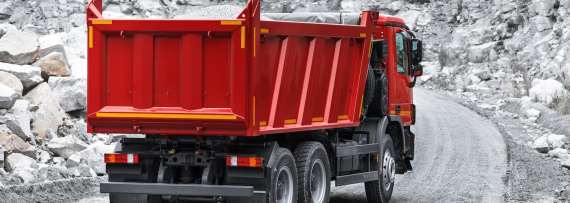
A typical dump truck like the one above holds 10-14 cubic yards (270-378 cu.ft.). A typical cubic yard of dirt weighs 2200 lbs. and of gravel 3000 lbs. 780,000 cubic yards equals: 858,000-1,170,000 tons of sediment, or 2,060-2,890 truckloads (like the truck above) to haul away.
Source: Lynch Truck Center
There are reasons why this problem and discussion has continued for decades.
Click on UGANDA for a 65 minute recording.
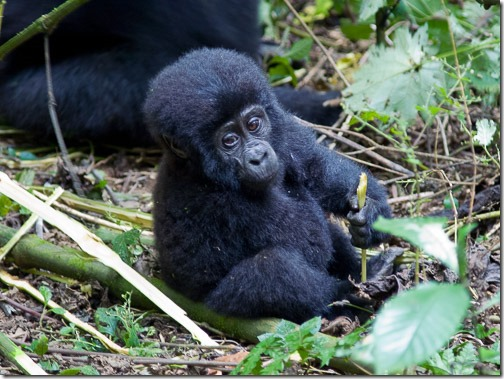
Tiny Mountain Gorilla
Uganda encloses about 91,000 square miles, which means it is larger than Minnesota but smaller than Michigan. There are 1007 species on the bird list, 800 of which breed there – there are a lot of different habitats for them, from swamps to snowy mountains. Its border runs through several large rift lakes: Victoria, Edward and Albert. Although it lies on the equator, its altitude varies from 3000 to 5000 feet and the climate is refreshingly mild, hence the nickname, The Pearl of Africa.
Alice and I traveled there with Gerry Bertrand from the Massachusetts Audubon Society. He arranged a great trip and we saw about 380 species, 170 of which were lifers. We visited the gorillas, chimps, and many monkeys – the tour was called Birds and Primates of Uganda. I hope you join us to hear about one of the rich but lesser-visited safari destinations in Africa.
[Posted by Chuck Almdale]
Femi Faminu is an L.A. area birder whom I have gotten to know over the past four or five years. She has come on many of our Malibu Lagoon walks as well as a few others like Back Bay Newport, and she always brings a friendly expertise to the trip as well as a few photos for the blog, and often a few more for me to puzzle out. She also birds abroad and makes short films about her adventures in travel, accommodations, birding and eating. Here’s her latest.
Femi has fifteen such films ranging from Borneo to Africa to Central & South America which can be found on YouTube HERE. They always give me that “wish I was there” feeling.



 SANTA MONICA BAY AUDUBON SOCIETY BLOG