Free email delivery
Please sign up for email delivery in the subscription area to the right.
No salesman will call, at least not from us. Maybe from someone else.
Just a little rain – Sepulveda Basin, 11 Mar 2023
[By Chuck Almdale]
Despite the NOAA prediction that the rain would stop by 4 AM, we had fair-to-middlin’ mist until about 10am. The sun never broke through and temperatures were in the 50’s. With little-to-no wind, it was quite pleasant and a welcome respite from the endless sun sun sun that constitutes SoCal weather nine months of the year.

(Ray Juncosa 3/11/23)
The binoculars and telescope lenses got a bit damp and had to be wiped from time to time. But it wasn’t a big deal in the grand scheme of things, said grand scheme including a morning of birding once in a while.
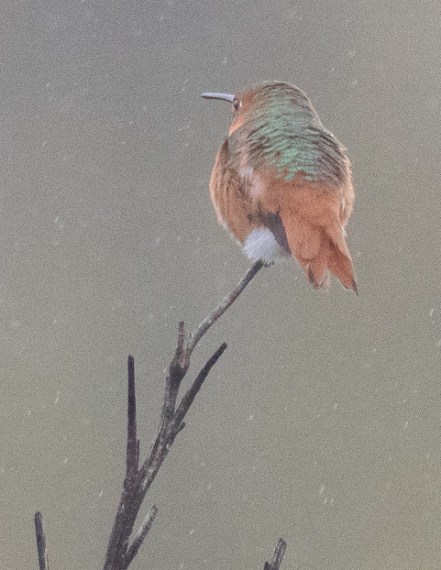
The clouds and rain suppressed air traffic at nearby Van Nuys airport which can get disconcertingly noisily frequent on clear days, and for most of the morning the only planes we heard or saw were the radio-controlled jobbies over at the model airplane field on the west side of Woodley Ave. Some of them have sound effects that are quite ferocious, or at least reminiscent of dog fighters and dive bombers from WW II movies. The Angry Gnats Squadron, defending freedom against the Bosch.

(Ray Juncosa 3/11/23)
It’s pretty easy to find five species of heron/egret at the nature reserve. Here’s three of them. Black-crowned Night-Herons are — for them — almost abundant with both adults and immature plumages present, due to the reed beds surrounding the lake. They were also sitting in the trees on the central island. I was recently advised that this body of water is now officially a “lake” as it covers 10 acres or more, and no longer merely a pond. I forgot the name of this new lake. Green Herons are nearly as abundant here. We had four. Some looked as if they were sporting fresh plumage as their backs were actually green, even in the clouded indirect lighting, and were quite pretty.

(Chris Tosdevin 3/11/23)
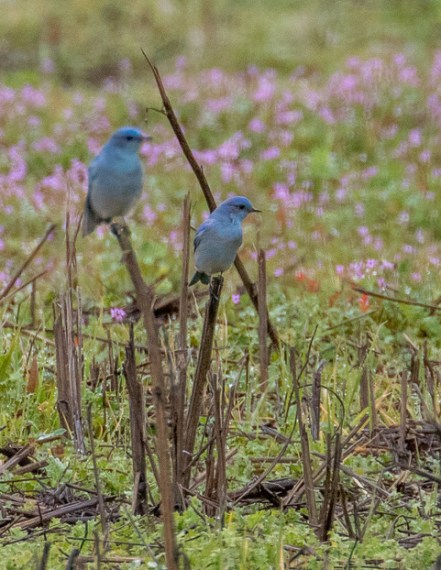
Two-bluebird days are pretty uncommon and I’m not sure if I’ve ever seen two bluebird species at the same time & place before. Western Bluebirds like parks and riparian areas; Mountain Bluebirds like wide-open spaces in the winter. In the winter we usually find the latter in the grasslands of the Carrizo Plain, Antelope Valley, San Joaquin Valley or south of the Salton Sea. Not in the Los Angeles Basin or San Fernando Valley. Both species are cavity-nesters. In olden days they sought out old woodpecker holes to nest in, but now they both readily nest in human-built bird houses.

The Mountain Bluebirds were all out in the big field at the corner of Burbank Blvd. and Woodley Ave. So were a number of sparrows and lots of Turkey Vultures.


There had been a lot of rain coming down Woodley Creek, judging by all the trash on its banks or caught in the brush. We found fish washed up by the side of the path in several locations. This one was fresh-looking, didn’t smell (as dead fish quickly do) and looked alive, but it didn’t move when I poked it with my foot. It looked as if it were made of rubber.

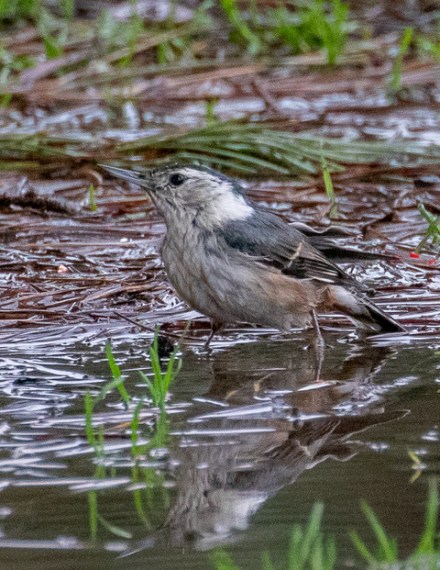
The bird below was taking a bath in one of the pools left when the creek overflowed it’s banks. Nuthatches are almost always seen in trees, clambering up and down the trunk and limbs, looking for insects. One out in the open, on the ground, taking a bath, is…unusual.
(Chris Tosdevin 3/11/23)
There weren’t a lot of ducks on the pond; mostly coots, cormorants, a pair of Hooded Mergansers, a few White Pelicans (most of them were on the island) and some Pied-billed Grebes, like this one.

Around the edges of the lagoon and on the island there were quite a number of birds including Osprey, several hawks, a Merlin, sparrows, warblers, finches, goldfinches and others species.

(Chris Tosdevin 3-11-23)

(Chris Tosdevin 3/11/23)

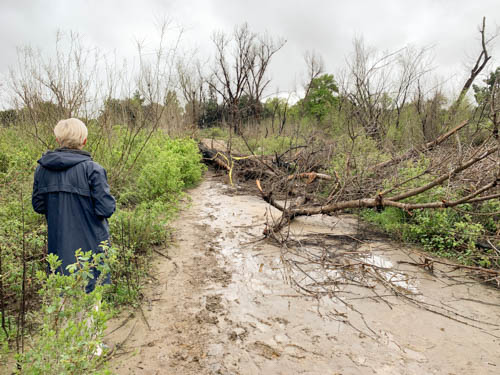
We continued down the west side path until we came to this sight below. The tree must have been there for a while because a well-trodden path, invisible until you got right up to it, circumvented it on the left side. We continued down the path to the south end of the lake where we saw oodles of swallows, four (perhaps more) species in all, mostly Tree, followed by Rough-winged.
I saved what may be the best for last. Although it’s very tough to beat a field full of Mountain Bluebirds — probably about 50 of them and more than I’ve ever seen in one place before — dozens of Lawrence’s Goldfinches hopping, flitting and poking on a dewy green lawn can do it, at least for me. I find this species of Goldfinch the most admirable, partially because they’re the least abundant in SoCal, and so when you happen upon them, it’s always a special treat.

The dark black face nicely contrasts what I think is one of the loveliest colors on a bird, this greenish-yellow on the bird’s belly and wings. Is it chartreuse? I commented to the group that I thought it was, and someone said no, chartreuse is a different shade of yellow, more of a greenish-yellow. OK. Here’s what I got when I googled “chartreuse.” Pretty close, I think, but color is in the eye (and the brain) of the beholder.

Anyway, great birding on a lovely day.
Before the trip began I stopped by the Burbank Blvd. bridge over the Los Angeles River, just to make absolutely sure that it was full of raging foamy water and unbirdable. It was, overflowing the concrete wall in one low spot and forming a shallow pool by which two Canada Geese kept watch.
As you can see from the list below, we hadn’t had a trip here in five years. We scheduled one for March 14, 2020, just after you-know-what hit America, and we had to cancel it. No, not because of COVID-19, but because the wildlife area was flooded with water and Woodley Ave. was closed. It had rained.
Abundance Code Key: X – present, A – 1-5, B – 6-10, C – 11-20,
D – 20-50, E – over 50
| Sepulveda Basin Field Trips | ||||
| Common Name | 3/11/23 | 3/10/18 | 2/11/17 | 2/13/16 |
| Canada Goose | E | X | X | X |
| Egyptian Goose | A | X | X | X |
| Muscovy Duck | X | |||
| Mallard | B | X | X | X |
| Hooded Merganser | A | X | X | |
| Pied-billed Grebe | B | X | X | X |
| Neotropic Cormorant | 1 | |||
| Double-crested Cormorant | D | X | X | X |
| American White Pelican | C | X | X | |
| Great Blue Heron | A | X | X | X |
| Great Egret | B | X | X | X |
| Snowy Egret | A | X | X | |
| Green Heron | A | X | X | X |
| Black-crowned Night-Heron | B | X | X | X |
| Turkey Vulture | C | X | X | X |
| Osprey | A | X | X | X |
| Cooper’s Hawk | A | X | X | |
| Red-shouldered Hawk | A | |||
| Red-tailed Hawk | A | X | X | |
| American Coot | D | X | X | X |
| Killdeer | X | |||
| Western Gull | X | |||
| Rock Pigeon | D | X | ||
| Eurasian Collared-Dove | 1 | |||
| Mourning Dove | C | X | X | X |
| Great Horned Owl | X | |||
| White-throated Swift | X | |||
| Anna’s Hummingbird | A | X | X | X |
| Rufous Hummingbird | X | |||
| Allen’s Hummingbird | B | X | X | X |
| Belted Kingfisher | 1 | X | X | X |
| Acorn Woodpecker | A | |||
| Red-breasted Sapsucker | X | |||
| Nuttall’s Woodpecker | A | X | X | X |
| Downy Woodpecker | X | X | ||
| Northern Flicker | A | X | X | |
| Merlin | 1 | |||
| Yellow-chevroned Parakeet | X | X | ||
| Black Phoebe | A | X | X | X |
| Ash-throated Flycatcher | X | |||
| Cassin’s Kingbird | A | X | X | |
| Western Scrub-Jay | X | X | ||
| American Crow | X | X | ||
| Common Raven | B | |||
| Tree Swallow | D | X | ||
| Violet-green Swallow | A | X | ||
| No. Rough-winged Swallow | C | X | X | |
| Cliff Swallow | B | |||
| Bushtit | C | X | X | |
| White-breasted Nuthatch | A | |||
| House Wren | X | |||
| Bewick’s Wren | X | X | ||
| Blue-gray Gnatcatcher | X | X | ||
| Ruby-crowned Kinglet | A | X | X | |
| Western Bluebird | B | X | X | X |
| Mountain Bluebird | D | |||
| Hermit Thrush | X | |||
| American Robin | A | |||
| California Thrasher | X | |||
| Northern Mockingbird | A | X | X | |
| European Starling | C | X | X | |
| Orange-crowned Warbler | X | X | ||
| Common Yellowthroat | B | X | X | X |
| Yellow-rumped Warbler | D | X | X | X |
| Spotted Towhee | X | X | X | |
| California Towhee | B | X | X | X |
| Chipping Sparrow | B | X | X | |
| Lark Sparrow | X | X | ||
| Savannah Sparrow | X | X | ||
| Song Sparrow | C | X | X | X |
| White-crowned Sparrow | D | X | X | X |
| Dark-eyed Junco | X | |||
| Red-winged Blackbird | D | X | X | X |
| Western Meadowlark | A | |||
| Great-tailed Grackle | C | X | X | |
| House Finch | D | X | X | X |
| Lesser Goldfinch | D | X | X | X |
| Lawrence’s Goldfinch | D | |||
| American Goldfinch | X | |||
| Total Species – 79 | 56 | 44 | 51 | 51 |
[Posted by Chuck Almdale, submitted by Lillian Johnson]
Three decades ago two kids in southern Madagascar wanted to sell me an Elephant Bird’s egg that looked a lot like the ones pictured in this article. I assumed was a fake. It looks like I was wrong. Oh well, U.S. Customs would never have let me bring it into the country in my luggage anyway.
Secrets of 9-Foot Tall, 1,500-Pound Elephant Birds Revealed by Ancient Eggshells
SciTechDaily | Univ. of Colorado Boulder | 9 Mar 2023
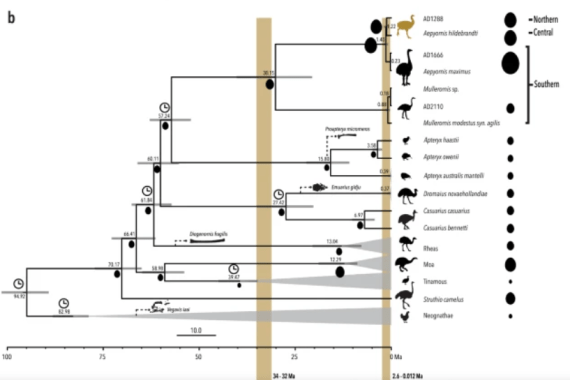
Elephant Birds weighted over half a ton and they’ve been extinct for a millennium. Their eggs were 1 1/2 feet long and can still be found, shattered into many pieces, in the sand dunes of Madagascar today. Analysis of the shells is revealing new information.
The cladogram at bottom indicates that Elephant Birds split off from the Kiwis 57.24 million years ago.
Link to larger version of cladogram.
Link to the Paper
Molecular exploration of fossil eggshell uncovers hidden lineage of giant extinct bird
Nature.com | Grealy, Miller, et.al. | 28 Feb 2023
Abstract:
The systematics of Madagascar’s extinct elephant birds remains controversial due to large gaps in the fossil record and poor biomolecular preservation of skeletal specimens. Here, a molecular analysis of 1000-year-old fossil eggshells provides the first description of elephant bird phylogeography and offers insight into the ecology and evolution of these flightless giants. Mitochondrial genomes from across Madagascar reveal genetic variation that is correlated with eggshell morphology, stable isotope composition, and geographic distribution. The elephant bird crown is dated to ca. 30 Mya, when Madagascar is estimated to have become less arid as it moved northward. High levels of between-clade genetic variation support reclassifying Mullerornis into a separate family. Low levels of within-clade genetic variation suggest there were only two elephant bird genera existing in southern Madagascar during the Holocene. However, we find an eggshell collection from Madagascar’s far north that represents a unique lineage of Aepyornis. Furthermore, divergence within Aepyornis coincides with the aridification of Madagascar during the early Pleistocene ca. 1.5 Ma, and is consistent with the fragmentation of populations in the highlands driving diversification and the evolution of extreme gigantism over shorts timescales. We advocate for a revision of their taxonomy that integrates palaeogenomic and palaeoecological perspectives.
In Addition to the Bear Divide Migrants program,
Dr. Ryan Terrill has four additional recorded presentations.

Dr. Ryan Terrill’s website: LINK
On the website you can select from five recorded presentations by Dr. Terrill.
- Bird Migrations in the San Gabriel Mountains: Bear Divide Update
- Identifying Birds in Flight
- Evolutionary Interactions of Feather Molt in Birds
- The Influence of Coloration and Life-history on Evolution of Prealternate Molt in Parulidae
- Neotenous Feather Replacement Facilitates Loss of Flight in Birds
Below is the description and biography we used to announce Dr. Terrill’s presentation to SMBAS.
The Migrating Birds of Bear Divide, with Dr. Ryan Terrill.
Bear Divide, in the San Gabriel mountains, has been recently found to host spectacular morning flights of migratory birds in the spring. For the past 5 years, birders have been counting migratory birds at Bear Divide, and over the past three years, the Bear Divide Migration Count has been intensively surveying this location to learn more about this unique phenomenon. Join count organizer Ryan Terrill to hear about this site, what kinds of birds use it, and what has been learned so far about this fantastic bird migration location.
Dr. Ryan S. Terrill grew up birding in California, and after graduating from U.C. Santa Cruz received his Ph.D. from Louisiana State University, for his study of the evolution of molt strategies in birds. He is a co-author of the Field Guide to the Birds of Bolivia, and the recent description of the Inti Tanager [see below], an avian genus and species new to science, as well as 24 other publications in peer-reviewed journals. He is active in the academic ornithology and the California birding communities, and has dedicated much of his past 5 springs to surveying morning flight of spring migrant birds at Bear divide.


[Posted by Chuck Almdale, submitted by Lillian Johnson]
Newly discovered hummingbird looks like it’s wearing a golden collar
When researchers found a hummingbird with shiny gold feathers on its throat in Peru, they thought it was a newly discovered species. Instead, the bird is a hybrid that resulted from two pink-throated species.
Bald Eagles in the Snow | Facebook
[Posted by Chuck Almdale, submitted by Paula Kayton]
It’s been frequently broadcast of late that Jackie & Shadow — the two Bald Eagles nesting in a tree at Big Bear Lake — are having a few problems with the snow and cold. The area recently received about 8 feet of show.
Watch this short Eagle-Cam video of the nest: CLICK HERE
Link to Live Eagle-Cam at Big Bear.
https://www.youtube.com/live/B4-L2nfGcuE?feature=share
It looks and sounds cold.



 SANTA MONICA BAY AUDUBON SOCIETY BLOG