Free email delivery
Please sign up for email delivery in the subscription area to the right.
No salesman will call, at least not from us. Maybe from someone else.
Tufted Puffin Natural History, 6 March | NOAA
[Posted by Chuck Almdale, submitted by Marsha Collins]
Ed’s Note: The announcement below is reproduced as faithfully as possible from an email received. The link to the webinar immediately below works, as do two at the very bottom.
RESERVE FOR WEBINAR

This webinar is co-sponsored by NOAA’s Olympic Coast
National Marine Sanctuary and Feiro Marine Life Center.
Scott Pearson (Washington Department of Fish and Wildlife) on Tufted Puffin Natural History, Research and Conservation Status
The Tufted Puffin is an iconic seabird that nests on offshore islands along Washington’s outer coast and on two islands in the Salish Sea. Recent analyses suggest that the puffin is declining from the Gulf of Alaska south to California, with more dramatic declines at the southern end of its breeding range. Scott will describe the species’ natural history, information on its status in Washington and beyond, and on research and conservation efforts to benefit the species locally.
Dr. Scott Pearson is a senior research scientist at Washington Department of Fish and Wildlife. He received his Ph.D. from the University of Washington and his B.S. and M.S. from the University of Michigan. His research is focused on assessing wildlife population status and trends and the underlying mechanisms driving declines to help inform conservation. His recent work is focused on gaining a better understanding of marine bird and mammal diets, habitat use and quality, and the effectiveness of conservation efforts with a focus on several species of conservation concern. Scott also supervises the west-side research team for the Wildlife Program.
After registering you will receive a confirmation email containing information about joining the webinar.
| The National Marine Sanctuaries Webinar Series provides educators with educational and scientific expertise, resources, and training to support ocean and climate literacy in the classroom. This series currently targets formal and informal educators, students (high school through college), as well as members of the community, including families. You can also visit the archives of the webinar series to catch up on presentations you may have missed here. |
Vernal Poolish Madrona Marsh: 11 February 2023
[Chuck Almdale & Jean Garrett ]

Although many of our members regularly visit Madrona Marsh Preserve in nearby Torrance, the last time we were there as a group was in December, 2016, way way back in the Before Times. It was nice to see it again with so much vegetation. As our visit was brilliantly **timed months in advance to fall between a gigantic atmospheric river and the winter-storm-of-the-century-so-far, we saw lots of water and ducks, but had a fine, dry day in the field. The numerous paths are crushed granite (or something similar) and are raised an inch or so, so none of us got wet or vanished into a sinkhole.
**Note: Patent-pending on our field trip prediction process, so don’t bother asking.

Northern (Red-shafted) Flickers in the brush were among the first birds we found. One of us glimpsed a possible Yellow-shafted which quickly fled. (C. Tosdevin 2-11-23)
That said, Madrona Marsh, located a few miles south of I-405 and a mile west of Crenshaw Blvd., is a great spot to know about and visit. It regularly hosts odd birds attracted to this restored coastal scrub oasis amid the malls and housing tracts of South Bay. The rains of Winter and Spring, if and when they occur, fill vernal pool basins and dragonflies and waterfowl proliferate. Before this area was domesticated by millions of people, it was part of an extensive coastal terrace lying just inland of the coastal dune system. There were innumerable potholes, cienegas and vernal pools, and early settlers reported winter waterfowl numbering into the millions. That’s hard to imagine today. Madrona Marsh is a small remnant of this vanished habitat which the Tongva people enjoyed for millennia.

We notified them ahead of time and a volunteer opened the gate for us at 8 AM, an hour or two before their normal opening time. We followed a trail to the northeast to the currently very large vernal pool.

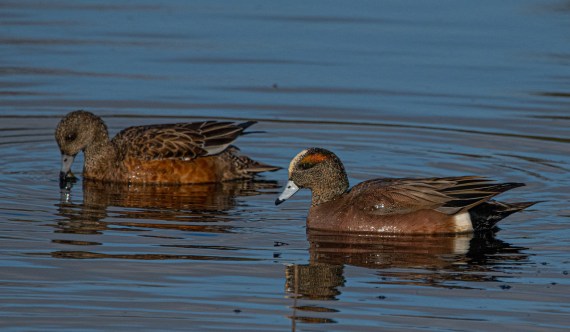
There was a nice variety of waterfowl, many of them apparently already in pairs.


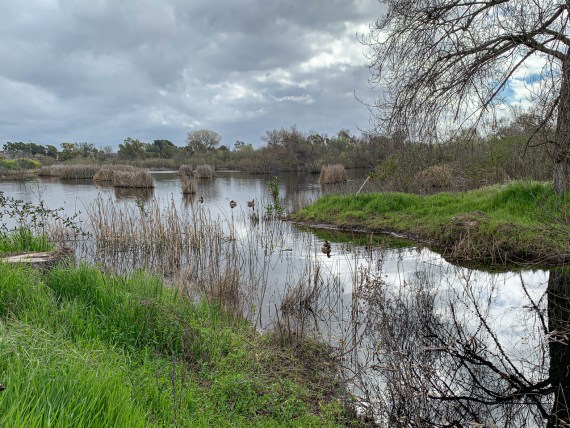
We looked for but didn’t find any Soras or other rails skulking in the reeds. Other birds hung out around the fringes of the pools.


We left the pools and wandered to the west. In the grassy fields around us were quite a few Western Meadowlarks, (see photo at top) singing for all they were worth. Frequently these birds are seen from afar across a field, their vocals muted by distance, but these were nearly at our feet. And they were sweetly melodious, yet piercingly loud.
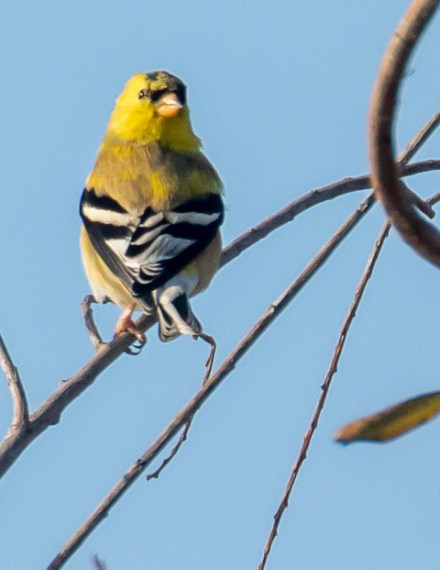
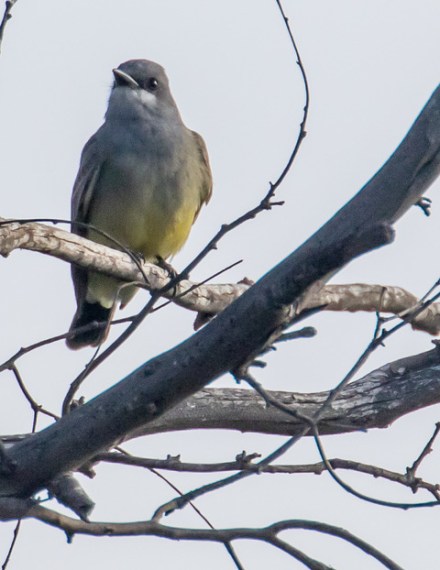
Cassin’s Kingbirds were flycatching from grass stalks and twigs. While Western Kingbirds typically fly farther south for the winter, Cassin’s often stick around in small numbers. We had both Anna’s and Allen’s Hummingbirds scattered around the fields and pathsides, sitting on twig-ends.

A few of us had heard Cedar Waxwings overhead but couldn’t see them. It is often said that when you begin to lose your hearing, the song of this species is the first to go. I don’t know if that’s absolutely true, but I can attest to the fact that I haven’t heard them in about 20 years. However, I did spot two flocks fly by overhead (hint: they’re always in a flock of 10-100 birds) before I spotted one come low and fly into a tree, where they stayed for quite a while.
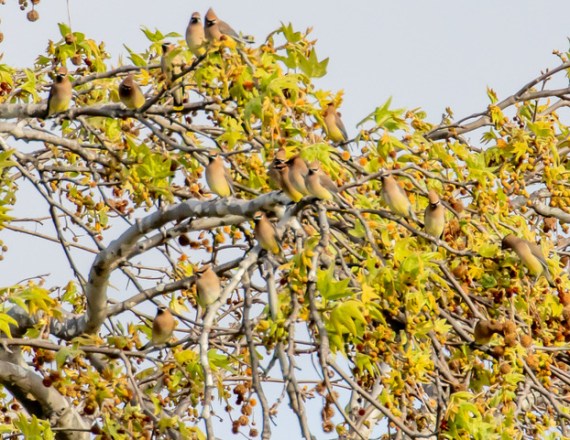
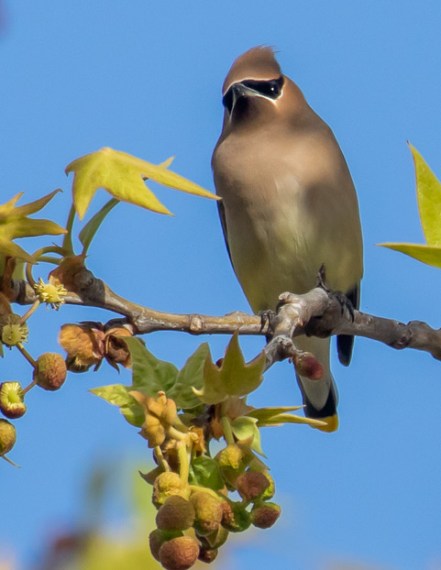
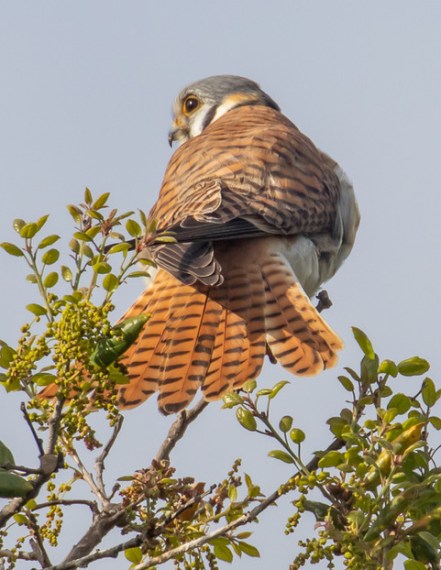
A female (brown back) kestrel landed in a nearby tree, but didn’t try to make any moves on the waxwings.
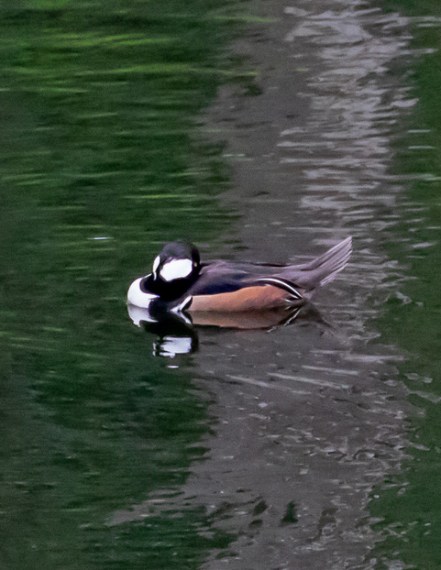
After watching the waxwings for a while — they’re a treat to see and we don’t see them every year — we wandered over to the “sump.” This area is fenced in to keep people — who may be wandering around and not watching where they’re walking because they’re fixated on looking at some bird — from falling down the sides. It’s a deep hole perhaps 75 yds. across, maybe farther, originally dug to drain water out of the surrounding marsh. This water eventually runs through a pipe and out to the ocean, but creates a small pond in the meantime. Some birds appreciate its privacy and shade, including a half-dozen Hooded Mergansers, like the snoozing male below. We also found a Green Heron that was actually green, unlike most of them, lurking in the pondside brush.

There were a lot of sparrows, which I haven’t mentioned until now. Most of them were White-crowned, as are the two below.

(Left: Ray Juncosa; Right: Chris Tosdevin 2-11-23)
Lighting, shading, angle, posture, distance, surrounding foliage: all can play tricks on you. I missed the Golden-crowned Sparrow which some of the group saw in a bush or low tree. This species is similar to the White-crowned but is much less common in SoCal, where White-crowned Sparrows can be abundant in proper habitat in the winter. When I saw the above right hand photo of the immature (almost a year-old) White-crowned, I thought for a while it was a Golden-crowned as it seemed so brown rather than gray. But the plumage — mostly of the head as you can’t see the back — wasn’t right for Golden-crowned. Yet the bill, especially the upper mandible, seemed too dark for White-crowned, which has a pinkish-yellow bill. Then again, young White-crowns can have a bit of dark on the upper mandible. Checking my NGS field guide, I wondered if the right-hand bird might not be in the subspecies Z.l.oriantha; this subspecies breeds from SE British Colombia to the Owens Valley of eastern Calif. and to north-central New Mexico, but winter in northern Mexico rather than coastal California. The upper mandible of the pictured bird seems a bit reddish, as are the bills of ss. oriantha, so I wonder if one didn’t wander off course and head SW from the Owens Valley instead of SE.
Then again, it could just be a trick of the light.
As always, many thanks to our photographers: Ray Juncosa and Chris Tosdevin.
| Madrona Marsh Trip List | 12/10/16 | 2/11/23 |
| Canada Goose | X | |
| Cinnamon Teal | X | |
| Northern Shoveler | X | |
| Gadwall | X | |
| American Wigeon | 6 | X |
| Mallard | 6 | X |
| Green-winged Teal | X | |
| Ring-necked Duck | 1 | |
| Hooded Merganser | X | |
| Rock Pigeon | 8 | X |
| Eurasian Collared-Dove | X | |
| Mourning Dove | 50 | X |
| Anna’s Hummingbird | 3 | X |
| Allen’s Hummingbird | 9 | X |
| American Coot | 5 | X |
| Killdeer | X | |
| Greater Yellowlegs | X | |
| Ring-billed Gull | 2 | |
| Western Gull | 4 | |
| California Gull | 2 | X |
| Green Heron | X | |
| Black-crowned Night-Heron | X | |
| Sharp-shinned Hawk | 1 | |
| Red-shouldered Hawk | 1 | |
| Red-tailed Hawk | 2 | X |
| Downy Woodpecker | 1 | |
| Northern Flicker | 2 | X |
| American Kestrel | 3 | X |
| Ash-throated Flycatcher | 1 | |
| Cassin’s Kingbird | 6 | X |
| Black Phoebe | 6 | X |
| Say’s Phoebe | 1 | X |
| American Crow | 4 | X |
| Common Raven | 2 | X |
| Bushtit | 50 | X |
| Ruby-crowned Kinglet | 12 | |
| Cedar Waxwing | 20 | X |
| Blue-gray Gnatcatcher | 13 | X |
| House Wren | 1 Heard | |
| European Starling | 8 | X |
| Hermit Thrush | 1 Heard | |
| Scaly-breasted Munia | 45 | |
| House Finch | 20 | X |
| Lesser Goldfinch | 3 | X |
| American Goldfinch | 45 | X |
| Chipping Sparrow | 6 | |
| Brewer’s Sparrow | 2 | |
| Fox Sparrow | 1 | |
| White-crowned Sparrow | 60 | X |
| Golden-crowned Sparrow | 2 | X |
| Savannah Sparrow | 4 | X |
| Song Sparrow | 2 | X |
| Lincoln’s Sparrow | 3 | X |
| California Towhee | 2 | X |
| Western Meadowlark | 10 | X |
| Red-winged Blackbird | 2 | X |
| Great-tailed Grackle | X | |
| Black-and-White Warbler | 1 | |
| Orange-crowned Warbler | 6 | X |
| Common Yellowthroat | 3 | |
| Yellow-rumped Warbler | 10 | X |
| Black-throated Gray Warbler | 1 | X |
| Townsend’s Warbler | 1 | |
| Total Species – 63 | 51 | 46 |
Emperor Penguins Relegated to Pygmy Status
Fascinating article on prehistoric penguins that were bigger than Shaquille O’Neal.
https://phys.org/news/2023-02-fossil-bones-largest-penguin-unearthed.html
The recording of this program is now available.
[Posted by Chuck Almdale]

|
Evolution in Urban Dark-eyed Juncos, with Dr. Pamela Yeh, Ellie Diamant, Mars Walters, Sam Bressler & Wilmer Amaya-Mejia.
The Yeh Lab is excited to be giving a talk on evolution in urban dark-eyed juncos. Pamela Yeh, Associate Professor at UCLA, will start by discussing some of the history of the lab’s work on the juncos and providing an overview of the work being done in her lab. PhD Candidate Ellie Diamant will discuss her work on urban junco fear. Recent MS graduate Mars Walters will then talk about juncos and aggression during the pandemic. Recent MS graduate Sam Bressler will next talk about phenotypic plasticity and nest placement in the junco. Finally, PhD student Wilmer Amaya-Mejia will discuss some of his current work in-progress with juncos and their parasites.
Dr. Pamela Yeh is an Associate Professor in the Department of Ecology and Evolutionary Biology at UCLA. She studies how human activities affect the evolution of species, focusing on the evolution of birds in urban environments and the evolution of drug resistant bacteria in urban and agricultural areas. She received her PhD in Evolutionary Biology from UC San Diego and has conducted postdoctoral work in the Center for Genomics Research and the Systems Biology Department both at Harvard University

Atmospheric Rivers | Los Angeles Times
[Posted by Chuck Almdale]
If it seems to you that “atmospheric river” is a term you didn’t hear a decade ago, you’re right. It’s usage began around 2004 when scientists discovered that moisture was frequently carried in the atmosphere in long, relatively narrow ribbons. These ribbons can be 100-500 miles wide, 2,000 miles long, 10,000 feet above us, and contain more water than the Amazon River. They’re whats responsible for the short-term heavy heavy downpours the west coast has been battered by over the past month. As our atmosphere heats up due to climate change, we can expect more and probably larger such rivers, interspersed with — here it comes — periods of drought.
The Los Angeles Times publishes too few science articles, so when they do a good one, a trumpet should be blown.
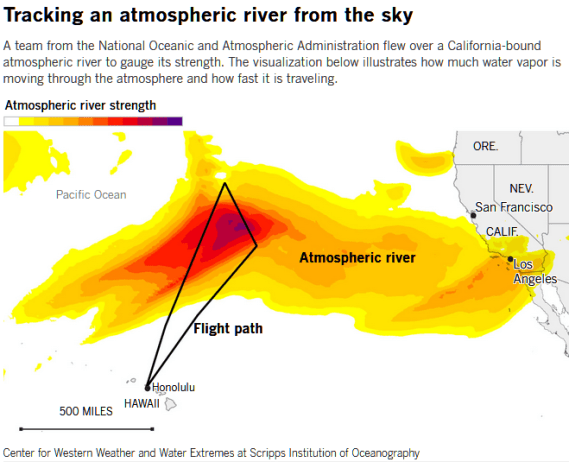
From high above an atmospheric river, a deep dive for data:
Los Angeles Times | Ian James (somewhere over the north Pacific Ocean | 2 Feb 2023
Article contains a 5 1/2 minute video.
From the article:
The science of atmospheric rivers has come a long way since [meteorologist Marty] Ralph and his colleagues published a 2004 study drawing on data from satellites and reconnaissance flights. Since then, Ralph said, more than 500 articles have been published in scientific journals with titles focusing on atmospheric rivers.
The concept of atmospheric rivers began to emerge in the 1970s, when research in the U.K. showed tha a low-level jet stream ahead of a cold front was connected to heavy rains in Britain.



 SANTA MONICA BAY AUDUBON SOCIETY BLOG