[Posted by Chuck Almdale, submitted by Lillian Johnson]
Three decades ago two kids in southern Madagascar wanted to sell me an Elephant Bird’s egg that looked a lot like the ones pictured in this article. I assumed was a fake. It looks like I was wrong. Oh well, U.S. Customs would never have let me bring it into the country in my luggage anyway.
Elephant Birds weighted over half a ton and they’ve been extinct for a millennium. Their eggs were 1 1/2 feet long and can still be found, shattered into many pieces, in the sand dunes of Madagascar today. Analysis of the shells is revealing new information.
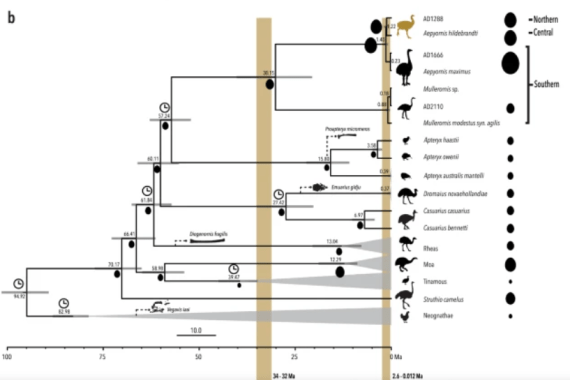
The cladogram at bottom indicates that Elephant Birds split off from the Kiwis 57.24 million years ago. Link to larger version of cladogram.
Abstract: The systematics of Madagascar’s extinct elephant birds remains controversial due to large gaps in the fossil record and poor biomolecular preservation of skeletal specimens. Here, a molecular analysis of 1000-year-old fossil eggshells provides the first description of elephant bird phylogeography and offers insight into the ecology and evolution of these flightless giants. Mitochondrial genomes from across Madagascar reveal genetic variation that is correlated with eggshell morphology, stable isotope composition, and geographic distribution. The elephant bird crown is dated to ca. 30 Mya, when Madagascar is estimated to have become less arid as it moved northward. High levels of between-clade genetic variation support reclassifying Mullerornis into a separate family. Low levels of within-clade genetic variation suggest there were only two elephant bird genera existing in southern Madagascar during the Holocene. However, we find an eggshell collection from Madagascar’s far north that represents a unique lineage of Aepyornis. Furthermore, divergence within Aepyornis coincides with the aridification of Madagascar during the early Pleistocene ca. 1.5 Ma, and is consistent with the fragmentation of populations in the highlands driving diversification and the evolution of extreme gigantism over shorts timescales. We advocate for a revision of their taxonomy that integrates palaeogenomic and palaeoecological perspectives.
In Addition to the Bear Divide Migrants program, Dr. Ryan Terrill has four additional recorded presentations.
On the lookout.
Dr. Ryan Terrill’s website: LINK On the website you can select from five recorded presentations by Dr. Terrill.
Bird Migrations in the San Gabriel Mountains: Bear Divide Update
Identifying Birds in Flight
Evolutionary Interactions of Feather Molt in Birds
The Influence of Coloration and Life-history on Evolution of Prealternate Molt in Parulidae
Neotenous Feather Replacement Facilitates Loss of Flight in Birds
Below is the description and biography we used to announce Dr. Terrill’s presentation to SMBAS.
The Migrating Birds of Bear Divide, with Dr. Ryan Terrill.
Bear Divide, in the San Gabriel mountains, has been recently found to host spectacular morning flights of migratory birds in the spring. For the past 5 years, birders have been counting migratory birds at Bear Divide, and over the past three years, the Bear Divide Migration Count has been intensively surveying this location to learn more about this unique phenomenon. Join count organizer Ryan Terrill to hear about this site, what kinds of birds use it, and what has been learned so far about this fantastic bird migration location.
Dr. Ryan S. Terrill grew up birding in California, and after graduating from U.C. Santa Cruz received his Ph.D. from Louisiana State University, for his study of the evolution of molt strategies in birds. He is a co-author of the Field Guide to the Birds of Bolivia, and the recent description of the Inti Tanager [see below], an avian genus and species new to science, as well as 24 other publications in peer-reviewed journals. He is active in the academic ornithology and the California birding communities, and has dedicated much of his past 5 springs to surveying morning flight of spring migrant birds at Bear divide.
Somehow the stunning Inti Tanager, now officially a new species, went unnoticed by birders and ornithologists visiting Peru and Bolivia over many decades. Daniel Lane
[Posted by Chuck Almdale, submitted by Lillian Johnson]
Newly discovered hummingbird looks like it’s wearing a golden collar When researchers found a hummingbird with shiny gold feathers on its throat in Peru, they thought it was a newly discovered species. Instead, the bird is a hybrid that resulted from two pink-throated species.
[Posted by Chuck Almdale, submitted by Paula Kayton]
It’s been frequently broadcast of late that Jackie & Shadow — the two Bald Eagles nesting in a tree at Big Bear Lake — are having a few problems with the snow and cold. The area recently received about 8 feet of show.
Watch this short Eagle-Cam video of the nest: CLICK HERE
You may have noticed that the advertising went away. We crossed the blog host’s palm with silver and poof! it disappeared.
DONATE OR JOIN
Taxpayer ID No: 95-3083785
By Check:
SMBAS, PO Box 4189, Malibu, CA 90264-4189
Or Click Donate button below. Then in field marked "+Add special instructions to the seller," type in purpose of your donation as below: Snowy Plovers Annual Appeal Donation Chapter-only Membership General Donation







 SANTA MONICA BAY AUDUBON SOCIETY BLOG