Free email delivery
Please sign up for email delivery in the subscription area to the right.
No salesman will call, at least not from us. Maybe from someone else.
Evolution of Feather Color in the Tanagers, with Dr. Allison Schultz. Evening in-person meeting reminder: Tuesday, 1 Nov, 7:30 p.m.
You are all invited to the first non-ZOOM meeting
of Santa Monica Bay Audubon Society since the before times.

Evolution of Feather Color in the Tanagers, with Dr. Allison Schultz.
Join Dr. Allison Schultz, Assistant Curator of Ornithology at the Natural History Museum of Los Angeles County, as she talks about the evolution of feather color in the largest family of birds – the tanagers. She will talk about why she is careful to use a bird’s visual perspective to study this important signaling trait, and how natural and sexual selection have shaped plumage color in males and females. She will end her talk by describing some of her current work on the mechanisms underlying the great diversity of colors in birds.

Be the first on your block to collect the entire set of White-cheeked Turacos.
Dr. Allison Shultz is Assistant Curator of the Ornithology Department at NHMLAC. With her research, she seeks to understand the evolution of bird diversity, focusing on two major areas: how birds are responding to human-caused environmental changes, and how and why bird colors evolve. Dr. Shultz is originally from Southern California, and was excited to get a job so close to home. She received her PhD from Harvard University, MS from San Diego State University, and BA from the University of California, Berkeley. In addition to her research, Dr. Shultz is passionate about increasing diversity, inclusion, access and equity in the sciences, and inspiring a love of nature in everyone. Dr. Schultz’s website.
Our meetings are at Christine Emerson Reed Park, 1133 7th Street. (between 7th St. & Lincoln Blvd., California Ave. & Wilshire Blvd.), Santa Monica. Previously known as Lincoln Park. If coming from outside Santa Monica, exit the #10 Fwy at Lincoln Blvd., turn north and drive 5 blocks north to Wilshire Blvd.
Meeting Room: Mid-park in Joslyn Hall, accessible from Lincoln Blvd, California Ave. and 7th St. Its glass wall faces north towards St. Monica Church on California St. If you’re walking from Lincoln Blvd., it’s located directly behind (west) of the large Miles Playhouse building. Not accessible directly from Wilshire Blvd.
Meetings begin at 7:30 sharp with a little business, and then our main presentation. Refreshments are served afterward. Please leave your coyote at home, however much they whine to come.
Parking: The entire block between Wilshire Blvd. and California Ave, 7th St. and Lincoln Blvd., on the sides closest to the park, is metered. $2/hour meter enforcement (except on Wilshire) ends at 6PM, so free parking for the meeting! However, the local natives are engaged in a survival-of-the-fittest scramble for free parking, so the after-6pm free parking spaces disappear quickly. We suggest that you arrive no later than 7:15 pm.
If all those spaces are filled, we found free parking as follows:
California Ave. between 6th and 7th
9th St. north of Wilshire Blvd.
10th St. north of California Ave.
Washington Ave. (next street north of and parallel to California)
If that fails, go south of Wilshire, not north of the park, as resident-only permit parking zones abound to the north. The east side of Lincoln Blvd. across from the park is by permit parking only. Spaces are more available on 7th St. or Lincoln south of Wilshire. Some of those are “until 9PM” meters also. You may need a flashlight to read & operate the meter. Wherever you park, please read parking signs carefully and avoid a big fat $40+ parking ticket. [Chuck Almdale]

Cherry-throated Tanager Nemosia rourei. Commonly found in one very small patch of forest in eastern Brazil . Source: Birds of the World
Survey deadline extended to 28 Oct on National Audubon Society dropping “Audubon” name
[Posted by Chuck Almdale]

Great Egret captures a lizard (Ray Juncosa 2-28-16)
To all readers:
National Audubon Society has extended the ending date of their survey to Friday 28 October. Their latest message, dated Friday, 21 Oct 2022 15:07:26 -0400, added two days, citing “technical difficulties” as the reason. These difficulties were the links to the survey sent out Monday 17 Oct evening at 5:21 (EDT) pm, but didn’t work until around noon (EDT) on Wednesday 19 Oct. Move fast, before it’s gone!
As we previously announced, some of us have already taken the survey. While there are multiple questions, the issue of dropping “Audubon” from the name is the crux of the matter, and it doesn’t appear until near the end of the survey. There is space at several spots to express your opinion. The survey stays open if you need to step away for a few minutes. You can’t go backwards through the pages if you change your mind, and the last question, “Before you finish this survey, is there anything else you would like to share that we have not covered?” comes when you’ve hit 95% completed.
The board of Santa Monica Bay Audubon Society thinks that the entire membership of Audubon chapters and National Audubon Society should have the opportunity—whatever their views—to take this survey and express their opinion. If you want to read about sparks & honey, the consultants running the survey, here’s their website.
The following is today’s email from NAS.
| Naming Survey: Make Your Voice Heard Thank you to everyone who has taken the survey already, and we profusely apologize to those who attempted to take the survey while we were experiencing technical difficulties. The root cause has been remedied and you may now complete the survey and share the link with the rest of your board. Thank you to everyone who reached out and let us know about this issue! The deadline for the survey has been extended to October 28. The strength of our organization comes from our vast network and from many individuals who share in the love of birds through chapter activities and programs. We deeply value your thoughts on this topic and ask you to take some time to complete this survey, if you haven’t already. Take the survey here |
National Audubon Society wants to hear what you think about their dropping the Audubon name – [Survey]
[Posted by Chuck Almdale]
Great Egret captures a lizard (Ray Juncosa 2-28-16)
To all readers:
National Audubon Society sent out the email letter below on Monday, 17 Oct 2022 at 21:21:27-0400. They want your reply within 9 days (7 days, now) by 26 October, which is Wednesday next week. Some of us have already taken the survey. While there are multiple questions, the issue of dropping “Audubon” from the name is the crux of the matter, and it doesn’t appear until near the end of the survey. There is space at several spots to express your opinion. The survey stays open if you need to step away for a few minutes. You can’t go backwards through the pages if you change your mind, and the last question, “Before you finish this survey, is there anything else you would like to share that we have not covered?” comes when you’ve hit 95% completed.
The board of Santa Monica Bay Audubon Society thinks that the entire membership of Audubon chapters and National Audubon Society should have the opportunity—whatever their views—to take this survey and express their opinion.
The following is the email from NAS.
| Dear Chapter Leaders, The National Audubon Society Board of Directors is seeking your input on the use of John James Audubon as our organization’s namesake. The strength of our organization comes from our vast network and from many individuals who share in the love of birds through chapter activities and programs. We deeply value your thoughts on this topic and ask you to take some time to complete the survey below. This survey will be open through October 26. Click here to begin, and let your voice be heard. We are asking for your individual views and opinions, and not necessarily for a collective recommendation on behalf of your entire chapter. Feel free to complete the survey sharing your personal opinions and thoughts. We invite you to share the link with others on your chapter board to ensure maximum participation from your chapter. Lastly, please note the survey contains a number of basic screening questions to assess respondents’ connection to the Audubon network or to environmental work in general. Since the survey is going to both internal and external audiences, these questions help us establish a baseline across many audiences when venturing to understand differing views and opinions on the topic. Why are we doing this? We understand that there are varying opinions regarding the actions of historical figures and that many feel passionately about their views. Before coming to any conclusion about the use of John James Audubon as our namesake, we are committed to listening to the input from our community, including chapter leaders such as yourself, as well as members, volunteers, donors, partners, and staff. For brief overview of who John James Audubon was please read Audubon publications: “What do we do about John James Audubon” by Dr. Drew Lanham and “The Myth of John James Audubon” by Dr. Gregory Nobles. What will be done with my response? The entirety of the audience engagement effort is being performed by our consultant�sparks & honey�so that we ca can ensure anonymity of individual respondents and to mitigate bias in the process. The insights gained from the surveys, interviews, and listening sessions will be synthesized by sparks & honey and presented to a Board Task Force in the coming months. Who should I contact to share my opinions? We understand that many have strong feelings around this topic and we encourage you to use the survey as the outlet for your perspectives to help inform the Board Task Force’s review. Please do not reach out to Chapter Services to provide your input. Opinions shared through the survey go directly to our consultant, to help retain anonymity and ensure ease of compiling feedback. We are unable to record and tabulate opinions not submitted through the survey at this time. When will a decision be made? With the amount of input that is being collected, the current plan is for sparks & honey to synthesize the audience engagement data and present it to the Board Task Force in December after which the task force will deliberate, culminating in a recommendation to the Full Board in February 2023. What does this mean for my chapter? We recognize the power of a network unified in name and we recognize the power of a chapter’s self-definition. As independently incorporated entities, each chapter has the autonomy and authority to make decisions in respect to their naming as best serves their needs. Some chapters name their organizations after prominent geological features, others after conservationists. Some have never had the name Audubon in their organization’s name at all. Still other chapters are eschewing the word “society” as it can be seen as exclusionary and superfluous. We welcome all of your organizations in our network, regardless of name. Take the Survey |
Huntington Central Park: 15 Oct 2022
[Written by Elizabeth Galton, posted by Chuck Almdale]

Red-shouldered Hawk, juvenile(ish) (Ray Juncosa 10-15-22)
There was a threat of rain on the day of our Huntington Central Park bird walk, but in the end it was merely overcast, and the grass was wet. Seven intrepid birders met for this walk. The local Mycelia had rapidly used the little rain there was to send up a few hundred mushrooms, visible from the parking lot.
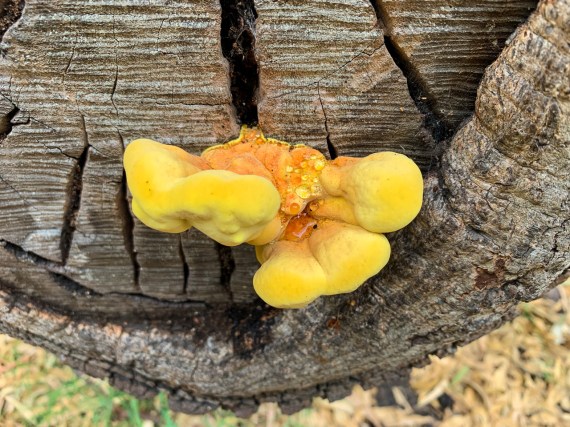
Yellow Tree Fungus (Ray Juncosa 10-15-22)
Our first sight was a mobbing, by five or six crows, of two perfectly peaceful looking perched Red-shouldered Hawks, although there was another one flying around calling. As we went to the lake, we saw a Belted Kingfisher flying. Nobody remembered having seen one there before. Also a perched Osprey indicated there must be good fishing. Swimming birds were limited to American Coots, in the beginning, and altogether it seemed there were rather few birds. Snowy and Great Egrets were represented in few numbers. A Green Heron stayed camouflaged and hard for some of us to see. A Northern Flicker and his wife presented lovely views as they perched near a Brazilian Pepper Tree.
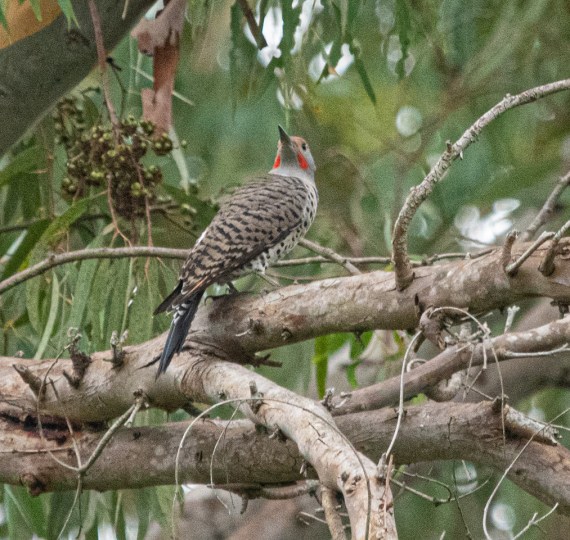
Northern Flicker (Ray Juncosa 10-15-22)
As we walked around to the more extensive part of the lake, we saw 18 Long-billed Dowitchers, busy fishing. A Double-crested Cormorant sat drying his wings. A couple of Black-crowned Night-Herons sat across the lake.

Long-billed Dowitcher (Ray Juncosa 10-15-22)
From the butterfly garden we were able to see the usual White-faced Ibis, busy fishing, then running with outspread wings. I saw a beautiful Townsend’s Warbler in the trees. We were pursued by about five Mallards, but we turned out to be ultimately disappointing to them.

White-faced Ibis without its white-faced alternate plumage, but iridescent olive-green on the back (Ray Juncosa 10-15-22)
Several lovely Lesser Goldfinches were clearing the seeds off a plant. One Downy Woodpecker, a gnatcatcher too hard to identify further (but most likely Blue-gray), several Orange-crowned Warblers, House Finches, and a number of Black Phoebes almost complete the list.
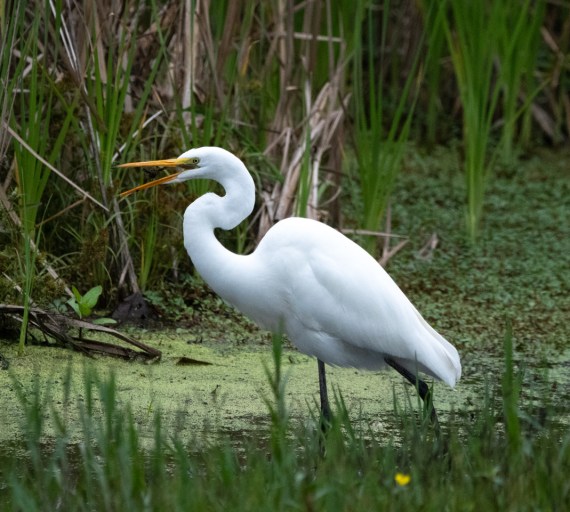
A Great Egret who might have something stuck in his craw (Ray Juncosa 10-15-22)
What others reported having seen, but we didn’t: Pin-tailed Whydah, Townsend’s Solitaire.
We did not see the resident owl.
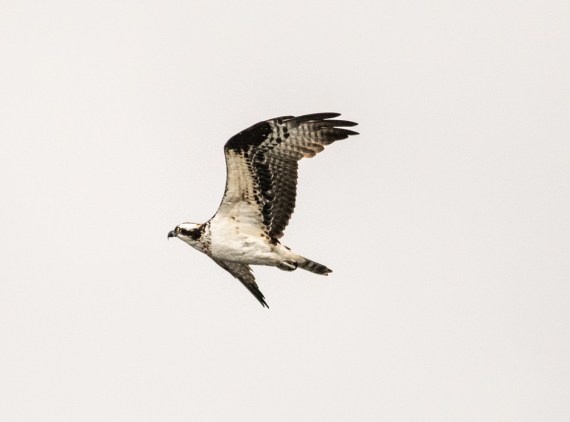
Osprey, overhead, where they often are until they suddenly aren’t (Ray Juncosa 10-15-22)
Trip List: Huntington Central Park – 15 Oct 2022
34 Species
- Cinnamon Teal 1
- American Wigeon 5 M&F
- Mallard 37
- Rock Pigeon (Feral Pigeon) 1
- Allen’s Hummingbird 7
- American Coot 30
- Long-billed Dowitcher 18
- gull sp. 1
- Double-crested Cormorant 1
- Great Blue Heron 1
- Great Egret 2
- Snowy Egret 3
- Green Heron 1
- Black-crowned Night-Heron 3 Adult 2 juvie1
- White-faced Ibis 1
- Osprey 1
- Cooper’s Hawk 2
- Red-shouldered Hawk 3
- Red-tailed Hawk (calurus/alascensis) 1
- Belted Kingfisher 1
- Downy Woodpecker 2
- Northern Flicker 2 M&F
- Black Phoebe 8
- American Crow 10
- Swinhoe’s White-eye 10
- Blue-gray Gnatcatcher 1 Heard only
- House Wren 2
- House Finch 12
- Lesser Goldfinch 4
- White-crowned Sparrow 3
- Song Sparrow 1
- Orange-crowned Warbler 4
- Common Yellowthroat 7
- Yellow-rumped Warbler 14
- Townsend’s Warbler 1
We look for the local Great Horned Library-Owl, a most erudite fellow and friend of Pooh.
Reservation necessary: Contact Liz Galton
Huntington [Beach] Central Park is a well-known Autumn trap for all our western migrant songbirds.
But wait, there’s more! Every fall the park hosts small numbers of stray flycatchers, vireos, sparrows and warblers from the eastern U.S.
And more! It also has resident exotics like Scaly-breasted Munia (aka Nutmeg Mannikin & Spice Finch) Lonchura punctulata, Orange-cheeked Waxbill Estrilda melpoda, Orange Bishop Euplectes franciscanus, and Pin-tailed Whydah Vidua macroura. Anything can happen!
If you take photos, please consider emailing them to leader for the trip report. Include photographer’s name.
Maximum participants: 20
Wide open spaces at the park: Mask wearing optional, Covid cards will not be checked.
NOTE: PLEASE SIGNUP WITH LEADER. IN CASE OF NO SIGNUPS, THE TRIP IS CANCELLED.

Pin-tailed Whydah, normally found in Africa.
Leader: Liz Galton egalton[AT]ucla.edu
Family Guide: 1-2 miles of walking on paved & crushed granite pathways and lawn.
Google Map to Huntington Central Park
Directions to Park [17775 Goldenwest St., Huntington Beach 92647]
From Santa Monica – 42 miles, allow 1 hour.
Take SAN DIEGO FWY (I-405), exit on GOLDEN WEST ST. Go south about 3 miles to SLATER AVE. Turn left on SLATER AVE, then about 100 yds to parking lot on right. Meet in parking lot.
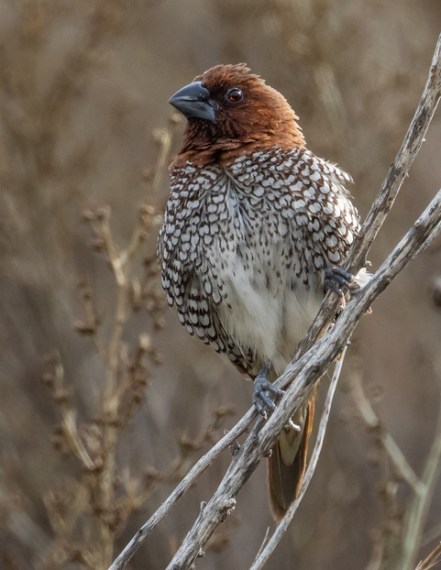
Scaly-breasted Munia male. (Photo: Chris Tosdevin)



 SANTA MONICA BAY AUDUBON SOCIETY BLOG