Free email delivery
Please sign up for email delivery in the subscription area to the right.
No salesman will call, at least not from us. Maybe from someone else.
Malibu Lagoon turning to autumn, 24 Sep. 2023
[By Chuck Almdale]
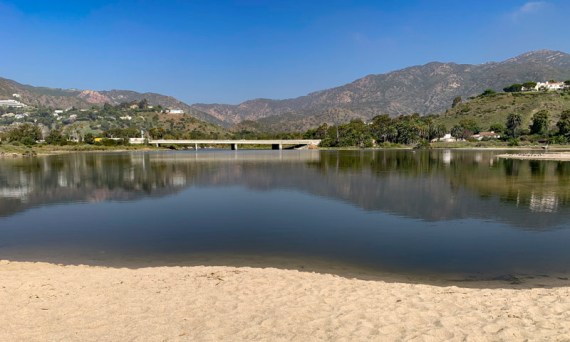
Mirroring Malibu Lagoon (Ray Juncosa 9/24/23)
The day started off nice and cool at 58°F. Three hours later it was 74° with very little wind as you can see by the mirrorlike lagoon above. So what season is it?

Snowy Egret with a gigantic insect, perhaps a holdout from the carboniferous era. Photographer Chris thinks it is [was] a Common Green Darner, Anax junius, 3″ long. (Chris Tostdevin 9/24/23)
As you can see below, we had a good mixture of shorebirds and gulls on the east side of the lagoon near Adamson House. We’ll go through some of them farther down.

Mixed shorebirds and gulls. (Ray Juncosa 9/24/23)
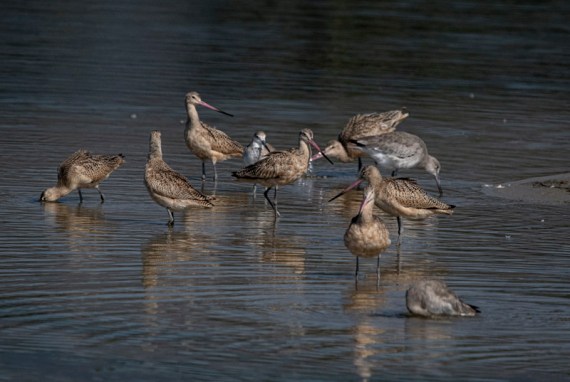
Seven Marbled Godwits, three Willets, but who’s counting?
(Ray Juncosa 9/24/23)

Which Whimbrel is real, which is illusion? (Ray Juncosa 9/24/23)
This was one of those days of the lunar month when the tide doesn’t fluctuate much; from the high at 7:39 am to the low at 11:53 am it only dropped .74 feet, or 9 inches. The tidepool rocks, never entirely covered, became slightly more exposed and those shorebirds inclined to do so, explored the shore.

Two Ruddy Turnstones (aka “The Turnstone” in Europe), molting into drabber basic plumage. (Grace Murayama 9/20/23)

Two Whimbrels poking about (Grace Murayama 9/20/23)

This Black Oystercatcher seems to have exceptionally fat toes.
(Grace Murayama 9/20/23)
Oystercatchers are definitely easier to find at Malibu when the tidal rocks are exposed, although occasionally we’ll see them on the large outer offshore rocks.

…and a Black-bellied Plover about as far into basic (non-breeding) plumage as they can get, wandering away from the crowd (Grace Murayama 9/20/23)

East end of the south channel with it’s snag and the Osprey pole sans Osprey in the middle distance (Ray Juncosa 9/24/230
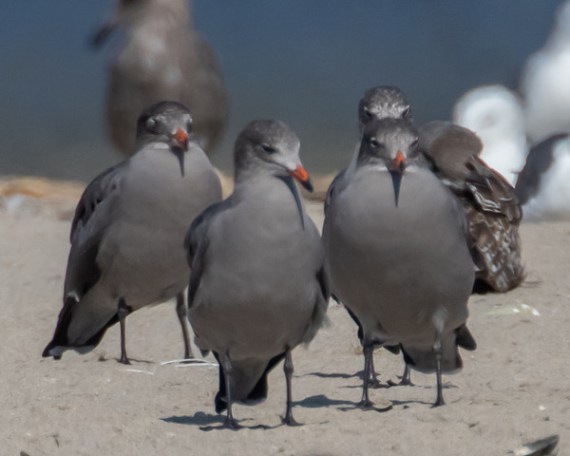
Back on the sand, a small cluster of the ~50 Heermann’s Gulls present (Chris Tosdevin 9/24/23)

Black-bellied Plovers, flying and not (Chris Tosdevin 9/24/23)
Elsewhere around the lagoon and its edges, there were butterflies.
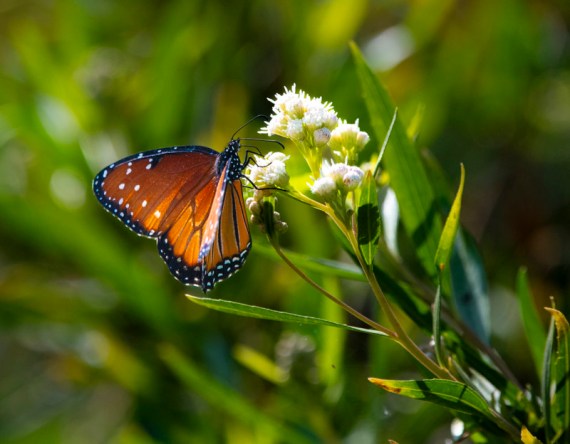
Butterfly (Ray Juncosa 9/24/23)
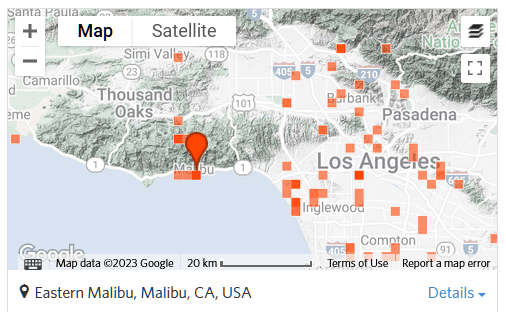
[Addendum]: I originally identified the above butterfly as Monarch (Daneus plexippus), although I was only 98% certain and Lillian much less so, as she suspected it was a Queen (Daneus gilippus). I soon received separate comments with varying levels of certainty from two readers, Jeri Edwards in San Luis Obispo and Ruth Dewar, with the same opinion, that it was actually a Queen, the closely-related and ridiculously-similar congener. [Jeri, by the way, ran the outhouse roof vent owl poo-poo project a few years back which SMBAS supported.] I examined the photos again and decided Jeri and Ruth were probably right, although I’d still like to hear an expert chime in with exactly why it’s a Queen. Anyway….grumble, grumble….Jeri kindly sent Ray’s three photos to iNaturalist. They officially identified it in their iNaturalistically way as a Queen Butterfly Danaus gilippus (Cramer, 1776), and it’s now got it’s own iNaturalist page, preserved until the End of Days. Like the Monarch, they also lay their eggs on milkweed, and now I’m wondering if all the Monarchs I’ve seen in SoCal are actually Queens. Here’s a map from it’s page:
I also sent the photo to NABA (North American Butterfly Association) of Orange County (L.A. County doesn’t have a chapter I could find), and Lee Shoemaker wrote back: “This is a female Queen. They are not common near the coast and are most common in California in our deserts. Great find.“
…and at least three Green Herons scattered in various locations. They don’t often gather in groups. Wondering where the green is?
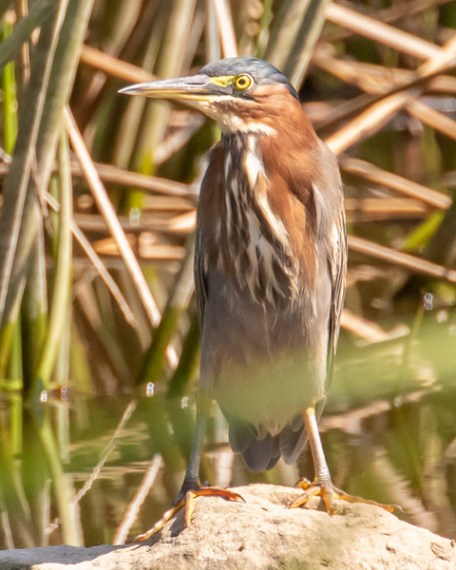
Green Heron (Chris Tosdevin 9/24/23)
I finally laid eyes on a Nuttall’s Woodpecker at the lagoon, although Femi Faminu seems to either see or hear them almost every trip. This one was, to my great surprise, in a palm tree in the back of the colony, not in a hardwood sycamore or oak as I (perhaps I’m the only one who thinks this) would expect. It was just below the base of the fronds, poking – and I suppose pecking – around the large bulge encircling the top of the trunk where the older fronds have been trimmed away. Alas, no photos – it was very dark under those fronds.
A Pied-billed Grebe, just after surfacing. Based on the bill and throat colors, I’d say this is a juvenile bird, born this year.
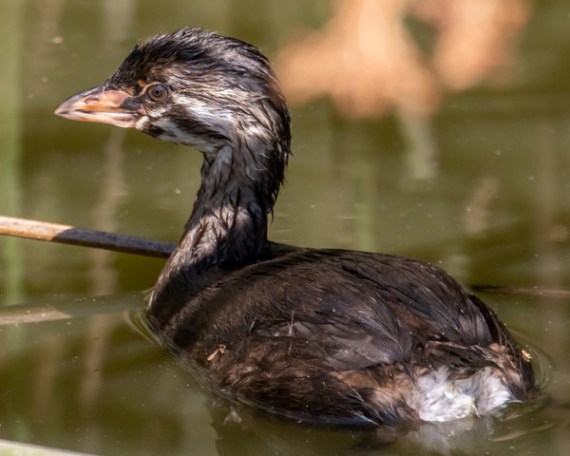
Pied-billed Grebe (Chris Tosdevin 9/24/23)
We should call these confusing fall Red-winged Blackbirds. I think they get mistaken for Rusty Blackbirds every now and then.
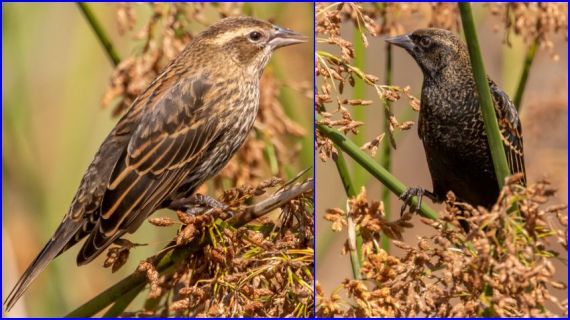
Red-winged Blackbirds: left female sometimes thought to be a sparrow, right male sometimes mistaken for Rusty Blackbird. (Chris Tosdevin 9/24/23)
Birds new for the Season: Green-winged Teal, Sora, Forster’s Tern, Black-vented Shearwater, Pelagic Cormorant, Red-shouldered Hawk, Belted Kingfisher, Nuttall’s Woodpecker, American Kestrel, Oak Titmouse, Northern Rough-winged Swallow, House Wren, Bewick’s Wren, Savannah Sparrow, Orange-crowned Warbler, Common Yellowthroat, Wilson’s Warbler, Western Tanager, Black-headed Grosbeak.

Osprey, probably back for the winter
(Left: Grace Murayama 9/20/23, Right: Chris Tosdevin 9/24/23)
Malibu Lagoon on eBird as of 9-29-23: 7141 lists, 319 species
Most recent species added: Lilac-crowned Parrot (13 May 2023, Nick Diaco).
Many, many thanks to photographers: Ray Juncosa, Larry Loeher, Grace Murayama, Chris Tosdevin
Upcoming SMBAS scheduled field trips:
- Huntington Beach Central Park, Sat. Oct 14, 8am. Already announced.
- Malibu Lagoon, Sun. Oct 22, 8:30 am. No reservations or Covid card required.
- Ballona Freshwater Marsh Sat. Nov 11 8.00 am.
- Malibu Lagoon, Sun. Nov. 26, 8:30 am. No reservations or Covid card required.
- These and any other trips we announce for the foreseeable future will depend upon expected status of the Covid/flu/etc. pandemic at trip time. Any trip announced may be canceled shortly before trip date if it seems necessary. By now any other comments should be superfluous.
- Link to Programs & Field Trip schedule.
The next SMBAS Zoom program: ““Gray Vireos in Baja” with Dr. Phil Unitt, Tuesday, 7 Nov. 2023, 7:30 p.m. A recording of our 3 Oct. program, “Birds of Cuba” with Alvaro Jaramillo, is now on the blog.
The SMBAS 10 a.m. Parent’s & Kids Birdwalk restarted April 23. Reservations for groups (scouts, etc.) necessary; not necessary for families.
Links: Unusual birds at Malibu Lagoon
9/23/02 Aerial photo of Malibu Lagoon
More recent aerial photo
Prior checklists:
2023: Jan-June
2021: Jan-July, July-Dec 2022: Jan-June, July-Dec
2020: Jan-July, July-Dec 2019: Jan-June, July-Dec
2018: Jan-June, July-Dec 2017: Jan-June, July-Dec
2016: Jan-June, July-Dec 2015: Jan-May, July-Dec
2014: Jan-July, July-Dec 2013: Jan-June, July-Dec
2012: Jan-June, July-Dec 2011: Jan-June, July-Dec
2010: Jan-June, July-Dec 2009: Jan-June, July-Dec
The 10-year comparison summaries created during the Lagoon Reconfiguration Project period, remain available—despite numerous complaints—on our Lagoon Project Bird Census Page. Very briefly summarized, the results unexpectedly indicate that avian species diversification and numbers improved slightly during the restoration period June’12-June’14.
Many thanks to Ray Juncosa, Chris Lord, Chris Tosdevin, Ruth Tosdevin and others for their contributions to this month’s checklist.
The species lists below is irregularly re-sequenced to agree with the California Bird Records Committee Official California Checklist. If part of the chart’s right side is hidden, there’s a slider button at the bottom of the list.
[Chuck Almdale]
| Malibu Census 2023 | 4/23 | 5/28 | 6/25 | 7/23 | 8/27 | 9/24 | |
| Temperature | 57-66 | 61-62 | 59-71 | 66-70 | 69-73 | 56-74 | |
| Tide Lo/Hi Height | L-.041 | L+0.81 | L+0.89 | L+0.81 | H+3.68 | H+3.77 | |
| Tide Time | 0637 | 1131 | 0919 | 0730 | 0832 | 0739 | |
| 1 | Canada Goose | 4 | 5 | 4 | 4 | ||
| 1 | Gadwall | 24 | 17 | 45 | 90 | 45 | 40 |
| 1 | Mallard | 15 | 12 | 33 | 77 | 20 | 12 |
| 1 | Green-winged Teal | 1 | |||||
| 1 | Surf Scoter | 3 | 2 | ||||
| 2 | Pied-billed Grebe | 2 | 2 | 1 | |||
| 2 | Western Grebe | 6 | |||||
| 7 | Feral Pigeon | 1 | 8 | 3 | 4 | ||
| 7 | Eurasian Collared-Dove | 2 | |||||
| 7 | Mourning Dove | 2 | 2 | 2 | 2 | 2 | 5 |
| 8 | Anna’s Hummingbird | 1 | 1 | 1 | 2 | ||
| 8 | Allen’s Hummingbird | 2 | 1 | 2 | 4 | 1 | |
| 2 | Sora | 1 | |||||
| 2 | American Coot | 6 | 5 | 6 | 49 | ||
| 5 | Black-bellied Plover | 6 | 39 | 82 | |||
| 5 | Killdeer | 4 | 4 | 8 | 8 | 13 | 6 |
| 5 | Semipalmated Plover | 14 | 1 | 7 | 3 | ||
| 5 | Snowy Plover | 1 | 7 | 13 | 22 | ||
| 5 | Whimbrel | 16 | 11 | 32 | 38 | 32 | |
| 5 | Long-billed Curlew | 4 | 3 | ||||
| 5 | Marbled Godwit | 1 | 48 | ||||
| 5 | Ruddy Turnstone | 2 | 4 | ||||
| 5 | Sanderling | 2 | 32 | ||||
| 5 | Dunlin | 2 | |||||
| 5 | Least Sandpiper | 19 | 4 | 8 | 18 | ||
| 5 | Western Sandpiper | 30 | 6 | 3 | 15 | ||
| 5 | Short-billed Dowitcher | 1 | 2 | ||||
| 5 | Spotted Sandpiper | 3 | 3 | ||||
| 5 | Willet | 2 | 7 | 5 | 9 | 29 | |
| 5 | Wilson’s Phalarope | 1 | |||||
| 5 | Red-necked Phalarope | 2 | |||||
| 6 | Bonaparte’s Gull | 3 | |||||
| 6 | Heermann’s Gull | 80 | 152 | 94 | 89 | 90 | 51 |
| 6 | Ring-billed Gull | 120 | 12 | 5 | 1 | ||
| 6 | Western Gull | 50 | 72 | 105 | 150 | 85 | 65 |
| 6 | California Gull | 60 | 2 | 3 | 7 | ||
| 6 | Herring Gull | 1 | |||||
| 6 | Caspian Tern | 2 | 1 | ||||
| 6 | Forster’s Tern | 1 | |||||
| 6 | Royal Tern | 3 | 20 | 10 | 4 | ||
| 6 | Elegant Tern | 630 | 305 | 150 | 2 | 40 | 24 |
| 6 | Black Skimmer | 2 | |||||
| 2 | Pacific Loon | 1 | |||||
| 2 | Common Loon | 1 | |||||
| 2 | Black-vented Shearwater | 20 | |||||
| 2 | Brandt’s Cormorant | 12 | 8 | 2 | |||
| 2 | Pelagic Cormorant | 3 | 3 | 1 | 1 | ||
| 2 | Double-crested Cormorant | 53 | 74 | 75 | 42 | 23 | 30 |
| 2 | Brown Pelican | 655 | 168 | 162 | 174 | 56 | 27 |
| 3 | Great Blue Heron | 1 | 4 | 4 | 5 | 3 | |
| 3 | Great Egret | 1 | 2 | 2 | 3 | 5 | |
| 3 | Snowy Egret | 1 | 3 | 4 | 4 | 8 | 5 |
| 3 | Green Heron | 1 | 3 | ||||
| 3 | Black-crowned Night-Heron | 2 | 2 | 5 | 2 | ||
| 4 | Turkey Vulture | 1 | 2 | ||||
| 4 | Osprey | 1 | 1 | 1 | 1 | ||
| 4 | Cooper’s Hawk | 1 | 1 | ||||
| 4 | Red-shouldered Hawk | 1 | |||||
| 4 | Red-tailed Hawk | 2 | 1 | 1 | |||
| 8 | Belted Kingfisher | 2 | |||||
| 8 | Nuttall’s Woodpecker | 1 | |||||
| 4 | American Kestrel | 1 | |||||
| 4 | Peregrine Falcon | 1 | |||||
| 9 | Pacific-slope Flycatcher | 1 | |||||
| 9 | Black Phoebe | 1 | 6 | 4 | 6 | 2 | 4 |
| 9 | California Scrub-Jay | 2 | 1 | 2 | |||
| 9 | American Crow | 4 | 3 | 9 | 20 | 9 | 6 |
| 9 | Common Raven | 2 | 2 | 1 | 2 | ||
| 9 | Oak Titmouse | 1 | 3 | ||||
| 9 | Northern Rough-winged Swallow | 6 | 5 | 15 | 2 | ||
| 9 | Barn Swallow | 15 | 30 | 35 | 12 | 35 | 4 |
| 9 | Cliff Swallow | 25 | 4 | 30 | |||
| 9 | Bushtit | 2 | 8 | 4 | 22 | 8 | |
| 9 | Wrentit | 1 | 1 | 1 | 4 | ||
| 9 | House Wren | 2 | 2 | ||||
| 9 | Bewick’s Wren | 1 | 1 | ||||
| 9 | Northern Mockingbird | 1 | 1 | ||||
| 9 | European Starling | 2 | 3 | 6 | 15 | ||
| 9 | House Finch | 7 | 13 | 8 | 15 | 5 | 6 |
| 9 | Lesser Goldfinch | 2 | 5 | 1 | |||
| 9 | Dark-eyed Junco | 1 | 1 | ||||
| 9 | Savannah Sparrow | 1 | |||||
| 9 | Song Sparrow | 7 | 10 | 5 | 5 | 4 | 5 |
| 9 | California Towhee | 5 | 3 | 1 | 3 | 3 | |
| 9 | Hooded Oriole | 1 | 1 | 3 | 1 | ||
| 9 | Red-winged Blackbird | 4 | 3 | 6 | 7 | ||
| 9 | Brown-headed Cowbird | 1 | 3 | 1 | |||
| 9 | Great-tailed Grackle | 4 | 2 | 1 | 1 | 1 | |
| 9 | Orange-crowned Warbler | 1 | 1 | 1 | |||
| 9 | Common Yellowthroat | 1 | 2 | ||||
| 9 | Yellow Warbler | 1 | |||||
| 9 | Wilson’s Warbler | 1 | 1 | ||||
| 9 | Western Tanager | 1 | |||||
| 9 | Black-headed Grosbeak | 1 | |||||
| Totals by Type | Apr | May | Jun | Jul | Aug | Sep | |
| 1 | Waterfowl | 46 | 36 | 82 | 171 | 65 | 53 |
| 2 | Water Birds – Other | 739 | 253 | 245 | 216 | 87 | 129 |
| 3 | Herons, Egrets & Ibis | 2 | 6 | 12 | 13 | 24 | 13 |
| 4 | Quail & Raptors | 5 | 1 | 3 | 1 | 2 | 4 |
| 5 | Shorebirds | 88 | 4 | 26 | 70 | 145 | 299 |
| 6 | Gulls & Terns | 940 | 549 | 376 | 244 | 230 | 152 |
| 7 | Doves | 3 | 12 | 2 | 2 | 5 | 9 |
| 8 | Other Non-Passerines | 3 | 1 | 3 | 5 | 0 | 6 |
| 9 | Passerines | 89 | 106 | 129 | 96 | 59 | 82 |
| Totals Birds | 1915 | 968 | 878 | 818 | 617 | 747 | |
| Total Species | Apr | May | Jun | Jul | Aug | Sep | |
| 1 | Waterfowl | 4 | 4 | 3 | 3 | 2 | 3 |
| 2 | Water Birds – Other | 9 | 4 | 5 | 2 | 4 | 7 |
| 3 | Herons, Egrets & Ibis | 2 | 3 | 4 | 4 | 5 | 4 |
| 4 | Quail & Raptors | 4 | 1 | 2 | 1 | 2 | 4 |
| 5 | Shorebirds | 8 | 1 | 3 | 9 | 15 | 14 |
| 6 | Gulls & Terns | 5 | 7 | 6 | 5 | 7 | 6 |
| 7 | Doves | 2 | 3 | 1 | 1 | 2 | 2 |
| 8 | Other Non-Passerines | 2 | 1 | 2 | 2 | 0 | 4 |
| 9 | Passerines | 20 | 20 | 17 | 14 | 9 | 23 |
| Totals Species – 94 | 56 | 44 | 43 | 41 | 46 | 67 |
They’re here! — Cornwall Wildlife Trust 2023 photo finalists
[Posted by Chuck Almdale, submitted by Adrian Douglas]
Six divisions, five photos per division.
The vole’s last look.
Kestrel in stoop mode, Keneggy Cove by Andy Maher

The Cornwall Wildlife Trust 2023 Wildlife Photography Competition Finalists
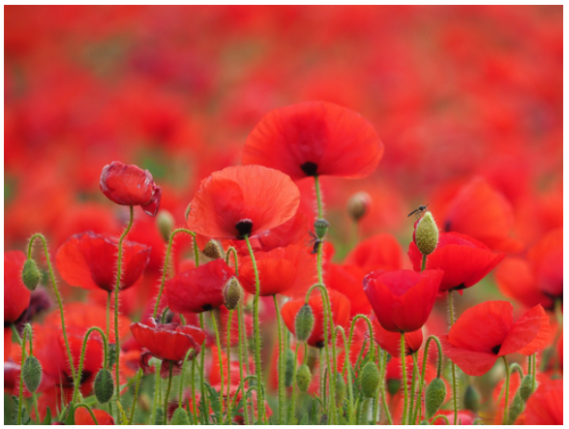
“…a pretty nurse is selling poppies for the train…” – P. McCartney
Common poppies, Pentire by William Hall
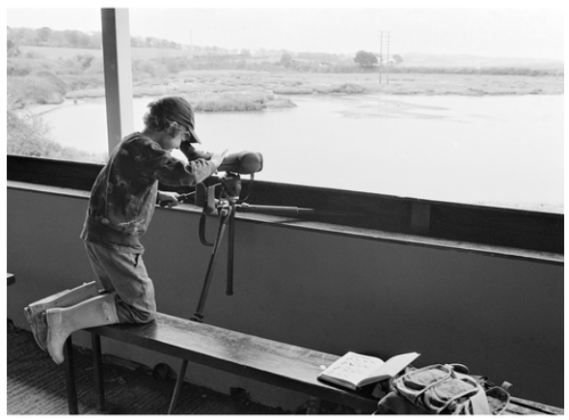
Brits build the best bird-blinds in the world.
First time in a hide, Hayle by Paul Hopwood
On mis-aging and mis-sexing birds in eBird (and elsewhere)
[Posted by Chuck Almdale]
Paul Lehman, a bird maven for more decades than I can count, recently posted this comment on the Los Angeles bird chat. It pertains initially to late summer/fall season eBird reporting errors from overconfident birders, but I think it has importance to the wider birding audience.
Fall has arrived and so have a few perennial errors in eBird submissions with the mis-aging and mis-sexing of a number of species. Well, actually this is a definite year-round problem continent-wide, but the examples below are mostly unique to fall and winter. Lately, the appearance of multiple Painted Redstarts has brought also a fair number of submissions stating that a particular individual is a “male,” or an “adult,” or an “adult male.” Essentially all Painted Redstarts look the same after they molt out of juvenal plumage on the breeding grounds. They can’t be easily aged and sexed (if not singing). And there is also now the yearly over-reporting of “female” Black-and-white Warblers because the birds have white throats. But most males lose their black throats in fall and winter, and sexing this species at this time of year should be done on the basis of the auricular/cheek color and secondarily on the flank color and boldness of the side and undertail-covert streaking. Soon, there will probably be reports of “adult male” Black-throated Blue Warblers and Hooded Warblers, despite the fact that young males are essentially identical to adults.
A large percent of eBird reviewers simply do not check age and sex designations, if made, due to lack of time. Or even if they see such an error, they sometimes do not wish to spend the time contacting the observer to get them to change it. Thus many, many incorrect designations fall through the cracks. As a result, I would wager that the overall eBird database has only limited value in this regard, given the large number of incorrectly aged and sexed birds it contains. It is fine NOT to make such designations unless one is truly certain, or perhaps only after consulting the literature and on-line sources to double-check before submitting.
–Paul Lehman, San Diego
24 Sep 2023
Pencils with teeth, glowing in the dark, coming for you | The Guardian
[Posted by Chuck Almdale, submitted by Lillian Johnson]
Talk about biting the hand that holds you.
Pencils with teeth: meet the tiny cookiecutter shark that attacked a catamaran off Cairns
The Guardian | Henry Belot | 7 Sep 2023
These parasitic sharks glow in the dark and are known to have a go at anything they come across, despite their small size. “They’ll find a large animal like a whale or a dolphin, living or dead, and attach themselves to it. They’ll twist and literally pull out a biscuit-sized chunks of flesh. They can do that repeatedly,” McPhee said.

And don’t miss this:
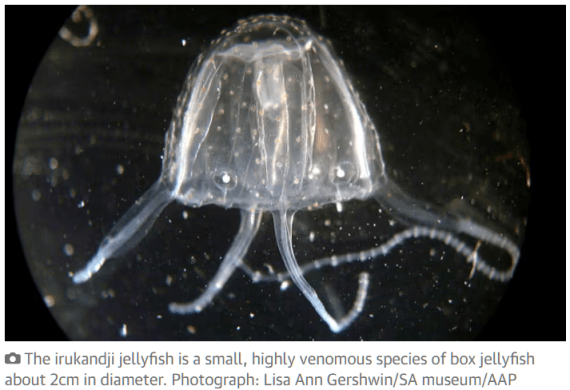
Two people stung by deadly irukandji jellyfish near Cairns
Returnees: Malibu Lagoon, 27 August 2023
[By Chuck Almdale]
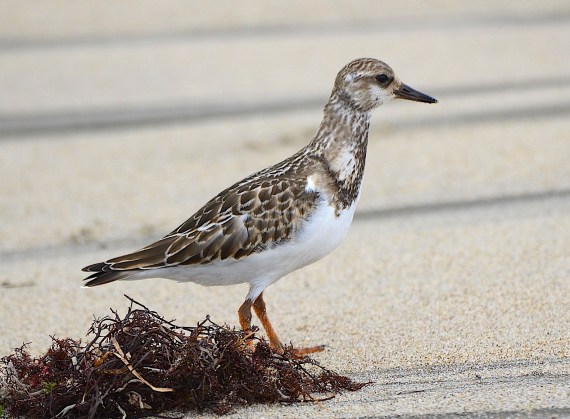
Stand up and be counted! Please! Ruddy Turnstone (Larry Loeher 8/31/23)
Turnstones rarely stand up straight, but hunch over, looking down for tiny things to eat. They’re at the upper end of peep-sized.
Last month we had 70 shorebirds in 9 species; this month we had 145 shorebirds in 15 species. And that’s about right for the July to August transition. Birds are returning. Some stay all winter, or at least the species is present if not the individuals. Some, Semipalmated Plovers for example, continue south, then return briefly in the Spring on their way north. Some, like the Brown Pelican (not an actual “shorebird” although technically it is a bird on the shore) below, continually drop in all year around.
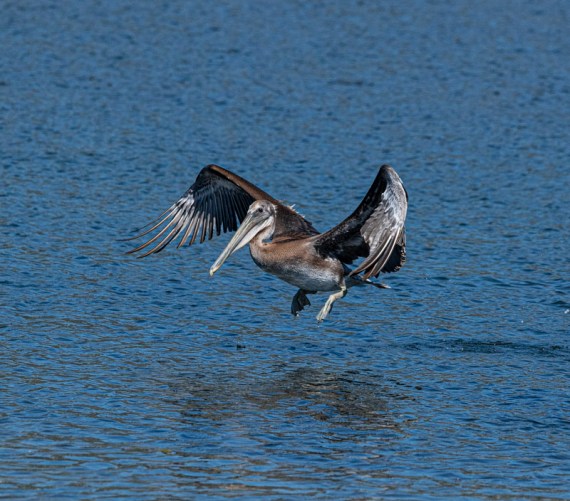
Brown Pelican levitates o’er the lagoon (Ray Juncosa 8/27/23)
I think we arrived at almost 30 birders (whom I rarely enumerate) who drifted in and out. Many arrive late — suddenly I find myself surrounded by people appearing out of nowhere — but by the time we hit the beach they’ve wandered off in different directions. The weather was nice, starting at 69°F and not getting much warmer.
The Osprey was on its Official Osprey Pole, installed a decade ago as a perch intended specifically for him. But he and/or she prefers the various cypress trees or the telephone pole by Malibu Colony, or the monkey-puzzle tree by Adamson House. He got up later and flew around a bit, even swooped low a couple of times, but didn’t actually dive on anything. He did give some of the peeps, gulls, and terns a fright. Notice the amber eye.
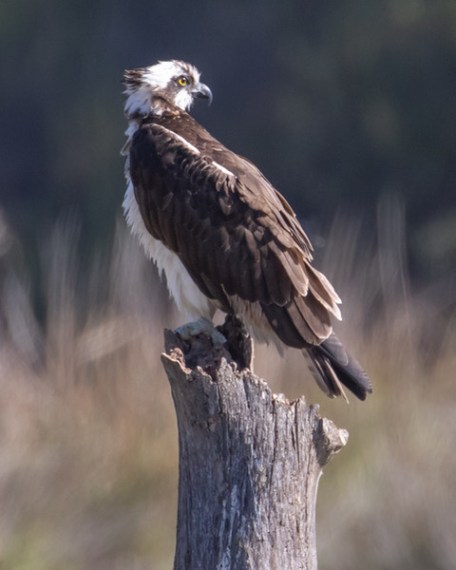
Osprey (Chris Tosdevin 8/27/23)
Black-crowned Night-Herons tend to feed by themselves, as someone else nearby might scare the fish or try to steal one you just caught. But these two juveniles stayed pretty close to each other. Perhaps they were recent nestmates, and weren’t used to being by themselves quite yet. Two young herons face the world!
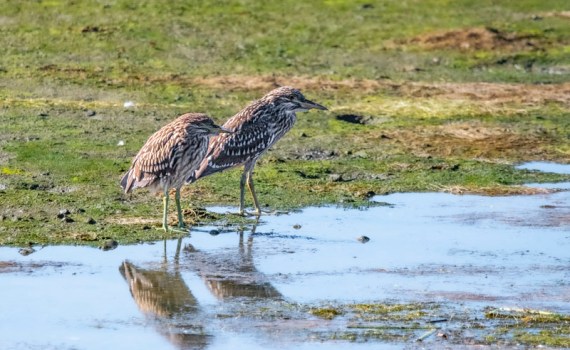
Black-crowned Night-Heron juveniles (Ray Juncosa 8/27/23)
Let’s take a look at some of the shorebirds, especially the “peeps.” Do you know, by the way, why they’re called “peeps?”

A baffling of birders on the west end path looking at peeps and egrets (Ray Juncosa 8/27/23)
Birders tend to confuse the smallest peeps with each other — the Least and the Western for example. As befits the name, the Least is the smallest peep, 1/4-1/2″ smaller than the Western. This time of year they can appear in juvenile, breeding (alternate), or winter (basic) plumages. The Least (below) tends to be a bit “warmer” brown , more streaky breast with a shorter slightly decurved bill and yellow-green legs. Westerns never have yellow-green legs, so thats a good “quickie” field mark, but which needs to be confirmed with the other marks. But sometimes the Least’s legs can look black from mud or shadow. Check the legs on this bird below. Black. But it looks like a Least, with warm brown colors, especially on the breast. Check that one toe in the sunlight. Yellow-green. Ah hah!
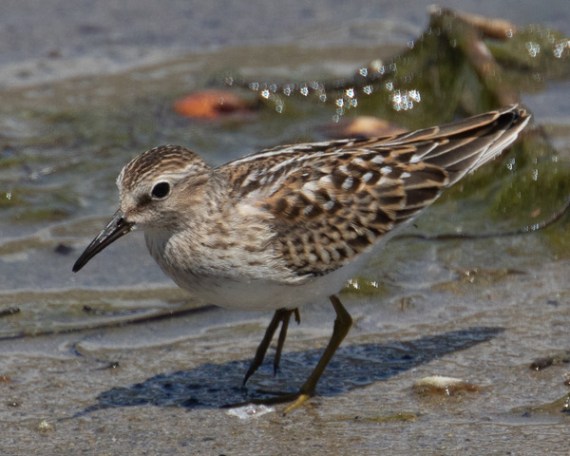
Least Sandpiper (Chris Tosdevin 8/27/23)
Below is a real Western Sandpiper. Not as warm brown, more gray-black-white, save for that rusty-brown streak on the shoulder, a left-over from breeding. Black legs and longer, more curved black bill. Check the bill closely. Tiny points like teeth on the bill edges. You rarely get a good enough look to see those.
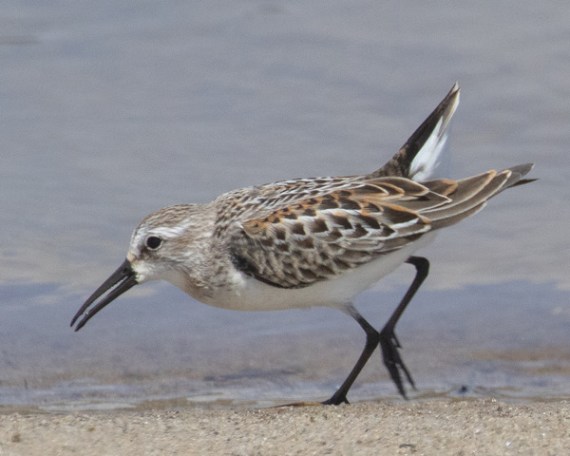
Western Sandpiper (Chris Tosdevin 8/27/23)
Sanderlings look a lot like both Western Sandpipers and Snowy Plovers, but not at the same time. It depends on the time of year. They’re generally even more gray-black-white than the Westerns, except in breeding when they can have a lot of warm rusty-red colors, but we rarely see that in SoCal. They frequently roost among the Snowy Plovers on Malibu Beach, so we have to be careful of them when we’re censusing the SNPLs and all we can see is the tops of their heads. They’re about 1.5″ larger than the Westerns, a significant difference except when they’re crouched down in a tiny dimple in the sand. Their legs and bill are black and the bill is thicker and shorter, often with a tiny bulge at the tip. They are often seen running back and forth on the sand as the wavelets wash in and out, and when most people think of “sandpiper,” they’re thinking of this bird. They are our chapter “mascot.”

Sanderling (Chris Tosdevin 8/27/23)
The three phalarope species look like peeps, but they are really their own group. 92% of our phalarope visits at the lagoon are by Red-throated, like the bird below, which has the intermediate-length bill of the three. They’re all about the same size or slightly larger than Sanderlings, but they look less bulky and behave differently. Sanderlings poke at the sand; phalaropes normally feed in fairly shallow calm water, spinning in a circle to make an tiny upwelling vortex which brings invertebrates to the surface where they pick them up. Phalaropes are also polyandrous: the females are more colorful than the males and they take multiple mates while the males tend to the nest and the young.
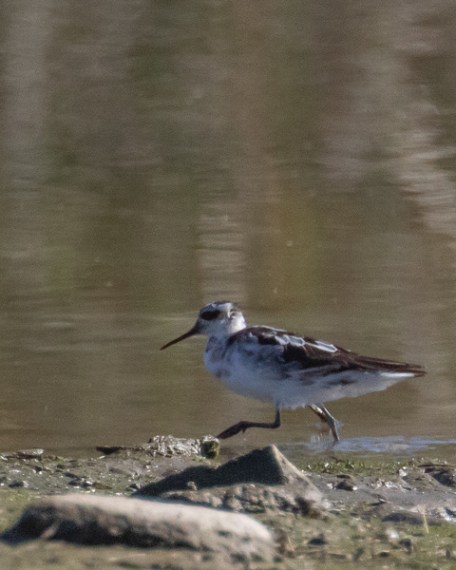
Red-throated Phalarope (Chris Tosdevin 8/27/23)
Snowy Plovers are semi-polyandrous. All our readers should be familiar with them as our chapter has “adopted” them and censused them on several L.A. County beaches over the past three decades. The males are ever-so-slightly more colorful than the females, and both male and female build the nest (such as it is, which isn’t much) and sit on the eggs. But within a few days of the eggs hatching, the female leaves and flies elsewhere to find a new mate and nest again. She may do this several times each breeding season. The male, meanwhile, stays with the young and watches over them. But he doesn’t bring them any food. They have to find their own, while he stands around and watches. Occasionally, when he feels that a potential predator (gull, larger shorebird) is nearby, he’ll try to chase it off. And he may rest near the young. But that’s about the extent of his parental care.
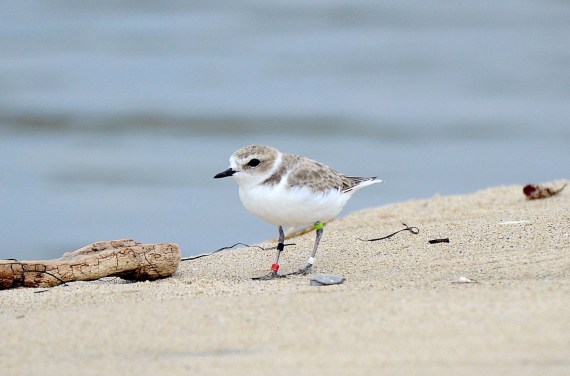
Snowy Plover Lw: kr (Larry Loeher 8/31/23)
The code stands for Left Side, Lime (above the ankle or “backwards knee”) over White: Right side, Black over Red.
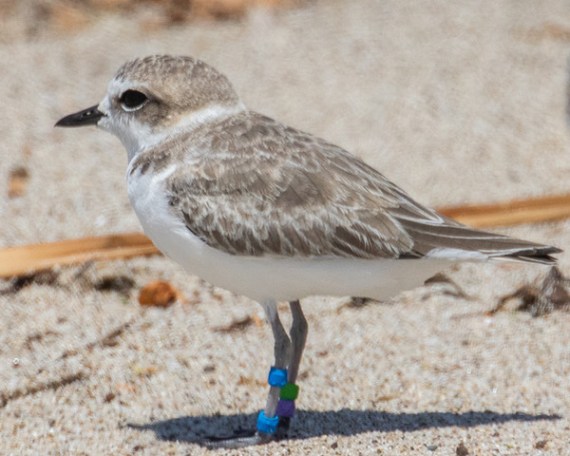
Snowy Plover bb: gv (Chris Tosdevin 8/27/23)
The code stands for Left Side, Blue over Blue: Right side, Green over Violet.
Our final sandpiper is not a “peep.” Fully grown they can be 23″ long. Their bills can vary in length as it takes a few months for their bill length to catch up to their body size. Long-billed Curlews look a lot like Whimbrels as their long bills curve downward. Whimbrels are about 50 times more common at the lagoon than the Long-billed, max out at 17.5″ long, have dark stripes on their head including one through the eye, and are less warmly brown all over. Curlews briefly stop at the lagoon to rest but don’t really like the limited habitat, and leave before long. A few dozen generally spend the winter at Upper Newport Bay which has more extensive marshland and grassy fields.
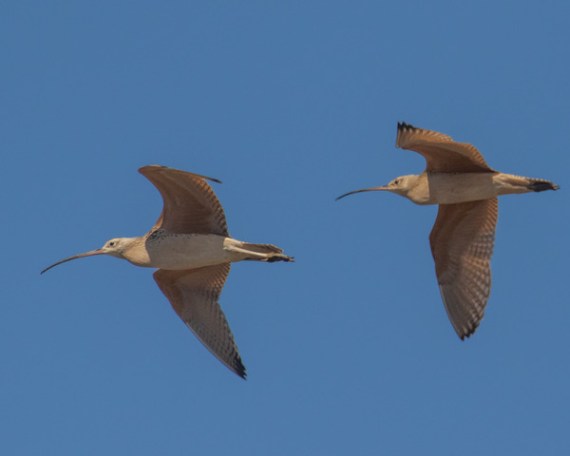
Long-billed Curlews (Chris Tosdevin 8/27/23)
I don’t know how Chris Tosdevin finds these butterflies, which at 1/2-3/4″ inch, wing-tip to wing-tip, are the world’s smallest butterfly. [The largest moth is the Atlas Moth of SE Asia, with a 10″ wingspan.] Their range is fairly extensive and includes the lagoon. I put one of his older Pygmy Blue photos into this month’s trip announcement; perhaps he saw it and felt it needed a companion.
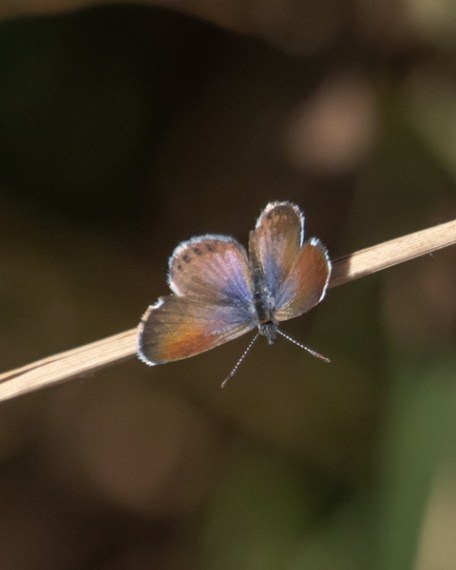
Western Pygmy Blue Butterfly, Brephidium exilis (Chris Tosdevin 8/27/23)

Range of the Western Pygmy Blue Butterfly, Brephidium exilis. Source: Butterflies & Moths
Occasionally the locals get rowdy, usually some sort of turf (or aerial equivalent) battle.
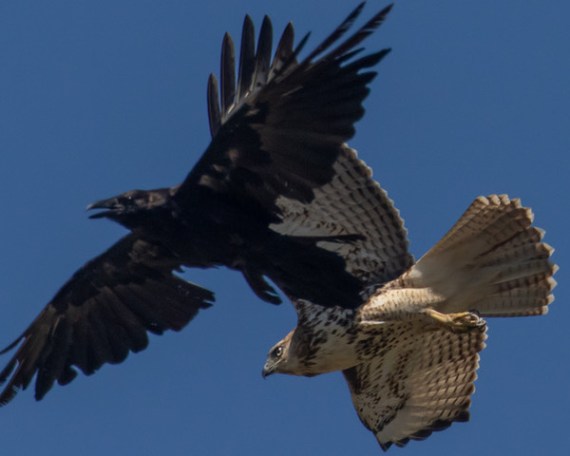
Northern Raven and juvenile Red-tailed Hawk (Chris Tosdevin 8/27/23)
You’ll be happy to know that The Arc of the Cormorant, Part II is still playing at the lagoon.

The Arc of the Cormorant [Double-crested] (Ray Juncosa 8/27/23)
One can only guess what this Heermann’s Gull is up to with this stick. The Western Gull seems bemused as well.
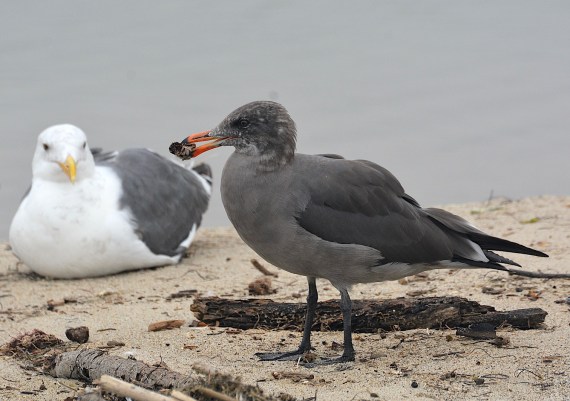
Western & Heermann’s Gulls (Grace Murayama 8/31/23)
Finally, we have a Snowy Egret stirring up the waters, trying to arouse some curiosity among the fish.
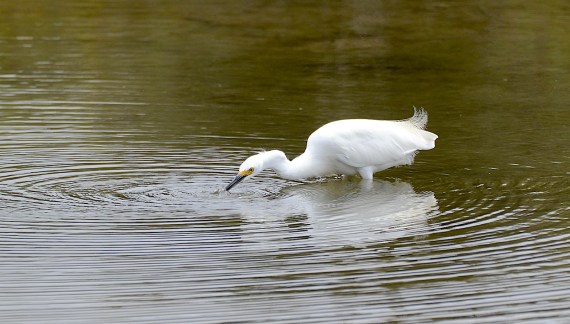
Snowy Egret (Larry Loeher 8/31/23)
Not much to report on the ducks and geese, alas. Not all the Mallards and Gadwall are full-sized yet, and after seven months our small family of four Canada Geese have left.
Birds new for the Season: Pied-billed Grebe, Feral Pigeon, Long-billed Curlew, Marbled Godwit, Ruddy Turnstone, Sanderling, Short-billed Dowitcher, Spotted Sandpiper, Red-necked Phalarope, Herring Gull, Caspian Tern, Green Heron, Osprey, Red-tailed Hawk, Wrentit, Yellow Warbler.
Malibu Lagoon on eBird as of 8-29-23: 7066 lists, 319 species
Most recent species added: Lilac-crowned Parrot (13 May 2023, Nick Diaco).
Many, many thanks to photographers: Ray Juncosa, Larry Loeher, Grace Murayama, Chris Tosdevin
Upcoming SMBAS scheduled field trips:
- Malibu Lagoon, Sun. Aug 24, 8:30 am. No reservations or Covid card required.
- Coastal Cleanup Day, Various Locations, Sat. Sep 23, 9 am–Noon
- Field trip to be announced: Sat. Oct 14.
- Malibu Lagoon, Sun. Oct 22, 8:30 am. No reservations or Covid card required.
- These and any other trips we announce for the foreseeable future will depend upon expected status of the Covid/flu/etc. pandemic at trip time. Any trip announced may be canceled shortly before trip date if it seems necessary. By now any other comments should be superfluous.
- Link to Programs & Field Trip schedule.
The next SMBAS Zoom program: “Birds of Cuba” with Alvaro Jaramillo. Tuesday, 3 Oct. 2023, 7:30 p.m.
The SMBAS 10 a.m. Parent’s & Kids Birdwalk restarted April 23. Reservations for groups (scouts, etc.) necessary; not necessary for families.
Links: Unusual birds at Malibu Lagoon
9/23/02 Aerial photo of Malibu Lagoon
More recent aerial photo
Prior checklists:
2023: Jan-June
2021: Jan-July, July-Dec 2022: Jan-June, July-Dec
2020: Jan-July, July-Dec 2019: Jan-June, July-Dec
2018: Jan-June, July-Dec 2017: Jan-June, July-Dec
2016: Jan-June, July-Dec 2015: Jan-May, July-Dec
2014: Jan-July, July-Dec 2013: Jan-June, July-Dec
2012: Jan-June, July-Dec 2011: Jan-June, July-Dec
2010: Jan-June, July-Dec 2009: Jan-June, July-Dec
The 10-year comparison summaries created during the Lagoon Reconfiguration Project period, remain available—despite numerous complaints—on our Lagoon Project Bird Census Page. Very briefly summarized, the results unexpectedly indicate that avian species diversification and numbers improved slightly during the restoration period June’12-June’14.
Many thanks to Ray Juncosa, Chris Lord, Chris Tosdevin, Ruth Tosdevin and others for their contributions to this month’s checklist.
The species lists below is irregularly re-sequenced to agree with the California Bird Records Committee Official California Checklist as updated Aug 2023. If part of the chart’s right side is hidden, there’s a slider button at the bottom of the list.
[Chuck Almdale]
| Malibu Census 2023 | 3/26 | 4/23 | 5/28 | 6/25 | 7/23 | 8/27 | |
| Temperature | 57-60 | 57-66 | 61-62 | 59-71 | 66-70 | 69-73 | |
| Tide Lo/Hi Height | L+0.28 | L-.041 | L+0.81 | L+0.89 | L+0.81 | H+3.68 | |
| Tide Time | 0800 | 0637 | 1131 | 0919 | 0730 | 0832 | |
| 1 | Canada Goose | 6 | 4 | 5 | 4 | 4 | |
| 1 | Gadwall | 42 | 24 | 17 | 45 | 90 | 45 |
| 1 | Mallard | 12 | 15 | 12 | 33 | 77 | 20 |
| 1 | Green-winged Teal | 5 | |||||
| 1 | Redhead | 3 | |||||
| 1 | Surf Scoter | 22 | 3 | 2 | |||
| 1 | Red-breasted Merganser | 2 | |||||
| 2 | Pied-billed Grebe | 1 | 2 | 2 | |||
| 2 | Western Grebe | 80 | 6 | ||||
| 7 | Feral Pigeon | 6 | 1 | 8 | 3 | ||
| 7 | Eurasian Collared-Dove | 2 | |||||
| 7 | Mourning Dove | 1 | 2 | 2 | 2 | 2 | 2 |
| 8 | White-throated Swift | 5 | |||||
| 8 | Anna’s Hummingbird | 1 | 1 | 1 | |||
| 8 | Allen’s Hummingbird | 3 | 2 | 1 | 2 | 4 | |
| 2 | American Coot | 37 | 6 | 5 | 6 | ||
| 5 | Black-bellied Plover | 3 | 6 | 39 | |||
| 5 | Killdeer | 5 | 4 | 4 | 8 | 8 | 13 |
| 5 | Semipalmated Plover | 14 | 1 | 7 | |||
| 5 | Snowy Plover | 1 | 7 | 13 | |||
| 5 | Whimbrel | 25 | 16 | 11 | 32 | 38 | |
| 5 | Long-billed Curlew | 4 | |||||
| 5 | Marbled Godwit | 2 | 1 | ||||
| 5 | Ruddy Turnstone | 2 | |||||
| 5 | Sanderling | 2 | 2 | ||||
| 5 | Dunlin | 2 | |||||
| 5 | Least Sandpiper | 19 | 4 | 8 | |||
| 5 | Western Sandpiper | 30 | 6 | 3 | |||
| 5 | Short-billed Dowitcher | 1 | |||||
| 5 | Spotted Sandpiper | 3 | |||||
| 5 | Willet | 7 | 2 | 7 | 5 | 9 | |
| 5 | Wilson’s Phalarope | 1 | |||||
| 5 | Red-necked Phalarope | 2 | |||||
| 6 | Bonaparte’s Gull | 3 | |||||
| 6 | Heermann’s Gull | 3 | 80 | 152 | 94 | 89 | 90 |
| 6 | Ring-billed Gull | 46 | 120 | 12 | 5 | 1 | |
| 6 | Western Gull | 26 | 50 | 72 | 105 | 150 | 85 |
| 6 | California Gull | 95 | 60 | 2 | 3 | ||
| 6 | Herring Gull | 2 | 1 | ||||
| 6 | Caspian Tern | 2 | 2 | 1 | |||
| 6 | Royal Tern | 13 | 3 | 20 | 10 | ||
| 6 | Elegant Tern | 90 | 630 | 305 | 150 | 2 | 40 |
| 6 | Black Skimmer | 2 | |||||
| 2 | Red-throated Loon | 1 | |||||
| 2 | Pacific Loon | 1 | 1 | ||||
| 2 | Common Loon | 2 | 1 | ||||
| 2 | Brandt’s Cormorant | 12 | 8 | 2 | |||
| 2 | Pelagic Cormorant | 2 | 3 | 3 | 1 | ||
| 2 | Double-crested Cormorant | 26 | 53 | 74 | 75 | 42 | 23 |
| 2 | Brown Pelican | 62 | 655 | 168 | 162 | 174 | 56 |
| 3 | Great Blue Heron | 2 | 1 | 4 | 4 | 5 | |
| 3 | Great Egret | 2 | 1 | 2 | 2 | 3 | 5 |
| 3 | Snowy Egret | 2 | 1 | 3 | 4 | 4 | 8 |
| 3 | Green Heron | 1 | |||||
| 3 | Black-crowned Night-Heron | 2 | 2 | 5 | |||
| 4 | Turkey Vulture | 5 | 1 | 2 | |||
| 4 | Osprey | 1 | 1 | 1 | 1 | ||
| 4 | Cooper’s Hawk | 1 | 1 | ||||
| 4 | Red-tailed Hawk | 2 | 2 | 1 | |||
| 4 | Peregrine Falcon | 1 | |||||
| 9 | Cassin’s Kingbird | 1 | |||||
| 9 | Pacific-slope Flycatcher | 1 | |||||
| 9 | Black Phoebe | 2 | 1 | 6 | 4 | 6 | 2 |
| 9 | California Scrub-Jay | 2 | 1 | ||||
| 9 | American Crow | 6 | 4 | 3 | 9 | 20 | 9 |
| 9 | Common Raven | 2 | 2 | 2 | 1 | ||
| 9 | Oak Titmouse | 1 | |||||
| 9 | Northern Rough-winged Swallow | 6 | 6 | 5 | 15 | ||
| 9 | Barn Swallow | 14 | 15 | 30 | 35 | 12 | 35 |
| 9 | Cliff Swallow | 3 | 25 | 4 | 30 | ||
| 9 | Bushtit | 3 | 2 | 8 | 4 | 22 | |
| 9 | Wrentit | 1 | 1 | 1 | |||
| 9 | Cedar Waxwing | 12 | |||||
| 9 | House Wren | 2 | |||||
| 9 | Bewick’s Wren | 1 | 1 | ||||
| 9 | Northern Mockingbird | 1 | 1 | ||||
| 9 | European Starling | 2 | 3 | 6 | |||
| 9 | House Finch | 5 | 7 | 13 | 8 | 15 | 5 |
| 9 | Lesser Goldfinch | 5 | 2 | 5 | 1 | ||
| 9 | Dark-eyed Junco | 1 | 1 | ||||
| 9 | White-crowned Sparrow | 12 | |||||
| 9 | Song Sparrow | 5 | 7 | 10 | 5 | 5 | 4 |
| 9 | California Towhee | 1 | 5 | 3 | 1 | 3 | |
| 9 | Hooded Oriole | 1 | 1 | 3 | 1 | ||
| 9 | Red-winged Blackbird | 2 | 4 | 3 | 6 | ||
| 9 | Brown-headed Cowbird | 1 | 3 | 1 | |||
| 9 | Great-tailed Grackle | 6 | 4 | 2 | 1 | 1 | |
| 9 | Orange-crowned Warbler | 3 | 1 | 1 | |||
| 9 | Common Yellowthroat | 3 | 1 | ||||
| 9 | Yellow Warbler | 1 | |||||
| 9 | Yellow-rumped Warbler (Audubon’s) | 7 | |||||
| 9 | Wilson’s Warbler | 1 | |||||
| Totals by Type | Mar | Apr | May | Jun | Jul | Aug | |
| 1 | Waterfowl | 92 | 46 | 36 | 82 | 171 | 65 |
| 2 | Water Birds – Other | 212 | 739 | 253 | 245 | 216 | 87 |
| 3 | Herons, Egrets & Ibis | 6 | 2 | 6 | 12 | 13 | 24 |
| 4 | Quail & Raptors | 8 | 5 | 1 | 3 | 1 | 2 |
| 5 | Shorebirds | 44 | 88 | 4 | 26 | 70 | 145 |
| 6 | Gulls & Terns | 277 | 940 | 549 | 376 | 244 | 230 |
| 7 | Doves | 7 | 3 | 12 | 2 | 2 | 5 |
| 8 | Other Non-Passerines | 8 | 3 | 1 | 3 | 5 | 0 |
| 9 | Passerines | 99 | 89 | 106 | 129 | 96 | 59 |
| Totals Birds | 753 | 1915 | 968 | 878 | 818 | 617 | |
| Total Species | Mar | Apr | May | Jun | Jul | Aug | |
| 1 | Waterfowl | 7 | 4 | 4 | 3 | 3 | 2 |
| 2 | Water Birds – Other | 9 | 9 | 4 | 5 | 2 | 4 |
| 3 | Herons, Egrets & Ibis | 3 | 2 | 3 | 4 | 4 | 5 |
| 4 | Quail & Raptors | 3 | 4 | 1 | 2 | 1 | 2 |
| 5 | Shorebirds | 6 | 8 | 1 | 3 | 9 | 15 |
| 6 | Gulls & Terns | 8 | 5 | 7 | 6 | 5 | 7 |
| 7 | Doves | 2 | 2 | 3 | 1 | 1 | 2 |
| 8 | Other Non-Passerines | 2 | 2 | 1 | 2 | 2 | 0 |
| 9 | Passerines | 20 | 20 | 20 | 17 | 14 | 9 |
| Totals Species – 92 | 60 | 56 | 44 | 43 | 41 | 46 |



