Every Florida Scrub Jay Faye Romero Saves Can Also Help Philippines’ Birds
[By Anthony Maddela]
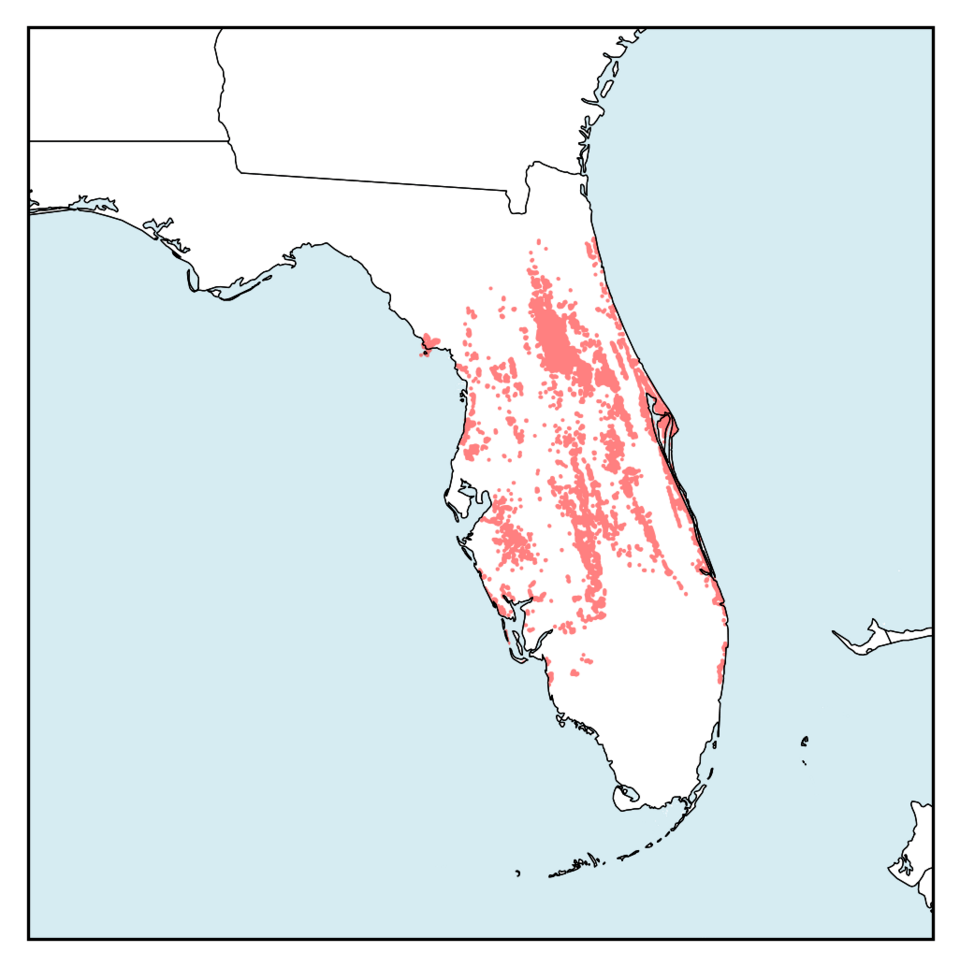
A few thousand Florida Scrub Jays occupy less than 50 square kilometers of Southeast Florida. The plight of this acorn eater on a diminishing swath of Florida oak scrub mirrors the struggles of many bird species that are endemic to isolated islands of the Philippines. Lessons learned from efforts to save the Florida Scrub Jay could help arrest the decline of critically endangered species like the Palawan Cockatoo.
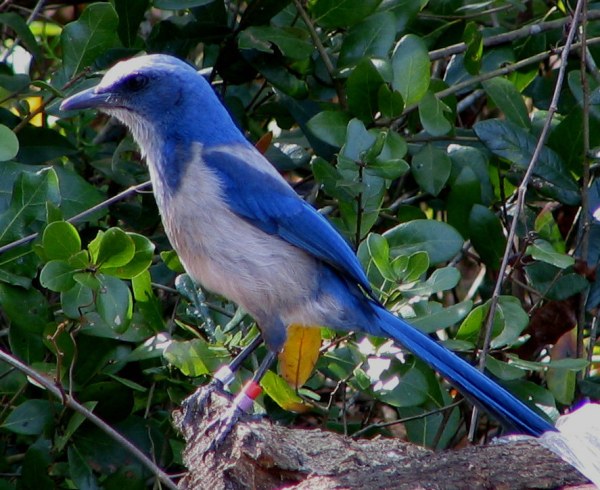
The Palawan Cockatoo and the Florida Scrub Jay are among the roughly 48,600 species on the International Union for Conservation of Nature (IUCN) Red List of Threatened Species. Their populations dwindle as habitat becomes the ground under housing developments, orchards, and other human interests.
Flocks of non-migratory birds like Florida Scrub Jays don’t seek new territories. Jays are social creatures, but their declining territories curtail social exchanges between neighboring flocks. As opportunities to refresh the gene pool collapse, inbreeding turns from a preventable risk into an unavoidable reality.
“That is a chronic problem in species that are declining on the wild,” states Faye Romero, doctoral candidate in Evolution, Ecology, Genetics and Genomics at University of Rochester in New York. “As populations get smaller and are confined to an area, then they’re going to interact with each other.”
“Some common outcomes from inbreeding start with reduced hatching success, lower birth weights of nestlings, and a smaller total number of offspring that each bird ends up having. In our field,” says Romero, “we call it the Extinction Vortex when individual animals show these negative consequences. It just keeps snowballing until they’re gone.”

Though her dissertation involves birds in the wild, Romero performs all her computational work indoors. “I do genetics work at a computer.” She elaborates, “The way I describe it to folks is that I’m basically 23 and Me and Ancestry.com for wild populations of animals. A central goal of conservation genetics is to develop models, techniques and tools to diagnose the health of a population.”
Genetics research can deliver accurate predictions of whether a species will flourish or languish. “We can look at the genetics of a species and see whether it’s in trouble. They may seem to be doing okay numbers wise today, but the genetics are telling us that maybe in fifteen, twenty years, they might be doing worse,” Romero exclaims.
Romero offers a ray of hope. “While we’re seeing their numbers continue to go down, I’m not pessimistic about the Florida Scrub Jay because we have lots of good scientists thinking about them.” People are naturally motivated to protect these birds that pack a high charm quotient and are part of our national identity. “They’re very charismatic and unique, and they’re one in only a handful of birds that are endemic to the U.S.”
Florida Scrub Jay are cousins of the American Crow in the Corvidae family. Like crows, these intelligent passerines or perching birds have sophisticated family structures. “They’re able to reproduce at one year old, but they are cooperative breeders. When they first reach maturity, they hang around the territory of their parents. They may do this for one or two years so their parents can raise successive generations.”
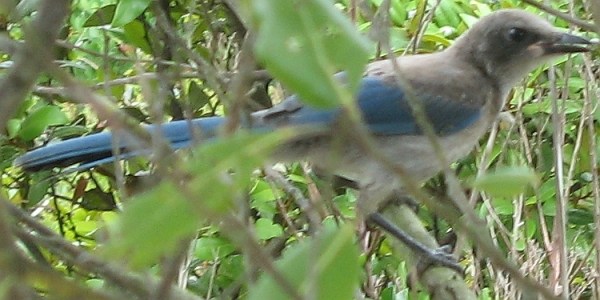
She will finish her doctorate in a year. Her insights add to over 40 years of research by a long line of friends of the Florida Scrub Jay. Genomic work with this affable species will not end when Dr. Romero leaves Rochester, but hope abounds that her research will keep inspiring the public to take initiative in protecting wild bird habitat. Adults and youth have embarked on citizen science projects that complement Romero’s genomic work and will lead to solutions we cannot yet imagine.
From Nature Lover to Birder to Scientist
Romero earned a B.S. in Molecular Environmental Biology from University of California at Berkeley before moving to Rochester, NY for graduate school. Asked her age, she answers, “late 20s.” She and younger sibling George were born to Art and Gena Romero after the couple immigrated from Batangas to Houston. Her husband is Nate, an engineer she met while swing dancing, her No. 1 non-scientific passion.
Fauna and flora engulfed her life in middle school after her family left Houston to live by th beach in Perth, Australia. While her life list spans 480 bird species, her interest in nature started as a generalist. “I was generally interested in the outdoors and nature. Because all the birds in Australia are so unique and different, it’s kind of ironic that I only got into studying birds as an undergrad at UC Berkeley.”
A preternatural curiosity about birds led to hikes with birdwatching groups, banding at Braddock Bay Bird Observatory in Ontario, Canada, a visit to Costa Rica and its over 930 species of birds including her favorite, the Resplendent Quetzel, and a nonstop vigil of alerts on her phone’s eBird app of sightings of the rare Kirtland’s Warbler.
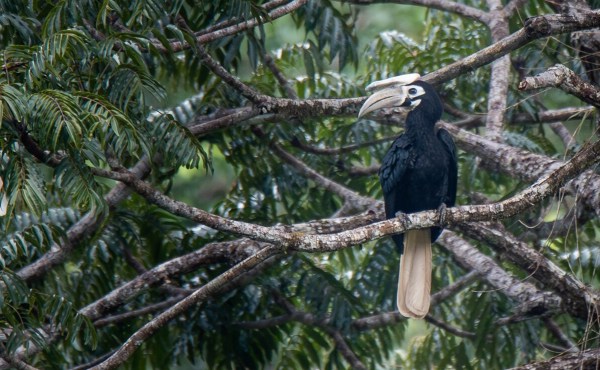
A lifer bird is a rare species that a birdwatcher expects to encounter only once in her lifetime. In May 2024 while on a family visit to the Palawan Islands, Romero saw two lifer birds. “The coolest thing I ever saw was either the Palawan Hornbill or the Stork-billed Kingfisher,” she gushes. “They are these amazingly unique birds.”
While she cannot name a “spark bird” that ignited her fascination with birds, the signature study where the former Berkeley undergraduate made her earliest mark in wildlife science involved hummingbirds—the world’s tiniest birds.
Illuminating A Human Hobby That Renews Bird Evolution
In 2019, Berkeley graduate student Nicholas Alexander embarked on his landmark study to examine whether the beaks of Anna’s Hummingbirds changed after 1940 when residents of Southern California and Baja California began hanging birdfeeders which offered sugar dissolved in water as a new food source other than the plant nectar hummingbirds consumed in nature.
Around the beginning of his research, Alexander recruited Romero as an undergraduate assistant. “He happened to be a teaching assistant in a biology course I was in. He noticed that I was passionate about the class and that I liked to participate,” remembers Romero. “He told me I have this question you can help me answer by using museum specimens.” She was intrigued.
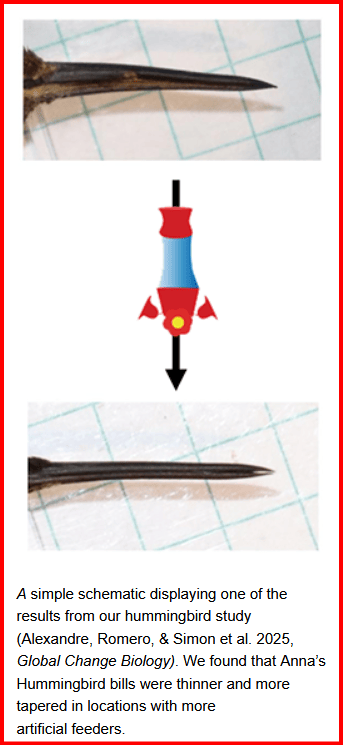
Alexander posited that by comparing the beaks of Anna’s Hummingbird specimens (known as study skins) from mid-1800s to1940 with those that lived after that year, they would observe structural (taxonomical) changes that improved access to the tiny holes of backyard hummingbird feeders.
While assisting Alexander in comparing pre-1940 study skins with post-1940 skins, she observed distinct differences in bill taxonomy. These adaptations became commonplace among Anna’s Hummingbirds. “We still see birds that lived in higher density of feeders had bills that are longer and more tapered than those that didn’t.”
Filipino Darwinists will note similarities between the Alexander study and the natural selection theory of their hero. Charles Darwin compared physiologies of a single species of finch that branched out into four distinct species over the course of two million years after its migration from South America to isolated islands of the Galapagos. It is myopic to dismiss Alexander and Romero’s work as a modern replication of Nineteenth Century findings. Their accomplishment has nothing to do with an existing body of knowledge but advances the new field of Urban Evolution, which focuses on survival of species in human environments, such as cities and suburbs.
Romero would love to conduct similar studies in the Philippines. “With seven thousand plus islands, the Philippines must be one of the top countries with the most endemic species on Earth,” she asserts. “There are amazing opportunities for scientists to learn about evolution and conservation.”
Some keepers of hummingbird feeders have more practical concerns than bill adaptations. Romero has good news for those who worry that an exclusive diet of sugar water is denying neighborhood hummingbirds essential nutrients. “I like to remind people that regardless of how frequently hummingbirds visit a bird feeder, a majority of their diet is still flower nectar.” She adds, “There are studies that show that if given an abundance of flowers or a feeder, the hummingbird will go for the flower.”
Faye Romero has coding skills to unravel genome sequences longer than the Milky Way. And she loves to swing dance! As to whether evolution endowed her with another talent that unites Filipinos everywhere, she proclaims, “Yes, I like to sing.” When she’s handed the karaoke mic, “You know who I’m obsessed with right now? Olivia Rodrigo. Her music is great, and she has great karaoke songs that are fun to sing. ‘Driver’s License’ is a classic.” She has tickets to see the immensely talented and famous Fil-Am singer-songwriter this October in Toronto. At the concert, at least one voice in the audience will be pitch perfect.
Anthony Maddela is a staff correspondent of Positively Filipino and a member of the Board of Santa Monica Bay Audubon Society. This article was originally published in Positively Filipino.
Discover more from SANTA MONICA BAY AUDUBON SOCIETY BLOG
Subscribe to get the latest posts sent to your email.



