Free email delivery
Please sign up for email delivery in the subscription area to the right.
No salesman will call, at least not from us. Maybe from someone else.
Supurb Owl Sunday VI | The Atlantic
[Posted by Chuck Almdale, submitted by Adrian Douglas]
A photographic essay: Twenty-eight stunning photos of owls from around the world.
Superb Owl Sunday VI
The Atlantic | Alan Taylor | 13 Feb 2022 | 5 minute look
Biden administration makes it harder to kill birds
[Posted by Chuck Almdale, submitted by Lucien Plauzoles]
FromBethLevin Vanity Fair quoting the WAPO
In break with Donald Trump, Biden administration will make it harder to kill birds
If you weren’t aware, Trump had made it easier to kill defenseless animals. Per The Washington Post 29 Sep 2021:
The Biden administration finalized a rule Wednesday revoking a Trump administration policy that eased penalties for killing birds, restoring federal protections that had been in place for a century. The Trump administration’s reinterpretation of the 1918 Migratory Bird Treaty Act ranked as one of its most contentious wildlife policies. It relaxed legal penalties for energy companies, construction firms, and land developers that unintentionally killed birds through activities such as construction and oil drilling.
The new U.S. Fish and Wildlife Service rule would restore protections under the bedrock environmental law, which prohibits the “take” of migratory bird species�regulatory-speak for hunting, killing, capturing, selling, or otherwise hurting them.Under President Donald Trump, officials had sought to exclude accidental deaths from the “take” definition,a move backed bythe oil and gas industry.
Naturally, companies in the business of killing birds were upset about the reversal. Mallori Miller, vice president of government relations at the Independent Petroleum Association of America, said the group was “disappointed” in the White House’s decision. “Repealing this provision will not have the desired outcome of additional conservation but will, in fact, financially harm businesses who have an incidental take through no fault of their own,” Miller said in an email to the Post. “This is not a case of punishing ‘bad actors’ but rather a situation where companies are set up for failure.”
Extreme Birds | Book recommendation
[By Chuck Almdale]
I know we did a ‘stocking stuffer’ posting on this particular book last November, and we never revisit book suggestions/recommendations. But I’ve now personally read it, recommend it and am excerpting its write-ups on two birds that I think particularly interesting to local birders.
As previously mentioned, it’s a coffee-table sized (4.2 pounds, 10 x 11 inches), it’s difficult to “curl up with,” but sitting in bed, knees bent up for book support (universally acknowledged as the worlds best reading position), it works just fine.
Most Prolific Breeder
Eurasian Collared Dove Streptopelia decaoto
Location Europe east to southeast Asia
Ability Attempting to raise the highest number of broods in a year
A collard dove feeds its youngsters, provisioning them with a unique type of “milk” synthesized in its crop and then regurgitated. Pigeons are among the very few birds in the world (along with flamingos and the emperor penguin) to feed their young on such a product. Supremely nutritious (containing 19 percent protein and 13 percent fat), the milk helps the youngster to grow quickly and move along the collared dove’s impressive production line.
Everything about a collared dove’s breeding seems to be dedicated to churning out young. For one thing the eggs are not incubated for long – only 13-18 days, which is short for the size of bird. Secondly the milk enables the chicks to grow so fast that, within a couple of weeks, they are able to fly. In this culture of haste the youngsters are turned out of the nest well before then attain anything close to the weight of the adults. A third shortcut is to overlap the breeding cycle, so that, when the father may still be feeding fledged young, the female will already be incubating the next batch of two eggs.
Many people who live in temperate parts of the world are surprised when they see nests of pigeons or doves in the middle of winter. However, this is yet another unusual feature of the breeding pattern of these birds. In contrast to the majority of birds, most pigeons and doves do not exhibit a “refractory period,” a kind of post-breeding hiatus in which the relevant organs regress to prevent inappropriate procreation. So there is nothing to stop them producing young all year round. Currently the collared dove holds the record for the most broods attempted in a year – nine. This is an impressive testament to the resilience and productivity of pigeons and doves as a whole.
[Ed. Note] This goes a long way to explain how the Eurasian Collared-Dove has been able to spread so rapidly across the U.S.]
Largest food store
Acorn Woodpecker Melanerpes formicivorus
Location Western North America south to Colombia
Behavior Hoarding tens of thousands of acorns
It’s one thing to make holes in trees, but this woodpecker seems to be overdoing things a bit. The species in this picture, however, is an acorn Woodpecker, a bird renowned for its unusual hoarding behavior. In the northern part of its range it depends heavily on acorn” these may constitute 50-60 percent of its annual diet, and a much higher proportion in winter.
Acorns, of course, are a highly seasonal crop, so the woodpecker harvests them in fall and stores them away. The holes in this tree, as you can see, are used as small deposit boxes. The nuts, which may also include almonds, walnuts and pecans, are firmly wedged in to keep out thieves, those with strong bills, who might be tempted to help themselves when the woodpecker isn’t looking.
The so-called “granaries,” which may contain 50,000 holes drilled over the generations, are, however, a considerable draw to rivals. So, in order to protect a large and vital resource, acorn woodpeckers form groups that live together on a permanent basis, sharing the granary stores. During the breeding season, the groups, which may contain up to 12 adults, also nest collectively. Every member of the group helps to incubate the eggs and feed the young in the nest.
Most acorn woodpeckers use trees for their stores, but other wooden structures, including telegraph poles, may be used instead. This can be something of a headache for telephone companies, but for the woodpeckers the strong, smooth wood is deal for their needs.
If you are looking for light reading, this book might not be for you (bad joke, this book weighs in at 4.2 pounds), but if you want weird and wonderful facts and gorgeous pictures, enjoy this!
The following is from the previous blog, written by Ellen Vahan.
The sub-title is “The World’s Most Extraordinary and Bizarre Birds” and each set of pages features a great picture, a name, location, an attribute and a few paragraphs describing the attribute. Such as…
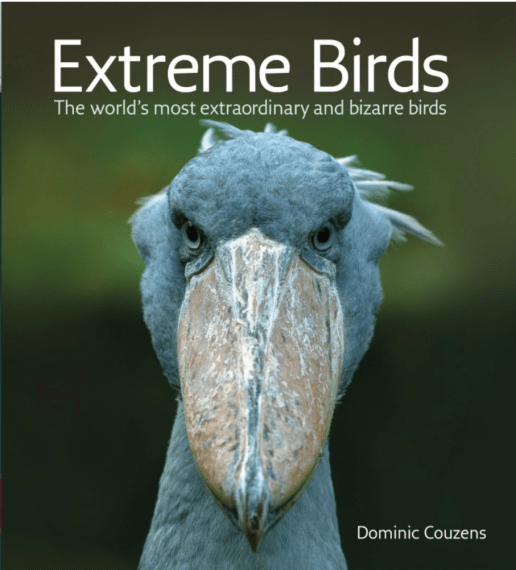
- Widest wingspan: Wandering Albatross – Southern Oceans and it uses “dynamic soaring”
- Biggest Belly: Hoatzin – Northern South America and attribute is “vastly expanded foregut”
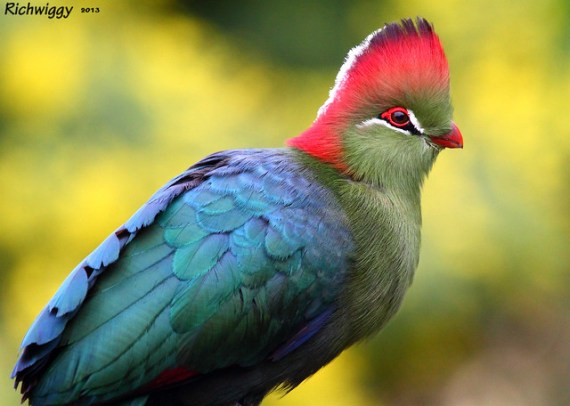
- Classiest colors: Fischer’s Turaco – coastal East Africa, astoundingly rare pigments in its plumage
- Best Karaoke: Purple Sandpiper – tundra of Eurasia and North America, pretending to be a rodent
- Best flock coordination: European Starling – much of the Northern Hemisphere. Aerial maneuvers of enormous flocks
- Longest penis: Lake Duck – Southern South America, largest penis for the size of the bird and you have to read about this!
- Bravest chick: Common Murre – circumpolar northern waters, jumping off a cliff!
- Best drummer: Palm Cockatoo – northern Australia and New Guinea, using a stick as a musical instrument
- …and many more.
This is a fascinating book – just right for those staying at home and dreaming about what they could see.
Extreme Birds. The World’s Most Extraordinary and Bizarre Birds
Dominic Couzens | A Firefly Book | New York. 1984 | 284 pages | 150 birds
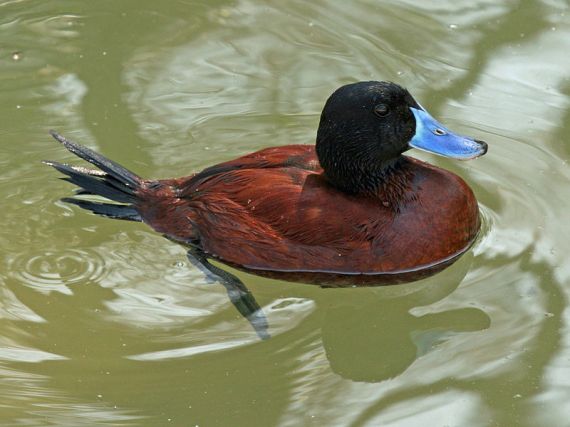
close relative of our Ruddy Duck (Wikipedia)
From the publisher’s blurb:
Extreme Birds is a photographic showcase of 150 birds at the extremes of nature. It reveals nature’s ingenuity and sometimes its sense of humor. The species in this book were chosen for their extraordinary characteristics and for behaviors far beyond the typical. They are the biggest, the fastest, the meanest, the smartest. They build the most intricate nests, they have the most peculiar mating rituals, they dive the deepest and they fly the highest. These are the overachievers of the avian world.
Amazon: Hard $52.92, Paper $23.48
Target: Paper $23.49
Barnes & Noble: Paper $24.95
Abe Books: Used copies from $21.74
The Wandering Steller’s Sea-Eagle
[Posted by Chuck Almdale]
A single Steller’s Sea-Eagle has been making history for 16 months across the United States and Canada. This is its story, so far—and it’s up to YOU to write the next chapter. Where do you think America’s Rarest Eagle will turn up next?
UPDATE: The Steller’s Sea-Eagle was in Georgetown, Maine from 30 Dec 2021-2 January 2022, when it vanished once more.
Two articles on the subject:
Rare Stellar’s sea eagle, native to northeastern Asia, baffles scientists and bird lovers with continued stay in Maine
MassLive | Assoc. Press | 25 Jan 2022 | 3 minute Read
Rare eagle hasn’t been spotted in Maine in last two weeks
13 WGME – Portland, Maine | 8 Feb 2022 | 2 minute read + video
Turkey Vultures with Frozen Wings
My sister lives near Lexington KY and sent me this interesting news. The East has been suffering through a lot of very cold weather and rain/sleet/snow storms. The Animal Control people are on the job in Lexington!



 SANTA MONICA BAY AUDUBON SOCIETY BLOG