Free email delivery
Please sign up for email delivery in the subscription area to the right.
No salesman will call, at least not from us. Maybe from someone else.
King tides Dec. 4-5 & Jan. 2-3
[Posted by Chuck Almdale]
California King Tide project wants your photos.

Not much dry beach during the 11-16-20 king tide. (Larry Loeher)

This Malibu Colony house looks like it’s falling into the sea during king tide, but I think the camera was a little tilted. It’s not that bad off. Normally the bottoms of the leftmost support pilings are not submerged. (Grace Murayama 11-16-20)
The highest high tides of the winter are on their way
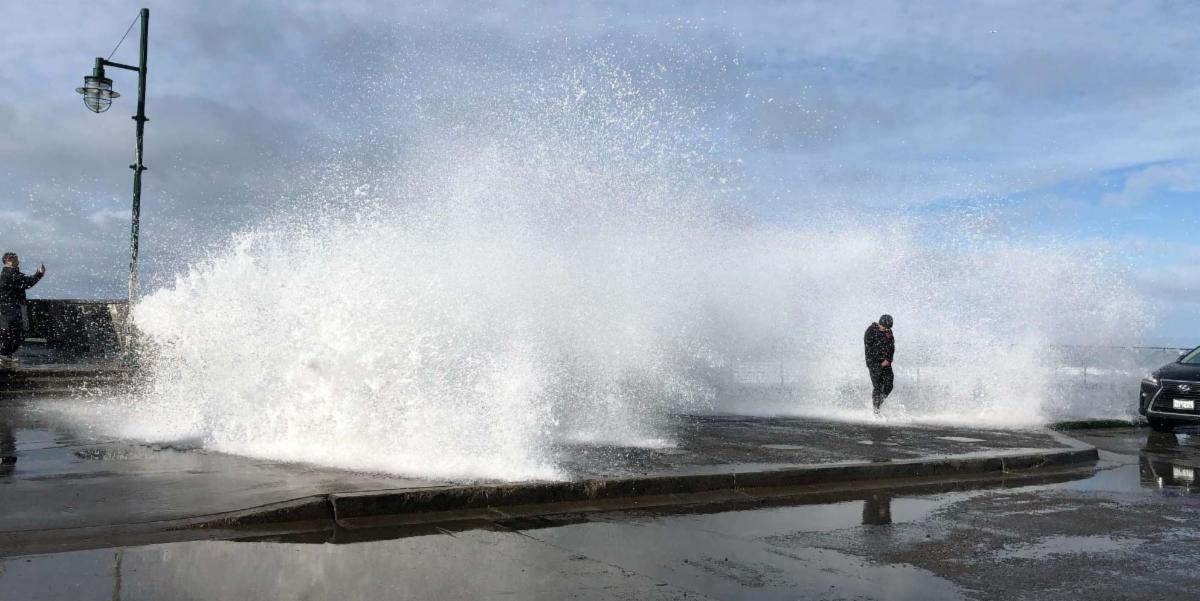
Look out for King Tides!
Dec. 4-5, 2021; Jan 2-3, 2022 Plus, for locations North of Ventura, Jan. 1, 2022
The California King Tides Project is calling on you to photograph our highest high tides of the year. Documenting these tides helps us preview the impacts of sea level rise and understand how our shoreline is affected by high water today.
If you’re able to safely take photos at the coast or Delta during King Tides you will be contributing to an important community science effort.
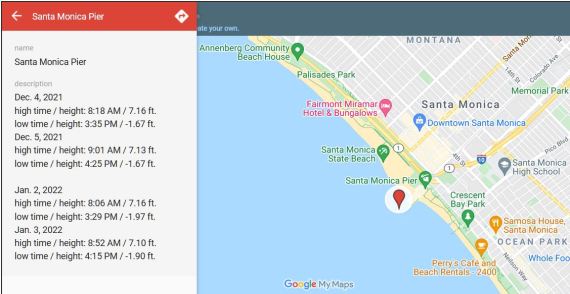
Find your local King Tide times and learn how to upload your photos on our website or with a free app. You can check out a selection of photos from each coastal county and access a map of all the King Tides photos from the last few years. Educators and parents can find ways to incorporate King Tides into student learning, including with an elementary-level science journal downloadable in English or Spanish. Middle and high school students may want to use King Tides images and concepts as they enter the Climate Video Challenge.
We can’t wait to see your photos! In the meantime, please join us on social media for #KingTides:
What causes sea level rise, and what do King Tides have to do with it?
The sea level rise we’re experiencing now and will experience in the future is caused by burning fossil fuels like coal, oil, and natural gas. Carbon dioxide in our atmosphere acts like a blanket, trapping in heat that would otherwise escape. When we burn fossil fuels, we’re adding more carbon dioxide, “thickening the blanket” and warming the planet and ocean. Sea level is rising because land-based glaciers and ice sheets are melting into the ocean and also because water expands in volume when it warms. The amount of sea level rise we will ultimately experience will depend on how quickly we stop burning fossil fuels.
King Tides themselves are not caused by sea level rise, but allow us to experience what higher sea level will be like. King Tides are the highest high tides of the year, about a foot or two higher than average tides, which corresponds to the one to two foot rise in sea level expected during the next few decades. When you observe the King Tides, imagine seeing these tides (and the flooded streets, beaches, and wetlands) every day. Understanding what a King Tide looks like today will help us plan for sea level rise in the future.
Sharing your photos and talking about what you’ve noticed helps others understand that they’re part of a community that cares about climate change.
Why are there different dates for northern and southern California?
Southern California will experience King Tides in November and December. There is an additional January King Tide in northern California, north of Point Conception/Vandenberg AFB, due to a combination of astronomical influences such as the relative tilt of the Earth’s rotation with respect to the Sun and seasonal influences on water level such as temperature and wind that differ in southern California as compared to northern California over the course of the year.
Thank you for your help! We look forward to seeing your photos! california.kingtides.net
California Coastal Commission
455 Market Street, Suite 228, San Francisco, CA 94105
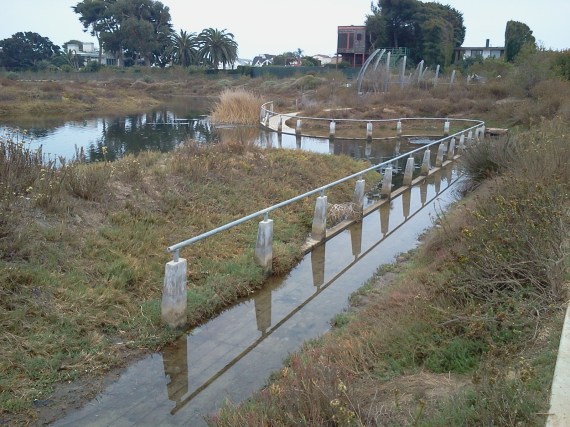
An inundated tidal clock sidewalk measured 6′ 9.6″ lagoon water
level a week after the king tide. (L. Johnson 11-23-20)
Devaux Bank, S.C. | 20,000 Whimbrels
[Posted by Chuck Almdale]

On the South Carolina coast, at the mouth of the North Edisto River, lies tiny 250 acre Devaux Bank, a V-shaped wedge of sand with the open end facing west. During the spring, for about a month, it is the nightly roosting spot for approximately half of the eastern North American population of Whimbrels. There are also thousands of breeding Brown Pelicans, Black Skimmers, American Oystercatchers, Royal Terns, Sandwich Terns, Laughing Gulls, herons and egrets.
A Miracle of Abundance as 20,000 Whimbrel Take Refuge on a Tiny Island
All About Birds | Scott Weidensaul \ Andy Johnson, photos | 13 Oct 2021
Whimbrels. pelicans, and more take to the sky at Deveaux Bank, South Carolina.

Make sure you watch the 9:26 video.
Extraordinary portraits of insects in flight | Ant Lab
[Posted by Chuck Almdale, suggested by Adrian Douglas]
Beauty from our four-winged friends. Five minutes and worth every second.

From Ant Lab:
A viewer sent me a copy of “Borne on the wind: The extraordinary world of insects in flight” which, in 1975, published photos of insects in mid-air flight. So, I filmed a bunch of insect flight sequences in a style inspired by the insect portraits in that book! All of these sequences were filmed at 6,000 frames per second. Most play back at 30fps, but some are edited to play back faster. Multiple captures are edited together so that more than one insect appears on-screen at the same time.
Passerine evolution likely began in Australia
[Posted by Chuck Almdale]
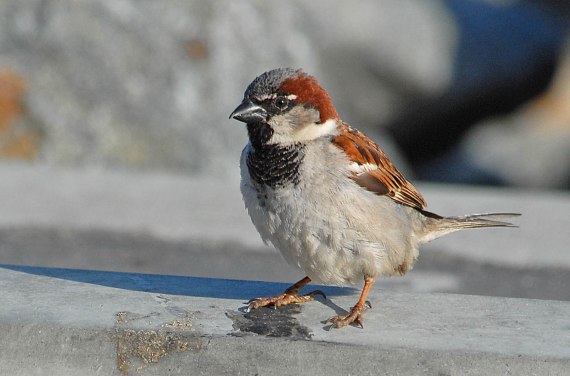
The following study, now several years old but years in the making, presents evidence for Australia as the origin of all Passerine birds.
A few highlights of the paper:
- Increases in Cenozoic (66 Million years ago to now) global temperature or colonization of new continents were not the primary forces driving passerine diversification.
- Analyzed DNA data from 4,060 nuclear loci, 221 individual birds representing all 137 passerine families and major subgroups.
- Suggests that passerines originated on the Australian landmass ∼47 Ma.
- Subsequent dispersal and diversification of passerines affected by a number of climatological and geological events, such as Oligocene glaciation and inundation of the New Zealand landmass.
- Previously, due to lack of reliably vetted fossils, the age of crown passerines had been calibrated based on the geological separation of New Zealand from the rest of Gondwana in late Cretaceous ∼82 Ma.
- Split between oscines and suboscines ∼44 Ma, occurs well before the appearance of ephemeral ice sheets in Antarctica during Late Eocene, which would have made the trans-Antarctic route implausible.
- Specific ecological, geological, and climatological events proposed to be associated with the diversification and global distribution of Neornithes:
- Opening of ecological niches following the Cretaceous-Paleogene (K-Pg ~66 Ma) mass extinction event (that dinosaur-killing meteor).
- Establishment of dispersal corridors linking the geographic origin of modern birds to other landmasses during the Paleogene.
- Rapid continental drift and island formation in Wallacea allowing the dispersal of songbirds out of Australia.
- Fragmentation of tropical habitats during cooling events of the Late Cretaceous and Cenozoic.
- Expansion of temperate habitats and retreat of glaciers during the Miocene.
The following will help you in reading the paper:
Crown Passerines: In phylogenetics, the crown group or crown assemblage is a collection of species, composed of the living representatives of the collection, plus the most recent common ancestor of the collection, plus all descendants of the most recent common ancestor. It is thus a way of defining a clade, a group consisting of a species and all its extant or extinct descendants. For example, Neornithes (birds) can be defined as a crown group, which includes the most recent common ancestor of all modern birds, and all of its extant or extinct descendants.
Oscine Passerines: Suborder Passeri, 5126 species. The half of the world’s birds with a fully developed syrinx, that can sing nicely and learn new songs.
Suboscine Passerines: Passerines with different syrinx structure, poorer singing, and can’t learn new songs. The 1348 suboscine species are classified in Suborder Tyranni, in three infraorders: Tyrannida – Tyrant Flycatchers & allies 10 families; Furnariida – Ovenbirds & allies, 9 families; Eurylaimides – Broadbills & allies, 5 families.
Acanthisitti: New Zealand Wrens, which are neither oscine nor suboscine. 1 family 2 species. They are not “wrens” as are those in the Americas and Europe.
This links to a useful cladogram which includes English names of families.

This links to a Wikipedia list of Passerine families (with links) with a nice cladogram.
The figures below are from the paper and are as large as I could fit onto this blog. You can download free jpeg files of the originals from the paper, linked below. The big star at the top of Figure 2 connects to the star at the bottom of Figure 1. All horizontal lines are time-lines; geological eras are at the bottom. The charts are data-rich, you can spend hours looking at them. The quote below is merely the introduction to the paper, it’s not even the abstract. There is much more.
Earth history and the passerine superradiation
PNAS | Carl H. Olveros & 31 others | 1 Apr 2019
Proceedings of the National Academy of Sciences of the United States of America
Significance
Our understanding of the factors that affected the diversification of passerines, the most diverse and widespread bird order (Passeriformes), is limited. Here, we reconstruct passerine evolutionary history and produce the most comprehensive time-calibrated phylogenetic hypothesis of the group using extensive sampling of the genome, complete sampling of all passerine families, and a number of vetted fossil calibration points. Our phylogenetic results refine our knowledge of passerine diversity and yield divergence dates that are consistent with the fossil record, and our macroevolutionary analyses suggest that singular events in Earth history, such as increases in Cenozoic global temperature or the colonization of new continents, were not the primary forces driving passerine diversification.
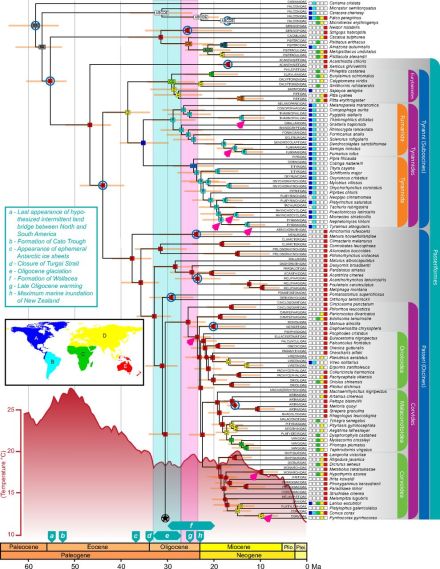
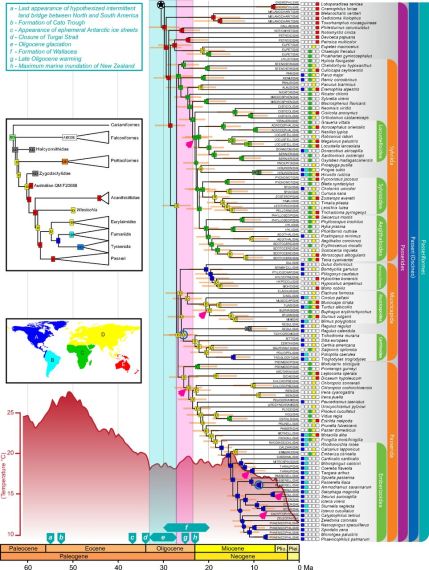
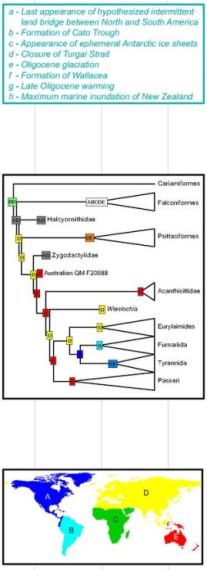
Fig. 2. Family-level phylogenetic relationships in passerines reconciled from concatenation and coalescent analyses (connects to bottom of Fig. 1 at the circled star). Biogeographic reconstruction including fossil taxa (Inset, tree) yields identical ancestral areas for crown lineages of passerines, suboscines, and oscines (also SI Appendix, Fig. S8). Plei., Pleistocene; Plio., Pliocene.
That’s all. Have fun.
Singaporian birders have problems with pipits
[Posted by Chuck Almdale, submitted by Lillian Johnson]
It’s not just American birders that have problems separating the common birds from the rarities. Photos, books and the discerning eye are essential.
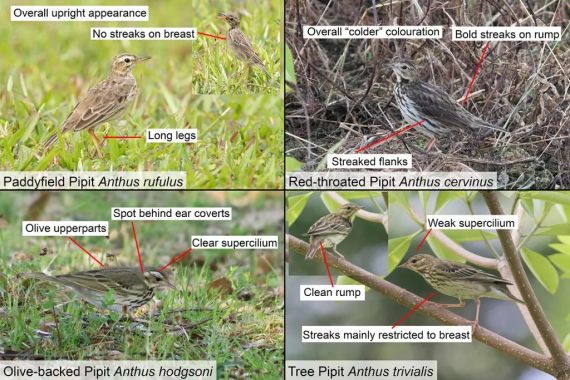
PIPIT101: Identifying Singapore’s First Tree Pipit Anthus trivialis
Singapore Birds Project | Richard Wright | 25 Oct 2021 | 8 min read
Introduction to the article:
The birding community was presented with an identification challenge today with the arrival of a vagrant pipit species. These small, brown, streaky birds can be difficult to identify at the best of times. An unfamiliar, out of context, vagrant can be a real headache. So how to start the identification process? These notes might help.
Worldwide, there are about 40 species of pipit, mostly in the genus Anthus. Within Southeast Asia nine species are regular; in Singapore Paddyfield Pipit A. rufulus is a resident breeder, Red-throated Pipit A. cervinus is an annual non-breeding visitor in small numbers and Olive-backed Pipit A. hodgsoni is a rare vagrant with only one record at Bidadari in December 2010.



 SANTA MONICA BAY AUDUBON SOCIETY BLOG