Free email delivery
Please sign up for email delivery in the subscription area to the right.
No salesman will call, at least not from us. Maybe from someone else.
Saving water during a drought*
[Posted by Chuck Almdale]
*We live in a desert. Assume there’s always a never-ending drought, and live knowing that.
The Los Angeles Times recently had another of it’s periodic tips on water saving, which we’ll get to in a minute. Among other information points, they mentioned that last July Governor Newsom asked Californians to reduce residential water usage by 15%, which, in my opinion, should be achievable by all Californians. But many Californians have already instituted all the saving measures suggested below, and already achieved such reductions, and for them saving an additional 15% will be difficult.
Who is using the water
And—and it’s a big and—we also recognize that a great deal of California’s water usage is out of the hands of homeowners and apartment-dwellers. There’s also agriculture, industry and the general environment. Here’s a chart from PPIC (Public Policy Institute of California) who are particularly interested in our water.
[Note: maf = million acre feet; 1 acre-foot = 325,851 gallons.]

The quick take-away from the chart is that while usage fluctuates from wet to dry years, our environment (aka nature) consumes roughly 50%, agriculture 40% and urban (including industry) about 10%. (PPIC). It’s also very interesting to note that total water usage does not include “conveyance losses…8% for agriculture.” This sounds like agricultural leakage is almost as much as all Urban usage. Something to think about, there.
Hello to the Los Angeles Times
On 10/10/21, the L.A. Times had an article by Steve Lopez: “Gulp! Are they using water in a fair way?” It describe just how much water one of the ~120 golf courses in the Coachella Valley (Palm Springs and environs) uses every night: 1.2 million gallons on average. I sent them a letter, which they published a few days later, albeit slightly modified:
Dear editors and Steve Lopez:
In Feb. 2009 we replaced the grass front lawn of our small San Fernando Valley home with drought-tolerant California native plants. No reimbursement ever received. Many plants are now large; some have died. We get compliments and our yard was part of a study of native-plant yards.Our water usage shrank 62%, saving 1,229 HCF (919,356 gallons) of water, and $6,333 in DWP charges. I like that. I don’t like knowing that one of the 120 Coachella Valley golf courses blows through our entire 12 2/3rds years of water savings in 9 1/4 hours, every single night.
In the permanently drought-stricken 4/5ths of Australia called “outback,” golf course fairways are dirt and “greens” are compacted black sand. People play on them daily. Some—Greg Norman and Jason Day, to name two—go on to world fame. Coachella golfers and golf course owners, state water resource managers, water-drinkers, are you listening?
I do not mind at all “doing my bit.” Americans are called upon from time to time to “pitch in.” During World War II Americans by the millions grew Victory Gardens, collected used tires and newspapers and metal cans, gave up copper and butter and eggs and new cars, scrimped and saved and went without—for years. It is—or should be—the same thing now. This is a war against adverse changes in our global climate, mostly of our own making, and the shrinking supply of fresh water is the most imminent battle in that war.
But, as my letter-to-the-editor indicates, it’s very annoying to do the best you can, and discover that what our household has individually accomplished is less than a drop in the bucket compared to the overuse and wastage going on elsewhere, every day.
And—and this is one of those big “ands”—because the notes to the chart above says, “Urban (7.9 maf) includes residential, commercial, and industrial uses; and large landscapes,” I suspect that golf courses are included in Urban usage, and thus can constitute a big chunk of Urban’s already relatively paltry portion of 10% of total California water usage.
A California behavioral study on energy usage
Here’s a study1 of prosocial behavior, done right here in California in 2007. The Dept. of Water and Power ought to know about it and use it.2
Researchers made residents of a California neighborhood more aware of energy usage levels in their community. Households were first identified as using more or less than their neighborhood average. Randomly selected Group One households were notified with a post card highlighting how much energy they used and how much the neighborhood averaged. Group Two households got the same information, but with a smiley face if they consumed less energy than the average, and a sad face if they consumed more than the average.
Weeks later, the researchers again measured energy usage. Group one households had cut back and conserved energy if they had been consuming more energy than average, but significantly increased usage if they had been consuming less energy than average.
Group two households—those who got the smiley or sad face stickers—also cut back and conserved energy if they had been consuming more energy than average, but did not significantly increase their usage if it was already below average.
The simple addition of smiley face or sad face reminded people to either join the rest of the neighborhood in conserving energy or that they were already doing the right thing and to keep on doing it.
Dept. of Power and Water—are you listening? Stick those smiley or sad faces on the bills and watch the conservation climb.
The Los Angeles Time article
Having said all that, here are tips for the ordinary citizens of California, with comments from L.A. Times journalist Jessica Roy. [And some from me, where appropriate, in brackets.] Many of you have already done most or all of these things. If you haven’t, here’s a reminder.
How to save water during a drought
Los Angeles Times | Jessica Roy | 2 Nov 2021 | 8 minute read
Rip out your lawn, or at least water it less.
This saves 40-80 gallons per watering. [Our water usage immediately dropped 70% when we took out our front lawn. As native plants grew in, they needed water, and our 12.67 years overall savings is 62%. If you insist on watering your lawn, longer, slower, deeper & fewer soaks are better than numerous short soaks because they will make the roots grow deeper.]
Replace non-native plants.
They suck up more water than natives, and native plants make our friendly native birds and bugs happy.
Find and fix leaks.
Watch your water bill. If it moves higher than usual, you may have a leak. Fix it immediately. [The two times in twelve years we went into Tier 2 water usage was due to a silent-running toilet, and a dying pressure valve. The high usage noted on the bill clued us in.]
Replace old appliances, shower heads and toilets.
Toilets made before 1990 can use 6 or more gallons per flush; new toilets can use as little as 1.28 gallons. A new shower head can save 12 gallons. [Turn off the water while lathering and you’ll save 75% or more.]
Small things add up.
Don’t run water while washing dishes or while washing your face, brushing your teeth or shaving. Don’t wash your car so much; a little dust won’t kill you. No more hour-long or even quarter-hour-long showers. Capture in a bucket the water you run to warm up the shower, then water your plants with it. Do the same at your kitchen sink. Make sure your lawn sprinklers aren’t watering the driveway or street or squirting 15 feet into the air. Sweep your driveway and sidewalks with a big push broom, not with rivers from your hose. Replace that costly gym membership with housework and home maintenance.
Other things we consume use water.
Raising fruit, vegetables, meat. New cotton T-shirt: 650 gallons. Plastic: 22 gal./pound. Smartphone: 3,000 gallons. Single-use 1-liter plastic water bottle: over 1 liter of water. [1 gallon per almond. 12 gallons per glass of wine.]
Other things you can do.
Write annoyed letters to your local paper. Ask your homeowners association to pull up the grass and install native plants. [Contact your politicians to back water-saving laws that target not just homeowners, but entities that use a thousand—or a million—times more water.]
I’m sure I missed something. Read the L.A. Times article.
Notes:
1. Schultz, P.W., Nolan, J.M., Cialdini, R.B., Goldstein, N.J., & Griskevicius, V. (2007). The constructive, destructive, and reconstructive power of social norms. Psychological Science, 18, 429-434.
2. The Life-Changing Science of Detecting Bullshit, by John V. Petrocelli, 2021. St. Martin’s Press, New York. pgs 245-46.
Black Metaltail, the coolest of birds | Metallura phoebe
[Posted by Chuck Almdale]
It’s hard enough to believe that tiny hummingbirds can thrive in the high Andes, but many do very well in the very thin air and painfully cold nights. There can be a lot of flowers up there that no other birds are using, so competition for sugar is reduced. And they get through the night by going into torpor, a temporary hibernation-like state where they slow everything way down.
- Body temperature drops from 40°C (104°F) to 3.26°C (37.9°F), as low as 1°C above ambient air temperature
- Heart rate drops from 1,200 beats/minute to as low as 40 beats/minute
- Torpor cuts their energy use by 95%
- This is the lowest temperature ever recorded in birds or non-hibernating mammal
- Torpor investigations done at over 12,460 ft. in the Andes
Video of Black Metaltail in flight – 50 seconds
Link to original paper:
Extreme and variable torpor among high-elevation Andean hummingbird species
Royal Society Publishing | Blair O. Wolf, et.al. | 9 Sep 2020
Abstract:
Torpor is thought to be particularly important for small endotherms occupying cold environments and with limited fat reserves to fuel metabolism, yet among birds deep torpor is both rare and variable in extent. We investigated torpor in hummingbirds at approximately 3800 m.a.s.l. in the tropical Andes by monitoring body temperature (Tb) in 26 individuals of six species held captive overnight and experiencing natural air temperature (Ta) patterns. All species used pronounced torpor, with one Metallura phoebe reaching a minimum Tb of 3.26°C, the lowest yet reported for any bird or non-hibernating mammal. The extent and duration of torpor varied among species, with overnight body mass (Mb) loss negatively correlated with both minimum Tb and bout duration. We found a significant phylogenetic signal for minimum Tb and overnight Mb loss, consistent with evolutionarily conserved thermoregulatory traits. Our findings suggest deep torpor is routine for high Andean hummingbirds, but evolved species differences affect its depth.

This hummingbird survives cold nights by nearly freezing itself solid
The black metaltail goes into a state of suspended animation, becoming ‘cold as a rock’
Science News | Jonathan Lambert | 8 Sep 2020 | 2 min read
The Coolest Hummingbird, as Measured by an Actual Thermometer
Black Metaltail. The name seems fit for a hard-hitting rock band, but this bird’s cool factor goes way beyond its heavy-metal moniker.
Cornell Lab-All About Birds | Marc Devokaitis | 20 Dec 2020 |
Exploring M87’s Supermassive Black Hole | How the Universe Works
[Posted by Chuck Almdale]
If you’re still staying at home most of the time and feeling really cooped up, take this short (10:24 minutes) trip to nearby galaxy M87, get a close-up view of the supermassive black hole at its center, as well as the giant jets of light shooting out of it. It’s worth the trip, you’ll return refreshed and ready to face another day of quite desperation.
If you liked that one, try this one, only 52 seconds long.
Cool Malibu Lagoon morning, 24 October 2021
[Posted by Chuck Almdale]

Low morning light turns a Double-crested Cormorant and Great Egret into shadowbirds. The lowering lagoon level drapes their snag in dead algae.
Unlike last month, there were few waves and few surfers. Partly cloudy, it remained cool all morning: 54°F at 8:30 and only 63° at 11am. The beach available to beach-sitters was quite narrow. Lagoon water level was down below the tidal clock sidewalk, so probably about 5 ft. high in the lagoon, and even more covered with algae, although that hardly seems possible. About a dozen people showed up.

The American Coots were the largest group of the day with 240 of them all over the lagoon and channels, paddling through the algae. Among them were 5 Ruddy Ducks. These little diving ducks would swim below the surface, leaving a trail of quivering algae as they swam along, mystifying us, then pop up. At first I thought it was a Mullet roiling the water. Nope—it was a Ruddy.

Common Yellowthroats, both male and female, occasionally popped out of the brush, usually to quickly pop back in.


Sanderlings were the next most numerous, with 104 birds crammed into a small patch 8-10 ft. across. Probably resting from a long flight, these birds are not at all territorial now that breeding season has past. They’ll happily crowd together with Snowy Plovers and Western Sandpipers into a small portion of a great wide beach. Third most numerous were Black-bellied Plovers. They have all lost their alternate (breeding) plumage and none have black bellies, and the British name Gray Plover will be more appropriate until next spring.

In addition to the coots and ducks, several other species of swimming birds ploughed through the algae.


Two Grebes: (L) Pied-billed (R) Eared (C. Tosdevin 10/24/21)
Gulls and terns are again low in numbers—79 birds—although above last month’s all-time second lowest count of 25 birds. Where oh where are they all?


Great Blue Heron (R. Juncosa 10/24/21)


Out on the ocean were a few gulls and Brown Pelicans. Swimming among them were Brandt’s and Pelagic Cormorants, plus a dozen Western Grebes. I saw a dozen dark sea ducks flying directly towards us, very low over the water, a long way away. They dropped down and out of sight onto the water. They seemed like Surf Scoters, which I’ve yet to see this fall, so that’s just a guess.

This Pelagic Cormorant, landing on the ocean, appears very poorly assembled (C. Tosdevin 10/24/21)


Say’s Phoebe – (L) scouting for a fly | (R) spotted a fly (Chris Tosdevin 10/24/21)
We had a few migrant passerines: House Wren, Marsh Wren, Ruby-crowned Kinglet. The Say’s Phoebe, White-crowned Sparrows and Yellow-rumped Warblers have definitely returned and will likely be with us all winter. Local chaparral-dweller Bewick’s Wren made an appearance. Great-tailed Grackles amused themselves by pointing the sky out to one other, just in case they hadn’t noticed it.

Shorebirds were there in good numbers, although the dowitchers and curlew left. Well, they don’t usually stay long anyway. Spotted Sandpiper was also absent (or just overlooked; sometimes they skulk). Aug-Oct is when they’re most likely to be present, although we’ve recorded them in every month except June, and just barely (3 birds total) in May.


Dunlin in dull gray-brown basic (winter) plumage. Not much to shout about in terms of “specky” plumage, but the long stout black bill with a droopy tip is distinctive. (C. Tosdevin 10/24/21)

Western Snowy Plovers were in their preferred location, at the southeast corner of the lagoon, resting in their assortment of heel-sized hollows on the beach, just inland of the berm (high point of the beach). They were more scattered than usual as an oddly-dressed person (draped in blanket or shawls, wearing many necklaces, feathers and various unidentifiable objects stuffed into their hair, had decided that the perfect spot to practice their Hatha Yoga asanas (the cobra, among others) was right in the middle of the flock of tiny—therefore inconsequential—birds. Grokking the universe in fullness and all that, no doubt. There were 34 WSP’s, just like last month, a most unusual repetition in numbers. I saw no bands, but I didn’t make them all stand up to be counted.


Western Snowy Plover – (L) resting in its little sand-dimple, its usual behavior | (R) standing and alert (C. Tosdevin 10/24/21)

Birds new for the season: Northern Shoveler, Eared Grebe, Western Grebe, Brandt’s Cormorant, Marsh Wren, Bewick’s Wren, Blue-gray Gnatcatcher, Ruby-crowned Kinglet, White-crowned Sparrow, Yellow-rumped Warbler.
Many thanks to photographers: Lillian Johnson, Ray Juncosa, Grace Murayama & Chris Tosdevin
The next SMBAS scheduled field trips: Maybe January 2022. Wear your masks, get your shots, and maybe someday we can have organized trips again.
The next SMBAS program: Zoom Evening Meeting, Birding the Horn of Africa, with Catherine McFadden, 2nd Tuesday! 9 November 2021, 7:30 p.m.
The SMBAS 10 a.m. Parent’s & Kids Birdwalk remains canceled until further notice due to the near-impossibility of maintained proper masked social distancing with parents and small children.

Links: Unusual birds at Malibu Lagoon
9/23/02 Aerial photo of Malibu Lagoon
Prior checklists:
2021: Jan-July
2020: Jan-July, July-Dec 2019: Jan-June, July-Dec
2018: Jan-June, July-Dec 2017: Jan-June, July-Dec
2016: Jan-June, July-Dec 2015: Jan-May, July-Dec
2014: Jan-July, July-Dec 2013: Jan-June, July-Dec
2012: Jan-June, July -Dec 2011: Jan-June, July-Dec
2010: Jan-June, July-Dec 2009: Jan-June, July-Dec.
The 10-year comparison summaries created during the Lagoon Reconfiguration Project period, remain available—despite numerous complaints—on our Lagoon Project Bird Census Page. Very briefly summarized, the results unexpectedly indicate that avian species diversification and numbers improved slightly during the restoration period June’12-June’14.

Many thanks to Lillian Johnson, Ray Juncosa, Chris Tosdevin and others for their contributions to this month’s checklist.
The appearance of the list below has changed slightly. I’ve added a column on the left side with numbers 1-9, keyed to the nine categories of birds at the bottom.
[Chuck Almdale]
| Malibu Census 2021 | 5/22 | 6/20 | 7/25 | 8/22 | 9/26 | 10/24 | |
| Temperature | 59-68 | 63-69 | 66-74 | 68-73 | 63-70 | 54-63 | |
| Tide Lo/Hi Height | L+1.57 | H+4.89 | H+4.20 | H+4.55 | L+2.52 | H+5.23 | |
| Tide Time | 0736 | 0627 | 1148 | 1034 | 0556 | 1105 | |
| 1 | Canada Goose | 6 | 10 | ||||
| 1 | Northern Shoveler | 2 | |||||
| 1 | Gadwall | 18 | 65 | 48 | 12 | 4 | |
| 1 | American Wigeon | 7 | 4 | ||||
| 1 | Mallard | 22 | 40 | 37 | 9 | 18 | 3 |
| 1 | Green-winged Teal | 1 | 5 | ||||
| 1 | Red-breasted Merganser | 1 | 1 | 1 | |||
| 1 | Ruddy Duck | 2 | 1 | 5 | |||
| 2 | Pied-billed Grebe | 1 | 2 | 1 | 3 | 5 | |
| 2 | Eared Grebe | 1 | |||||
| 2 | Western Grebe | 12 | |||||
| 7 | Feral Pigeon | 15 | 9 | 15 | 6 | 8 | 6 |
| 7 | Mourning Dove | 2 | 4 | 3 | 5 | ||
| 8 | Anna’s Hummingbird | 1 | 1 | 1 | 1 | ||
| 8 | Allen’s Hummingbird | 2 | 1 | 3 | 1 | 3 | |
| 2 | American Coot | 6 | 9 | 8 | 2 | 130 | 240 |
| 5 | Black-bellied Plover | 5 | 13 | 43 | 90 | 103 | 87 |
| 5 | Snowy Plover | 9 | 29 | 34 | 34 | ||
| 5 | Semipalmated Plover | 1 | 4 | 3 | 2 | ||
| 5 | Killdeer | 6 | 4 | 9 | 20 | 10 | 23 |
| 5 | Whimbrel | 19 | 9 | 51 | 17 | 8 | 4 |
| 5 | Long-billed Curlew | 1 | |||||
| 5 | Marbled Godwit | 4 | 30 | 34 | |||
| 5 | Ruddy Turnstone | 2 | 2 | 8 | 3 | 6 | |
| 5 | Red-necked Stint | 1 | |||||
| 5 | Sanderling | 12 | 20 | 104 | |||
| 5 | Dunlin | 2 | 2 | ||||
| 5 | Baird’s Sandpiper | 5 | |||||
| 5 | Least Sandpiper | 8 | 35 | 12 | 9 | ||
| 5 | Western Sandpiper | 12 | 65 | 2 | 2 | ||
| 5 | Short-billed Dowitcher | 3 | |||||
| 5 | Long-billed Dowitcher | 1 | |||||
| 5 | Spotted Sandpiper | 2 | 1 | ||||
| 5 | Willet | 1 | 40 | 14 | 25 | ||
| 5 | Red-necked Phalarope | 1 | 4 | ||||
| 6 | Heermann’s Gull | 280 | 2 | 1 | 1 | 2 | |
| 6 | Ring-billed Gull | 1 | 2 | ||||
| 6 | Western Gull | 35 | 45 | 52 | 55 | 10 | 63 |
| 6 | California Gull | 10 | 4 | 1 | 4 | 9 | |
| 6 | Glaucous-winged Gull | 1 | 1 | 1 | |||
| 6 | Least Tern | 1 | |||||
| 6 | Caspian Tern | 13 | 3 | 2 | |||
| 6 | Royal Tern | 2 | 5 | 13 | 2 | ||
| 6 | Elegant Tern | 107 | 1 | 240 | 1 | ||
| 2 | Brandt’s Cormorant | 2 | |||||
| 2 | Double-crested Cormorant | 26 | 26 | 52 | 27 | 35 | 67 |
| 2 | Pelagic Cormorant | 1 | 2 | 1 | |||
| 2 | Brown Pelican | 235 | 27 | 58 | 30 | 11 | 21 |
| 3 | Great Blue Heron | 3 | 2 | 5 | 4 | 3 | 3 |
| 3 | Great Egret | 1 | 4 | 11 | 4 | 1 | 3 |
| 3 | Snowy Egret | 1 | 6 | 22 | 24 | 14 | 11 |
| 3 | Green Heron | 1 | |||||
| 3 | Black-crowned Night-Heron | 9 | 3 | 3 | 1 | ||
| 4 | Turkey Vulture | 1 | |||||
| 4 | Osprey | 1 | 2 | ||||
| 4 | Cooper’s Hawk | 1 | 1 | ||||
| 4 | Red-shouldered Hawk | 2 | 1 | ||||
| 8 | Belted Kingfisher | 1 | |||||
| 4 | Merlin | 1 | |||||
| 4 | Peregrine Falcon | 1 | |||||
| 9 | Black Phoebe | 6 | 3 | 4 | 5 | 5 | |
| 9 | Say’s Phoebe | 1 | 1 | ||||
| 9 | Western Kingbird | 1 | |||||
| 9 | California Scrub-Jay | 1 | 1 | 1 | |||
| 9 | American Crow | 4 | 3 | 4 | 4 | 4 | 6 |
| 9 | Violet-green Swallow | 2 | |||||
| 9 | No. Rough-winged Swallow | 3 | 2 | ||||
| 9 | Cliff Swallow | 8 | 4 | 4 | |||
| 9 | Barn Swallow | 30 | 18 | 40 | 25 | 3 | |
| 9 | Oak Titmouse | 2 | 1 | 2 | |||
| 9 | Bushtit | 8 | 4 | 1 | 20 | ||
| 9 | House Wren | 1 | 2 | ||||
| 9 | Marsh Wren | 2 | |||||
| 9 | Bewick’s Wren | 1 | |||||
| 9 | Blue-gray Gnatcatcher | 4 | |||||
| 9 | Ruby-crowned Kinglet | 1 | |||||
| 9 | Wrentit | 1 | |||||
| 9 | Northern Mockingbird | 5 | 2 | 1 | 1 | 2 | |
| 9 | European Starling | 8 | 30 | 40 | |||
| 9 | American Pipit | 1 | |||||
| 9 | House Finch | 6 | 6 | 6 | 18 | 7 | 4 |
| 9 | Lesser Goldfinch | 2 | 1 | ||||
| 9 | Spotted Towhee | 1 | |||||
| 9 | California Towhee | 3 | 1 | 2 | |||
| 9 | Song Sparrow | 8 | 4 | 5 | 3 | 5 | 4 |
| 9 | White-crowned Sparrow | 5 | |||||
| 9 | Western Meadowlark | 1 | 1 | ||||
| 9 | Hooded Oriole | 1 | |||||
| 9 | Red-winged Blackbird | 4 | 25 | ||||
| 9 | Brown-headed Cowbird | 1 | |||||
| 9 | Great-tailed Grackle | 6 | 8 | 20 | 5 | 1 | 4 |
| 9 | Orange-crowned Warbler | 1 | |||||
| 9 | Common Yellowthroat | 4 | 2 | 5 | 4 | ||
| 9 | Yellow Warbler | 2 | |||||
| 9 | Yellow-rumped Warbler | 6 | |||||
| Totals by Type | May | Jun | Jul | Aug | Sep | Oct | |
| 1 | Waterfowl | 46 | 116 | 86 | 24 | 27 | 23 |
| 2 | Water Birds – Other | 268 | 62 | 120 | 61 | 181 | 349 |
| 3 | Herons, Egrets & Ibis | 6 | 12 | 47 | 35 | 21 | 18 |
| 4 | Quail & Raptors | 4 | 0 | 1 | 2 | 4 | 0 |
| 5 | Shorebirds | 31 | 28 | 136 | 341 | 242 | 332 |
| 6 | Gulls & Terns | 446 | 55 | 300 | 65 | 25 | 79 |
| 7 | Doves | 15 | 11 | 19 | 9 | 8 | 11 |
| 8 | Other Non-Passerines | 3 | 2 | 1 | 5 | 1 | 3 |
| 9 | Passerines | 99 | 62 | 107 | 126 | 75 | 56 |
| Totals Birds | 918 | 348 | 817 | 668 | 584 | 871 | |
| Total Species | May | Jun | Jul | Aug | Sep | Oct | |
| 1 | Waterfowl | 3 | 4 | 3 | 4 | 4 | 6 |
| 2 | Water Birds – Other | 4 | 3 | 4 | 5 | 5 | 8 |
| 3 | Herons, Egrets & Ibis | 4 | 3 | 4 | 4 | 4 | 4 |
| 4 | Quail & Raptors | 3 | 0 | 1 | 2 | 3 | 0 |
| 5 | Shorebirds | 4 | 4 | 9 | 17 | 14 | 12 |
| 6 | Gulls & Terns | 6 | 5 | 5 | 7 | 4 | 6 |
| 7 | Doves | 1 | 2 | 2 | 2 | 1 | 2 |
| 8 | Other Non-Passerines | 2 | 2 | 1 | 3 | 1 | 1 |
| 9 | Passerines | 17 | 11 | 11 | 18 | 13 | 19 |
| Totals Species – 95 | 44 | 34 | 40 | 62 | 49 | 58 |
Brasilian Atlantic and Amazonian Rainforests | Femi Faminu video
[Posted by Chuck Almdale]
Wondering just how long Femi Faminu has been coming to Malibu Lagoon, I searched through my email and found that she first appeared on 10/23/11 among the “new faces.” We first communicated by email about the 12/8/18 Back Bay Newport field trip, I mentioned her in that trip’s write-up as the only one to spot a Sora, and we sorted out the other rail sightings and photos. Since then we communicate in bursts: I help her ID a bird photo, she comments on (or corrects!) some posting of mine, we swap jokes and discuss trips one or the other of us have taken or will soon take.
We’re both rather introverted (yes, really), we both feel that introversion is not a defect, and we both love birds.
Once, after what seemed like the 15th photo of a small blurry bird which she had sent to me, I commented, “I hope you don’t become one of those people who takes endless photos and ID’s everything back at home.” “Too late for that, I’m afraid,” she replied.
Her photography has improved considerably over the years. Her photo last August of the Red-necked Stint was the only one I saw—including all the photos by all the eBirders—that caught the bird walking closely to and paralleling a Western Sandpiper, perfectly displaying their subtle differences in plumage, size, bill length and bill curvature.
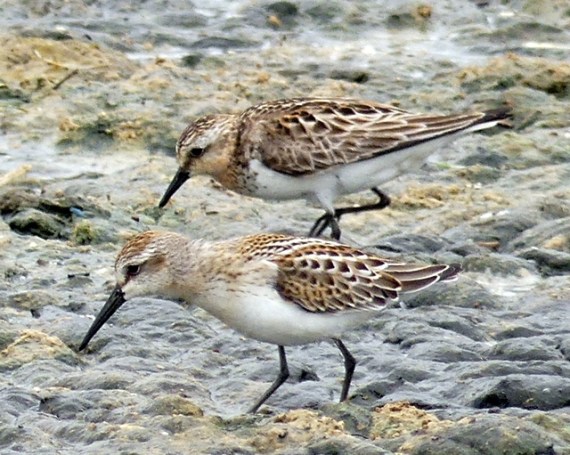
About this photo, Femi commented when she sent it to me: “I’m not sure if it’s helpful or a hindrance to have other (hopefully more familiar) birds in the photo to help with identification of our mystery bird.”
If I didn’t say so then, I’ll say it now: Yes. It definitely helps. It makes many ID problems much easier, especially the always difficult estimation of size, at which nearly everyone is far worse than they would care to believe.
I didn’t know until quite recently (last month!) that she also took films. After viewing this short YouTube film I contacted her for permission to put it on the blog. I think you’ll enjoy it. Part of the trip was at Rio Cristalino in the southern Amazonian Basin, an excellent, hot and humid birding spot I’ve visited. Her comments are below the link.
Brazilian people were very friendly. A lot of them speak English and are too shy to use it, however if they see you making an effort (by speaking lousy Spanish), they will do the same. Food at the lodges was pretty good. Food at the airports was like airport food the world over; pretty awful.
Key thing to note is that I requested that no playback of recorded calls be used to lure the birds which I was able to do because I had private guides. Both guides (Atlantic and Amazon) were quite anxious about this in the beginning but eventually they relaxed and were surprised by the number and ‘quality’ of species we did see.
I missed flight segments both going and coming. Be wary of those ‘legal’ connection times which are nigh impossible to meet due to security checks, etc. To their credit, United re-booked me on the next available flights with minimal fuss.
At the end of the film there is a complete trip list of birds, the great length of which will surprise most people because, as Femi writes above, they were found without the use of tape recordings.



 SANTA MONICA BAY AUDUBON SOCIETY BLOG