Free email delivery
Please sign up for email delivery in the subscription area to the right.
No salesman will call, at least not from us. Maybe from someone else.
Ocean temperature contour maps | NOAA
[Posted by Chuck Almdale]
A few years ago, after a few thousand of our favorite jumping fish (Striped “Jumping” Mullet) died in Malibu Lagoon after many days of high heat and low O2 levels in the lagoon water, I posted a thermal map of the Pacific Ocean, as there was a local “hot blob” ocean temperature anomaly stretching up the SoCal coast from Baja to Santa Barbara. Here’s that map.
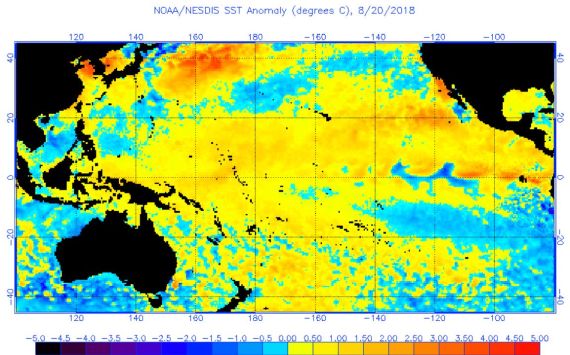
This particular map can be found on the NOAA site here.
Many hundreds of maps for this and other “anomalies” for period 1996-2019 are available from NOAA here. Here’s a close-up of the map above, a bit pixelated.
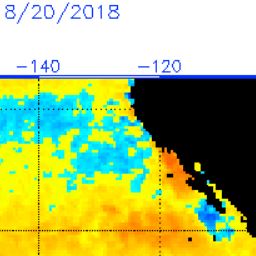
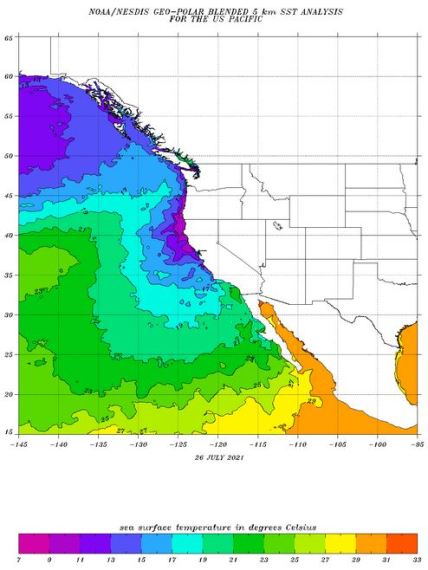
Dozens of temperature maps like these for at least sixteen areas are available daily from NOAA. Here’s one for roughly the same area for the most current day, Monday 26 July, 2021. There is no anomaly right now. Big difference, eh? Link to current day map.
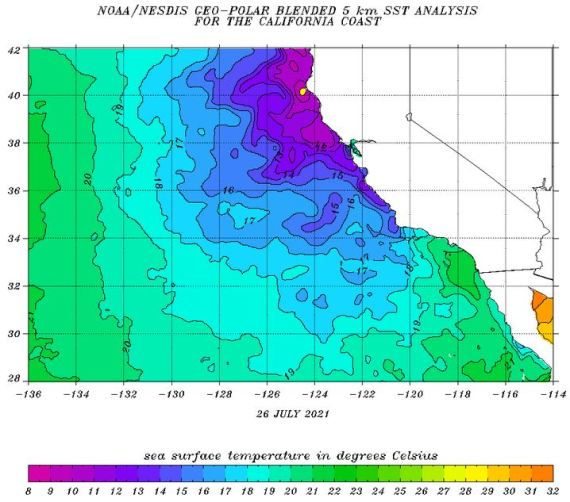
The next one focuses on the Gulf of California, 26 July 2021. Any blobs in our near future will most likely appear here first, then spread north.
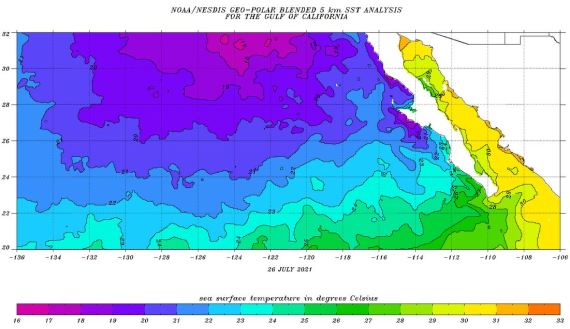
A wider-view one of the U.S. Pacific coast, 26 July 2021.
The entire world, below on 26 July 2021, found here.

The links to the maps above, except the 2018 anomaly map, will take you to the most recent day posted by NOAA.
Now that you know where to look, you can keep an eye out for any approaching fish-killing “blobs.” Let me know if you see one and we’ll post it here.
While we on the subject of ocean temperatures, here’s a page on El Niño from Pacific Marine Environmental Laboratory that will answer all your El Niño questions.
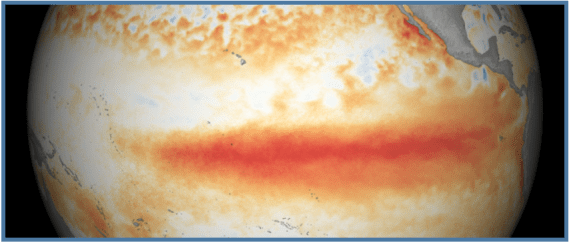
Why does El Niño occur?
El Niño results from interaction between the surface layers of the ocean and the overlying atmosphere in the tropical Pacific. It is the internal dynamics of the coupled ocean-atmosphere system that determine the onset and termination of El Niño events. The physical processes are complicated, but they involve unstable air-sea interaction and planetary-scale oceanic waves. The system oscillates between warm (El Niño) to neutral (or cold) conditions with a natural periodicity of roughly 3-4 years. External forcing from volcanic eruptions (submarine or terrestial) have no connnection with El Niño. Nor do sunspots as far as we know.
Two more useful maps
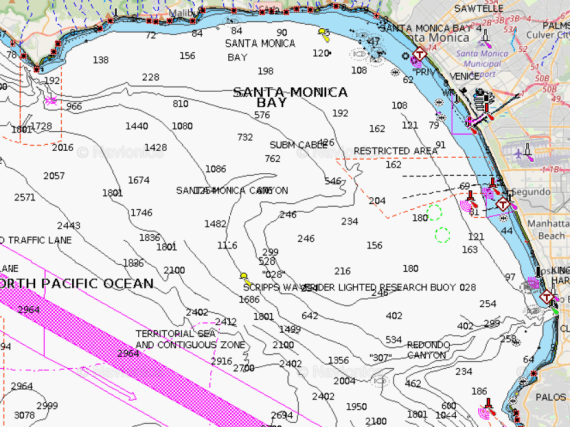
U.S. Fisherman’s map of Pacific Ocean
Shows depths, zoom in/out
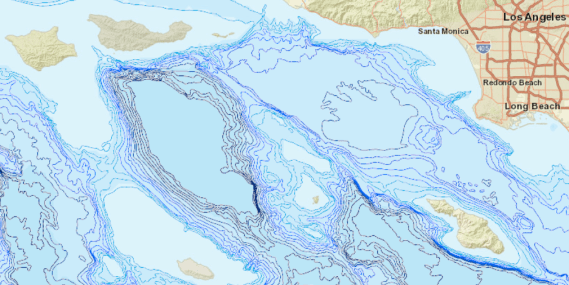
Database.org – 100 Meter depth contours
This map is capable of many interactive tricks
[Posted by Chuck Almdale]
As we mentioned a week ago, thousands of Elegant Terns that abandoned their nests at Bolsa Chica Ecological Reserve in Orange County after a drone helicopter crashed in their midst, flew northwest to Long Beach Harbor and renested on two barges. Things could be better (like no crashing drones) but they’re managing with a little help from their friends at International Bird Rescue and the barge owners.
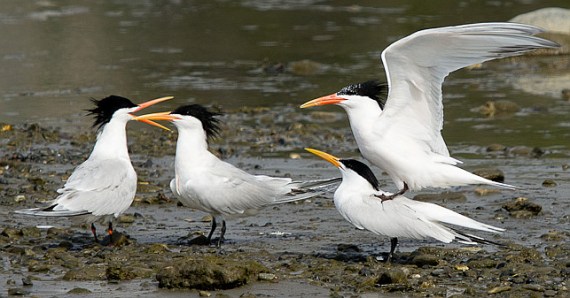
The barges were never designated as nesting grounds for birds. Construction firm Connolly-Pacific Co. was getting ready to send them to Naval Weapons Station Seal Beach when they discovered their rock-filled barges had been commandeered by 17″-long seabirds.
As best as I could discover (Handbook of Birds of the World) Elegant Terns incubate their single egg (2% lay two eggs) for about 25 days. The young fledge (leave the nest) after another 30-35 days, but continue to accompany and be fed by the young until November. We saw many hundreds of Elegant Terns at Malibu Lagoon yesterday (Sunday 25 July). For them, nesting season is over.
As baby terns washed up on the Long Beach shore just after July 4th, it’s reasonable to assume they’ll occupy the barges for a month after that, or until Mid-August.
I hope someone somewhere in the government is giving thought to compensating barge-owner Connolly-Pacific Co. for loss of income. Not everyone obeys the law in such matters, and they are to be commended for their good citizenship.
Here’s the write-up from the Los Angeles Times.
In Long Beach, a better turn for the Elegant Terns
Los Angeles Times | Faith E. Pinho | 26 July 2021
Conservation group is rescuing seabirds that settled on barges after colony was disrupted.
Want to help defray International Bird Rescue’s costs for rescuing tern chicks? Go to their donation page.
[Posted by Chuck Almdale]
You’d have to be loony* to not like loons. The first time you hear their eerie, plaintive, ________ (insert your preferred adjectives here) call on a quiet northern lake, you fall in love. It’s a call from one creature’s heart to the soul of another.
[*Sorry, couldn’t resist.]
Loon Lessons: Uncommon Encounters with the Great Northern Diver
James D. Paruk | University of Minnesota Press | 2021 | 256 pages
From University of Minnesota Press:
The nature of the common loon, from biology to behavior, from one of the world’s foremost observers of the revered waterbird.
Written by one of the world’s foremost experts on the subject, Loon Lessons is a compendium of knowledge about the common loon and an engaging record of scientific sleuthing, documenting more than twenty-five years of research. It describes the common loon’s biology in an entertaining style that affords a deeper understanding of the bird’s natural history and annual life cycle.
James D. Paruk has written a wonderful, personal account of loon biology. He recounts thirty years of adventures with loons, summarizing what we know about them in the context of loons’ basic biology and behavior. Highly readable and informal, this book is for anyone who wants to learn more about loons. — Charles Walcott, former director, Cornell Laboratory of Ornithology

[Posted by Chuck Almdale, submitted by Lillian Johnson]
Bird rescue operation in Long Beach seeks to save elegant terns
Los Angeles Times | Faith E. Pinho | 16 July 2021

It’s quite likely that the Elegant Terns who abandoned their nests at Bolsa Chica (reported June 4 and June 8) after a drone crashed in their midst then moved up to the Long Beach Harbor for a try at barge life. International Bird Rescue is now rescuing nestlings fallen into the water from the barges and needs donations to cover their additional expenses including the cost of the 100+ pounds of fish they gobble down every day.
The following is the introduction to today’s story on the Los Angeles Times website.
It’s been a tough year for elegant terns in Southern California.
A drone crash in June forced an estimated 3,000 of the sleek seabirds with their pointed orange bills to abandon their eggs on Bolsa Chica Ecological Reserve in Orange County. Experts say it’s possible that many of the birds set up camp on two commercial barges in nearby Long Beach Harbor.
Now droves of the baby birds are falling into the ocean and drowning.
“They basically landed on the barge a day or so, and it may have been two or three days, after the incident involving the drones when they left Bolsa Chica,” said Tim Daly, spokesman for California Department of Fish and Wildlife. “There’s really no way of proving or knowing, but we think there’s a possibility, because they suddenly appeared.” More…

[By Chuck Almdale]
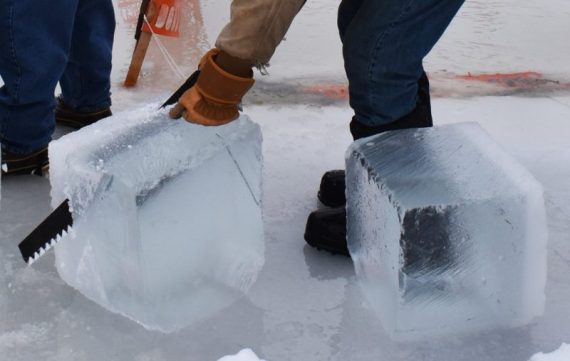
One way to beat summer heat (Source: Wisconsin Life)
Your electrical utility wants you to pre-cool your home. Pre-cooling may save you money and definitely lowers utility managers’ levels of stress. Month after month of torrid days with high peak demand make these people very uncomfortable. Do pre-cooling right* and it won’t be any worse than what you live with now. It may even be better.
*Doing it right means:
Read this posting, check with your local utility, experiment, take notes, be lucky.
What is pre-cooling?
Pre-cooling means cooling your home before you actually need it, letting your A/C “coast” during the worst part of the day, then turning it on again after the high peak if you need it. The worst of the day, utilities say, is during the period of peak demand. This typically is the hottest part of the day as that’s when everyone cranks up their air conditioner. That’s what they want you to stop doing (cranking it up). Thus…pre-cooling.
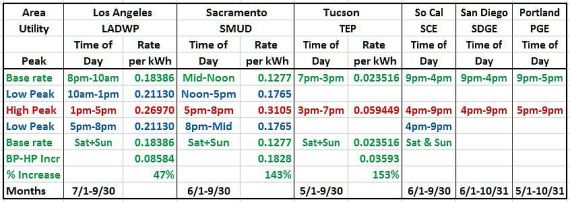
Figure 1. Six utilities: Time-of-use periods and rates (where available).
Utility Links:
Los Angeles Dept. of Water & Power
Portland Gas & Electric
Sacramento Municipal Utility District
San Diego Gas & Electric
Southern California Edison
Tucson Electric Power
[NOTE: Some utilities such as Southern California Edison – which admittedly serves many localities with differing conditions – hide their rates from the merely curious, partly because they have many options available. Current customers may uncover their options by logging into their accounts.]
Definition: kWh – kilowatt-hour – A measure of electrical energy equivalent to a power consumption of 1,000 watts for 1 hour.
Worth knowing: Water can be stored behind a dam for society’s future use. Electricity cannot. What you’re taking out of the wire must be simultaneously generated and stuffed into the other end of the wire. The closest thing we have to storage of massive quantities of electricity is…water behind a hydroelectric dam.
Utility electrical rates and high-low peak rate differences vary
LADWP high peak rate is 47% higher than their base rate of $0.18386 per kilowatt-hour.
Tucson Electric Power high peak rate is 153% higher than their base rate of $0.023516 per kilowatt-hour. That’s a big increase but from a base rate that’s 87% lower than LADWP.
Utilities differ in their suggestions about how best to do pre-cooling.
What they do agree on is:
- Smart (programmable) thermostats are very handy. You can “set ‘em and forget ‘em,” which is mostly true.
- Cool you home before (and after, if needed) the high peak period – at night and/or in morning.
- If you need some cooling during the peak (e.g. leaky house, poor insulation, it’s really hot outside) set your (smart!) thermostat to 3°F above your preferred setting.
To be more specific:
- Find out your utility’s peak hour time bracket. For the 3 hours preceding that, set your A/C thermostat to 3°F below your preferred temperature (longer, if necessary). During the peak bracket, set to 3°F above your preferred temperature. At the end of the peak bracket, set it to your preferred temperature.
- They really want your preferred temperature to be 78°F or higher, certainly not 68° or 72°F.
- If your utility has three (or more) rates—base, low peak and high peak rates, as does LADWP—you may want to pre-cool during base rate and let it “coast” during all low peak and high peak periods. This may be too long for you to tolerate. This is where experimentation and taking notes comes in.
- The Sacramento Bee suggested during their 2020 heat wave, “Set the thermostat low each evening after 9 p.m. Cool your house as much as possible until about 1 p.m. the next day. Then, turn the thermostat up to avoid stressing the community’s grid system.” Again: experiment.
Rate schedules options vary
Besides time-of-use (TOU) rate schedules, there may also be:
- The self-explanatory same-rate-never-changes rate schedules
- Tiered rates schedules which charge by total electricity used per month: the more you use the more you pay for your usage above the lower tiers. Again, you have to know what your local utility offers. They’re all different.
- Video on LADWP two residential rate plans: Standard 3-Tiers (R-1A) and Time-of-Use (R-1b) (3 minutes)
Got solar panels?
Lucky you, you’re almost in a different ballpark. Depending on the number of panels and how much it generates versus your usage at high peak, you may be able to ignore everything I’ve written so far. But there are a few things to consider:
- If you run your A/C or recharge your Tesla (see below) during low light/base rate periods, you’ll be drawing on power from the utility.
- If you use your A/C or charge your car by drawing on your solar panels, you’ll be doing this during high peak periods.
- If you’re using your own panel power during high peak, you’re not selling your electricity to the utility at the highest rate possible.
- You may be better off dollar & power-wise by selling your power during high peak and using their power during base rate periods to cool and charge things. You may also be providing more benefit to your community by doing this.
- Your utility may not provide many—or any!—price or time-of-usage incentives; they may pay you for your electricity at a rate lower than they charge you for their electricity; or not pay you at all. Always check with your utility.
- If you use your panels largely to supply power to the utility, they may be more efficient dollar-wise by facing slightly to the west, as the sun is in the western half of the sky during the high peak periods of middle-to-late afternoons.
- Keep your panels clean. A quick hose washing gets off about 90-95% of the accumulated dust, but avoid spraying cold water on hot panels.
How many homes have solar in your zip code area? Link to: TheSolarNerd.
Net metering
Some states, including California, require publicly-owned utilities to offer net metering to homes with solar panels. Net metering uses the Time-Of-Use (TOU) rates previously discussed. The TOU periods generally follow the curve of daily usage.
Link to chart of net metering by state.
Only five states have no policy concerning net metering. Of those five, only Alabama actually levies a charge of $5.41 per kW per month for interconnected solar customers. They really don’t want newfangled solar panels there.
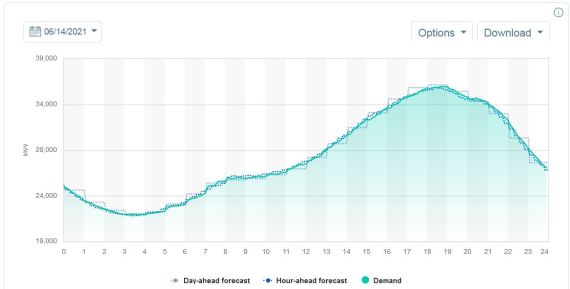
Figure 2. Usage chart for California on 6/14/21, the state-wide highest temperature day so far in 2021. Vertical axis in megawatts, horizontal axis in 5-minute increments. The lowest demand was 21,908 megawatts at 3:40 am, the highest was 35,970 megawatts at 6:40 pm. Average temperature in California ranged 58°-84°F.
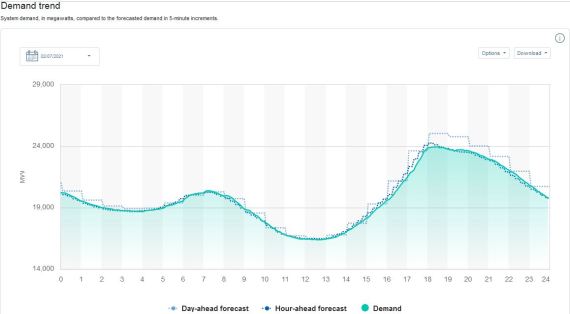
Figure 3. Usage chart for California on 2/07/21, the state-wide lowest peak demand day so far in 2021. Vertical axis in megawatts, horizontal axis in 5-minute increments. The lowest demand was 16,382 megawatts at 12:35 pm, the highest was 23,956 megawatts at 6:30 pm. Average temperatures in California ranged 44°-67°F.
Charging electric vehicles
This is unwelcome news, but the electricity it take to charge your electric car doesn’t fall out of the sky like manna from heaven. (Mmmm….manna. Melts in your mouth.) One site said it will likely cost you more than all the rest of your electrical usage combined. The 100 kWh-battery of your Tesla, by design, won’t charge to full capacity; 50 kWh may be the typical charge. Over 120 brands of EVs other than Tesla average 60 kWh of capacity.
| Cost to charge that Tesla! | ||||
| At local base rate | 25 kWh | 50 kWh | 75 kWh | 100 kWh |
| LADWP | 4.60 | 9.20 | 13.80 | 18.40 |
| Sacramento | 3.20 | 6.40 | 9.60 | 12.80 |
| Tucson | 0.60 | 1.20 | 1.80 | 2.40 |
Figure 4. Cost of home charging Tesla battery with three utilities, four charge levels
Fast charging doesn’t take less energy, just less time, so it costs the same. If you’re charging at home, use an appropriate timer to charge at early morning base rate.
Something to think about: Electric vehicle mavens and wonks say things like: “By 2050 50% of all cars in the U.S. will be fully electric.” True or not, I don’t know. I just wonder where all that extra juice is going to come from. If you’re charging at night, which most people using home charging do, solar won’t help, unless you’re importing it from central Asia where the sun shines as Americans sleep. Perhaps we can extract electricity from the temperature differentials at different depths of the ocean?
Common household electrical uses, sorted by cost
| Home Appliance | Cost at | |
| Energy Usage | Usage kWh | 13¢ / kWh |
| kWh / year | Cost / year | |
| Xbox One | 233 | 30.29 |
| Cable box | 139 | 18.00 |
| Roku | 26.2 | 3.41 |
| Computer tablet | 12 | 1.56 |
| kWh / month | Cost / mo | |
| Water heater | 380-500 | 50-65 |
| Frost-free fridge 15CF | 150 | 19.50 |
| Energy star FF fridge 17cf | 35 | 4.55 |
| Clock | 2-4 | .26-.52 |
| kWh / hour | Cost / hour | |
| Electric furnace | 10.5 | 1.37 |
| A/C Central 3 ton-12SEER | 3 | 0.39 |
| Oven | 2.3 | 0.30 |
| Window A/C 18,000 BTU | 1.8 | 0.23 |
| Hair dryer | 1.5 | 0.20 |
| Space heater (1500W) | 1.5 | 0.20 |
| Baseboard heater 6ft 250W/ft | 1.5 | 0.20 |
| Stovetop | 1-1.5 | .13-.20 |
| Iron | 1.08 | 0.14 |
| Toaster oven | 0.75 | 0.10 |
| Vacuum cleaner | 0.75 | 0.10 |
| Window A/C 8k BTU | 0.73 | 0.09 |
| TV Plasma | 0.4 | < 0.05 |
| Bulb – Halogen 300W | 0.3 | 0.04 |
| Whole house fan | 0.2-0.4 | .03-.05 |
| Sleep apnea machine | 0.2 | 0.03 |
| Computer – desktop | 0.06 | .01-.03 |
| TV LED 4k >75″ | 0.18 | < .02 |
| Fan – pedestal | 0.03 | < 0.01 |
| Fan – ceiling | .025-.075 | < 0.01 |
| TV LED 4k 40-50″ | 0.071 | < 0.01 |
| Computer Monitor 17″ LCD | 0.04 | < 0.01 |
| Stereo | 0.05 | < 0.01 |
| Bulb – Compact Fluor. 8W | 0.008 | < 0.01 |
| Bulb – Heat Lamp | 0.04 | < 0.01 |
| kWh per use or load | ||
| Energy star dryer | 2.28 / load | 0.30 |
| Dishwasher normal | 1-2.17 / load | .13-.28 |
| Electric blanket king size | 1 / night | 0.13 |
| Microwave oven | .12 / 5 min | 0.02 |
| Coffee maker | .12 / brew | 0.02 |
| Toaster | .04 / use | < .01 |
| Additional information at: | ||
| Silicon Valley Power |
Electricity and water
The closest thing we have to enormous electricity batteries we can flick on and off are large hydroelectric dams with plenty of water piled up behind them. So we also have to think about our water supply. A few fortunate locales can channel ocean tidal flows through gates and generate electricity as the tide flows back and forth. Most places have to capture fresh water behind dams. With more and more people and more and more uses for electricity and less and less rainfall and snowfall, it’s getting difficult to capture enough fresh water to supply either our electrical or water needs. With climate change, there’s no rational reason to expect this situation to significantly improve in either the near or far future.
Speaking of dams, they’re not holding as much water as they use to do.
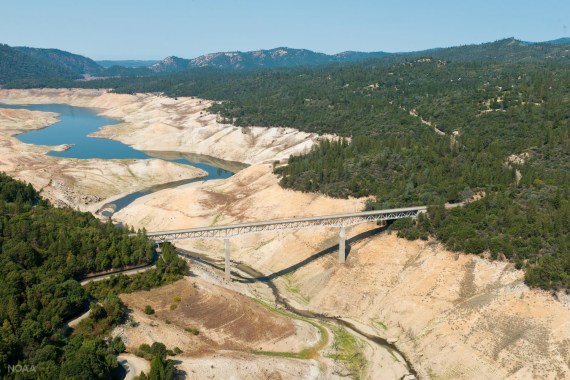
Lake Oroville in 2014, second-largest state reservoir in northern California, Source: California Department of Water Resources
Peaks and troughs of electrical usage are of critical importance. With more and more hotter and hotter days in our foreseeable future coming at us, demand and electrical rates will continue to rise. Our electrical utilities really want us to think a bit more about the juice we use and when we use it. The well is not bottomless.
So they’re coming up with ideas like time-of-use and pre-cooling—and they’ll be far happier campers if we all play along with them. In the long run, so will we.
When it comes to our supply of fresh water, which generates much of our electricity, we may be “circling the drain,” houseboats and all.

Bridge Bay in Shasta Lake, 23 Jan 2014,
water 100 feet below normal level. Source: The Atlantic
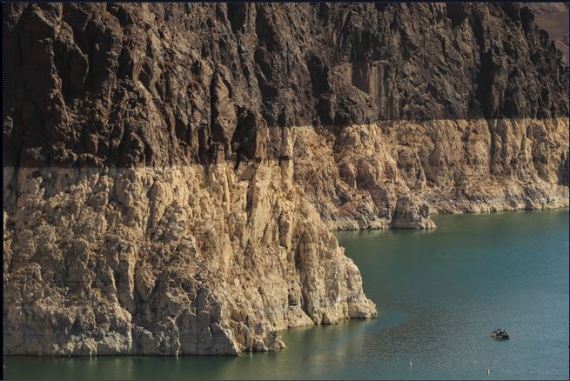
At 247 square miles, America’s largest reservoir, Lake Mead.
Highest level of 1225.44 feet above sea level reached in July, 1983.
Now 152 feet below that.
(Source: Los Angeles Times)



 SANTA MONICA BAY AUDUBON SOCIETY BLOG