Free email delivery
Please sign up for email delivery in the subscription area to the right.
No salesman will call, at least not from us. Maybe from someone else.
Summer Birding Festivals Virtual and In-Person
Pomona Valley Audubon Burrowing Owl Virtual Festival:
Burrowing Owls were once common throughout Southern California but are fast disappearing. The Pomona Valley Audubon Society is working to protect these little owls and their nesting grounds so they can thrive in our area for years to come. Join us in celebrating Burrowing Owls at the Virtual Festival that is free and open to all online. It is the place for curious minds of all ages to observe and learn about these unique and fascinating creatures, how to protect them, and how to get involved. The festival has videos, talks, and slideshows on Burrowing Owl biology, behavior, and conservation with a special emphasis on owls in the Pomona Valley of Southern California. There are owl stories, videos, and activities for kids, including coloring pages and a Burrowing Owl mask to download. Visitors can learn how to help protect the little owls, watch a live camera feed from the San Diego Zoo Burrowing Owl enclosure, see clips from recent, live festivals, and enjoy whimsical advice on love, life, and home decorating from Ms. Bea, foremost (and possibly only) Burrowing Owl advice columnist. Some content is available in Spanish as well. The festival store features t-shirts, pins, and decals. For more information go to: www.PVASBurrowingOwlFestival.com
Tucson Audubon has announced the in-person Southeast Arizona Birding Festival 2021.We just received this information and registration opened yesterday, so hurry on over to tucsonaudubon.org/festival for more details. Birdwatching trips, photography events and the inevitable trying-out-of-expensive-optics will all be featured.
NOTE: the links were incorrect but have been fixed. Apologies.
[Posted by Chuck Almdale]

Peafowl have been in SoCal over 140 years. If they’re in your area, you’ve heard their loud raucous calls. Sharon McNary interviews Kimball Garrett, Ornithology collections manager at the Natural History Museum of Los Angeles County, and Richard Schulhof, CEO of the Los Angeles County Arboretum and Botanic Garden about one of our largest and noisiest avian neighbors.
Link to the program page. Then click the big blue arrow left of the program title.
Listening time: 17:34
From the KPCC Air Talk website:
Owning a peacock was once considered a status symbol, particularly around the turn of the twentieth century. Elias J, “Lucky” Baldwin, founder of Arcadia, imported several pairs of peafowl—known colloquially as peacocks—from India to his Santa Anita Ranchero in 1879. Since then, peafowl have roamed the streets of San Gabriel Valley and even Palos Verdes, which has resumed its bird trapping.
Most recently, the Los Angeles County Board of Supervisors drafted an ordinance last Tuesday prohibiting the intentional feeding of the bird.
After the show was recorded, Kimball Garrett posted this note on LACoBirds:
Air Talk just aired. Richard Schulhof (CEO of the Arboretum in Arcadia) and I were, I suppose, the “experts.”
I didn’t get a chance to get in my planned pearls of wisdom, e.g.:
(1) peafowl actually fly well (and roost in trees, rooftops); many folks assume they can’t fly
(2) peacock tails are actually rather unspectacular (uniform brownish and not especially long); many people think the train is the tail, when it is actually the upper tail coverts. But LACoBirds folks knew this.
(3) the Pleistocene turkey fossils from Rancho La Brea were actually first described as having belonged to a peafowl (genus Pavo).
Oh well….
KLG
Kimball L. Garrett
Ornithology Collections Manager
Natural History Museum of Los Angeles County
Rosa: The Story of the Rose | Book Suggestion
[Posted by Chuck Almdale]
Everyone likes roses, despite their thorns. They’re beautiful, there are countless varieties resulting from cross-breeding by humans, they yield valuable oil important in many economies, and they have a wonderful aroma.
Well…they used to smell wonderful until human tinkering managed to eliminate any detectable aroma in many modern varieties. That dis-improvement rivals the creation of the flavorless super* tomato developed to benefit packing and shipping.
[*Super because when dropped it rebounds to 90% of its original height.]
But the rose has a long and glorious history. Anyone who loves them, uses their oil, inhales their aroma, grows them or who only “stops and smells the roses on the way” will enjoy this book.
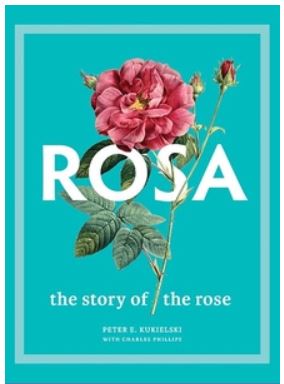
Rosa: The Story of the Rose
Peter Kukielski with Charles Phillips | Quarto Publishing (Yale University Press | 2021 | 256 pages | 143 color illustrations | $30, as low as $18 elsewhere
From the publisher:
A beautifully illustrated and unique history of the rose—the “queen of flowers”—in art, medicine, cuisine, and more
“The social, cultural and horticultural history of the rose is entertainingly and thoughtfully displayed.”—Garden News
“I would recommend Rosa as a gift for anyone who loves flowers, although once purchased you would find it hard to pass on!”—Judith Blacklock, Flora Magazine
Few flowers have quite the same allure or as significant a place in history as the rose. A symbol of love, power, royalty, beauty, and joy, the rose has played many roles, both literal and symbolic, in poetry, art, literature, music, fashion, medicine, perfume, decoration, cuisine, and more.
In this beautifully illustrated guide, award-winning horticulturist Peter E. Kukielski and his coauthor, Charles Phillips, tell the fascinating and many-layered history of this “queen of flowers.” The book explores many stories from the long association of roses with human societies, from their first cultivation—likely in China some five thousand years ago—to their modern genetic cultivars. It shows how roses have been prominent across time and many cultures, including ancient Greece and Rome, Christianity, Islam, and Sufism.
The book, with more than 140 color illustrations, offers a unique look at the essential contributions that roses have made throughout human history.
Peter E. Kukielski is an acclaimed horticulturalist who was curator of the award-winning Peggy Rockefeller Rose Garden at the New York Botanical Garden from 2006 to 2014. He lives in Portland, ME. Charles Phillips is a writer and editor with more than 30 years’ experience. He lives in London, England.
A few highlights from Kulielski’s article in Natural History, May 2021
- Roses are thought to have first appeared in central Asia.
- Rose fossils found in South Park, Colorado dating back 35 million years, resembling most closely Rosa nutkana and R. palustris.
- First mentioned in history about 3000 BCE; Confucius wrote of them ~500 BCE
- Widely cultivated in China ~210 CE
- Faristan, Iran claims to be birthplace of cultivated roses
- Faristan exported rose water all over the world, including 30,000 bottles annually to the caliph of Bagdad
- For over 5,000 years China & Persia were only places where naturally fragrant rose varieties grew.
- Single-layered Iranian rose growing in Qasmar has such exquisite perfume that it is grown solely for its oil
- Mesopotamian tablets & jugs reveal perfume extraction ~3500 BCE
- Indian god Vishnu’s wife Lakshmi created by god Brahma from 108 large and 1008 small rose petals.
- In Gujarat India ~1300 CE a Persian traveler noted “the people were very wealthy and happy and grew no less than 70 kinds of roses.”
- Egyptian wall paintings ~2500 BCE show roses associated with goddess Isis
- Romans used roses in: food, cosmetics, ointments, oils, medicines, cushions, paintings, scented water, wearable wreaths, smothering guests in roses, and burials.
- President Reagan in Nov. 1986 designated the rose the U.S. national floral emblem.
An appreciation of the book by website CommonWeeder.
Condor cam, live action | Cornell Lab Bird Cams
[Posted by Chuck Almdale, links supplied/suggested by Julie Bongers]
When I posted this on Friday, 6-11-21, the large nestling was eating something. It’s developing a neck ruff. Map of Hopper Mountain National Wildlife Refuge, north of Fillmore, CA, below.
From the video site:
The California Condor cam is a collaboration between the U.S. Fish and Wildlife Service, the Santa Barbara Zoo, the Western Foundation of Vertebrate Zoology, and the Cornell Lab of Ornithology.
Thanks for watching!
***********************************
This condor nest, known as the Huttons Bowl nest, is located in a remote canyon near the Hopper Mountain National Wildlife Refuge. This season features ten-year-old female #594 and fifteen-year-old male #374, a newly established pair who have been tending to their single chick #1075 that hatched on April 10.
Female condor #594 previously paired with male condor #462 in 2018 and 2020, successfully fledging one chick each year. Her previous mate is still alive and tending to their fledgling from last year. Male condor #374 is an experienced parent with six nesting attempts under his belt. He has successfully fledged four chicks in previous years—three of which are still alive today. Unfortunately, his previous mate was lost over the past year before pairing up with #594.
The Huttons Bowl nest site was last featured on the California Condor cam in 2018 when male #374 and his former mate successfully raised their chick (#923) to fledge.
Link to 17 other Cornell Lab bird live bird cams: kestrels, hawks, Panama fruit feeder, ospreys, tropicbirds, albatrosses, petrels, West Texas and more.
[Posted by Chuck Almdale]
[Suggested by Carol Prismon-Reed, our correspondent in Washington State]

Our lives are forever bound to water, and wild salmon are the canaries in our watery coal mine. Where wild salmon exist, so do healthy watersheds. Upstream: Searching for Wild Salmon from River to Table is author Langdon Cook’s love letter to salmon. Thoroughly researched and beautifully written, this book is worth your time, not just because you may love fish, but because all of us can learn much from vibrant, wild places.
— Mark Paxton, Director of Development for Carol’s local library in Washington, where everyone knows and cares about salmon.
Link to book on Penguin Random House
About Upstream
Finalist for the Washington State Book Award • From the award-winning author of The Mushroom Hunters comes the story of an iconic fish, perhaps the last great wild food: salmon.
For some, a salmon evokes the distant wild, thrashing in the jaws of a hungry grizzly bear on TV. For others, it’s the catch of the day on a restaurant menu, or a deep red fillet at the market. For others still, it’s the jolt of adrenaline on a successful fishing trip. Our fascination with these superlative fish is as old as humanity itself. Long a source of sustenance among native peoples, salmon is now more popular than ever. Fish hatcheries and farms serve modern appetites with a domesticated “product”—while wild runs of salmon dwindle across the globe. How has this once-abundant resource reached this point, and what can we do to safeguard wild populations for future generations? more…



 SANTA MONICA BAY AUDUBON SOCIETY BLOG