Vanilla: the Extraordinary Bean | Natural History
[Posted by Chuck Almdale]
This is a bird-adjacent article about something we all love: The flavor of vanilla!
Many decades ago, while sweltering and vomiting our way through three weeks of birding in Madagascar, we had one very pleasant and singular surprise having to do with comestibles. We were investigating a tiny local cinder-block shop, perhaps ten-feet-square, and on one of the few shelves was a stack of chocolate bars. They were very cheap, and if they were horrible we wouldn’t be out much money. We bought one, unwrapped it and took a bite. Suddenly…dawn over the Serengeti…the bird chorus in the dripping Amazonian rain forest dawn. The best chocolate we had ever eaten in a lifetime of trying chocolate everywhere. We bought all she had. In the next two tiny bodegas we found we bought all they had. For two years back home we ate Madagascar chocolate until we ran out, by which time it was beginning to oxidize.
We’ve always wondered just why their chocolate was so good. What did they know, what did they do? After reading the review of the book below in Natural History, we think we know.

Vanilla: the History of an Extraordinary Bean
Eric T. Jennings; Yale University Press, 2025, 312 pages, $30.
Publisher’s page link
Some excerpts from the Natural History review:
Is there a pantry anywhere that lacks a bottle of vanilla extract? An ice-creme shop without vanilla heading its list of flavors? Vanilla, in one form or another, is so ubiquitous that the word today has taken on connotations of “plain” and “unexciting.” But there was a time when vanilla was exotic, traded like precious metal by great colonial powers, the epitome of culinary extravagance.
Vanilla – a member of the orchid family and native to Mexico and Central America where it was fertilized by local bees – was unknown to Europeans until the Spanish conquest in the 16th century. Among other uses the Aztecs flavored their chocolate drinks with it. Spain monopolized it for almost three centuries, but the French managed to smuggle the vines or pirate the pods, and replanted them, along with chocolate, in their tropical possessions like Tahiti, the Comoros, Java, Guadalupe, Mauritius, and voilà! – Madagascar. In 1880 a 12-year-old slave boy figured out how to fertilize this very finicky flower by hand, and the cultured vanilla industry took off.
Jennings’ narrative , based on extensive access to letters and official records, is particularly detailed on this period, recounting the experiences of growers and commercial traders during the century when vanilla was diffusing globally, culminating in “vanillamania” that affected virtually every cuisine….vanilla remains one of the most labor-intensive crops per gram, requiring, as it does, manual pollination of individual flowers at precise times, along with manual harvesting, drying, and extraction. It is correspondingly expensive: Natural pods were selling for as much as $600 a kilogram in 2018.
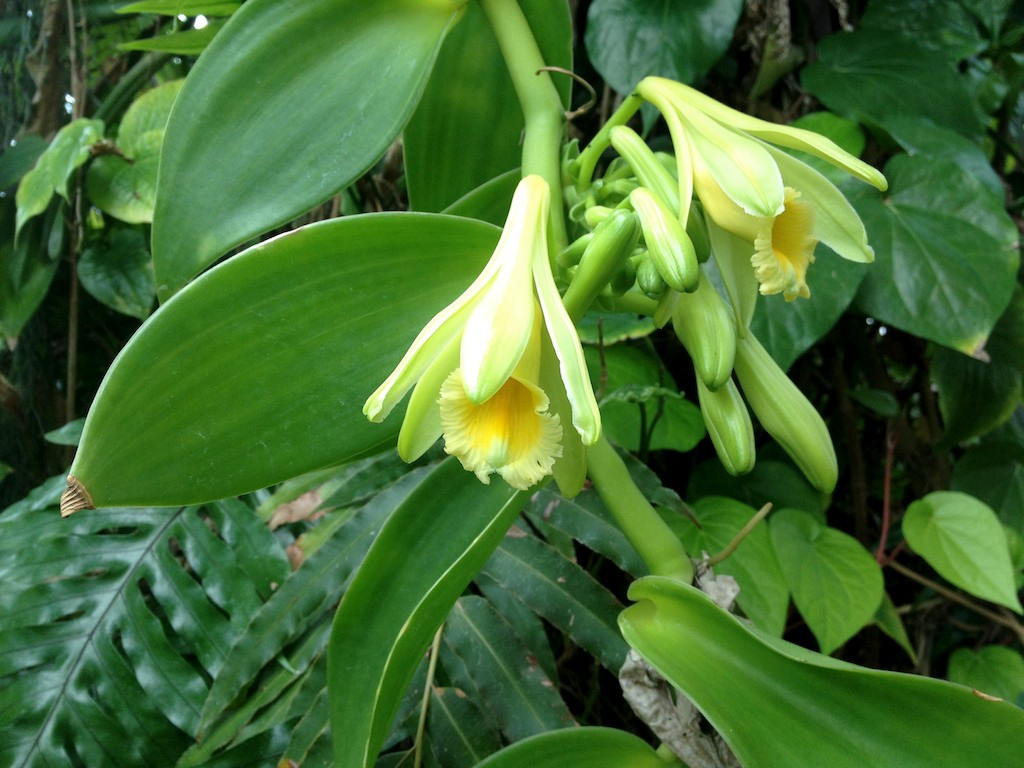
(Wikipedia, Malcolm Manners photo)
In the late 1800’s, chemists isolated the main flavoring agent, vanillin, and economic ways of synthesizing it were sought, finally falling upon lignin, a byproduct of pulp paper manufacture. Now oceans of “vanilla” can cheaply flow. Natural vanilla is still prized, however, “perhaps because it owes its flavor to trace chemicals not present in vanillin substitutes. Ninety-nine percent of vanilla-flavored foods in the world contain artificial vanillin.”
So – it seems to us – the key ingredients of the marvelous chocolate bars of Madagascar was not only locally grown chocolate, complements of the sneaky and industrious French, but locally cultivated vanilla, real vanilla, not vanillin made from sawdust. Real vanilla and real chocolate, two flavors made for each other and discovered millennia ago in the forests of Central America.

(Wikipedia, B. navez photo)
Discover more from SANTA MONICA BAY AUDUBON SOCIETY BLOG
Subscribe to get the latest posts sent to your email.



 SANTA MONICA BAY AUDUBON SOCIETY BLOG
Okay, I’m off to the local supermarket that carries the winner of a research project into such things: Tillamook Vanilla Bean ice cream. Thanks for the nudge.
LikeLike
Hey Charles;
Tillamook has a good reputation, but do us a favor and report back on just how good it is, and check the label or website to make sure they’re not lying about using real Vanilla BEAN. You never know, someone may have created a fake flavor and copyrighted the name Vanilla Bean for their fake flavor. (If that isn’t illegal, it should be.)
My suggestion: buy 3-5 brands and do a blind taste testing with bowls marked A to E. Don’t forget aroma, a major factor with real vanilla. And… ta da!…Trader Joe’s has recently carried real Madagascar chocolate bars, and they’re pretty darn good.
LikeLike