Backpacking birds, Mosquito gourmets, Penguin poop | 3 from The Conversation
[Posted by Chuck Almdale]
The Conversation is an web-based news outlet, now also podcasting, whose motto is Academic rigor, journalistic flair, which seems accurate to me, and I often read their articles. I don’t think I’ve posted links to them before so this is a bit of an experiment, but as they don’t have a paywall there should be no access problem. All three of the articles below are interesting and have pictures. If you like these articles and their presentation, consider subscribing to The Conversation or at least getting onto their mailing list.
Tiny backpacks reveal the secret, sometimes circuitous migrations of small songbirds
A tracker must be light enough to not weigh down a bird that weighs only as much as a spoonful of sugar. Thor Veen
Published: September 8, 2026 | The Conversation
Author: Stephanie Szarmach, James Smithson Postdoctoral Fellow, Smithsonian Institution
Exerpted from the article:
Squinting through my binoculars, I scanned the dense branches of a black spruce, trying my best to catch a glimpse of the thin legs of a small black, white and yellow songbird. I was on the hunt for a yellow-rumped warbler – a bird affectionately called “butter-butt” by bird-watchers after the distinctive buttery yellow patch of feathers above its tail.
Once I spotted a flash of red on one of the bird’s legs, I knew that this individual was special – in fact, it was one that I already knew well. That’s because I had placed identifying bands on it the previous year as part of my Ph.D. research, and it was carrying a very important piece of new technology.
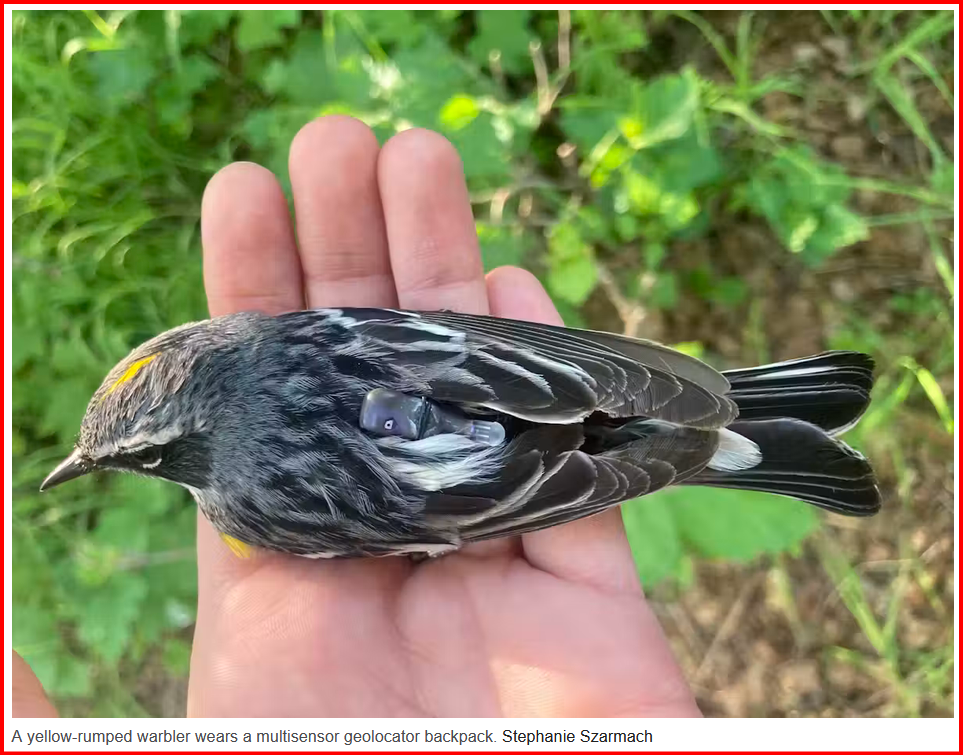
I played the high pitched “warble” of its song through a speaker placed below a mist net of fine, nearly invisible mesh. Thinking another male had intruded on his territory, the bird quickly descended. My tactic worked – he got caught in the net. As I gently removed him, I breathed a sigh of relief as I saw the Tic Tac-size device sitting on his back
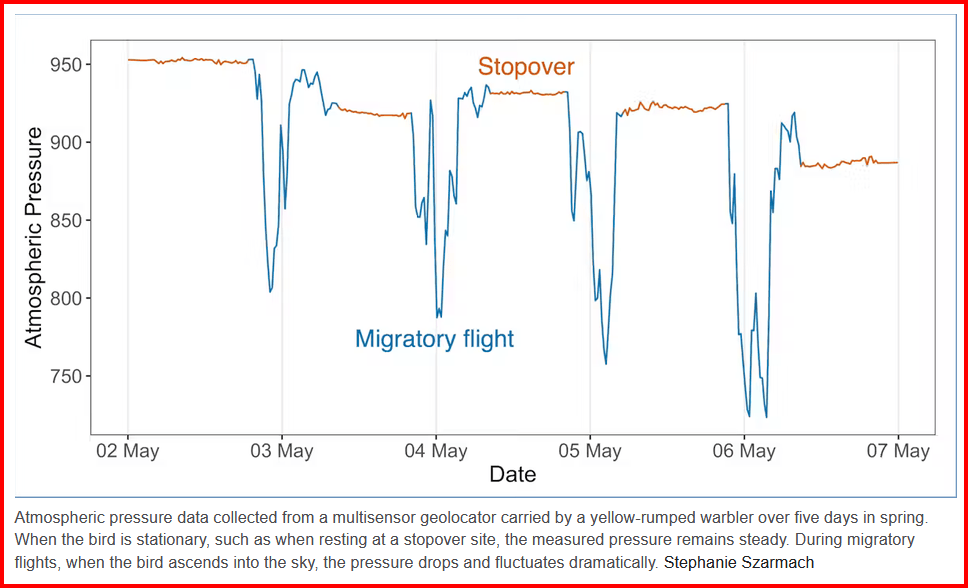
Over the past year, this warbler carried a multisensor geolocator backpack throughout his migratory journey, recording the long trek from his breeding grounds in Anchorage, Alaska, to a yet unknown winter refuge and back again. Working with my Ph.D. adviser, evolutionary biologist David Toews, I deployed dozens of these cutting-edge tags to illuminate the migratory journeys of these high-latitude breeding warblers at a scale not previously possible for small birds.
Now, after a year of waiting, I finally had the data in hand.
Light-level Geolocaters:
Just as scientists can determine the sunrise and sunset time based on location, they can also use sunrise and sunset times to predict a location. Light-level geolocators are tracking devices that use daylight to estimate location. A light-level geolocater has a light sensor, an internal clock, a battery and a computer that stores a measurement of the amount of light that the sensor is exposed to. Recording light levels does not require a lot of electricity, so batteries for these devices can be very small and last longer than a year. Because of this, these devices are incredibly lightweight (just 0.3 grams) and can be placed on any bird that weighs more than 7 grams. Smithsonian National Zoo
Mosquitoes are picky eaters – we studied 3 common South Florida species to learn why they like some people more than others
Published: September 4, 2026 | The Conversation
Authors
Kaylee Marrero, Ph.D. Student and Transdisiplinary Biomolecular and Biomedical Sciences Fellow, Florida International University
Matthew DeGennaro, Associate Professor of Biological Sciences, Florida International University
Exerpted from the article:
If you’ve ever had to prepare a meal for a picky eater, you know it’s not easy. They may not like certain flavors or textures, and there are often foods you have to avoid altogether. And it turns out, humans aren’t the only species with picky eaters – mosquitoes can also be finicky.
We are biology researchers who study mosquito behavior, and we recently discovered that mosquitoes can be picky about their favorite food – that is, human blood.
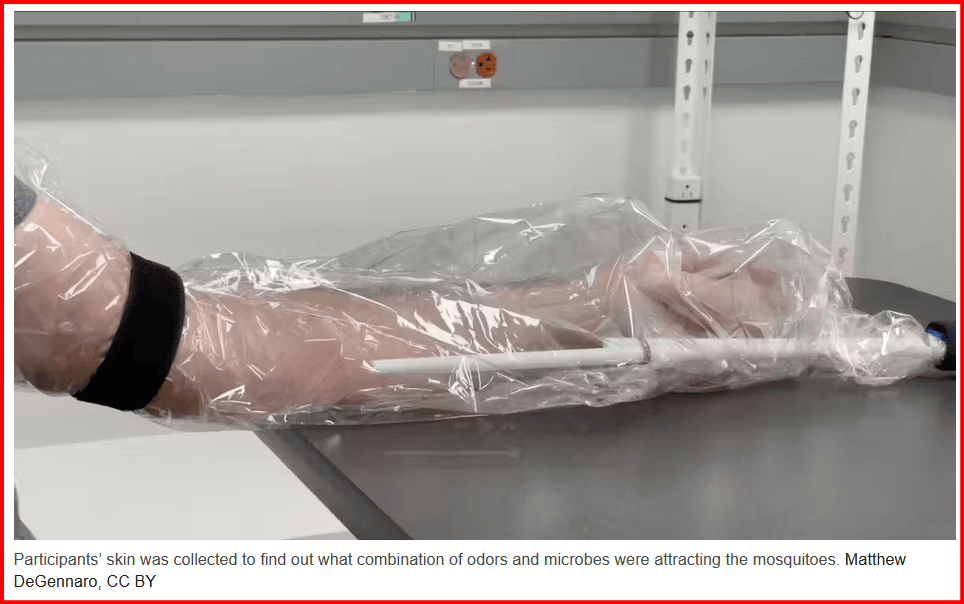
Learning what attracts these mosquitoes could be useful to designing repellents that deter them from biting people and reducing the local populations of mosquitoes that spread disease. And understanding why the living community of microbes on our skin appeals to mosquitoes could help in the development of probiotic mosquito repellents.
Satellite images show how penguins’ diets are changing in response to Antarctic climate change
The color of penguin poop, as seen from space, is offering a new window into how the ecology and the environment of Antarctica are changing over time.
Published: September 3, 2026
Casey Youngflesh, Assistant Professor of Biological Sciences, Clemson University
Exerpted from the article:
Adélie penguins are one of the most abundant predators in the Southern Ocean. They rely on food sources in the ocean, but nest on rocky outcrops all around the Antarctic continent.
Penguin colonies often have hundreds of thousands of nesting birds, which generate a lot of guano – so much so that it can be readily identified from space, using NASA’s Landsat satellites.
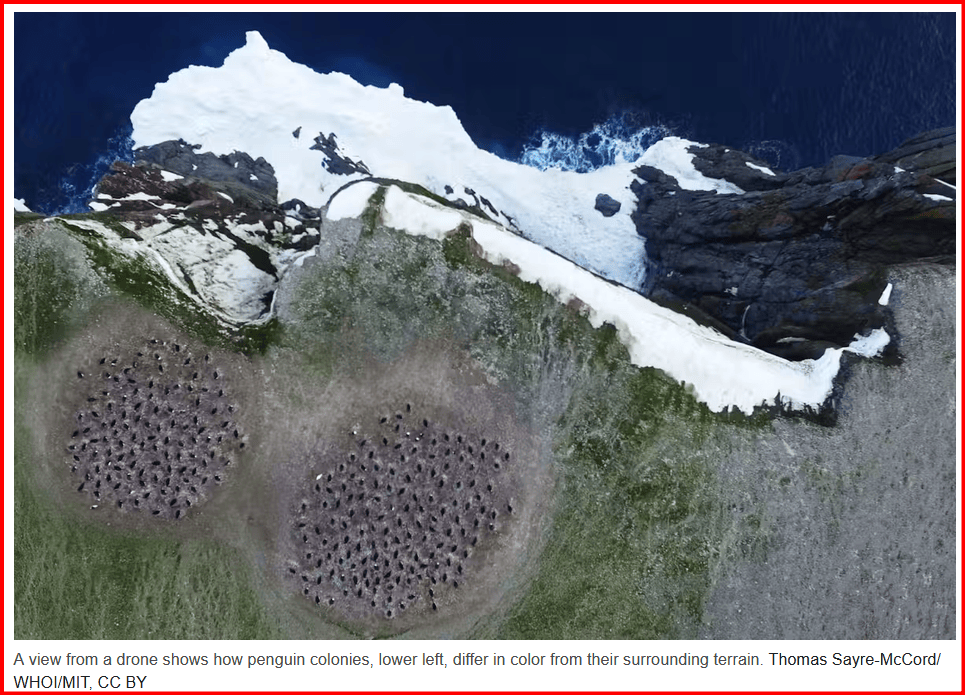
A multidisciplinary group of scholars that I led has used thousands of satellite images dating as far back as the 1980s to examine these patches of penguin guano, to reveal what these birds are eating and how changes in the environment are affecting their diets – which also affect their survival.
In particular, we found that when there is an abundance of sea ice at a colony, Adélie penguins there tend to rely more on small fish. When there is less sea ice, they depend more on krill, which are small shrimplike crustaceans.
Discover more from SANTA MONICA BAY AUDUBON SOCIETY BLOG
Subscribe to get the latest posts sent to your email.



