Free email delivery
Please sign up for email delivery in the subscription area to the right.
No salesman will call, at least not from us. Maybe from someone else.
Where is She Now?
[Posted by Chuck Almdale]
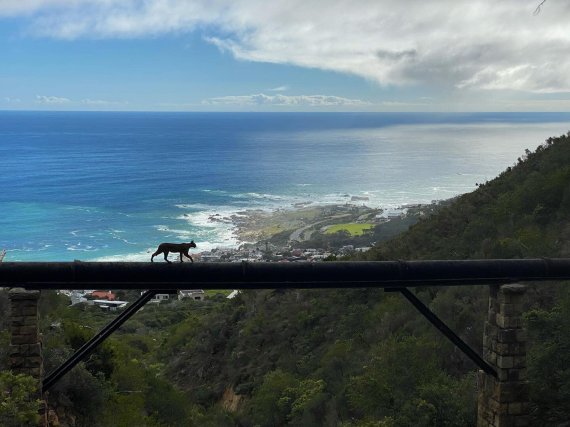
Dr. Laurel Klein Serieys is familiar to most members of Santa Monica Bay Audubon Society. We help support her research on urban bobcats from 2008 to 2014 while she was working on her Ph.D. at UCLA on the deleterious effect of rodenticides on bobcat and mountain lion health. In return, Laurel gave short presentations about her work at our evening meetings, culminating in a full program after she received her Ph.D. It was rewarding to watch her grow in confidence and skill. Afterwards, she moved to South Africa to work on their local cats, particularly the Caracal. The following is from her website biography.

Her introduction to the world of wild cat research was a National Park Service internship in Los Angeles, California, USA in 2006. There she worked on an urban bobcat and mountain lion study. She carried the work into her PhD research at the University of California, Los Angeles graduate program in Ecology and Evolutionary Biology. Her Ph.D. research focused on how urbanization and pesticides drives genetic change and disease susceptibility in urban bobcats. Amongst the achievements she is most proud of– data from her bobcat work was used to enact new legislation across California to reduce consumer availability of rat poisons. The Environmental Protection Agency has requested the data as they review national policy on the use of those pesticides. Her collaborative work on the genetics of urban mountain lions has led to a movement to build a wildlife corridor across one of the busiest freeways in the U.S.
The Urban Caracal Project is a project of the Institute for Communities and Wildlife in Africa (iCWild) at the University of Cape Town. Key collaborators also include South Africa National Parks, Universities of California (Santa Cruz and Los Angeles), the City of Cape Town, and private landowners in Cape Town.

Urban Caracal Project CapeTalk Podcast interview: 15 min
Caracals are shy by nature and avoid contact with humans. But the Urban Caracal Project keeps track of the numbers and distribution of these beautiful wild animals and have tagged several of them. Joining us on the line is Dr Laurel Serieys from the Urban Caracal Project.
Caracals face wipe-out in Cape Town: 6:30 min
The CapeTalk midday talk with Mandy Weiner, interview with Dr. Laurel Serieys of the Urban Caracal Project.
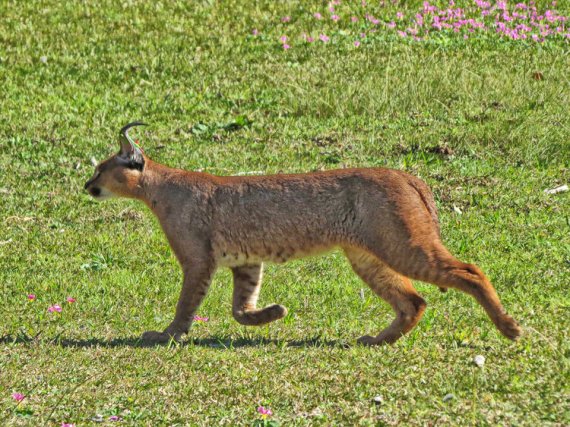
Fun Caracal Facts. Due to similar distinctive ear tufts and short tail, the caracal is often called a ‘desert lynx’ though it is not closely related to the lynxes of the northern hemisphere. Caracal comes from the Turkish name ‘Karakulak’, meaning ‘black ear’. Egyptians portrayed caracals in wall paintings and in bronze as elegant hieratic figures sitting upright or as guardians of tombs; they also embalmed their bodies and placed them in tombs. In Persia and India, the caracal was trained to hunt birds as well as hares, foxes and small antelope.
Theodore Paine Poppy Hour, Thurs. 10/29 5:30 PM
[Posted by Chuck Almdale]
Note: If this email does not display well for you, go to the blog by clicking on the title above. It came to me with a great deal of underlying HTML formatting which it could take a couple of hours for me to reconfigure. So I pasted it in and hoped for the best.
| OCTOBER POPPY HOUR Join us this Thursday (10/29) at 5:30PM PST for an episode of Poppy Hour dedicated to California wildfire and its relationship to our native plants. Poppy Hour: Wildfire Thursday, October 29 5:30 PM -7:00 PM Via ZOOM or YouTube, Free Wildfire is a complicated force in Southern California, being simultaneously dangerous, destructive and regenerative. During this episode of Poppy Hour we’ll be joined by two wildfire experts to shed light on this issue: Dr. Jon Keeley, a fire ecologist with the U.S. Geological Survey, and Henry Herrera, a Forester with California Department of Forestry and Fire Protection (CAL FIRE). We’ll take a close look at our local fire ecology, discuss what it’s like on the ground as a fire-fighter, and learn about actions we can all take to create wildfire resilient communities. TPF Nursery Manager, Flora Ito will start the show by sharing a few of her favorite fire adapted plant selections. Poppy Hour is our California native plant internet mashup. Part interviews, part garden tour, part happy hour, we explore the amazing diversity of people and ideas that connect to Southern California plants and landscapes. Join us! 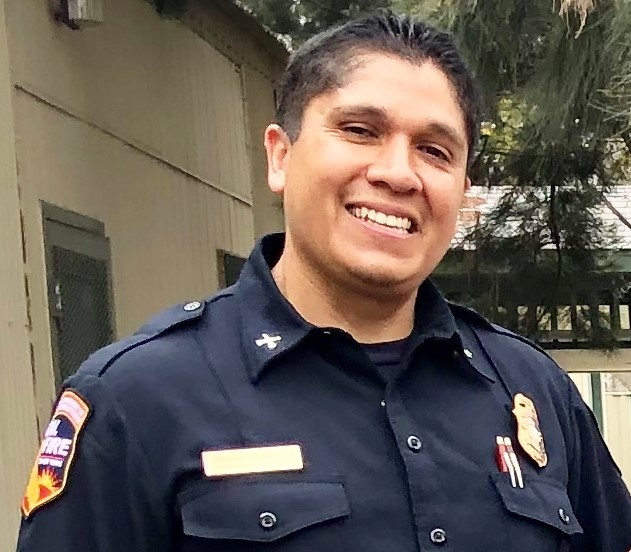 Henry Herrera began his forestry career with the Forest Service in the San Bernardino National Forest working as a wildland firefighter while attending forestry school at Cal Poly, San Luis Obispo. He’s worked in several National Forests as a firefighter, forester, and lands/special uses officer. Since May of 2019, Henry has worked as CAL FIRE’s Regional Urban Forester for Los Angeles and Ventura counties. Henry’s main experience is with fuels/vegetation management, prescribed fire and reforestation.  Dr. Keeley is currently a research scientist with the U.S. Geological Survey. Prior to this appointment, he served one year in Washington, D.C. as director of the ecology program for the National Science Foundation. He was professor of biology at Occidental College for 20 years. His research has focused on ecological impacts of wildfires as well as other aspects of plant ecology, including rare plants, rare habitats such as vernal pools, and plant physiology. We would like to thank an anonymous donor for making Poppy Hour season 2 possible. Theodore Payne Foundation for Wild Flowers & Native Plants 10459 Tuxford Street Sun Valley, CA 91352 |
Golden Eagle “Sky-Dancing” | Cornell Lab of Ornithology
A film from the Cornell Lab of Ornithology. If no film or link appears in this email, go to the blog to view it by clicking on the blog title above. If the film stops & starts in an annoying manner, press pause (lower left double bars ||) to let it buffer and get ahead of you. The Lab is a member-supported organization; they welcome your membership and support. [Chuck Almdale]
A Flea’s Fantastic Jump Takes More Than Muscle | Deep Look Video
Before they can bite your cat or dog, these little “itch hikers” make an amazing leap 100 times faster than the blink of an eye. So how do they do it?
Spring is here, and with it, the start of flea season. With the warming weather, people and their pets are spending more time outside — which increases the chances of bringing home a hungry “itch hiker.”
While pet owners curse the tiny insects and look for a way to rid them from their homes, it turns out fleas actually perform some remarkable athletic feats, like jumping 50 times their height — the equivalent of a human jumping 300 feet — or leaping so fast that they take off 100 times faster than the blink of an eye.
No larger than a sesame seed and flattened side to side, fleas can slip through fur with ease. Their jump is so fast they seem to simply vanish and reappear somewhere else.
“It’s there and then it’s gone,” said Gregory Sutton, a professor of biomechanics at the University of Lincoln in the United Kingdom.
This is another installment of the PBS Deep Look series. If no film or link appears in this email, go to the blog to view it by clicking on the blog title above. If the film stops & starts in an annoying manner, press pause (lower left double bars ||) to let it buffer and get ahead of you. [Chuck Almdale]
Did you know Ravens can talk?! | Fable the Raven
From the producer:
However this video today is all about a very special bird of mine I’d like you to meet. She’s not a bird of prey but she’s very awesome in her own way and I am planning a mini series all about her. Fable is a two year old raven. She is captive bred and I hand reared her from just a few weeks old. Ravens can live over 40 years so she has a lot of time ahead of her to learn. She can already articulate over 50 words and noises and loves to solve puzzles and hide/bury her favourite things – more on that in the next videos.
A film from Falconry and Me. If no film or link appears in this email, go to the blog to view it by clicking on the blog title above. If the film stops & starts in an annoying manner, press pause (lower left double bars ||) to let it buffer and get ahead of you. The Lab is a member-supported organization; they welcome your membership and support. [Chuck Almdale]



 SANTA MONICA BAY AUDUBON SOCIETY BLOG