Free email delivery
Please sign up for email delivery in the subscription area to the right.
No salesman will call, at least not from us. Maybe from someone else.
Shorebird Studies | Point Blue
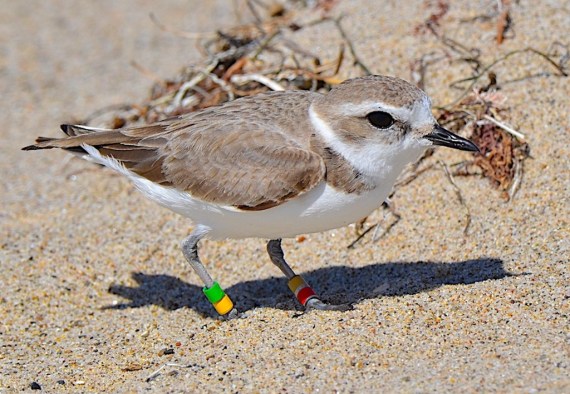
(Larry Loeher 2-25-18)
[Posted by Chuck Almdale, 14 Nov 2020]
Point Blue, which used to be known as Point Reyes Bird Observatory, is involved in several birds studies of interest to SMBAS and chapter members have contributed to their work since the middle 1990’s.
One such study is the Pacific Flyway Shorebird Survey. They conduct an annual census of shorebirds in eleven countries along the Pacific Coast to which citizen scientists and organizations contribute information. The surveys are timed to catch the birds when their movements are minimal, and for the two sites I do – Malibu Lagoon and Sepulveda Dam – the date window is Nov 15 – Dec 15.
They’ve put out their first paper on the results: A monitoring framework for assessing threats to nonbreeding shorebirds on the Pacific Coast of the Americas. A one-page summary of the paper is here on the Point Blue website. In the lower-right corner of that page you’ll find a link to the complete paper. Here’s a short extract:
With over 40 partner organizations, we counted birds annually at 84 critical wetland sites between Canada and Chile. In each of the first three annual surveys from 2013/14 to 2015/16, we counted ~1 million shorebirds of 44 species, including five species for which >20% of their population was recorded annually, and nine additional species with >5% recorded. Results highlighted new areas of importance for shorebirds including Delta del Rio Estero Real in Nicaragua which supports 20% of the population of Wilson’s Plovers.
Another study of theirs is the Snowy Plover censusing project, which undoubtedly has some long official title but that’s what I call it. Various SMBAS members have collected data on at least five winter roosting sites, especially Zuma Beach, Malibu Lagoon and Santa Monica Beach, since the mid-1990’s.
Point Blue issued a free report on our favorite shorebird in June 2020: Assessing Accuracy of Sampling Schemes to Estimate Western Snowy Plover Reproductive Success. They also have a one-page summary here of this paper. Here’s a snippet:
These results are useful for designing a sampling scheme within a monitoring plan that is needed to meet a desired level of accuracy. For example, by monitoring nests hatching only on weekdays (equivalent to 71% of sampling effort), fledge rate estimates would typically be within 8.5% of the actual value. At 50% of sampling effort (the current target in Monterey Bay), fledge rate estimates would typically be within 13.4% ofthe actual value.
Anyone who is, has been or might want to be a Snowy Plover monitor will be interested in this.
Additionally, Point Blue has a very large database, accessible by the public, of more than 2,000 technical reports and peer reviewed scientific articles. About this they say:
We use these findings to address real-world challenges, working hand-in-hand with land, ocean, and wildlife managers to improve conservation outcomes.

Covid Chart – Cases by State Partisanship
[Posted by Chuck Almdale]
This site- DanGoodSpeed.com – actually has seven charts. They move through time as the cases and deaths mount up, and the states shift position up and down the chart as they experience outbreaks. If you’re not colorblind, you can clearly see the effect that the politics of a state has on their pandemic status. Here’s a snip, frozen in time.
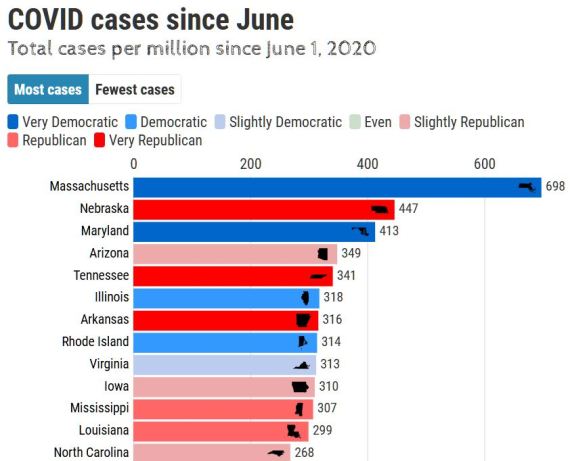
This is what it looked like on June 3. But go to the site to watch all the action. It’s not a video, but a very active chart. Controls to pause, change dates, etc. are at the bottom. No matter how much you already know about the pandemic across the USA, you’ll see it with fresh eyes.
First king tides arrive November 15-16
[Posted by Chuck Almdale]
We are posting this as a public service.
| The highest high tides of the year are on their way |
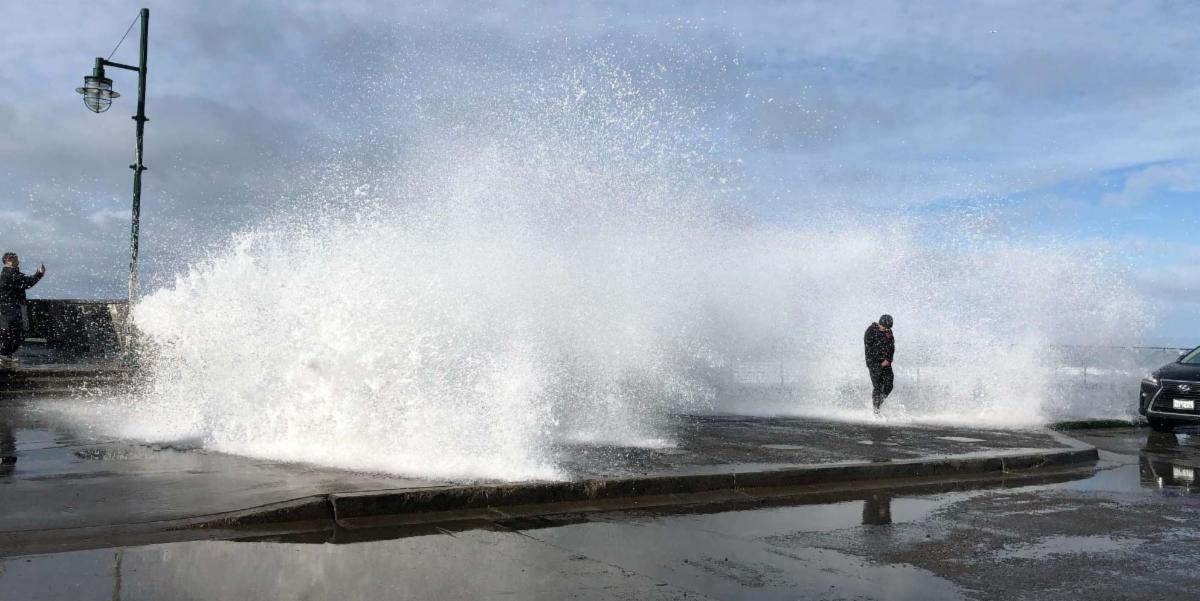 Look out for King Tides! Nov. 15-16, 2020 Dec. 13-15, 2020 Plus, for locations North of Vandenberg/Point Conception, Jan. 11-12, 2021 Look out for King Tides! Nov. 15-16, 2020 Dec. 13-15, 2020 Plus, for locations North of Vandenberg/Point Conception, Jan. 11-12, 2021  The California King Tides Project is calling on you to photograph our highest high tides of the year. Documenting these tides helps us preview the impacts of sea level rise and understand how our shoreline is affected by high water today. The California King Tides Project is calling on you to photograph our highest high tides of the year. Documenting these tides helps us preview the impacts of sea level rise and understand how our shoreline is affected by high water today.If you’re able to safely take photos at the coast or Delta during King Tides you will be contributing to an important community science effort. Find your local King Tide times and learn how to upload your photos on our website or with a free app. You can check out a selection of photos from each coastal county and access a map of all the King Tides photos from the last few years. Educators and parents can find ways to incorporate King Tides into student learning, including with an elementary-level science journal downloadable in English or Spanish. Middle and high school students may want to use King Tides images and concepts as they enter the Climate Video Challenge. We can’t wait to see your photos! In the meantime, please join us on social media for #KingTides: What causes sea level rise, and what do King Tides have to do with it? The sea level rise we’re experiencing now and will experience in the future is caused by burning fossil fuels like coal, oil, and natural gas. Carbon dioxide in our atmosphere acts like a blanket, trapping in heat that would otherwise escape. When we burn fossil fuels, we’re adding more carbon dioxide, “thickening the blanket” and warming the planet and ocean. Sea level is rising because land-based glaciers and ice sheets are melting into the ocean and also because water expands in volume when it warms. The amount of sea level rise we will ultimately experience will depend on how quickly we stop burning fossil fuels. King Tides themselves are not caused by sea level rise, but allow us to experience what higher sea level will be like. King Tides are the highest high tides of the year, about a foot or two higher than average tides, which corresponds to the one to two foot rise in sea level expected during the next few decades. When you observe the King Tides, imagine seeing these tides (and the flooded streets, beaches, and wetlands) every day. Understanding what a King Tide looks like today will help us plan for sea level rise in the future. Sharing your photos and talking about what you’ve noticed helps others understand that they’re part of a community that cares about climate change. Why are there different dates for northern and southern California? Southern California will experience King Tides in November and December. There is an additional January King Tide in northern California, north of Point Conception/Vandenberg AFB, due to a combination of astronomical influences such as the relative tilt of the Earth’s rotation with respect to the Sun and seasonal influences on water level such as temperature and wind that differ in southern California as compared to northern California over the course of the year. Thank you for your help! We look forward to seeing your photos! california.kingtides.net |
| California Coastal Commission 455 Market Street, Suite 228, San Francisco, CA 94105 |
Walking Sticks Stop, Drop and Clone to Survive | Deep Look Video
Indian walking sticks are more than just twig impersonators. They even clone themselves into a surprising variety of colors to stay hidden in plain sight from predators.
There’s that old cheesy joke: What’s brown and sticky? A stick.
But sometimes it’s not just a stick — but a walking stick. This non-native insect, originally from India, relies on clever camouflage to hide from predators. They’re so skilled at remaining undercover, you may not have noticed that they’ve made themselves right at home in your local park. Some Bay Area researchers are studying the insects’ genetics to learn more about how they are such masters of camouflage.
“I can’t think of any other insect as effective as they are in remaining hidden in plain sight,” said Edward Ramirez, an undergraduate researcher at the University of California, Berkeley who is currently studying the genetics of Indian walking sticks.
“How is this possible? was always the question that came to mind, so I wanted to search for a more clear answer.”
This is another installment of the PBS Deep Look series. If no film or link appears in this email, go to the blog to view it by clicking on the blog title above. If the film stops & starts in an annoying manner, press pause (lower left double bars ||) to let it buffer and get ahead of you. [Chuck Almdale]
Interesting events at Malibu Lagoon: 21 October, 2020
Small, controlled field trips in open spaces still seem feasible.
We had ten people this time.
[By Chuck Almdale]

Malibu beach-birder-lagoon-pier (R. Juncosa 10-21-20)
We had ten masked and equidistant birders this time, including Mary Prismon and daughter Roxie, neither of whom we’d seen in at least six months. The lagoon breach had closed up and water was quite high, reaching about 6 ½ ft. on the tidal clock sidewalk. (It’s hard to be certain as the marker tiles are covered by dirt and plants.) Temperatures were good – 64 to 68° – a semi-sunny day, no breeze at all and the waves were middlin’ to good and dotted with surfers. A nice day.

Inundated tidal clock sidewalk (L Johnson 10-21-20)
Despite all the water, there were surprisingly few ducks, although there were over 100 coots. Seventeen ducks, nine of which were Ruddy Duck, which is very unusual. Not even a Mallard! The White Wagtail which had been present on 5 October when the low water left a sandy rim around lagoon and channel, was gone.
[Later note: Jimy Tallal send in a note on 11/3/20 that all the Mallards and a lot of egrets were across PCH at Legacy Park on Civic Center Way. That’s also where Chris Tosdevin saw the immature Yellow-crowned Night-Heron.]

Vermilion Flycatcher (C. Tosdevin 10-19-20)
But it was replaced by another rarity for the lagoon – a Vermilion Flycatcher. The bird had been there for at least two days, as Chris Tosdevin photographed it on the 19th. This was the first sighting at the lagoon for him and for all of us, and was a life bird for one of our group. It looked like a first year male as the vermilion on the center of the breast was incomplete. This bird’s breeding range extends from SoCal (Morongo Valley) to central Texas and south all the way to Argentina, but the birds that winter along the SoCal coast must come from nearby. He was madly flying and flitting and flycatching all over the west end of the channel, making the taking of photographs quite a challenge.


Left – Vermilion Flycatcher (C. Tosdevin 10-19-20)
Right – Vermilion Flycatcher U.S. Range | BirdFellow_com

Common Yellowthroat male at home (R. Juncosa 10-21-20)
We beat our way along the path to the beach, but other than several large bands of Bushtits, there weren’t many birds. Yellow-rumped Warblers were scattered in ones and twos, the Common Yellowthroats were in bushes and reeds around the edges of the channels, and the two Orange-crowned Warblers were gleaning tiny ants – Argentinian, I suppose – from leafy bushes.

Yellow-rumped Warbler (R. Juncosa 10-21-20)
The eminently surfable waves were washing over the offshore rocks, so no birds there, but several Pelagic Cormorants dove and swam in the surf zone, looking like snake birds. Far offshore a loon flew by. It looked like a Red-throated, slender, with head and tail lower than back and mostly pale underneath, although October is a bit early for them.

Cormorants & Egret in a reflective mood (R. Juncosa 10-21-20)
Several groups of Sanderlings, totaling 75 birds, ran back and forth with the lapping waves. Ray commented that they were feeding only on the wet sand. As the water retreated, they’d run down to the wettest portion they could reach, quickly poke around, then run back up to avoid getting knocked down by the next incoming wavelet. Here’s what Terres’ Audubon Society Encyclopedia of North American Birds says about this behavior:

Sanderling scatter to avoid a wave (C. Bragg 10-21-20)
…on wet beaches of coasts, probes vigorously with partly opened bill, making series of small holes in straight or curving lines to catch minute crustaceans (beach “fleas,” hippa crabs, shrimps, etc.), also eats small mollusks (mussels, for example), marine worms (Bent, 1927)…

Sanderling on foam (R. Juncosa 10-21-20)
I’ve never heard of a “hippa crab,” so I looked them up. They’re crustaceans, ten-legged (order: Decapoda), known as Sand Crabs (family Hippidae), and they fall into three genera Emerita, Hippa and Mastigochirus. At this point, confusion takes over. Around here, it may be the Pacific Mole Crab (Hippa pacifica), or it may be the Pacific Mole Crab (Emerita analoga). [Not a typo]. Or these two may be the exact same animal. Wikipedia on Hippa says Hippa “is closely related to the genus Emerita, and species have often been transferred between the two genera.” Wikipedia on Emerita says ” the related genus Hippa is found across the Indo-Pacific, including Australia.” So it’s Emerita analoga (I concluded) who live in our SoCal “swash zones,” the area of the sandy beach constantly washed over by incoming waves. This site says Emerita analoga ranges from Baja’s Magdalena Bay to Alaska, and grow to 1.4” long and 1” wide.

Female Pacific Mole Crab Emerita analoga (Wikipedia)
It turned out I’ve caught-and-released many of these creatures. It’s easy and fun and they wriggle in your hands, trying to burrow backwards between your fingers to hide, just as they do in the wave-washed sand. Unfortunately for them, it’s also easy for gulls, sandpipers and surf fishermen to catch them, only they don’t “release.”
Link to a very nice PBS Deep Look film on Pacific Mole Crabs and some discussion.
Link to an autobiography by a Pacific Mole (or Sand) Crab.

Beach, waves & pier (L. Johnson 10-21-20)
Sanderlings are only 8” long and there’s no way (on God’s Green Earth!!) they’ll be swallowing a 1.4” x 1” crab. Whatever they were catching was invisible to our naked human eyes. My guess is that they were catching really really small crabs – crabs have to start really really small, before they reach 1.4” long, right? – or eggs; perhaps mole crab eggs, perhaps grunion eggs, perhaps any number of invertebrate eggs. I have seen Marbled Godwits and Whimbrels snagging the larger 1.4” Mole Crabs from the “swash zone.” I welcome enlightenment from any of our readers on what they might have been eating.

Ray photographs the sandpipers (L. Johnson 10-21-20)
That mystery now unsolved, we wandered over to the lagoon edge where the sandpipers and plovers, such as they were, were spread out along the water’s edge. Leaving out the 75 Sanderlings in the swash zone, of the 154 sandpipers and plovers, 91 were Black-bellied Plover, 42 were Snowy Plover, and the few remaining birds were in five species. They were mostly snoozing, or trying to snooze. About 10 of the 42 Snowy Plovers were busily running around; the rest sat in their little dimples in the sand, soaking up the sun. I saw no banded birds.

Snowy Plover (R. Juncosa 10-21-20)
The Ruddy Turnstones and the other plovers and ‘pipers were all well into their winter (or basic) plumages.

Ruddy Turnstone steps lightly (R. Juncosa 10-21-20)
Birds new for the season: Surf Scoter, Ruddy Duck, Eared Grebe, Anna’s Hummingbird, Red-throated Loon, Vermilion Flycatcher, White-crowned Sparrow, Yellow-rumped Warbler.

South channel to lagoon (L. Johnson 10-21-20)
Birds new for the season: Northern Pintail, Vaux’s Swift, Marbled Godwit, Sanderling, Spotted Sandpiper, Say’s Phoebe, Loggerhead Shrike, Marsh Wren, Blue-gray Gnatcatcher, Lesser Goldfinch, Lawrence’s Goldfinch, California Towhee, Orange-crowned Warbler, Yellow Warbler.
Many thanks to photographers: Chuck Bragg, Lillian Johnson, Ray Juncosa, and Chris Tosdevin.
The next three SMBAS scheduled field trips: Who knows? Not I.
The next SMBAS program: November 3, Seaweed Faceoff! with Lauren Smith, on ZOOM, 7:30 PM.
The SMBAS 10 a.m. Parent’s & Kids Birdwalk is canceled until further notice due to the near-impossibility of maintained proper masked social distancing with parents and small children.
Links: Unusual birds at Malibu Lagoon
9/23/02 Aerial photo of Malibu Lagoon
Prior checklists:
2019: Jan-June, July-Dec 2020: Jan-July,
2018: Jan-June, July-Dec 2017: Jan-June, July-Dec
2016: Jan-June, July-Dec 2015: Jan-May, July-Dec
2014: Jan-July, July-Dec 2013: Jan-June, July-Dec
2012: Jan-June, July -Dec 2011: Jan-June, July-Dec
2010: Jan-June, July-Dec 2009: Jan-June, July-Dec.
The 10-year comparison summaries created during the Lagoon Reconfiguration Project period, despite numerous complaints, remain available on our Lagoon Project Bird Census Page. Very briefly summarized, the results unexpectedly indicate that avian species diversification and numbers improved slightly during the restoration period June’12-June’14.
[Chuck Almdale]
| Malibu Census 2020 | 5/22 | 6/25 | 7/22 | 8/26 | 9/24 | 10/21 |
| Temperature | 68-73 | 64-70 | 60-66 | 70-77 | 66-77 | 64-68 |
| Tide Lo/Hi Height | H+3.53 | L-0.52 | L+0.71 | L+2.52 | L+3.05 | L+2.70 |
| Tide Time | 1031 | 0733 | 0819 | 0958 | 1004 | 0634 |
| Canada Goose | 14 | 8 | 8 | |||
| Gadwall | 34 | 31 | 40 | 5 | 2 | 2 |
| American Wigeon | 3 | |||||
| Mallard | 12 | 23 | 27 | 16 | 14 | |
| Northern Pintail | 2 | |||||
| Green-winged Teal | 1 | |||||
| Surf Scoter | 3 | |||||
| Ruddy Duck | 9 | |||||
| Pied-billed Grebe | 3 | 3 | 2 | 2 | ||
| Eared Grebe | 1 | |||||
| Western Grebe | 1 | |||||
| Rock Pigeon | 7 | 10 | 4 | 6 | 10 | |
| Mourning Dove | 4 | 3 | 5 | 4 | 2 | |
| Vaux’s Swift | 8 | |||||
| Anna’s Hummingbird | 1 | 1 | ||||
| Allen’s Hummingbird | 4 | 3 | 3 | 1 | 1 | |
| American Coot | 4 | 2 | 48 | 118 | ||
| Black-bellied Plover | 14 | 10 | 15 | 66 | 102 | 91 |
| Snowy Plover | 8 | 26 | 27 | 42 | ||
| Semipalmated Plover | 4 | 8 | ||||
| Killdeer | 2 | 6 | 2 | 7 | 12 | 1 |
| Whimbrel | 18 | 5 | 15 | 14 | 1 | 3 |
| Marbled Godwit | 4 | 1 | 3 | 5 | ||
| Ruddy Turnstone | 2 | 2 | 1 | 6 | ||
| Sanderling | 39 | 75 | ||||
| Least Sandpiper | 2 | 21 | 12 | |||
| Western Sandpiper | 2 | 1 | 8 | 1 | ||
| Short-billed Dowitcher | 2 | |||||
| Long-billed Dowitcher | 4 | |||||
| Spotted Sandpiper | 2 | 1 | ||||
| Wandering Tattler | 1 | |||||
| Willet | 1 | 6 | 8 | 47 | 40 | 5 |
| Heermann’s Gull | 4 | 9 | 65 | 10 | 14 | |
| Western Gull | 210 | 120 | 90 | 98 | 90 | 21 |
| California Gull | 4 | 17 | 12 | 1 | ||
| Glaucous-winged Gull | 3 | |||||
| Least Tern | 2 | 2 | ||||
| Caspian Tern | 60 | 15 | 4 | 1 | ||
| Forster’s Tern | 4 | |||||
| Royal Tern | 55 | 11 | 12 | |||
| Elegant Tern | 195 | 221 | 1 | |||
| Red-throated Loon | 1 | |||||
| Brandt’s Cormorant | 1 | |||||
| Double-crested Cormorant | 14 | 15 | 16 | 18 | 43 | 16 |
| Pelagic Cormorant | 1 | 1 | 1 | 3 | ||
| Brown Pelican | 94 | 30 | 19 | 8 | 5 | 5 |
| Great Blue Heron | 3 | 2 | 4 | 3 | 3 | |
| Great Egret | 1 | 3 | 4 | 20 | 1 | |
| Snowy Egret | 3 | 2 | 8 | 4 | 2 | 5 |
| Black-crowned Night-Heron | 1 | 2 | ||||
| Osprey | 1 | 1 | 1 | |||
| Cooper’s Hawk | 1 | |||||
| Belted Kingfisher | 1 | 2 | ||||
| Black Phoebe | 1 | 5 | 5 | 4 | 5 | |
| Say’s Phoebe | 1 | 2 | ||||
| Vermilion Flycatcher | 1 | |||||
| Loggerhead Shrike | 1 | |||||
| California Scrub-Jay | 1 | 1 | 2 | |||
| American Crow | 2 | 2 | 4 | 3 | 3 | 4 |
| Rough-winged Swallow | 1 | |||||
| Cliff Swallow | 1 | |||||
| Barn Swallow | 10 | 18 | 22 | 20 | ||
| Bushtit | 6 | 22 | 16 | 50 | 16 | 75 |
| House Wren | 1 | 2 | ||||
| Marsh Wren | 5 | |||||
| Blue-gray Gnatcatcher | 5 | 2 | ||||
| Wrentit | 1 | 1 | ||||
| Western Bluebird | 4 | |||||
| Northern Mockingbird | 2 | 2 | 2 | 1 | 2 | |
| European Starling | 9 | 60 | 12 | 27 | 2 | 5 |
| House Finch | 16 | 24 | 5 | 4 | 8 | 4 |
| Lesser Goldfinch | 2 | 2 | ||||
| Lawrence’s Goldfinch | 15 | |||||
| California Towhee | 1 | 1 | 1 | |||
| Song Sparrow | 12 | 3 | 3 | 4 | 3 | 7 |
| White-crowned Sparrow | 4 | |||||
| Western Meadowlark | 25 | |||||
| Hooded Oriole | 7 | |||||
| Red-winged Blackbird | 1 | |||||
| Great-tailed Grackle | 4 | 3 | 20 | 2 | 2 | |
| Orange-crowned Warbler | 4 | 2 | ||||
| Common Yellowthroat | 1 | 4 | 4 | 5 | ||
| Yellow Warbler | 2 | |||||
| Yellow-rumped(Aud) Warbler | 10 | |||||
| Totals by Type | May | Jun | Jul | Aug | Sep | Oct |
| Waterfowl | 60 | 62 | 75 | 22 | 18 | 17 |
| Water Birds – Other | 113 | 47 | 40 | 30 | 99 | 146 |
| Herons, Egrets & Ibis | 4 | 6 | 13 | 14 | 25 | 9 |
| Quail & Raptors | 2 | 0 | 0 | 1 | 0 | 1 |
| Shorebirds | 39 | 30 | 58 | 197 | 248 | 229 |
| Gulls & Terns | 334 | 144 | 358 | 364 | 129 | 22 |
| Doves | 0 | 11 | 13 | 9 | 10 | 12 |
| Other Non-Passerines | 4 | 3 | 4 | 1 | 11 | 2 |
| Passerines | 62 | 137 | 99 | 152 | 79 | 135 |
| Totals Birds | 618 | 440 | 660 | 790 | 619 | 573 |
| Total Species | May | Jun | Jul | Aug | Sep | Oct |
| Waterfowl | 3 | 3 | 3 | 3 | 3 | 4 |
| Water Birds – Other | 4 | 4 | 4 | 4 | 5 | 7 |
| Herons, Egrets & Ibis | 2 | 3 | 3 | 4 | 3 | 3 |
| Quail & Raptors | 2 | 0 | 0 | 1 | 0 | 1 |
| Shorebirds | 5 | 6 | 10 | 10 | 12 | 9 |
| Gulls & Terns | 6 | 3 | 5 | 8 | 5 | 2 |
| Doves | 0 | 2 | 2 | 2 | 2 | 2 |
| Other Non-Passerines | 1 | 1 | 2 | 1 | 3 | 2 |
| Passerines | 9 | 11 | 13 | 15 | 18 | 18 |
| Totals Species – 84 | 32 | 33 | 42 | 48 | 51 | 48 |



 SANTA MONICA BAY AUDUBON SOCIETY BLOG