Free email delivery
Please sign up for email delivery in the subscription area to the right.
No salesman will call, at least not from us. Maybe from someone else.
King tides again December 13-15
[Posted by Chuck Almdale]
We are posting this again as a public service.

Not much dry beach during the 11-16-20 king tide. (Larry Loeher)

This Malibu Colony house looks like it’s falling into the sea during king tide, but I think the camera was a little tilted. It’s not that bad off. Normally the bottoms of the leftmost support pilings are not submerged. (Grace Murayama 11-16-20)
| The highest high tides of the year are on their way |
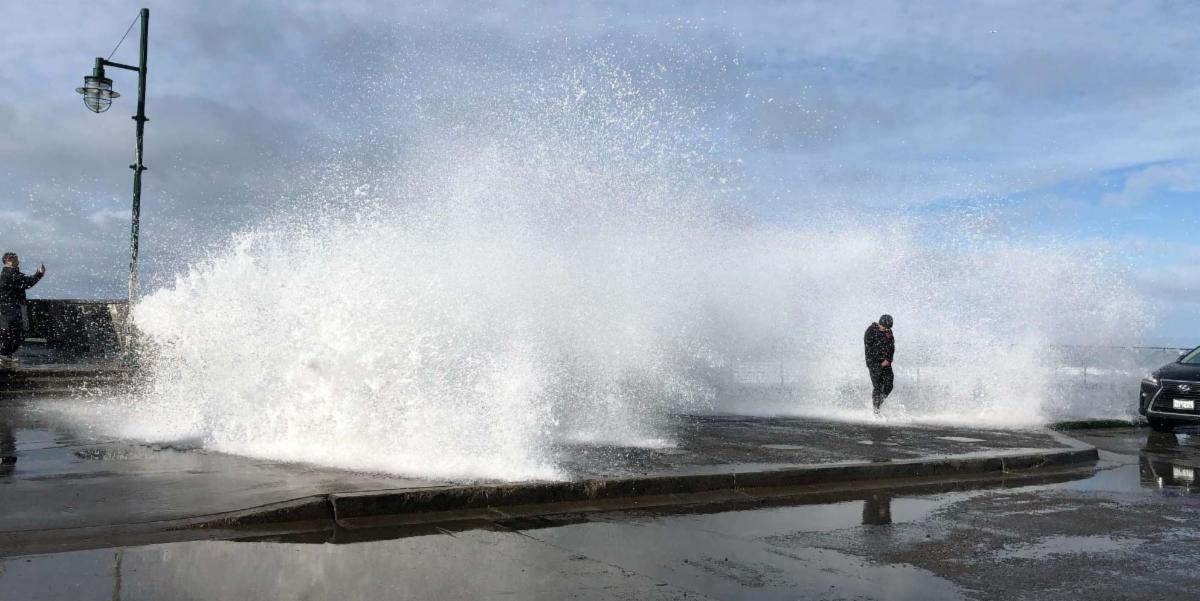 Look out for King Tides! Look out for King Tides! Dec. 13-15, 2020 Plus, for locations North of Vandenberg/Point Conception, Jan. 11-12, 2021 The California King Tides Project is calling on you to photograph our highest high tides of the year. Documenting these tides helps us preview the impacts of sea level rise and understand how our shoreline is affected by high water today. If you’re able to safely take photos at the coast or Delta during King Tides you will be contributing to an important community science effort. Find your local King Tide times and learn how to upload your photos on our website or with a free app. You can check out a selection of photos from each coastal county and access a map of all the King Tides photos from the last few years. Educators and parents can find ways to incorporate King Tides into student learning, including with an elementary-level science journal downloadable in English or Spanish. Middle and high school students may want to use King Tides images and concepts as they enter the Climate Video Challenge. We can’t wait to see your photos! In the meantime, please join us on social media for #KingTides: What causes sea level rise, and what do King Tides have to do with it? The sea level rise we’re experiencing now and will experience in the future is caused by burning fossil fuels like coal, oil, and natural gas. Carbon dioxide in our atmosphere acts like a blanket, trapping in heat that would otherwise escape. When we burn fossil fuels, we’re adding more carbon dioxide, “thickening the blanket” and warming the planet and ocean. Sea level is rising because land-based glaciers and ice sheets are melting into the ocean and also because water expands in volume when it warms. The amount of sea level rise we will ultimately experience will depend on how quickly we stop burning fossil fuels. King Tides themselves are not caused by sea level rise, but allow us to experience what higher sea level will be like. King Tides are the highest high tides of the year, about a foot or two higher than average tides, which corresponds to the one to two foot rise in sea level expected during the next few decades. When you observe the King Tides, imagine seeing these tides (and the flooded streets, beaches, and wetlands) every day. Understanding what a King Tide looks like today will help us plan for sea level rise in the future. Sharing your photos and talking about what you’ve noticed helps others understand that they’re part of a community that cares about climate change. Why are there different dates for northern and southern California? Southern California will experience King Tides in November and December. There is an additional January King Tide in northern California, north of Point Conception/Vandenberg AFB, due to a combination of astronomical influences such as the relative tilt of the Earth’s rotation with respect to the Sun and seasonal influences on water level such as temperature and wind that differ in southern California as compared to northern California over the course of the year. Thank you for your help! We look forward to seeing your photos! california.kingtides.net |
| California Coastal Commission 455 Market Street, Suite 228, San Francisco, CA 94105 |
An inundated tidal clock sidewalk measured 6′ 9.6″ lagoon water
level a week after the king tide. (L. Johnson 11-23-20)
Books for budding scientists | Natural History Magazine
[Posted by Chuck Almdale]
Every year at Christmastime Natural History, the magazine of the American Museum of Natural History in New York City, lists books for ‘budding scientists.’ Here’s a few from their Dec ‘20 – Jan ’21 issue. It’s not too late to order one and pick it up at your local bookstore and support our local businesses. Descriptions below are from Natural History, written by Dolly Setton.
For Young Readers
The Boy Who Dreamed of Infinity: A Tale of the Genius Ramanujan
by Amy Alznauer, Illustrated by Daniel Miyares: Candlewick Press, 2020; 48 pages, $17.99
When Srinivas Ramanujan (1887-1920) was a young boy in a small town in India, he chopped a mango in half, and in half again. He imagined that if he continued cutting, the number of bits would approach infinity; yet, if he put the pieces back together, there would be one mango. “Will and endless list of tiny numbers add up to one or to infinity?” he wondered. “What is big?” and “What is small?” His questions multiplied as he got older. He experimented and explored on his own. Without knowing their names, he filled notebooks with his discoveries about primes, partitions, and infinite sums. He solved problems that, unbeknownst to him, were considered unsolvable. After reading a pamphlet on infinity by Cambridge University mathematician G.H. Hardy (1877-1947), Ramanujan humbly introduced himself in a letter. Weeks later, Hardy responded – “magnificent, outlandish ideas” – and invited Ramanujan to visit him in England. Illustrated with warm watercolor paintings, this book stands out for its endearing biographical tale, its flavor of the beauty and mystery of math, and its sense of intellectual freedom and creativity to which children can relate.
Also recommended
The Big Book of Blooms
by Yuval Zommer; Thames & Hudson, 2020; 64 pages, $19.95
Packs: Strength in Numbers
by Hannah Salver; HMH Books for Young Readers, 2020; 48 pages, $17.99
Sharuko: El Archeologo Peruano Julio C. Tello / Peruvian Archeaologist Julio C. Tello
by Monica Brown, Illustrated by Elisa Chavarri, Translated by Adriana Dominguez;
Children’s Book Press, 2020; 40 pages $19.95
A Way with Wild Things
by Larissa Theule, Illustrated by Sara Palacios; Bloomsbury Children’s Books, 2020; 32 pages, $17.99
For Intermediate Readers
Unseen Worlds: Real-Life Microscopic Creatures Hiding All Around Us
by Hélène Rajcak, Illustrated by Damien Laverdunt; What On Earth Books, 2019; 36 pages, $21.99
Peruse the table of contents, and anticipation of strange new visions of familiar vistas will grow: “The Miniature Jungle of Your Bed,” “The Secret Life of the Beach,” “A Parade of Ocean Floor Monsters.” Magnificent illustrations put microscopic beings, such as “lonely mud dragon,” at the center of a seemingly alien world that is really our own. On the ocean floor, “a snow of bacteria and plankton falls all around. Spiny silhouettes of loriciferans haunt the shadowy waters. Meanwhile, at the beach, “creatures slink around in the spaces between the grains of sand…the dark, damp mazes…are both an ideal hideaway and a well-stocked pantry.” Richly detailed illustrations and eloquent descriptions invite continued examination and wonder. A final spread describes the portal to these invisible worlds, the microscope.
Also recommended
The Ocean: Exploring Our Blue Planet
by Miranda Krestovnikoff, Illustrated by Jill Calder; Bloomsbury Children’s Books, 2020; 64 pages, $23.99
Stay Curious! A Brief History of Stephen Hawking
by Kathy Krull & Paul Brewer, Illustrated by Boris Kulikov; Crown Books for Young Readers, 2020; 40 pages, $23.99
Tiger, Tiger, Burning Bright! An Animal Poem for Every Day of the Year
Selected by Fiona Waters, Illustrated by Britta Teckentrup; Nosy Crow, 2020, 328 pages, $34.42
For Advanced Readers
The Natural History Puzzle Book
Dr. Gareth Moore; Carlton Books, 2019; 224 pages, $29.99
Why is space silent? What do dolphin clicks mean? What makes cypress trees fire resistant? Over 100 puzzles – inspired by London’s Natural History Museum – explore a variety of scientific questions, clearly sorted into three levels of difficulty. Easy puzzles, such as mazes and spot-the-differences, can be done by any age, while the more challenging ones, such as nonograms and bridge puzzles, might require an adult’s help. There are also quizzes and brainteasers, including questions like: “What is the longest bone in the human body?” and “How many genes does a banana have?” Readers get to keep territorial primates away from each other, trace the wiggle dance movements of bees and learn about the tectonic movement of plates. The puzzles are divided into six categories: animals, oceans, space, dinosaurs, human evolution, the natural world. Fun facts and scientific background are scattered throughout this beautifully designed book.
Also recommended
Music for Tigers
by Michelle Kardarusman; Pajama Press, 2020; 224 pages, $17.95
The Radium Girls: The Scary but True Story of the Poison that Made People Glow in the Dark
(Young Readers’ Edition) by Kate Moore; Sourcebooks Explore, 2020; 432 pages, $17.99
Rocket Science: A Beginner’s Guide to the Fundamentals of Spaceflight
by Andrew Rader, Illustrated by Galen Frazer; Candlewick Press, 2020; 64 pages, $16.99
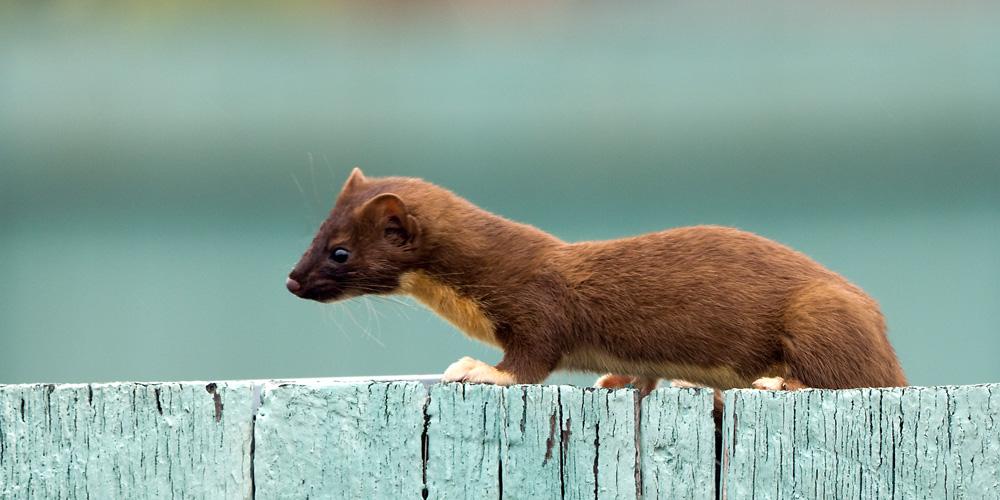
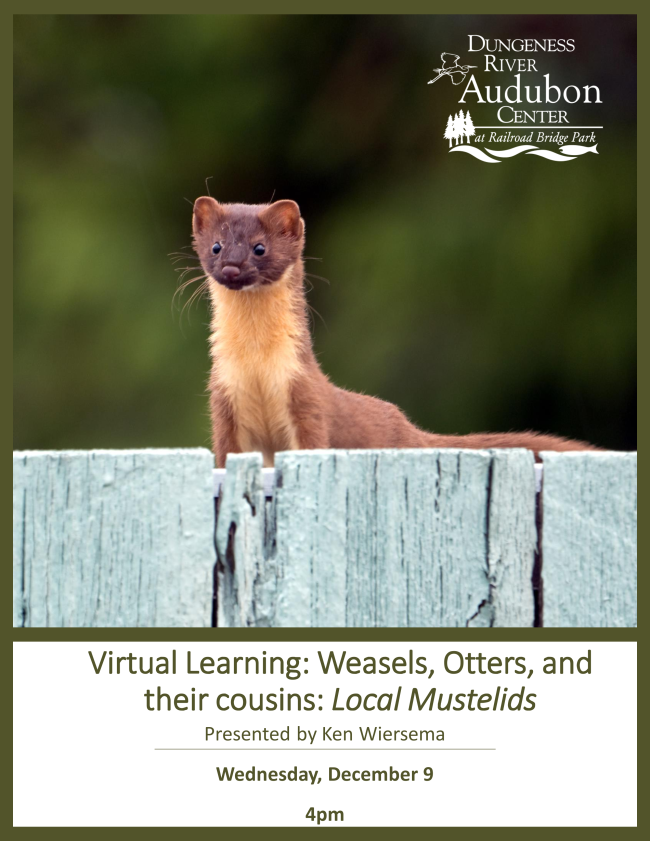
Weasels, otters and their cousins | Dungeness River Audubon Center
[Posted by Chuck Almdale, thanks to Carol Prismon-Reed]
I received this at the last minute. If you like these furry critters, the show is tomorrow afternoon at 4 PM, December 9, 2020, but REGISTER FIRST. I hope you can read this as I didn’t have time to change any of the formatting, and it might look very weird. If unreadable, go to the blog.
|



Ducks returning to Malibu Lagoon: 23 November, 2020
Small, controlled field trips in open spaces still seem feasible.
We had five people this time. And we stopped by Legacy Park.
[By Chuck Almdale]

Brant is a regular visitor in very small numbers (Ray Juncosa 11-23-20)
We had five masked and equidistant birders this time. Most of the irregulars were busily preparing for Thanksgiving, or simply forgot, but Chris and Ruth Tosdevin joined Lillian, Ray and I on a cool and cloudy day.


View from the meeting place (Lillian Johnson 11-23-20)
Flat, flat, flat waves. The few surfers decking the water sat upon their boards. None attempted to catch a wave. “Maybe they’re working out New Year’s resolutions to surf at least one hour each day of the year,” I mused. What other reasonable reason could there be?

Lifeguard station, barren beach, no surfers and Malibu Pier in distance on a cloudy, foggy day. (L. Johnson 11-23-20)
The duck (plus one goose) population jumped up from October’s 17 birds in 5 species to 125 birds in 7 species. The Brant, Green-winged Teal (fly-bys), Red-breasted Merganser and Bufflehead – both females and bold-patterned males – were new. The coot population more than doubled; everywhere you looked jet-black coots were crusing, fighting, diving.

Say’s Phoebe on a rain bird (R. Juncosa 11-23-20)

On 11/16/20 Grace Murayama caught a different Say’s taking off.
The gull population exploded: October had 22 birds, November had 687; most were California Gull, finally arriving from Mono Lake.

At the time we thought this was a Mew Gull.
Now it’s looks Ring-billed to me. (R. Juncosa 11-23-20)
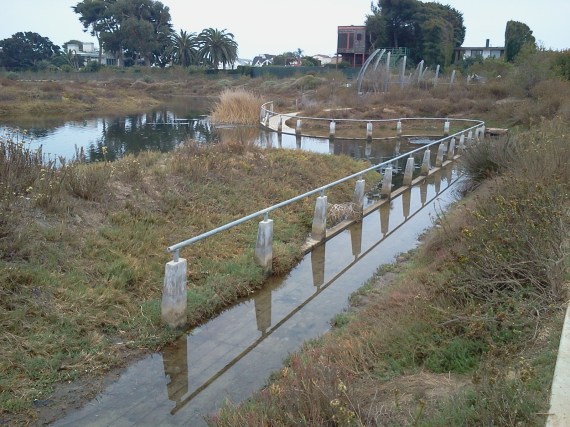
The lagoon water level was quite high. Every year, starting November 1st, the Tapia Water Reclamation Plant, located a few miles up Malibu Creek, is permitted to channel unsold reclaimed water into the creek. It used to be that they could do this November 1 – May 1, but not during the six hot months. (Does anyone know if they’re still doing this?) This water dumping used to be a significant source of pollution some 20-40 years ago, but Tapia cleaned up their act. Now their water (if they discharge into the creek) is cleaner than that from further upstream, which runs past horse farms, malls hosing down their parking lots, homeless encampments and tens of thousands of suburban homes filled to the brim with people washing their cars and forever fertilizing their endless rolling lawns.

An inundated tidal clock sidewalk measured 6′ 9.6″ water level
(L. Johnson 11-23-20)

Even the cormorant-barely-laden snag was drowning (R. Juncosa 11-23-20)
We had some rain a few weeks ago, well under an inch (about 0.05″ at our house), and that might have added a little something. There’d also been a King Tide on November 15-16, when waves washed right over the beach into the lagoon. All that brought the water level up to about 6′ 9″. Pretty high.

Many rocks exposed by 10:55 am. Low tide was 40 minutes later. It looks cloudy and cold, doesn’t it? (L. Johnson 11-23-20)

A sleepy Sea Lion resting on the exposed shore rocks (R. Juncosa 11-23-20
Of the 10 shorebird species, most (78) were Sanderlings, but there were also 30 Black-bellied Plovers and 28 Snowy Plovers. As the tide was dropping most of the shorebirds were running around looking for prey, including nearly all the Snowy Plovers. This makes it hard to count them, but after about 10 counts, I came up with 28 three times, so that’s my official count.

Not a Snowy Plover, but a close cousin, the Black-bellied Plover. What?, you say, where’s the black belly? Gone, with the breeding plumage of spring and summer. (R. Juncosa 11-23-20)

This Great Blue Heron is looking exceedingly fit & plumy.
(R. Juncosa 11-23-20)
There were a lot of Brown Pelicans, mostly sitting on the low-tide-exposed slightly-offshore rocks. I thought 206 pelicans seemed like a lot – it’s usually less than 90 – so I checked my spreadsheet at home. Not even close; the 15th highest, with 1490 birds on 4-26-15 as the record.

If you look closely at this pelican, the underwing and body feathers seem abbreviated. They look like pinfeathers, but I haven’t seen this effect before so I’m not certain. (R. Juncosa 11-23-20)
It was a good day for raptors: 2 Turkey Vultures, 1 Osprey, 1 Cooper’s Hawk and 1 Red-tailed Hawk. Chris mentioned that he’d heard that White-tailed Kites were declining (again). I think he’s right. We used to see White-tailed Kites at the lagoon, but the last one was on 12-28-14.

This Turkey Vulture passed so closely by that you could see it’s eye color.
If you look very closely, I think you can see right through it’s nostrils.
(R. Juncosa 11-23-20)

A contemplative Marbled Godwit (R. Juncosa 11-23-20
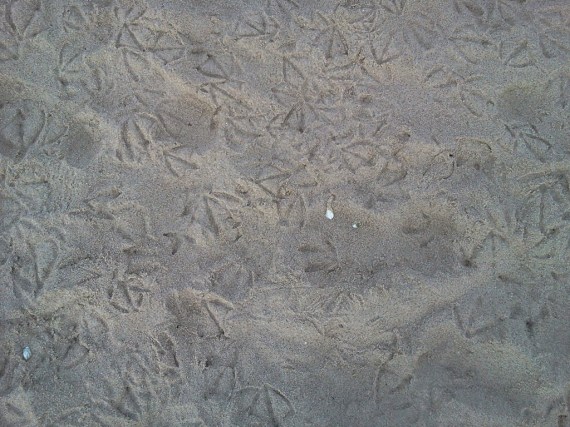
Footprints in time. For awhile, anyway. (L. Johnson 11-23-20)
We went over to Legacy Park – it’s not Malibu Lagoon, but still Malibu – as some of our missing ducks and a couple of “good birds” had been reported from there. As we circled the shrinking freshwater pond we were constantly surrounded by Yellow-rumped Warblers, Ruby-crowned Kinglets, and White-crowned Sparrows. Sure enough, when we reached the back side of the pond, there were at least 50 Mallards, all gathered around the feet of a woman scattering bread crumbs. Free lunch! No wonder the lagoon is empty of Mallards. We also found two Soras paddling around, but the reported wisp of Snipe had fled. Chris had been there a few days earlier and sent me some photos.

Easiest of the rails to view, the Sora often walks and swims in the open, unlike true skulkers like Black or Yellow Rail. I’ve never before seen the black facial feathers erect. (Chris Tosdevin ~11-20-20)
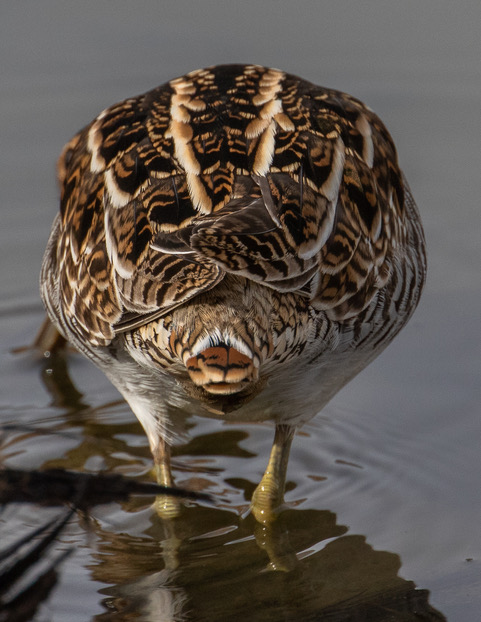
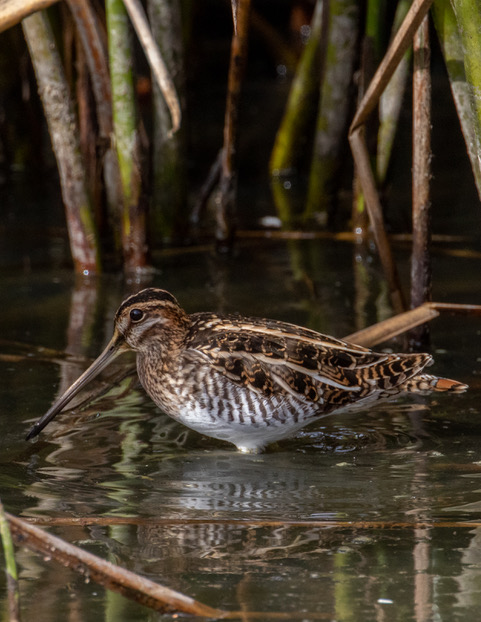
Even when people know the (Wilson’s) Snipe is really a real bird and not a myth that you send the naive out to catch with a sack, they often mistake it for a dowitcher because of the chunky shape and long straight bill. But Snipe (in my experience) vastly prefer fresh water, damp grass and maybe a few reeds, to brackish water and mud flats. Their streaky back and head plumage camouflages the motionless snipe very well.
(C. Tosdevin ~11-20-20)

I heard that someone thought this was not a Scaly-breasted Munia (Lonchura puntulata) but a “Checkered” Munia. I looked it up and “Checkered” is yet another of the many names for this bird. Other names: Nutmeg Mannikin, Nutmeg Finch, Spotted Munia, Spotted Mannikin, Barred Munia, Spice Finch, Spicebird, Spice Mannikin, Ricebird. Whew!) The breast feathers on this bird appear to be still growing. This common yet beautiful cage bird, native to Southeast Asia from west India to Taiwan to east Indonesia, has been feral and breeding in SoCal for at least 20 years. It was not in the bush at Legacy Park where it was supposed to be! Drat!
(Photo: C. Tosdevin ~11-20-20)
Birds new for the season: Brant, Green-winged Teal, Bufflehead, Red-breasted Merganser, Western Grebe, Mew Gull, Ring-billed Gull, Herring Gull, Glaucous-winged Gull, Forster’s Tern, Pacific Loon, Brandt’s Cormorant, Turkey Vulture, Cooper’s Hawk, Red-tailed Hawk, Tree Swallow, Bewick’s Wren, Ruby-crowned Kinglet .
Many thanks to photographers: Lillian Johnson, Ray Juncosa, Grace Murayama and Chris Tosdevin
The next three SMBAS scheduled field trips: Who knows? Not I.
The next SMBAS program: December 1, Birds and Islands, the Story of Cuba: Why the Island is Unique. Or Not. With Tom Hinnebusch, on ZOOM, 7:30 PM.
The SMBAS 10 a.m. Parent’s & Kids Birdwalk is canceled until further notice due to the near-impossibility of maintained proper masked social distancing with parents and small children.
Links: Unusual birds at Malibu Lagoon
9/23/02 Aerial photo of Malibu Lagoon
Prior checklists:
2019: Jan-June, July-Dec 2020: Jan-July,
2018: Jan-June, July-Dec 2017: Jan-June, July-Dec
2016: Jan-June, July-Dec 2015: Jan-May, July-Dec
2014: Jan-July, July-Dec 2013: Jan-June, July-Dec
2012: Jan-June, July -Dec 2011: Jan-June, July-Dec
2010: Jan-June, July-Dec 2009: Jan-June, July-Dec.
The 10-year comparison summaries created during the Lagoon Reconfiguration Project period, despite numerous complaints, remain available on our Lagoon Project Bird Census Page. Very briefly summarized, the results unexpectedly indicate that avian species diversification and numbers improved slightly during the restoration period June’12-June’14.
[Chuck Almdale]
| Malibu Census 2020 | 6/25 | 7/22 | 8/26 | 9/24 | 10/21 | 11/23 |
| Temperature | 64-70 | 60-66 | 70-77 | 66-77 | 64-68 | 52-64 |
| Tide Lo/Hi Height | L-0.52 | L+0.71 | L+2.52 | L+3.05 | L+2.70 | L+2.17 |
| Tide Time | 0733 | 0819 | 0958 | 1004 | 0634 | 1135 |
| (Black) Brant | 1 | |||||
| Canada Goose | 8 | 8 | ||||
| Gadwall | 31 | 40 | 5 | 2 | 2 | 28 |
| American Wigeon | 3 | 30 | ||||
| Mallard | 23 | 27 | 16 | 14 | ||
| Northern Pintail | 2 | |||||
| Green-winged Teal | 1 | 12 | ||||
| Surf Scoter | 3 | |||||
| Bufflehead | 10 | |||||
| Red-breasted Merganser | 9 | |||||
| Ruddy Duck | 9 | 35 | ||||
| Pied-billed Grebe | 3 | 3 | 2 | 2 | 3 | |
| Eared Grebe | 1 | 1 | ||||
| Western Grebe | 6 | |||||
| Rock Pigeon | 7 | 10 | 4 | 6 | 10 | 9 |
| Mourning Dove | 4 | 3 | 5 | 4 | 2 | 9 |
| Vaux’s Swift | 8 | |||||
| Anna’s Hummingbird | 1 | 1 | ||||
| Allen’s Hummingbird | 3 | 3 | 1 | 1 | 2 | |
| American Coot | 2 | 48 | 118 | 287 | ||
| Black-bellied Plover | 10 | 15 | 66 | 102 | 91 | 30 |
| Snowy Plover | 8 | 26 | 27 | 42 | 28 | |
| Semipalmated Plover | 4 | 8 | ||||
| Killdeer | 6 | 2 | 7 | 12 | 1 | 8 |
| Whimbrel | 5 | 15 | 14 | 1 | 3 | 5 |
| Marbled Godwit | 1 | 3 | 5 | 4 | ||
| Ruddy Turnstone | 2 | 2 | 1 | 6 | 2 | |
| Sanderling | 39 | 75 | 78 | |||
| Least Sandpiper | 2 | 21 | 12 | 4 | ||
| Western Sandpiper | 2 | 1 | 8 | 1 | ||
| Short-billed Dowitcher | 2 | |||||
| Long-billed Dowitcher | 4 | |||||
| Spotted Sandpiper | 2 | 1 | 2 | |||
| Wandering Tattler | 1 | |||||
| Willet | 6 | 8 | 47 | 40 | 5 | 14 |
| Heermann’s Gull | 9 | 65 | 10 | 14 | 85 | |
| Mew Gull | 2 | |||||
| Ring-billed Gull | 10 | |||||
| Western Gull | 120 | 90 | 98 | 90 | 21 | 53 |
| California Gull | 4 | 17 | 12 | 1 | 535 | |
| Herring Gull | 1 | |||||
| Glaucous-winged Gull | 1 | |||||
| Least Tern | 2 | |||||
| Caspian Tern | 15 | 4 | 1 | |||
| Forster’s Tern | 4 | 1 | ||||
| Royal Tern | 11 | 12 | ||||
| Elegant Tern | 195 | 221 | 1 | |||
| Red-throated Loon | 1 | |||||
| Pacific Loon | 1 | |||||
| Brandt’s Cormorant | 1 | 1 | ||||
| Double-crested Cormorant | 15 | 16 | 18 | 43 | 16 | 108 |
| Pelagic Cormorant | 1 | 1 | 1 | 3 | 4 | |
| Brown Pelican | 30 | 19 | 8 | 5 | 5 | 206 |
| Great Blue Heron | 3 | 2 | 4 | 3 | 3 | 3 |
| Great Egret | 1 | 3 | 4 | 20 | 1 | |
| Snowy Egret | 2 | 8 | 4 | 2 | 5 | 4 |
| Black-crowned Night-Heron | 2 | |||||
| Turkey Vulture | 2 | |||||
| Osprey | 1 | 1 | 1 | |||
| Cooper’s Hawk | 1 | |||||
| Red-tailed Hawk | 1 | |||||
| Belted Kingfisher | 1 | 2 | 1 | |||
| Black Phoebe | 1 | 5 | 5 | 4 | 5 | 4 |
| Say’s Phoebe | 1 | 2 | 2 | |||
| Vermilion Flycatcher | 1 | |||||
| Loggerhead Shrike | 1 | |||||
| California Scrub-Jay | 1 | 1 | 2 | |||
| American Crow | 2 | 4 | 3 | 3 | 4 | 11 |
| Tree Swallow | 3 | |||||
| Rough-winged Swallow | 1 | |||||
| Cliff Swallow | 1 | |||||
| Barn Swallow | 18 | 22 | 20 | |||
| Bushtit | 22 | 16 | 50 | 16 | 75 | |
| House Wren | 1 | 2 | 1 | |||
| Marsh Wren | 5 | 3 | ||||
| Bewick’s Wren | 2 | |||||
| Blue-gray Gnatcatcher | 5 | 2 | 2 | |||
| Ruby-crowned Kinglet | 2 | |||||
| Wrentit | 1 | 1 | ||||
| Western Bluebird | 4 | |||||
| Northern Mockingbird | 2 | 2 | 1 | 2 | ||
| European Starling | 60 | 12 | 27 | 2 | 5 | 85 |
| House Finch | 24 | 5 | 4 | 8 | 4 | 4 |
| Lesser Goldfinch | 2 | 2 | 2 | |||
| Lawrence’s Goldfinch | 15 | |||||
| California Towhee | 1 | 1 | 1 | |||
| Song Sparrow | 3 | 3 | 4 | 3 | 7 | 12 |
| White-crowned Sparrow | 4 | 12 | ||||
| Western Meadowlark | 25 | |||||
| Hooded Oriole | 7 | |||||
| Red-winged Blackbird | 1 | |||||
| Great-tailed Grackle | 3 | 20 | 2 | 2 | 8 | |
| Orange-crowned Warbler | 4 | 2 | ||||
| Common Yellowthroat | 1 | 4 | 4 | 5 | 8 | |
| Yellow Warbler | 2 | |||||
| Yellow-rumped Warbler | 10 | 8 | ||||
| Totals by Type | Jun | Jul | Aug | Sep | Oct | Nov |
| Waterfowl | 62 | 75 | 22 | 18 | 17 | 125 |
| Water Birds – Other | 47 | 40 | 30 | 99 | 146 | 617 |
| Herons, Egrets & Ibis | 6 | 13 | 14 | 25 | 9 | 7 |
| Quail & Raptors | 0 | 0 | 1 | 0 | 1 | 5 |
| Shorebirds | 30 | 58 | 197 | 248 | 229 | 175 |
| Gulls & Terns | 144 | 358 | 364 | 129 | 22 | 688 |
| Doves | 11 | 13 | 9 | 10 | 12 | 18 |
| Other Non-Passerines | 3 | 4 | 1 | 11 | 2 | 3 |
| Passerines | 137 | 99 | 152 | 79 | 135 | 170 |
| Totals Birds | 440 | 660 | 790 | 619 | 573 | 1808 |
| Total Species | Jun | Jul | Aug | Sep | Oct | Nov |
| Waterfowl | 3 | 3 | 3 | 3 | 4 | 7 |
| Water Birds – Other | 4 | 4 | 4 | 5 | 7 | 9 |
| Herons, Egrets & Ibis | 3 | 3 | 4 | 3 | 3 | 2 |
| Quail & Raptors | 0 | 0 | 1 | 0 | 1 | 4 |
| Shorebirds | 6 | 10 | 10 | 12 | 9 | 10 |
| Gulls & Terns | 3 | 5 | 8 | 5 | 2 | 8 |
| Doves | 2 | 2 | 2 | 2 | 2 | 2 |
| Other Non-Passerines | 1 | 2 | 1 | 3 | 2 | 2 |
| Passerines | 11 | 13 | 15 | 18 | 18 | 18 |
| Totals Species – 96 | 33 | 42 | 48 | 51 | 48 | 62 |
Thoughts On Eradicating Eponymous Bird Names | Peter Roberts
[Posted by Chuck Almdale, 16 November, 2020]
Peter Roberts, author of the following essay, has lead over three hundred birding and wildlife tours over the past forty years, and has found over 6,500 species of birds. His brief description of himself:
“I am from the UK and have worked in birding and conservation all my life. I’ve travelled the world extensively, particularly guiding tours for birders of various nationalities.”
Peter characterizes his essay as “…thoughts on eponyms…sent to some of my regular fellow travellers in the USA. I have had quite a few replies – mostly agreeing to varying degrees that eradicating eponyms is a bit ‘Over The Top.’ The main thrust of my thoughts is that, it is indeed parochial, subjective and achieves very little.”
Until now, all opinions I’ve read on this subject of changing eponymous bird names were those of Americans. We easily become cocooned within our own views, and a “view from outside” is always valuable. Forgetting to listen to viewpoints from outside is one thing; deliberately rejecting the views of others before they are even stated, claiming that because they are not “one of us” they have can nothing useful to say, as is happening right now across America, is dangerous.
At the beginning of his essay, Peter refers to the website “Bird Names for Birds,” (BNFB) created by those wishing to eradicate all eponymous names for birds. If you haven’t heard of this group, or think that Peter misstates their intentions, read this opinion piece published on the Washington Post website, written by the BNFB website creators themselves, Gabriel Foley and Jordan Rutter: “The Stench of Colonialism mars these bird names. They must be changed.” Don’t miss the reader’s comments section at the end.
A longer bio of Peter follows his essay.
Thoughts On Eradicating Eponymous Bird Names
I have read with interest the discussion on the “Bird Names For Birds” website: https://birdnamesforbirds.wordpress.com. I am very aware of the various abhorrent aspects of world history such as colonialism, slavery, empire-building, subjugation and disenfranchisement of indigenous peoples. This period in our history coincided with much of the official naming of animal and plant species. Those taxa named after people of that era, whether the “discoverers”, sponsors or other naturalists clearly include people implicated whether by deed or association in, what is nowadays considered the totally unacceptable business of slavery, colonialism and so forth.
However, I feel that the move to expunge the eponymous common names of birds is misguided for a number of reasons.
Is it “democratic”? It has been variously reported that there were 2,500 signatures on the petition to change the name of McCown’s Longspur. This is a tiny proportion of ornithologists/birders in the USA and does not represent anywhere near a majority. I’d be happier with the decision to rid the USA of eponymous common bird names if there was a proper referendum amongst birders and a clear majority were in favour. It is even more undemocratic when you consider that birds cross continents. Wilson’s Petrel for example has occurred offshore from most continents – do 2,500 birders from the USA have the legitimacy, based purely on their own view of what is acceptable and politically correct, to make all other birders worldwide accept whatever they may suggest as an alternative name?
Will ridding North America of eponymous common bird names actually solve any problems and make anyone feel any better? Those birders who know of McCown’s Longspur and all the other eponyms in the common names of North American birds will have field guides and know that there are also many eponyms in the scientific names of North American birds: 85-90 by my reckoning in a quick flip through my Sibley Guide. Thick-billed Longspur is still known as Rhynchophanes mccownii. So those who were affronted by the bird being named after McCown will continue to be affronted every time they open their field guide to that page or send in a record of Thick-billed Longspur to e-bird? Confederate General McCown is still glorified there – as is Bachman, Townsend and many others who are embedded in the scientific names. Surely the only remedy for the “Bird Names For Birds” lobby is to also rid North America of all scientific eponyms. Do we need to embark on the utter chaos and hugely contentious issue of revising the offending scientific names as well as the common names – or just forget the whole thing?
Why Only North American Birds? By my calculation there are about 800 eponymous common names of birds in the world. Just about everyone naming taxa in the 18th & 19th centuries (when most of it happened) was associated with some sort of Imperialism, colonisation, subjugation, enslavement and exploitation of ethnic/indigenous peoples. It seems rather “parochial”, to try and cleanse one continent of eponyms and leave the rest of the world in this mire of lauding historical figures who may have been great naturalists but didn’t necessarily behave towards others as we aspire to nowadays? I assume that “Birds Names For Birds” lobbyists would also wish to rename birds named for Speke, Burton and Livingstone in Africa and Blyth in Asia?
Why Stop At Birds? I am sure that other naturalists involved in botany, entomology and other disciplines are equally aware of the darker aspects of our world history and sensitive to the issues of eponymy in their own fields. There are many thousands of common and scientific eponymous names given to plants and other animal taxa, so why should botanists, mammologists and entomologists be left offended by eponymy? Perhaps the answer is that most (like most birders) are decent, caring people, aware of the inhuman aspects of world history, but have a sense of proportion?
Why Stop At Flora And Fauna? The vast majority of the population of the USA, UK and elsewhere are not birders and are blissfully unaware of the names of birds. Surely it is more relevant to focus our attention and efforts on addressing issues of our unpleasant history that the majority can relate to? Many more folk than are upset by eponyms in bird names may feel justifiably aggrieved as they pass statues of people formerly revered and now discredited, or walk through streets and pass buildings named after those implicated in slavery, colonialism and imperialism.
Where Does The “Historical Cleansing” End? I believe that the proposal from “Bird Names For Birds” is to eradicate all eponyms regardless of who the eponym relates to. This means that several well-deserved, more modern eponyms (Ted Parker and Paul Coopmans for example?) have to go in this “clean sweep”. But at least that approach avoids subjectivity and the need for a self-appointed committee deciding on how bad the various historical characters were and whether they should stay or go.
There are already moves afoot (certainly in USA and UK, but probably in other countries too) to rename streets and take down statues of historical figures implicated in our murky past. I am not necessarily opposed to this, and am in favour of putting up plaques at these sites to fully explain the history of those venerated. But it does leave unanswered the question – “where does it end?”. If we are trying to rid ourselves of all such eponymous reference to the nastier aspects of our history then it has to become subjective – otherwise it becomes totally unworkable.
Apart from the inevitable heated debate on “who goes and who stays”, which may whip up extremism on all sides, if you take this aspect of “political correctness” to its logical conclusion it does truly become absurd. Once statues are taken down, landmarks, scholarships, streets and buildings renamed, there are much bigger issues to tackle. Thinking from an American perspective, there are dozens of towns and counties named after historical figures now rightly recognised as being unsavoury proponents of slavery and colonialism. Are we going to rename these? If not, why not? Logically, if birds named after slave-owners and colonialists have to go, then surely these towns, landmarks and so on are equally offensive – and to far more people than a few birders?
Perhaps whole States should be renamed? Virginia was named after Queen Elizabeth I who was a great sponsor of colonising the Americas. Washington, Pennsylvania, Carolina, Georgia – all named for people potentially guilty of the same associations as those named for some of our birds. And to be “Devil’s Advocate” in extremis: don’t forget that America was named after Amerigo Vespucci – the original “discoverer” of the New World who set the whole colonial land-grab and need for the slave trade in motion. What committee is going to set themselves up to rename the USA!
An “Ideal World”. In an ideal world, where everyone was good and decent, slavery, empire-building and colonialism would never have happened. As a species we should be rightly ashamed of these aspects of our history. But as a species we should be aware it is an unpleasant part of human nature almost everywhere throughout history – and many such evils are still being perpetrated today. Slavery, empire-building and colonialism still goes on, as does the brutality of war.
But we cannot turn the clock back. History is just that – history. Ideally the Americas would never have suffered the awful subjugation and disenfranchisement of its native peoples. What are we to do to make amends? Every immigrant from Europe – and every one of their descendants now calling themselves an American is to some extent “guilty by association”. For all immigrants to the New World to feel sufficiently remorseful and make amends by repatriating to their ancestral homelands and leave the Americas to the rightful native peoples is clearly ridiculous. Equally ridiculous, in my view, in terms of its making any real difference is tinkering with a few bird names.
Who are the rightful original inhabitants of the British Isles – the Gaels or the Picts? We’ve had so many invasions and take-overs through history – Celts, Anglo-Saxons, Vikings, Romans and Normans that nobody knows or cares. We are nowadays a great melting pot of people from all over the world – if only it were more completely harmonious.
A Better And More Constructive Way Forward. I appreciate that those promoting “Bird Names For Birds” are deeply concerned about “Righting wrongs” and human rights – as we all should be. However, fiddling about with a few bird names seems to be subjective, divisive and irrelevant to a larger audience. I understand and appreciate the sentiments involved in the campaign – who wouldn’t like history to have been different – and who wouldn’t like to put things right? But I cannot see much of practical worth being produced by it – but can see a disproportionate amount of chaos arising within adjusting the scientific nomenclature. You could argue that “every little helps” and “oak trees from small acorns grow”, but words are just words and much bigger step-changes are needed.
The USA (or any other place in the world with similar issues) will not be that much a better place by enforced name changes – whatever level they go to. If every eponymous animal name (common and scientific), every street and building and even towns and landmarks are renamed it makes no difference if there are some people with a mind-set that still marginalises, persecutes and treats badly, groups of our fellow citizens. Eradicating a few bird eponyms is at best a well-meaning token gesture that will make little impact other than to a few birders. Sorting out the ingrained iniquities and making a real difference to the lives of mistreated minorities is a much more important and massive socio-political problem. We should be concentrating on as much education about our history as possible to make as many people aware of what has gone on in the past; then relate that to all the equally similar and evil practises going on today. Why air-brush the nastier aspects of our history out of existence? Write books and make documentaries about all the horrible folk memorialised in bird names and street names and names of towns so that we can all read and learn and make it clear to aspiring naturalists and the general public that, while they may have given large bequests or named new birds we no longer revere everything these people did. Don’t let these erstwhile despots off the hook by allowing them to fade into the unknown – keep them there for our education and if it makes you feel better spit every time you mention McCown’s name!
We should be passing laws and righting historical wrongs wherever possible, practical and feasible to make changes for everyone’s good. If that were possible it might lead to us creating a more decent world whose history our great grandchildren can look back on with pride rather than the disgust and embarrassment that many of us now look back on ours.

Peter Roberts is based in Britain and lives on the Scottish island of Islay. A keen naturalist since childhood in London, birds are his main passion, but whale-watching, African big game, snorkeling and insects are all areas of further interest. A life of wildlife-related work has included nature reserve management, teaching wildlife field courses, ornithological survey and research, environmental consultancy and managing bird-ringing observatories and the Aldabra Research Station in the Indian Ocean. Peter has an MSc in woodland invertebrate ecology and published research on various subjects from feeding ecology of fruit bats to bird migration, identification, and behaviour through to ecology of seabirds and Red-billed Choughs. He has lead and arranged over 300 birding and wildlife tours over the past 40 years, finding over 6,500 bird species in over 100 countries worldwide from Antarctica to the Arctic and to all seven continents, working with many of the major specialist tour companies in the UK and USA as well as many personally arranged tours for private clients.



 SANTA MONICA BAY AUDUBON SOCIETY BLOG