Free email delivery
Please sign up for email delivery in the subscription area to the right.
No salesman will call, at least not from us. Maybe from someone else.
Marmots

Yellow-bellied Marmot M. flaviventris in Tuolumne Meadows, Yosemite N.P.
Photo by David Iliff, License: CC BY-SA 3.0
If you’ve done any alpine hiking in North America, Europe or Asia (including the Himalayas) you have undoubtedly seen a marmot. I met my first marmot in California’s eastern Sierras, specifically at Base Camp, altitude 12,000 feet above tree line and below Mt. Whitney. I’d taken my canteen to a nearby stream to get some water – this was during the years before giardia became widespread – and returned to find him halfway into my backpack, snuffling for snacks. Trail mix most likely. I had not been aware that large fat animals this size lived so high up in the mountains. I spent most of that afternoon watching them investigate and invade all the backpacks of hikers who – like me – left them unattended for more than a moment. Another hiker, just as surprised as me, came over and asked, “What is that thing, a giant rat?” “Marmot,” I replied with an air of authority, as if I hadn’t looked it up in my Sierra Natural History book only five minutes earlier.
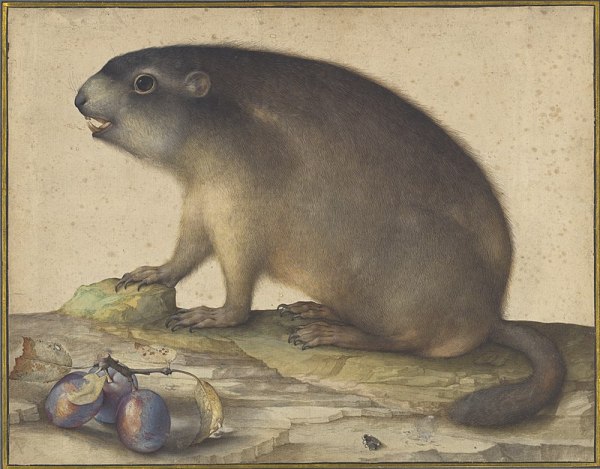
Jacopo Ligozzi, A Marmot with a Branch of Plums, 1605.
NGA 139309, Wikipedia.
According to Wikipedia, the etymology of the term “marmot” is uncertain. It may have arisen from the Gallo-Romance prefix marm-, meaning to mumble or murmur (an example of onomatopoeia). Another possible origin is post-classical Latin, mus montanus, meaning “mountain mouse”. I would not like to meet a mouse this size, scampering alongside the baseboard in my bedroom in the dead of night, or perhaps creeping across my bedcovers, pausing to sniff my breath.
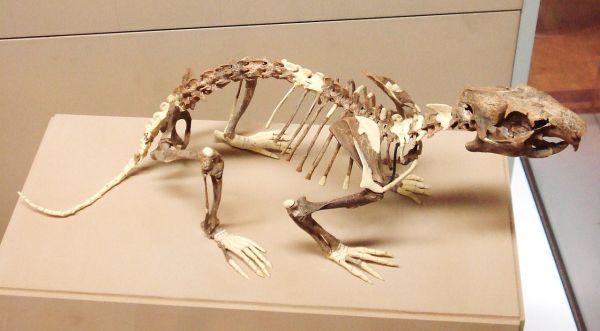
Marmota primigenia fossil. Photo by Ghedoghedo, Aug 2010, Staatliches Museum für Naturkunde Stuttgart; Wikipedia
What is a marmot? It’s essentially a large fat mostly-alpine herbivorous ground squirrel. At last count, there are fifteen species of marmots (read more: Wikipedia). One species, Marmota momax was featured in the film Groundhog Day (also starring Bill Murray.) They are classified in Order Rodentia (rodents), Family Sciuridae (squirrels & allies), Subfamily Xerinae (ground squirrels & allies), Tribe Marmotini (medium-sized ground squirrels), Genus Marmota. There are two subgenera: Marmota with eleven species including Groundhog, Alaska Marmot, and nine species in Eurasia; Petromarmota with four North American species, including Olympic Marmot M. olympus. The film below is about this last species.
If no film or link appears in this email, go to the blog to view it by clicking on the blog title above. If the film stops & starts in an annoying manner, press pause (lower left double bars ||) to let it buffer and get ahead of you.
Thanks to Carol Prismon-Reed for this film suggestion. [Chuck Almdale]
Insects are all over our planet, and you can find these alive today! They’re some of the most dangerous on earth, from the woods, jungles, desert, and rain forest. One things for sure, if you find one – you should definitely run away!
This is an installment of the TheRichest series. If no film or link appears in this email, go to the blog to view it by clicking on the blog title above. If the film stops & starts in an annoying manner, press pause (lower left double bars ||) to let it buffer and get ahead of you. [Chuck Almdale]
Chicks on Display at Malibu Lagoon
A few weeks ago we reported on our two-person trip to Malibu on 5-22-20. Among our sightings were four – maybe as many as six – Canada Goose goslings. Photographer Chris Tosdevin was there a few days earlier and recorded five goslings, plus another very interesting bird. See below. [Chuck Almdale]

Canada goose with five goslings in tow (C. Tosdevin 5-18-20)

Canada goose goslings (C. Tosdevin 5-18-20)
And here’s the “other interesting bird.”

Yes! Killdeer can swim at a very young age (C. Tosdevin 5-18-20)

Killdeer chick wading at lagoon’s edge (C. Tosdevin 5-18-20)
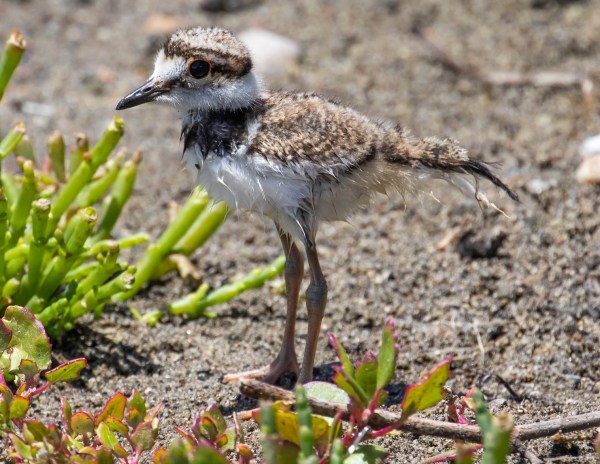
Killdeer chick drying off in the sun (C. Tosdevin 5-18-20)
Every fall, male tarantulas leave home for good with one thing on their minds: sex. But before these spiders can make the ultimate connection, they have to survive the perils of the open road…which include their potential mates.
Every September, a generation of newly mature male tarantulas leave their underground homes to wander the landscape south of La Junta, Colorado, to look for mates. The lucky males will find females, who remain near their dens the whole lives, and possibly mate. But this so-called “migration” is a one‐way trip.
Among the many risks for these itinerant tarantulas, besides running out of time and becoming roadkill, are the local tarantula hawks. The two‐inch long, blue‐and‐gold wasps pounce on the unsuspecting arachnid travelers, hit them with a paralyzing sting, then drag them off to their lairs. Once there, the female wasp lays an egg on the spider that eventually hatches into a larva. The larva burrows inside him to feast and grow before emerging from his body, Alien‐like, as an adult.
If a male does survive long enough to find a den, he courts the female by first “knocking” at the entrance by tapping the ground with his front mouth parts, called pedipalps. He must rely on vibration to communicate his intentions, since tarantulas are mostly blind. If the larger and more dangerous female comes out to investigate, they face off at the den entrance. She may reply with drumming of her own to indicate that she’s receptive ‐‐ or she might try to eat him.
But he’s come prepared. When male tarantulas reach maturity, right before they set out on their quest, they develop a special set of clasps on their front legs called “tibial hooks.” Tibial hooks serve a single purpose: to fasten underneath the female’s fangs during courtship, allowing him to keep danger at arm’s length, so to speak.
This is another installment of the PBS Deep Look series. If no film or link appears in this email, go to the blog to view it by clicking on the blog title above. If the film stops & starts in an annoying manner, press pause (lower left double bars ||) to let it buffer and get ahead of you. [Chuck Almdale]
Diorama Challenge
Another Fun Night at the Museum!

No vegetables were harmed in the construction of these dioramas.
The celebrated diorama halls of the Natural History Museum of the County of Los Angeles’s capture nature in painstaking detail. They each portray breathtakingly realistic scenes of wildlife in their natural habitats, whether it’s a herd of moose in Alaska, a polar bear family in the frozen Arctic, a herd of elephants in Africa, or hippos snoozing by a pond.
Not only are these dioramas iconic for their captivating presence at the Museum, but also for their contributions to pop culture—from Sheryl Crow’s “If It Makes You Happy” music video, to Honda’s “Matthew Broderick’s Day Off” commercial.
Now, we challenge you to recreate the magic at home.
The concept is simple: we are challenging our participants to recreate our classic diorama scenes with items found at home. To participate, all you have to do is:
- See the website for images of our dioramas
- Create your own diorama photo using items found in your home….get creative!
- Include an image of it side-by-side with the original NHM Diorama image
- In your post include tag @NHMLA and #DioramaChallenge
Are you ready to take on the #DioramaChallenge?
Then go to the NHMCLA website where you will find additional creative examples.

Enlist members of your family. Or any loose food.



 SANTA MONICA BAY AUDUBON SOCIETY BLOG