Free email delivery
Please sign up for email delivery in the subscription area to the right.
No salesman will call, at least not from us. Maybe from someone else.
Piping Plovers nest on Chicago beach
A collection of articles about the Piping Plover pair – now dubbed Monty & Rose – who nested and raised chicks on Chicago’s Montrose Beach in 2019, and have returned again this year. The most recent prior hatching in the Chicago area was in 1955.
Both Piping Plovers and Western Snowy Plovers are classified as threatened species. The Piping Plover population is around 4000 pairs, of which approximately 1400 pairs nested in the northern Great Plains in 1996. The North American Snowy Plover population is around 9000 pairs, with the threatened Western (coastal) population totaling around 1500 pairs. [Chuck Almdale]

Photo: USFWS
Piping Plovers Nest in Chicago for the First Time in Over Half a Century
National Audubon Society, by Kawai Marin, June 28, 2019
The enterprising pair have made Montrose Beach their new home, and not even flooding will keep them from trying to build a family. Includes a 53-second video.
Chicago Tribune photo gallery of the Piping Plovers and environs
14 photos, various dates May 8 – June 19, 2019
Three Piping Plover chicks hatch in Chicago, forcing cancellation of concert
Bird Watching Daily, byFor the first time since 1955, Piping Plovers in Chicago have hatched chicks. One young bird hatched on Wednesday, July 17, and two more emerged the following day. A fourth egg in the nest didn’t hatch. After the 2018 breeding season, the Great Lakes population of Piping Plovers numbered only 67 breeding pairs, so every new chick is a cause for celebration. And that’s especially true when the birds breed in a big city.
Piping Plover Watch
Chicago Ornithological Society, June 1 – August 18, 2019
A collection of nine articles with many photos, various dates.
Direct link to Piping Plover Slideshow
Chicago Ornithological Society, photos by Susan Szeszol.
28 photos June 21 – August 18, 2019
Included in the collection of nine articles above.
Piping Plover (Charadrius melodus), Great Lakes Population
U.S. Fish & Wildlife Service, Chicago Ecological Field Services Office, December 31, 2019
Article plus links to other articles.
Three Piping Plover chicks hatch in Chicago, forcing cancellation of concert
Bird Watching Daily, byFor the first time since 1955, Piping Plovers in Chicago have hatched chicks. One young bird hatched on Wednesday, July 17, and two more emerged the following day. A fourth egg in the nest didn’t hatch. After the 2018 breeding season, the Great Lakes population of Piping Plovers numbered only 67 breeding pairs, so every new chick is a cause for celebration. And that’s especially true when the birds breed in a big city.
Endangered piping plovers return to deserted Montrose Beach
Chicago Sun-Times, Last year, the piping plovers’ nest forced the cancellation of the Mamby on the Beach music festival. This year, the beach is already completely empty for the birds.
Monty And Rose, Chicago’s Piping Plover Pair, Return To Montrose Beach For Second Year
Block Club Chicago, by Joe Ward, May 4, 2020
The birds’ nesting efforts could be boosted because the lakefront is closed to the public.
Piper at the Sunset Gates
Andrew McGregor has played the bagpipes for more than two years now. When the coronavirus hit and safer at home initiatives were enacted, he wanted to do something for his neighborhood. Nightly, he goes to a fenced off area in Palisades Park to play ‘Amazing Grace.’ He chose the song, because it captures all the emotion of this uncertain time, he says.
The sun then bids farewell to sunny Southern California, and softly passes through the gates of night.
[Chuck Almdale]
Santa Monica Bagpiper Gets People Through Rough Waters With ‘Amazing Grace’
Huffpost, by Mary Papenfuss, May 11, 2020
Andrew McGregor is “doing his best to give the people anything they can grab onto,” said a neighbor.
The Los Angeles Times Story:
Bagpiper’s nightly coronavirus serenade sounds a mournful yet hopeful note in Santa Monica parkHailey Branson-Potts,May 10, 2020
This might be behind a subscriber wall. Try anyway.
You’ll notice, in the video below, that while many are wearing their mandatory masks, many are not. About 45% of all COVID-19 transmissions are by people who are pre-symptomatic (infected and infectious but not yet showing symptoms) or asymptomatic (infected and infectious but will never show symptoms). Short of staying home, masks are your best protection against infecting others.
Reprise 14: Bird Song Opera | YouTube Video
Editor’s Note: Entry number fourteen in our tenth anniversary honor roll was originally posted 6-5-18 and is eighteenth in overall popularity. It’s popularity on our blog has increased greatly in recent months, and it has appeared many other places on the web. [Chuck Almdale]
***********************************************************
This must be seen and heard to be believed.
Watch it at least twice. It gets better. 3 ½ minutes.
Based on music by Wolfgang Amadeus Mozart, arranged and edited by Volker Pannes, www.shakeup.de. ShakeUp Music recomposed the Magic Flute “Papageno/Papagena” Duet into a colorful Mozart bird aria. Listen to an audiovisual Twitterstorm performed by our feathered fellows.
Many thanks to “Hollywood” Dave Surtees, aficionado of strange humor, for sending this in. [Chuck Almdale]
Your Neighborhood Birds – A Free Handout
Editor’s Note: I apologize if the email version of this posting was unreadable, unintelligible or bizarrely formatted. It looked fine in the preview on the web before I posted it, but it’s appearance in the email I received was just awful. It’s really hard sometimes to get these things to look right in the emails. The material below should display properly. If you download any of the attachments, they should look fine, although in the WORD versions, you may have to play with the margins. I tend to use narrow margins in order to cram more information onto a page. – Chuck Almdale
Back in 2013 I was asked by a local elementary school to give a presentation about their neighborhood birds. I put together a twenty-minute slide show, added a couple of nests, some feathers and bones and off I went. I also took a one-page two-sided handout printed on heavy plasticized 8.5×11″ paper which could be used as a relatively sturdy field guide for absolute beginners. I think the handout was pretty good, so I’m posting it here.
You can print it, download and save it, or simply admire it’s fabulous beauty and wealth of information. If you like the appearance, idea or format, feel free to download and use it. Add or delete birds and information to suit your desires. Make it become your neighborhood birds. Make thousands of versions and millions of copies. Give one to everyone on the planet. Whatever. This bird is now free.
There are three versions attached to this post.*
- Adobe PDF File: Los Angeles Neighborhood Birds – The Ten Most Common. Two pages, designed to be printed one page/two sides. If you have access to a program that can edit PDF files (I don’t) you can use this and adapt it to your desires. Otherwise, it can’t be altered.
- MS Word File – Los Angeles Neighborhood Birds – The Ten Most Common. Same text and photos as above, but anyone with MS Word on their computer can download and edit it as they see fit.
- MS Word File – Los Angeles Neighborhood Birds – The Most Common. Twelve pages. Same as #2 with eleven additional birds, two birds per page, longer text descriptions, two local birdwalks for children and some weblinks.
* Note: There are really eleven birds in the list of ten, but hummingbirds are very small and easily-confused, so the two most-common species are counted as one.
[Chuck Almdale]
Los Angeles Neighborhood Birds – The Ten Most Common
All Photos: Jim Kenney
Text: Ballona Wetlands Land Trust & Chuck Almdale
AMERICAN CROW – Corvus brachyrhynchos
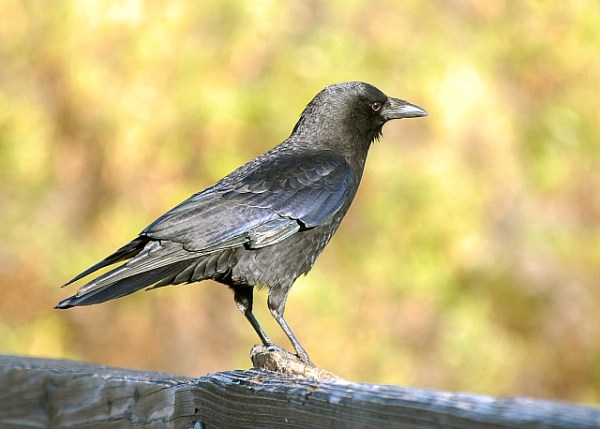 Length: 17.5”. Presence: All year.
A large, all black bird with a thick black bill, black eyes and black legs. Its loud “caw” call is often heard before the bird is seen. Common in parks, mall parking lots and neighborhoods, especially at dawn and dusk. Usually in families of 3-10 birds, sometimes in large flocks. Can be seen in trees, on the ground or in flight. Our largest common neighborhood bird. Large nest is usually high in a tree. Male and female look alike.
NORTHERN MOCKINGBIRD – Mimus polyglottos
Length: 10”. Presence: All year.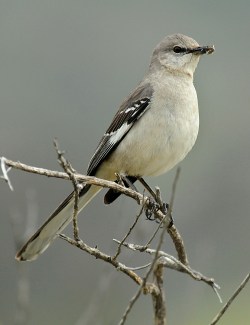
Medium-sized bird with gray back and light underside. Black wings have white wing patches that can be seen in flight. Tail has white edges. Usually very vocal and often heard before seen, imitating songs of other birds, machinery and electronics, sometimes late at night. Often leaping and fluttering wings while singing, it may attack nearly any other animal. Nests in dense bushes and trees. Male and female look alike.
MOURNING DOVE – Zenaida macroura
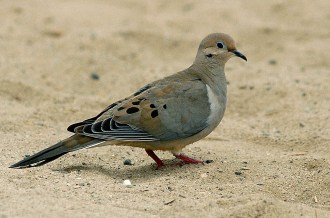 Length: 12”. Presence: All year.
Medium-sized bird with a grayish back and lighter underside and dark spots on the wings. The long pointed tail with white edges is best seen in flight. It has a distinctively slow, mournful call. Its wings also make a whistling sound when it starts to fly. Common on phone wires or on ground looking for seeds or insects. Male and female look alike.
HOUSE FINCH male – Haemorhous mexicanus
Length: 6”. Presence: All year.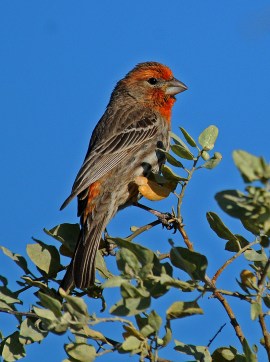
Small seed-eating bird with a cone-shaped bill. Males have red on the face, breast and rump. Both males and females have streaking on their breasts. Common in neighborhoods and parks and most often seen in flocks. Very common at seed feeders with House Sparrows and Mourning Doves. Their small cup-shaped nest may be in a bush, tree or building cranny. Their musical up-and-down song is heard all year; song often ends with an up-slurred “zreeeep.”
ANNA’S HUMMINGBIRD male – Calypte anna
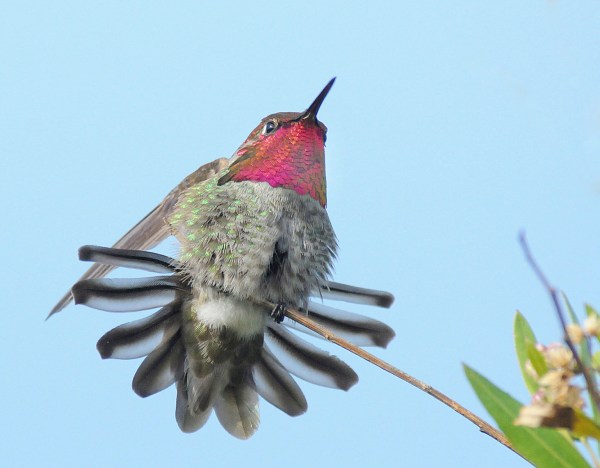 Length: 4”. Presence: All year.
Very small bird able to hover, fly backwards or upside down. Male is green overall with rosy-red forehead and throat. Female has only a few colorful flecks on the throat. Most often seen at hummingbird feeders or at flowers, sipping nectar. Male displays to female by rising to great height, plummeting to below female, making an explosive “chirp”, then rising to above her, hovering, and singing a squeaky song. Female watches all this from her perch on a twig.
ALLEN’S HUMMINGBIRD male – Selasphorus sasin
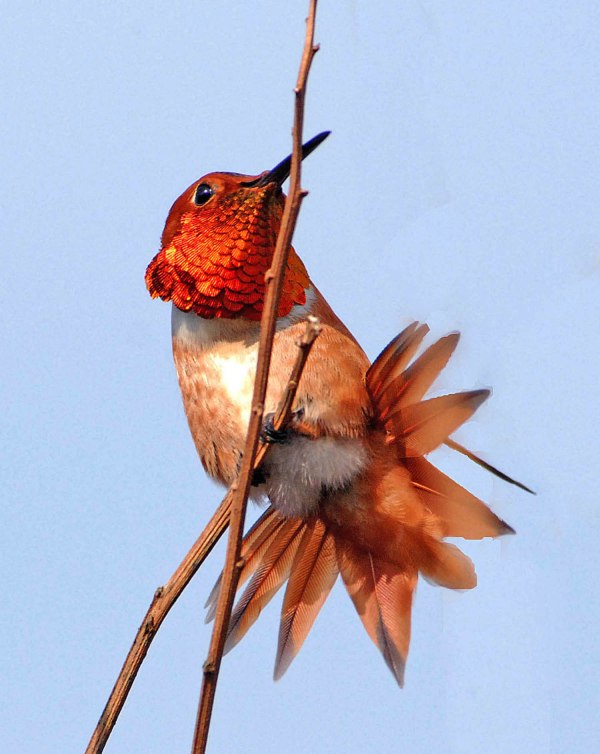 Length: 3.25”. Presence: All year.
Our smallest neighborhood bird. Like all hummingbirds it is able to hover, fly backwards or upside down. Male has a green back with rusty-orange face, belly, rump and tail. Female is rusty-orange on sides and in tail with a few colorful flecks on her throat. Hummingbirds’ wings hum in flight, some species louder than others. Male’s display flight is a tall ‘J’-pattern, plummeting from a great height, making a metallic buzz at the bottom, and curving up to hover in front of the female. All hummingbird females build their nest, incubate eggs, feed and care for the young without help from the males.
ROCK PIGEON – Columba livia
 Length: 12.5”. Presence: All year.
Chunky medium-sized bird very common around parks, parking lots, malls and developed areas. Nearly always in flocks. Also known as ‘park pigeon’ or ‘carrier pigeon’, it comes in many colors from pure white to dark gray. Natural color is gray-blue, two dark wing-bars, white rump and shiny neck and breast. Song is a repeated “coo coo” often made when resting. Eats nearly anything from ground.
HOUSE SPARROW male – Passer domesticus
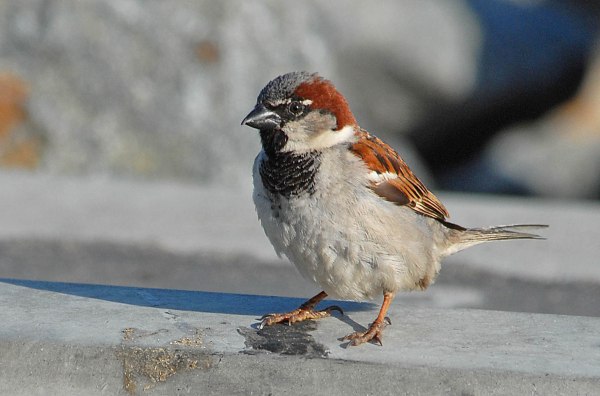 Length: 6.25”. Presence: All year.
Small bird, very common around buildings, parks, parking lots and fast food restaurants. Male has a gray stripe on the crown of its head, brown eyebrows and wings, a black bib and bill and white cheeks. The female is a much duller bird with a pale tan eyebrow. The simple song is a frequently sung “cheep.”
BLACK PHOEBE – Sayornis nigricans
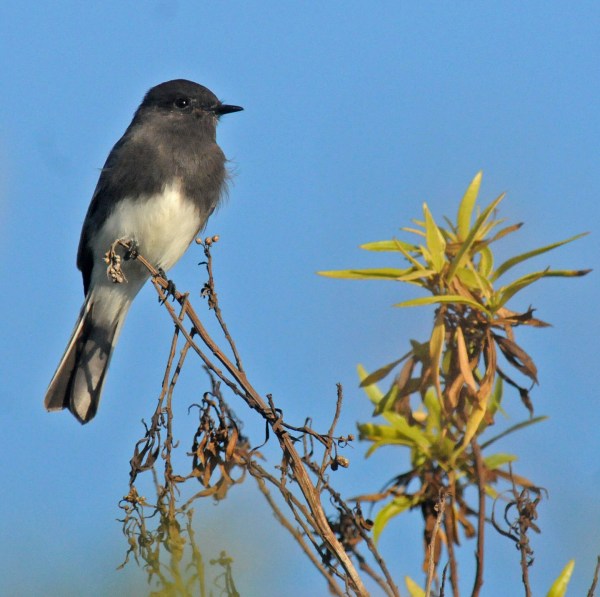 Length: 6.75”. Presence: All year.
Small flycatcher with black head, chest, back, tail and wings. The white belly comes up to a point on the breast. Often seen in residential yards and local parks, flying back and forth from a perch as it hunts flies and other insects. It often pumps its tail up and down when perched. Often nests on houses in the eaves, gutter supports, or lights. Frequently heard song is a soft whistled descending ‘seeeep.” May be near its mate or young, but never in flocks. Sexes look alike.
CALIFORNIA SCRUB-JAY – Aphelocoma californica
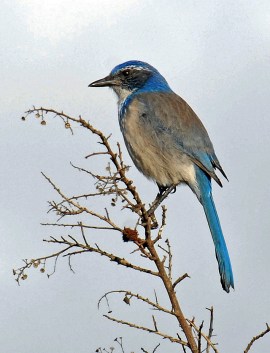 Length: 11”. Presence: All year.
Medium-sized bird with blue and gray back and light gray belly. Dark cheeks and bill and white eyebrow. White throat is bordered by blue breast band. Seen in parks or neighborhoods around thick, brushy areas and oak trees. Often heard before seen. Aggressive at feeders and will eat nearly anything. Often in loose pairs or small family flocks, but also forages alone. Male and female look alike.
CALIFORNIA TOWHEE – Melozone crissalis
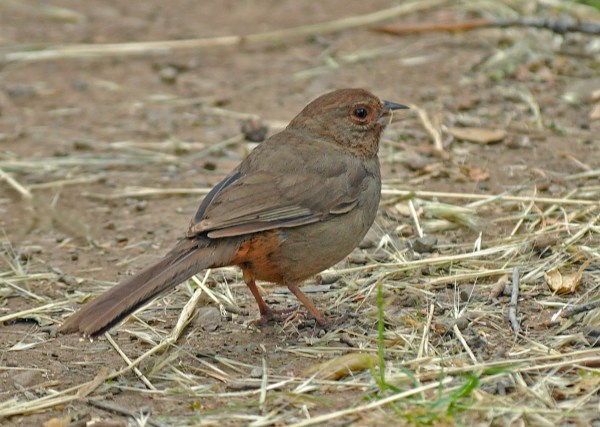 Length: 9”. Presence: All year.
Medium-small brown bird with dark eyes, cone-shaped bill and a long tail with reddish undertail coloring. It feeds quietly on the ground and moves mouse-like through bushes and brush. Its metallic “chink” call note is often heard before the bird is seen. Eats seeds, fruit and insects. Male and female look alike.
Facebook Photo Album of Songbirds – 67 photos
https://www.facebook.com/media/set/?set=a.215104801919570.46394.108132545950130&type=3
Facebook Photo Album of Other Birds – 170 photos
https://www.facebook.com/media/set/?set=a.128635707233147.25144.108132545950130&type=3
Birds make some of the weirdest sounds in the natural world – here’s just a handful of some of the most outrageous!
0:07 Grey Go-away-bird 0:40 Capuchinbird 1:08 American Bittern 1:29 Brown Sicklebill 1:40 Laughing Kookaburra 2:05 Great Potoo 2:35 Willow Grouse 3:13 Jack Snipe 3:44 Channel-billed Cuckoo 4:26 Black-footed Albatross 5:17 Western Capercaillie 6:10 Black-throated Loon 6:43 Northern Lapwing 7:11 Southern Cassowary 7:28 Tui 8:27 Montezuma Oropendola
This is an installment of the Bird Kind series. If no film or link appears in this email, go to the blog to view it by clicking on the blog title above. If the film stops & starts in an annoying manner, press pause (lower left double bars ||) to let it buffer and get ahead of you. [Chuck Almdale]



 SANTA MONICA BAY AUDUBON SOCIETY BLOG