Free email delivery
Please sign up for email delivery in the subscription area to the right.
No salesman will call, at least not from us. Maybe from someone else.
Editor’s Note: Entry number sixteen in our tenth anniversary tour began life as a blog – number three in a series of ten – and later became part of a permanent page. The series, our sixth most popular item, appropriately started Sunday morning 8-14-16, and was reformatted as a single page in November, 2018. Each installment discussed a bird or birds mentioned (infrequently) in the Bible (both Jewish & Christian writings), followed by a biblical factoid – some poorly-known or little-discussed detail of biblical structure, history or lore. As both a birder of many decades and a former student of the Bible, I may have been uniquely qualified for this peculiar task, which was no task at all, but tremendous fun. The initial introductory paragraph immediately below was part of the first installment only. [Chuck Almdale]
Whatever one may think of the bible, it was inarguably written long ago by humans not significantly different than us, who wrote about what they knew and what they imagined, just as we do today. Any mention of a bird means – at a minimum – the writers had noticed them, however little they might have to say about them, or however accurate it might be. In this series, we begin with what the bible says about birds, to which we add what we’ve learned over the centuries since then, to see if we can reveal anything new and interesting. Each essay begins with a citation.
Flood-pigeons, desert-quail – what could be next? Our topic this week is arguably the second most famous bird in the bible, following the pigeon and his Noah. We speak, of course, of the chicken, or more specifically, the male of the species, the cock.

Cock Red Junglefowl in all his glory, Corbett Nat. Park. northeast India (Rahul Pratti)
Peter replied, ‘Everyone else may fall away on your account, but I never will.’ Jesus said to him, ‘I tell you, tonight before the cock crows you will disown me three times.’ Matt. 26:33-34 New English Bible

Methinks the man doth protest too much. (Tatcog School)
Shortly afterwards the bystanders came up and said to Peter, ‘Surely you are another of them; your accent gives you away!’ At this he broke into curses and declared with an oath: ‘I do not know the man.’ At that moment a cock (ἀλέκτωρ – alektor) crew; and Peter remembered how Jesus had said, ‘Before the cock crows you will disown me three times.’ He went outside, and wept bitterly. Matt. 26.73-75 New English Bible
The third time is the charm, as they say. All Christians ought to know of this story, as will many non-Christians. Who cannot feel both pity for poor Simon “Peter” (Πέτρος – Petros: Greek** for rock), and embarrassed empathy with him in his cowardice and fear. How many of us would be courageous and foolish enough to declare faith and allegiance to Jesus, when he’d just been hauled off, probably to be executed, along with any followers who didn’t slip away.
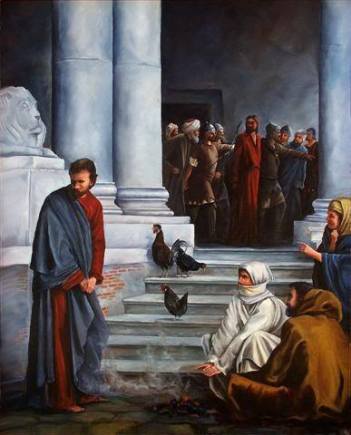
Peter, the rooster and Jesus; Copy of painting by Carl Heinrich Bloch 1834-90 (RonCarol205)
The story tells us that Jesus – well aware of Simon’s rash and boastful tendencies – told him that despite his protestations of faithfulness unto death, Simon wouldn’t even make it until the next dawn before “chickening out” three times. Yet, Jesus forgives Simon his weakness in advance.
This is one of the few tales found in all four Gospels. After the troops arrest Jesus, Simon follows them to see what will happen. Perhaps he will rescue Jesus! In three versions, Simon is alone; in John 18:15 he is accompanied by another disciple. He (or they), end up at the High Priest’s house, where he mingled with others in the courtyard around a fire, trying to stay warm, (see picture) yet still keep a low profile. But his northerner’s accent gave him away as one of the Galilean followers of Jesus.
Mark 14:72 has the cock crowing twice; the other three passages agree on once. But we’ll now leave Simon and Jesus to follow our own trail, which is to examine the third actor in this play, that crowing rooster, and see how he got to first century Judea and why he was crowing.
Anyone who has ever slept near a farmyard, anywhere around the world, knows that roosters (or cocks, as the male of the chicken and allied species are called, as in Peacock), call at dawn, waking us up whether we want to or not. Actually, nearly all birds with any kind of voice and who maintain personal territories, call around dawn during their breeding season, largely to let their avian neighbors know that they lived through the night and they’d better stay out of his territory. Most aren’t as loud as the rooster, for whom it seems to be always breeding season.
Travelers to the tropics are often enchanted by the rainforest “dawn chorus’. Birds begin murmuring their nearly inaudible ‘whisper songs’ around first light, as if still groggy, get really loud around dawn, and dwindle away by ½ – 1 hour after dawn, when it’s light enough for them to begin finding their first meal of the day. In fact this happens everywhere; but it’s more noticeable when 500 species of birds sing within a mile of your bed. Cocks are no exception; his territory may consist of only a few bare square feet of ground, but it’s his and he will fight to the death to protect it and his mating rights with any hens therein. In Muslim countries, cocks first crow at first light, when the Muezzin first calls the faithful to prayer, when the still-unseen sun tints, however slightly, the eastern sky.
About one-third of the 174 members of the Phasianidae (Pheasant & Partridge family) are non-monogamous, including the Red Junglefowl (Gallus gallus), the official English name for our chicken species. Red Junglefowl are very sexually dimorphic, and the male has larger tail and fleshy comb, with overall brighter and more colorful plumage. The male maintains his territory by crowing and fighting with male intruders, using his bony spurs as weapons, and he gathers as many females as he can. Crowing, especially at dawn, is essential to his survival, to fulfill his evolutionary imperative to get his genes into the next generation as often and as successfully as possible. Within his territory, the rooster (cock) “rules the roost.”
According to the Oxford English Dictionary, the English name “cock” for the male chicken is from “kokke” in Old English, “coq” in 12th century French, and kokkr in Old Norse. All these names are likely echoic, imitative of its voice, as in “cock-a-doodle-doo.” The name “rooster” comes from “one who roosts;” both males and females of many Phasianidae species spend the night safely roosting on tree limbs.

Home range of Red Junglefowl
(Handbook of Birds of the World)
All domesticated animals originated somewhere; they haven’t always lived in our backyards. Cattle originated in Europe, where wild cattle are long extinct; Ring-necked Pheasants ranged from western Georgia, east of the Black Sea, to east China; Guinea Pigs began in Peru, where they were a favorite food of the Incas. Red Junglefowl originated in Southeast Asia, where they still range from Nepal and central India eastward through Burma, Vietnam, and Malaysia to the Indonesian Lesser Sunda Islands. Their traditional range likely stopped at Bali, just west of the Wallace Line dividing Asian fauna from Austronesian fauna, but they now live throughout Sulawesi and the Philippines
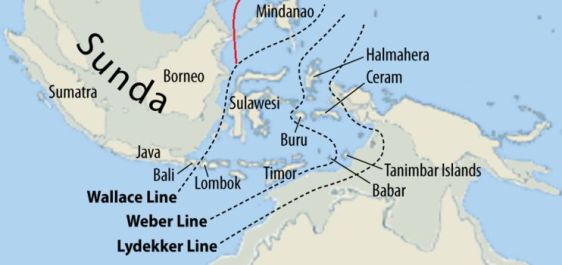
Wallace Line – Bali is eastern end of Red Junglefowl range, excluding introductions by humans. (Wikimedia)
where they were introduced millennia ago. Their official English name, Red Junglefowl, comes from their original color and preferred habitat. Even now, they regally stalk silently through the forest undergrowth, scratching the soil for seeds, grubs, and grit, leading their precocial chicks on their daily search for food. It is a wonderful thing to hear the dawn territorial call of a cock Red Junglefowl in the dripping ink-black rainforest of Malaysia, and know that this bird has escaped the doom befallen so many of his brethren. It’s even more wonderful to see them; both sexes are beautiful, magnificently plumaged birds. This pair, at least, will never suffer that most humiliating of all fates, to become a McNugget.
According to recent genetic studies, the clade of Red Junglefowl living at the western end of their range, in India, are the ancestors of all domestic chickens now found throughout the New World, Europe and the Middle East.
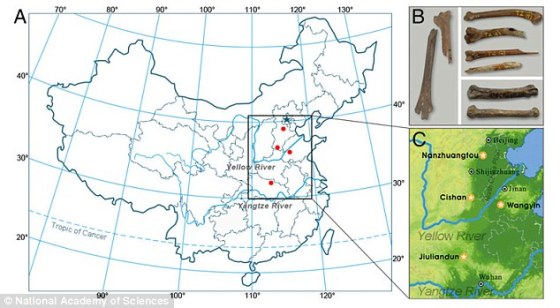
Location of chicken fossils, Yellow River area, China (Daily Mail)
In northern China, fossilized Chicken bones dating back 10,500 years were recently discovered in the Yellow River area, which DNA analysis determined to be Gallus gallus. This area is well outside the known historical range of the species and they are likely the oldest examples of domesticated chickens in the world. It is thought that the ancestors of this group were from southeast Asia – Vietnam for example – rather than from the Indian clade.
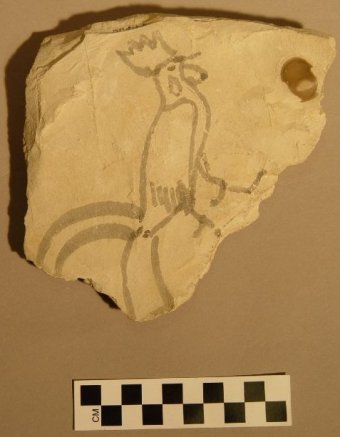
Ostracon of rooster c.1500 BCE, discovered by Howard Carter, 1923, while searching for King Tut’s tomb. (British Museum)
An ostracon (inscription on potsherd) from fifteenth century BCE Egypt depicts a cock. The Annals of Thutmose III (1558-1538 BCE), describing his battles in Babylonia, mentions bringing back to Egypt the “bird that gives birth every day.” By the fifth century BCE they appeared in Lydia (Western Turkey) and Greece.
A Greek legend tells us that western civilization was saved by chickens! In 480 BCE, Athenian general Themistocles, leading his troops to fight Persian invaders stopped to watch two cocks fighting by the side of the road. He gathered his men to watch and said, “Behold, these do not fight for their household gods, for the monuments of their ancestors, for glory, for liberty or the safety of their children, but only because one will not give way to the other.” The soldiers took heart from this – perhaps they didn’t want to seem less courageous than chickens – and marched on to defeat the Persians, thereby saving Athens, Greece, Democracy and Western Civilization. Score one for the chickens, the very models of bravery.
Nowadays, chickens are found by the billions wherever humans live. We are surrounded by these fowl in so-called egg or chicken “factories,” living lives that make our lives of quiet desperation (as Thoreau said) seem in comparison like ecstasy in paradise. We have thoroughly, remorselessly, and unremittingly domesticated them, but it wasn’t always so.
Chickens then, as now, were common trade goods between peoples. These useful and easily maintained animals produce eggs, feathers and flesh; they’re great predators of annoying pests in your garden; the males, equipped with sharp spurs on the back of their feet, are the central attraction of one of the world’s oldest blood “sports” and gambling attractions. Such an animal would spread rapidly among all people who encountered them. Evidence suggests that the residents of Harappa in the Indus Valley not only had chickens, but they traded with the Middle East. Directly or indirectly, chickens were traded hand to hand, village to village, tribe to tribe, nation to nation, until they made their way to Persia, Syria, Egypt, Lydia, Greece and Judea, where they were common as dirt long before the birth of Jesus. Jesus and Simon may have walked from the Galilee to Jerusalem, but that rooster and his ancestors came a whole lot farther. They were so common in Judea that they were hardly worth mentioning, and wouldn’t have been, if first century Jews couldn’t reliably count on them as heralds of the coming dawn, when the new sun shines upon us all.
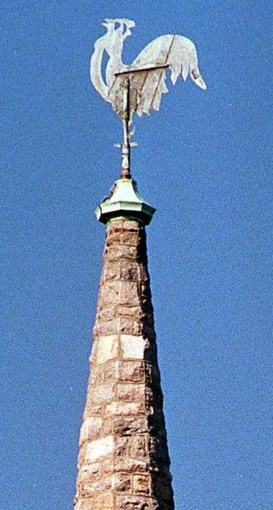
Rooster on top of First Presbyterian Church, Wilmington, NC (MyReporter)
There is one – and only one – additional mention of chickens in the entire bible.
“O, Jerusalem, Jerusalem the city that murders the prophets and stones the messengers sent to her! How often have I longed to gather your children, as a hen (ὄρνις – ornis) gathers her brood under her wings, but you would not let me.” Matthew 23:37
Had this image caught on, rather than that of the good shepherd with his lambs, it might have completely changed the course of Christian iconography. Imagine, if you can, Jesus as the “Hen of God,” and all people as his chicks.
But chickens weren’t completely overlooked by the new religion. Pope Nicholas I (858-867 CE) decreed that a figure of a rooster should be placed atop every church as a reminder of our story—which is why many churches still have rooster-shaped weather vanes.
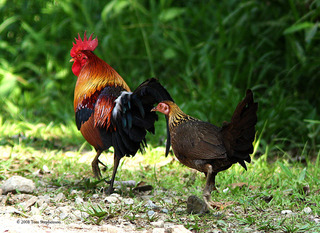
Red Junglefowl pair in forest, where they belong.
(DiscoverLife – Tom Stephenson)
I’ll leave you with one final thought. People today often assume that commerce of goods and ideas between the Orient and the Occident was nearly nonexistent in ancient days. But we now see that chickens, tangible, living animals subject to loss, escape and death, were transported by humans through forests, deserts and rugged mountains, at least 2500 miles by land, well before the time of Jesus. What about intangible things? Our so-called “Arabic numerals” originated in India, where Persians discovered them and popularized them in the Middle East around 825 CE. We know that chickens preceded Arabic numerals by 2300 years. Might not ideas, ethics, philosophies, religious values and theological tenets have made their way back and forth even more easily? Perhaps the origins of the religions and philosophies of the Mediterranean and Middle East – the philosophy of Greece, the polytheism of Egypt, Greece, and Rome, the monotheism of Jews, Christians and Muslims – are not so local and insular as they appear on first glance.
For much more on the history of Red Junglefowl: Smithsonian – How the Chicken Conquered the World
And…just to shake the ground beneath our feet, here’s another view which posits that the cock in our story was not a bird at all, but a horn!
**Bible Factoid #3 – New Testament Greek
You may have noticed that we are now translating from Greek, not Hebrew. The New Testament was written in Greek – not Hebrew, Aramaic, Latin and definitely not the English of the King James Version (1611). The language was not classical Greek, but Koine (street, common or vulgar) Greek. Koine, also called Hellenistic Greek, developed from the various classical Greek dialects and was the main spoken form from the time of Alexander the Great (died 323 BCE) until about the time of Tiberius II Constantine, circa 580 CE. New Testament Koine Greek was filled with local semiticisms, not used elsewhere in the Greek-speaking world. [Imagine if the King James Version had been written in modern Jamaican patois rather than Elizabethan English.]
After Alexander’s conquest, the Middle East was ruled by Greeks (Hellenistic Period) until the Romans conquered the Middle-Eastern empire of the Seleucids in 63 BCE. Greek was the dominant cultural language, so much so that the Jewish Scriptures (the Christian Old Testament) were translated from the original Hebrew into Koine Greek, beginning in the third century BCE and finished in 132 BCE. This translation, called the Septuagint (frequently abbreviated LXX) for the 70 (or 72) scholars reportedly involved in the translation, is believed to have been commissioned by Egyptian King Ptolemy II Philadelphus and intended for the Library at Alexandria. In 1st century CE Judea, Hebrew was still spoken alongside Greek and Aramaic. Aramaic was dominant in Galilee and was probably spoken by Jesus and his followers. A few of the words of Jesus quoted in the Gospels are in Aramaic – abba (familiar form of father – “papa”) and ephphatha (“be opened”) for example. [Chuck Almdale]
References not linked above
Handbook of Birds of the World (HBW), Vol. 2. del Hoyo, J., Elliott, A. & Sargatal, J. eds. (1994) Lynx Edicions, Barcelona. Pgs 452, 529-30.
New English Bible with the Apocrypha, The, Oxford Study Edition. Sandmel, Samuel, Suggs, M. Jack, Tkacik, Arnold J.; eds. (1972) Oxford University Press, New York
Oxford Companion to the Bible. Metzger, Bruce M. & Coogan, Michael D. eds. (1993) Oxford University Press, New York.
Additional Reading
How the Chicken Conquered the World. Adler, Jerry & Lawler, Andrew. Smithsonian Magazine, June 2012.
Birds make some of the weirdest sounds in the natural world – here’s some more of the most outrageous!
0:00 Barred Owl, 0:09 Swinhoe’s Snipe, 0:54 Crested Oropendola, 1:20 Dusky Grouse, 2:00 Cory’s Shearwater, 2:39 Emu, 3:05 European Nightjar, 3:42 Australian Magpie, 4:15 Barred Owl, 4:51 Gunnison Sage Grouse, 5:33 Great-tailed Grackle, 6:23 Common Eider, 7:00 Greater Hoopoe-lark, 7:33 Atlantic Puffin, 8:07 Eurasian Bittern, 8:36 Greater Racket-tailed Drongo, 9:24 Pin-tailed Snipe.
This is an installment of the Bird Kind series. If no film or link appears in this email, go to the blog to view it by clicking on the blog title above. If the film stops & starts in an annoying manner, press pause (lower left double bars ||) to let it buffer and get ahead of you. [Chuck Almdale]
Night (and day) at the Museum
The Natural History Museum of Los Angeles County
has created a portal for the stuck-at-home.
From their website:
We invite you to explore natural and cultural wonders: safely and digitally from home.
Think social distancing with dinosaurs and mammoths, and connecting with nature and community science right outside your own door. The museums want to know: What Blows Your Mind? Connect with inspiring educators, scientists and each other for virtual adventures. Access rich school curriculum and activities to do with your family at home. Participate in exciting crowd-sourced science and social media campaigns. This month, NHMLAC Connects is spotlighting bugs and butterflies.

From NHMLAC website
They have the following activities.
Bug Out With Us
Those shiny, spiky, and furry creatures zipping and buzzing all around us are glorious beings with interesting bios. Introducing Spiky, Hairy, Shiny: Insects of L.A., Bug Fair Is On The Horizon!, Itsy-Bitsy Made Big
Walk On The Wild Side
Nature Comes Home, Celebrate Nature in L.A., There’s Climate History at the Bottom of the Ocean, What Just Flew By My Window?, Owl About Odin
For Families
Spiders, Insects, Snails, Fossil & Dinosaur Puppets, Coloring and more
For Teachers
iNaturalist, BioSCAN Nightwatch kit, RASCals, Butterflies, Slime, Slugs and Squirrels
Out In Los Angeles
Diorama Challenge, Your Story Matters, Ellen Soo Moon, Message from a Bottle, Ladies on the Black Lagoon, A Mural Remembers L.A., Sewing for the Gold, L.A.’s Street Trees, Hollywood Found a Home, The Stories behind L.A.’s Street Names
Global Adventures
The Ant-decapitating Fly, Netting Specimens in Costa Rica, From Giant Ground Sloths to Fossil Poop, Humans on the Move, My Dinosaur Dig, Woolly Rhino Fossil with Xiaoming Wang, Meet our Polar Explorer
We have over 35 million specimens in our collections, including dino bones, colorful birds, and bits of L.A. History. Most of those treasures are behind the scenes! Take a peek inside our hidden museum worlds.
Behind the Scenes at NMH
Skype a Scientist, A Fossilized Turtle Revealed, Our Pollinator Meadow, Time-traveling Marine Biologist, Birds of a Feather, and more
Behind the Scenes at the Tar Pits
Our Rich Digs, Prehistoric Plants Unlock Ice Age Secrets, Bats Living at the Tar Pits, Mammoths, Sloths and more
Behind the Scenes at the Hart
Lizards, Shields, Games, Bison, William S. Hart, A Cowboy’s Collection
MindBlown at Home
Animal Care, Digging into Dinosaurs, Creatures, our Plesiosaur and other employees
[Chuck Almdale]
Lightsail 2 still orbits Earth
LightSail 2 is a reflective aluminized mylar sail 340 square feet (32 square meters) in size. The core, containing imaging and communications equipment, is 4″ x 4″ x 12″ (10cm x 10cm x 30cm). It is a giant kite, successfully sailing on the solar wind.
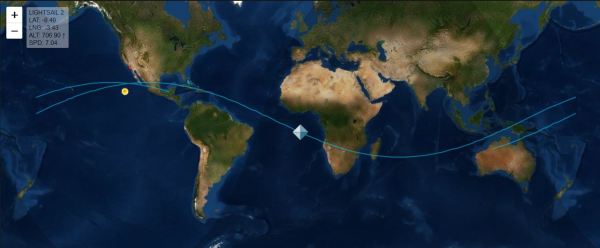
Location of LightSail 2 (shiny square) on 5-12-20 at 1319 PDT. Red dot locates Los Angeles, CA; yellow dot locates apparent direction of sun as seen from Los Angeles at that moment. Map adjusts to your location.
Lightsail 2, the Planetary Society’s second foray into crowdfunded interplanetary travel, was launched on 25 June, 2019, carried to orbit altitude on a SpaceX Falcon Heavy rocket. Eighty minutes later the sail’s Prox-1 carrier spacecraft was released at 720 kilometers (447 miles) above the ground.
Link to LightSail 2 Mission Control information panel
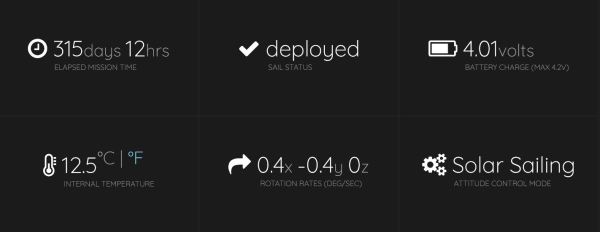
Researchers received their first pictures from LightSail 2 on 7 July, 2019, and its solar sails deployed on 23 July 2019. By 31 July 2019, despite much random tumbling, LightSail 2’s slightly off-center ovoid orbit had been raised by a measurable amount. On 4 September, 2019 it had achieved a maximum apogee (maximum altitude) of 734 Km above ground, with a counterbalancing perigee (minimum altitude) of 699 Km. By 10 March, 2020 the orbit had slightly decayed – as intended – to 727 Km apogee and 693 Km perigee. In September, 2020 the perigee is expected to begin to encounter Earth’s atmosphere, and LightSail 2 will initiate reentry.

When the sun is slightly below the horizon and Lightsail is in the proper position, you can see it by reflected sunlight. This page will tell you the times/dates of all passes nearest your location and the upcoming visible passes for your location.
If you see it, the Planetary Society wants to hear from you! They’ll want to know: your name, your observing location, your observing date and time, and any other additional info you want to share, including pictures. [Chuck Almdale]
Reprise 15: Western Snowy Plovers on the Beach
Editor’s Note: Entry number fifteen in our tenth anniversary tour was never a blog (i.e. emailed to readers). These two related public service information pages were created in October 2012, accessible only by visiting the blog, yet is our seventh most popular page or blog. It began as an effort to document all the banded Western Snowy Plovers in Los Angeles County, including their origins. After a great deal of work we were nearly caught up when things fell apart: personnel at Point Reyes Bird Observatory (now Point Blue) changed, their method of keeping their historical records changed, the entire banding code system changed, and communication with everyone involved became far more difficult. In late 2018 work on it stalled; we hope to soon re-edit it and bring it up to date. What you find below are snippets of information; there is much more on the permanent pages (Banded WSPs, WSP History) on the blogsite.
[Chuck Almdale]
****************************************************
It all starts with a banded chick in hand
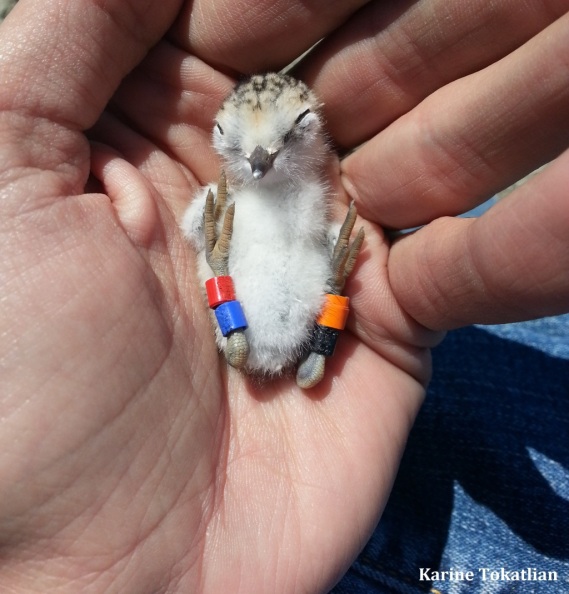
KO:BR banded Summer 2013 at Eden Landing
San Francisco Bay Bird Observatory (photo: Karine Tokatlian)
A rogue’s gallery of banded Snowy Plovers
seen in Los Angeles County (60 photos)
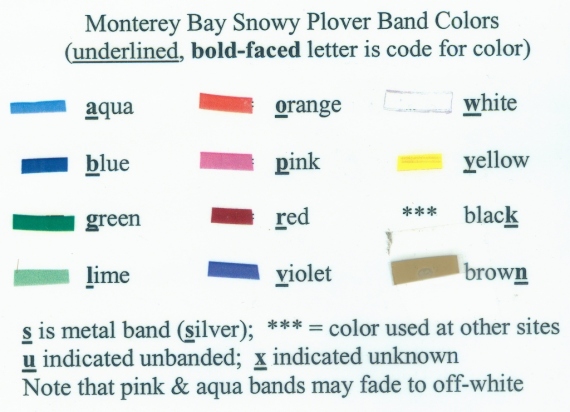
Snowy Plover leg band color chart from Point Blue
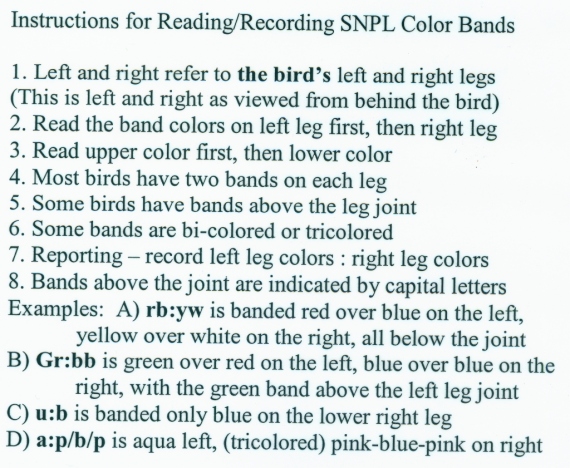
Instructions for use on flip side of chart
VIDEO #1 – THE SNOWY PLOVER AND YOU (10 minutes)
SNOWY PLOVER RING COMBINATIONS SEEN IN LOS ANGELES COUNTY
Data Order: Band Combo, location & date banded, additional comments, locations seen followed by dates for each location. Dates are in sequential order, with location changes noted.
Example: Zuma (next two dates are for Zuma) 10/18/15, 10/21/15, Malibu (new location for next 3 dates) 10/22/15, 10/23/15, 10/24/15, Zuma (back to Zuma for next 3 dates) 10/28/15, 10/29/15, 11/10/15
METAL: As yet unidentified Gov’t Agency numbered band
Read Bands: Left Top, Left Bottom: Right Top, Right Bottom
* Photograph of this bird on this date is in the slide show
X or x – No band or no 2nd band, either fell off or never present
/ – As in R/O/R – denotes “split” band, one narrow color overlaying wider color; can be double R/O or triple R/O/R
SLIDESHOW AT TOP ABOVE CONTAINS PHOTOS OF THESE BIRDS:
aa:bl – Ft. Ord 2016 – Malibu 8/28/16, *9/6/16, 9/11/16, 9/25/16, *10/12/16, 10/23/16, 11/15/16, 12/9/16, 12/25/16, 1/02/17, 1/17/17, 1/26/17, 1/31/17, 2/8/17, Zuma 2/22/17, 2/26/17, Malibu 9/29/17, 10/22/17, 10/27/17, 11/24/17, Zuma Beach 12/2/17, Malibu 1/26/18, Zuma 2/2/18, 2/16/18, 10/3/18, 10/12/18,
BN:RW [If BN:RW, Great Salt Lake¹] Later changed to NW:OW or NW:RW below, Vandenberg 2016
BO:AA or WW – ?? – Cabrillo Beach *8/23/10
Bp:ow.3 – [B = anodized Blue band above left leg joint; w.3 = white band with “3” on band] Coronado Naval Base San Diego hatched 5/12/17, fledged 6/11/17 – Zuma *9/29/17
BW:WW – Oceano Dunes¹ 2014 – Malibu *9/17/14, 9/24/14, 9/28/14, 10/3/14, 10/26/14,
ga:oy – Oceano Dunes¹ 2014, 2 chicks banded – Malibu 9/28/14, *10/3/14, 10/26/14, 12/28/14, *1/25/15; one nested Bolsa Chica 2015 fledged 6 chicks, the other nested Coal Oil Point Sta Barbara Co.; 3 more chicks banded GA:OY Oceano Dunes 2015 due to lack of bands; Malibu 9/27/15, 10/25/15, *11/22/15, *12/5/15, 1/19/16; nested Bolsa Chica 2016 fledged 3 chicks; 2 GA:OY banded birds – likely 2015 fledges – nested Oceano Dunes 2016; Malibu 7/24/16, 7/27/16, 8/5/16, 8/17/16, 8/28/16, 9/6/16, 9/11/16, 9/22/16, 10/13/16, Bolsa Chica 12/7/16, Malibu 12/9/16, 12/25/16, 1/2/17, 1/11/17, Bolsa Chica female 1/14/17, 1/27/17, 1/31/17, 2/7/17, 2/8/17, 2/28/17, Malibu 7/23/17, 7/28/17,
NR:NR – Band originally used Vandenberg AFB¹ 2013 on 3 chicks, birds not seen since 2013 until the following Malibu sightings of adult bird with no metal exposed on lower left R band – Malibu *7/4/16, 7/16/16; combo reused Vandenberg AFB 2016 on multiple chicks, has metal exposed on the upper and lower portions of lower left R band.
rr:bb – Oceano Dunes¹ 2016 female 1 of 2 chicks – Malibu *9/22/16, *10/12/16, 10/23/16, 12/9/16, 12/25/16, 1/17/17, 1/26/17, 1/31/17, Zuma Beach 2/22/17, 2/26/17, 3/7/17, Malibu 4/7/17, 4/23/17 (female), 5/4/17* on eggs, 5/12/17 on eggs, 5/19/17 on eggs, 5/22/17 on eggs, 5/26/16 on eggs, 5/28/17, 9/9/17, 9/15/17, 9/20/17, 9/24/17, 9/29/17, 10/22/17, 11/10/17, 11/24/17, 12/2/17, 12/24/17,
*5/4/17 rr:bb discovered mated and nesting (2 eggs) on Malibu Beach
W/R/W:R – Bandon Beach Coos County Ore, 2 banded 6/18/11 & fledged²; left leg is a “triple-striper” band, – Santa Monica *02/04/12
Yy:ob – Monterey Bay Moss Landing female banded 7/18/18. Yy means yellow above ankle & below – Zuma 10/3/18, 10/12/18,
Another 30 band combinations are listed on the blog page.
Lead photo on the Slide Show page
KO:BR – Chick banded Summer 2013 Eden Landing SFBO, not seen in LA County
OTHER BIRDS SEEN IN THE COUNTY, NO PHOTOS YET AVAILABLE
AR:AP – North Marina, 2001 – Male – Zuma 01/04/02, 02/06/02, 02/22/02, 03/10/02, 03/27/02, 12/02/02 (orig rept as AR:SP S is Silver, P is mottled), 01/04/03, (AR:SP) 02/23/03
AV:RS – Moss Landing Salt Ponds, 2099 (a guess, tape missing) [Unknown combo. All AV on Left at this time were from Monterey Bay & Service Bands on these plovers all were placed on lower Left legs.¹] – Cabrillo 12/24/00
AY:AA – ?? – Malibu 11/28/10, 12/26/10, 2/27/11
AY:RO – Salinas S.B. 2007 – male – Malibu 08/26/07
AY:Yx – [Prob. chick banded New River, Oregon 7/23/04¹] – missing band R leg – Hermosa 01/19/05
Another 52 band combinations are listed on the blog page.
Notations for above two lists:
Orig Rpt – Originally reported as
Superscript ¹ – Per communication from Lynne Stenzel 12/15/16
Superscript ² – Per communication from Dave Lauten 1/9/17
PACIFIC COAST NESTING LOCATIONS
- Washington State
- Oregon
- California
- Humboldt and Mendocino Counties
- San Francisco Bay Bird Observatory
- Monterey Bay
- Oceano Dunes
- Vandenberg AFB
- Guadalupe – banding discontinued 2005
- Chevron – no banding
- Coal Oil Point Reserve – banding discontinued 2006
- Bolsa Chica
- San Diego

nb:gw at Zuma (G. Murayama 2-16-18)
The following seven-part article, written in August, 2012,
first appeared on Malibu Patch, a local blogsite.
It focused on the Snowy Plover winter roosting colony
on Surfrider Beach, adjacent to Malibu Lagoon.
The other six parts can be found here on the blog.
Western Snowy Plover History
Part I – The Birds Themselves
Few people know it, but some very rare birds live on Surfrider Beach. They spend most of their time resting in little hollows in the sand, like the ones your heel makes. Countless people saunter through their flock, never noticing them until they scurry away from underfoot.
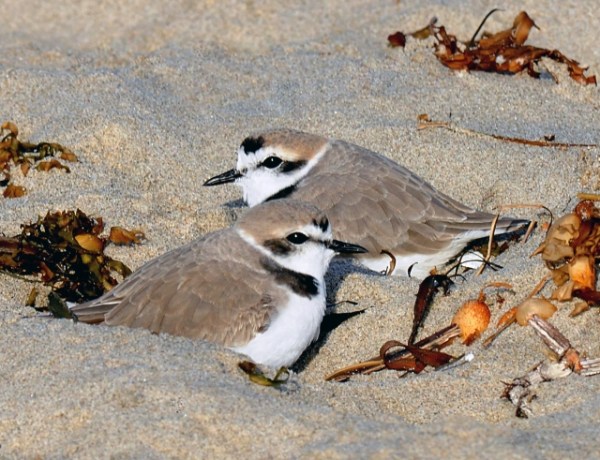
Western Snowy Plover adult pair on Surfrider Beach (J. Kenney 3/26/10)
Western Snowy Plovers are small, even for a bird, only 6 ¼” long, much smaller than your foot. Their cryptic gray, brown, white and black plumage blends perfectly into the sandy beach. They’ll crouch for hours, motionless in sandy hollows. They’re hard to see even when searching for them.
Snowies, like all shorebirds, are carnivores; more accurately, insectivores, eating any invertebrate or tiny fish they can find. Their preferred foraging area is wrack (washed-up sea vegetation) left at the high-tide line, often abundant with kelp flies and small invertebrates. Their short stubby

1st winter Western Snowy Plover & wrack, Surfrider Beach (J. Kenney 1/31/10)
bills, typical of plovers, are unlike the long and thin bills of sandpipers, who often probe – even underwater – for prey in sand and mud. Snowies don’t; they pick their food from the wrack or sand.
Because they prefer to forage in wrack,
the best feeding time is just after high tide when waves are retreating; wrack is fresh and full of living invertebrates. They will go onto wet sand to forage, but they avoid waves, however small.
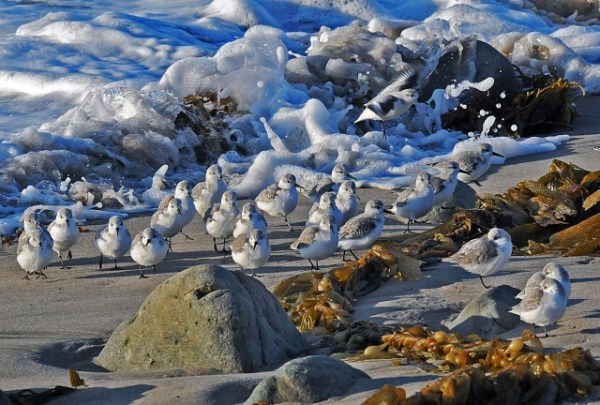
Sanderling flock on Surfrider Beach
(J. Kenney 11/29/09)
The flocks of small gray-white-brown birds which rapidly scurry on little black legs, following and fleeing the wavelets as they wash in and out, will almost certainly be Sanderlings. They are slightly larger than Snowies, with long, pointed black bills. They run a lot. They resemble Snowies, feed with Snowies, even roost within Snowy flocks. It takes experience to reliably tell them apart in the field. Found nearly worldwide, Sanderlings are abundant.
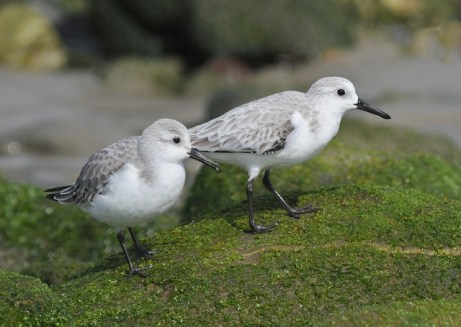
Sanderling duo in nonbreeding plumage (J. Kenney 11/19/09)
Snowy Plovers are far from abundant. We’ll discuss that in a later part.
Unlike the “I’m late, I’m late” scurrying of the Sanderlings, Snowies move in a pensive, hesitant, almost thoughtful manner. They take a few steps, 3–15 perhaps, and pause, often with one leg cocked, ready for their next step, whenever they decide to take it. All of the 67 Plover species walk this way.
By the time the tide begins to rise, they’ve stopped foraging. They rest together in a small area, their roost, slightly inland of the beach berm (high ridge) between the lagoon and ocean, separated by a few inches to a few feet from one another, in small sand hollows they make, find, or improve upon. When it’s quiet with no predators or noisy humans nearby, they may sleep, although at least one lookout stays awake. When feeling frisky, they’ll chase one other around, jumping in and out of each other’s hollows.
Like you and me, Snowies need to rest and recharge their batteries. For millions of years, their lonely, windswept, barren beaches were sufficiently safe and undisturbed places to live, forage and breed. Times have changed. [Chuck Almdale]
The other six parts of this article can be found here on the blog.

How many Snowies can you find in this picture?
(C. Almdale 3/28/10)



 SANTA MONICA BAY AUDUBON SOCIETY BLOG