Free email delivery
Please sign up for email delivery in the subscription area to the right.
No salesman will call, at least not from us. Maybe from someone else.
Reprise 18: It’s Right There…In The Green Tree!
Editor’s Note: Entry number eighteen in our tenth anniversary tour began life on February 6, 2011 as a blog then was given a permanent page due to continuing interest from birders around the country. Although both authors strive tirelessly to practice the advice given below, Lillian is far better at it than Chuck. [Chuck Almdale]
It’s Right There…In The Green Tree!
Getting others onto that bird
by Chuck Almdale & Lillian Johnson
[Introductory Note: Feel free to copy this document. To satisfy our boundless curiosity, please take a minute and drop us a line to let us know you did. Also, sign up on our blog to receive our future brilliant, useful, lovely and informative missives. A shorter version is also posted on the American Birding Association website here.]
For many of us birding is both fun and art. As with any art, the better you get, the more you enjoy it and vice versa. But like any art, there are certain techniques you can learn that will enhance both your enjoyment and ability to share that enjoyment with others. Many of these techniques and skills are covered in field guide introductions or magazine articles. Neglected – until now – is the skill of getting others onto the bird you’ve found. The joy of finding a new, interesting or beautiful bird increases when you share it with others. But you can’t share the joy if you can’t help others find the bird. In our years of birding, we have personally made and witnessed others make every single error mentioned below, and we find the suggested techniques to be the most useful and easily learned. Of the five basic points presented here, the final point is the least known, most difficult to learn and gets the longest explanation.
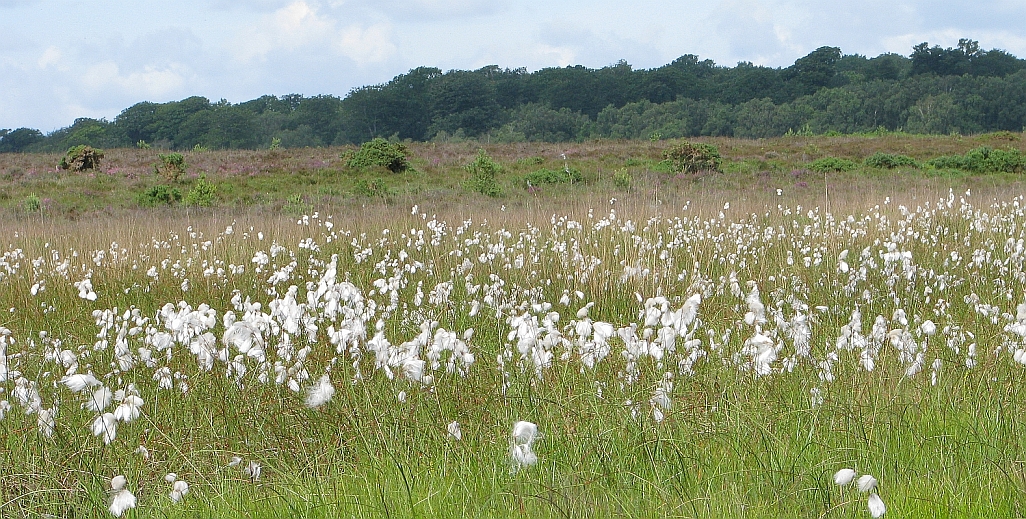
“Next to the white flower, you say?” (C. Almdale)
Five Basics Points
1. Scope: If you have a scope, it’s easy to put it on the bird and let others look through it. This works well with birds like shorebirds, ducks or resting raptors who don’t move around quickly; it’s nearly useless with birds flitting through foliage. When the bird is cryptic, partially hidden or distant and small, give useful additional hints: look in the upper left portion of the field of view; behind that vertical snag, at the base of the red rock. Knowing which part of the scope’s view contains the bird can quickly ensure a useful look. (When a group of people are waiting to use the scope, it’s good birding etiquette to take the briefest look possible, yet still see the bird. However, if you just can’t find the bird in a “reasonable” amount of time, move aside and let others take a first quick look, before returning to the scope to try again. Second looks are for lingering.) If people of widely varying heights will likely be using your scope, the 45°-angled eyepiece is easiest for everyone, especially tall people who won’t have to stoop so much.
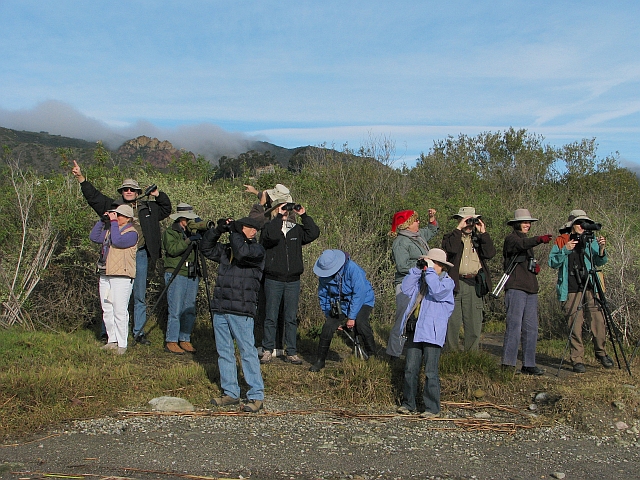
Photo: C. Almdale
2. Make sure they are looking in the same direction as you are: If possible, just glance around. Birders are often looking in completely different directions while arguing about what they’re seeing. This happens so frequently that it’s a standing joke. A quick, “Stand behind me and look where I’m looking,” can at least get them into the general area.
3. Clock face: In many situations, using a clock face can aid speedy location. In an open area, twelve o’clock is always straight ahead, six is directly behind, three and nine are 90 degrees right and left, respectively. Other hours fall in between. For a vertical object such as a tree, twelve is the top, three is ½ way down on the right side, and so on. On a boat or in a car (or line of cars), twelve is always straight ahead down the road, six is straight behind down the road, and so on. It should go without saying (but won’t) that 12 o’clock is not simply the direction in which you happen to be looking at that very moment. [I once had to ask a professional bird tour leader why everything was always at 12 o’clock.] If you’re young and don’t know how to read an analog clock, now is a good time to learn.
4. Laser Pointers: Pen-sized lasers are now available in various powers and produce either a red or a (preferred) green beam. Many professional tour guides have them, but not all are equally adept at using them. The key is to start from something obvious like a large rock or tree trunk. Starting somewhere close to the bird is far less important. Once everyone

5mW green laser pointer from SciPlus.com

Flash Gordon’s
Laser Gun
sees your laser “dot”, they can follow it as you move it along trunk, limb and twig to the bird. Never shine the beam on the bird. Keep the dot where the bird cannot see it so you don’t startle it. Just below the bird works well, as does slowly circling the bird. The dot will display better on solid objects like trunks or twigs than on leaves. Avoid jerky movements. In a forest of leaves, a moving laser beam scatters over many yards. Birders more than a few feet to either side of the pointer-holder sees only a series of bright dots scattered over many leaves and won’t have a clue as to which dot is nearest the bird. Warn the viewers of this scattering and reduce beam movement to a minimum. In southern California where the sun always shines and forests can be thin, lasers aren’t as useful. An alternative low-tech solution is a small hand mirror of glass or polished metal, for which you will need the friendly cooperation of the sun.
5. Start from something obvious, easily locatable or describable: How many times have you heard someone say “Near the red leaf in the green tree,” or “By the tall grass stem”? You look around and are confronted with dozens of trees with hundreds of red leaves or an entire field of grass. Which tree, which leaf, which stem? Which direction, how far? This person has forgotten that no one else can see from their exact perspective. They’ve also forgotten that what is absurdly obvious to them through their own binocular’s tiny field of view is not at all obvious to anyone else confronted with a 360° view of the whole, wide world.
The Toughest Basic: Starting from the Obvious
Selecting the Obvious: So what’s considered obvious? Here are some examples: a lone tree, bush, rock or structure; the largest, tallest, darkest, lightest of an assortment of such items; the only group of trees; the leftmost or rightmost tree in a line of trees; the only cloud in the sky; the sun; the only red house in sight; the only house on the left side of the road; the only green sailboat on the sea. Something unique (in the proper sense of one-of-a-kind).
Often the bird is in a flock which everyone has already spotted. “There’s a Ominous Cleft-Toe in with that flock of warblers.” They now know that you’ve seen the warblers, are not simply misidentifying one of them, and it helps someone who is way off target to know that they can first find a larger target (a flock) and then look for one individual.
Watch the Birdie: Keep your eye on the bird while giving directions: if it flies, you can follow it and give information about its movements (“going left through the foliage, watch for movement”). Often you can anticipate its movements, especially useful when someone is looking through a scope’s small field of vision. If it flies out of sight, you don’t waste your time telling people where the bird used to be.
Moving from the Obvious: Once you’ve gotten everyone looking in the same direction with your “see the big red house on the hill?”, you can bring them along step-by-step to the bird. “OK, starting from the house, come down to seven o’clock ½ way down the hill to a large brown rock with a big white spot on the bottom left side. Got that? OK, from four o’clock on the rock, go about three times the width of the rock to a round gray-green bush with a forked leafless stick pointing out ten o’clock from the center of the bush. The bird is on the left fork.”
Occasionally someone “jumps the gun” on your instructions. They hear the first instruction, “See the big red house…” and immediately complain that they can’t see the bird. Deal with this as best you can. We tend to steamroll right over such comments and restate, perhaps enunciating slightly more forcefully: “Now, starting from the red house on the hill, come down to seven o’clock…”, and so on. We figure that getting many or most of the people on the bird is good for the first pass; there is always someone who wasn’t listening or couldn’t follow. If the bird stays put long enough, we try again.
Distance: Use fractions or multiples of an obvious dimension: ½ way down the hill; ¾ of the distance from bottom to top of the tree; 1/3 of distance from trunk to the left edge of the tree; twice as high as that radio tower; ½ way from the sun to the left edge of the lake. Although the size of the field of vision varies widely among binoculars, the number of binocular fields often works as a rough estimate, especially for small specks in the sky: “About two binocular fields 12 o’clock from the red house.” Absolute distances such as 30 ft or 200 yards are of little use. Most people are poor judges of distance or size (although few will agree), and we underestimate distances more often than overestimate. When you do give a distance, qualify it with a phrase like “about”, “approximately” or “between” to indicate that this is a rough estimate. Saying “about 20 to 40 ft away” or “less than 50 feet” can keep people from searching in vain 500 feet away. The exact distance does not matter, it’s the order of magnitude which is important. At sea, where people are looking at a lot of water, distance should be relative to the horizon. Hearing, “Plummeting Mackerel-Snapper, Ten o’clock, ½ way to the horizon,” is a lot more useful than “500 meters off the port bow.”
Practice this on your own, in your own mind. Assume your friends are down the trail when you spot the extremely rare and highly-prized Divested Widget and signal them. They come running. The bird is in the middle of a bunch of trees and bushes, not thrashing around, nor drawing attention to itself. Start from the obvious, and work your way to the bird, using the clock and relative distances. After a while, this sort of verbal guidance becomes close to second nature.
A starting point can be near or far from the bird, above or below, closer or farther. It only has to be OBVIOUS to everyone. Sometimes a building two miles away is the best point from which to start. Sometimes it’s a knee high red flower 5 feet away. It could be a group of bushes halfway across a field. It could be a moving car, boat or airplane, or even another bird that everyone has already seen. It all depends on the situation.
Other Problems
Partially Obscured Birds & Parallax: Sometimes you see a bird through a hole in foliage or twiggy brush. It can’t be seen except from exactly where you are standing. You can confirm this by moving a bit and seeing if the bird becomes obscured. In this case, you either hog the view for yourself, or you move aside and give someone else your spot. We recommend the latter. Birders are typically polite, and you’ll rarely be criticized for staying put. But your courteous behavior will be appreciated and you’ll likely be helped in return soon or later by legions of grateful fellow-birders. When a bird is likely to be obscured from points of view other than your own, and you sense that someone simply cannot see it from where they are standing, you can either advise them of this or physically move them into a better location. This is a matter of putting yourself into their shoes, which comes with experience.
Bird Color, Shape, Orientation, and Relative Size: Sometimes leaves, grass or twigs obscure a bird, or it blends into the background. In these cases, giving a description of the relative size, color, bill shape, or body orientation e.g. “hanging upside down” can help. Woodpeckers often blend into the trunk or limbs to which they cling. Warblers are famous for moving through the canopies of leafy trees. Towhees and thrashers match their dead leaf feeding grounds in coloration. “Facing left, body almost horizontal, shoulder hunched, tail hidden” can get someone onto a well-camouflaged motionless bird.
Dealing with Beginners: The special problems beginners experience usually fade with time, so you’ve probably forgotten that you once had them too. Try to figure out their views and put them into perspective for them and others in the group. When one person says that he is looking at a “really big bird way up high” and others can’t find the soaring eagle, the leader who sees where the beginner is looking can help by saying something like, “that robin ten feet up in the oak does look huge and high compared to the juncos on the ground we have just been watching.” A statement like that explains the original observer’s perspective to more experienced participants, helps the others to know what they are looking for (if they want to see the robin), teaches the beginner something about perspective and comparison, and probably won’t be interpreted as an insult. A similar problem arises after looking at very small birds – sparrows or warblers for example – for a long time, and you then spot something larger like a thrush, and it looks enormous. Alternatively, watch geese for a while, and sparrows will look like gnats.
Wide Open Spaces
Reference points for birds flying across an open space (ocean, lake, marsh, desert, prairie, etc.) may be impossible. If you dare not stop looking, try giving these pointers. 1) Direction of flight (right, left, away, towards, etc.). 2) Height (at horizon, X binocular fields above horizon, directly overhead, etc. 3) “Look at me and look where I’m looking.” 4) Stand behind you and imitate your direction and height. 5) If available, reference obvious clouds, mountains, etc. 6) Get well “ahead” of bird’s approximate location, and either wait for it to fly through your field of view, or sweep back towards the bird. This works better than trying to catch up to or hit directly on the current location. 7) Suggest a likely focal distance, although infinity usually works best. When you’re far out-of-focus, you can look directly at a bird and still be unable to see it.
It Won’t Always Work
You will not always be successful. Accept that. You’re just birding, not solving world peace; keep your sense of humor about this. Some people are not listening, some are hard of hearing, some have vision problems, some may be angry about the coffee they spilled on themselves, and some have bad binoculars or dirty glasses. Sometimes you’re off your own game, thinking about something else, short-tempered, irritated, too cold, too hot, or you brain just isn’t working properly that day. That’s life. Some people seemingly cannot follow directions from anyone. Some people can never learn to give them. Some of the best birders in the world are unable to give decent directions to anyone else, no matter what. And then there are those most fortunate and irritating few who seem to never need directions. They instantly see everything, everywhere, until you want to bop them on the head from frustration with your own inability.
Main Points to Remember
If you learn these basics and pay attention to your own words, you’ll find that you are actually practicing a form of mindfulness which benefits yourself as well as others. Start from the obvious: something they can’t miss, unique in color, shape, size, type, or direction. Use clock face directions. Identify which member of a group (e.g. 2nd tree from the right). Use fractions and multiples of visible and identified objects rather than absolute distances. Identify bird color and other characteristics when needed. After a short while, you’ll find it actually takes less time and energy to give good directions than to give poor ones. When others quickly get onto the bird, you don’t have to keep repeating your inadequate directions. In the amount of time it takes to say, “It’s right there, in the green tree,” you can say, “Single oak, 8 o’clock, 50 meters, 9 o’clock at the foliage edge.” And you will have said something useful.
And Finally – What Not To Say
There’s no end to the list of unhelpful, frustrating and irritating directions one might give. And – like speaking to someone in a foreign language – emphasis, raising your voice and waving your arms around does little more than scare away the bird.
Here is a small sampling: It’s right there. Just look. Over there. IT’S RIGHT THERE! There! No, there! Are you blind? It’s right behind the green leaf.
Some useless directions are situation specific. For example: out there in the grass (in a large grassy field); on the phone wire (in a city forest of wires); on the pole (with dozens of phone poles stretching off to the horizon); on the bush (in the chaparral); on the water (from the beach). And the ever-favorite classic, frequently heard in the forest: it’s in the tree, the green tree. You get the idea.
Getting into details of distance and size can mislead. “A foot high bird on a 100-foot boulder 500 yards away,” can be really misleading when the bird is really a Rock Wren 50 yards away on a car-size boulder.
Americans and British traveling overseas should avoid our imperial system of inches, feet, yards and miles. Metric system users vastly outnumber us. Most Americans have a vague notion that a meter is about the same as a yard, so it’s easy to stick to meters. Metric system users probably won’t have a clue as to what an inch, foot or a mile means, nor will they see any point in learning unless they are aficionados of archaic systems of measurement.
When your knowledge of vegetation, rocks, soil, clouds and so forth is better than average, it’s easy to assume your audience knows what you know. “It’s in the Phalanopsis growing by the Dichrodendria next to that crumbled intrusion of franitactic gneiss,” can be as useless as saying “over there” to the person who cannot identify those objects. And you just might use the wrong term, thus confusing those that actually do know. Common English is best. It’s probably safe to point out the sole oak in a stand of conifers, or a brick among the rocks, but don’t assume too much.
And if you want to really irritate your birding mates, just give a lengthy description of the bird before giving any clue as to where you’re looking. Make sure you pop in such exclamations as, “Oooh….Wow…what IS that?…It’s soooo beautiful….Pleeeese tell me what it is!”, ad nauseam, finishing up with “well…it’s….geee…how can I – whoops!, it just took off! You missed it? Are you blind? It was right there…in the green tree!”
We wish to thank the following people who replied to our BirdChat and CalBird solicitations for comments: Brandon Best, Wim van Dam, Richard Danca, Roy John, David Spector, John van der Woude, Bob & Carol Yutzy. Buried somewhere in the verbiage above, you will find your suggestions, perhaps mutilated beyond all recognition.
Authors Biographical Note, in case you reprint this. Chuck and Lillian live in a northern Los Angeles suburb where – when not peering at birds far and wide and jotting down notes – Lillian tends their ever-growing assortment of native California plants, fruit trees and vegetables, and maintains contacts with other humans. Meanwhile, Chuck practices piano, studies philosophy and edits the Santa Monica Bay Audubon chapter blog (where you can see other examples of their off-kilter humor, especially their controversial monograph on the Western Roof Owl). They’ve been birding for over thirty-five years and leading local bird trips for over twenty years. Now retired, they report that dinner time conversation is always “exciting and richly detailed” due to their previous careers as accountants.
Editor’s Note: Entry number seventeen in our tenth anniversary honor roll was originally posted 4-1-18 and is eleventh in overall popularity. Although not a “monograph” in the usual sense of the term, it was written by only one person (me), so we classify it as the fifth installment in our SMBAS Spring Quarter Monograph Series for purposes of convenience. Many local birders were unhappy to have missed this very unusual bird. [Chuck Almdale]
***********************************************************
The Ehler’s Sandhopper-Warbler, Harenadsultim ehleri, a rarely-glimpsed member of the little-known central Asian family of Sandhopper-Warblers, was photographed recently at Malibu Lagoon by the same team of ornithologists who first discovered the bird in its native habitat, and for whom it is named.

Breeding grounds of Harenadsultim ehleri, northern Gobi Desert, south central Mongolia
Despite the preferred mode of locomotion as implied by the name, the bird is capable of sustained flight over long distances. Its normal migration takes it from its breeding grounds in central Mongolia to the interior desert of Western Australia.

Approximate wintering grounds of Harenadsultim ehleri in Central Western Australia
The exact migratory route is unknown, but is conjectured to lead through southward through China and Indochina to Indonesia, then eastward through Indonesia to the Australian mainland, where it gravitates to a remote area in the arid central western desert. This route would necessitate numerous short and several long flights over water.
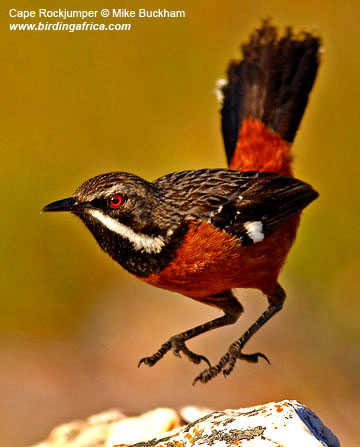
Cape Rockjumper,Chaetops frenatus. Not at all the same bird. (Mike Buckham BirdingAfrica.com)
The bird sighted at Malibu must have flown east across the Bering Strait, but – it is believed – otherwise could have hopped its way east and southward along the sandy shores of the Pacific Northwest and down to Southern California.
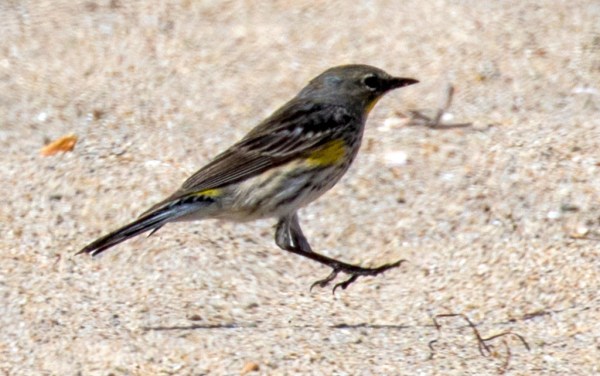
Hareanadsultim ehleri – Ehler’s Sandhopper-Warbler – on the move at Malibu Surfrider Beach (photo: R. Ehler 3-25-18)
Adventurers, explorers, scientists and all-around bon vivants Drs. Randy & Polly Ehler originally discovered and documented this elusive species in the Gobi Desert of Southern Mongolia. The bird has been sighted only once on its presumed regular wintering grounds in the Australian desert.
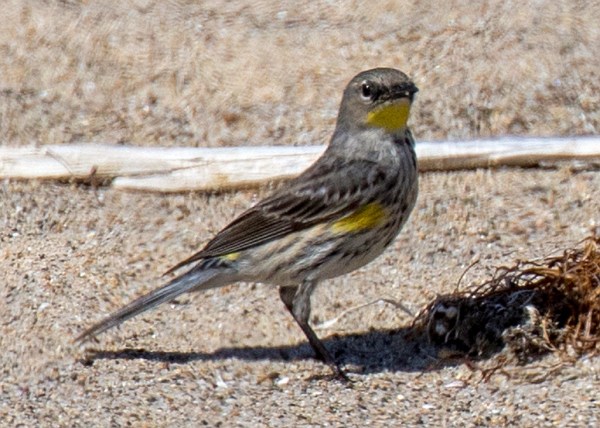
Hareanadsultim ehleri momentarily at rest
(photo: R. Ehler 3-25-18, Malibu Surfrider Beach)
LATE-BREAKING ALERT !
Several days after our original publication on 1 April, 2018, we received notification of another sighting of Ehler’s Sandhopper-Warbler. This sighting was on 1 April, 2018, but several hundred miles farther north and quite likely was a different bird. Well-known international birder, Don Roberson, was out doing some morning birding at a local patch, – the Iris Canyon vicinity of the Monterey MPC campus in Monterey, CA, to be exact – when he spotted and photographed what he naturally assumed at the time to be a typical Yellow-rumped Warbler, well on its way into alternate (breeding) plumage. Alerted by our announcement of the presence of the Ehler’s Sandhopper-Warbler in Southern California, he reexamined his photograph, and discovered it to be the Ehler’s. This second sighting supports Dr. Ehler’s conjecture (see below) that the birds may have been wintering in North America for a very long time, their presence unsuspected until now, due to their exceptionally close resemblance to the completely unrelated and very common Yellow-rumped Warblers.
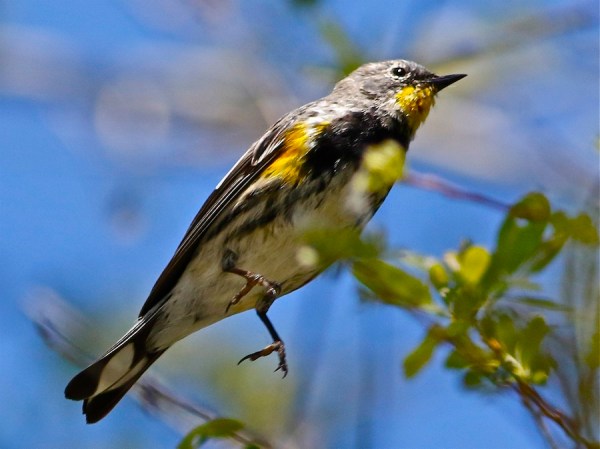
Another sighting of Ehler’s Sandhopper-Warbler in Monterey, CA, this time hopping over both a large bush and the photographer. (Don Roberson 4-1-18)
The photo is included in Roberson’s eBird checklist for that day (not yet corrected to include Ehler’s Sandhopper-Warbler). Roberson commented (personal communication):
I read your article with interest. Just yesterday I photographed what I thought was a Yellow-rumped Warbler but I wonder if I misidentified the Ehler’s Sandhopper-Warbler? Please note that subject in question is clearly hopping — without spreading its wings — except this hop was much higher — well over my head — and might suggest a means to hopping from canopy to canopy across North America. Just a hypothesis, of course, as you guys are on the cutting edge of science here.
Roberson has long been fascinated by the entire spectrum of the families of birds of the world, and has assembled his photographs and discussions into an extremely attractive and informative website*, Creagrus @ Monterey Bay, deserving of the attention of any birder similarly inclined. I didn’t see Sandhopper-Warblers among the avian families listed, so this sighting will give him something to catch up on. Many thanks to Don Roberson for his alert attention to detail!
* Note: The lovely Swallow-tailed Gull Creagrus furcatus is endemic to the Galapagos Islands and is the sole species in its genus.
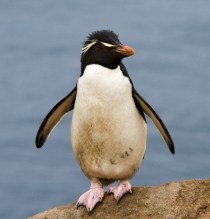
Rockhopper Penguin, Gorfou sauteur, Antartica (Samuel Blanc 12-21-07 wikicommons)
Renowned Ornithologist Dr. Leotard Skynyrd, of Miskatonic University in Arkham, Mass. confirmed the once-in-a-lifetime nature of the sighting. “It’s an extremely long way for an six-inch bird to hop, and well away from the presumed route to its normal winter destination. As far as I know, this species has never previously appeared in North America. In fact, I’ve never heard of this species at all. It’s completely new to me.”
Dr. Ehler said of his namesake: “Despite the close resemblance to our locally common Setophaga coronata auduboni, the habits of the bird are quite different. In its native treeless Mongolian desert, it feeds on small invertebrates found on salt-tolerant shrubs in the Ephedra genus of Ephedraceae, plants not too dissimilar from our own Mormon Tea Ephedra

Sand Hopper, Talitrus saltator, Bornholm Is., Baltic Sea (Arhold Paul 7-7-06 Wikicommons)
nevadensis of western America, except that the stimulating effect of the plant’s leaves is enormously greater than that of our local plant. Invertebrates feeding on the plant ingest the ephedrine alkaloids, which are then passed on to the bird which feeds on them. We believe that the birds cannot stand still because of all the ephedrine in their diet. They are quite literally “hopped up.”
H. ehleri do not build nests, rather laying their eggs directly on the sand in the shade of an ephedra bush. The eggs are then covered with 1-3 inches of

American Bird Grasshopper, Schistocerca americana, Green Swamp, Florida, 6-29-08 (birdphotos.com)
sand. The chicks hatch 25-30 days later, depending on ambient weather and the warmth of the sun-heated sand. Highly precocious, the 2-4 chicks immediately move into the shady bush and begin gleaning for insects feeding on the leaves and stems. How they find their way to Australia after maturation is unknown.
Dr. Ehler adds: “For all we know, they may have been coming to North America for a very long time, but were previously unnoticed due to their strong

Common Bush Hopper male, Ampittia dioscorides, Kadavoor, Kerala, India
(Jeevan Jose 10-2-11)
resemblance to the local race of Yellow-rumped Warblers. Although it is currently presumed that they normally winter in the Australian desert, this presumption is based entirely on that single sighting. With this new sighting here in North America, we have to consider the possibility that North America is the preferred and usual wintering location, and the Australian winter locale was the aberration, or even a misidentification, as unlikely as that may seem.
Starting from the unusual behavior of this

Candy-striped Leaf Hopper, Graphocephala coccinea (Bruce Marlin 6-15-05)
little-known avian family, some zoologists and taxonomists have gone so far as to call into question the current phylogeny, asking themselves whether a complete re-sequencing needs to be considered. Dr. Skynyrd comments: “Some are conjecturing that the family of “Hoppers” be created, and animals that share the unusual preference of locomotion by hopping be classified to it. This seems premature to me. Much more research needs to be done before such a radical reconfiguration is made. But if the reclassifications are done, the new family would contain only hoppers, not jumpers. Despite superficial similarities between hopping and jumping, entirely different musculoskeletal structures are involved.”
We look forward to these exciting possibilities in avian nomenclature and classification. Congratulations to the Ehlers for their revolutionary discoveries.
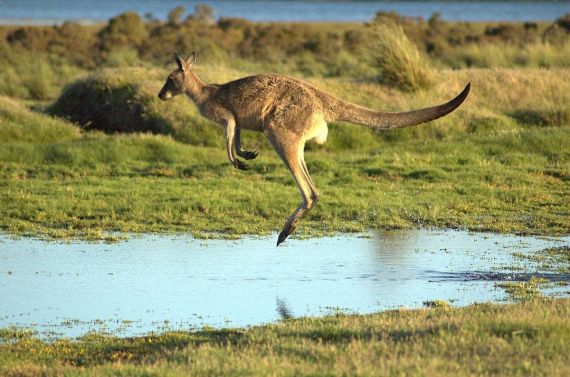
Forester Kangaroo in mid-hop, Narawntapu Park, Tasmania
(PanBK at the English language Wikipedia, Dec 05)

Attha Hoppers courting rituals frequently consist of numerous participants involved in simultaneous gyrations, akin to the mating behavior of squid. (The Medestrian.com)
The above species member of the proposed family of Hoppers has numerous songs utilized only during courting.
Those who found this article plausible, should also read:
2013: Birders Take Their Lumps With Their Splits
2012: Canyonland Roadrunner Captured on Film
2011: New Hummingbird Species Discovered in Los Angeles County!
2010: The Western Roof-Owl: Bird of Mystery
[Chuck Almdale — 1 April, 2018]
Oxpeckers and other Birds in the News
Birds in Science News Magazine, to be specific.
Here’s four recent articles.
1. Hitchhiking oxpeckers warn endangered rhinos when people are nearby
Black rhinos responded to the birds’ alarm calls by becoming vigilant
By Gloria Dickie. April 9, 2020
2. A naturalist writes an homage to bird migration
Ken Kaufmann’s new book, A Season on the Wind, shares observations of the passage of birds through northwestern Ohio.
By Diana Steele. January 17, 2020
3. ‘Wonderchicken’ is the earliest known modern bird at nearly 67 million years old
The animal is a common ancestor of today’s ducks and chickens
By Carolyn Gramling. March 18, 2020
4. Seabirds may find food at sea by flying in a massive, kilometers-wide arc
Radar shows that groups of birds can form a giant, coordinated line over the ocean’s surface
By Jake Buehler. April 13, 2020
And another about our clever and manually dexterous ancestors. Are you surprised?
5. This is the oldest known string. It was made by a Neandertal
A cord fragment was found clinging to a stone tool at a French archaeological site
By Bruce Bower April 9, 2020
Editor’s Note: Entry number sixteen in our tenth anniversary tour began life as a blog – number three in a series of ten – and later became part of a permanent page. The series, our sixth most popular item, appropriately started Sunday morning 8-14-16, and was reformatted as a single page in November, 2018. Each installment discussed a bird or birds mentioned (infrequently) in the Bible (both Jewish & Christian writings), followed by a biblical factoid – some poorly-known or little-discussed detail of biblical structure, history or lore. As both a birder of many decades and a former student of the Bible, I may have been uniquely qualified for this peculiar task, which was no task at all, but tremendous fun. The initial introductory paragraph immediately below was part of the first installment only. [Chuck Almdale]
Whatever one may think of the bible, it was inarguably written long ago by humans not significantly different than us, who wrote about what they knew and what they imagined, just as we do today. Any mention of a bird means – at a minimum – the writers had noticed them, however little they might have to say about them, or however accurate it might be. In this series, we begin with what the bible says about birds, to which we add what we’ve learned over the centuries since then, to see if we can reveal anything new and interesting. Each essay begins with a citation.
Flood-pigeons, desert-quail – what could be next? Our topic this week is arguably the second most famous bird in the bible, following the pigeon and his Noah. We speak, of course, of the chicken, or more specifically, the male of the species, the cock.

Cock Red Junglefowl in all his glory, Corbett Nat. Park. northeast India (Rahul Pratti)
Peter replied, ‘Everyone else may fall away on your account, but I never will.’ Jesus said to him, ‘I tell you, tonight before the cock crows you will disown me three times.’ Matt. 26:33-34 New English Bible

Methinks the man doth protest too much. (Tatcog School)
Shortly afterwards the bystanders came up and said to Peter, ‘Surely you are another of them; your accent gives you away!’ At this he broke into curses and declared with an oath: ‘I do not know the man.’ At that moment a cock (ἀλέκτωρ – alektor) crew; and Peter remembered how Jesus had said, ‘Before the cock crows you will disown me three times.’ He went outside, and wept bitterly. Matt. 26.73-75 New English Bible
The third time is the charm, as they say. All Christians ought to know of this story, as will many non-Christians. Who cannot feel both pity for poor Simon “Peter” (Πέτρος – Petros: Greek** for rock), and embarrassed empathy with him in his cowardice and fear. How many of us would be courageous and foolish enough to declare faith and allegiance to Jesus, when he’d just been hauled off, probably to be executed, along with any followers who didn’t slip away.
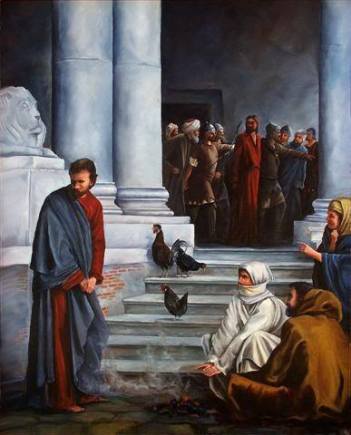
Peter, the rooster and Jesus; Copy of painting by Carl Heinrich Bloch 1834-90 (RonCarol205)
The story tells us that Jesus – well aware of Simon’s rash and boastful tendencies – told him that despite his protestations of faithfulness unto death, Simon wouldn’t even make it until the next dawn before “chickening out” three times. Yet, Jesus forgives Simon his weakness in advance.
This is one of the few tales found in all four Gospels. After the troops arrest Jesus, Simon follows them to see what will happen. Perhaps he will rescue Jesus! In three versions, Simon is alone; in John 18:15 he is accompanied by another disciple. He (or they), end up at the High Priest’s house, where he mingled with others in the courtyard around a fire, trying to stay warm, (see picture) yet still keep a low profile. But his northerner’s accent gave him away as one of the Galilean followers of Jesus.
Mark 14:72 has the cock crowing twice; the other three passages agree on once. But we’ll now leave Simon and Jesus to follow our own trail, which is to examine the third actor in this play, that crowing rooster, and see how he got to first century Judea and why he was crowing.
Anyone who has ever slept near a farmyard, anywhere around the world, knows that roosters (or cocks, as the male of the chicken and allied species are called, as in Peacock), call at dawn, waking us up whether we want to or not. Actually, nearly all birds with any kind of voice and who maintain personal territories, call around dawn during their breeding season, largely to let their avian neighbors know that they lived through the night and they’d better stay out of his territory. Most aren’t as loud as the rooster, for whom it seems to be always breeding season.
Travelers to the tropics are often enchanted by the rainforest “dawn chorus’. Birds begin murmuring their nearly inaudible ‘whisper songs’ around first light, as if still groggy, get really loud around dawn, and dwindle away by ½ – 1 hour after dawn, when it’s light enough for them to begin finding their first meal of the day. In fact this happens everywhere; but it’s more noticeable when 500 species of birds sing within a mile of your bed. Cocks are no exception; his territory may consist of only a few bare square feet of ground, but it’s his and he will fight to the death to protect it and his mating rights with any hens therein. In Muslim countries, cocks first crow at first light, when the Muezzin first calls the faithful to prayer, when the still-unseen sun tints, however slightly, the eastern sky.
About one-third of the 174 members of the Phasianidae (Pheasant & Partridge family) are non-monogamous, including the Red Junglefowl (Gallus gallus), the official English name for our chicken species. Red Junglefowl are very sexually dimorphic, and the male has larger tail and fleshy comb, with overall brighter and more colorful plumage. The male maintains his territory by crowing and fighting with male intruders, using his bony spurs as weapons, and he gathers as many females as he can. Crowing, especially at dawn, is essential to his survival, to fulfill his evolutionary imperative to get his genes into the next generation as often and as successfully as possible. Within his territory, the rooster (cock) “rules the roost.”
According to the Oxford English Dictionary, the English name “cock” for the male chicken is from “kokke” in Old English, “coq” in 12th century French, and kokkr in Old Norse. All these names are likely echoic, imitative of its voice, as in “cock-a-doodle-doo.” The name “rooster” comes from “one who roosts;” both males and females of many Phasianidae species spend the night safely roosting on tree limbs.

Home range of Red Junglefowl
(Handbook of Birds of the World)
All domesticated animals originated somewhere; they haven’t always lived in our backyards. Cattle originated in Europe, where wild cattle are long extinct; Ring-necked Pheasants ranged from western Georgia, east of the Black Sea, to east China; Guinea Pigs began in Peru, where they were a favorite food of the Incas. Red Junglefowl originated in Southeast Asia, where they still range from Nepal and central India eastward through Burma, Vietnam, and Malaysia to the Indonesian Lesser Sunda Islands. Their traditional range likely stopped at Bali, just west of the Wallace Line dividing Asian fauna from Austronesian fauna, but they now live throughout Sulawesi and the Philippines

Wallace Line – Bali is eastern end of Red Junglefowl range, excluding introductions by humans. (Wikimedia)
where they were introduced millennia ago. Their official English name, Red Junglefowl, comes from their original color and preferred habitat. Even now, they regally stalk silently through the forest undergrowth, scratching the soil for seeds, grubs, and grit, leading their precocial chicks on their daily search for food. It is a wonderful thing to hear the dawn territorial call of a cock Red Junglefowl in the dripping ink-black rainforest of Malaysia, and know that this bird has escaped the doom befallen so many of his brethren. It’s even more wonderful to see them; both sexes are beautiful, magnificently plumaged birds. This pair, at least, will never suffer that most humiliating of all fates, to become a McNugget.
According to recent genetic studies, the clade of Red Junglefowl living at the western end of their range, in India, are the ancestors of all domestic chickens now found throughout the New World, Europe and the Middle East.

Location of chicken fossils, Yellow River area, China (Daily Mail)
In northern China, fossilized Chicken bones dating back 10,500 years were recently discovered in the Yellow River area, which DNA analysis determined to be Gallus gallus. This area is well outside the known historical range of the species and they are likely the oldest examples of domesticated chickens in the world. It is thought that the ancestors of this group were from southeast Asia – Vietnam for example – rather than from the Indian clade.
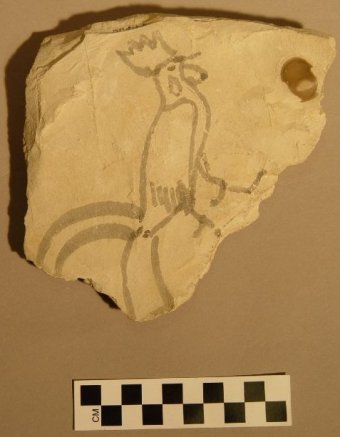
Ostracon of rooster c.1500 BCE, discovered by Howard Carter, 1923, while searching for King Tut’s tomb. (British Museum)
An ostracon (inscription on potsherd) from fifteenth century BCE Egypt depicts a cock. The Annals of Thutmose III (1558-1538 BCE), describing his battles in Babylonia, mentions bringing back to Egypt the “bird that gives birth every day.” By the fifth century BCE they appeared in Lydia (Western Turkey) and Greece.
A Greek legend tells us that western civilization was saved by chickens! In 480 BCE, Athenian general Themistocles, leading his troops to fight Persian invaders stopped to watch two cocks fighting by the side of the road. He gathered his men to watch and said, “Behold, these do not fight for their household gods, for the monuments of their ancestors, for glory, for liberty or the safety of their children, but only because one will not give way to the other.” The soldiers took heart from this – perhaps they didn’t want to seem less courageous than chickens – and marched on to defeat the Persians, thereby saving Athens, Greece, Democracy and Western Civilization. Score one for the chickens, the very models of bravery.
Nowadays, chickens are found by the billions wherever humans live. We are surrounded by these fowl in so-called egg or chicken “factories,” living lives that make our lives of quiet desperation (as Thoreau said) seem in comparison like ecstasy in paradise. We have thoroughly, remorselessly, and unremittingly domesticated them, but it wasn’t always so.
Chickens then, as now, were common trade goods between peoples. These useful and easily maintained animals produce eggs, feathers and flesh; they’re great predators of annoying pests in your garden; the males, equipped with sharp spurs on the back of their feet, are the central attraction of one of the world’s oldest blood “sports” and gambling attractions. Such an animal would spread rapidly among all people who encountered them. Evidence suggests that the residents of Harappa in the Indus Valley not only had chickens, but they traded with the Middle East. Directly or indirectly, chickens were traded hand to hand, village to village, tribe to tribe, nation to nation, until they made their way to Persia, Syria, Egypt, Lydia, Greece and Judea, where they were common as dirt long before the birth of Jesus. Jesus and Simon may have walked from the Galilee to Jerusalem, but that rooster and his ancestors came a whole lot farther. They were so common in Judea that they were hardly worth mentioning, and wouldn’t have been, if first century Jews couldn’t reliably count on them as heralds of the coming dawn, when the new sun shines upon us all.
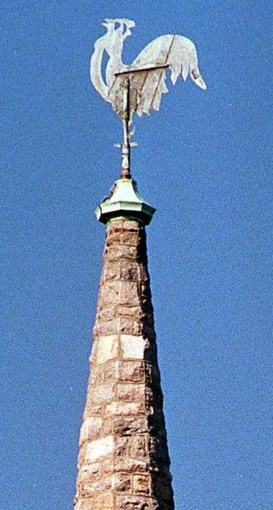
Rooster on top of First Presbyterian Church, Wilmington, NC (MyReporter)
There is one – and only one – additional mention of chickens in the entire bible.
“O, Jerusalem, Jerusalem the city that murders the prophets and stones the messengers sent to her! How often have I longed to gather your children, as a hen (ὄρνις – ornis) gathers her brood under her wings, but you would not let me.” Matthew 23:37
Had this image caught on, rather than that of the good shepherd with his lambs, it might have completely changed the course of Christian iconography. Imagine, if you can, Jesus as the “Hen of God,” and all people as his chicks.
But chickens weren’t completely overlooked by the new religion. Pope Nicholas I (858-867 CE) decreed that a figure of a rooster should be placed atop every church as a reminder of our story—which is why many churches still have rooster-shaped weather vanes.
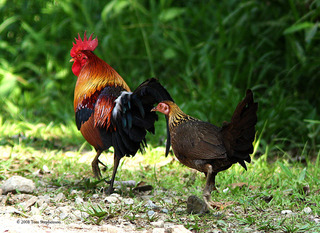
Red Junglefowl pair in forest, where they belong.
(DiscoverLife – Tom Stephenson)
I’ll leave you with one final thought. People today often assume that commerce of goods and ideas between the Orient and the Occident was nearly nonexistent in ancient days. But we now see that chickens, tangible, living animals subject to loss, escape and death, were transported by humans through forests, deserts and rugged mountains, at least 2500 miles by land, well before the time of Jesus. What about intangible things? Our so-called “Arabic numerals” originated in India, where Persians discovered them and popularized them in the Middle East around 825 CE. We know that chickens preceded Arabic numerals by 2300 years. Might not ideas, ethics, philosophies, religious values and theological tenets have made their way back and forth even more easily? Perhaps the origins of the religions and philosophies of the Mediterranean and Middle East – the philosophy of Greece, the polytheism of Egypt, Greece, and Rome, the monotheism of Jews, Christians and Muslims – are not so local and insular as they appear on first glance.
For much more on the history of Red Junglefowl: Smithsonian – How the Chicken Conquered the World
And…just to shake the ground beneath our feet, here’s another view which posits that the cock in our story was not a bird at all, but a horn!
**Bible Factoid #3 – New Testament Greek
You may have noticed that we are now translating from Greek, not Hebrew. The New Testament was written in Greek – not Hebrew, Aramaic, Latin and definitely not the English of the King James Version (1611). The language was not classical Greek, but Koine (street, common or vulgar) Greek. Koine, also called Hellenistic Greek, developed from the various classical Greek dialects and was the main spoken form from the time of Alexander the Great (died 323 BCE) until about the time of Tiberius II Constantine, circa 580 CE. New Testament Koine Greek was filled with local semiticisms, not used elsewhere in the Greek-speaking world. [Imagine if the King James Version had been written in modern Jamaican patois rather than Elizabethan English.]
After Alexander’s conquest, the Middle East was ruled by Greeks (Hellenistic Period) until the Romans conquered the Middle-Eastern empire of the Seleucids in 63 BCE. Greek was the dominant cultural language, so much so that the Jewish Scriptures (the Christian Old Testament) were translated from the original Hebrew into Koine Greek, beginning in the third century BCE and finished in 132 BCE. This translation, called the Septuagint (frequently abbreviated LXX) for the 70 (or 72) scholars reportedly involved in the translation, is believed to have been commissioned by Egyptian King Ptolemy II Philadelphus and intended for the Library at Alexandria. In 1st century CE Judea, Hebrew was still spoken alongside Greek and Aramaic. Aramaic was dominant in Galilee and was probably spoken by Jesus and his followers. A few of the words of Jesus quoted in the Gospels are in Aramaic – abba (familiar form of father – “papa”) and ephphatha (“be opened”) for example. [Chuck Almdale]
References not linked above
Handbook of Birds of the World (HBW), Vol. 2. del Hoyo, J., Elliott, A. & Sargatal, J. eds. (1994) Lynx Edicions, Barcelona. Pgs 452, 529-30.
New English Bible with the Apocrypha, The, Oxford Study Edition. Sandmel, Samuel, Suggs, M. Jack, Tkacik, Arnold J.; eds. (1972) Oxford University Press, New York
Oxford Companion to the Bible. Metzger, Bruce M. & Coogan, Michael D. eds. (1993) Oxford University Press, New York.
Additional Reading
How the Chicken Conquered the World. Adler, Jerry & Lawler, Andrew. Smithsonian Magazine, June 2012.



 SANTA MONICA BAY AUDUBON SOCIETY BLOG